Office Manager Resume Example
An office manager resume example with budget management, supplier negotiations, and onboarding coordination.

Laddro Team
Free to use. No account needed to start.
Free to use. No account needed to start.
Overview
Office manager resumes have a unique challenge: the role covers everything from ordering stationery to negotiating six-figure contracts, and it is hard to make all of that look coherent on one page. Most office manager resumes end up as a grab-bag of tasks. "Managed office supplies." "Organised meetings." "Liaised with suppliers." All true, all meaningless without context.
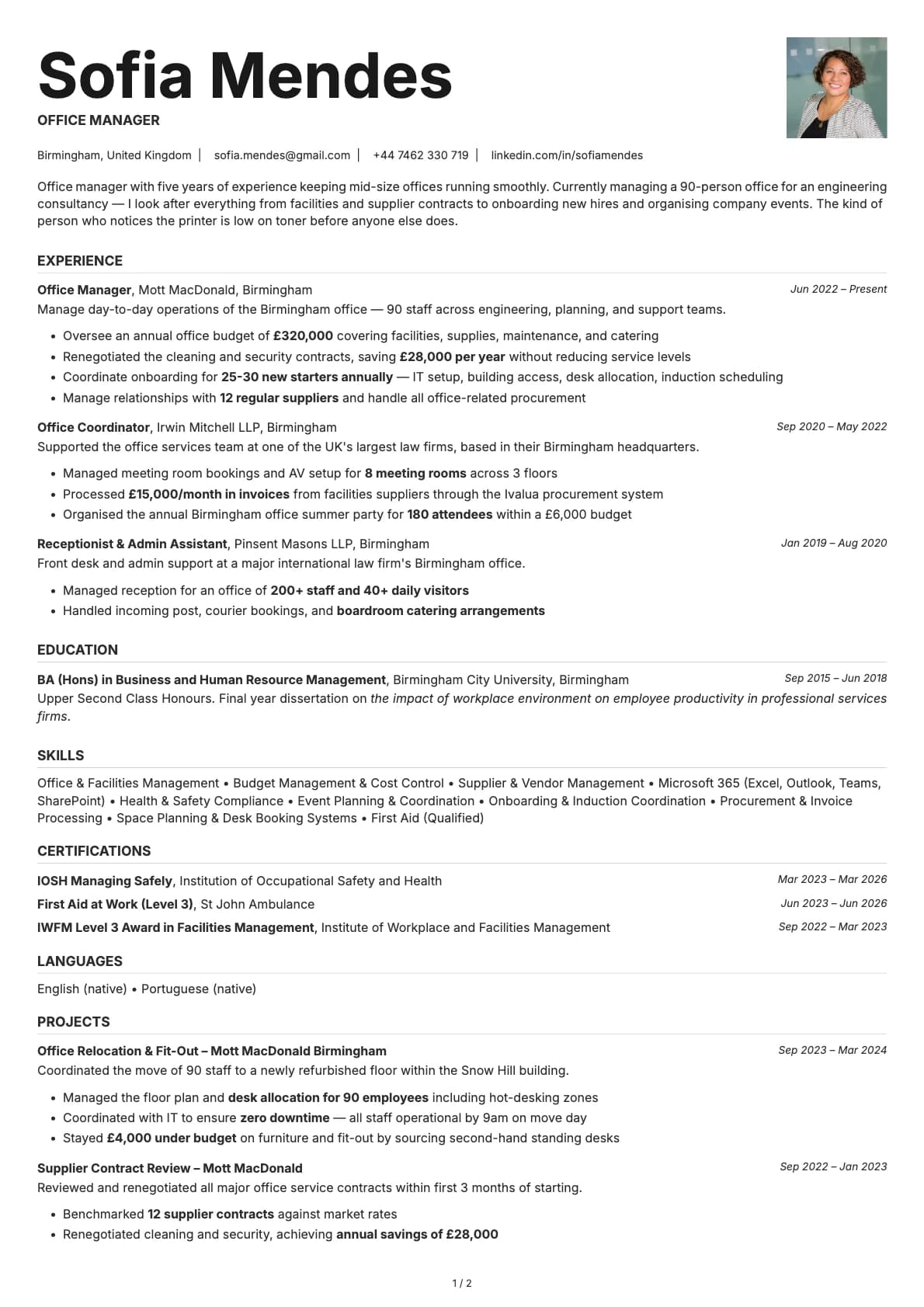
This resume belongs to Sofia Mendes, an office manager with five years of experience. She currently runs a 90-person office for Mott MacDonald, an engineering consultancy. Before that, she worked at two Birmingham law firms. What makes this resume work is that she treats the office like a business operation and describes it with real numbers: a £320,000 budget, 12 suppliers, £28,000 in annual savings from contract renegotiations.
Let us look at how she does it.
Your summary should describe the office you run
The biggest differentiator between office manager roles is scale. Managing a 15-person startup office is a different job from running a 200-person corporate floor. Your summary needs to establish your scale immediately.
Here is Sofia's:
Office manager with five years of experience keeping mid-size offices running smoothly. Currently managing a 90-person office for an engineering consultancy. I look after everything from facilities and supplier contracts to onboarding new hires and organising company events.
Three sentences. The reader knows: five years of experience, 90-person office, engineering consultancy, and the breadth of her responsibilities. No personality traits, no "highly organised professional" claims. Just facts.
Your formula: Years of experience + size of office + type of company + the main areas you manage.
How to write experience bullets that show business impact
The trap with office management is writing bullets that sound administrative. "Managed office supplies and procurement" is admin. "Oversee an annual office budget of £320,000" is operations.
Look at these bullets from Sofia's current role:
"Oversee an annual office budget of £320,000 covering facilities, supplies, maintenance, and catering"
"Renegotiated the cleaning and security contracts, saving £28,000 per year without reducing service levels"
"Coordinate onboarding for 25-30 new starters annually. IT setup, building access, desk allocation, induction scheduling"
The first shows she manages real money. The second shows she saves real money. The third shows the scope of her coordination work.
The formula: What you manage + the scale (budget, headcount, number of suppliers) + the result or standard you maintain.
Even routine tasks become strong bullets when you add context. "Managed meeting room bookings for 8 meeting rooms across 3 floors" tells the recruiter much more than "managed meeting rooms."
Earlier roles should show your progression
Sofia's career goes from receptionist at Pinsent Masons, to office coordinator at Irwin Mitchell, to office manager at Mott MacDonald. Each step up is clear:
Receptionist: "Managed reception for an office of 200+ staff and 40+ daily visitors"
Coordinator: "Processed £15,000/month in invoices" and "Organised the annual Birmingham office summer party for 180 attendees within a £6,000 budget"
Manager: "Oversee an annual office budget of £320,000" and "Renegotiated contracts saving £28,000 per year"
The numbers grow with each role. Reception was about volume (200 staff, 40 visitors). Coordination was about budget handling (£15k/month, £6k event). Management is about strategic cost control (£320k budget, £28k savings). That is a clear upward story.
Skills: include health and safety and facilities management
This resume lists IOSH Managing Safely, First Aid at Work, and an IWFM qualification alongside the operational skills. That combination is important for office managers because health and safety compliance is increasingly part of the role.
If you have an IOSH, NEBOSH, or IWFM qualification, list it prominently. Many office manager job postings now include "H&S compliance" in the person specification. Having the certificate puts you ahead of candidates who have the experience but not the formal training.
Also list your software. Microsoft 365 is a given, but if you use specific tools like desk booking systems (Envoy, Robin), procurement platforms (Ivalua, SAP Ariba), or visitor management systems, name them.
Projects show you do more than keep the lights on
The two projects here are excellent. The office relocation shows Sofia can manage a complex logistical challenge:
"Coordinated the move of 90 staff to a newly refurbished floor. Managed the floor plan and desk allocation. Coordinated with IT to ensure zero downtime. Stayed £4,000 under budget."
And the supplier contract review shows cost management skills:
"Benchmarked 12 supplier contracts against market rates. Renegotiated cleaning and security, achieving annual savings of £28,000."
If you have managed a move, a refurbishment, a system migration, or any other project beyond day-to-day operations, include it. These projects show you can handle work that is not in the job description.
Mistakes that hurt office manager resumes
Describing yourself as "the glue that holds the office together." It sounds nice, but it is not evidence. Replace it with what you actually do and the scale you do it at.
Not mentioning the budget. If you manage a budget, state the amount. "Managed office budget" is vague. "Managed a £320,000 annual office budget" positions you as someone who handles real financial responsibility.
Ignoring supplier management. Office managers who negotiate contracts and manage vendor relationships are more valuable than those who just place orders. If you negotiate, renegotiate, or benchmark contracts, put it on your resume.
Using a cluttered template. Office managers are supposed to be organised. Your resume should reflect that. This one uses Platinum, a clean professional layout. No sidebars, no decorative elements. Just clear information.
One more thing
Office manager roles vary wildly. Some are mostly facilities focused. Some are heavily HR adjacent. Some involve finance and procurement. Before you apply, read the job description carefully and reorder your bullets to match their priorities. If they emphasize supplier management, lead with your contract negotiation experience. If they focus on employee experience, lead with onboarding and events. The same resume can work for very different roles if you adjust the emphasis.
Build your own version
Open this layout in the builder and swap in your own details. It takes a few minutes.
Free to use. No account needed to start.
Was this resume example helpful?
Rate this example to help us create better content for you.
4.7 average from 142 ratingsRelated resume examples
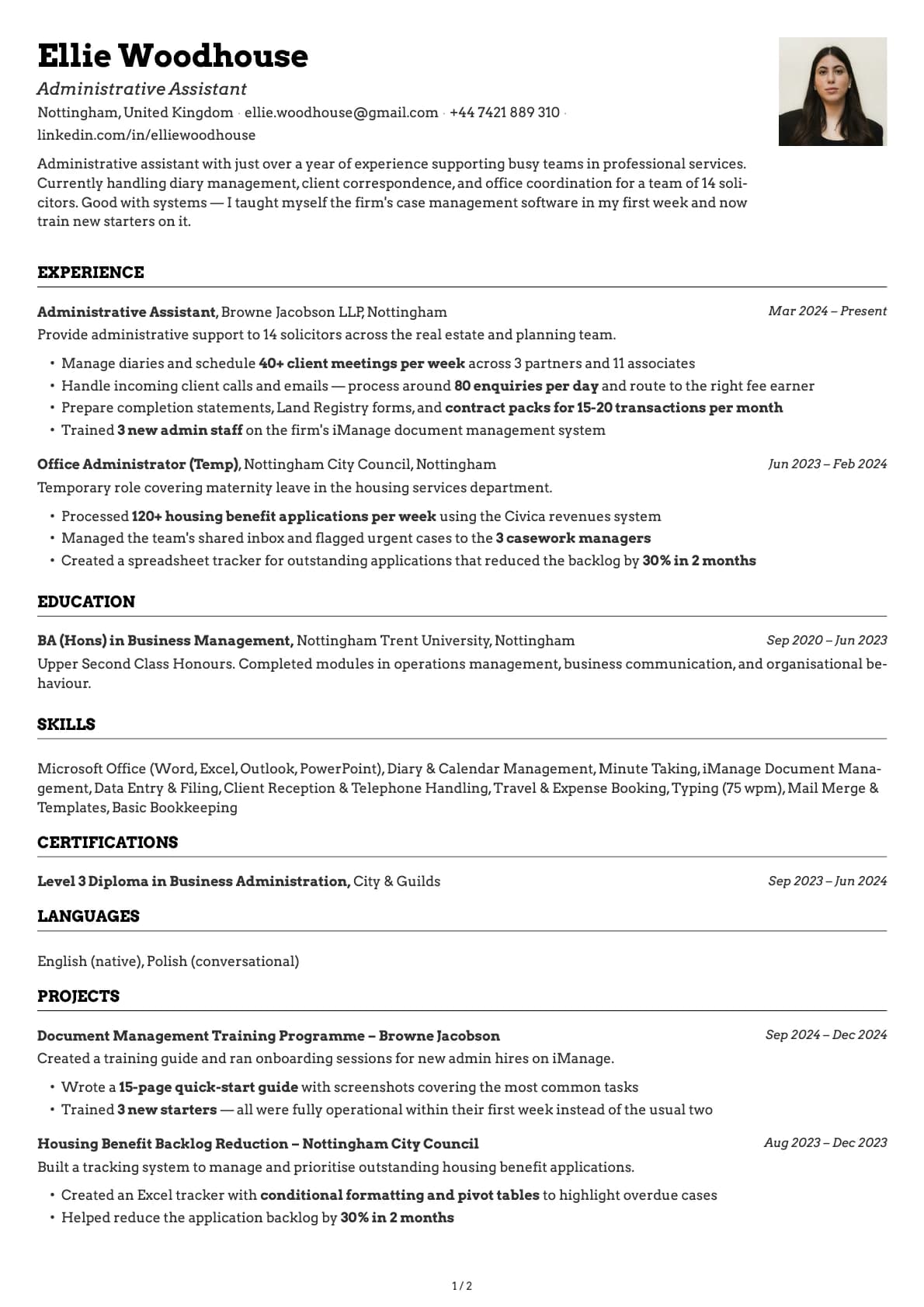
Administrative Assistant
An administrative assistant resume example with law firm experience, showing how to present volume of work, systems knowledge.
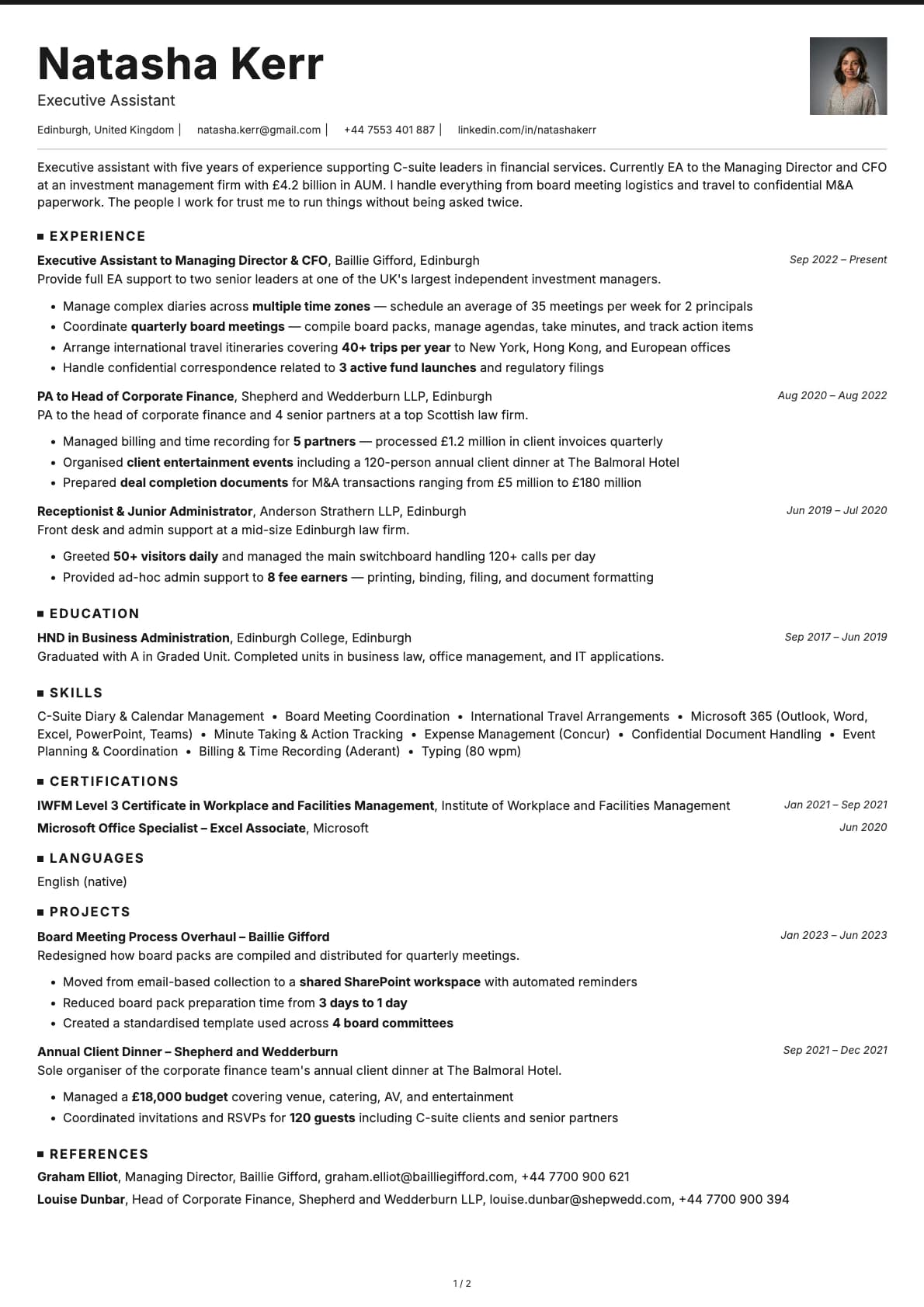
Executive Assistant
An executive assistant resume example supporting C-suite leaders in financial services.
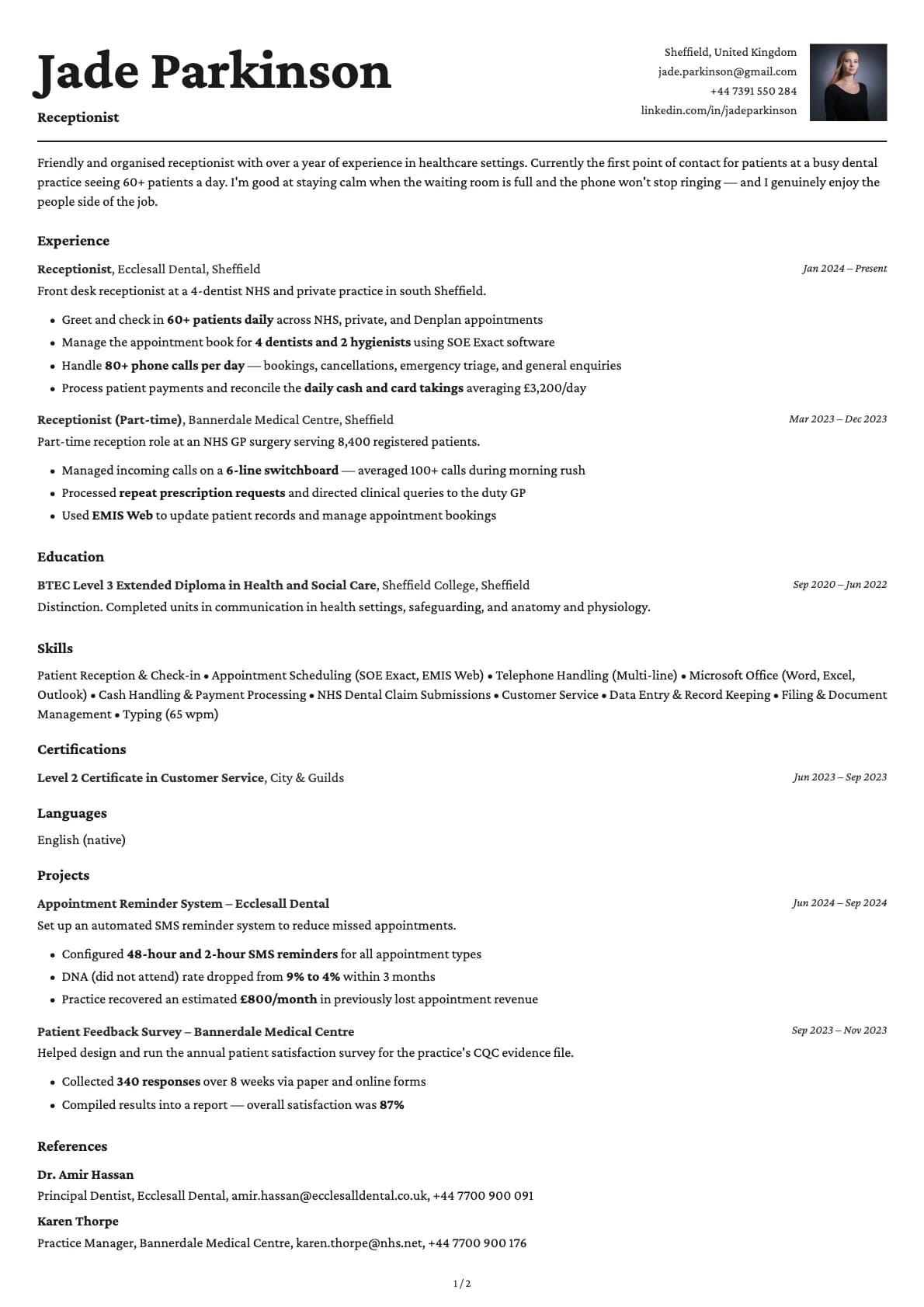
Receptionist
A receptionist resume example from a healthcare setting with patient volumes, phone handling stats, and a process improvement that cut missed.
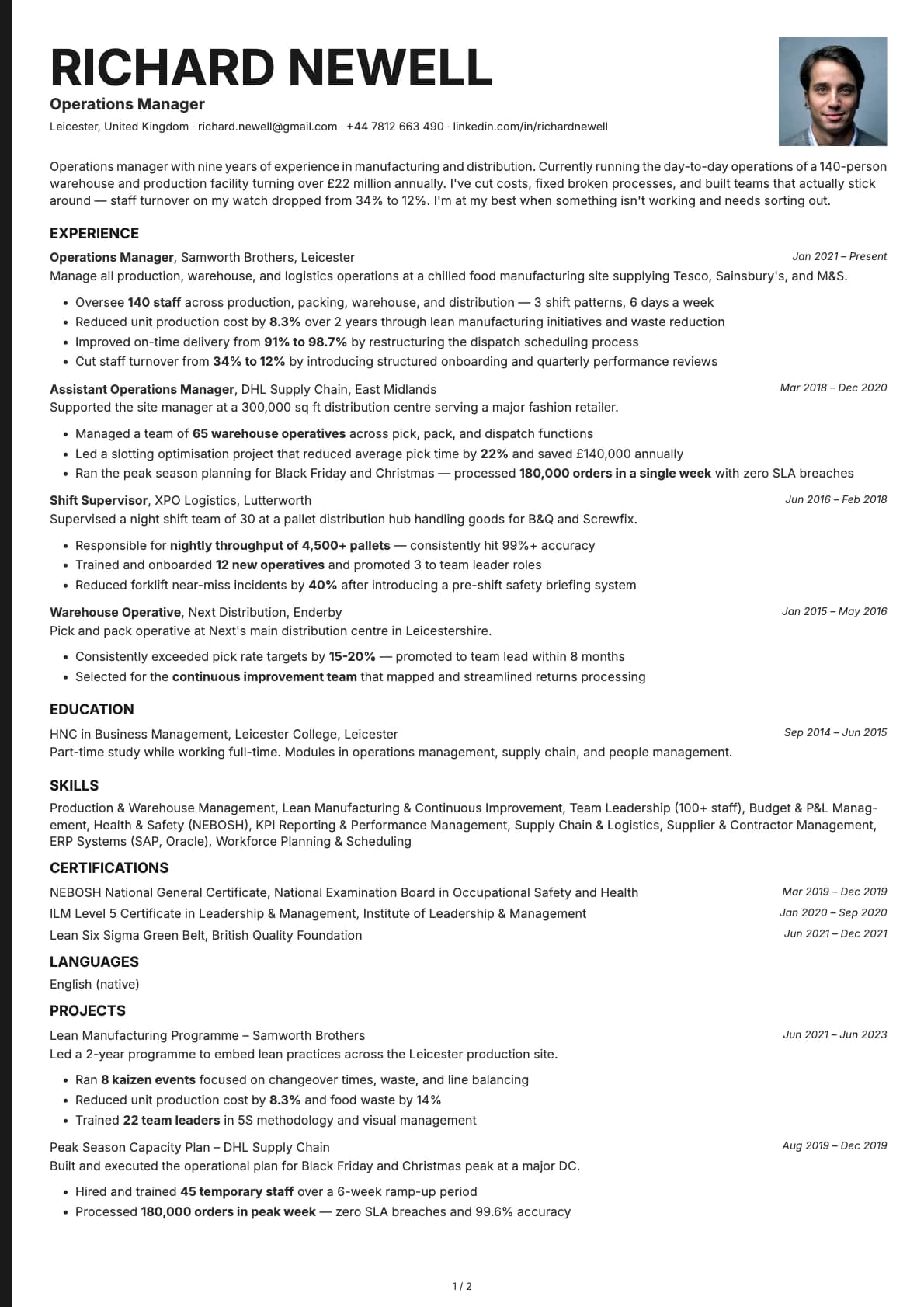
Operations Manager
An operations manager resume example with production KPIs, lean manufacturing results, and team leadership numbers.
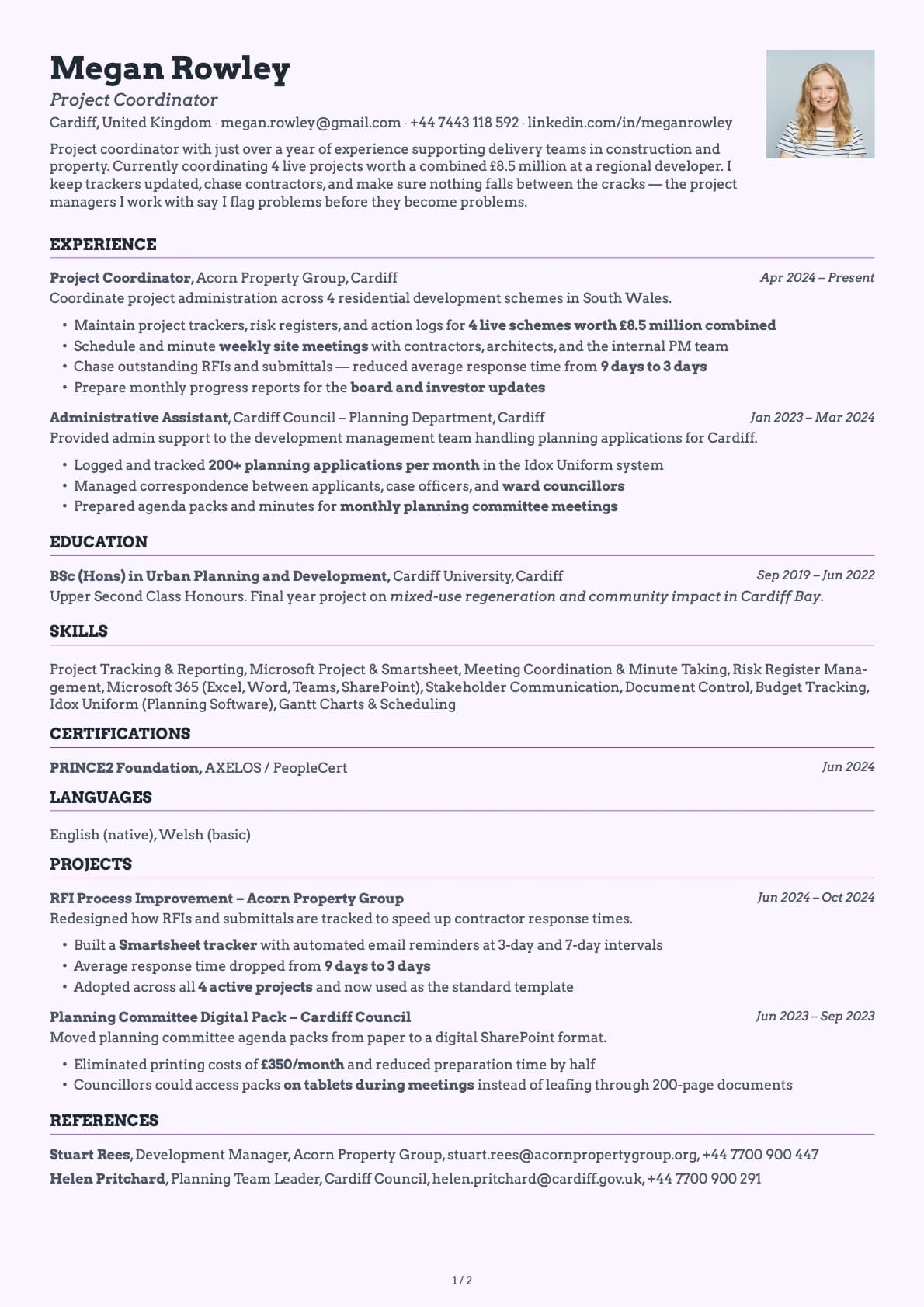
Project Coordinator
A project coordinator resume example with construction project tracking, process improvements, and real cost savings from an early-career professional.
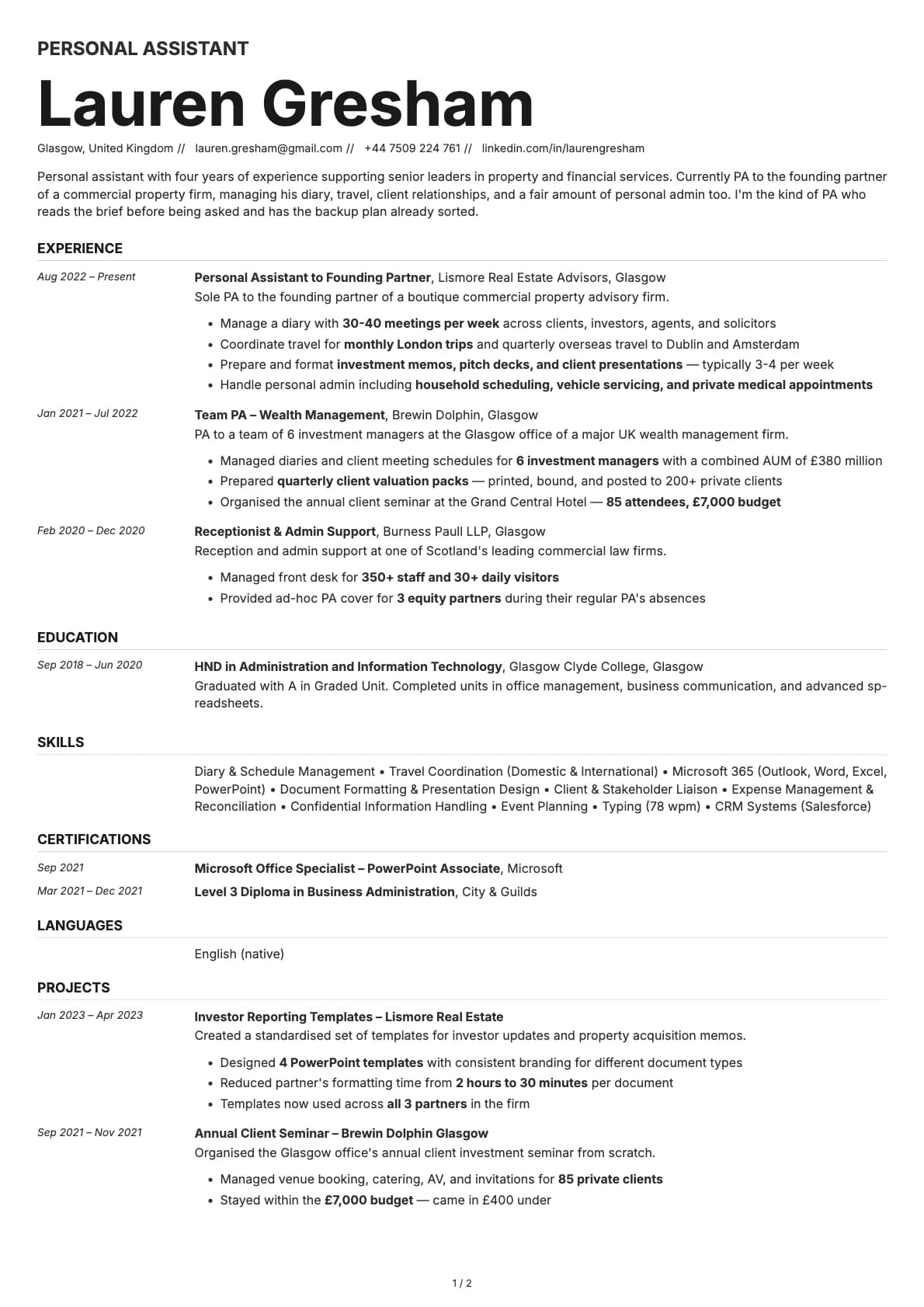
Personal Assistant
A personal assistant resume example showing how to present diary management, event coordination, and executive support with real numbers.
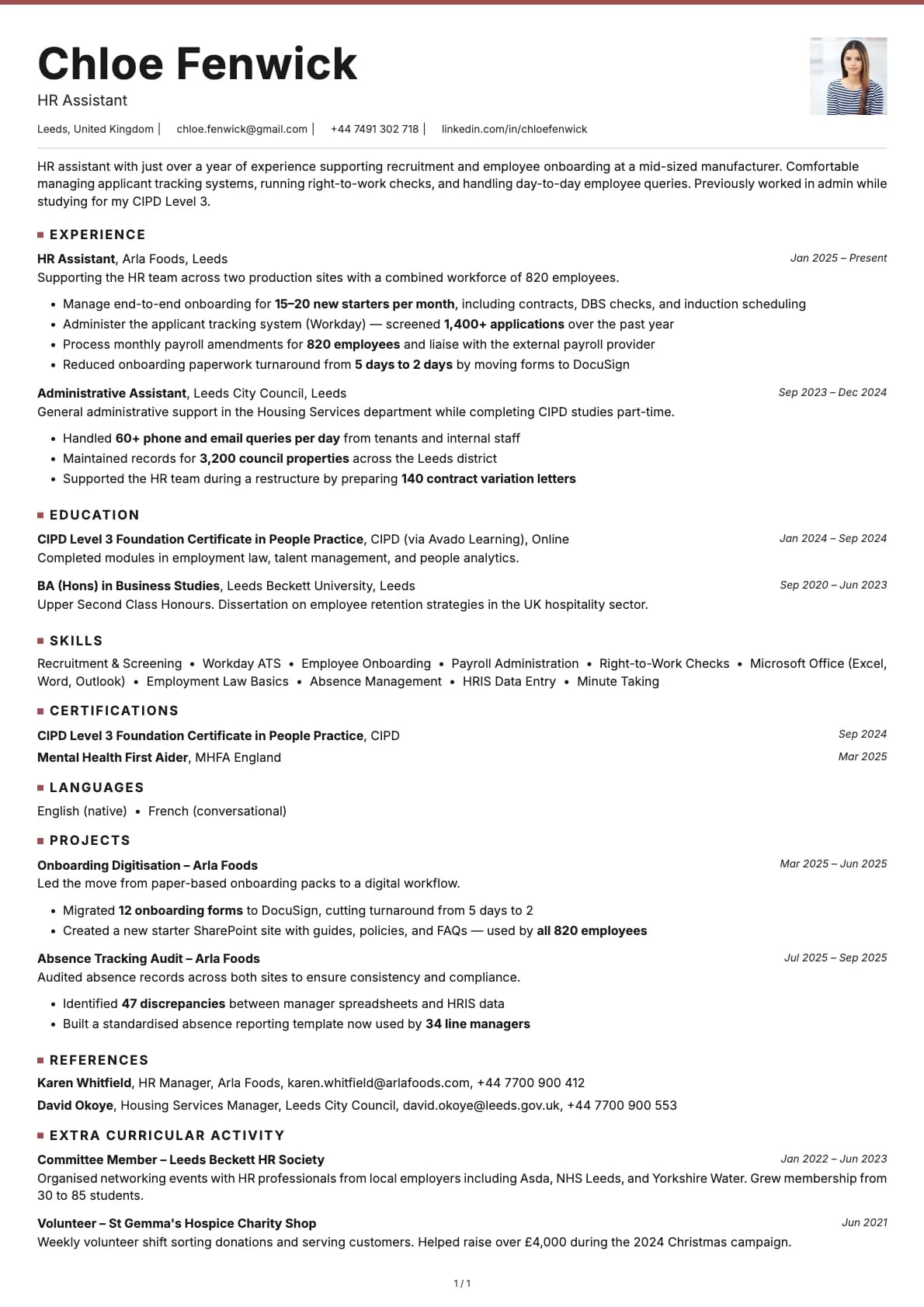
HR Assistant
An HR assistant resume example with onboarding metrics, ATS screening numbers, and a CIPD Level 3 qualification.
Related articles

AI Is Screening Your Resume Before Any Human Sees It
AI screens most resumes before a human ever reads them. 97.4% of Fortune 500 companies run an ATS. This is what that means for you and what you can do about it.

The Best Resume Builders in 2026, Compared Honestly
Resume.io, Zety, Enhancv, Kickresume, Teal, and Laddro compared honestly: real pricing, free tiers, mobile apps, and where each tool wins. All prices checked in September 2026.

Burnout Recovery: A Real Timeline, Not 'Take a Bubble Bath'
55% of the U.S. workforce is burned out. Recovery takes 3 to 12 months. Here's what that actually looks like, stage by stage.