Project Coordinator Resume Example
A project coordinator resume example with construction project tracking, process improvements, and real cost savings from an early-career professional.

Laddro Team
Free to use. No account needed to start.
Free to use. No account needed to start.
Overview
Project coordinator is often someone's first step into project management. And that creates a resume challenge. You are not the project manager. You do not own the budget or make the big decisions. You are the person who keeps everything moving, tracks every action, and makes sure nothing gets lost. So how do you write a resume that shows real value when your title is not the one at the top of the org chart?
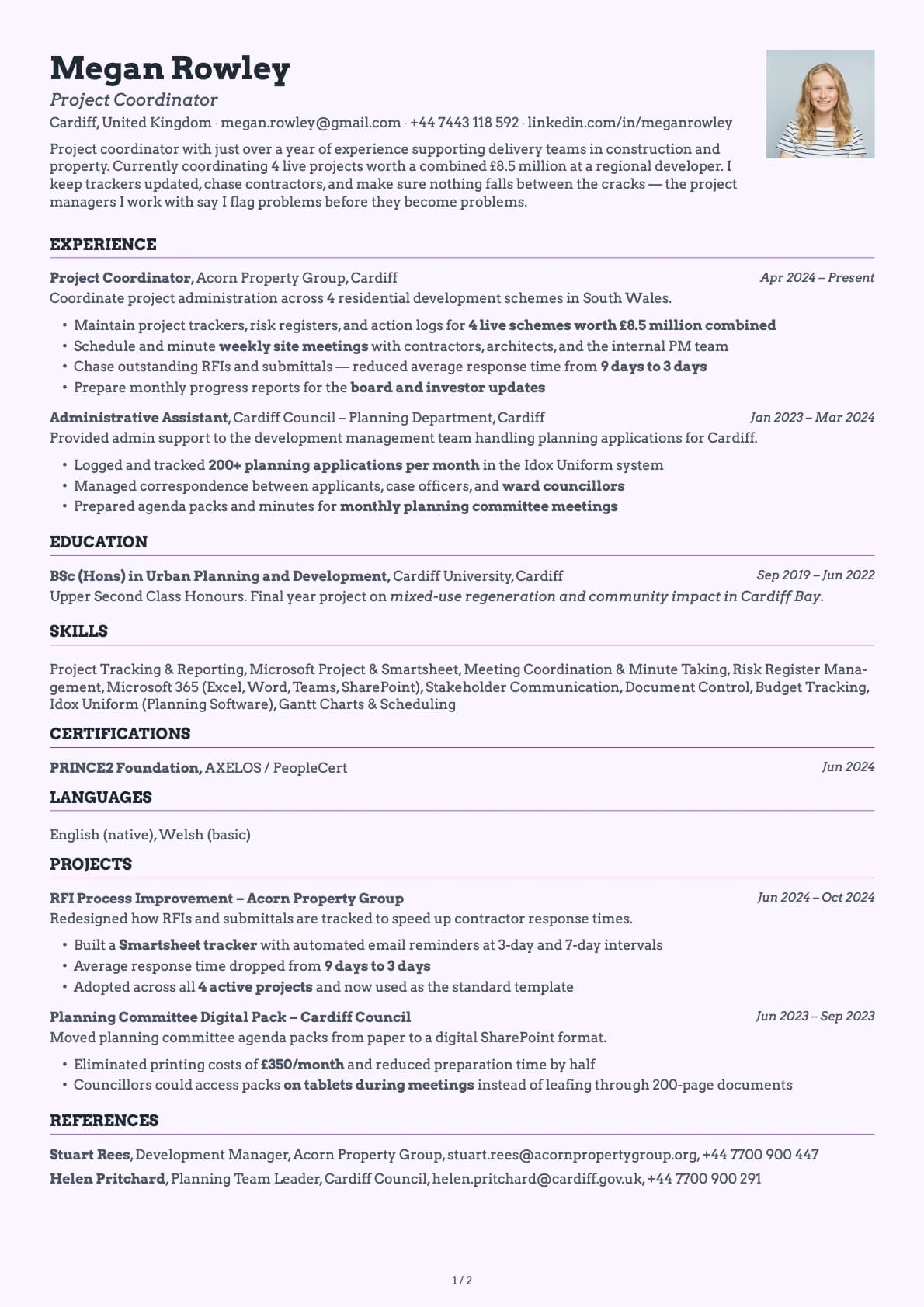
This resume belongs to Megan Rowley, based in Cardiff, with just over a year of experience as a project coordinator at a property developer. She coordinates four live construction projects worth a combined £8.5 million. Before that, she worked as an administrative assistant in Cardiff Council's planning department.
What makes this resume work is that it focuses on what she improved, not just what she was asked to do. Let us go through it section by section.
Write a summary that shows your value, not just your title
Most project coordinator summaries say "organised and detail-oriented professional seeking to grow in project management." That tells the reader you want something. It does not tell them what you bring.
Megan's summary names her current scope (4 live projects, £8.5 million combined), her working style ("I flag problems before they become problems"), and what she actually does day to day (trackers, contractor chasing, quality control).
The line about flagging problems early is effective because it shows awareness. Project coordinators who catch issues before they escalate are the ones project managers want to keep. That is worth saying on a resume.
For yours: Name the number of projects you support and their total value (if known). Describe one thing you do well in your own words. Keep it to three or four sentences.
How to write experience with limited work history
Megan has two roles. That is fine. What matters is how she describes them.
For her current role, she focuses on scope and improvement:
"Maintain project trackers, risk registers, and action logs for 4 live schemes worth £8.5 million combined"
"Chase outstanding RFIs and submittals, reduced average response time from 9 days to 3 days"
"Prepare monthly progress reports for the board and investor updates"
The first bullet shows the scale she manages. The second shows she made something better. The third shows she works with senior stakeholders. Three bullets, three different things a hiring manager cares about.
For her earlier admin role, she pulls out transferable details:
"Logged and tracked 200+ planning applications per month in the Idox Uniform system"
"Prepared agenda packs and minutes for monthly planning committee meetings"
Even though it was an admin role, she is framing it in terms that a project manager would recognise: tracking volumes, managing correspondence, preparing materials for committee meetings. If you are coming from an admin background, look for these parallels.
Projects: show what you fixed
Megan's standout entry is her RFI process improvement:
"Built a Smartsheet tracker with automated email reminders at 3-day and 7-day intervals"
"Average response time dropped from 9 days to 3 days"
"Adopted across all 4 active projects and now used as the standard template"
She saw a problem (contractors taking too long to respond to RFIs), built a simple solution (automated reminders in Smartsheet), and it worked so well that the whole company adopted it. That is exactly the kind of initiative that gets a project coordinator promoted to project manager.
Her second project (moving planning committee packs from paper to digital) saved £350/month in printing costs and cut preparation time in half. Again, small scope. But the structure is the same: problem, solution, measurable result.
If you have improved any process, even a small one, write it up this way. Moved from email to a shared tracker? Set up a template? Created a filing system that actually works? Those are resume-worthy.
Skills: name the tools you use
Megan lists Microsoft Project, Smartsheet, Idox Uniform, SharePoint, and Excel. These are the tools a project coordinator actually uses day to day. Naming them matters because many job listings filter by software.
If you use Asana, Monday.com, Smartsheet, MS Project, Jira, or any other project tool, list it by name. "Project management software" is too vague. The hiring manager wants to know if you can start working on day one.
Also list any industry-specific software. Megan's Idox Uniform experience is relevant for anyone hiring in local government or planning. Your equivalent might be SAP, Primavera, Procore, or something else specific to your industry.
Certifications: PRINCE2 is a good start
Megan has PRINCE2 Foundation, which is the most commonly requested project management certification for UK roles. If you have it, list it. If you are studying for it, list it as "in progress" with an expected date.
Other certifications worth considering: APM Project Fundamentals Qualification (PFQ), Agile PM, or the CAPM from PMI. Any of these tell the employer you are serious about a career in project management, not just passing through.
Mistakes project coordinators make on their resumes
Describing yourself as "just" a coordinator. You are not "just" anything. You tracked projects worth £8.5 million. You reduced response times by two-thirds. You saved £350 a month. Own the work, even if someone else made the final decisions.
Not including project values. The financial scale of the projects you support matters. "Coordinated 4 construction projects" and "Coordinated 4 construction projects worth £8.5 million" create very different impressions.
Leaving out software skills. This is an admin-adjacent role. The hiring manager wants to know exactly which tools you use. Do not make them guess.
Using jargon from only one industry. If you are applying outside construction, translate your experience. "RFI tracking" becomes "request tracking." "Submittals" becomes "document submissions." Match the language to the job listing.
One more thing
Project coordinator roles are stepping stones. The hiring manager knows this. They are not expecting you to have ten years of experience. What they want to see is someone who is organised, pays attention, and makes things run better. If your resume shows one or two examples of taking initiative and improving a process, you have done more than most candidates. That is enough to get the interview.
Build your own version
Open this layout in the builder and swap in your own details. It takes a few minutes.
Free to use. No account needed to start.
Was this resume example helpful?
Rate this example to help us create better content for you.
4.6 average from 87 ratingsRelated resume examples
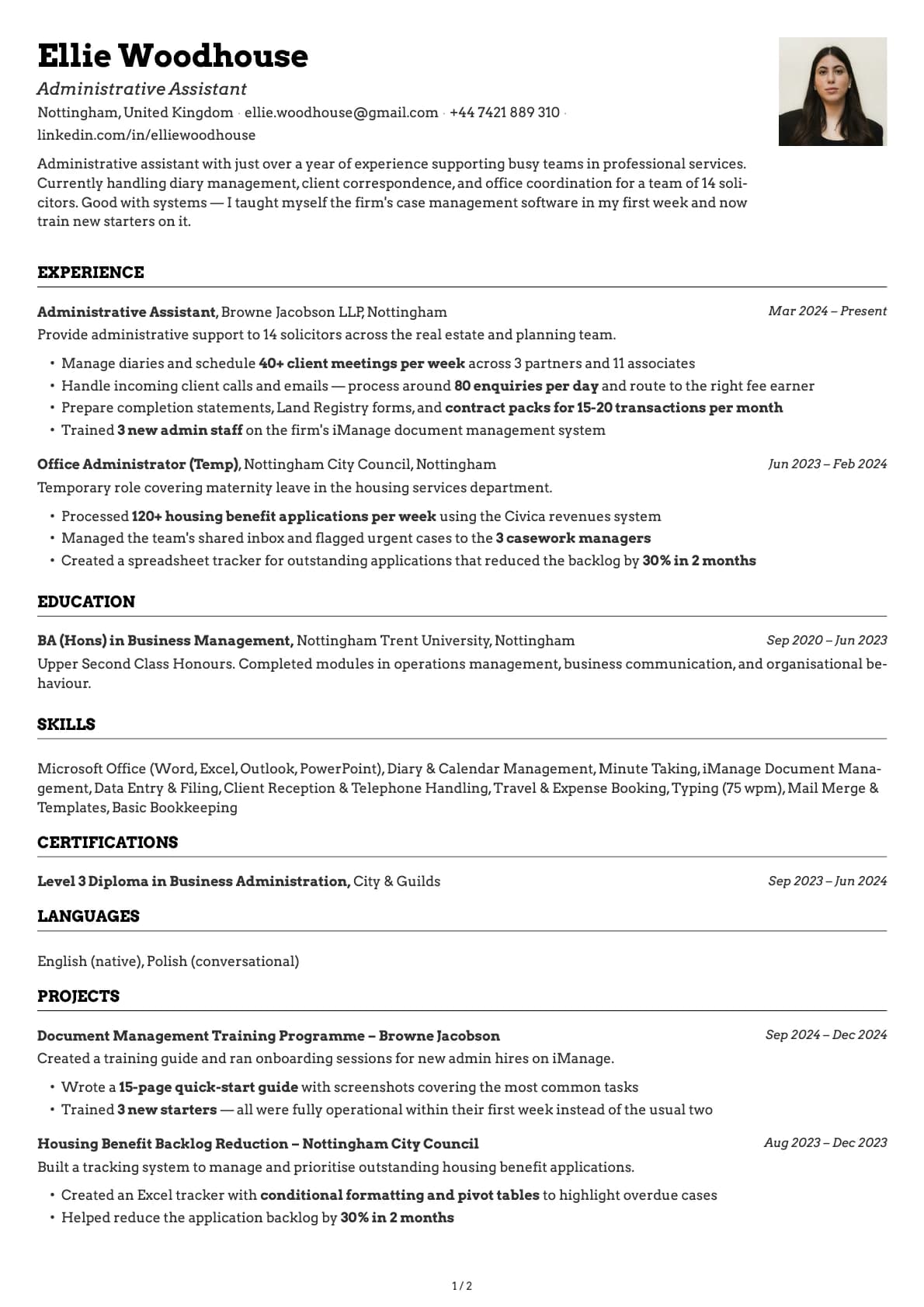
Administrative Assistant
An administrative assistant resume example with law firm experience, showing how to present volume of work, systems knowledge.
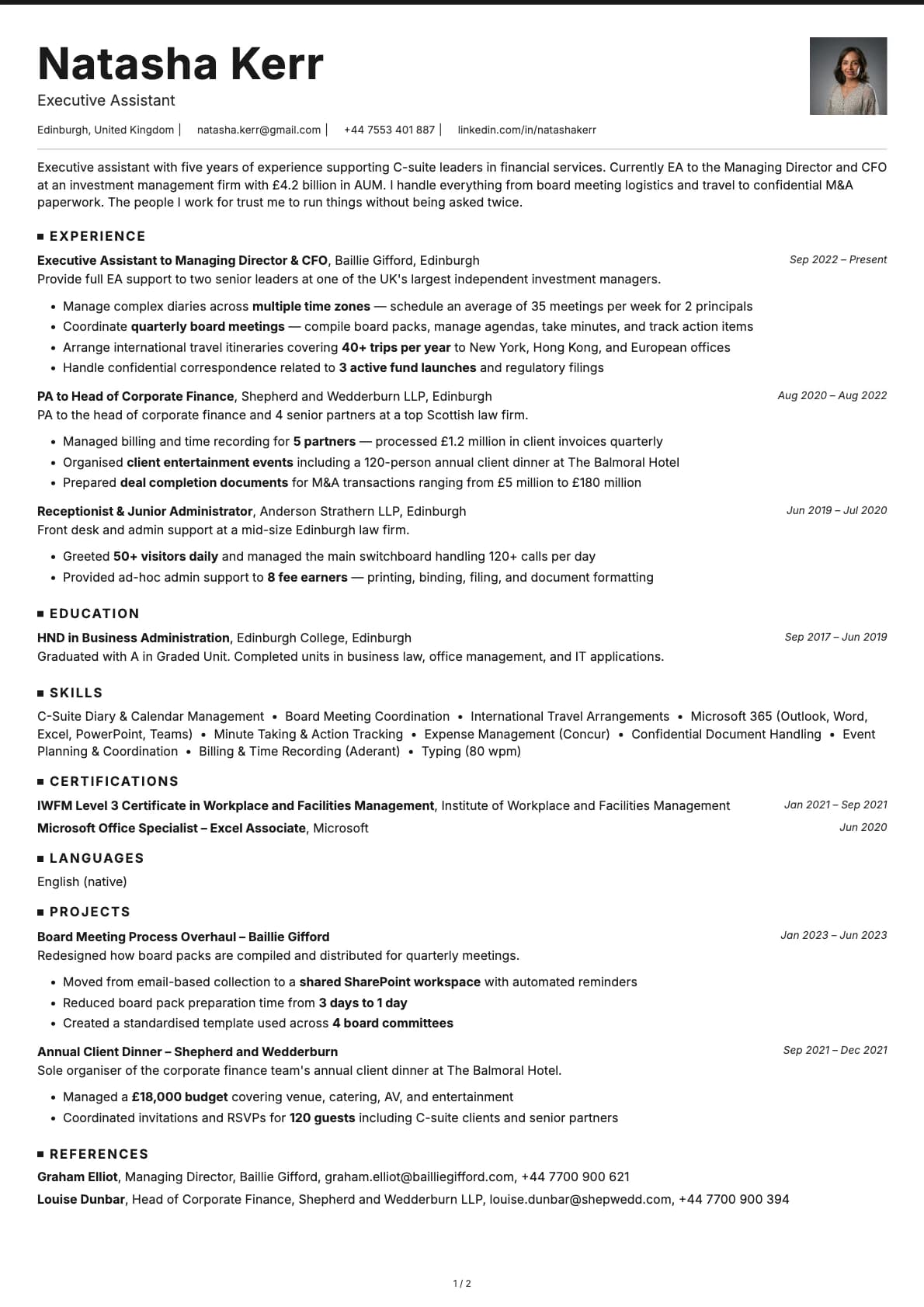
Executive Assistant
An executive assistant resume example supporting C-suite leaders in financial services.
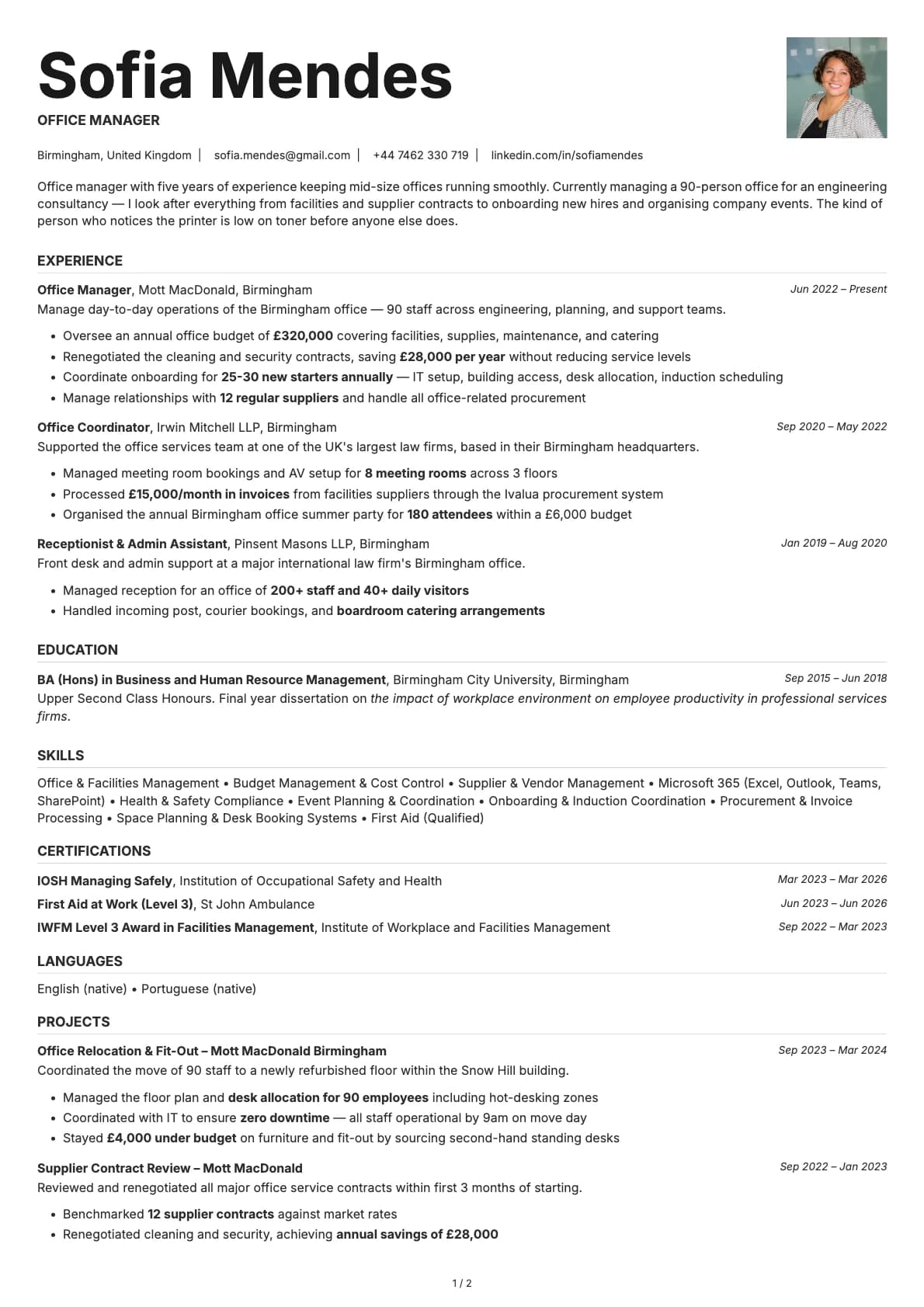
Office Manager
An office manager resume example with budget management, supplier negotiations, and onboarding coordination.
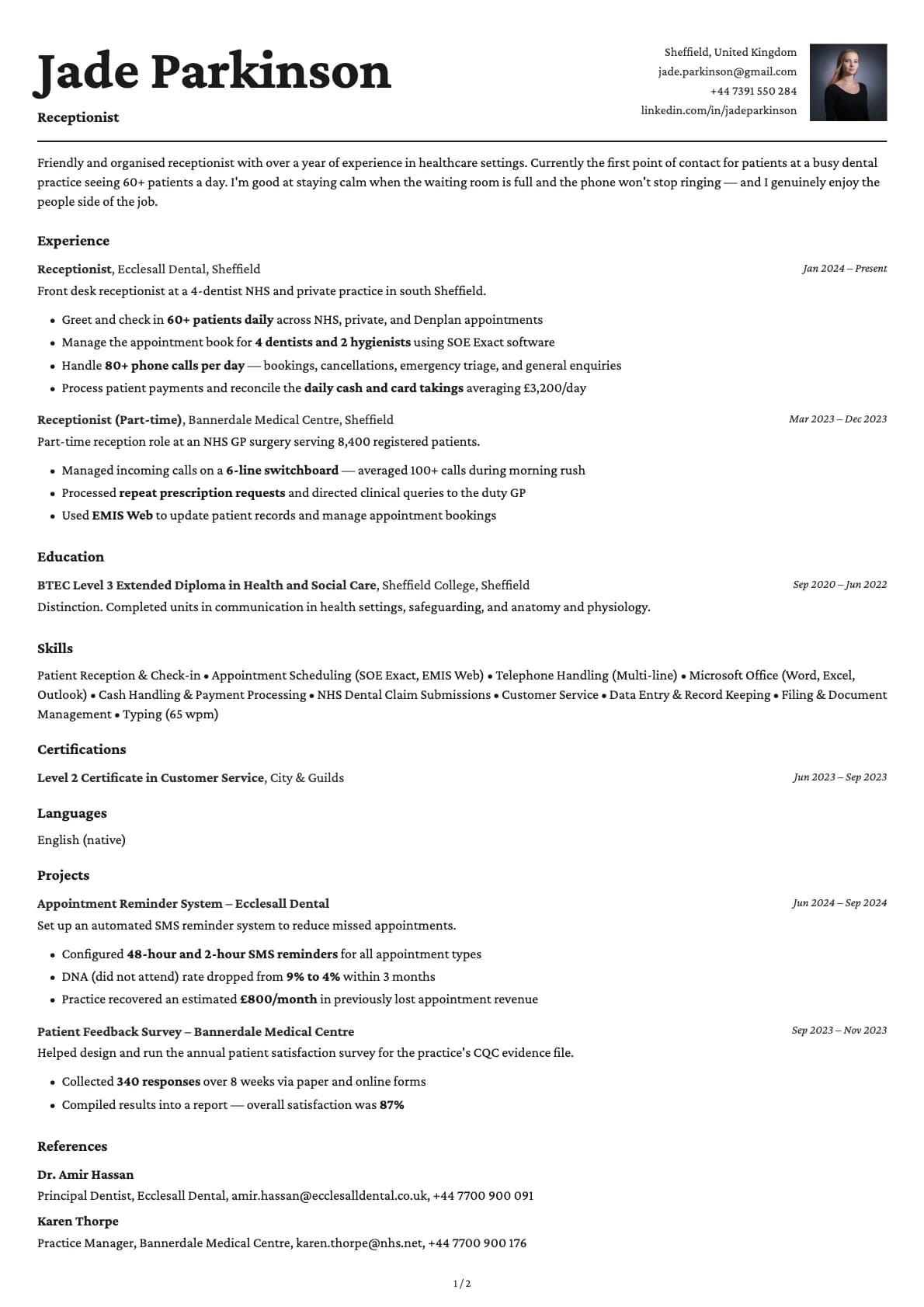
Receptionist
A receptionist resume example from a healthcare setting with patient volumes, phone handling stats, and a process improvement that cut missed.
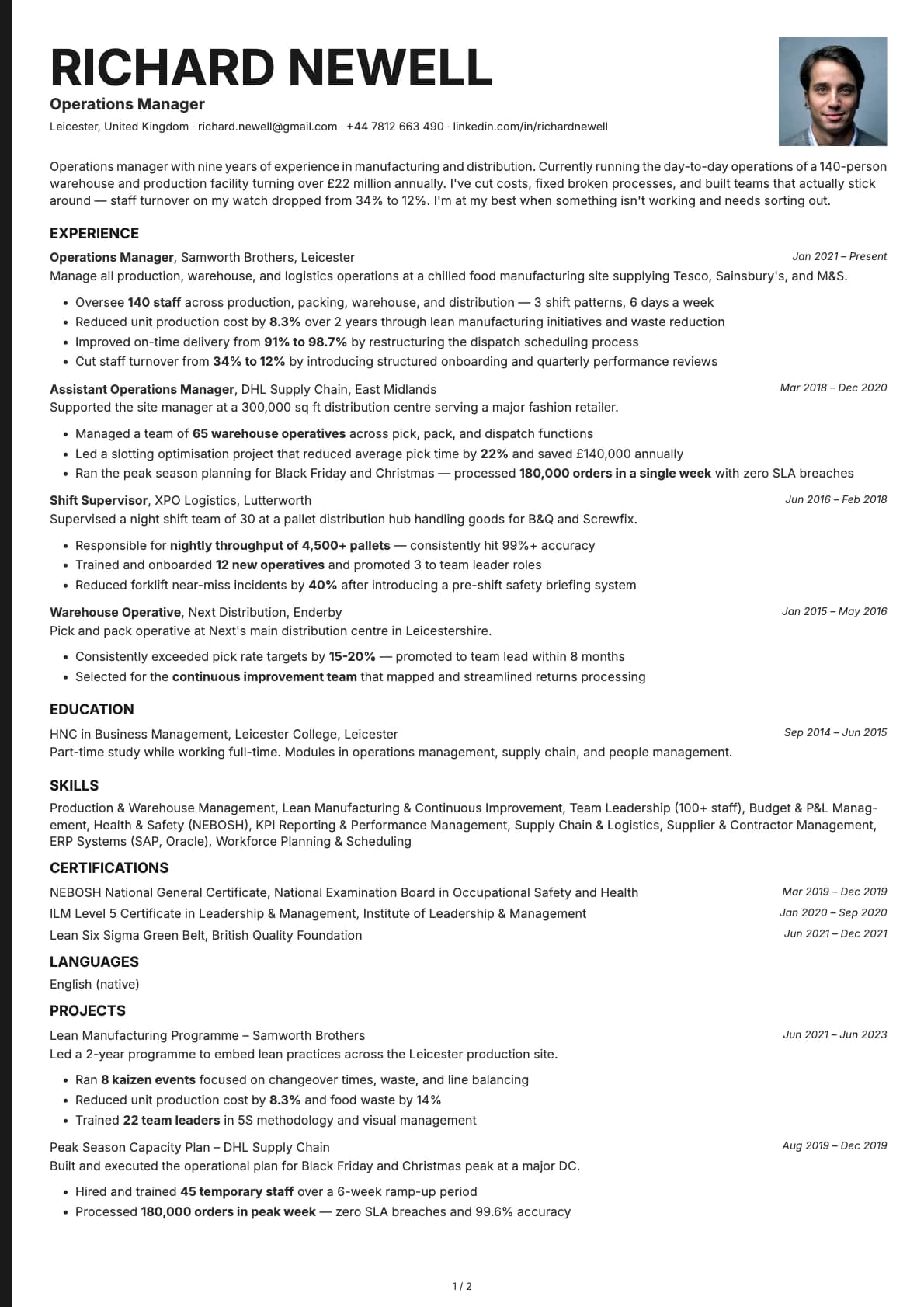
Operations Manager
An operations manager resume example with production KPIs, lean manufacturing results, and team leadership numbers.
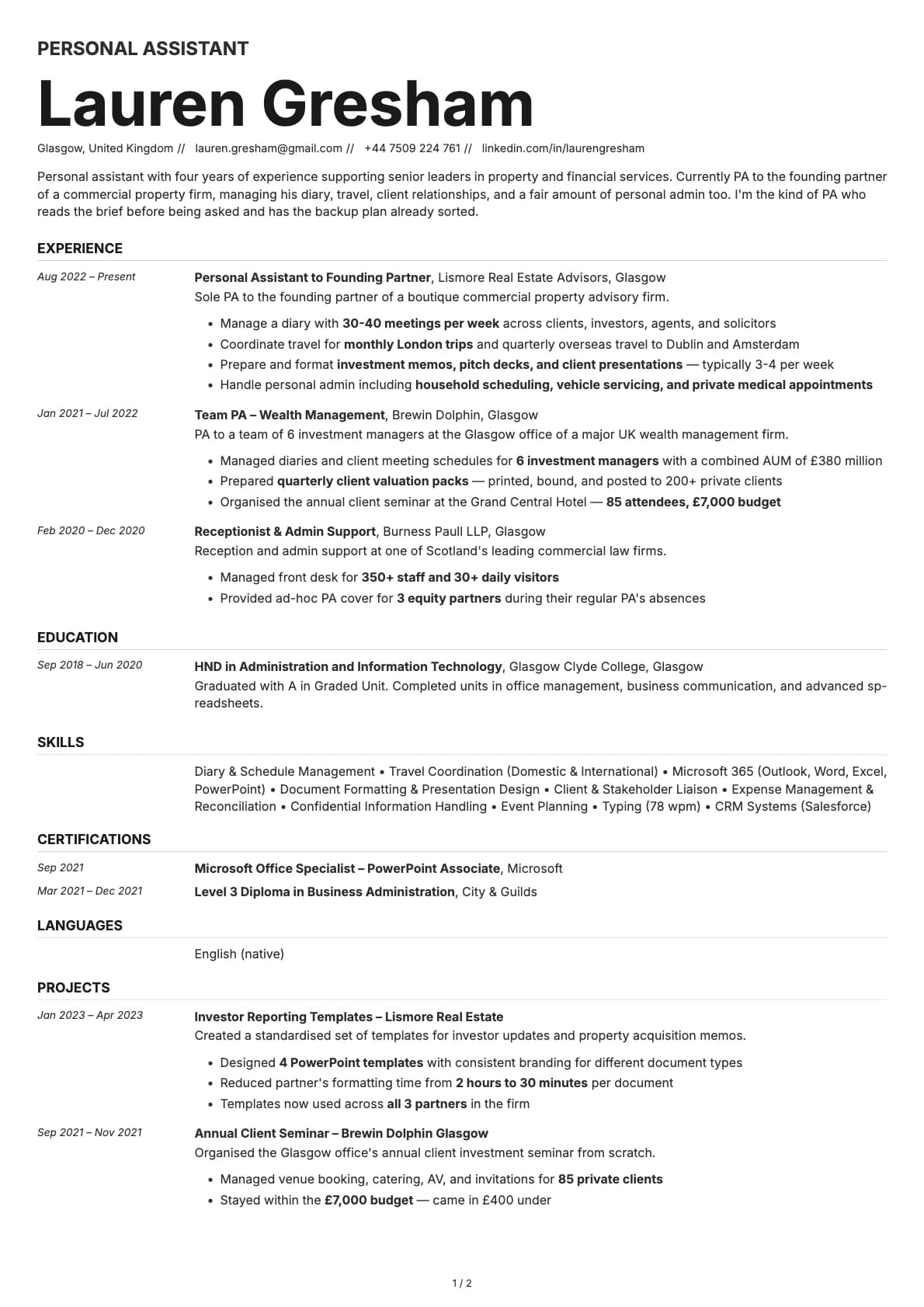
Personal Assistant
A personal assistant resume example showing how to present diary management, event coordination, and executive support with real numbers.
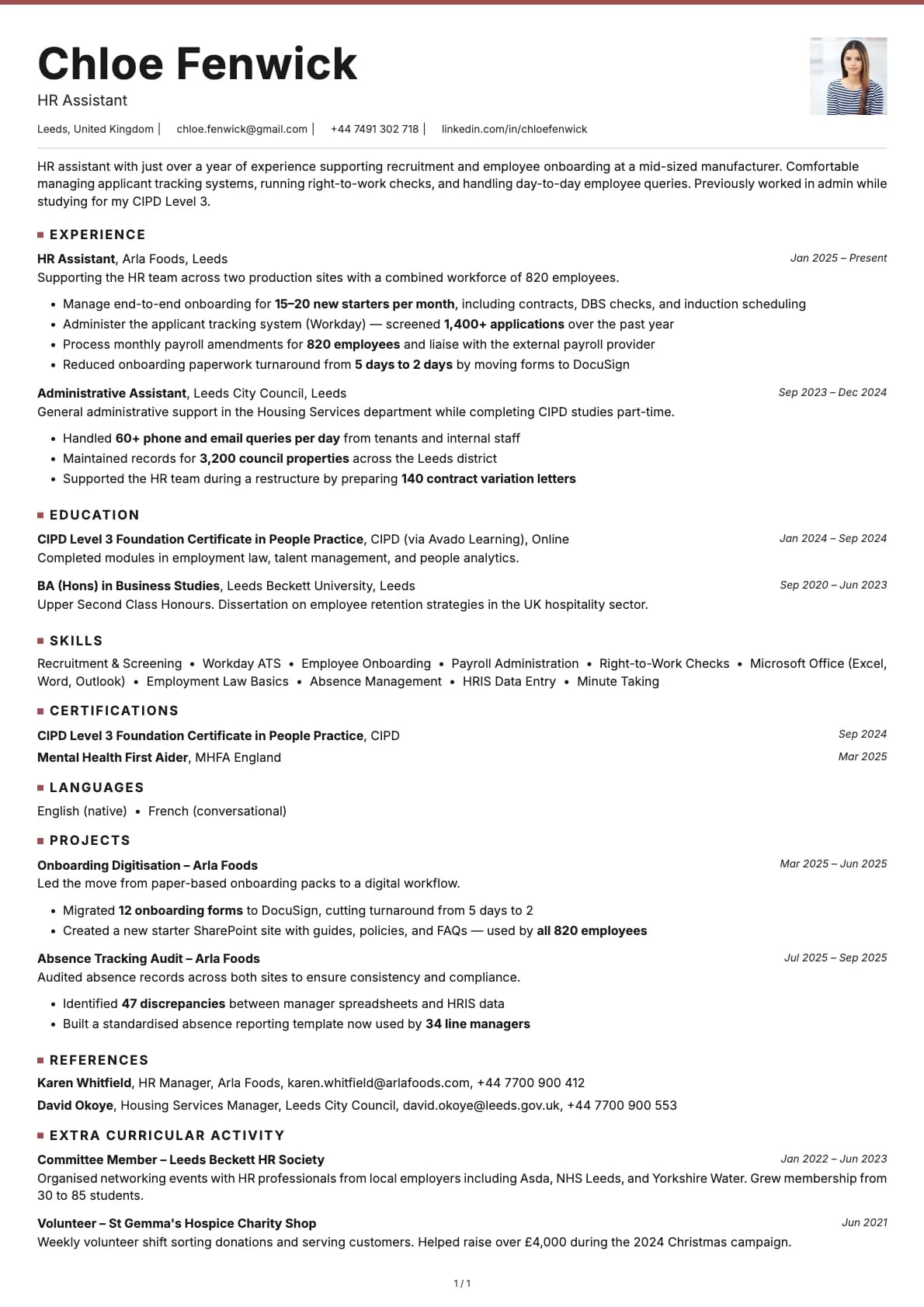
HR Assistant
An HR assistant resume example with onboarding metrics, ATS screening numbers, and a CIPD Level 3 qualification.
Related articles

AI Is Screening Your Resume Before Any Human Sees It
AI screens most resumes before a human ever reads them. 97.4% of Fortune 500 companies run an ATS. This is what that means for you and what you can do about it.

The Best Resume Builders in 2026, Compared Honestly
Resume.io, Zety, Enhancv, Kickresume, Teal, and Laddro compared honestly: real pricing, free tiers, mobile apps, and where each tool wins. All prices checked in September 2026.

Burnout Recovery: A Real Timeline, Not 'Take a Bubble Bath'
55% of the U.S. workforce is burned out. Recovery takes 3 to 12 months. Here's what that actually looks like, stage by stage.