Tax Advisor Resume Example
A tax advisor resume example with CTA qualification and 9 years of corporate tax experience across Big Four and in-house roles.

Laddro Team
Free to use. No account needed to start.
Free to use. No account needed to start.
Overview
Tax advisor resumes have a problem most people do not think about: the hiring manager reading yours is almost certainly a tax specialist themselves. They know what a corporation tax computation looks like. They know what an R&D claim involves. So writing "prepared corporation tax returns" tells them nothing about your actual capability.
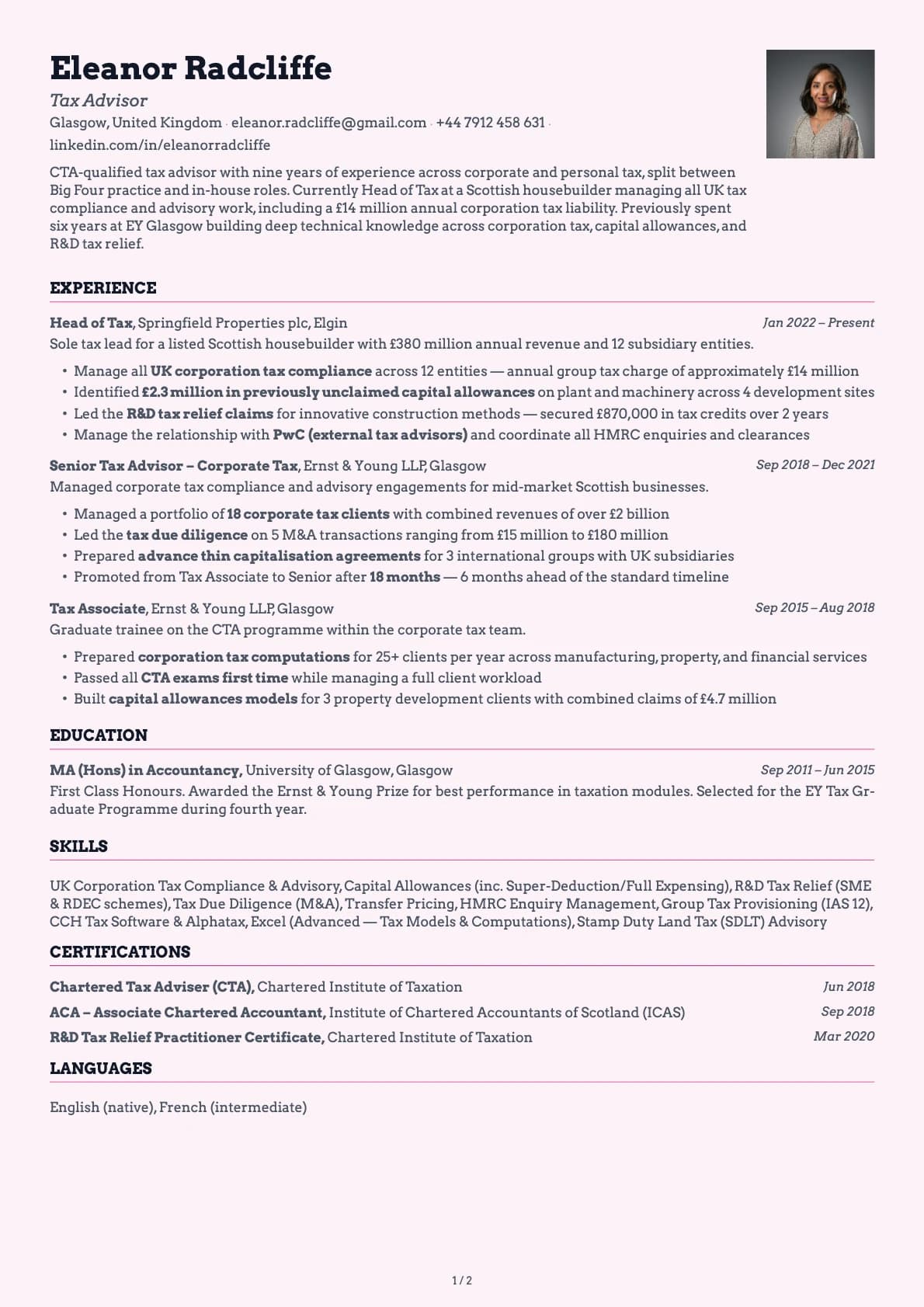
This resume belongs to Eleanor, a CTA-qualified tax advisor who is currently Head of Tax at Springfield Properties plc, a listed Scottish housebuilder. She spent six years at EY Glasgow before moving in-house. What makes this resume work is the combination of technical specificity and commercial impact. She does not just say she handles corporation tax. She manages a £14 million annual group tax charge across 12 entities. She does not just say she works on R&D claims. She secured £870,000 in tax credits over two years.
Here is how to write your tax resume the same way.
Your summary needs to show technical depth and commercial value
Here is Eleanor's summary:
CTA-qualified tax advisor with nine years of experience across corporate and personal tax, split between Big Four practice and in-house roles. Currently Head of Tax at a Scottish housebuilder managing all UK tax compliance and advisory work, including a £14 million annual corporation tax liability.
Two sentences and the recruiter knows: her qualification (CTA), her experience split (Big Four plus in-house), her current scope (sole tax lead for a listed company), and the scale (£14 million tax charge, 12 entities). This is dense with useful information.
For yours: Lead with your tax qualification (CTA, ATT, ACA). State your years and whether your experience is practice-side, in-house, or both. Then describe your current scope with a number that shows scale. For practice-side advisors, that might be the number of clients or total fees managed. For in-house, it is the group tax charge or revenue.
How to describe practice experience
Most tax resumes from Big Four or mid-tier practice read like job descriptions. "Prepared corporation tax computations for a range of clients." Every tax associate does that. The question is: how many, how complex, and what was the outcome?
Eleanor's EY Senior role:
Managed a portfolio of 18 corporate tax clients with combined revenues of over £2 billion
Led the tax due diligence on 5 M&A transactions ranging from £15 million to £180 million
The first bullet shows portfolio size and client scale. The second shows she worked on transactions, not just compliance. And the deal values (£15 million to £180 million) tell the recruiter this was mid-market M&A, not small-company accounts.
For her associate role:
Passed all CTA exams first time while managing a full client workload
This is a simple fact but it tells the recruiter a lot. First-time CTA passes are not easy, and doing it alongside a full workload shows capacity and discipline.
For your practice experience: Count your clients, add up their combined revenue or fee value, and mention the most complex work you did. Did you work on any transactions, restructurings, or HMRC enquiries? Those are the bullets that differentiate you.
In-house experience: show the business impact
Eleanor's Springfield Properties role is where the resume really shines:
Identified £2.3 million in previously unclaimed capital allowances on plant and machinery across 4 development sites
Led the R&D tax relief claims for innovative construction methods. Secured £870,000 in tax credits over 2 years
These are not compliance tasks. These are advisory wins that saved the business real money. The £2.3 million in unclaimed allowances is the kind of finding that makes a tax advisor extremely valuable in-house.
If you work in-house, think about every time you found money the business did not know it was missing. Unclaimed reliefs, restructuring benefits, overpaid stamp duty, incorrect transfer pricing that was costing the group. Those findings are your best resume bullets.
Skills: be specific about your technical areas
The skills section here names exact areas of tax: Corporation Tax, Capital Allowances (including Super-Deduction/Full Expensing), R&D Tax Relief (SME & RDEC), Tax Due Diligence (M&A), Transfer Pricing, HMRC Enquiry Management.
Each of these is a keyword that a recruiter or ATS will match against the job spec. "Tax advisory" is too vague. "R&D Tax Relief (SME & RDEC schemes)" is a direct match for any role that involves R&D claims.
Eleanor also lists her software: CCH Tax Software, Alphatax, and Advanced Excel. If you use any tax compliance software, name it. CCH, Alphatax, Thomson Reuters ONESOURCE, Digita. These are not glamorous, but they are genuine differentiators when a firm is shortlisting.
Mistakes tax advisors make on their resumes
No commercial numbers. "Advised on corporation tax matters" is meaningless. What was the tax charge? How much did you save the client? What was the deal value? Tax is a numbers profession. Your resume should reflect that.
Not specifying your tax area. "Tax advisor" covers everything from personal tax returns to international transfer pricing. Be explicit about what you actually do. If you are a corporate tax specialist, say so. If you focus on VAT, property tax, or employment tax, name it.
Underselling your CTA. The CTA qualification is difficult to achieve and highly respected. If you passed first time, say it. If you were awarded a prize or placed highly, mention it. Eleanor notes the EY Prize for best performance in taxation modules in her education section.
Ignoring HMRC interaction. Many tax roles involve managing HMRC enquiries, clearance applications, or advance pricing agreements. If you have dealt with HMRC directly, include it. It shows you can handle regulatory pressure, not just prepare computations.
One more thing
If you are moving from practice to in-house (or the other way), your resume needs to bridge the gap. Eleanor does this well. Her EY experience shows technical depth. Her Springfield role shows she can apply that knowledge to a real business with commercial impact.
If you are making that move, emphasise the transferable elements. Practice experience teaches technical rigour and client management. In-house experience teaches business context and stakeholder communication. Whichever direction you are moving, highlight the skills the other side values.
Build your own version
Open this layout in the builder and swap in your own details. It takes a few minutes.
Free to use. No account needed to start.
Was this resume example helpful?
Rate this example to help us create better content for you.
4.8 average from 108 ratingsRelated resume examples
Accountant
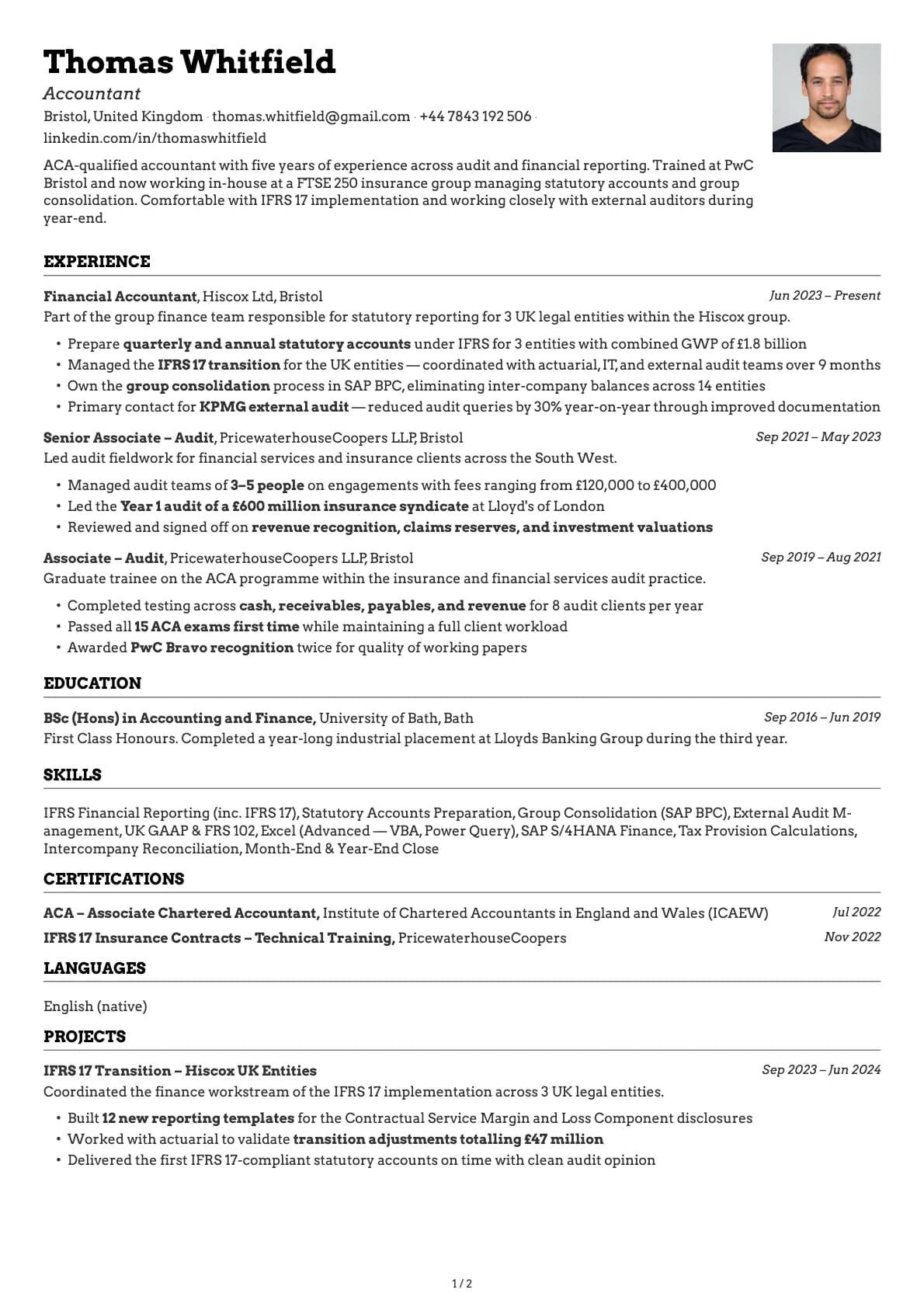
An ACA-qualified accountant resume example with Big 4 audit experience and FTSE 250 in-house reporting.
Financial Analyst
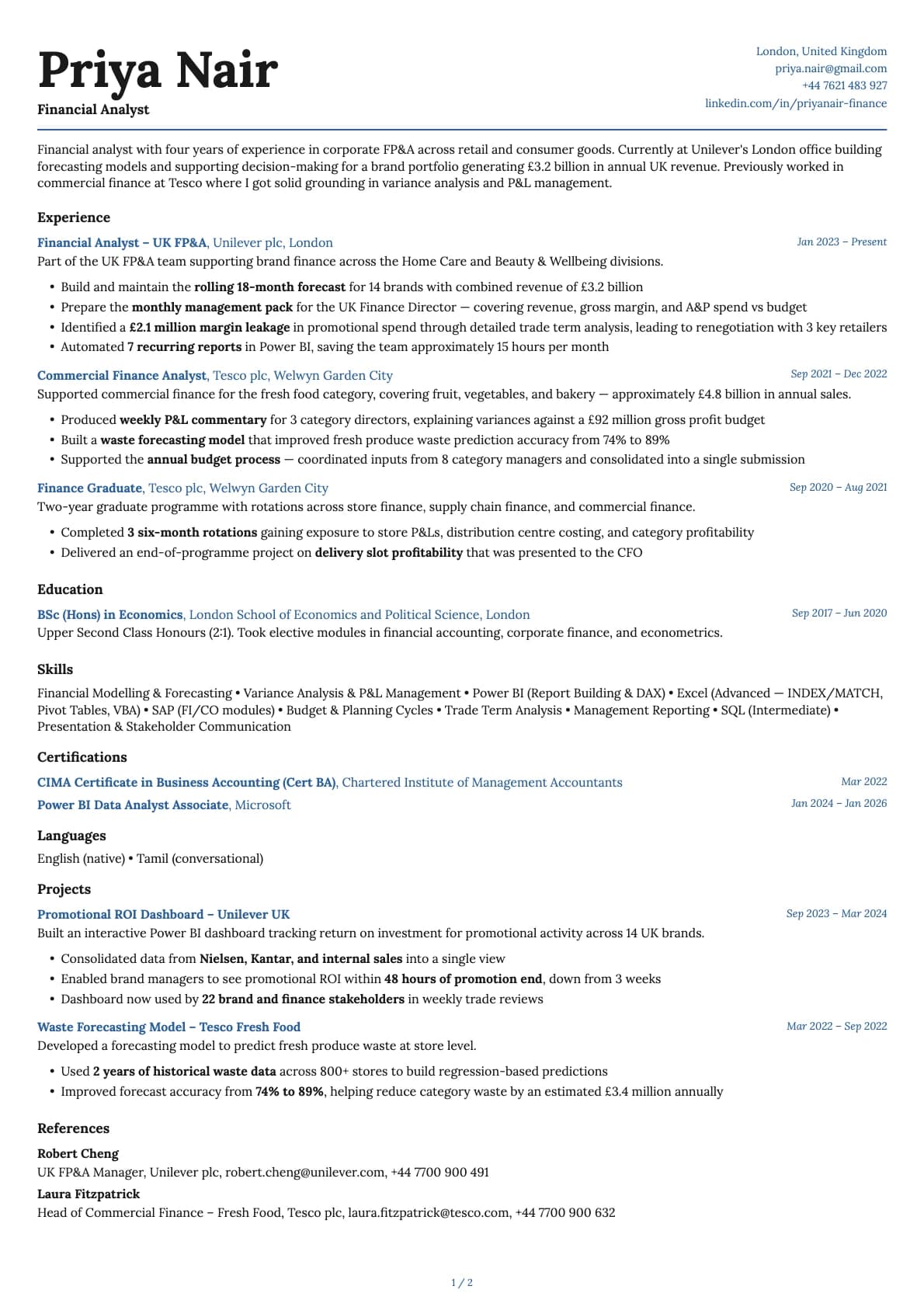
A financial analyst resume example from FP&A roles at Unilever and Tesco. Learn how to present forecasting models, variance analysis, and business impact.
Investment Banker
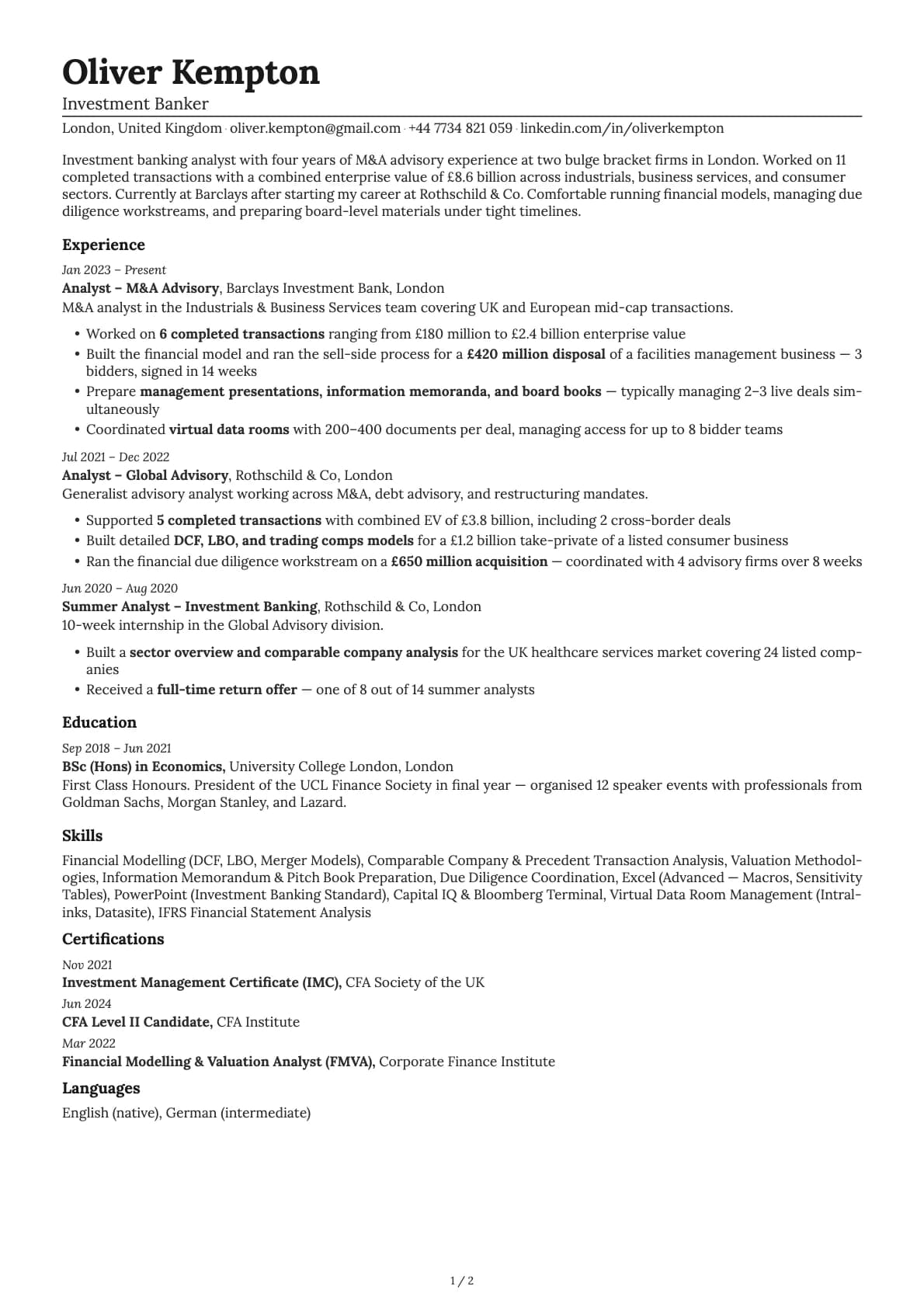
An investment banker resume example with M&A deal values, financial modelling, and bulge bracket experience.
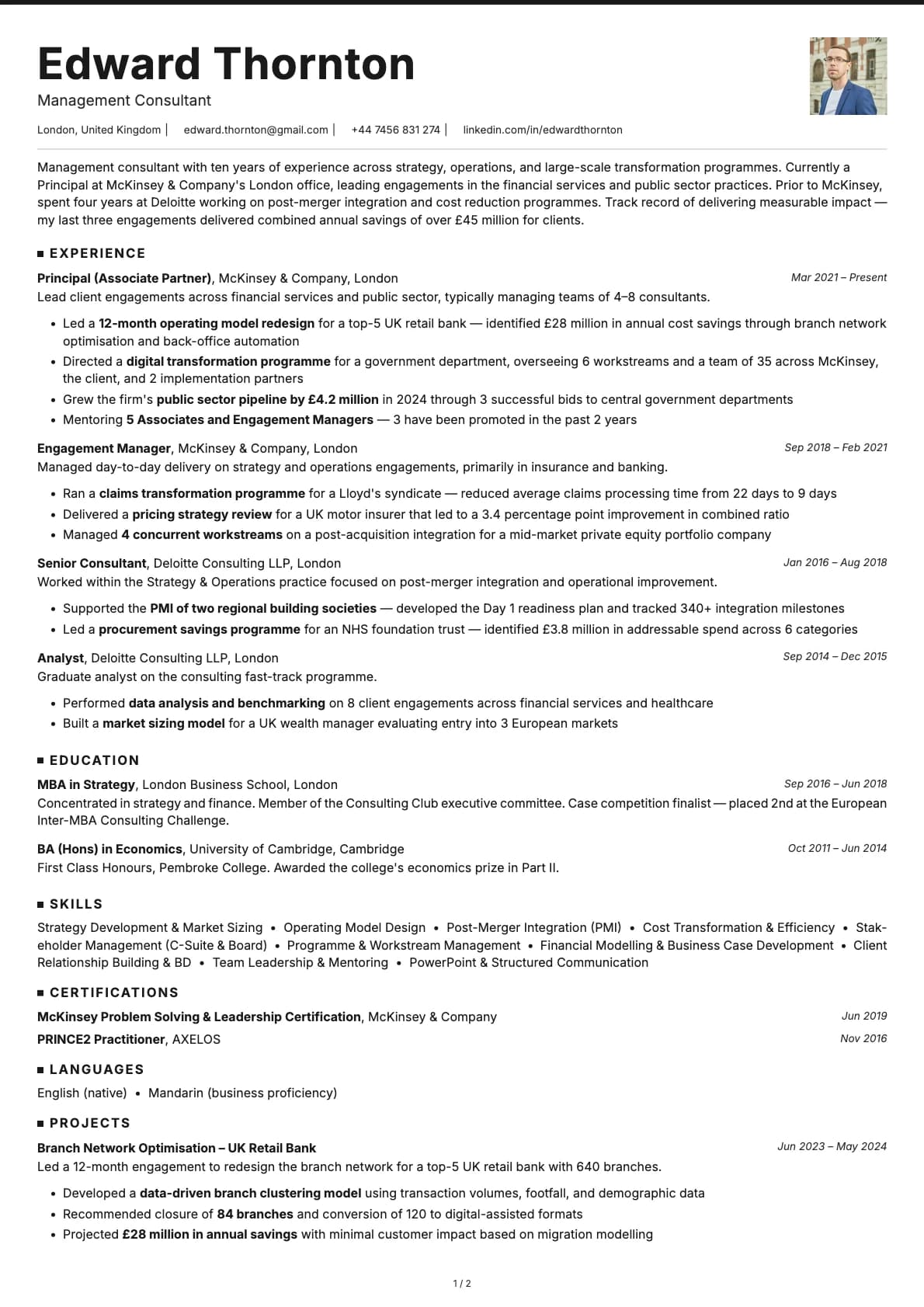
Management Consultant
A management consultant resume example from McKinsey with client impact numbers, engagement details, and business development wins.
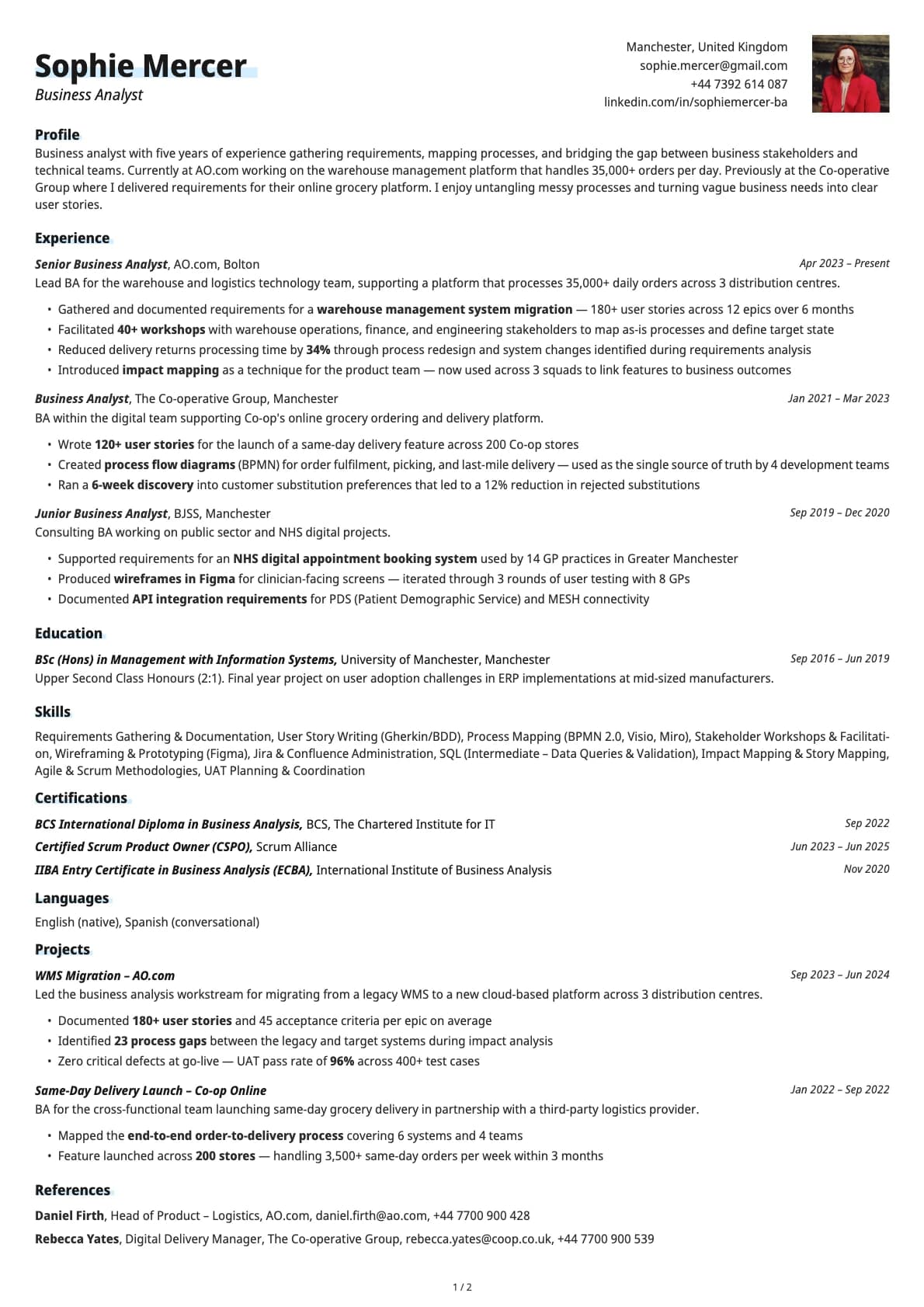
Business Analyst
A business analyst resume example with requirements documentation, stakeholder workshops, and process redesign experience across e-commerce and grocery.
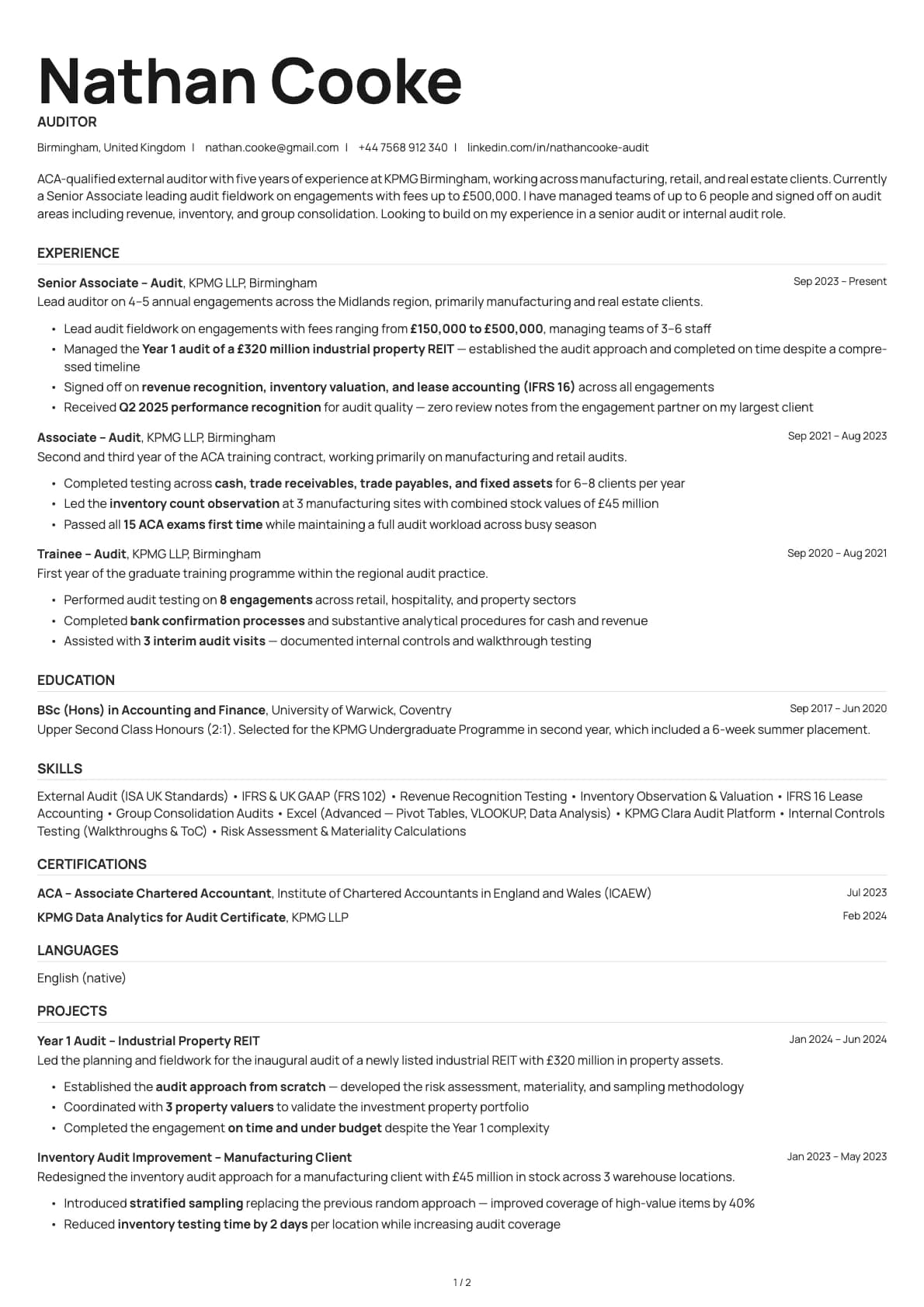
Auditor
An ACA-qualified auditor resume example from KPMG with engagement fee ranges, team management, and ISA Standards experience across manufacturing and real.
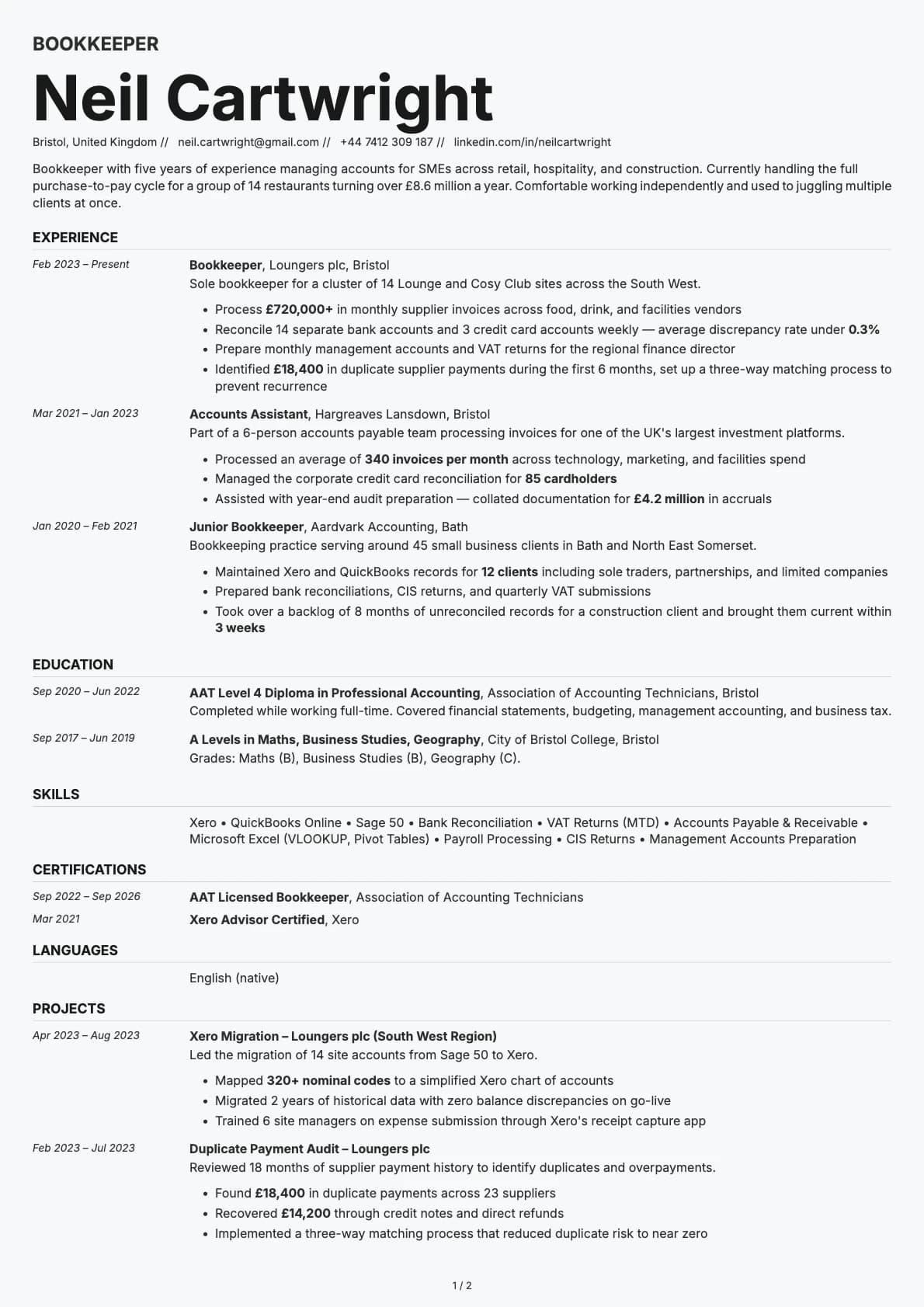
Bookkeeper
A bookkeeper resume example with Xero, Sage, and QuickBooks experience across hospitality and retail SMEs.
Compliance Officer
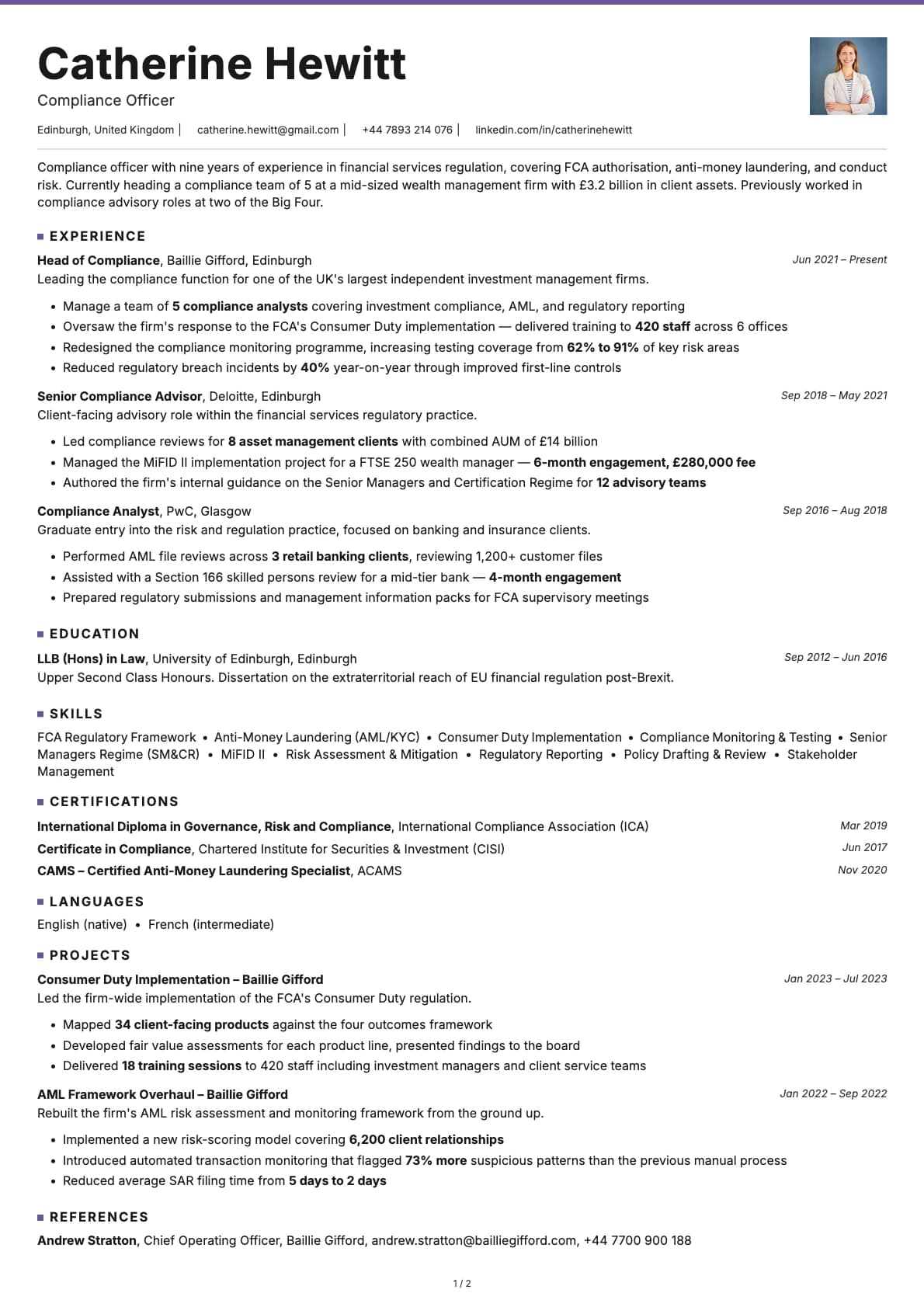
A compliance officer resume example with 9 years in financial services regulation at Baillie Gifford, Deloitte, and PwC.
Customer Service Representative
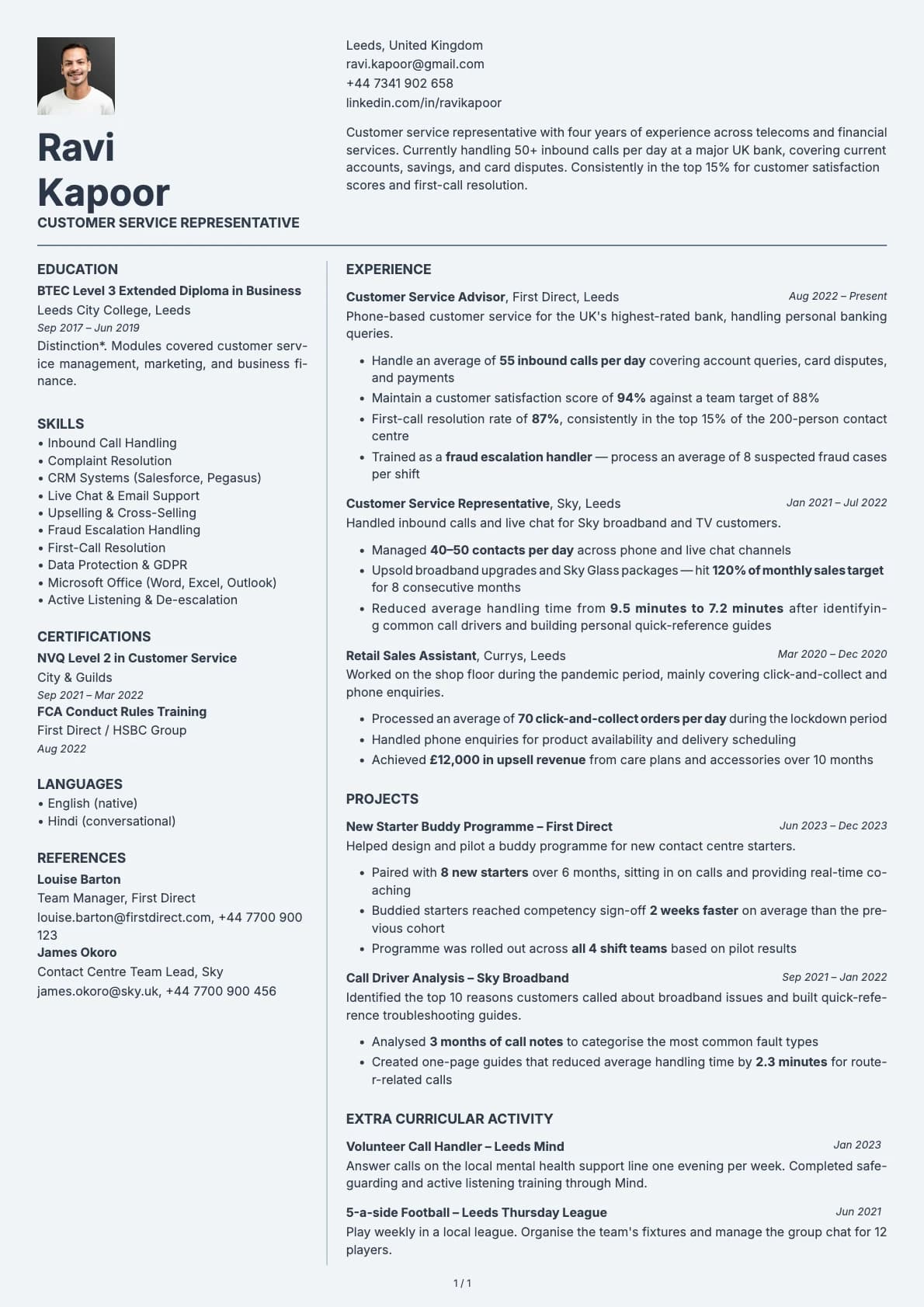
A customer service representative resume example with experience at First Direct and Sky.
Related articles

AI Is Screening Your Resume Before Any Human Sees It
AI screens most resumes before a human ever reads them. 97.4% of Fortune 500 companies run an ATS. This is what that means for you and what you can do about it.

The Best Resume Builders in 2026, Compared Honestly
Resume.io, Zety, Enhancv, Kickresume, Teal, and Laddro compared honestly: real pricing, free tiers, mobile apps, and where each tool wins. All prices checked in September 2026.

Burnout Recovery: A Real Timeline, Not 'Take a Bubble Bath'
55% of the U.S. workforce is burned out. Recovery takes 3 to 12 months. Here's what that actually looks like, stage by stage.