Financial Analyst Resume Example
A financial analyst resume example from FP&A roles at Unilever and Tesco. Learn how to present forecasting models, variance analysis, and business impact.

Laddro Team
Free to use. No account needed to start.
Free to use. No account needed to start.
Overview
Financial analyst resumes all start to look the same after a while. Everyone writes "financial modelling," "variance analysis," and "stakeholder management." Those are real skills, but when every candidate lists them the same way, nobody stands out.
The difference is specifics. Which financial model? What size of P&L? What did your analysis actually change?
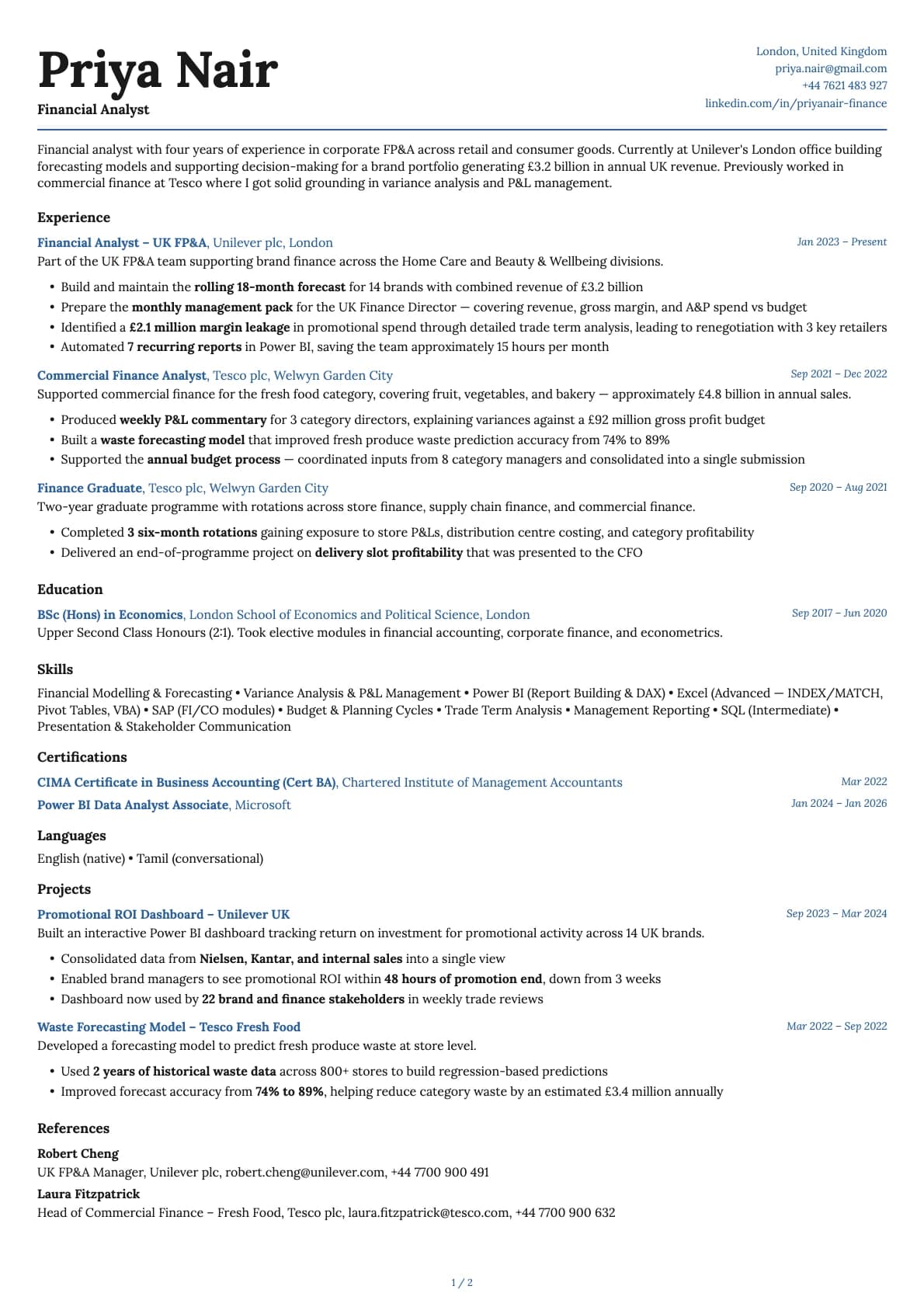
This resume belongs to Priya, a financial analyst with four years of FP&A experience. She works at Unilever's London office, building forecasting models for a brand portfolio generating £3.2 billion in UK revenue. Before that, she worked in commercial finance at Tesco covering the fresh food category. The resume works because every bullet connects the analysis to a business outcome.
Here is how to do the same for yours.
Your summary needs a revenue number
Finance recruiters think in numbers. So your summary should lead with one.
Financial analyst with four years of experience in corporate FP&A across retail and consumer goods. Currently at Unilever's London office building forecasting models and supporting decision-making for a brand portfolio generating £3.2 billion in annual UK revenue.
Two sentences. The recruiter now knows: FP&A experience, retail and FMCG background, currently at a blue-chip company, and the portfolio she covers is worth £3.2 billion. That last number is doing the heavy lifting. It immediately communicates the scale of the work.
For your summary: Name your specialism (FP&A, commercial finance, investment analysis, etc.), the industry, your current company, and the revenue or budget you support. That is your opening.
Experience bullets: connect analysis to decisions
The number one mistake on financial analyst resumes is describing the report without describing what happened because of it. "Prepared monthly management reports" is a task. This is an achievement:
Identified a £2.1 million margin leakage in promotional spend through detailed trade term analysis, leading to renegotiation with 3 key retailers
That bullet starts with the analysis (trade term review), names the finding (£2.1 million leakage), and shows the outcome (renegotiation with retailers). The recruiter can see that this person does not just build spreadsheets. She uses them to find things that matter.
Here is another one that works differently:
Build and maintain the rolling 18-month forecast for 14 brands with combined revenue of £3.2 billion
No single outcome here. But the scope is impressive: 14 brands, £3.2 billion, 18-month rolling forecast. Sometimes the scale of what you manage is the achievement.
The formula for financial analyst bullets: What you analysed + What you found or built + What business decision it informed (or what money it saved/recovered).
Technical skills: show the depth
Finance roles require a mix of tools. This resume lists them clearly:
- Modelling: Financial Modelling & Forecasting, Variance Analysis & P&L Management
- Tools: Power BI (Report Building & DAX), Excel (Advanced, INDEX/MATCH, Pivot Tables, VBA), SAP (FI/CO modules), SQL (Intermediate)
- Process: Budget & Planning Cycles, Trade Term Analysis, Management Reporting
The parenthetical details matter. "Excel (Advanced)" is vague. "Excel (Advanced, INDEX/MATCH, Pivot Tables, VBA)" is specific. It tells the recruiter exactly what you can do and gives the ATS more keywords to match.
If you use Power BI or Tableau, mention what you have built, not just that you know the tool. The projects section in this resume expands on the Power BI dashboard:
Built an interactive Power BI dashboard tracking return on investment for promotional activity across 14 UK brands. Enabled brand managers to see promotional ROI within 48 hours of promotion end, down from 3 weeks.
That is a concrete deliverable with a measurable improvement (3 weeks to 48 hours).
How to write about your graduate programme
Many financial analysts start in a structured graduate scheme. The challenge is making 6-month rotations sound substantial. Look at how this resume handles it:
Completed 3 six-month rotations gaining exposure to store P&Ls, distribution centre costing, and category profitability
Delivered an end-of-programme project on delivery slot profitability that was presented to the CFO
The rotations show breadth (three different areas of the business). And the end-of-programme project is specific and impressive. Being presented to the CFO tells the recruiter the work was taken seriously.
If you did a graduate programme, name each rotation area and pick one deliverable that shows real analytical work. "Presented to the CFO" is more powerful than "completed the programme successfully."
Certifications: CIMA, ACA, ACCA, or CFA?
This resume lists a CIMA Certificate in Business Accounting and a Power BI Data Analyst Associate. The CIMA qualification signals that the candidate is on the management accounting path, which aligns with FP&A work.
Which qualification you pursue depends on your career direction. CIMA for management accounting and FP&A. ACA or ACCA for financial reporting and audit. CFA for investment analysis. The important thing is to list where you are in the qualification and be honest. "CIMA Cert BA" is fine. Do not claim to be a qualified accountant when you have only passed the certificate level.
If you are studying for the next level, include it with "in progress" or an expected completion date.
Mistakes that financial analyst resumes make
Listing every Excel function you know. Your Excel skills should be demonstrated through your achievements, not listed as a 20-item catalogue. Mention VBA if you use it, Pivot Tables if you rely on them, and leave it at that.
Being vague about the P&L you cover. "Supported budget management" means nothing without a number. Is it a £5 million budget or a £500 million one? The difference matters.
Forgetting to mention the audience. Who reads your reports? If your management pack goes to the UK Finance Director, say so. If your model was used by 22 stakeholders in weekly trade reviews, say that. It shows the level of trust placed in your work.
Not showing progression. Finance is a structured career. Graduate to analyst to senior analyst to manager. Make sure each role shows a clear step up in responsibility, scope, or complexity.
One last thing
If you have automated anything, put it on your resume. The bullet about automating 7 recurring reports in Power BI and saving 15 hours per month is exactly the kind of initiative that separates a good analyst from an average one. Finance teams are always drowning in manual reporting. If you have fixed even one of those processes, that is a strong talking point.
Build your own version
Open this layout in the builder and swap in your own details. It takes a few minutes.
Free to use. No account needed to start.
Was this resume example helpful?
Rate this example to help us create better content for you.
4.9 average from 104 ratingsRelated resume examples
Accountant
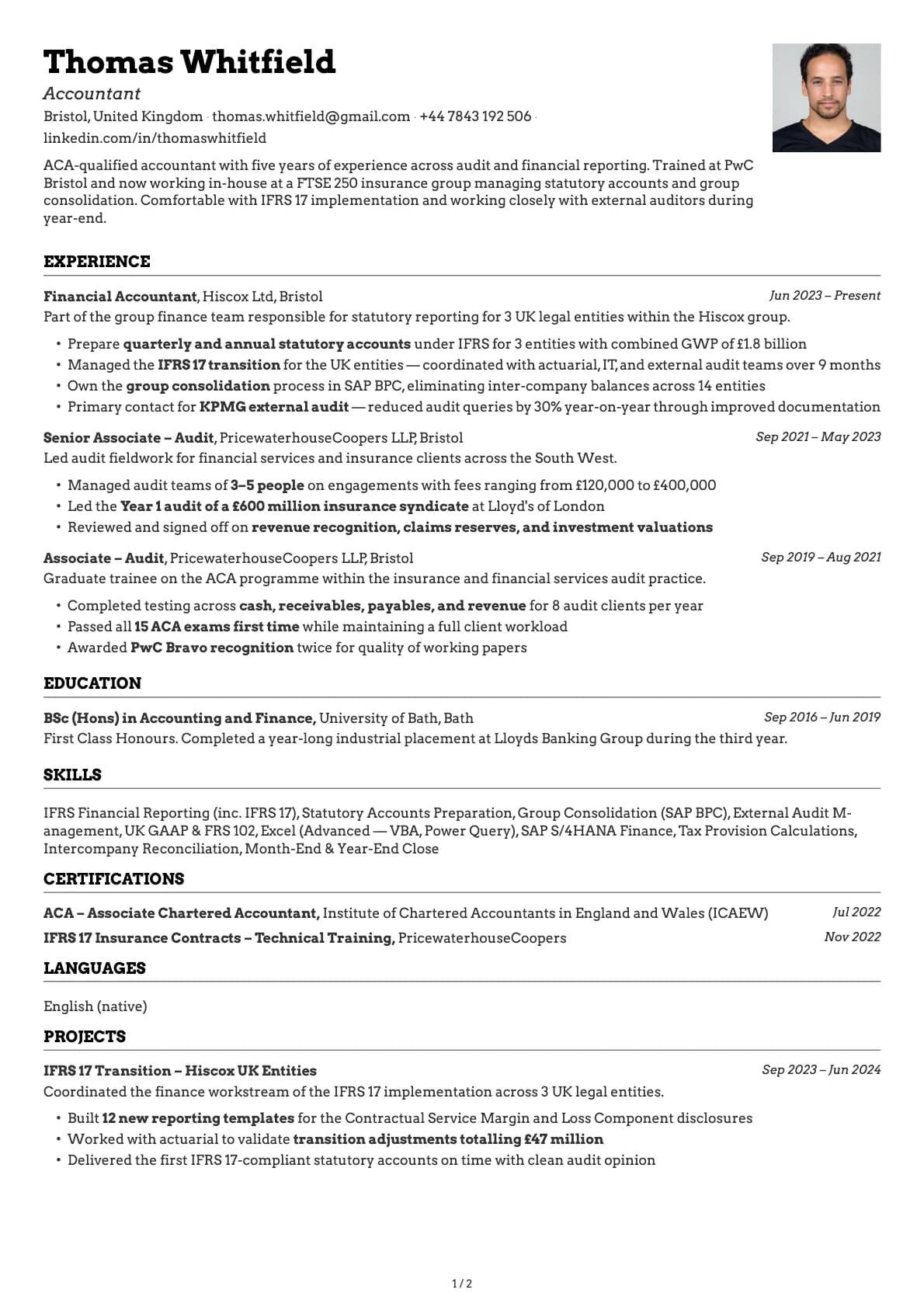
An ACA-qualified accountant resume example with Big 4 audit experience and FTSE 250 in-house reporting.
Investment Banker
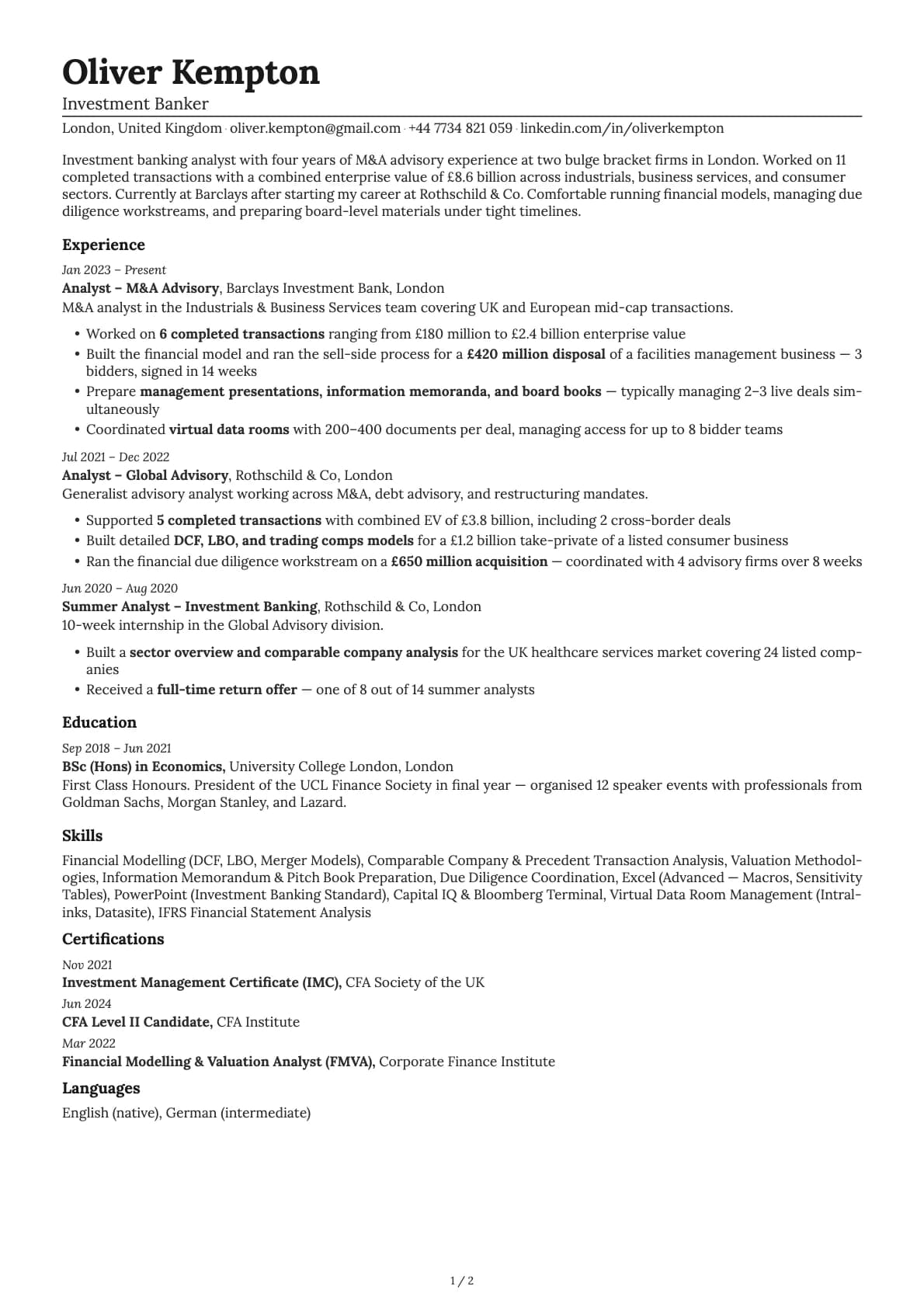
An investment banker resume example with M&A deal values, financial modelling, and bulge bracket experience.
Management Consultant
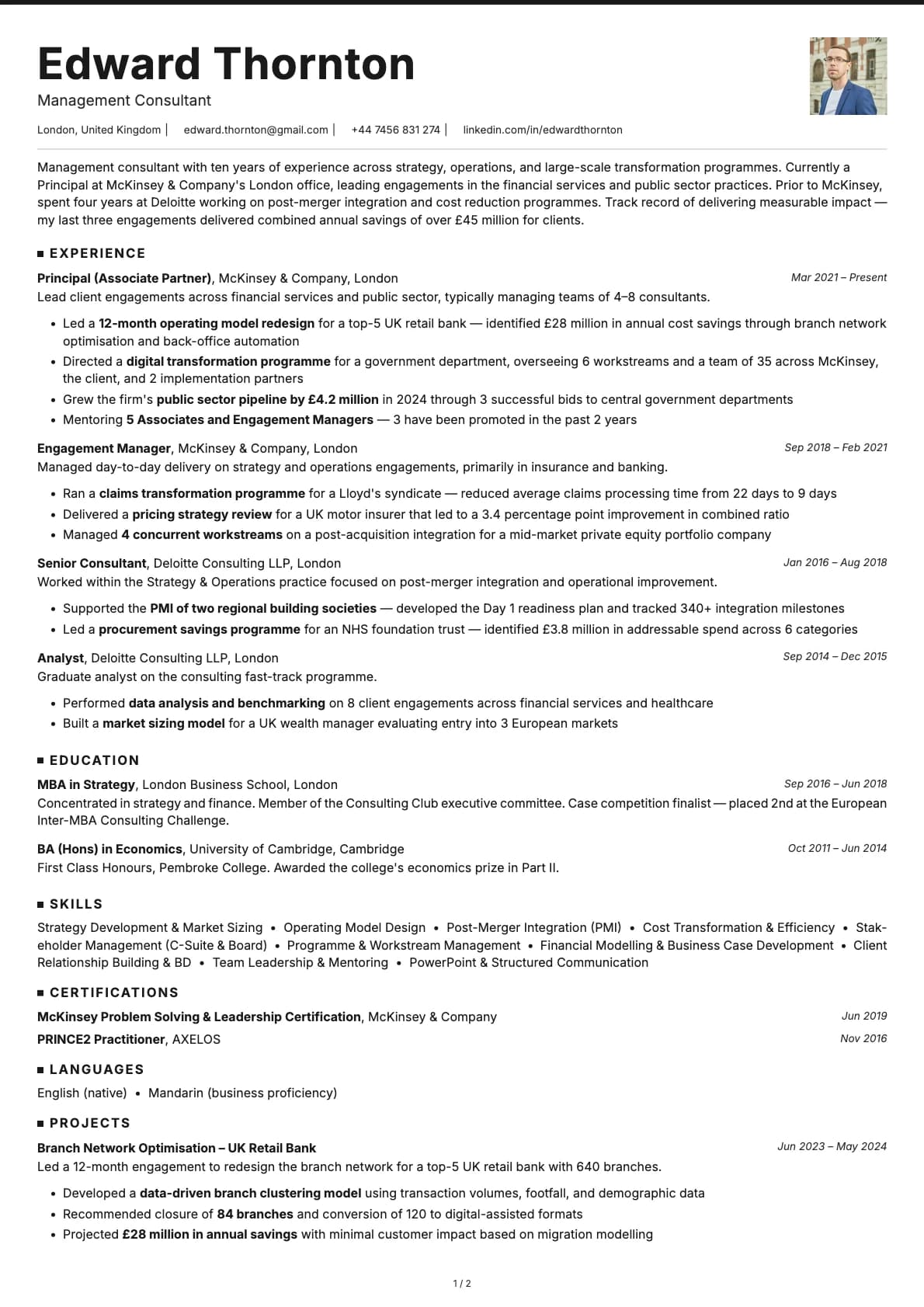
A management consultant resume example from McKinsey with client impact numbers, engagement details, and business development wins.
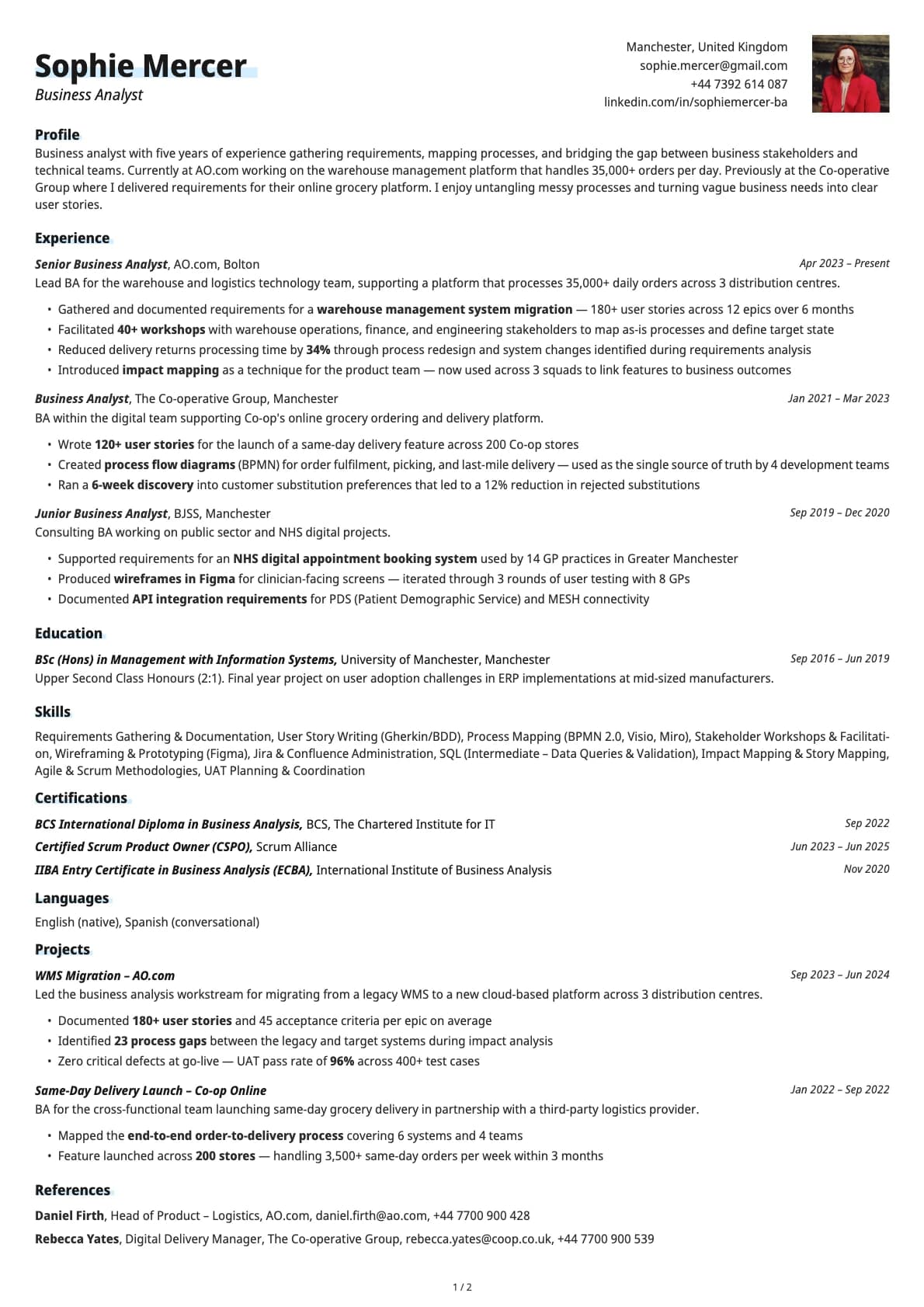
Business Analyst
A business analyst resume example with requirements documentation, stakeholder workshops, and process redesign experience across e-commerce and grocery.
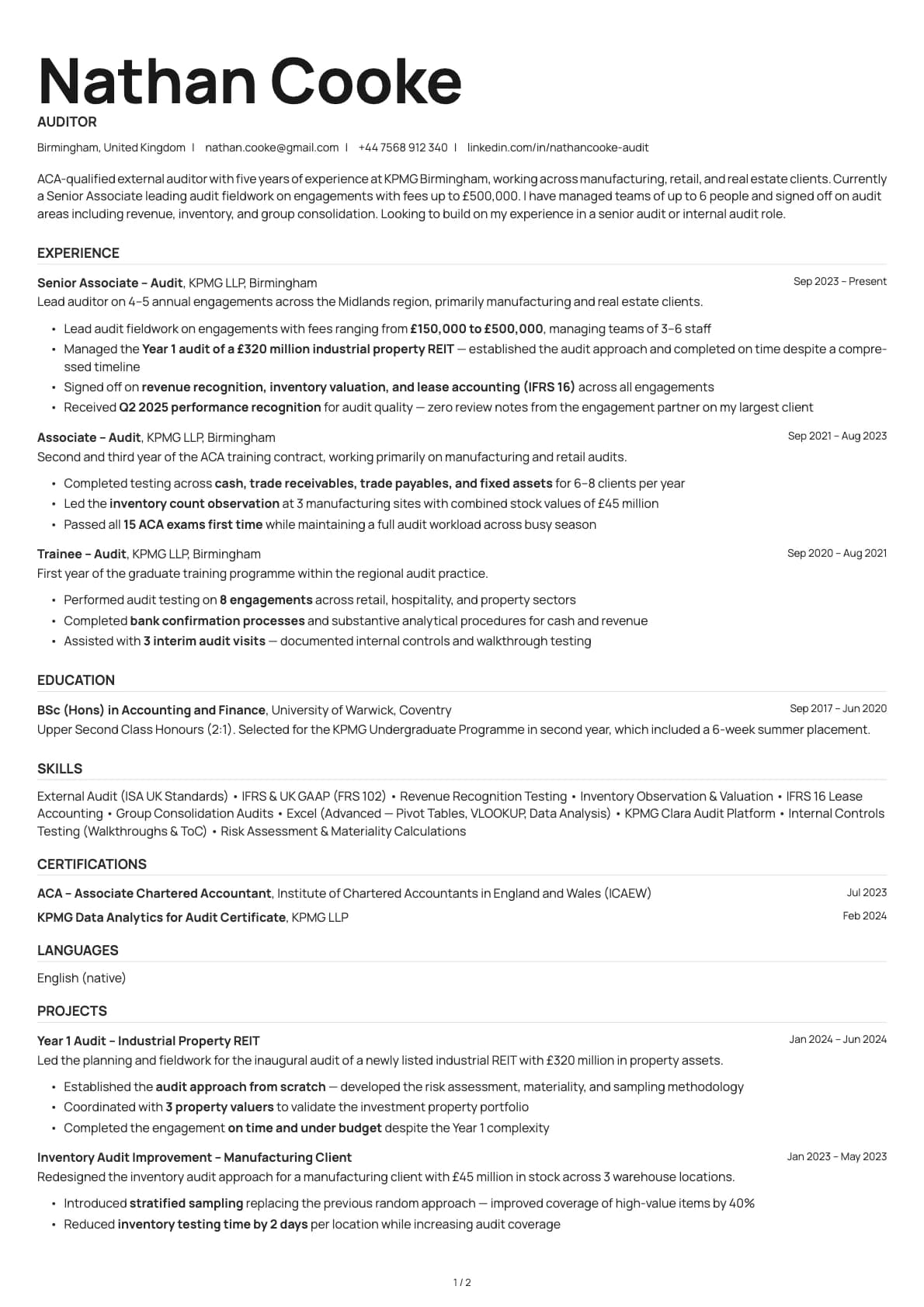
Auditor
An ACA-qualified auditor resume example from KPMG with engagement fee ranges, team management, and ISA Standards experience across manufacturing and real.
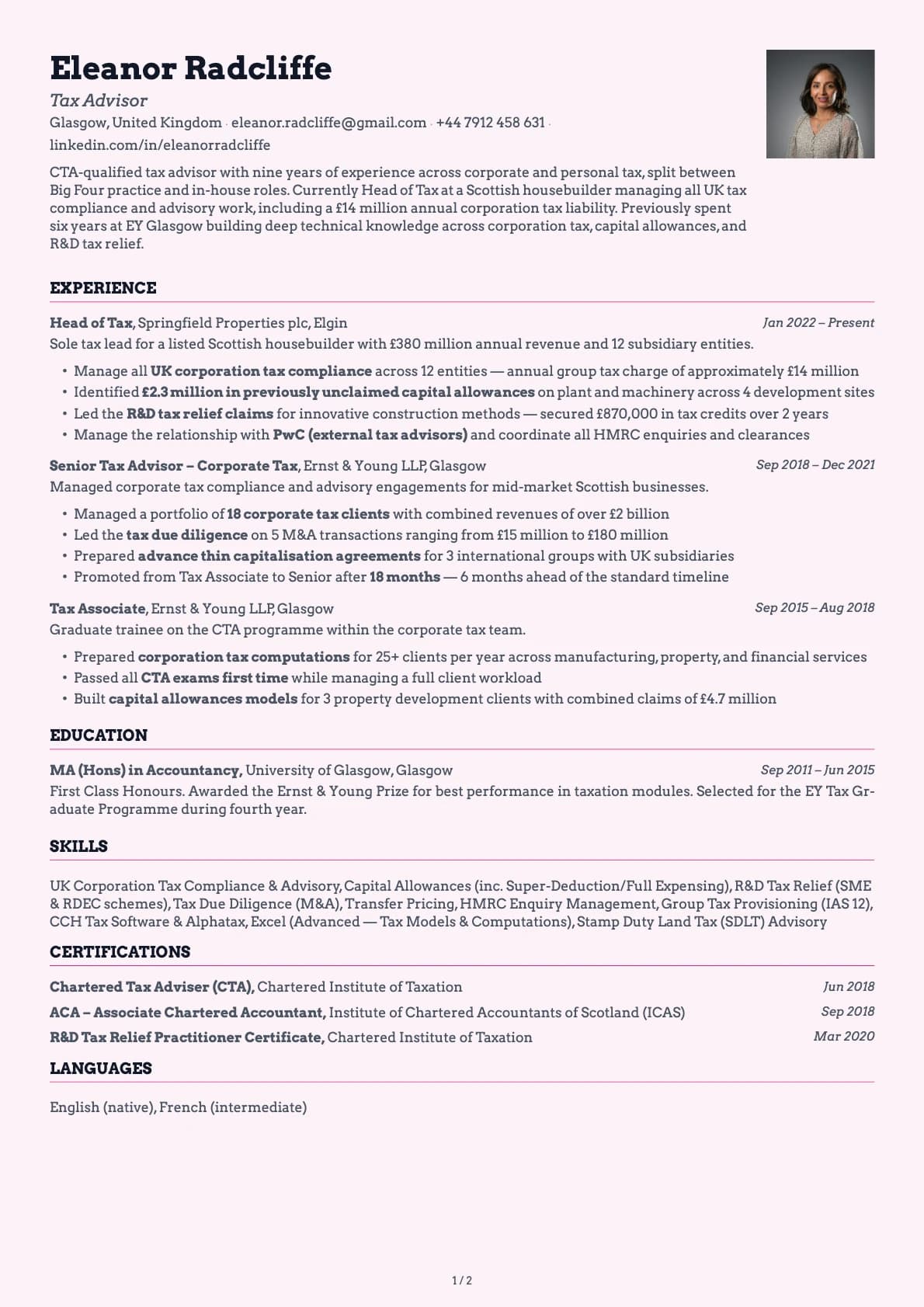
Tax Advisor
A tax advisor resume example with CTA qualification and 9 years of corporate tax experience across Big Four and in-house roles.
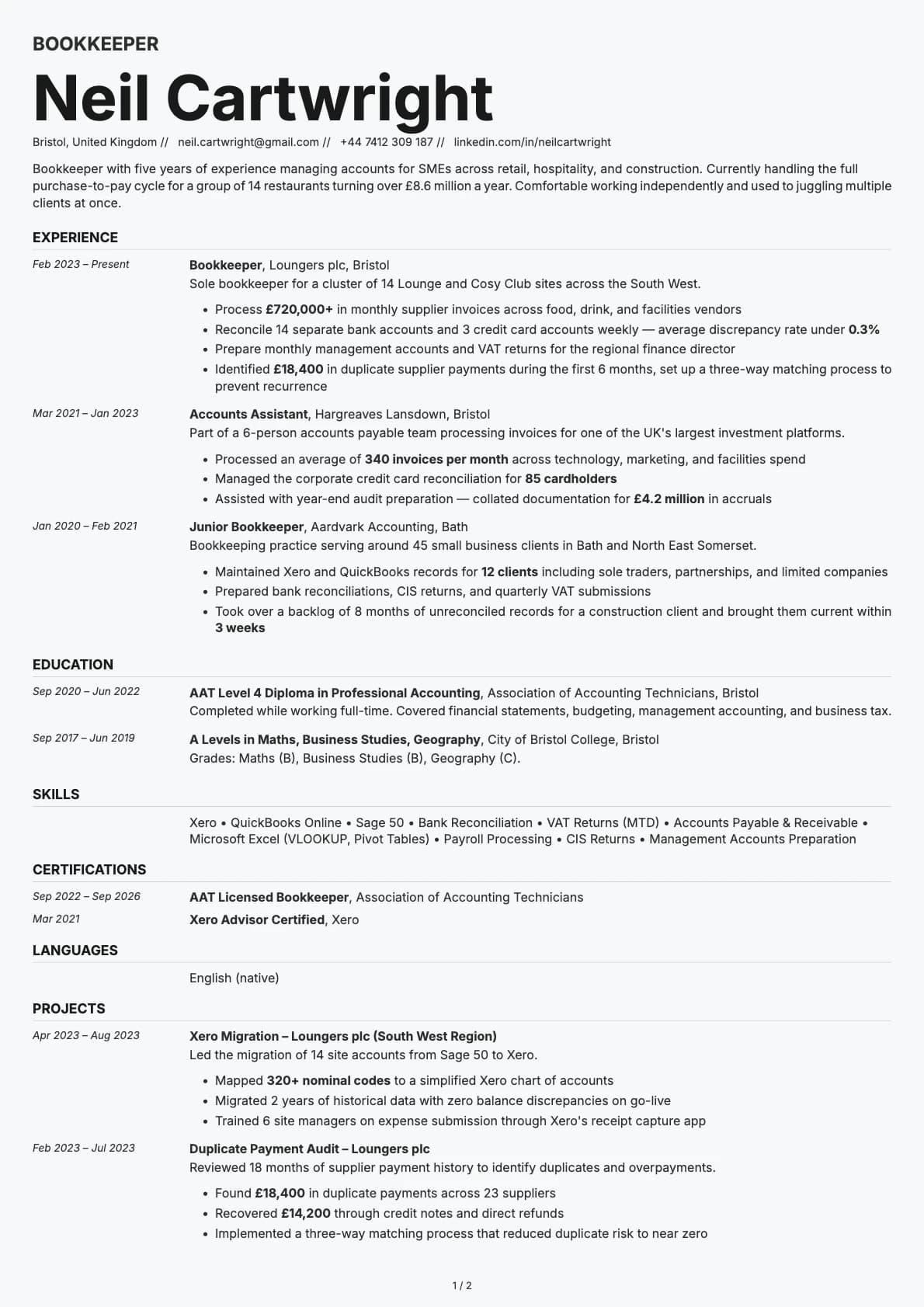
Bookkeeper
A bookkeeper resume example with Xero, Sage, and QuickBooks experience across hospitality and retail SMEs.
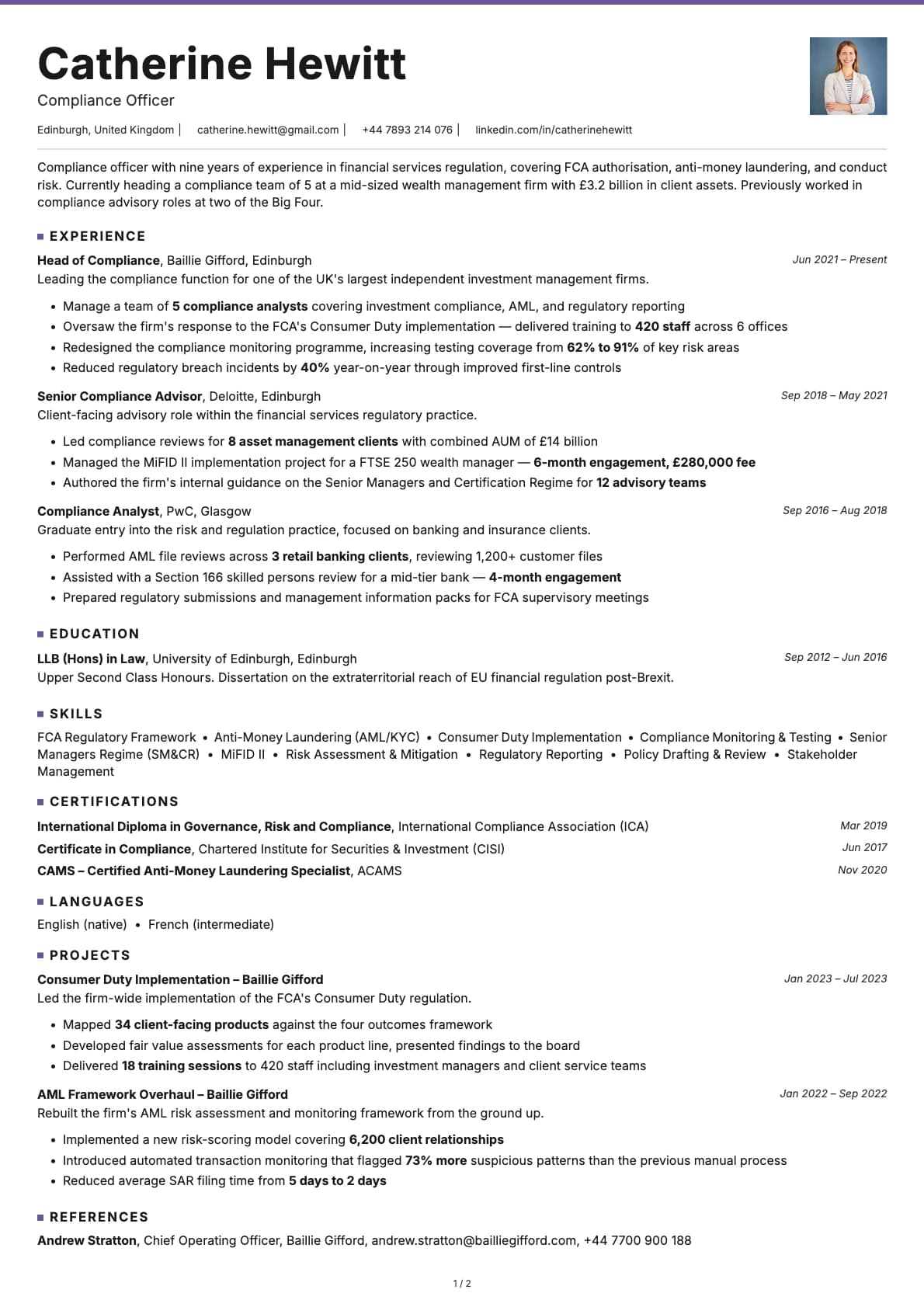
Compliance Officer
A compliance officer resume example with 9 years in financial services regulation at Baillie Gifford, Deloitte, and PwC.
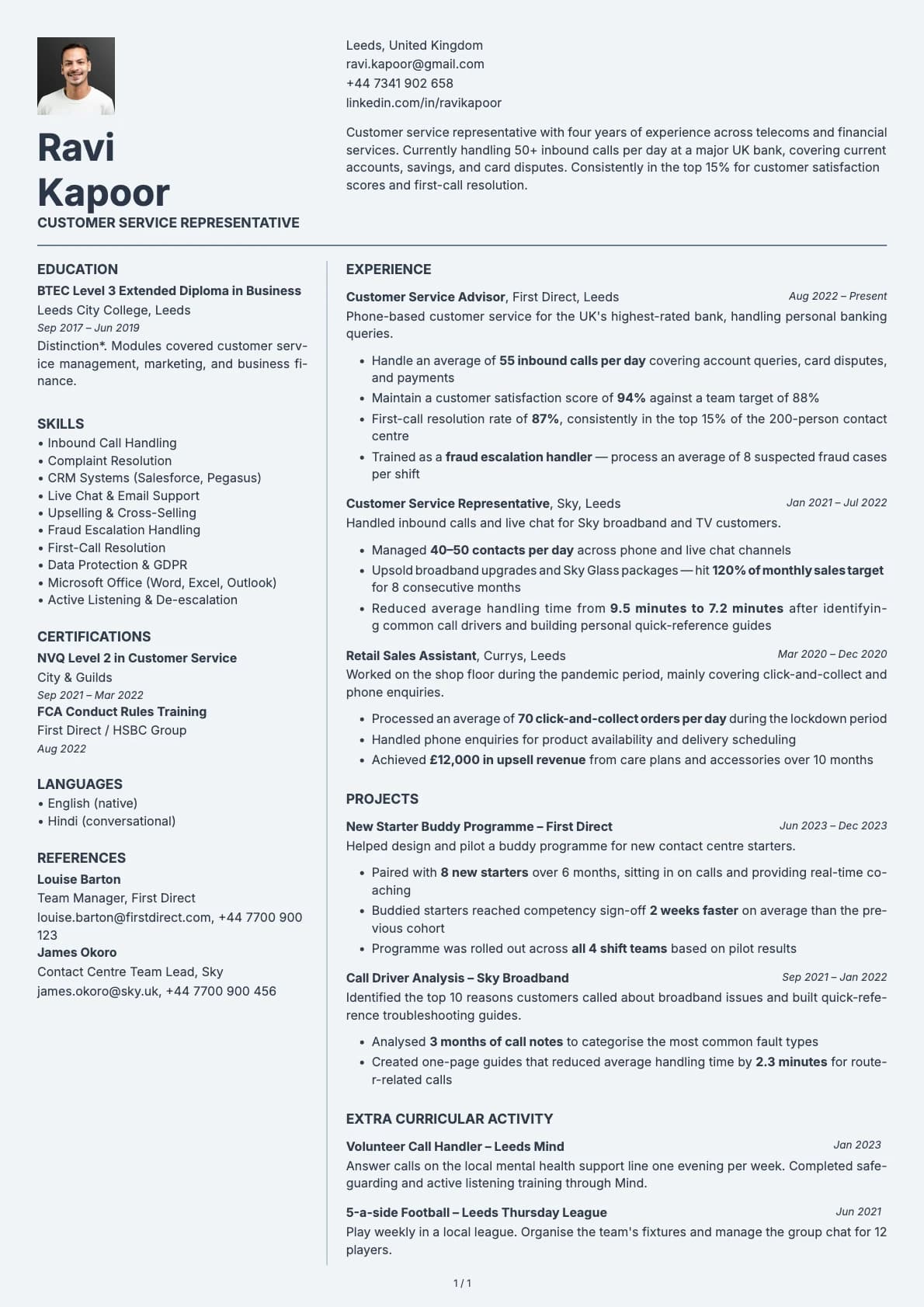
Customer Service Representative
A customer service representative resume example with experience at First Direct and Sky.
Related articles

AI Is Screening Your Resume Before Any Human Sees It
AI screens most resumes before a human ever reads them. 97.4% of Fortune 500 companies run an ATS. This is what that means for you and what you can do about it.

The Best Resume Builders in 2026, Compared Honestly
Resume.io, Zety, Enhancv, Kickresume, Teal, and Laddro compared honestly: real pricing, free tiers, mobile apps, and where each tool wins. All prices checked in September 2026.

Burnout Recovery: A Real Timeline, Not 'Take a Bubble Bath'
55% of the U.S. workforce is burned out. Recovery takes 3 to 12 months. Here's what that actually looks like, stage by stage.