Investment Banker Resume Example
An investment banker resume example with M&A deal values, financial modelling, and bulge bracket experience.

Laddro Team
Free to use. No account needed to start.
Free to use. No account needed to start.
Overview
Investment banking resumes follow unwritten rules that most other industries do not have. The format is conservative. The language is specific. And every line needs to show deal experience, technical skill, or both. A hiring manager at a bank will spend maybe 15 seconds on your resume before deciding whether to interview you. There is no room for vague statements or generic finance language.
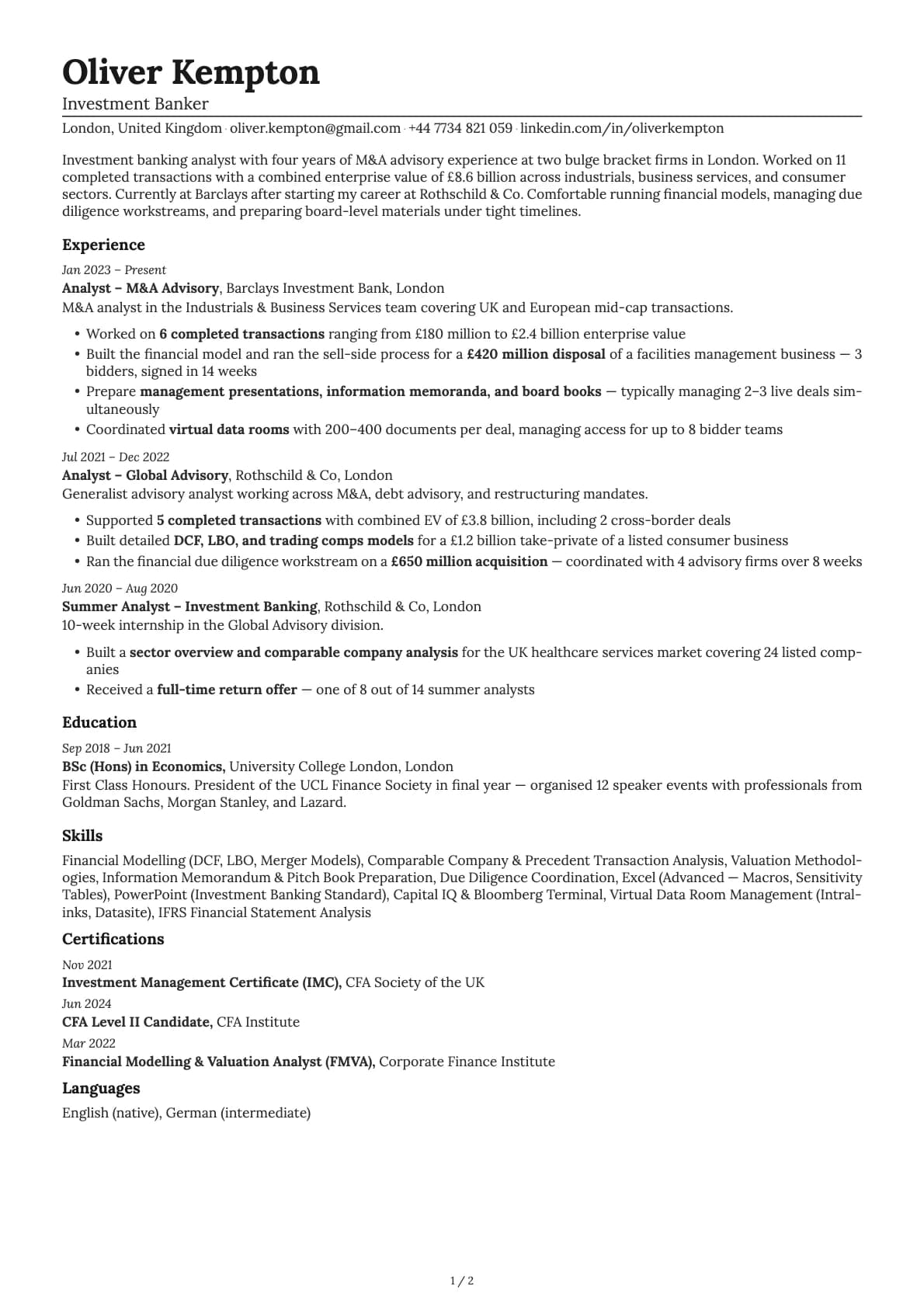
This resume belongs to Oliver, an M&A analyst at Barclays Investment Bank in London. He has four years of experience, starting with a summer internship at Rothschild & Co that converted to a full-time offer. He has worked on 11 completed transactions with a combined enterprise value of 8.6 billion. The resume is a masterclass in how to present banking experience at the analyst level.
The summary: keep it dense and deal-focused
Banking recruiters do not read summaries for personality. They read them for a quick scan of your deal sheet. Oliver's summary packs in everything they need:
Investment banking analyst with four years of M&A advisory experience at two bulge bracket firms in London. Worked on 11 completed transactions with a combined enterprise value of £8.6 billion across industrials, business services, and consumer sectors. Currently at Barclays after starting my career at Rothschild & Co.
Three sentences. He names the banks, the deal count, the total enterprise value, the sectors, and his career path. No filler words. No "motivated team player" or "strong analytical skills." Just facts.
Your version: Job title. Years of experience. Bank names. Deal count and total value. Sector focus. That is it.
Experience: every bullet needs a deal or a number
The most important thing on an investment banking resume is your deal experience. Every bullet in your experience section should reference a specific transaction, a financial model, or a measurable output.
From Oliver's role at Barclays:
"Worked on 6 completed transactions ranging from £180 million to £2.4 billion enterprise value"
"Built the financial model and ran the sell-side process for a £420 million disposal of a facilities management business, 3 bidders, signed in 14 weeks"
"Coordinated virtual data rooms with 200-400 documents per deal, managing access for up to 8 bidder teams"
The first bullet gives the range. The second gives a specific deal with the model type, deal value, number of bidders, and timeline. The third shows operational ownership of the data room process.
From his time at Rothschild:
"Built detailed DCF, LBO, and trading comps models for a £1.2 billion take-private of a listed consumer business"
"Ran the financial due diligence workstream on a £650 million acquisition, coordinated with 4 advisory firms over 8 weeks"
Again, specific model types, deal values, and the scope of his work. No bullet says "assisted with various financial analyses." Every one has a number and a deal.
The formula: What you did (built/ran/coordinated) + model type or work product + deal value + outcome or scope.
The internship matters more than you think
In banking, the summer internship is where careers start. Oliver's Rothschild internship is on the resume with two bullets:
"Built a sector overview and comparable company analysis for the UK healthcare services market covering 24 listed companies"
"Received a full-time return offer, one of 8 out of 14 summer analysts"
The first shows technical work. The second shows performance against a cohort. Getting a return offer is a meaningful signal to any banking recruiter. If you received one, include it. If you did not convert but still gained strong technical experience, focus on the work products you delivered.
Skills: be specific about model types and tools
Generic "financial analysis" means nothing on a banking resume. Oliver's skills section names exact model types (DCF, LBO, Merger Models), specific tools (Capital IQ, Bloomberg Terminal), and even the level of Excel proficiency (Macros, Sensitivity Tables).
A few things to notice:
He lists "Information Memorandum & Pitch Book Preparation" as a skill. At analyst level, this is a huge part of the job. Showing you can produce client-facing materials under time pressure is valuable.
He lists specific data room platforms (Intralinks, Datasite). If you have used these, include them. Deal teams care about whether you know the tools or need training.
And he lists "IFRS Financial Statement Analysis." This signals that he can read and interpret financial statements, which sounds obvious but is something banks specifically test for.
Certifications: IMC and CFA progression
Oliver has the Investment Management Certificate (IMC), which is standard for anyone working in UK financial services. He is a CFA Level II candidate, showing progression. And he holds an FMVA from the Corporate Finance Institute.
For banking, the CFA is the gold standard credential. Even if you are only at Level I, include it with "Candidate" status. It shows commitment to the profession and technical seriousness. The IMC is expected in the UK. If you do not have it, that is a gap worth closing.
Education: keep it brief but show the numbers
Oliver has a BSc in Economics from UCL with First Class Honours. He also notes that he was President of the UCL Finance Society. At the analyst level, education still matters in banking. First Class or 2:1 from a target university is the baseline expectation.
If you have a non-target university degree, your deal experience and technical skills need to be even stronger. But do not hide your education. List it with your grade and any relevant activities.
Mistakes to avoid on a banking resume
Vague deal descriptions. "Assisted on M&A transactions" is useless. Name the deal value, the model type, and your role. If you cannot name the client due to confidentiality, describe the deal by sector and size.
Too many soft skills. Banking resumes should be almost entirely technical and deal-based. "Strong communication skills" belongs nowhere on this resume. If you communicate well, it shows in the fact that you "prepared management presentations and board books."
Wrong format. Investment banking resumes are one page. Always. Even if you have 10 years of experience. Single column, conservative font, no colour. Oliver's resume uses Nickel, which is a clean single-column layout with minimal design. Anything more creative will look out of place.
Missing the return offer. If you got a return offer from your internship, include it. If you were one of a small cohort, include the numbers. "One of 8 out of 14 summer analysts" is a powerful signal. Do not be modest about it.
No deal count. The first thing a banking recruiter wants to know is how many deals you have worked on and what size they were. Put the total count and combined enterprise value in your summary. Do not make them read through every bullet to work it out.
One final thought
Banking resumes are not the place to show personality. Save that for the interview. Your resume should be a clean, dense summary of your deal experience, technical skills, and credentials. If a senior banker can scan it in 15 seconds and see "Barclays, Rothschild, 11 deals, 8.6 billion EV, CFA candidate," you will get the interview.
Build your own version
Open this layout in the builder and swap in your own details. It takes a few minutes.
Free to use. No account needed to start.
Was this resume example helpful?
Rate this example to help us create better content for you.
4.9 average from 87 ratingsRelated resume examples
Accountant
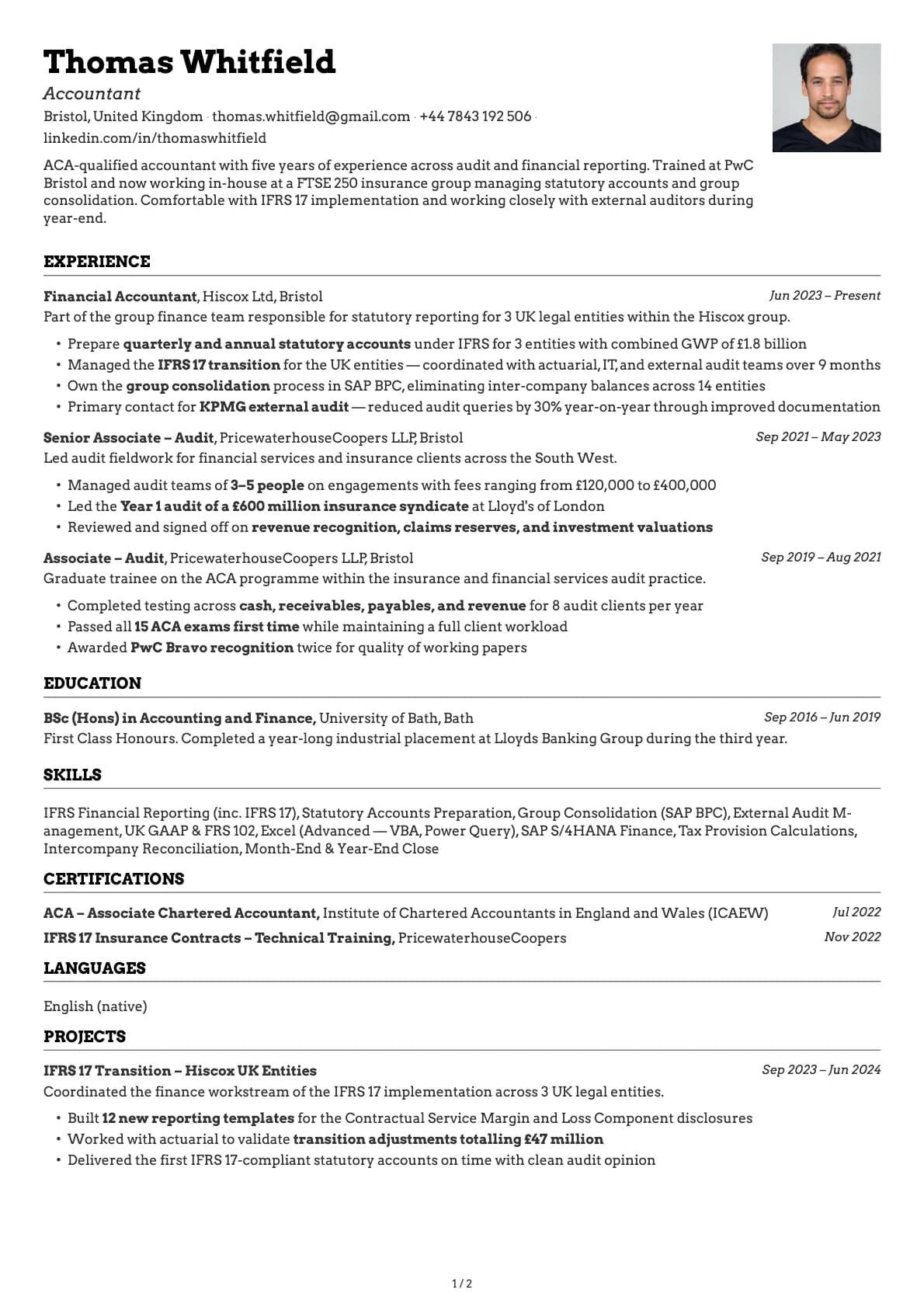
An ACA-qualified accountant resume example with Big 4 audit experience and FTSE 250 in-house reporting.
Financial Analyst
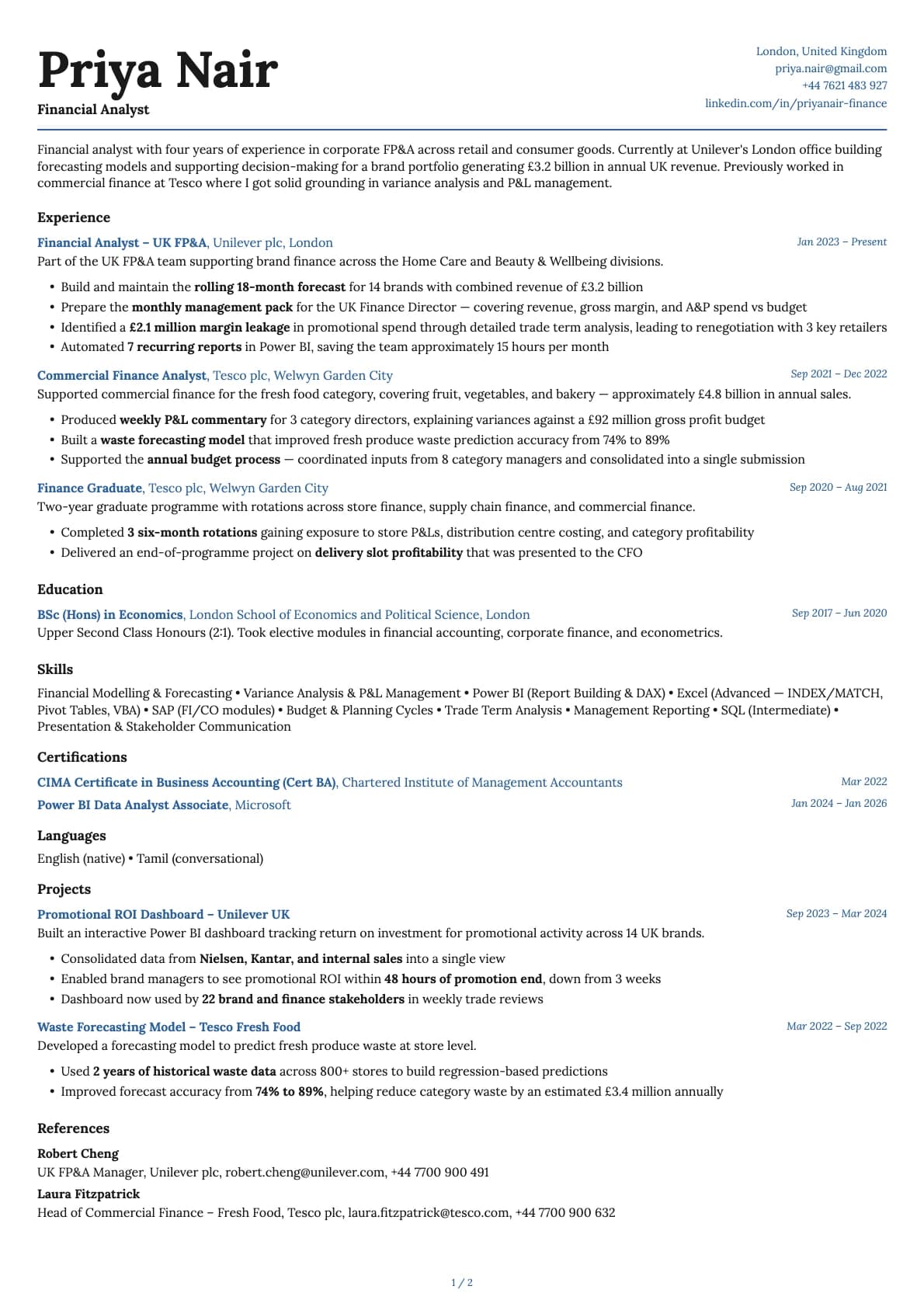
A financial analyst resume example from FP&A roles at Unilever and Tesco. Learn how to present forecasting models, variance analysis, and business impact.
Management Consultant
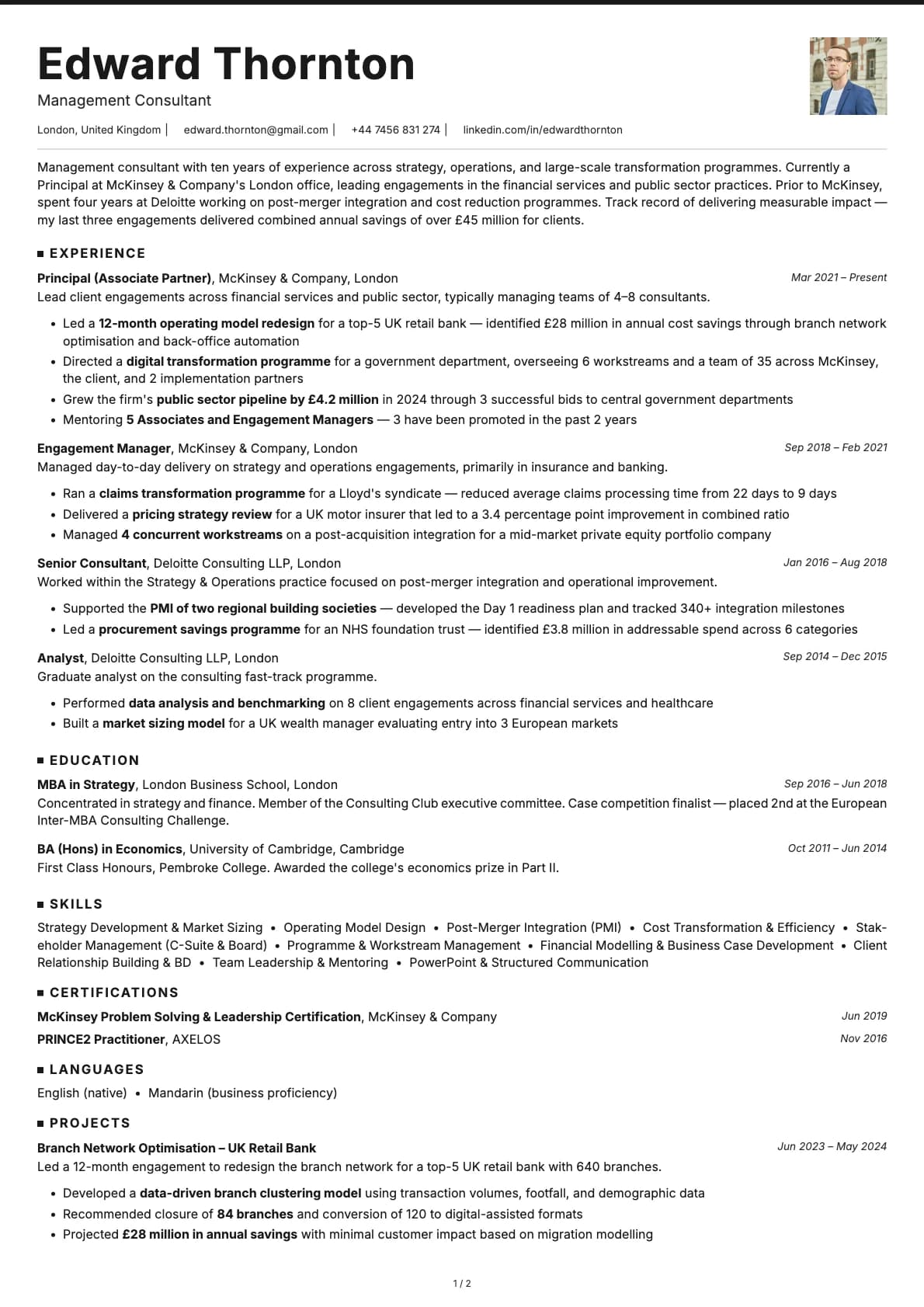
A management consultant resume example from McKinsey with client impact numbers, engagement details, and business development wins.
Business Analyst
A business analyst resume example with requirements documentation, stakeholder workshops, and process redesign experience across e-commerce and grocery.
Auditor
An ACA-qualified auditor resume example from KPMG with engagement fee ranges, team management, and ISA Standards experience across manufacturing and real.
Tax Advisor
A tax advisor resume example with CTA qualification and 9 years of corporate tax experience across Big Four and in-house roles.
Bookkeeper
A bookkeeper resume example with Xero, Sage, and QuickBooks experience across hospitality and retail SMEs.
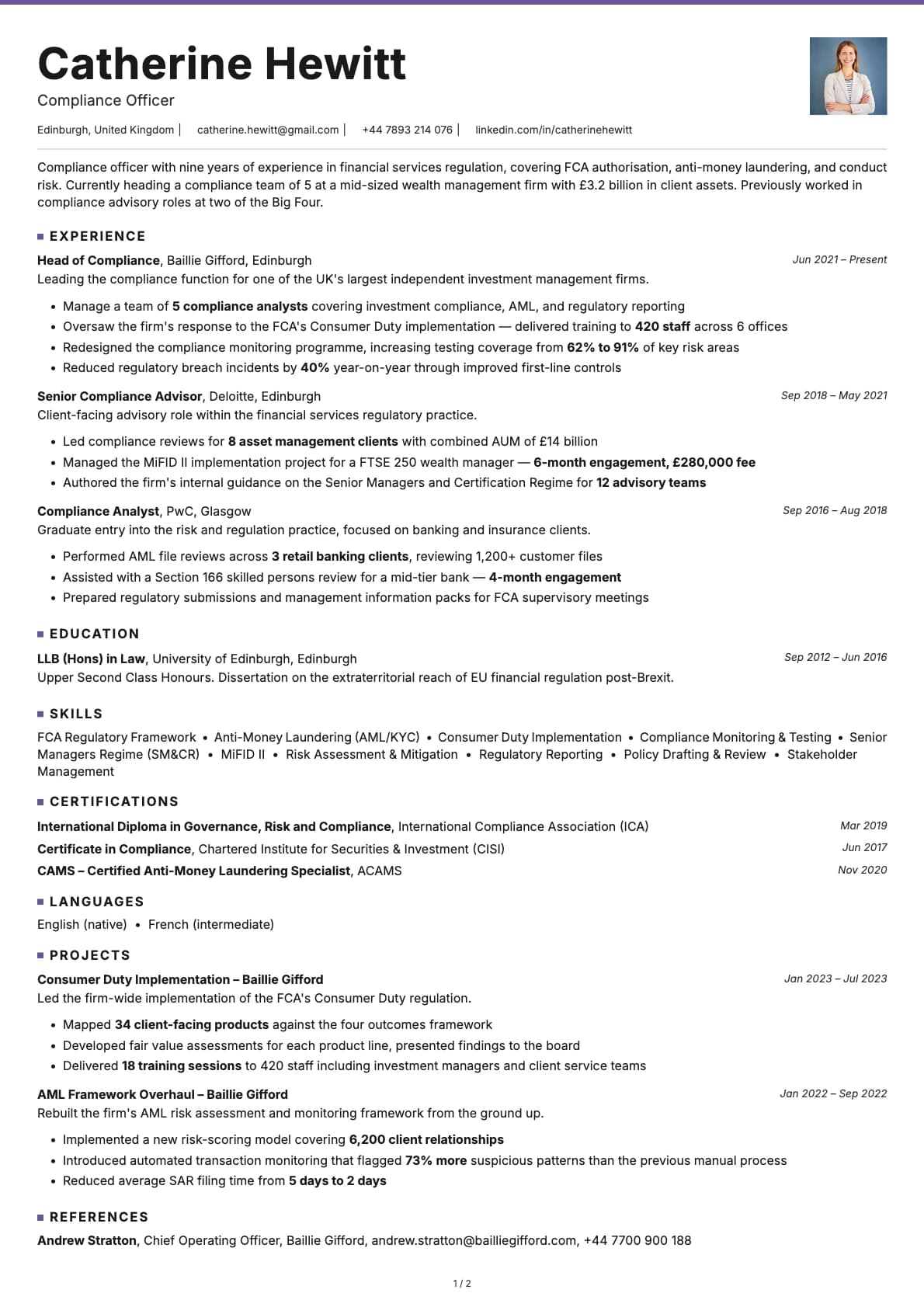
Compliance Officer
A compliance officer resume example with 9 years in financial services regulation at Baillie Gifford, Deloitte, and PwC.
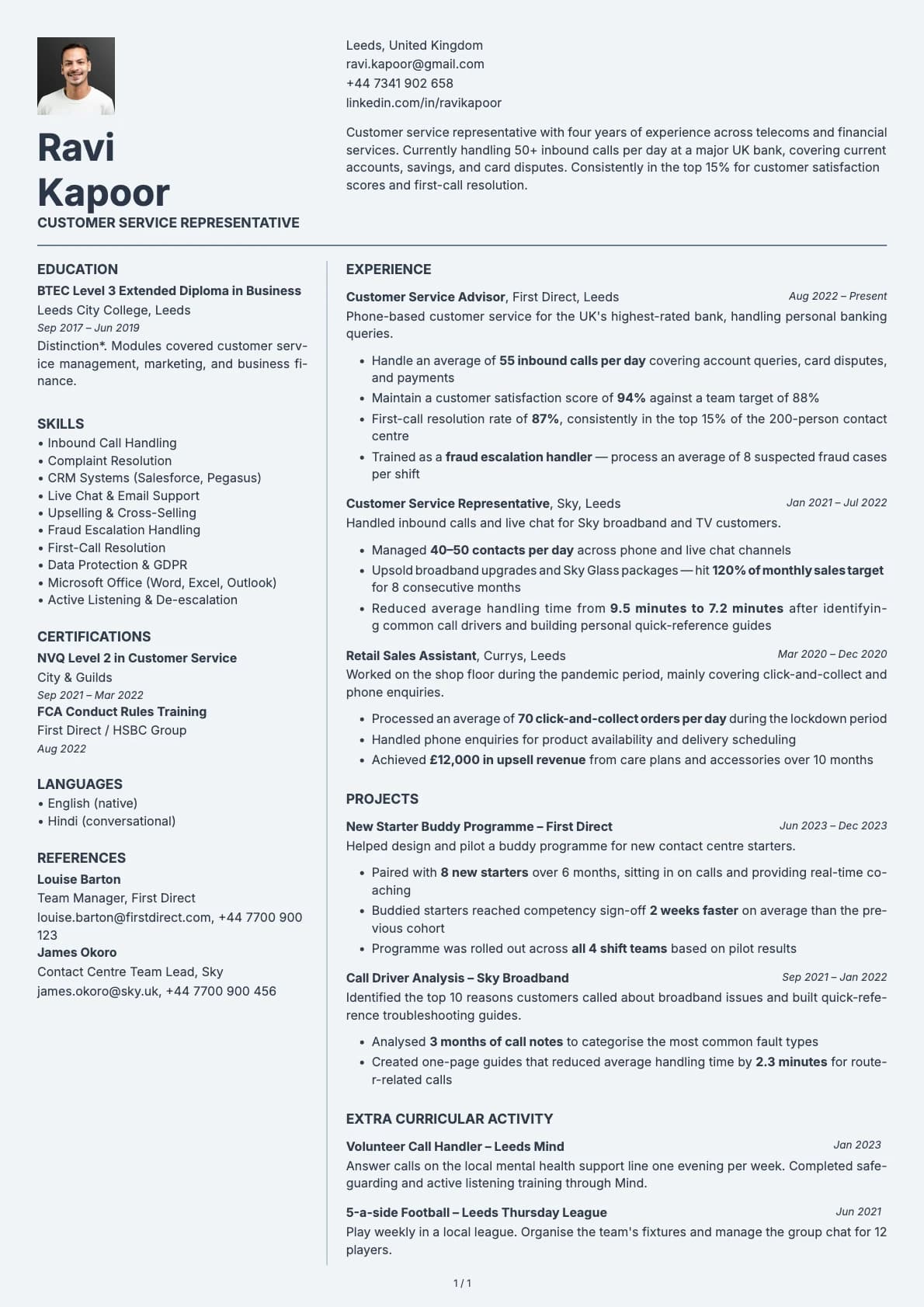
Customer Service Representative
A customer service representative resume example with experience at First Direct and Sky.
Related articles

AI Is Screening Your Resume Before Any Human Sees It
AI screens most resumes before a human ever reads them. 97.4% of Fortune 500 companies run an ATS. This is what that means for you and what you can do about it.

The Best Resume Builders in 2026, Compared Honestly
Resume.io, Zety, Enhancv, Kickresume, Teal, and Laddro compared honestly: real pricing, free tiers, mobile apps, and where each tool wins. All prices checked in September 2026.

Burnout Recovery: A Real Timeline, Not 'Take a Bubble Bath'
55% of the U.S. workforce is burned out. Recovery takes 3 to 12 months. Here's what that actually looks like, stage by stage.