Management Consultant Resume Example
A management consultant resume example from McKinsey with client impact numbers, engagement details, and business development wins.

Laddro Team
Free to use. No account needed to start.
Free to use. No account needed to start.
Overview
Consulting resumes are a strange beast. You have done real work, but you cannot always name the client. You have delivered results, but the credit belongs to the client organisation. And every other applicant at your level has "strategy," "transformation," and "stakeholder management" somewhere on their resume too.
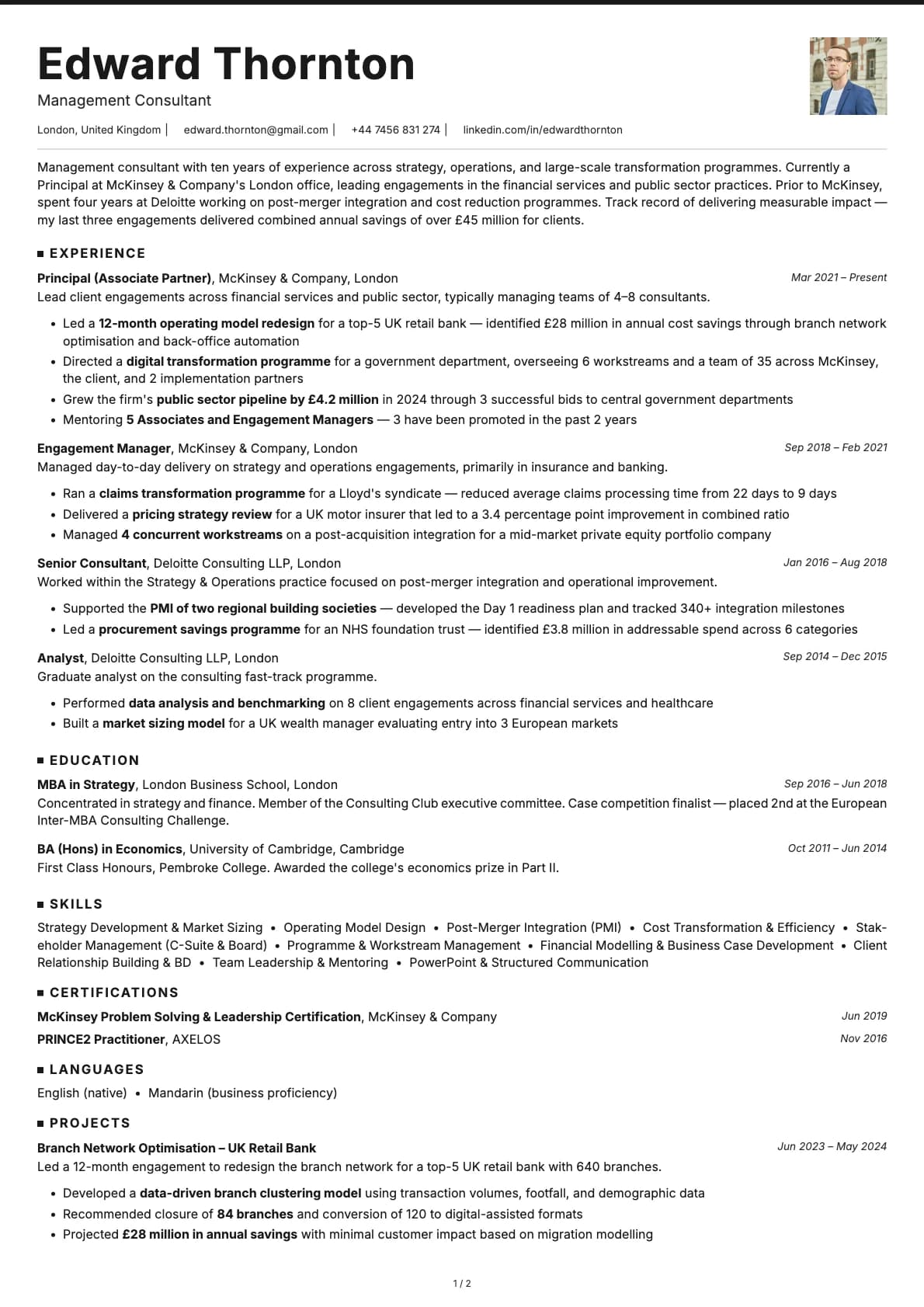
This resume belongs to Edward Thornton, a Principal (Associate Partner) at McKinsey with ten years of consulting experience. Before McKinsey, he spent four years at Deloitte. His last three engagements delivered combined annual savings of over £45 million. The resume works because every bullet ties back to a specific engagement with a measurable outcome. Not vague claims about "driving change." Actual numbers.
Let us break down what makes this resume effective and what you can copy for yours.
Your summary needs a throughline, not a buzzword list
Consulting resumes often open with a wall of skills. "Strategy, transformation, stakeholder management, financial modelling, change management..." That tells the reader nothing about what you have actually done.
Here is Edward's approach:
Management consultant with ten years of experience across strategy, operations, and large-scale transformation programmes. Currently a Principal at McKinsey & Company's London office. My last three engagements delivered combined annual savings of over £45 million for clients.
Three sentences. The first states scope and tenure. The second names the firm and office. The third gives a headline number that makes the reader want to keep going.
Your formula: Years of experience + practice area + current firm and level + your single most impressive client impact number.
How to write engagement bullets without breaking confidentiality
This is the part most consultants get wrong. They either write so vaguely that the bullet means nothing, or they name clients they should not be naming.
Edward strikes the right balance:
"Led a 12-month operating model redesign for a top-5 UK retail bank. Identified £28 million in annual cost savings through branch network optimisation and back-office automation"
He does not name the bank. But "top-5 UK retail bank" gives enough context for the reader to understand the scale. And the £28 million figure makes the impact concrete.
Here is another one:
"Ran a claims transformation programme for a Lloyd's syndicate. Reduced average claims processing time from 22 days to 9 days"
Again, no client name. But the sector (Lloyd's), the problem (claims processing), and the result (22 days to 9) are all there.
The formula for consulting bullets: Sector context + what you did + the measurable outcome.
If you cannot share the exact number, use ranges or percentages. "Reduced processing time by approximately 60%" still works.
Show your progression through the ranks
Consulting firms have clear promotion tracks, and hiring managers at other firms (or at client-side roles) know them. Your resume should make the progression obvious.
Edward's resume shows: Analyst at Deloitte, then Senior Consultant, then Engagement Manager at McKinsey, then Principal. Four roles, clear upward trajectory. Each role has bullets that match the expected scope at that level. The Analyst role focuses on data analysis and model building. The Principal role focuses on client relationships, team leadership, and business development.
If you are at Associate or Engagement Manager level, your bullets should show you managed workstreams and delivered client work. If you are at Principal or Partner level, add business development wins and mentoring.
Business development matters at senior levels
One bullet that stands out:
"Grew the firm's public sector pipeline by £4.2 million in 2024 through 3 successful bids to central government departments"
At Principal level and above, BD is part of the job. Including it on your resume shows you are not just delivering work but also winning it. If you have written proposals, led pitches, or grown a practice area, include the revenue or pipeline number.
Education: keep it tight
Edward has a Cambridge BA and an LBS MBA. Both are listed with minimal detail. The MBA entry mentions the Consulting Club and a case competition. That is enough.
If your MBA or undergraduate degree is from a well-known programme, a single line is fine. Consulting hiring managers know what those programmes involve. Do not pad the education section with module lists. Spend that space on your engagement experience instead.
Mistakes that hurt consulting resumes
Writing responsibilities instead of outcomes. "Managed a team of 6 consultants on a banking engagement" describes your role. "Led a team of 6 that reduced claims processing time from 22 days to 9 days" describes your impact. Always lead with impact.
Listing every framework you have ever used. "MECE, Porter's Five Forces, BCG Matrix, McKinsey 7S..." This is what undergrads put on their resumes. At your level, frameworks are assumed. Show results instead.
Overloading the skills section. Edward lists 10 skills. Not 20. "Strategy Development & Market Sizing" and "Operating Model Design" tell the reader what he actually does. Keep it focused on your real practice areas.
Using a complex template. Consulting firms and recruiters expect clean, professional formatting. No sidebars, no colour gradients. This resume uses Graphite. It looks like something you would send to a client. That is the point.
One more thing
If you are moving from consulting to an industry role, rewrite your bullets from the client's perspective. Instead of "led a 12-month engagement," write "redesigned the operating model for a 640-branch retail bank." The hiring manager at the bank does not care about your engagement structure. They care about what the work looked like from their side.
Build your own version
Open this layout in the builder and swap in your own details. It takes a few minutes.
Free to use. No account needed to start.
Was this resume example helpful?
Rate this example to help us create better content for you.
4.9 average from 187 ratingsRelated resume examples
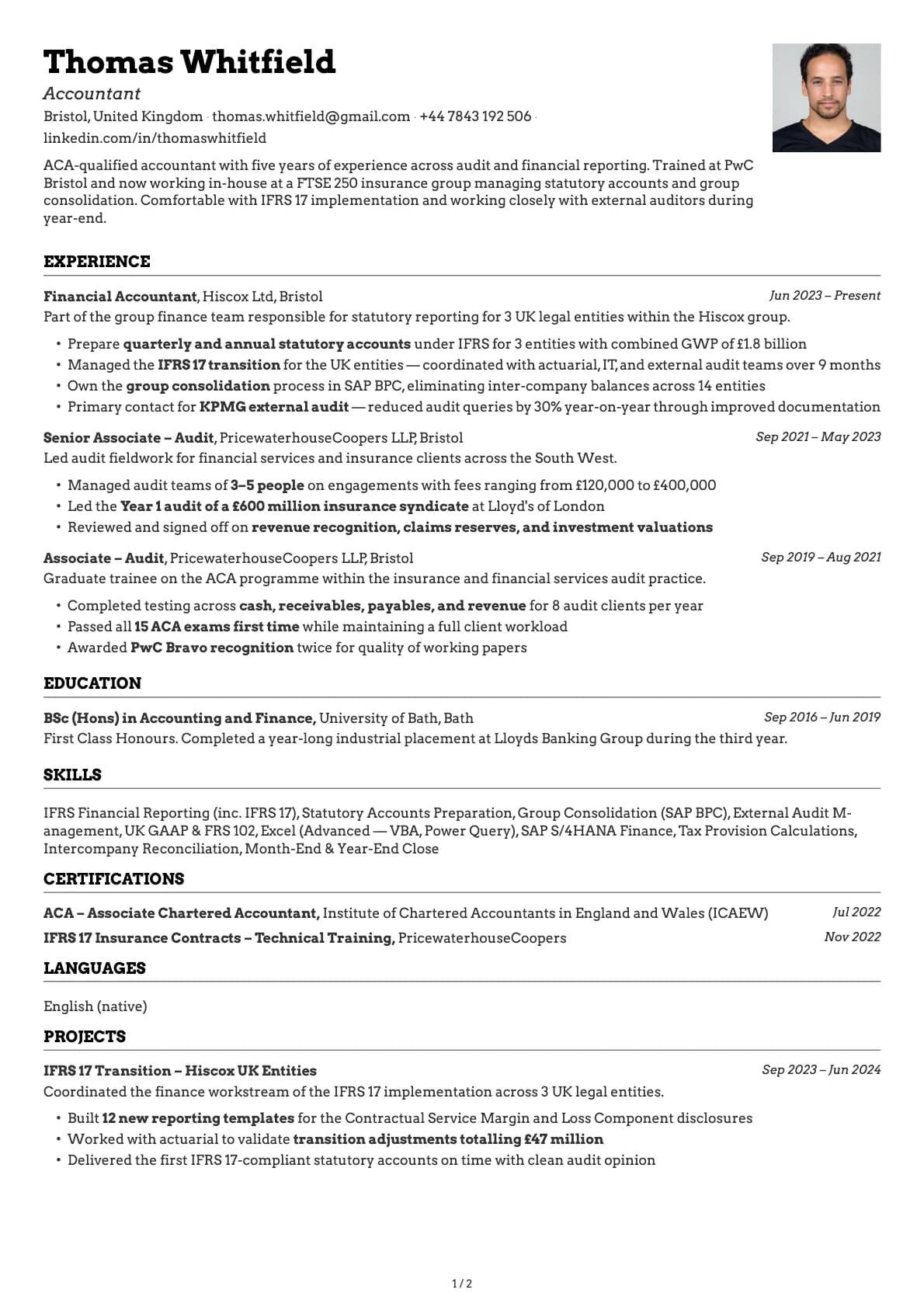
Accountant
An ACA-qualified accountant resume example with Big 4 audit experience and FTSE 250 in-house reporting.
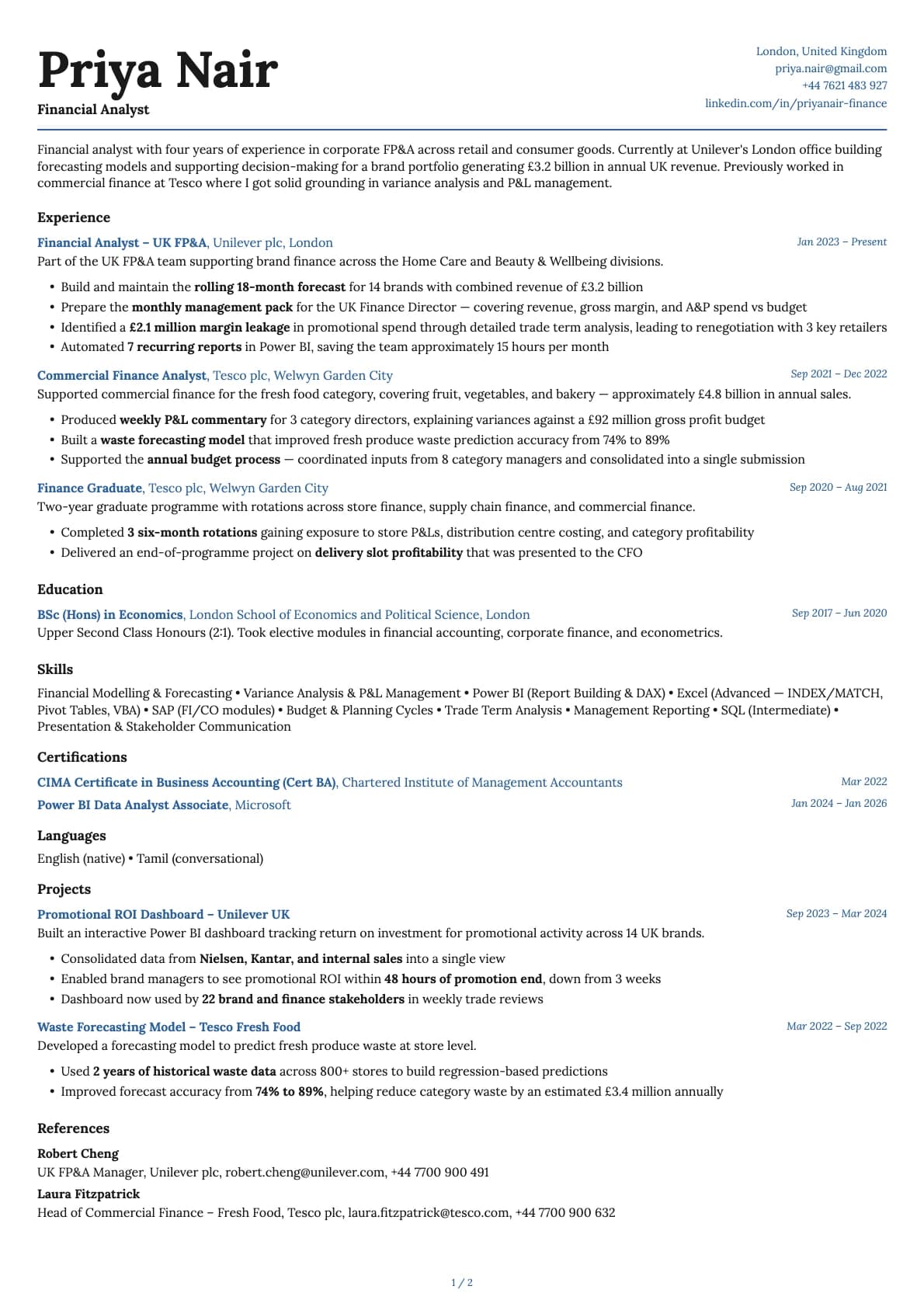
Financial Analyst
A financial analyst resume example from FP&A roles at Unilever and Tesco. Learn how to present forecasting models, variance analysis, and business impact.
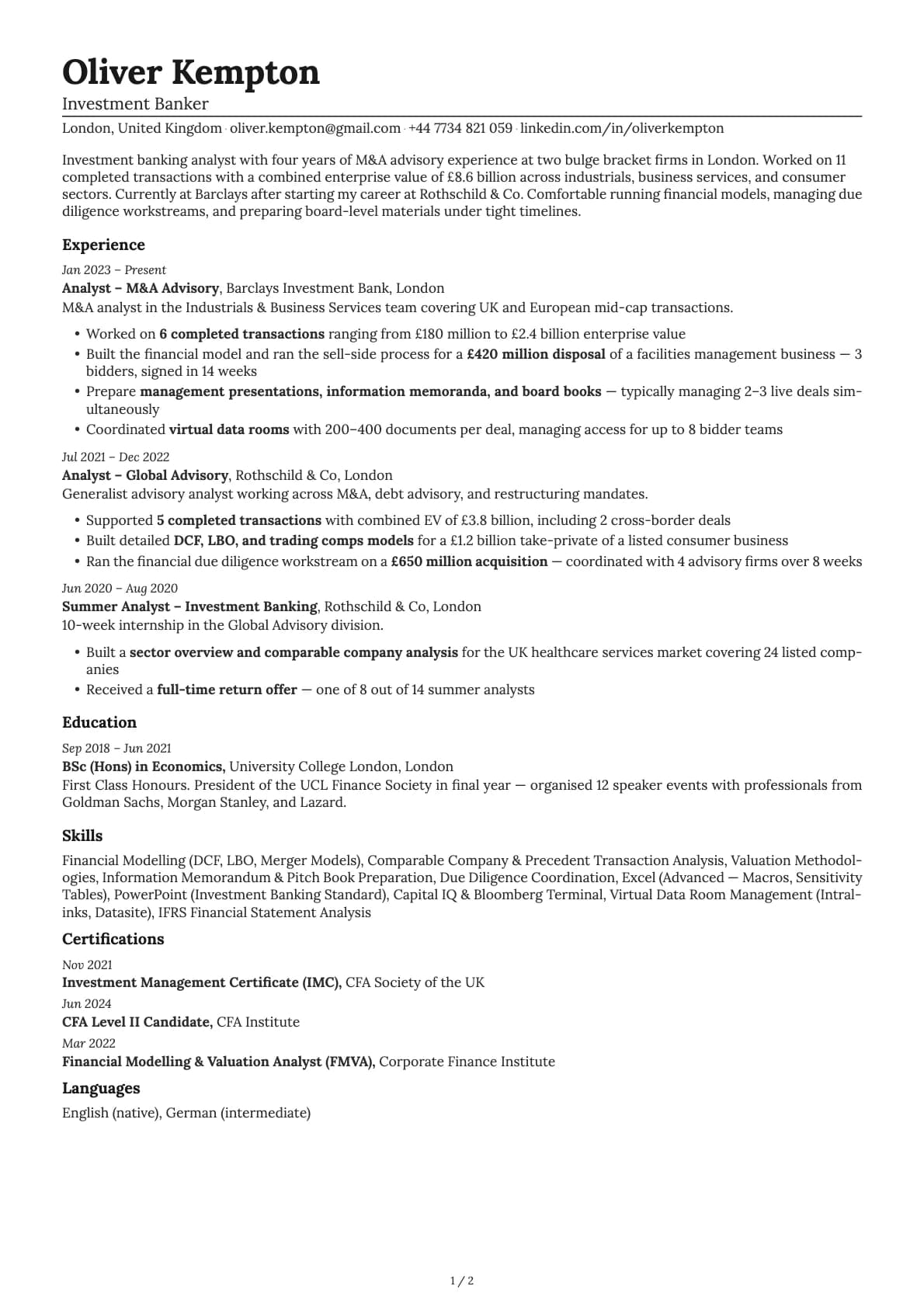
Investment Banker
An investment banker resume example with M&A deal values, financial modelling, and bulge bracket experience.
Business Analyst
A business analyst resume example with requirements documentation, stakeholder workshops, and process redesign experience across e-commerce and grocery.
Auditor
An ACA-qualified auditor resume example from KPMG with engagement fee ranges, team management, and ISA Standards experience across manufacturing and real.
Tax Advisor
A tax advisor resume example with CTA qualification and 9 years of corporate tax experience across Big Four and in-house roles.
Bookkeeper
A bookkeeper resume example with Xero, Sage, and QuickBooks experience across hospitality and retail SMEs.
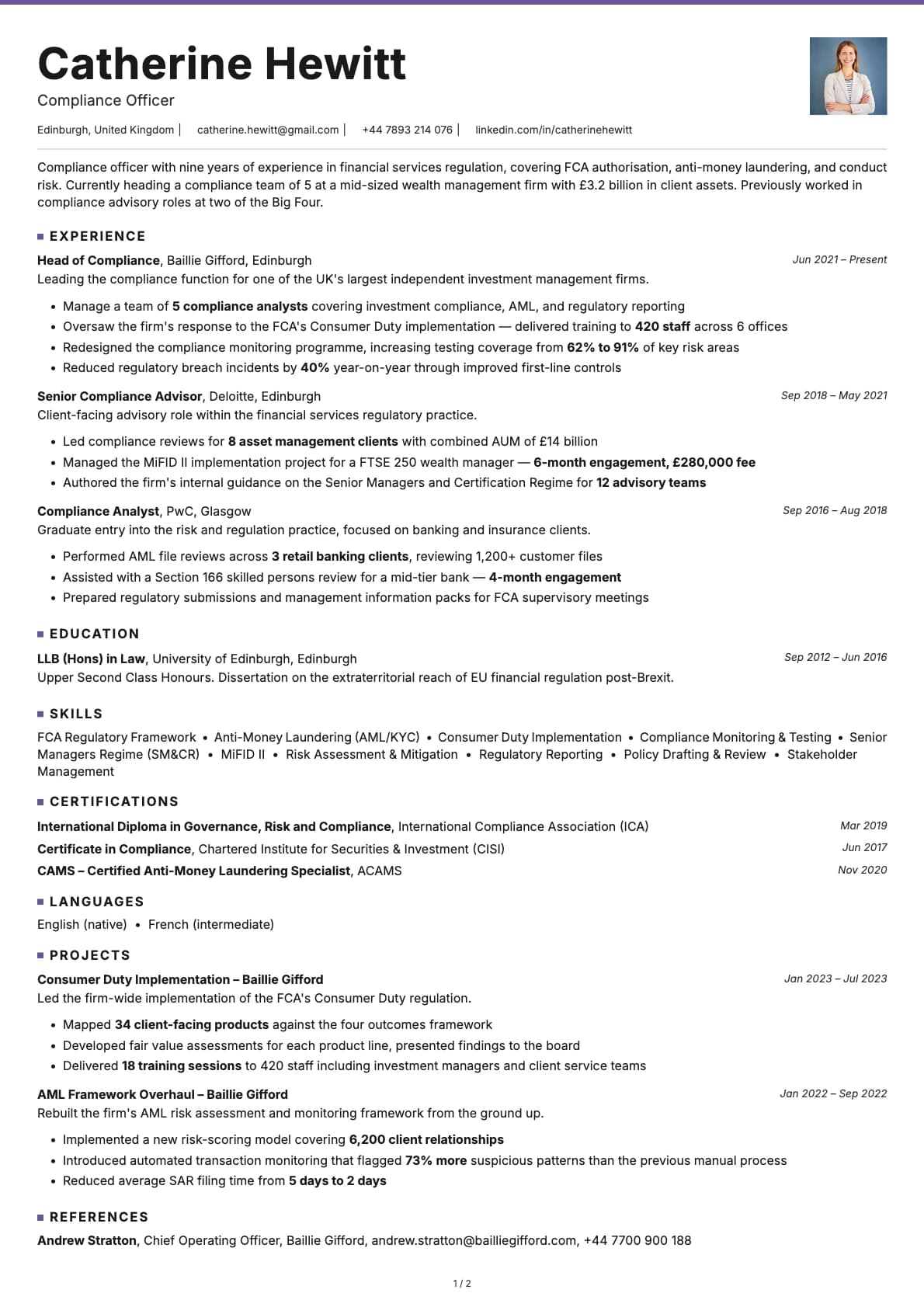
Compliance Officer
A compliance officer resume example with 9 years in financial services regulation at Baillie Gifford, Deloitte, and PwC.
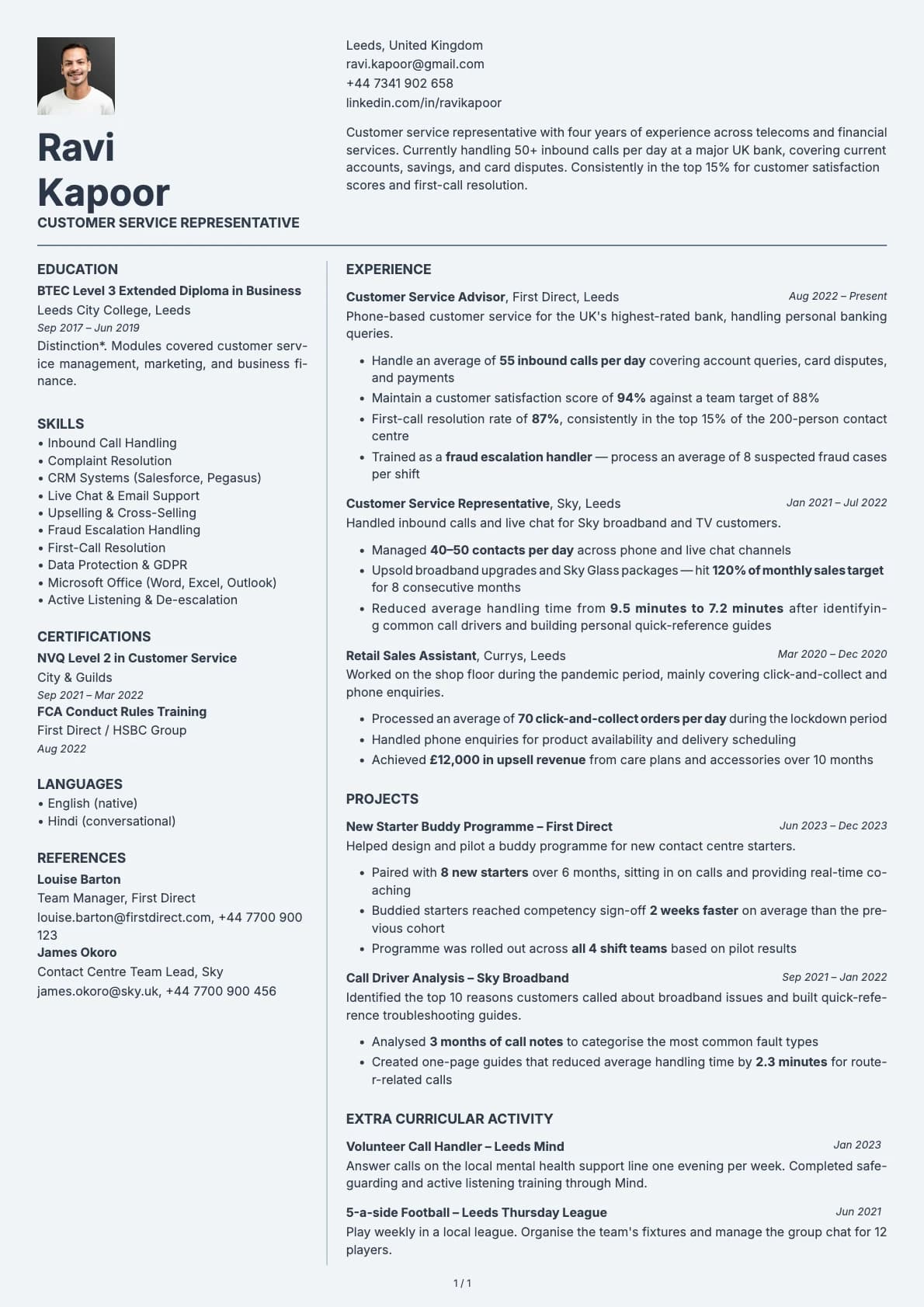
Customer Service Representative
A customer service representative resume example with experience at First Direct and Sky.
Related articles

AI Is Screening Your Resume Before Any Human Sees It
AI screens most resumes before a human ever reads them. 97.4% of Fortune 500 companies run an ATS. This is what that means for you and what you can do about it.

The Best Resume Builders in 2026, Compared Honestly
Resume.io, Zety, Enhancv, Kickresume, Teal, and Laddro compared honestly: real pricing, free tiers, mobile apps, and where each tool wins. All prices checked in September 2026.

Burnout Recovery: A Real Timeline, Not 'Take a Bubble Bath'
55% of the U.S. workforce is burned out. Recovery takes 3 to 12 months. Here's what that actually looks like, stage by stage.