Construction Worker Resume Example
A construction worker resume example with 4 years of site experience at Wates and Willmott Dixon.

Laddro Team
Free to use. No account needed to start.
Free to use. No account needed to start.
Overview
A lot of construction workers do not bother with a resume. They get work through word of mouth, agency calls, or showing up at a site gate. But when you want to move from agency work to a permanent role with a Tier 1 contractor, or when you want to prove your experience to a new site manager, a proper resume makes the difference.
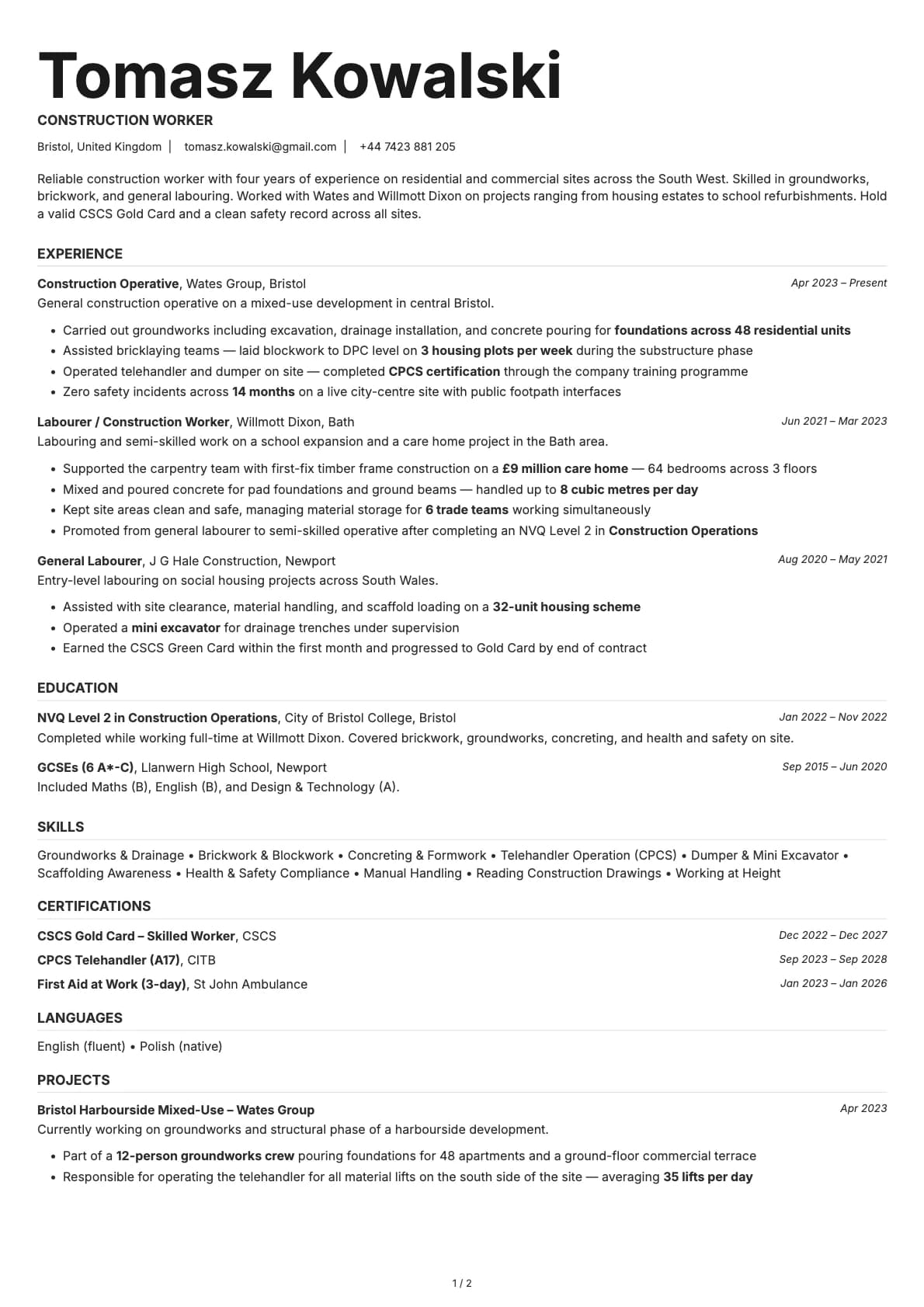
This resume belongs to Tomasz Kowalski, a construction operative with four years of experience on residential and commercial sites across the South West. He has worked with Wates and Willmott Dixon on projects ranging from housing estates to care homes. Started as a general labourer, earned his NVQ Level 2, and now holds a CSCS Gold Card and CPCS plant tickets. No LinkedIn. No website. Just a clean document that puts his cards, his skills, and his site experience front and centre.
Here is how to do the same for yours.
CSCS card first. Everything else second.
On a construction resume, your CSCS card is the single most important item. You cannot set foot on a UK construction site without one. The site manager checking your resume will look for it before reading anything else.
This resume mentions it in the summary:
Hold a valid CSCS Gold Card and a clean safety record across all sites.
And it appears in the certifications section with the full details: CSCS Gold Card, Skilled Worker, valid until 2027. The card colour matters. Green is for labourers. Blue is for skilled workers (NVQ Level 2). Gold is for advanced craft or supervisory (NVQ Level 3). Black is for managers. State your card colour and type clearly.
If your card is about to expire, renew it before you apply. An expired CSCS card is the fastest way to get your resume binned.
Write your experience by trade, not by vague descriptions
Construction resumes often say things like "carried out general labouring duties" or "assisted trades on site." Those lines tell the site manager nothing useful. They need to know which trades you have worked alongside, what tasks you can do independently, and what plant you can operate.
Look at this bullet from the Wates role:
"Carried out groundworks including excavation, drainage installation, and concrete pouring for foundations across 48 residential units"
That is specific. Groundworks. Drainage. Concrete. 48 units. The site manager reading this knows exactly what tasks Tomasz can handle and at what scale.
"Assisted bricklaying teams, laid blockwork to DPC level on 3 housing plots per week during the substructure phase"
This shows semi-skilled work. Laying blockwork to DPC level is not general labouring. It is a measurable skill that tells the reader this person can be trusted with trade-level work under supervision.
"Operated telehandler and dumper on site, completed CPCS certification through the company training programme"
Plant operation is a significant upgrade on a construction resume. CPCS tickets (Construction Plant Competence Scheme) show you are certified to operate specific machines. This resume lists the telehandler (A17 category). If you hold any CPCS or NPORS tickets, list them by category.
For yours: Name the trades you have worked in (groundworks, brickwork, carpentry, drainage). Give the project type and size. List any plant you can operate with the certification reference.
Show your progression
One of the strongest things about this resume is the visible career progression. General labourer at J G Hale Construction. Semi-skilled operative at Willmott Dixon. Construction operative at Wates. Each role is a step up.
The Willmott Dixon entry shows the promotion:
"Promoted from general labourer to semi-skilled operative after completing an NVQ Level 2 in Construction Operations"
If you have been promoted on site, or if you completed a qualification while working, say so. It tells the site manager you are the type of person who improves and takes on more responsibility.
The J G Hale entry is honest about the starting point:
"Assisted with site clearance, material handling, and scaffold loading on a 32-unit housing scheme"
"Earned the CSCS Green Card within the first month and progressed to Gold Card by end of contract"
Starting as a labourer is normal. Getting your CSCS sorted quickly and moving up shows reliability and ambition. Do not hide your early roles. Show the progression.
Safety record: say it plainly
Construction sites take safety seriously. A zero-incident record is worth stating directly.
"Zero safety incidents across 14 months on a live city-centre site with public footpath interfaces"
That last detail, "public footpath interfaces," adds context. Working on a live city-centre site where members of the public walk past the hoarding is a different level of safety awareness than working on a fenced greenfield site in the countryside. If your site had particular safety challenges, mention them.
If you have completed site-specific safety inductions, toolbox talks, or safety training beyond the basic CSCS test, include them. Manual handling training, working at height, asbestos awareness. These all count.
Education and qualifications
This resume lists an NVQ Level 2 in Construction Operations, completed while working full-time. For construction workers, vocational qualifications matter more than academic ones. The NVQ proves you have the skills to hold a CSCS Blue or Gold card.
The GCSEs are listed briefly. For a construction resume, they do not need much detail. But if your GCSEs include Maths and English at grade C/4 or above, mention them. Some employers and apprenticeship schemes require them.
If you are considering further qualifications, an NVQ Level 3 in a specific trade (brickwork, carpentry, plastering) opens up the CSCS Gold Card and potentially supervisory roles.
Skills: practical and plant-focused
The skills section is direct: Groundworks & Drainage, Brickwork & Blockwork, Concreting & Formwork, Telehandler Operation (CPCS), Dumper & Mini Excavator, Reading Construction Drawings, Working at Height.
"Reading Construction Drawings" is a skill that many labourers do not list but should if they can do it. Being able to read a drawing and set out work from it moves you from labourer to operative in a site manager's eyes.
Mistakes construction workers make on resumes
Not listing CSCS card details. Card colour, card type, expiry date. Without these, your resume will not get past the first check.
No plant tickets. If you can operate a telehandler, dumper, excavator, or forklift, list the CPCS or NPORS category. These tickets are valuable and employers actively look for them.
Vague descriptions. "Worked on various construction sites" does not help anyone. Name the contractor, name the project type, and describe what you did.
Ignoring the NVQ. If you have an NVQ Level 2 or 3, put it on your resume. It is the qualification that backs up your CSCS card level and shows verified competence.
Using a complicated layout. Site managers often view resumes on their phones or print them on site. Keep the layout simple. This resume uses Platinum, a clean format with no sidebars or graphics.
One more thing
Construction worker recruitment is often fast. A site manager has a gap on Monday and needs someone by Tuesday. Your resume needs to be ready to send at short notice. Keep it updated with your current CSCS expiry date, your latest plant tickets, and your most recent project. When the call comes, you want to be able to send it within the hour.
Build your own version
Open this layout in the builder and swap in your own details. It takes a few minutes.
Free to use. No account needed to start.
Was this resume example helpful?
Rate this example to help us create better content for you.
4.7 average from 189 ratingsRelated resume examples
Civil Engineer
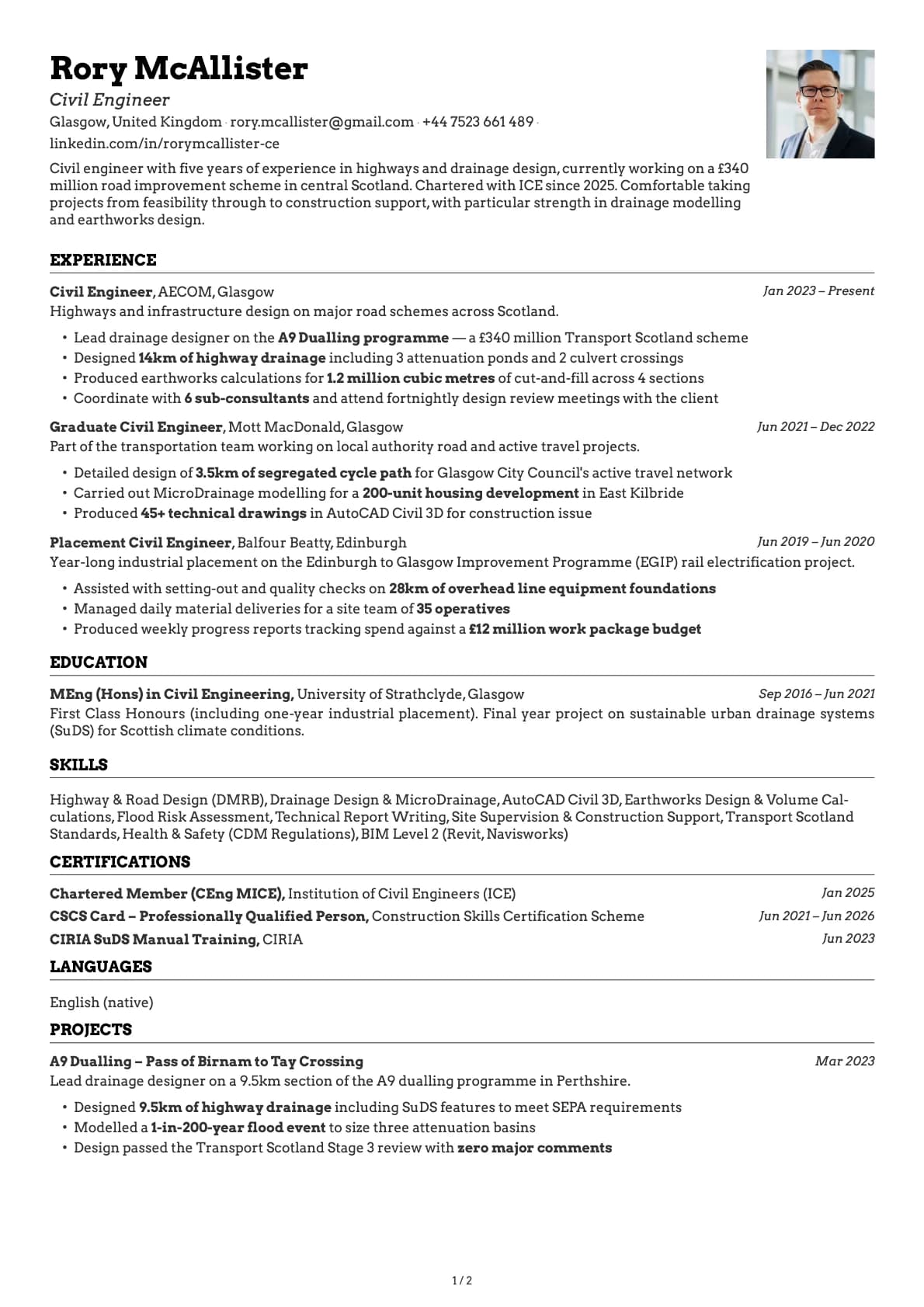
A civil engineer resume example with highways and drainage design experience at AECOM and Mott MacDonald.
Structural Engineer
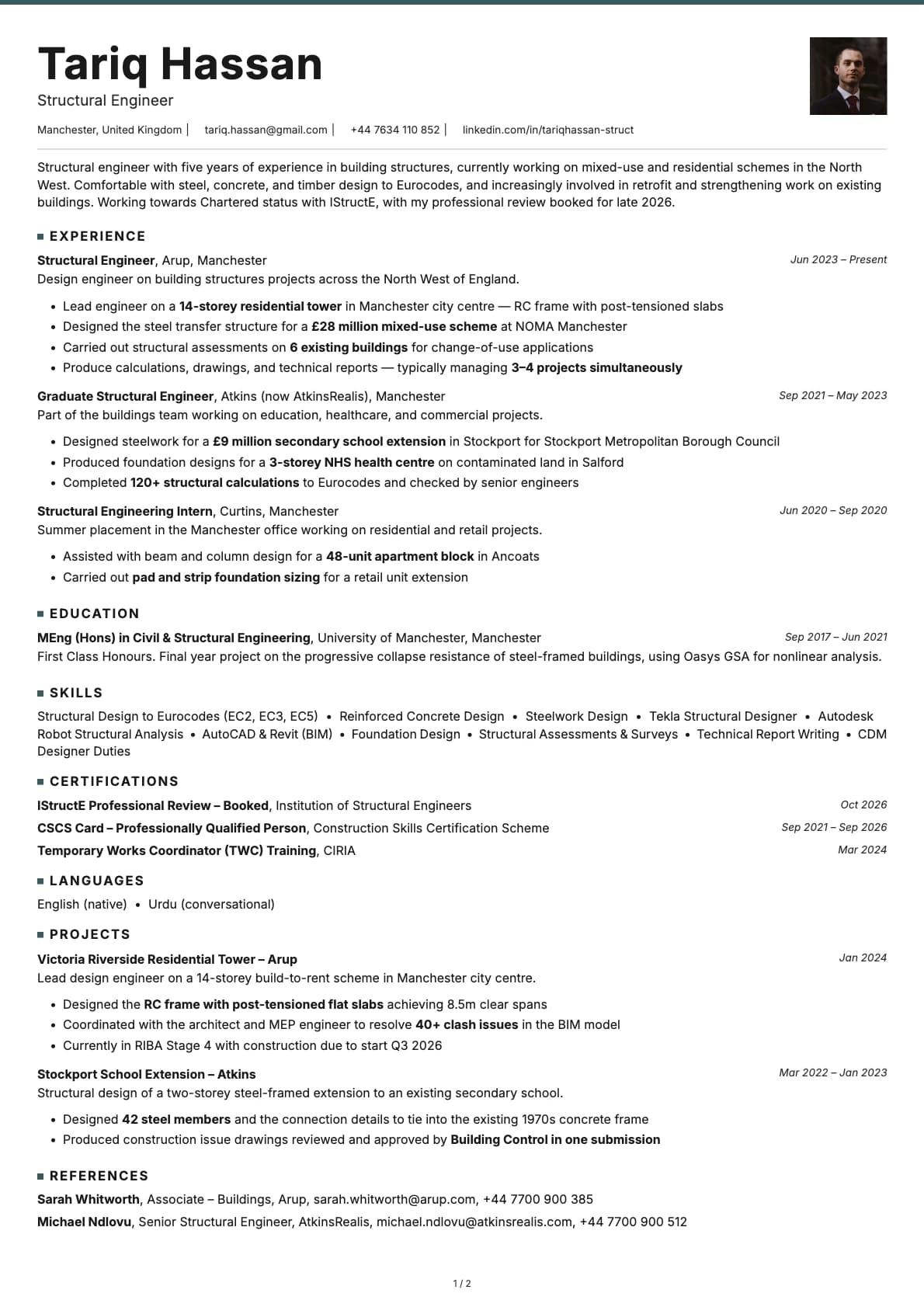
A structural engineer resume example with 5 years of experience at Arup and Atkins.
Electrician
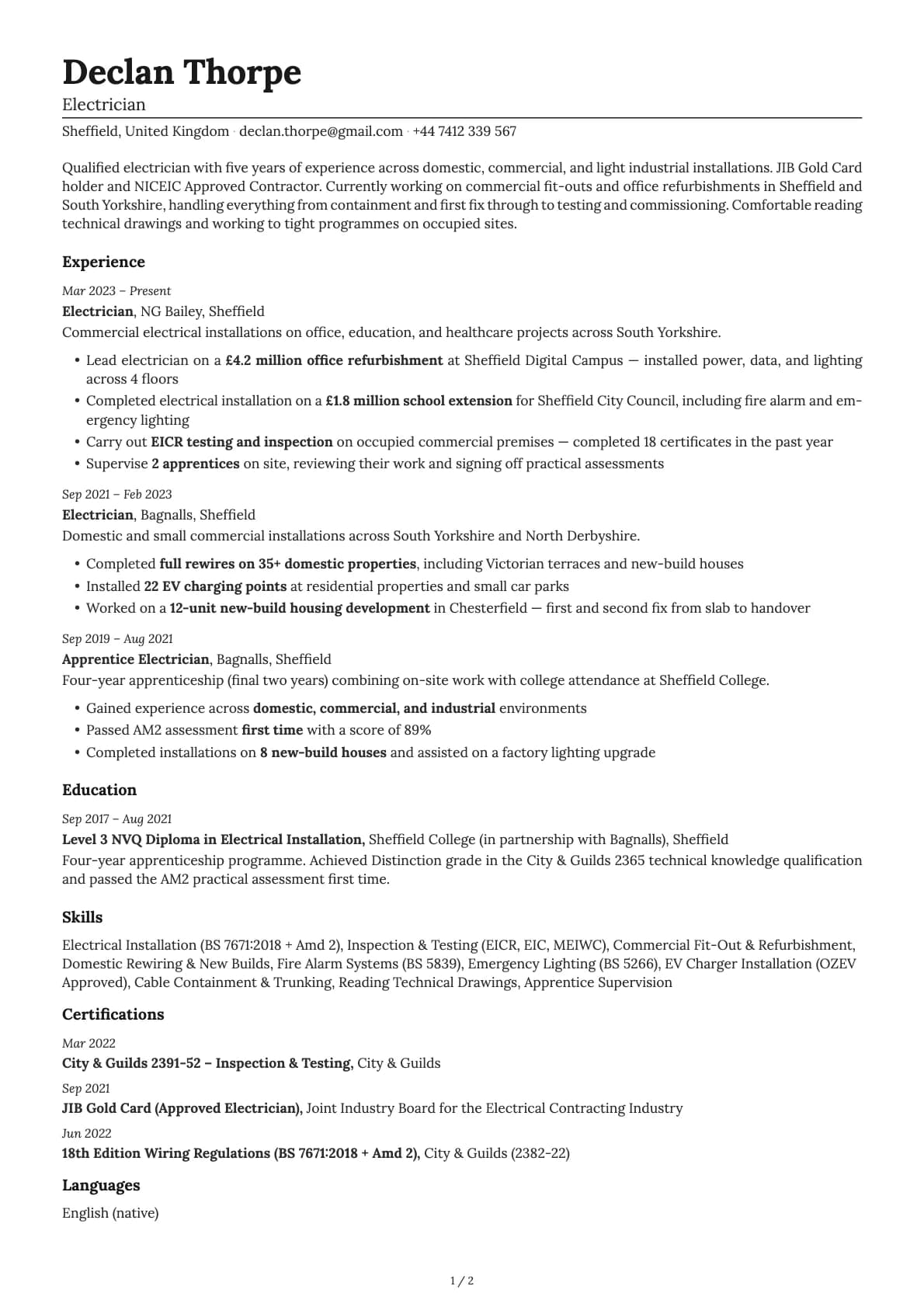
An electrician resume example with commercial and domestic installation experience.
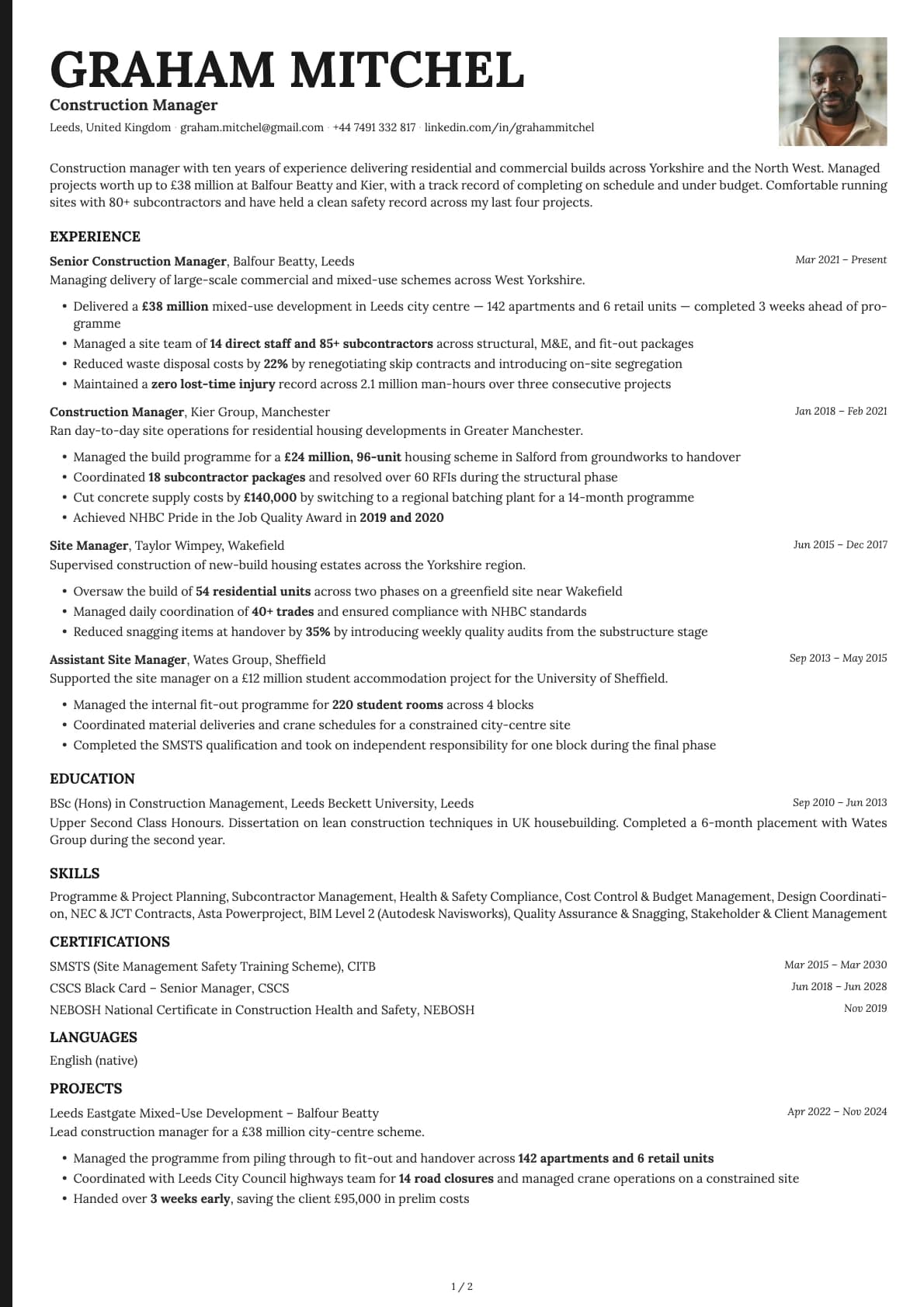
Construction Manager
A construction manager resume example with 10 years of experience delivering projects up to £38 million at Balfour Beatty and Kier.
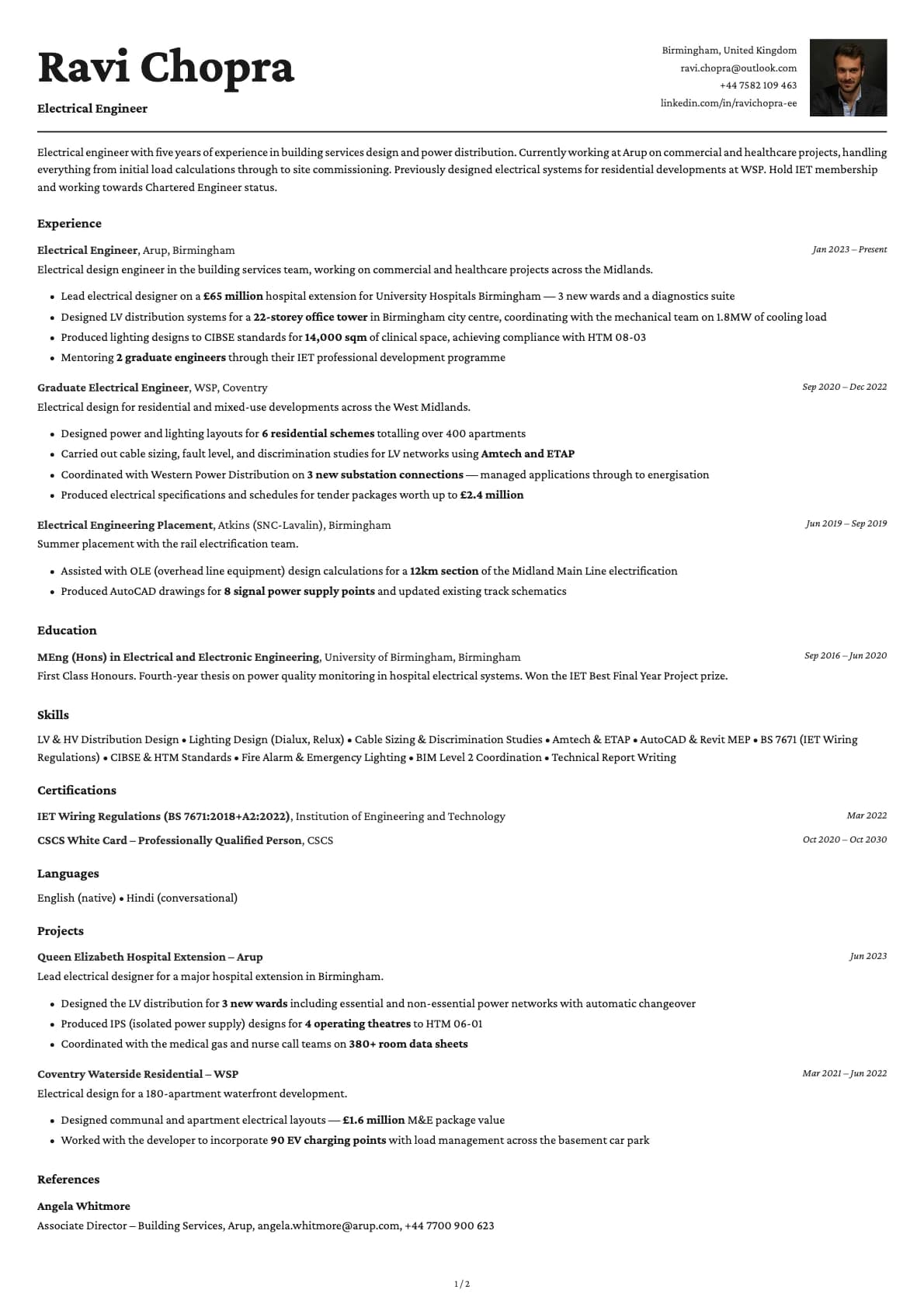
Electrical Engineer
An electrical engineer resume example with building services design experience at Arup and WSP.
Related articles

AI Is Screening Your Resume Before Any Human Sees It
AI screens most resumes before a human ever reads them. 97.4% of Fortune 500 companies run an ATS. This is what that means for you and what you can do about it.

The Best Resume Builders in 2026, Compared Honestly
Resume.io, Zety, Enhancv, Kickresume, Teal, and Laddro compared honestly: real pricing, free tiers, mobile apps, and where each tool wins. All prices checked in September 2026.

Burnout Recovery: A Real Timeline, Not 'Take a Bubble Bath'
55% of the U.S. workforce is burned out. Recovery takes 3 to 12 months. Here's what that actually looks like, stage by stage.