Electrician Resume Example
An electrician resume example with commercial and domestic installation experience.

Laddro Team
Free to use. No account needed to start.
Free to use. No account needed to start.
Overview
A lot of electricians do not have a formal resume. They get their next job through word of mouth, a call from a mate, or a contractor they have worked with before. But when you want to move to a bigger company, apply for a site supervisor role, or get on the books with a national contractor like NG Bailey or Balfour Beatty, you need a resume that shows what you can do on paper.
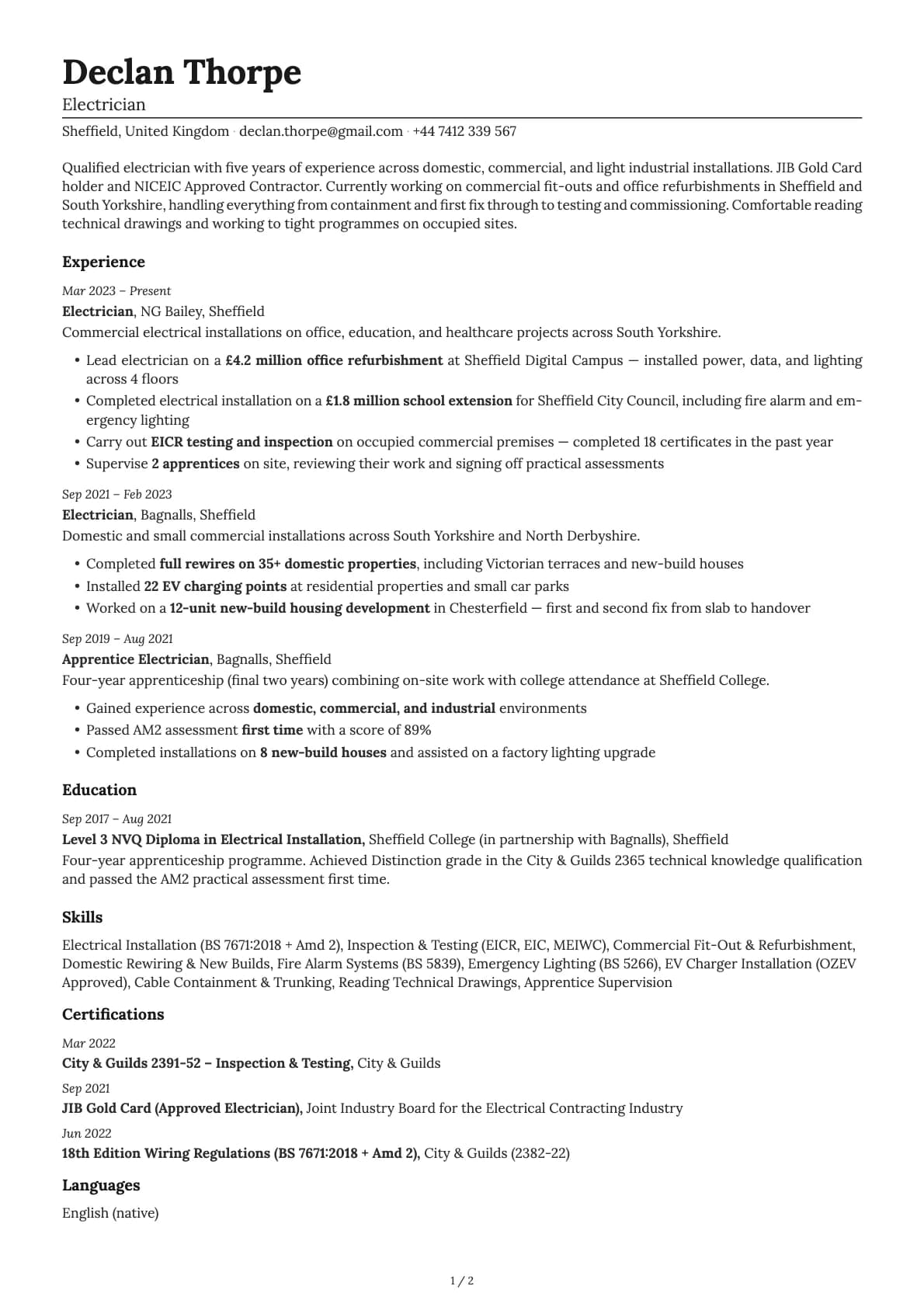
This resume belongs to Declan, a qualified electrician with five years of experience based in Sheffield. He currently works for NG Bailey on commercial fit-outs and school extensions. Before that, he did domestic and small commercial work at Bagnalls, where he also completed his apprenticeship. The resume works because it lists the right cards and certs up front, describes actual project scope, and makes it clear what kind of work he can handle independently.
Here is how to write yours the same way.
Lead with your cards and qualifications
For electricians, the first thing a contracts manager or agency will check is whether you have the right cards. It is the equivalent of a licence to work. If your JIB card, 18th Edition, and 2391 are not immediately visible, your resume might get skipped before anyone reads a single bullet point.
This resume lists three key certifications:
- City & Guilds 2391-52 (Inspection & Testing)
- JIB Gold Card (Approved Electrician)
- 18th Edition Wiring Regulations (BS 7671:2018 + Amd 2)
Put these near the top of your resume or in a clearly labelled certifications section. If the job ad asks for a specific card, make sure the exact name appears on your resume. "18th Edition" is fine in conversation, but on paper, writing "BS 7671:2018 + Amd 2" helps with keyword matching, especially if you are applying through an agency portal.
How to describe your work experience
Most electricians' job descriptions sound the same: "Carried out electrical installations." That tells a contracts manager nothing about the scale of your work or what you can handle unsupervised.
Look at how this resume describes the NG Bailey role:
Lead electrician on a £4.2 million office refurbishment at Sheffield Digital Campus. Installed power, data, and lighting across 4 floors.
Project value, location, and scope in one bullet. Now the reader knows this person can handle a multi-floor commercial job worth over £4 million. That is very different from someone who has only done domestic board changes.
Another good one:
Completed electrical installation on a £1.8 million school extension for Sheffield City Council, including fire alarm and emergency lighting
Adding "fire alarm and emergency lighting" is important because it shows competence beyond basic power and lighting. These are specialist systems that not every electrician works on.
The formula for your bullets: What kind of installation + Project value or scope + Any specialist systems involved.
Domestic work counts too
If your background is mainly domestic, do not downplay it. Look at the Bagnalls bullets:
Completed full rewires on 35+ domestic properties, including Victorian terraces and new-build houses
Installed 22 EV charging points at residential properties and small car parks
The number of rewires shows volume and experience. Mentioning Victorian terraces is smart because anyone in the trade knows that rewiring a Victorian terrace is harder than a new build. It suggests the candidate can handle tricky routing, old wiring, and difficult access.
EV charging is also worth highlighting. It is a growing market and having OZEV-approved installer status is a selling point right now. If you have installed chargers, include the number and the types (7kW, 22kW, etc.).
Testing and inspection: a separate selling point
If you hold the 2391 (or the older 2395), make it a featured part of your resume. Testing and inspection work is a different skill from installation, and many employers specifically look for electricians who can do both.
This resume includes:
Carry out EICR testing and inspection on occupied commercial premises. Completed 18 certificates in the past year.
The number matters. 18 EICRs in a year shows regular testing experience, not just a certificate gathering dust. If you do testing work, count up your certificates and include the number.
Skills section: be specific about systems
This resume lists 10 skills, and most of them are specific to electrical work: BS 7671 installation, EICR/EIC/MEIWC testing, fire alarm (BS 5839), emergency lighting (BS 5266), EV charging (OZEV), and containment work.
Notice that each skill includes the relevant standard number where applicable. This is important for two reasons: it proves you know the standards (not just the general topic), and it helps with ATS keyword matching.
If you can read technical drawings, say so. If you are comfortable working on occupied sites, mention it. These are practical skills that contractors care about.
Apprentice supervision and mentoring
If you supervise apprentices, include it. This resume mentions supervising 2 apprentices and signing off practical assessments. For an electrician looking to step into a supervisor or foreman role, evidence of developing junior staff is a real advantage.
Even if you do not supervise formally, mentoring apprentices at college (like this resume's extracurricular section shows) demonstrates leadership that goes beyond just installing cables.
Mistakes that cost you the job
Not listing your cards at all. Some electricians assume the recruiter will check their JIB status directly. Do not make them chase it. List your cards clearly with full names and numbers.
Being vague about project types. "Worked on various commercial and domestic projects" is useless. Name the type (office refurb, school extension, housing development), give the value if you know it, and describe what you personally installed.
Forgetting to mention AM2 results. If you passed your AM2 first time, say so. This resume notes "first time with a score of 89%." That is a real differentiator when a contractor is choosing between candidates.
Using a complicated template. Keep it clean and simple. This resume uses the Nickel template. No graphics, no colour blocks. Just clear text that a contracts manager can read in 30 seconds.
One last thing
If you are applying to a national contractor, check whether they require specific site cards beyond JIB. CSCS, IPAF, PASMA, or confined spaces training might be relevant depending on the project type. List every card you hold with its expiry date. Letting a card expire before applying is an easy mistake to avoid.
Build your own version
Open this layout in the builder and swap in your own details. It takes a few minutes.
Free to use. No account needed to start.
Was this resume example helpful?
Rate this example to help us create better content for you.
4.7 average from 197 ratingsRelated resume examples
Civil Engineer
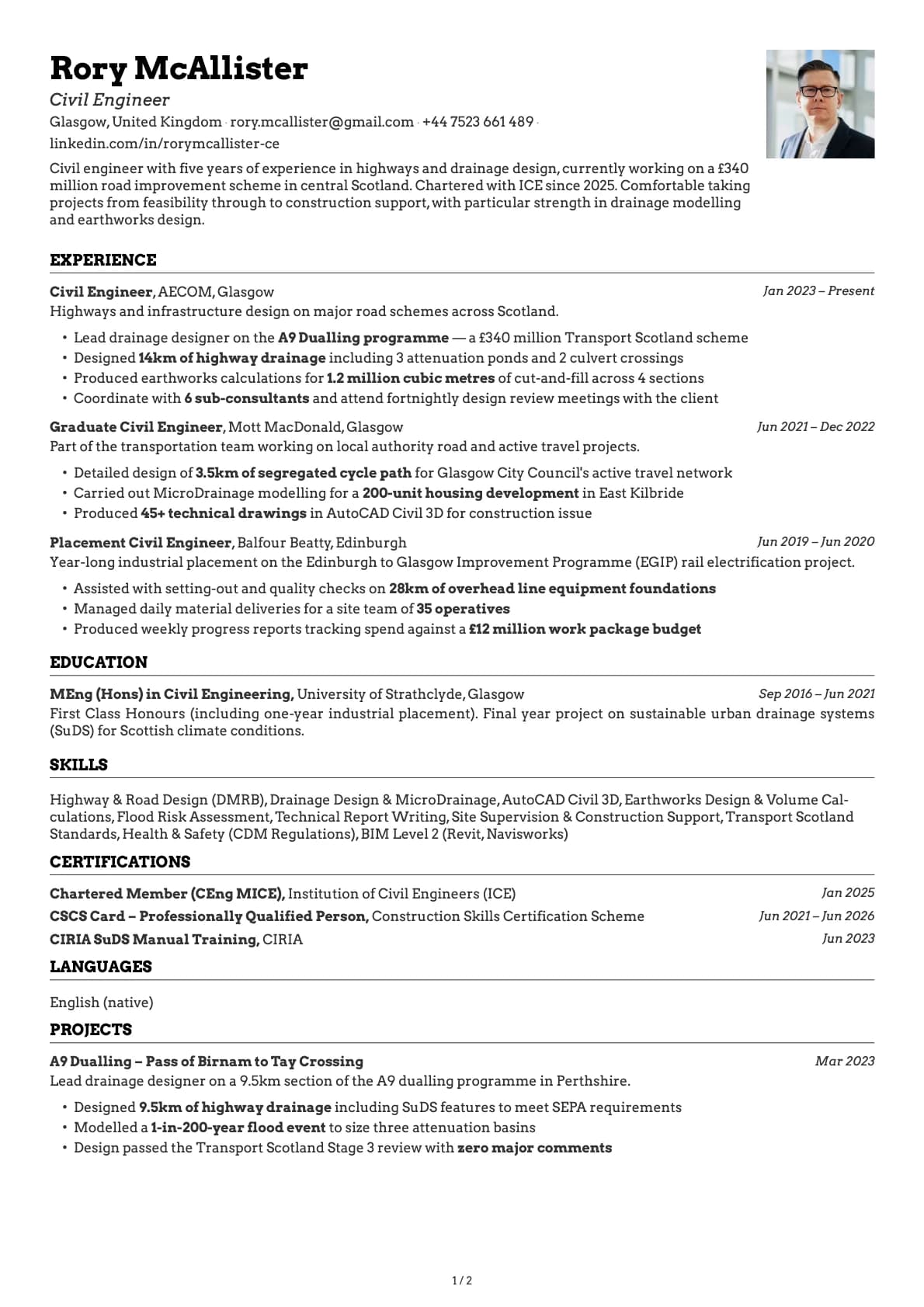
A civil engineer resume example with highways and drainage design experience at AECOM and Mott MacDonald.
Structural Engineer
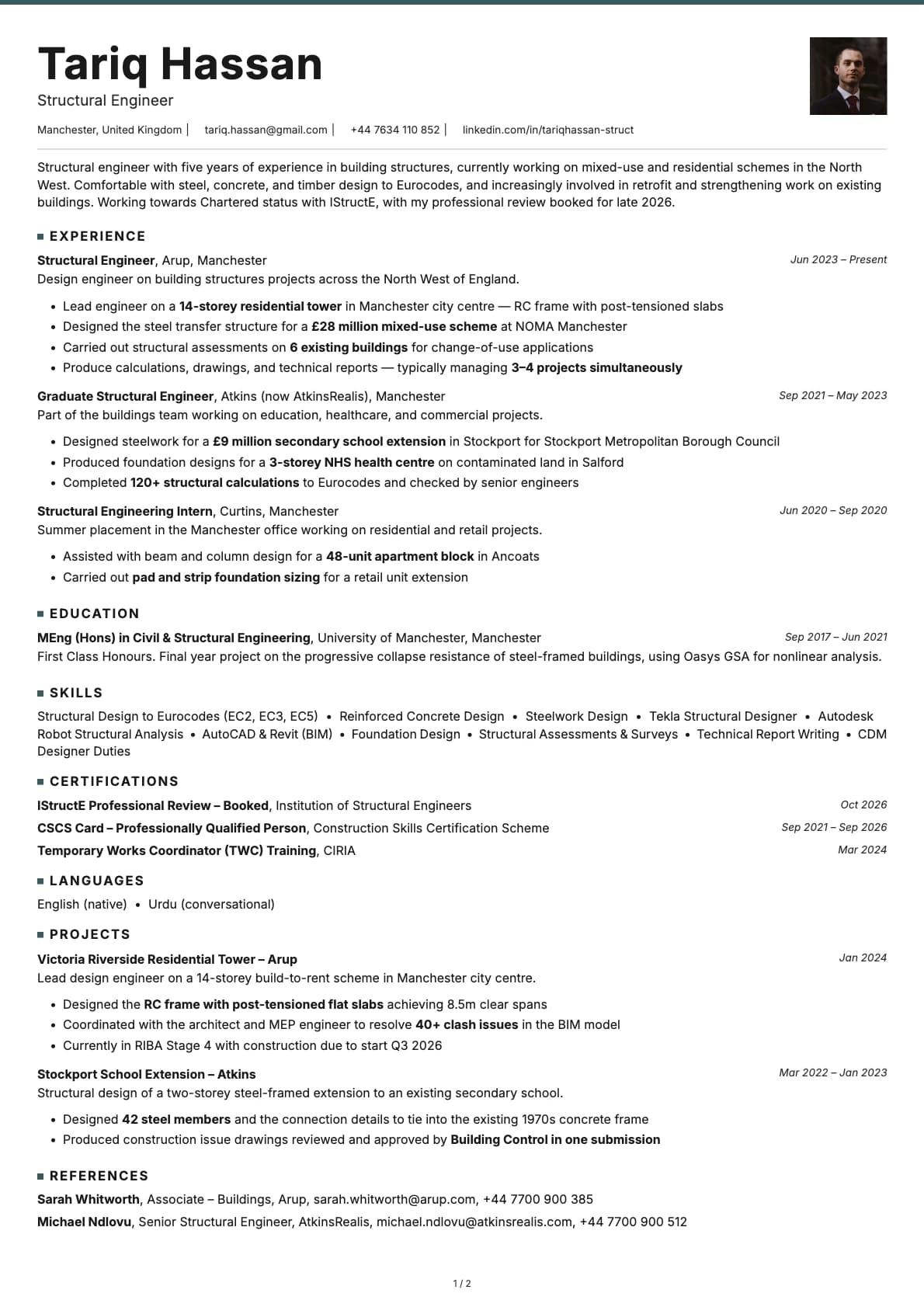
A structural engineer resume example with 5 years of experience at Arup and Atkins.
Construction Manager
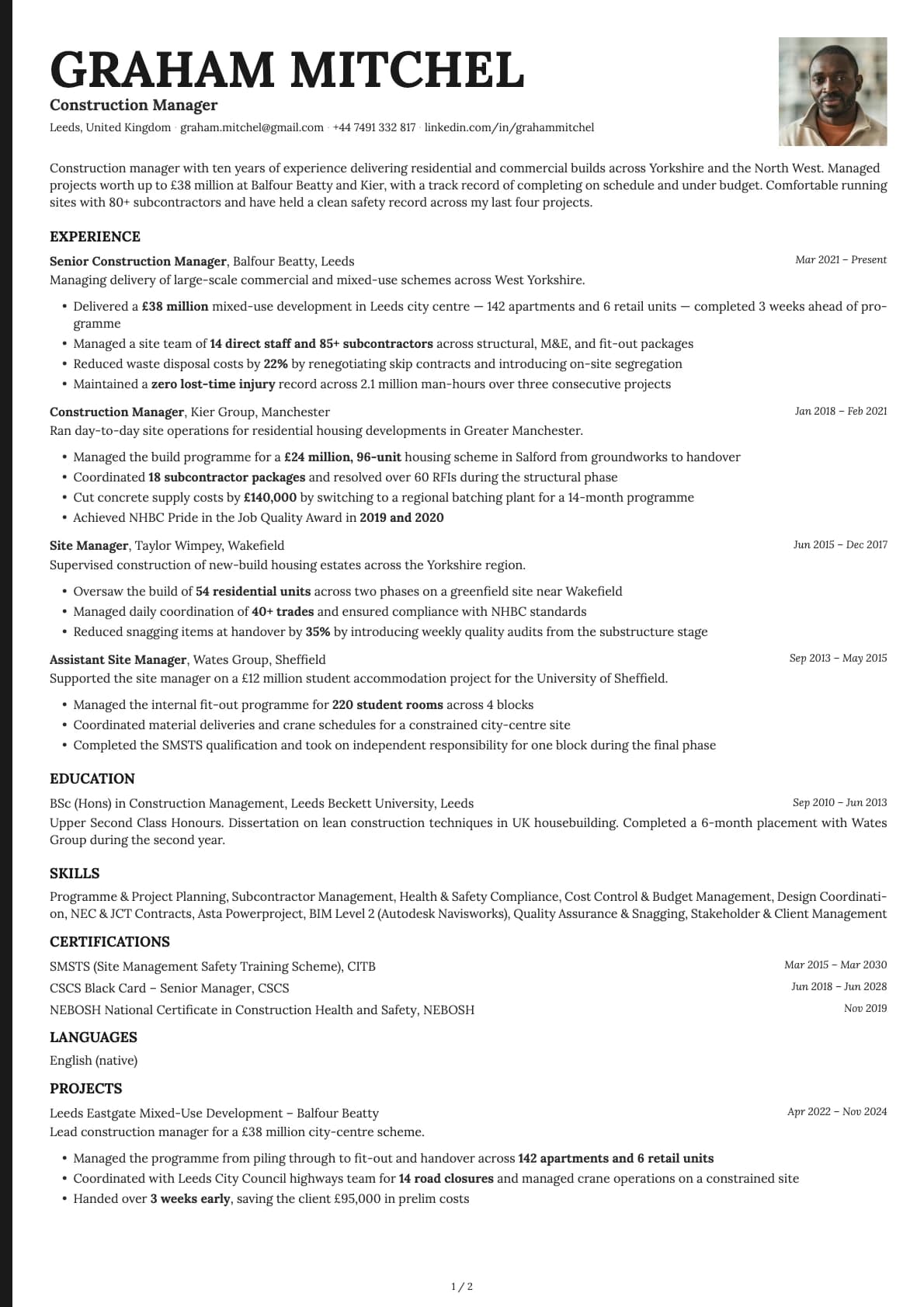
A construction manager resume example with 10 years of experience delivering projects up to £38 million at Balfour Beatty and Kier.
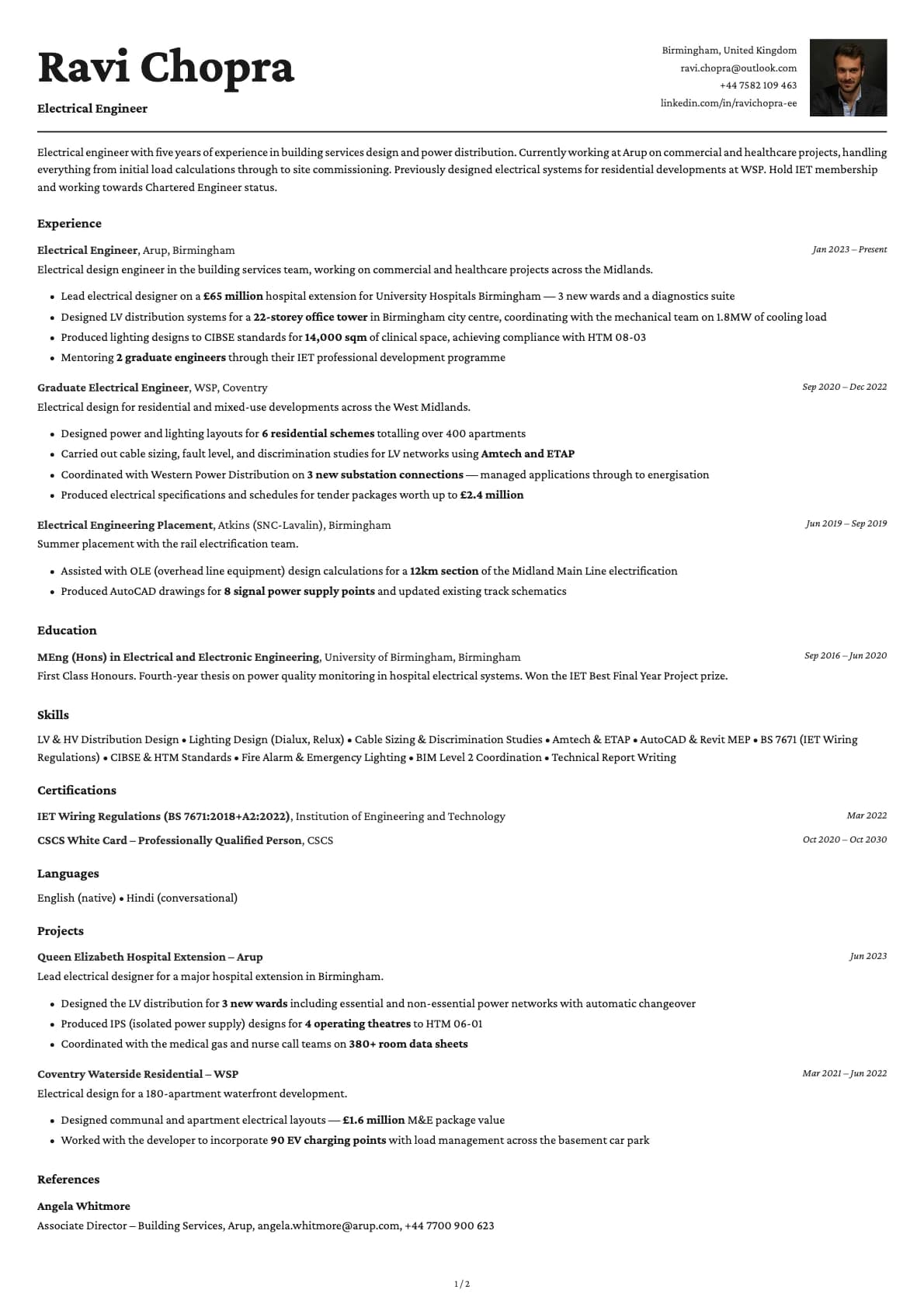
Electrical Engineer
An electrical engineer resume example with building services design experience at Arup and WSP.
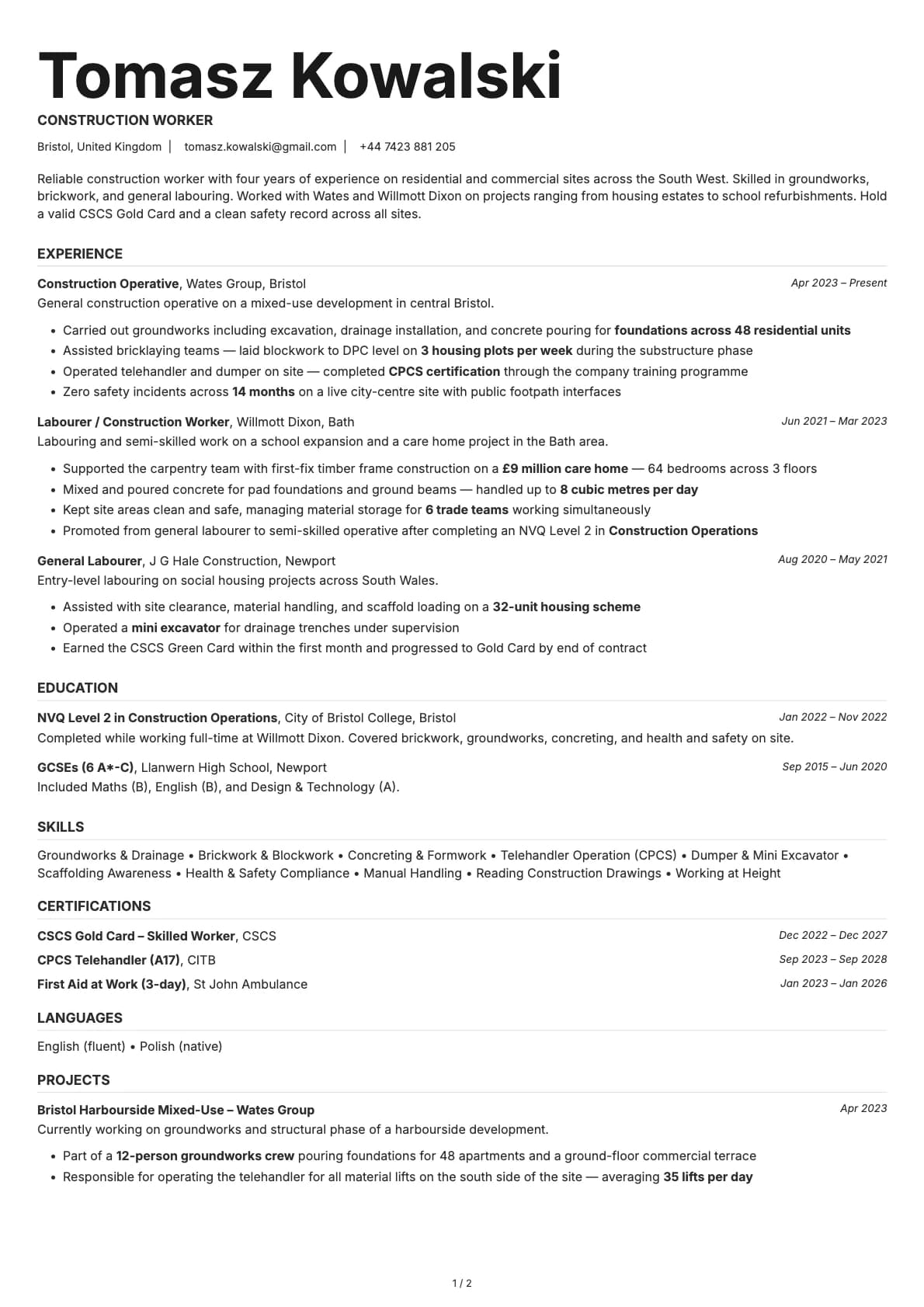
Construction Worker
A construction worker resume example with 4 years of site experience at Wates and Willmott Dixon.
Related articles

AI Is Screening Your Resume Before Any Human Sees It
AI screens most resumes before a human ever reads them. 97.4% of Fortune 500 companies run an ATS. This is what that means for you and what you can do about it.

The Best Resume Builders in 2026, Compared Honestly
Resume.io, Zety, Enhancv, Kickresume, Teal, and Laddro compared honestly: real pricing, free tiers, mobile apps, and where each tool wins. All prices checked in September 2026.

Burnout Recovery: A Real Timeline, Not 'Take a Bubble Bath'
55% of the U.S. workforce is burned out. Recovery takes 3 to 12 months. Here's what that actually looks like, stage by stage.