Business Analyst Cover Letter Example
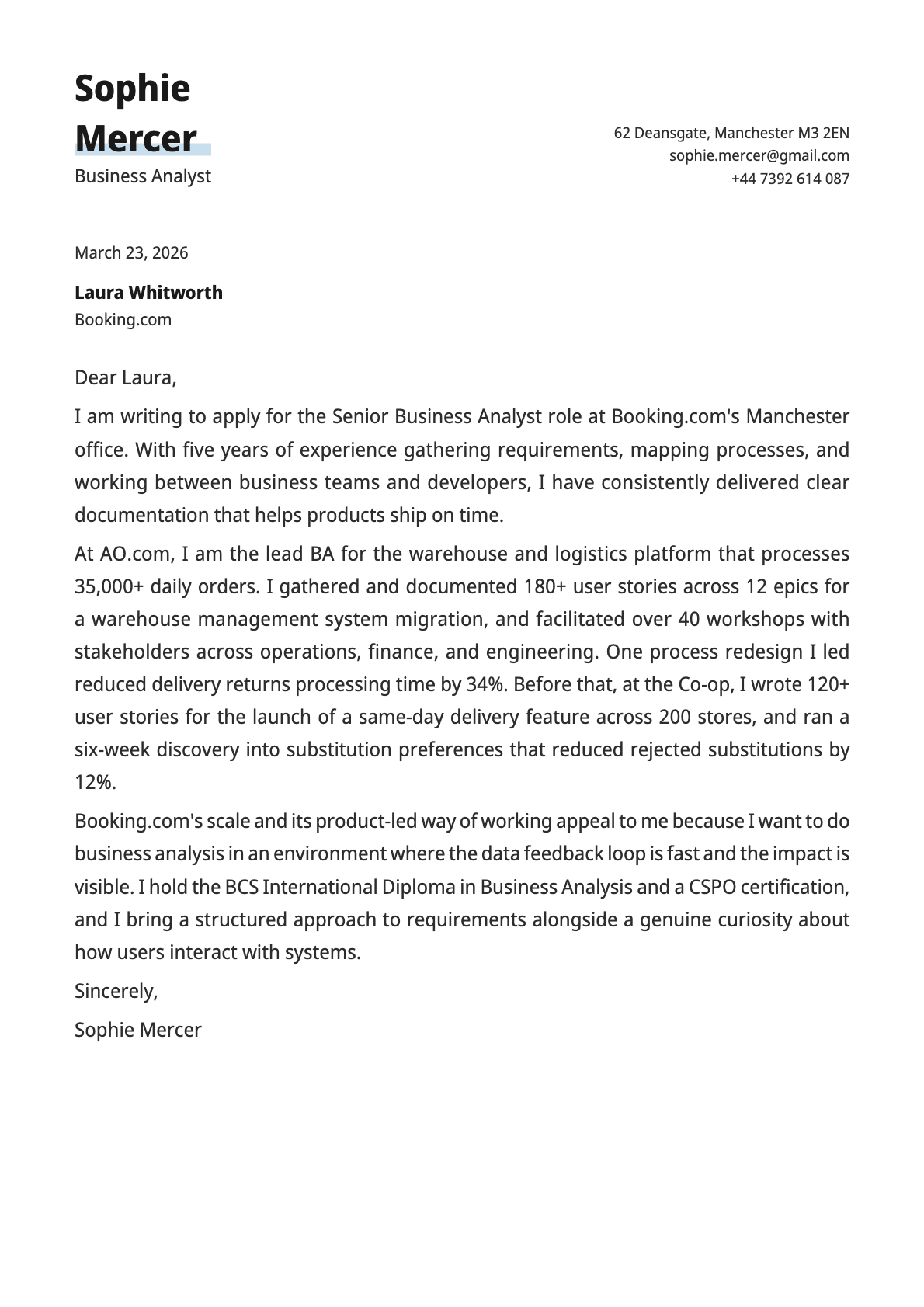
A business analyst cover letter example for a senior BA role at Booking.com.

Laddro Team
Free to use. No account needed to start.
Free to use. No account needed to start.
Overview
Business analyst cover letters have a particular problem. The role itself is hard to define in a single sentence, which means most candidates default to vague descriptions. "I bridge the gap between business and technology." "I translate requirements into solutions." These phrases sound reasonable but tell the hiring manager nothing about what you actually do or how well you do it.
This cover letter belongs to Sophie Mercer, a business analyst with five years of experience at AO.com and the Co-op, applying for a Senior BA role at Booking.com. What sets her letter apart is that she talks in specifics: user story counts, workshop numbers, and the measurable outcomes of her analysis work.
The opening: define what you do, precisely
Sophie opens by naming the role and immediately defining her version of business analysis. Not "bridging gaps" but "gathering requirements, mapping processes, and working between business teams and developers." That is a concrete description of actual work.
With five years of experience gathering requirements, mapping processes, and working between business teams and developers, I have consistently delivered clear documentation that helps products ship on time.
The phrase "clear documentation that helps products ship on time" is doing important work. It connects her output (documentation) to a business outcome (shipping on time). Too many BA cover letters describe the process without ever connecting it to what the business actually cares about.
For your letter: define your BA work in terms of what it produces, not what it involves. "I write user stories" becomes "I write user stories that engineering teams can pick up and build without ambiguity." Same skill, much stronger framing.
The body: numbers that show scale and impact
The middle paragraph is packed with specifics from two roles. At AO.com, she gives the daily order volume (35,000+), the user story count (180+ across 12 epics), the number of workshops (40+), and a process improvement result (34% reduction in delivery returns processing time). At the Co-op, she gives similar detail: 120+ user stories, 200 stores, and a 12% reduction in rejected substitutions.
What makes this work is that each number tells a different part of the story. The order volume shows she works in high-scale environments. The user story count shows she handles large bodies of work. The workshops show stakeholder management. The outcomes show her analysis leads to real improvements.
The key takeaway: BAs often struggle to quantify their work because the output is documentation rather than revenue. But you can quantify volume (stories written, workshops run, stakeholders managed), speed (delivery timelines met), and downstream impact (process improvements, cost savings, error reductions). Find those numbers.
The closing: company fit and credentials
Sophie's closing paragraph connects Booking.com's product-led culture to what she wants from her next role. The phrase "fast data feedback loop" shows she understands how product companies work, and it signals that she wants to be in an environment where the impact of her analysis is visible quickly.
She also mentions her BCS International Diploma in Business Analysis and CSPO certification. These are not thrown in randomly. The BCS diploma signals formal BA training, and the CSPO shows she understands agile product ownership. Both are relevant to a product company like Booking.com.
If you hold BA certifications, include them in your closing. BCS, IIBA CBAP, CSPO, and similar credentials carry weight because they tell the reader you have invested in formal training, not just learned on the job.
What makes this letter effective
Three things. First, Sophie never uses abstract language. Every claim is anchored to a specific project, a number, or a named company. Second, she shows range by including examples from two different industries (ecommerce and grocery retail), which suggests adaptability. Third, the letter is focused. She does not try to cover every BA skill. She picks requirements gathering, stakeholder workshops, and process improvement, and she goes deep on those.
Mistakes business analysts make in cover letters
Describing the role instead of your results. "I gather requirements and create process maps" describes what any BA does. "I gathered 180+ user stories across 12 epics for a warehouse management system migration" describes what you specifically did. Always choose the second version.
Using too much methodology jargon. Phrases like "using agile frameworks to drive digital transformation" are meaningless filler. If you use Agile, say so plainly. If you run discovery phases, describe what you actually do in them. Clarity beats buzzwords every time.
Forgetting to show stakeholder skills. BA work is fundamentally about working with people. If your letter reads like a technical spec, you are missing the human dimension. Mention the workshops you facilitated, the number of stakeholders you managed, and the cross-functional teams you worked with.
Not tailoring to the company's domain. A BA letter for a fintech startup should read differently from one for an NHS trust. Research the company's product, industry, and way of working, and make sure your examples demonstrate relevant domain experience or transferable skills.
Was this cover letter example helpful?
Rate this example to help us create better content for you.
4.7 average from 156 ratingsBuild your own version
Open this layout in the builder and swap in your own details. It takes a few minutes.
Free to use. No account needed to start.
Related cover letter examples
Accountant
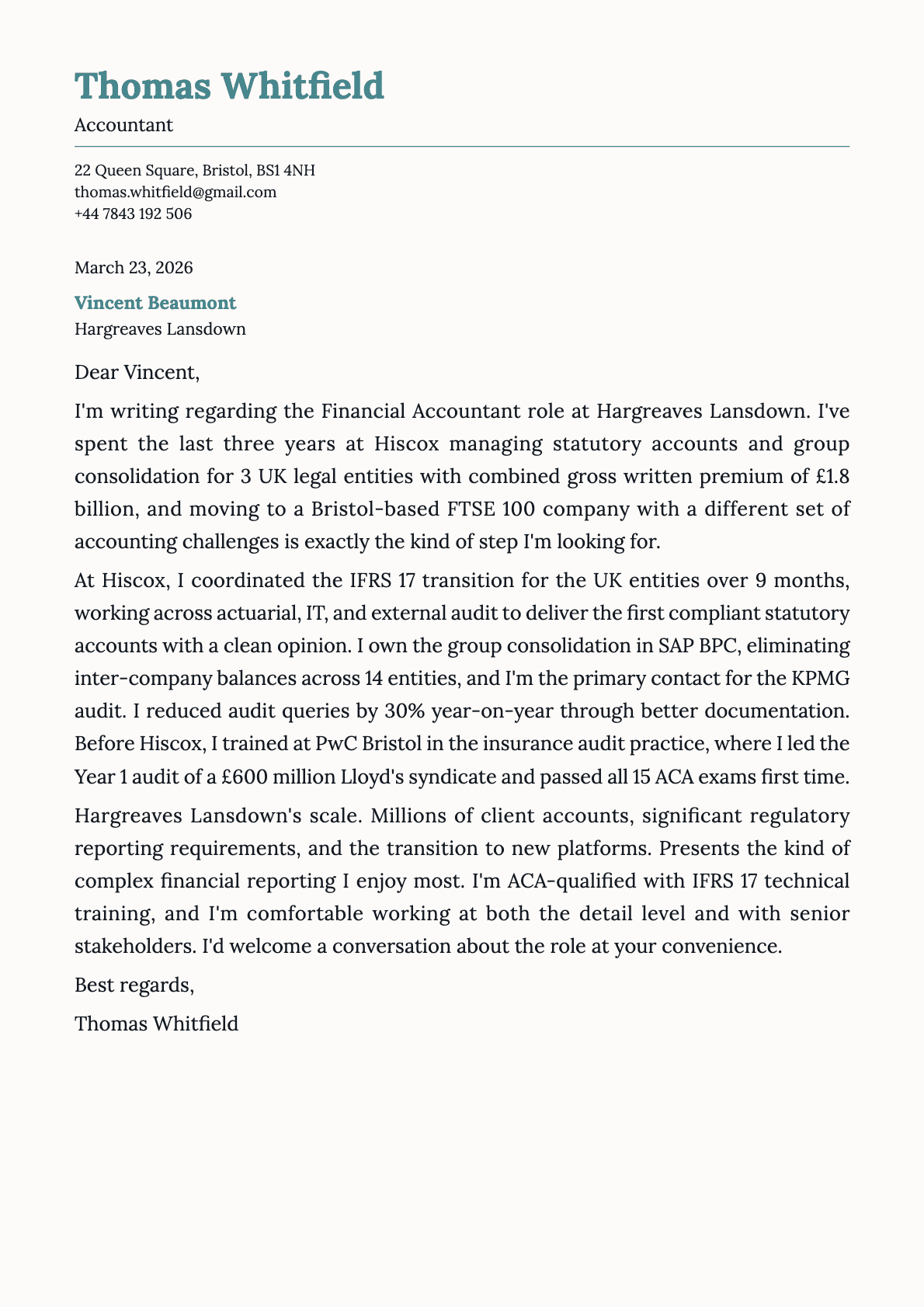
An accountant cover letter example showing how to present IFRS expertise, audit coordination, and financial reporting skills when applying to a FTSE 100.
Financial Analyst
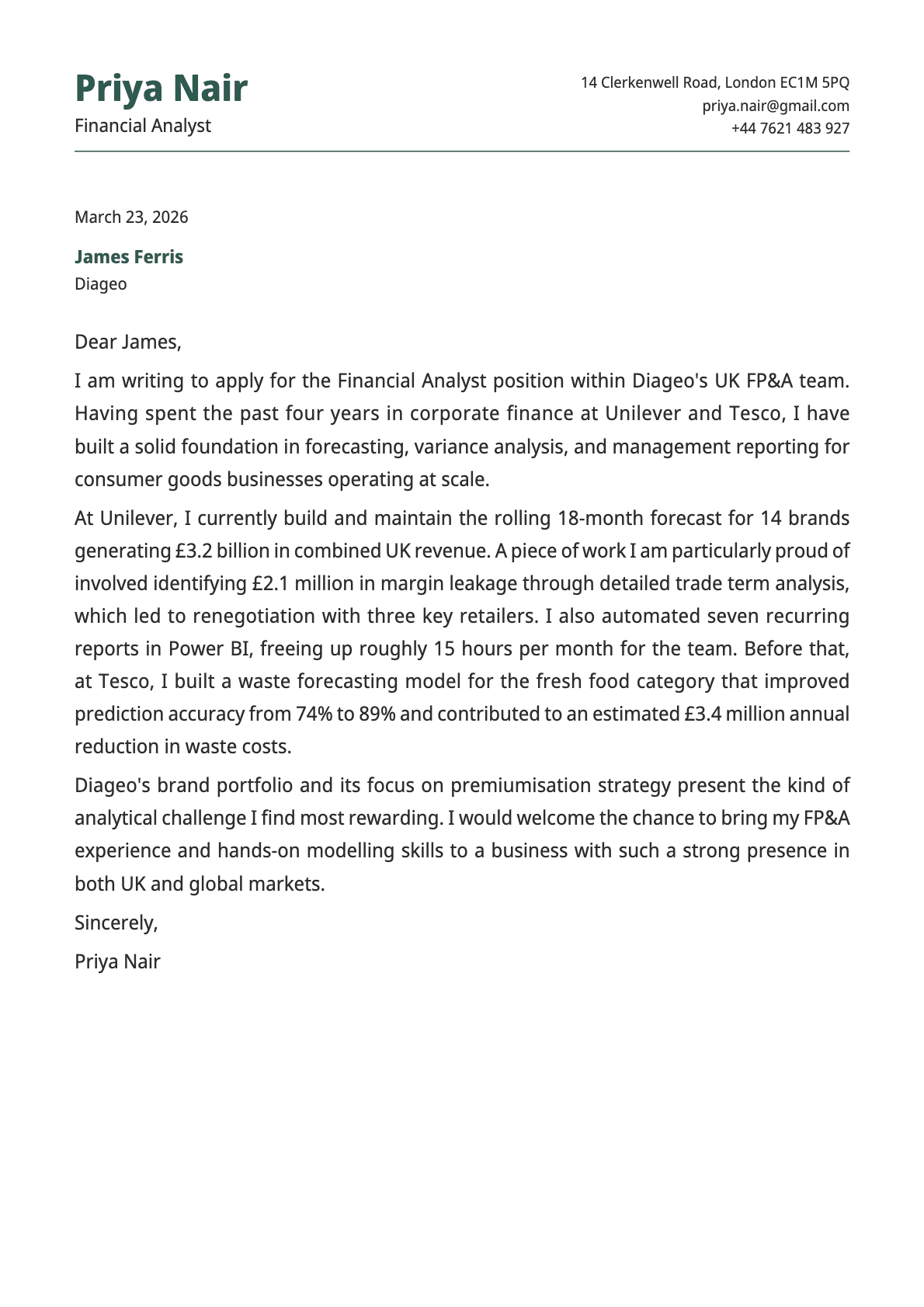
A financial analyst cover letter example targeting an FP&A role at Diageo. See how to present forecasting skills, variance analysis, and commercial impact.
Management Consultant
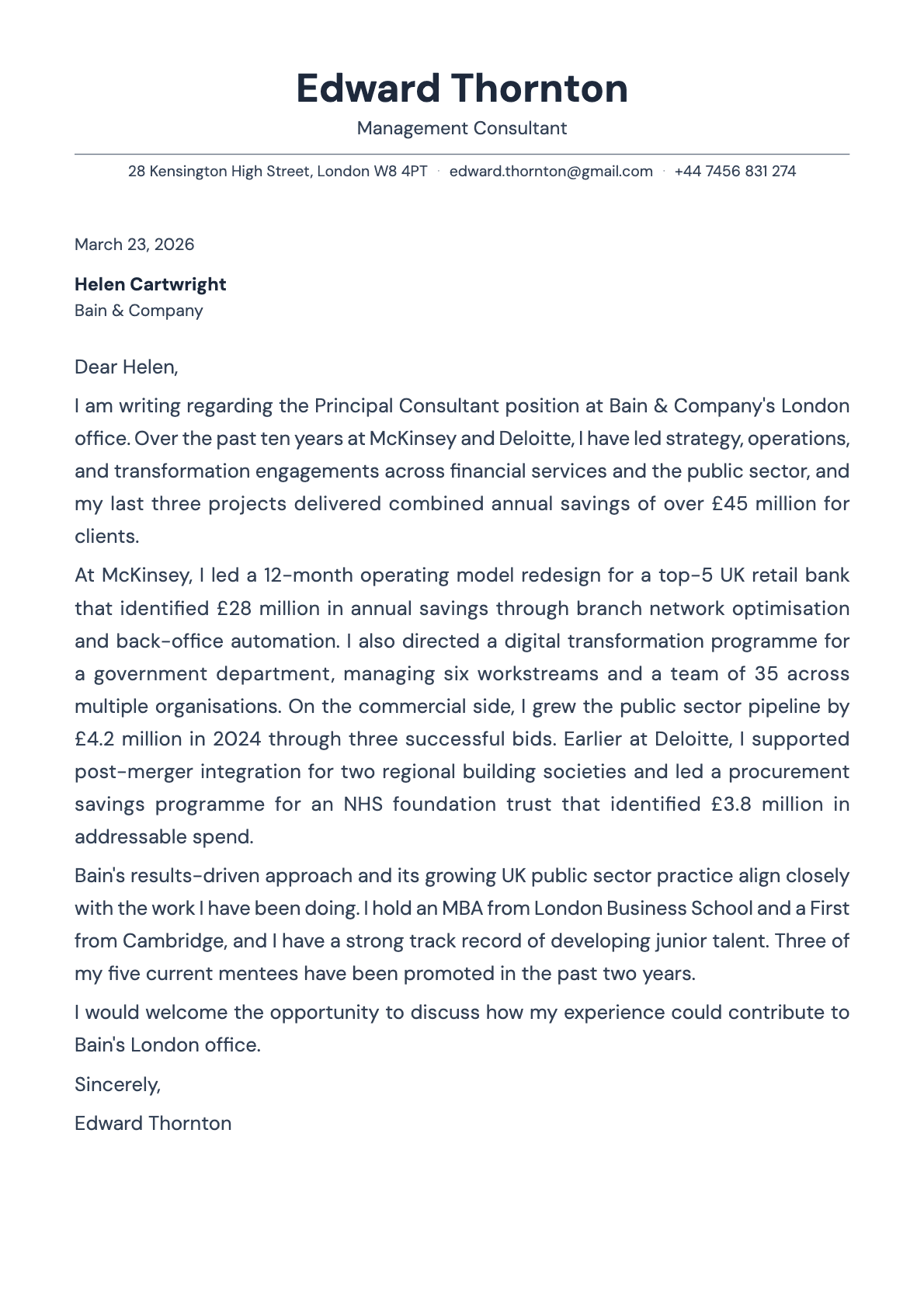
A management consultant cover letter example targeting Bain & Company. See how to present engagement results, team leadership, and business development.
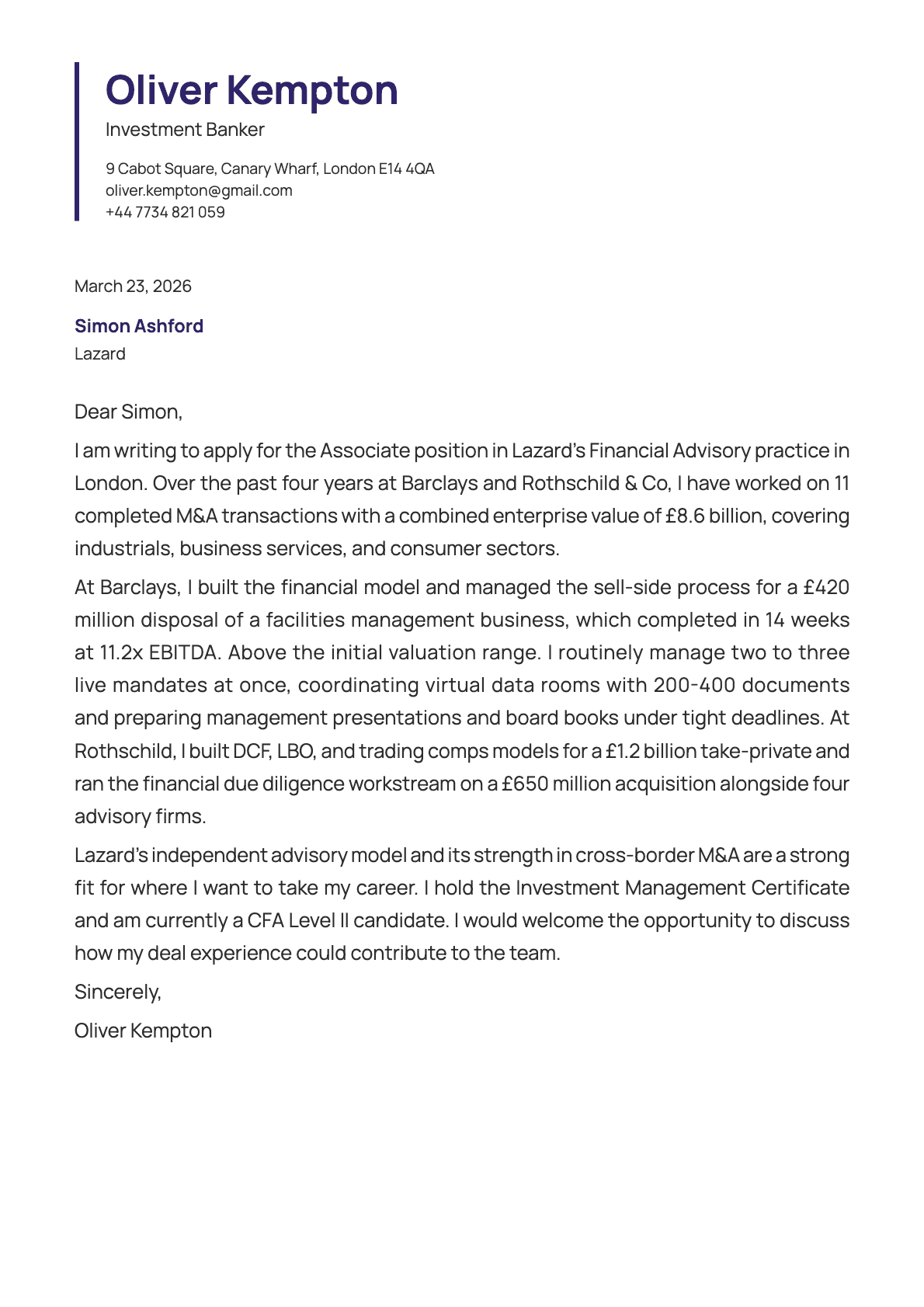
Investment Banker
An investment banking cover letter example targeting an associate role at Lazard.
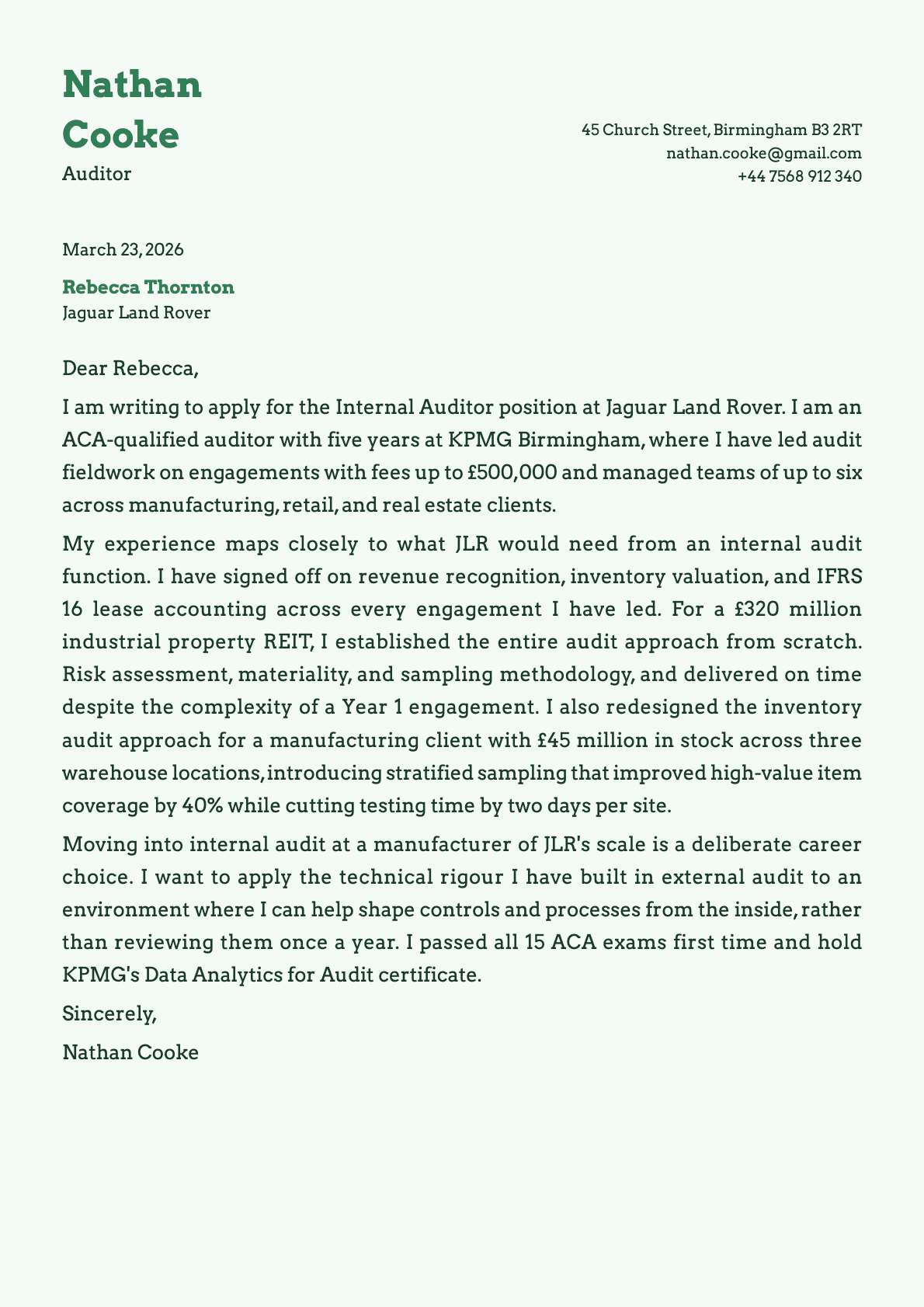
Auditor
An ACA-qualified auditor cover letter example targeting an internal audit role at Jaguar Land Rover.
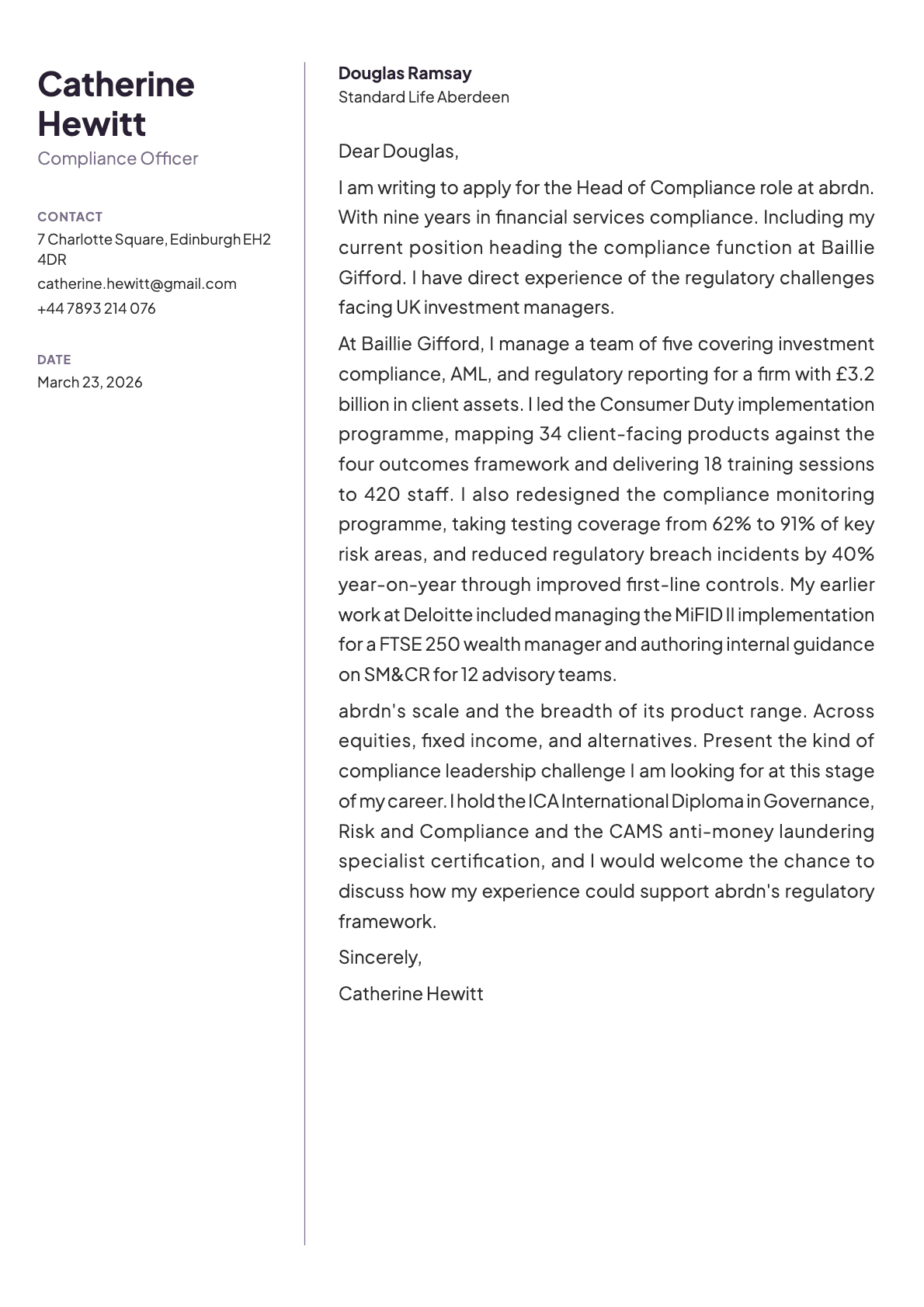
Compliance Officer
A compliance officer cover letter example for a senior role at abrdn.
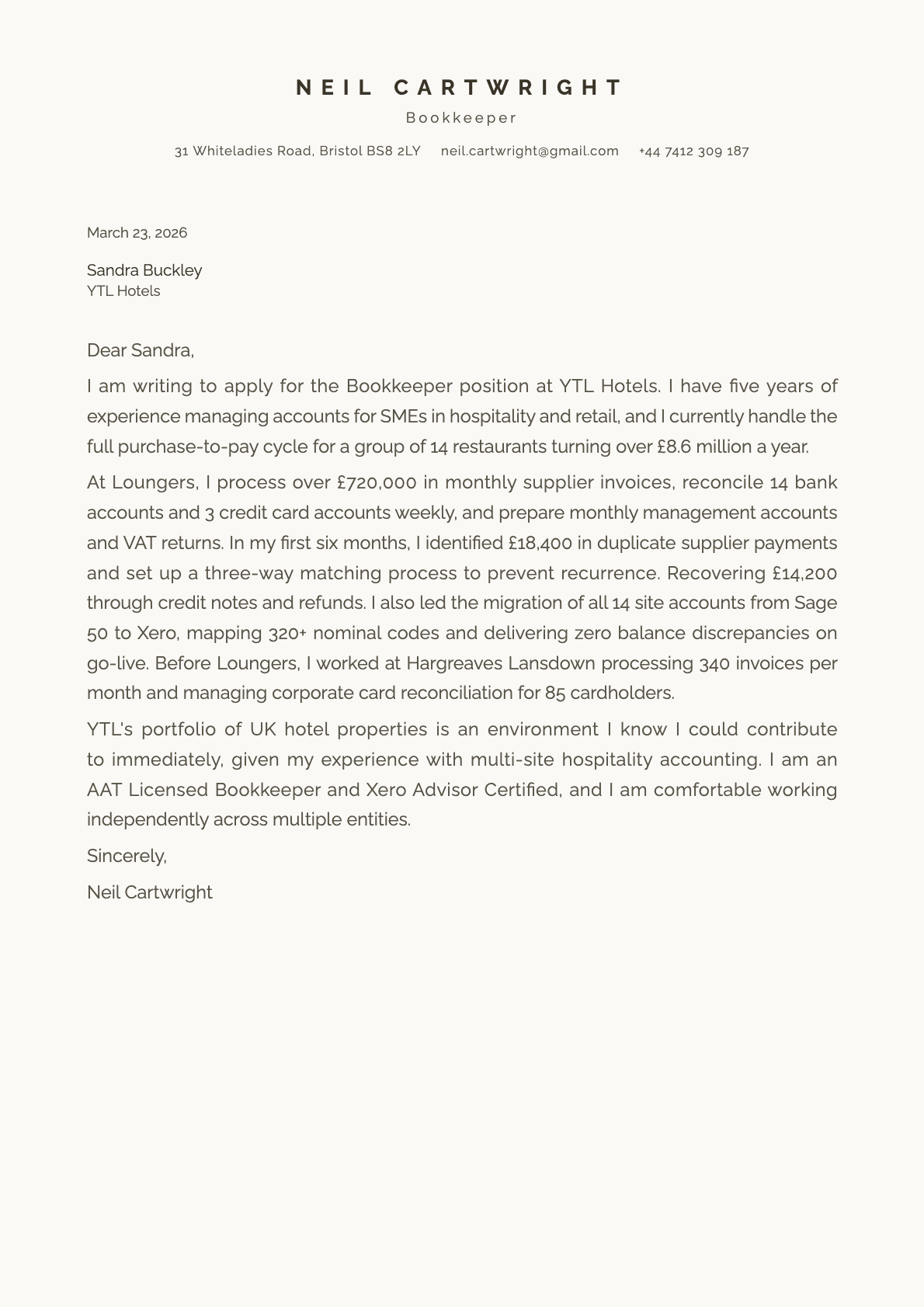
Bookkeeper
A bookkeeper cover letter example for a multi-site hospitality role at YTL Hotels.
Related articles

AI Is Screening Your Resume Before Any Human Sees It
AI screens most resumes before a human ever reads them. 97.4% of Fortune 500 companies run an ATS. This is what that means for you and what you can do about it.

The Best Resume Builders in 2026, Compared Honestly
Resume.io, Zety, Enhancv, Kickresume, Teal, and Laddro compared honestly: real pricing, free tiers, mobile apps, and where each tool wins. All prices checked in September 2026.

Burnout Recovery: A Real Timeline, Not 'Take a Bubble Bath'
55% of the U.S. workforce is burned out. Recovery takes 3 to 12 months. Here's what that actually looks like, stage by stage.