Compliance Officer Cover Letter Example
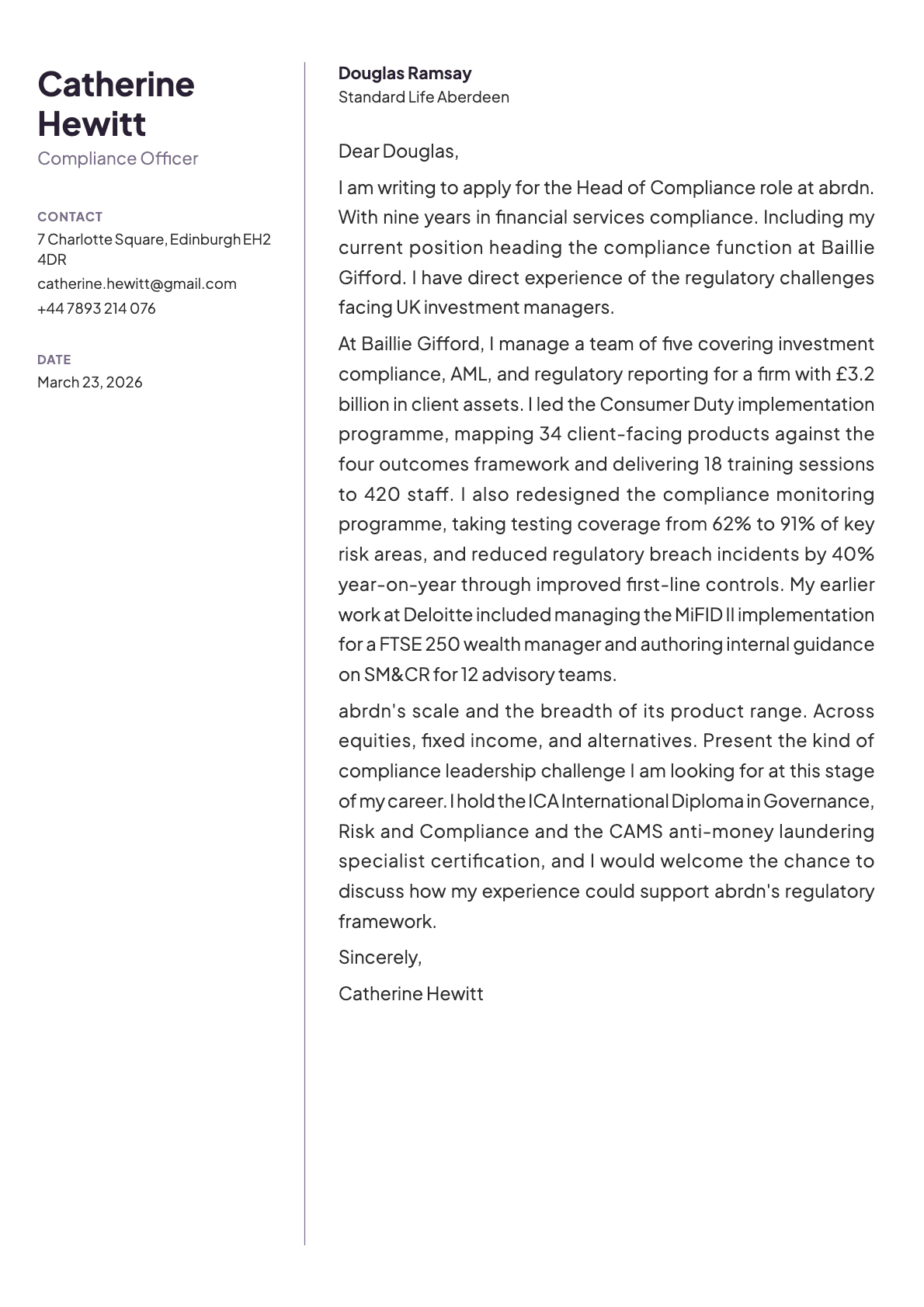
A compliance officer cover letter example for a senior role at abrdn.

Laddro Team
Free to use. No account needed to start.
Free to use. No account needed to start.
Overview
Compliance officer cover letters tend to be dry and formulaic. Most candidates list the regulations they know (FCA, MiFID II, SM&CR) and describe their monitoring activities in general terms. The problem is that every compliance professional knows these regulations. What separates a strong candidate is the ability to show how they applied that knowledge to solve real problems, build better systems, or navigate complex regulatory changes.
This letter belongs to Catherine Hewitt, a compliance officer with nine years in financial services, currently heading the compliance function at Baillie Gifford. She is applying for the Head of Compliance role at abrdn. Her letter stands out because she treats regulatory knowledge as a baseline and focuses on what she has built, changed, and improved.
The opening: role, seniority, and sector relevance
Catherine opens with a clear statement of her experience level and current position. Crucially, she names both the firm she works for and its AUM figure, which immediately contextualises the scale of her compliance responsibility.
With nine years in financial services compliance, including my current position heading the compliance function at Baillie Gifford, I have direct experience of the regulatory challenges facing UK investment managers.
The phrase "direct experience of the regulatory challenges facing UK investment managers" is targeted and specific. She is not saying she knows about compliance generally. She is saying she knows about compliance in the exact industry and regulatory environment that abrdn operates in.
For your own letter: always connect your experience to the specific regulatory environment of the company you are applying to. Compliance in asset management is different from compliance in retail banking or insurance. Make that distinction clear.
The body: implementation over knowledge
The middle paragraph covers four major achievements. The Consumer Duty implementation (34 products mapped, 18 training sessions, 420 staff) shows she can lead a large-scale regulatory programme. The compliance monitoring redesign (coverage from 62% to 91%) shows process improvement. The 40% reduction in breach incidents shows measurable impact on the firm's risk profile. The MiFID II and SM&CR experience at Deloitte adds breadth.
What makes this effective is that Catherine does not just say she "managed compliance." She describes specific programmes she designed and delivered, with numbers that show the scope and the outcome. The Consumer Duty detail is particularly strong because it demonstrates experience with one of the FCA's most significant recent regulatory changes.
The principle here: compliance letters should show implementation, not just knowledge. Anyone can say they understand Consumer Duty. Describing how you mapped 34 products against the four outcomes framework and trained 420 staff is a fundamentally different statement.
The closing: career direction and credentials
Catherine's closing connects abrdn's product range (equities, fixed income, alternatives) to the kind of compliance leadership challenge she is looking for. This shows ambition and intentionality. She is not just looking for any senior compliance role. She wants one with enough complexity to be genuinely challenging.
The certifications (ICA International Diploma in GRC, CAMS) are relevant and well placed. In compliance, professional qualifications are taken seriously because they demonstrate specialist training beyond what most firms provide internally.
What works about this letter
Catherine writes with the confidence of someone who runs a compliance function, not someone who works within one. The tone is authoritative without being boastful. She lets the scope of her work speak for itself. A team of five, £3.2 billion in client assets, 420 staff trained. These numbers tell the reader she operates at a senior level without her needing to say so directly.
The letter also balances technical compliance skills (monitoring, testing, regulatory reporting) with leadership and programme management skills (training delivery, team management, cross-firm implementation). Senior compliance roles require both, and Catherine demonstrates both.
Mistakes to avoid in compliance cover letters
Listing regulations without context. "Experienced in FCA regulation, MiFID II, and SM&CR" is not useful on its own. Describe a specific implementation or advisory engagement for each one. What was the challenge? What did you do? What was the result?
Ignoring the commercial side. Compliance professionals sometimes write as if they exist outside the business. But modern compliance roles require commercial awareness. If you have experience working with product teams, advising on new product launches, or balancing regulatory requirements with business objectives, mention it.
Being too cautious with language. Compliance professionals are trained to be precise and careful, which sometimes translates into overly hedged writing. "I believe I could potentially contribute to your compliance framework" is weak. "I would welcome the chance to discuss how my experience could support abrdn's regulatory framework" is direct and confident.
Not mentioning current regulatory developments. The FCA's regulatory agenda is constantly evolving. If you have experience with Consumer Duty, the new ESG disclosure requirements, or operational resilience, mention it. These are the topics that compliance leaders are dealing with right now, and demonstrating awareness of them shows you are current.
Was this cover letter example helpful?
Rate this example to help us create better content for you.
4.7 average from 98 ratingsBuild your own version
Open this layout in the builder and swap in your own details. It takes a few minutes.
Free to use. No account needed to start.
Related cover letter examples
Accountant
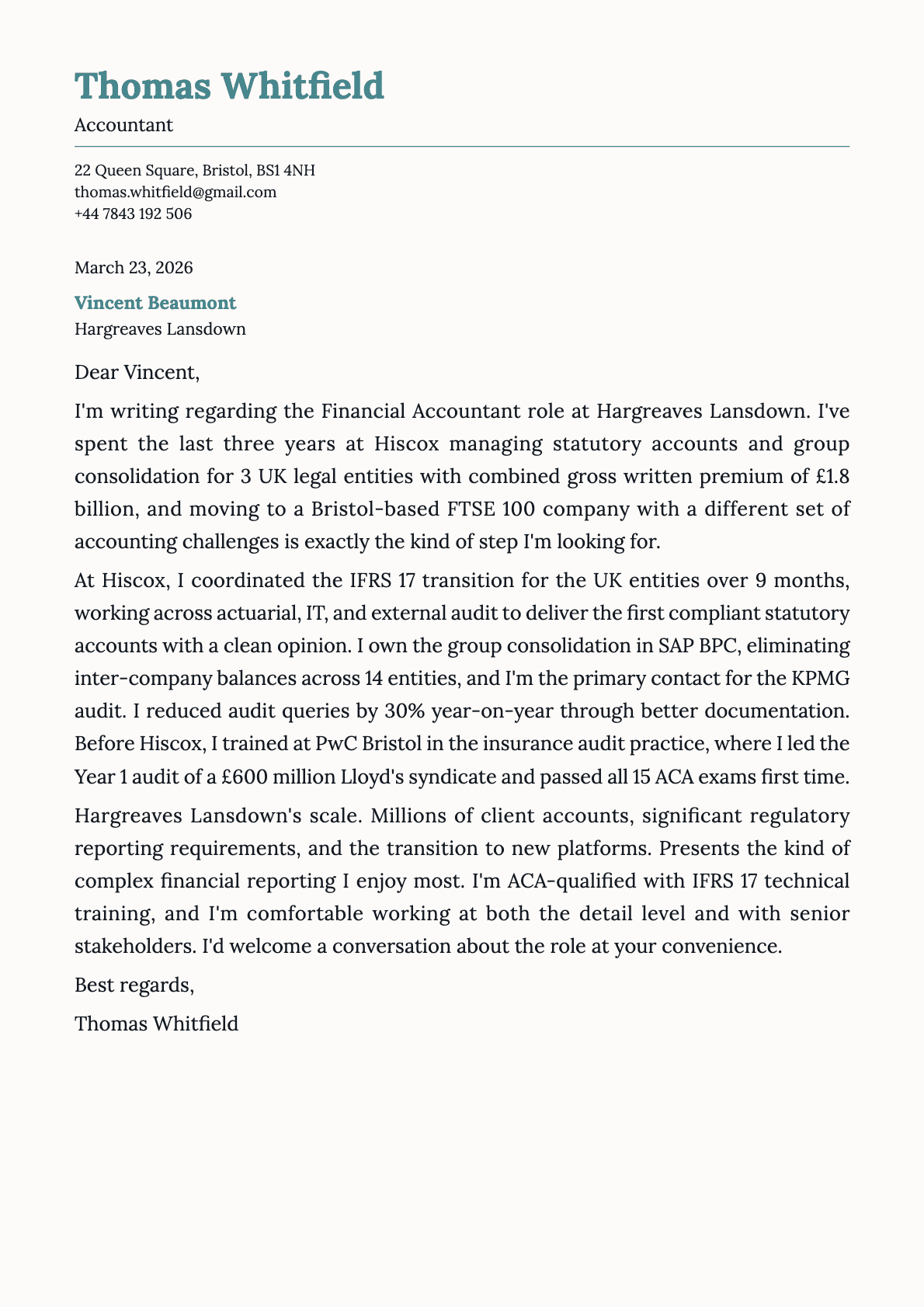
An accountant cover letter example showing how to present IFRS expertise, audit coordination, and financial reporting skills when applying to a FTSE 100.
Financial Analyst
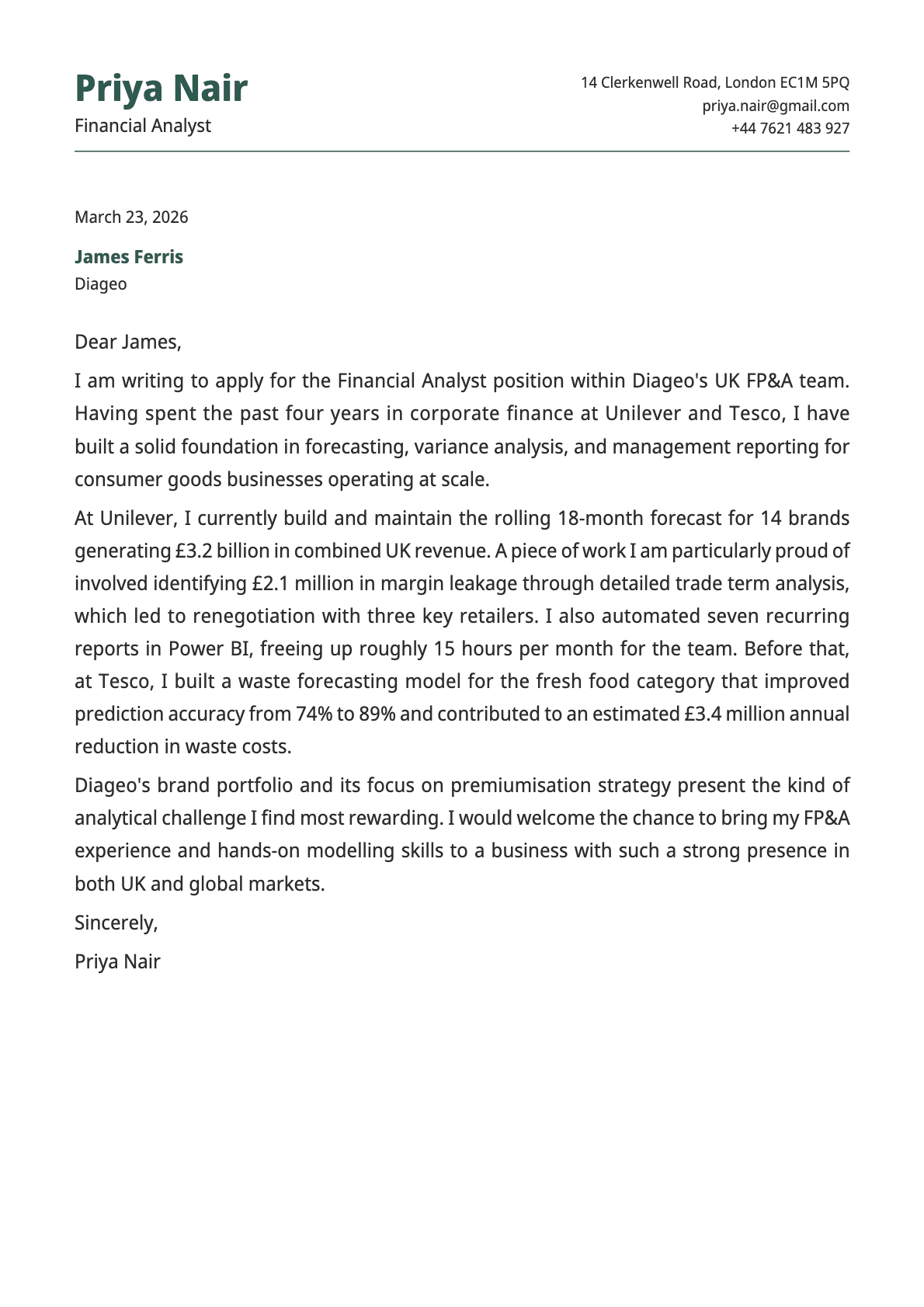
A financial analyst cover letter example targeting an FP&A role at Diageo. See how to present forecasting skills, variance analysis, and commercial impact.
Management Consultant
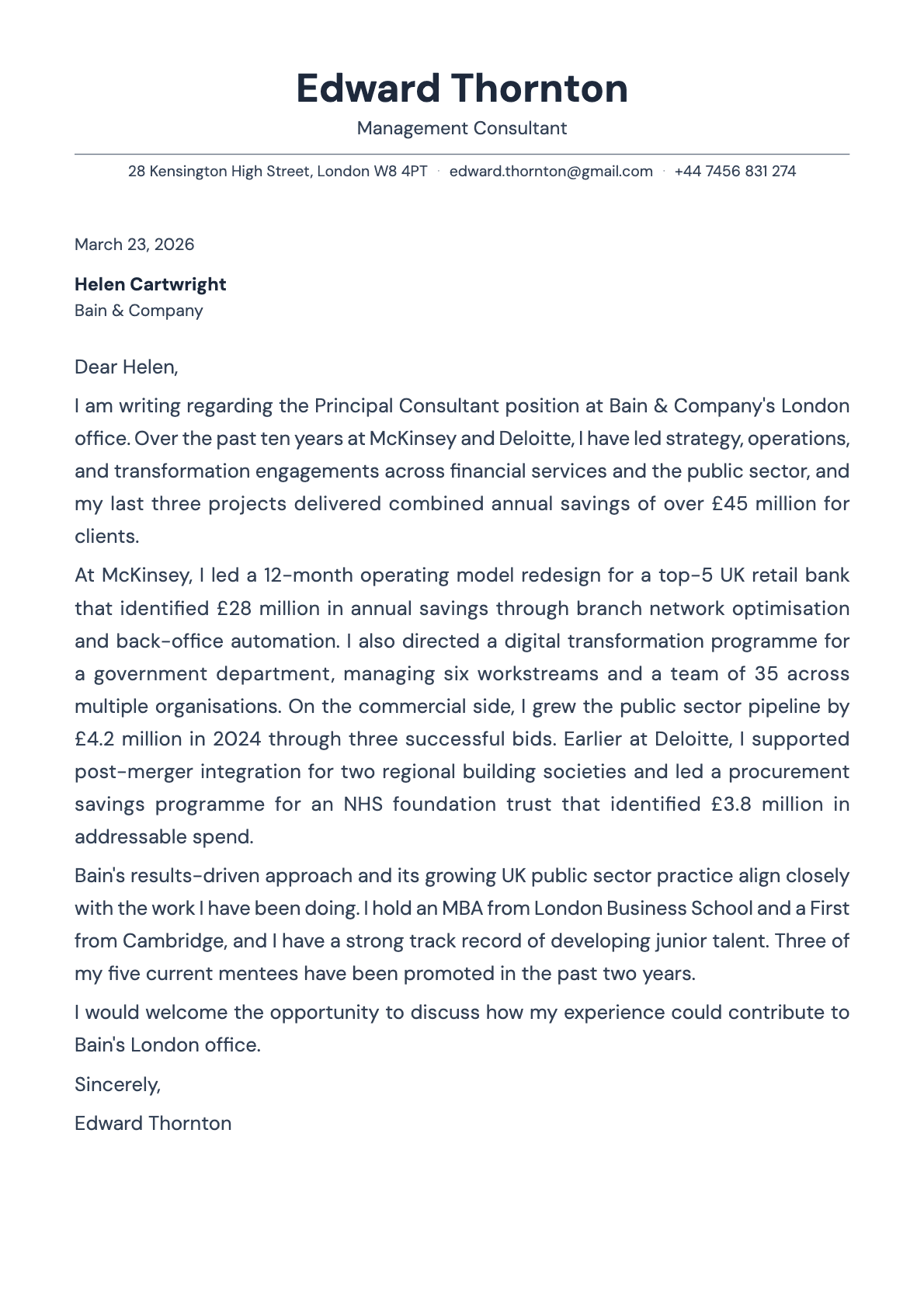
A management consultant cover letter example targeting Bain & Company. See how to present engagement results, team leadership, and business development.
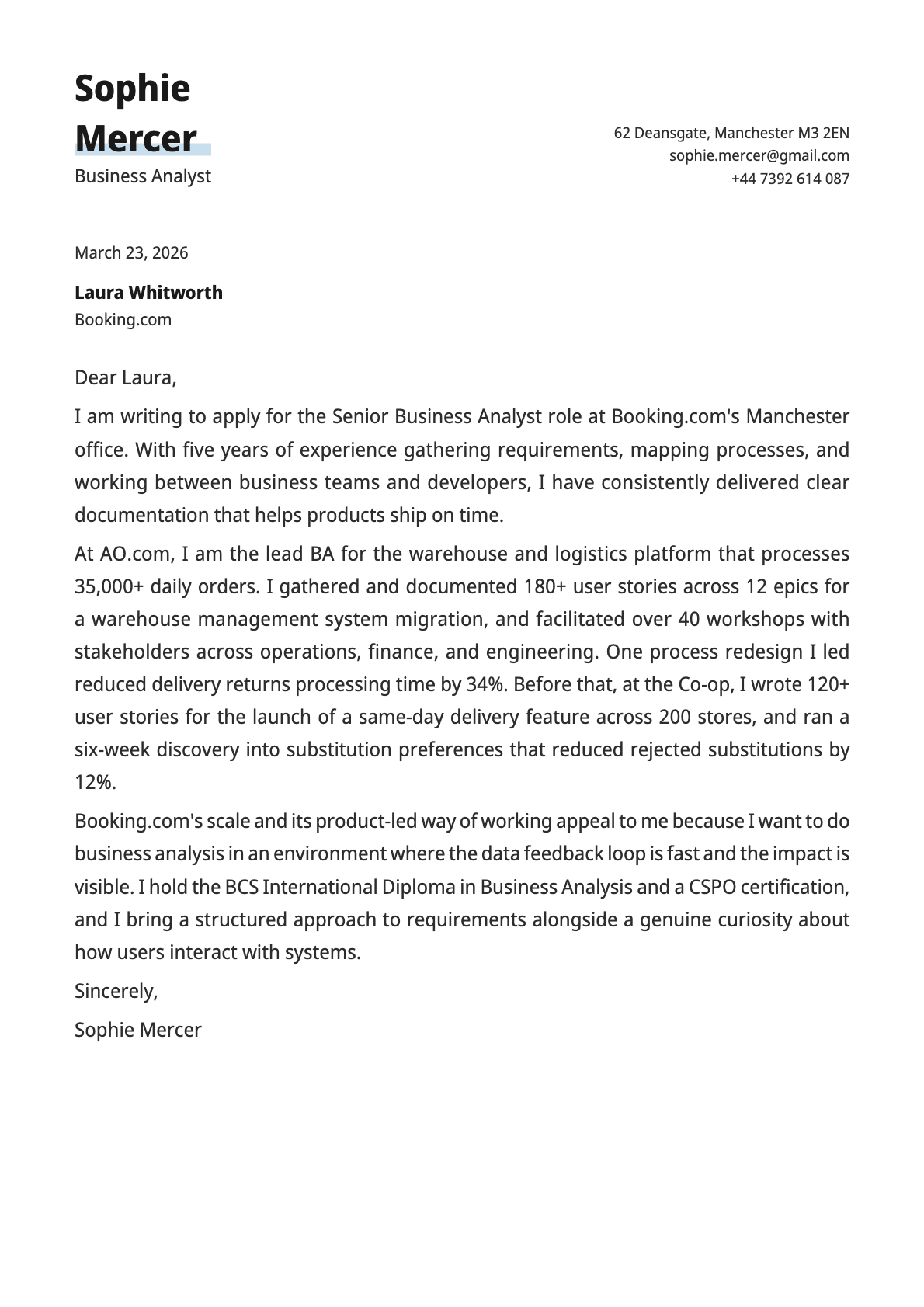
Business Analyst
A business analyst cover letter example for a senior BA role at Booking.com.
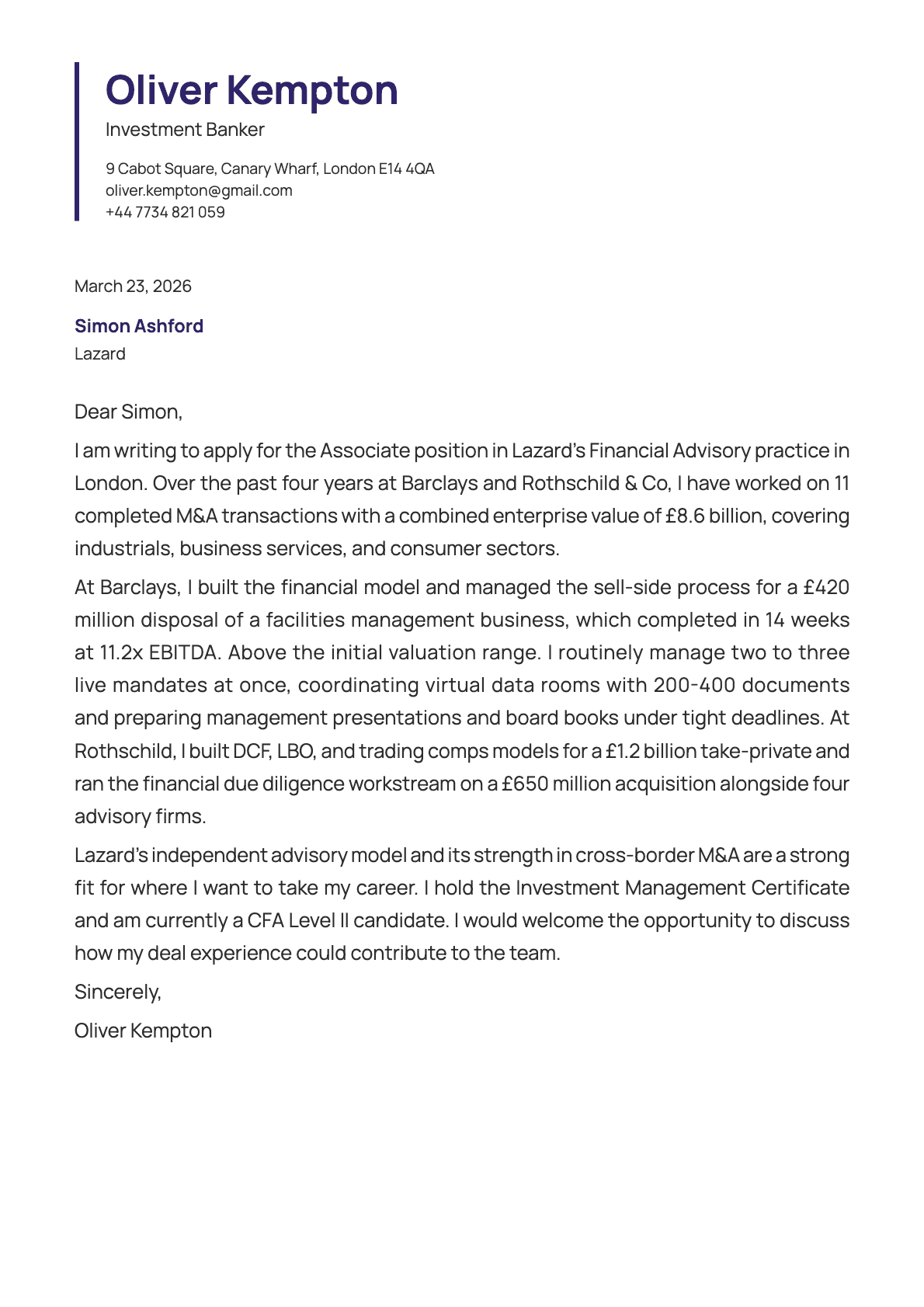
Investment Banker
An investment banking cover letter example targeting an associate role at Lazard.
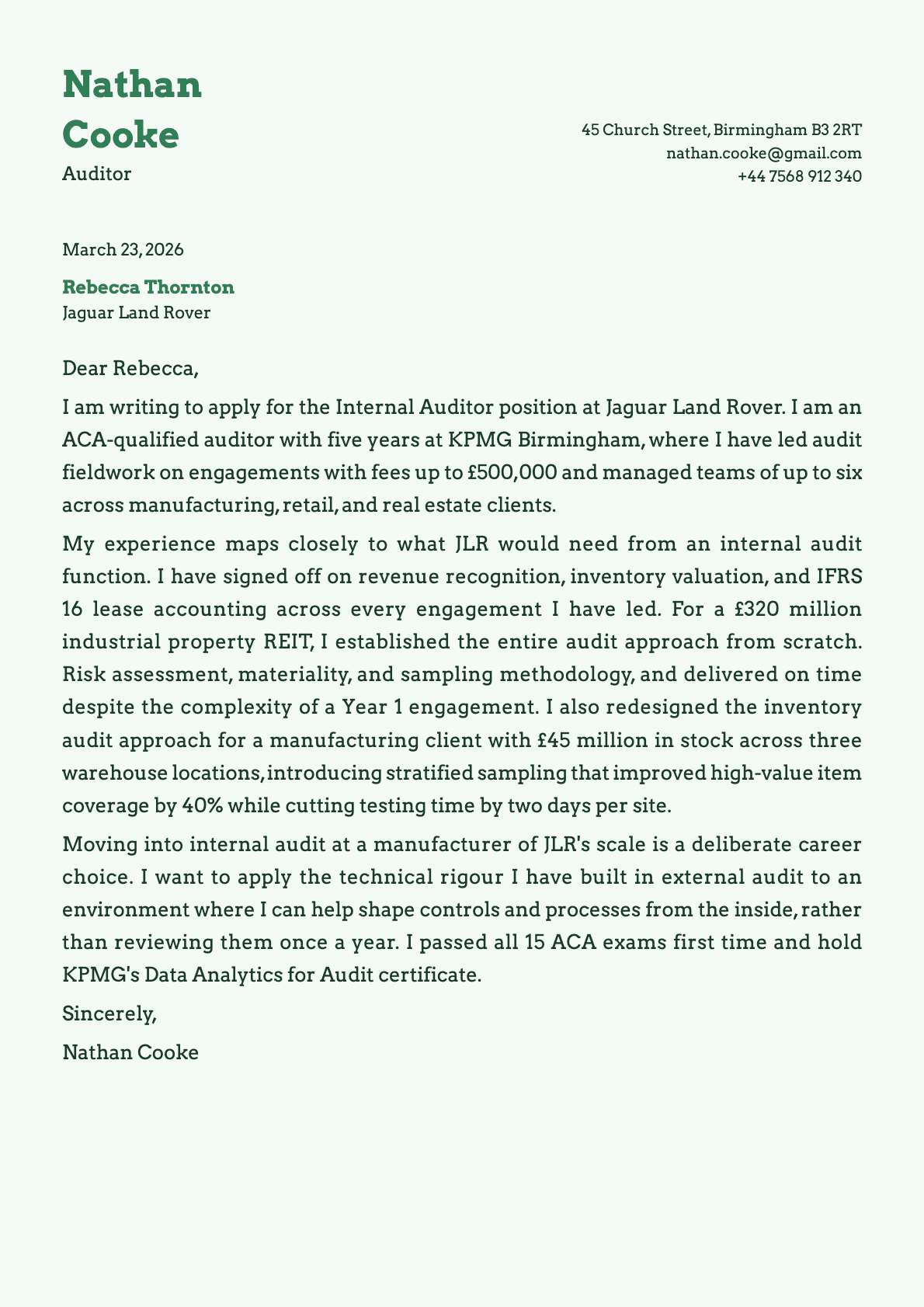
Auditor
An ACA-qualified auditor cover letter example targeting an internal audit role at Jaguar Land Rover.
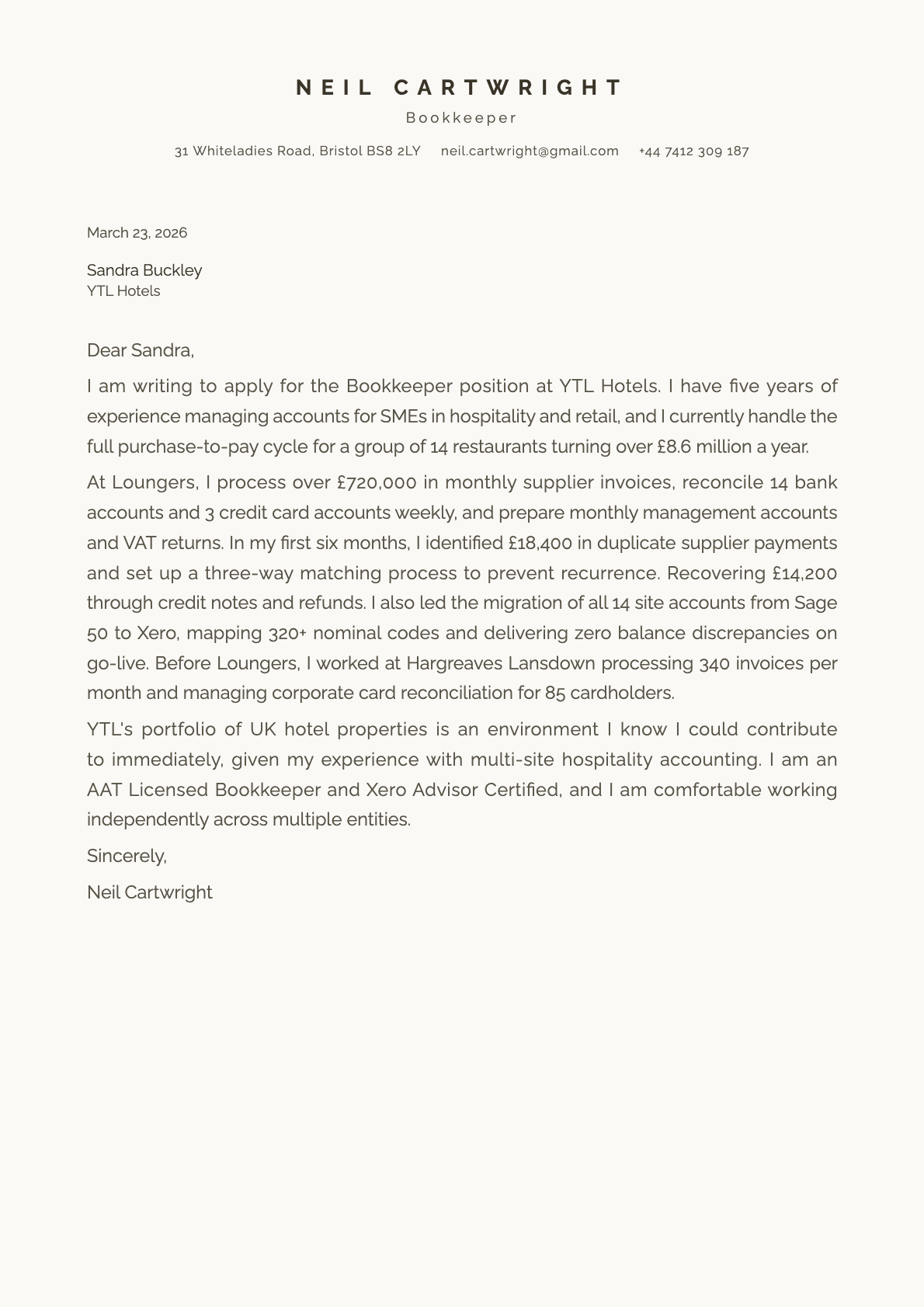
Bookkeeper
A bookkeeper cover letter example for a multi-site hospitality role at YTL Hotels.
Related articles

AI Is Screening Your Resume Before Any Human Sees It
AI screens most resumes before a human ever reads them. 97.4% of Fortune 500 companies run an ATS. This is what that means for you and what you can do about it.

The Best Resume Builders in 2026, Compared Honestly
Resume.io, Zety, Enhancv, Kickresume, Teal, and Laddro compared honestly: real pricing, free tiers, mobile apps, and where each tool wins. All prices checked in September 2026.

Burnout Recovery: A Real Timeline, Not 'Take a Bubble Bath'
55% of the U.S. workforce is burned out. Recovery takes 3 to 12 months. Here's what that actually looks like, stage by stage.