Management Consultant Cover Letter Example
A management consultant cover letter example targeting Bain & Company. See how to present engagement results, team leadership, and business development.

Laddro Team
Free to use. No account needed to start.
Free to use. No account needed to start.
Overview
Consulting cover letters sit in an awkward spot. You are writing to people who read for a living, who spend their days evaluating arguments and spotting weak ones. The bar for clarity and precision is genuinely high. A vague letter will not just fail to impress. It will actively work against you, because it signals that you cannot structure a compelling case.
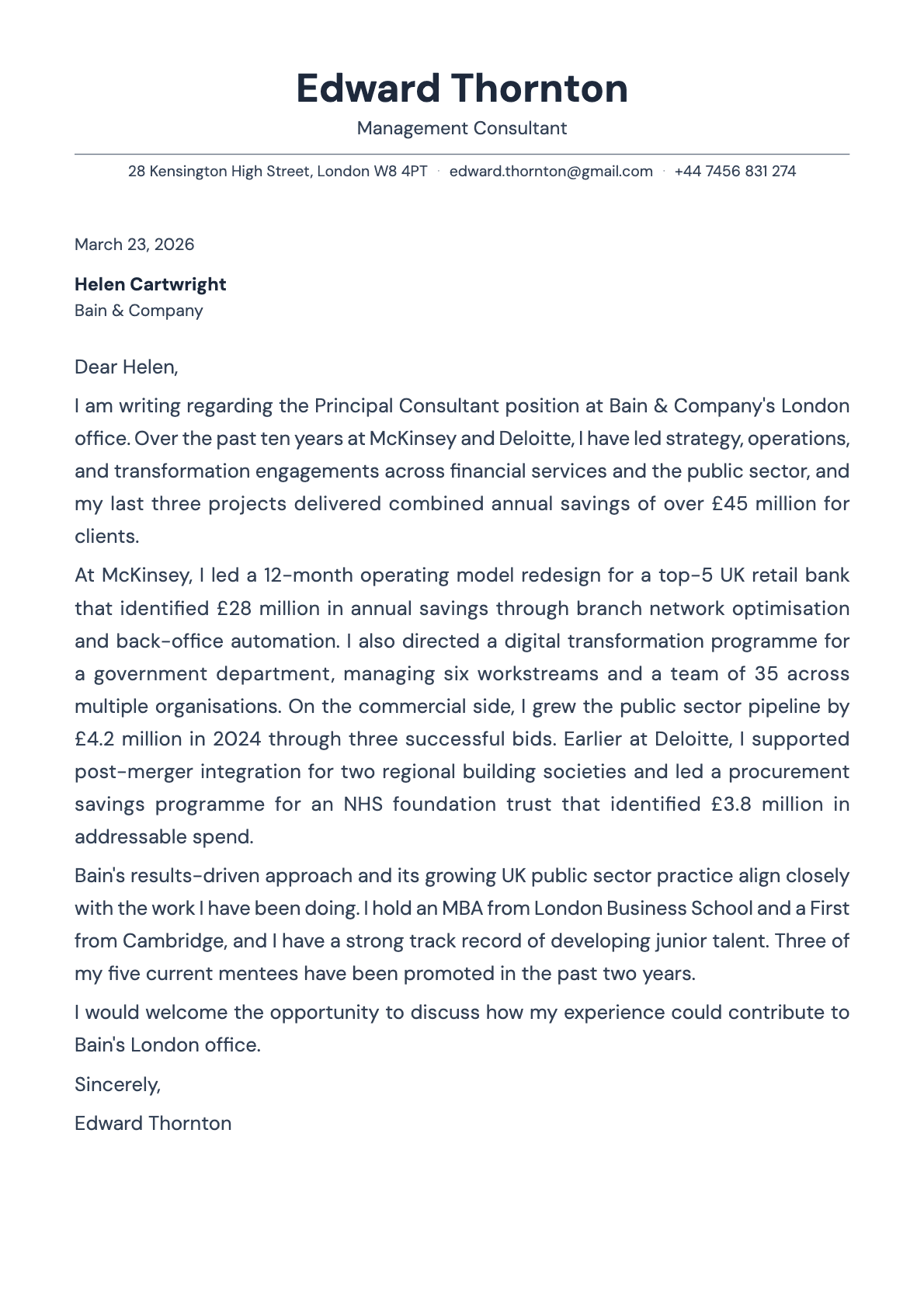
This letter belongs to Edward Thornton, a management consultant with ten years at McKinsey and Deloitte, applying for a Principal Consultant role at Bain & Company. His approach is worth studying because he treats the cover letter like a client pitch. Here is what I did, here is what it delivered, and here is why I want to do it for you.
The opening: credentials and impact in two lines
Edward does not waste time with pleasantries. His opening paragraph names the role, states his tenure, and drops a combined savings figure that anchors everything that follows.
Over the past ten years at McKinsey and Deloitte, I have led strategy, operations, and transformation engagements across financial services and the public sector, and my last three projects delivered combined annual savings of over £45 million for clients.
That final clause is doing serious work. Before the reader even gets to the detail, they know the scale of impact this person delivers. It sets an expectation, and the rest of the letter pays it off.
For your own letter: if you can summarise your total career impact in one number (total revenue influenced, total savings delivered, combined deal value), put it in your opening. It gives the reader a reason to keep going.
The body: structure it like a case study
The middle paragraph reads like a mini case portfolio. Edward gives four distinct examples across two firms, each one scoped tightly: what the engagement was, what he did, and what it achieved.
The McKinsey bank restructuring (£28 million annual savings) shows strategy execution at scale. The government digital transformation (six workstreams, 35 people) shows he can manage complexity across organisations. The pipeline growth (£4.2 million through three bids) shows commercial ability. The Deloitte examples add breadth without repeating the same skill.
Notice how he varies the type of impact. Cost savings, team size, pipeline value, and deal scope. Each bullet proves a different capability. This is important in consulting, where partners want to see that you can sell work, run teams, and deliver results. Not just one of those.
If you are writing a consulting cover letter, think about the three or four capabilities the role requires and match each one to a different project example. Strategy roles want commercial thinking. Operations roles want process improvement. Digital roles want technology fluency. Pick your examples to match.
The closing: credentials plus culture fit
Edward's closing paragraph does two things efficiently. First, he connects Bain's approach (focused, growing UK public sector practice) to his own track record. Second, he drops his academic credentials and a mentoring detail that signals leadership depth.
The mentoring line is quietly powerful: "Three of my five current mentees have been promoted in the past two years." That tells the reader he invests in developing people, and that he is good at it. At principal or partner level, talent development is part of the job description.
A word on academic credentials in consulting: MBA, undergraduate institution, and class of degree still matter in this industry, especially at MBB firms. If you have strong credentials, include them. If you do not, lean harder on your project results. The numbers can outweigh the pedigree if they are strong enough.
What this letter gets right
The letter is dense with evidence but never feels cluttered. Every sentence either states a fact or makes a connection between Edward's experience and Bain's needs. There is no wasted space. No "I am keen about solving complex problems." No "I thrive in fast-paced environments." Just results, context, and a clear ask.
That restraint is harder than it looks. Most consulting cover letters try to sound impressive through language. Long words, abstract concepts, consulting jargon. Edward sounds impressive because of what he has actually done. That is the difference.
Mistakes to avoid in consulting cover letters
Writing like a case interview. Your cover letter is not a case study framework. Do not structure it with "situation, complication, resolution" headers or use consulting jargon like "value creation levers" or "north star metrics." Write like a professional who happens to be a consultant, not like someone performing the role of a consultant.
Focusing only on the firm's prestige. "I have always admired Bain's reputation" is not a reason to hire you. Focus on what you will bring, not on how honoured you would be to join.
Neglecting the commercial side. If you are applying at manager level or above, you need to show evidence of business development or pipeline contribution. Firms want people who can bring in work, not just deliver it.
Leaving out the team dimension. Consulting is a team sport. Mention team sizes you have managed, junior staff you have developed, or cross-functional coordination you have led. Solo heroics do not sell at senior levels.
Was this cover letter example helpful?
Rate this example to help us create better content for you.
4.7 average from 143 ratingsBuild your own version
Open this layout in the builder and swap in your own details. It takes a few minutes.
Free to use. No account needed to start.
Related cover letter examples
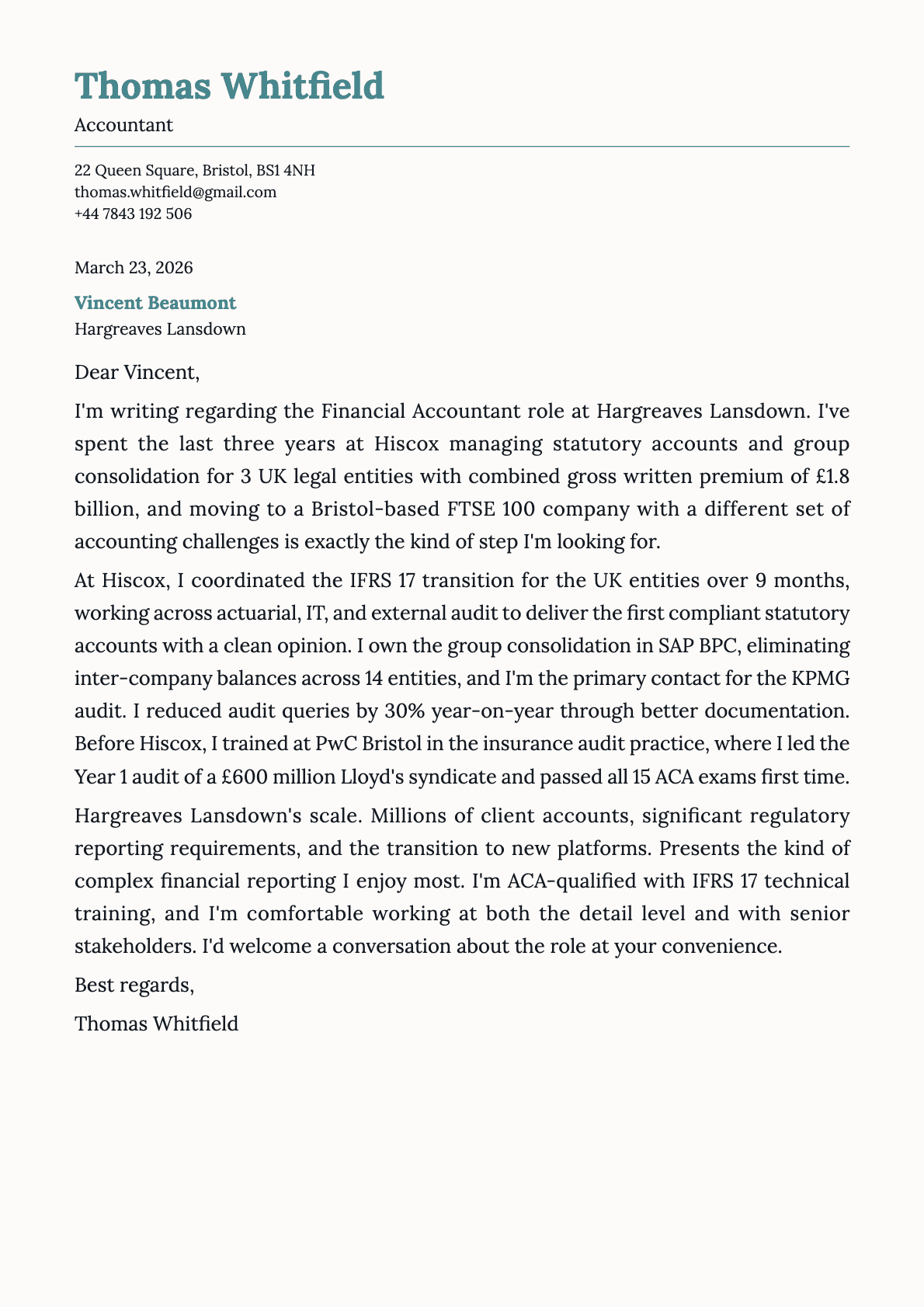
Accountant
An accountant cover letter example showing how to present IFRS expertise, audit coordination, and financial reporting skills when applying to a FTSE 100.
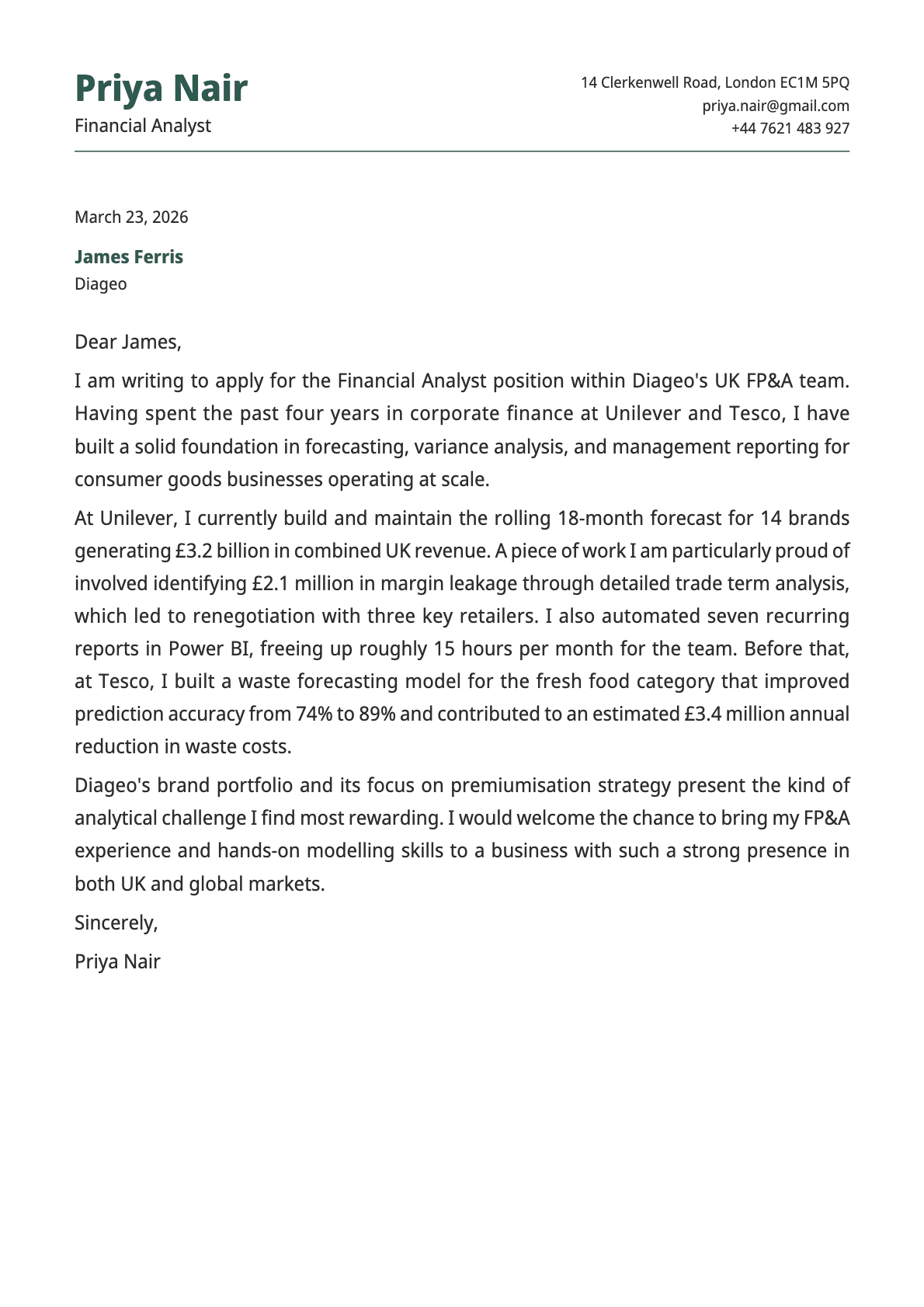
Financial Analyst
A financial analyst cover letter example targeting an FP&A role at Diageo. See how to present forecasting skills, variance analysis, and commercial impact.
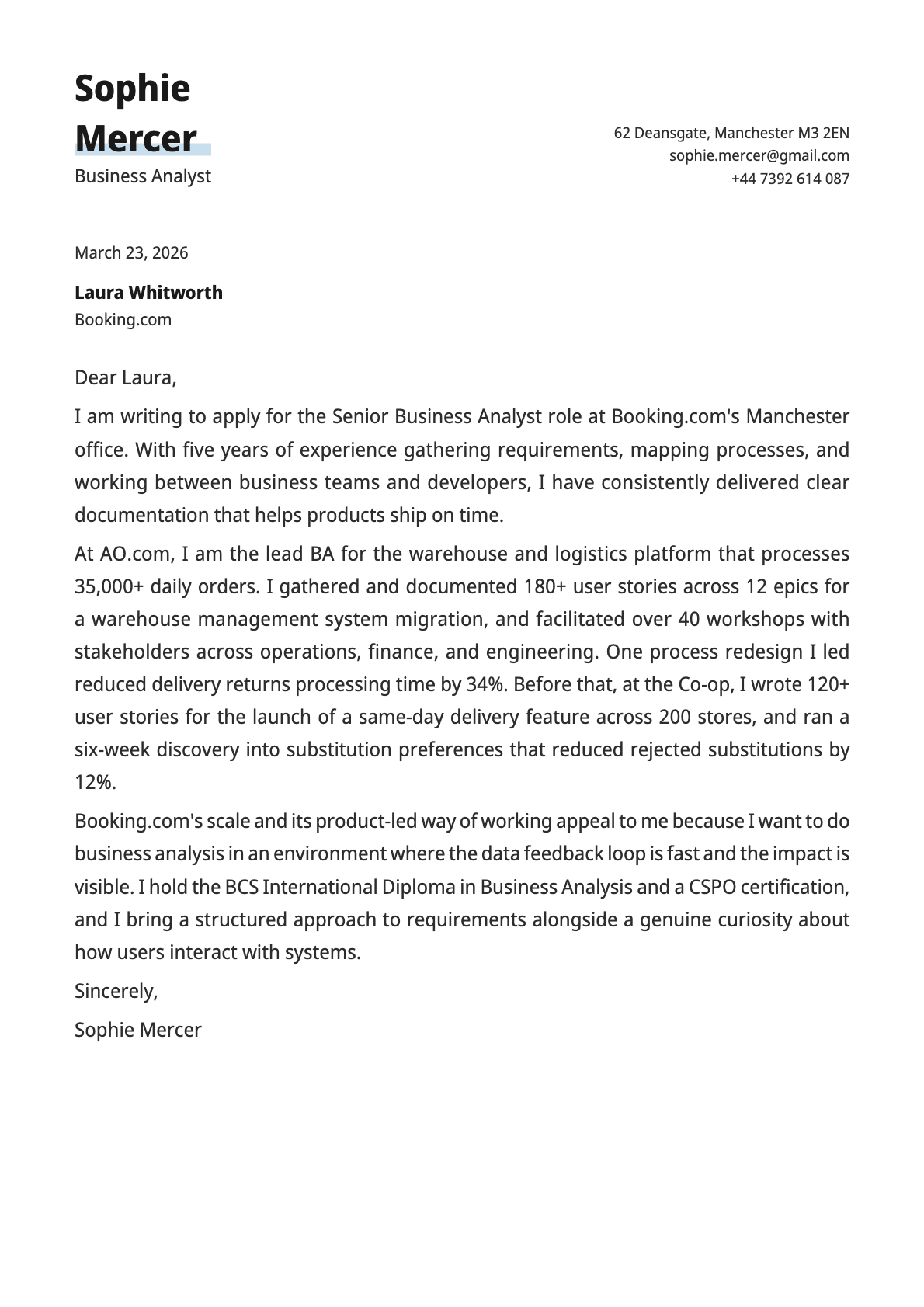
Business Analyst
A business analyst cover letter example for a senior BA role at Booking.com.
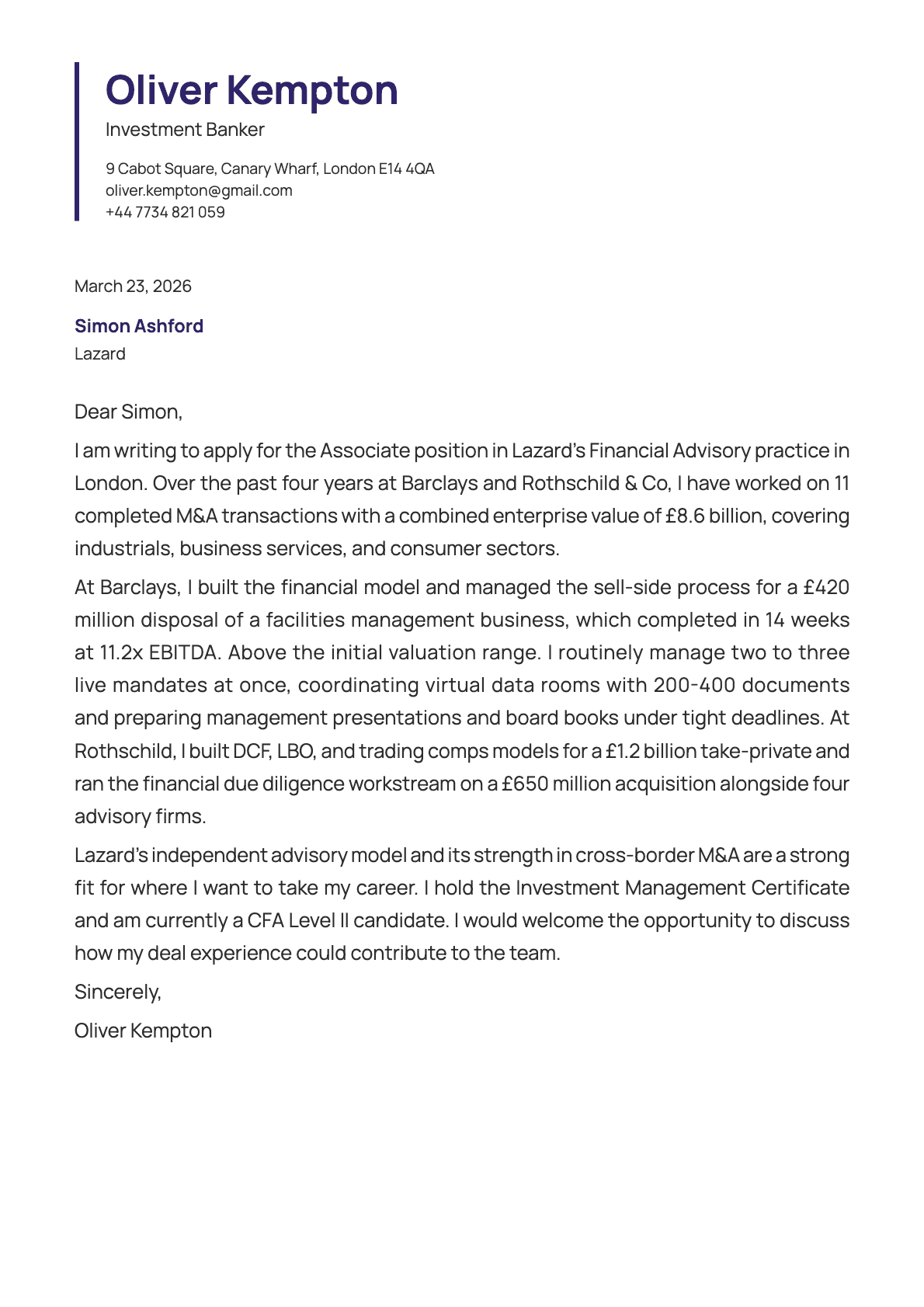
Investment Banker
An investment banking cover letter example targeting an associate role at Lazard.
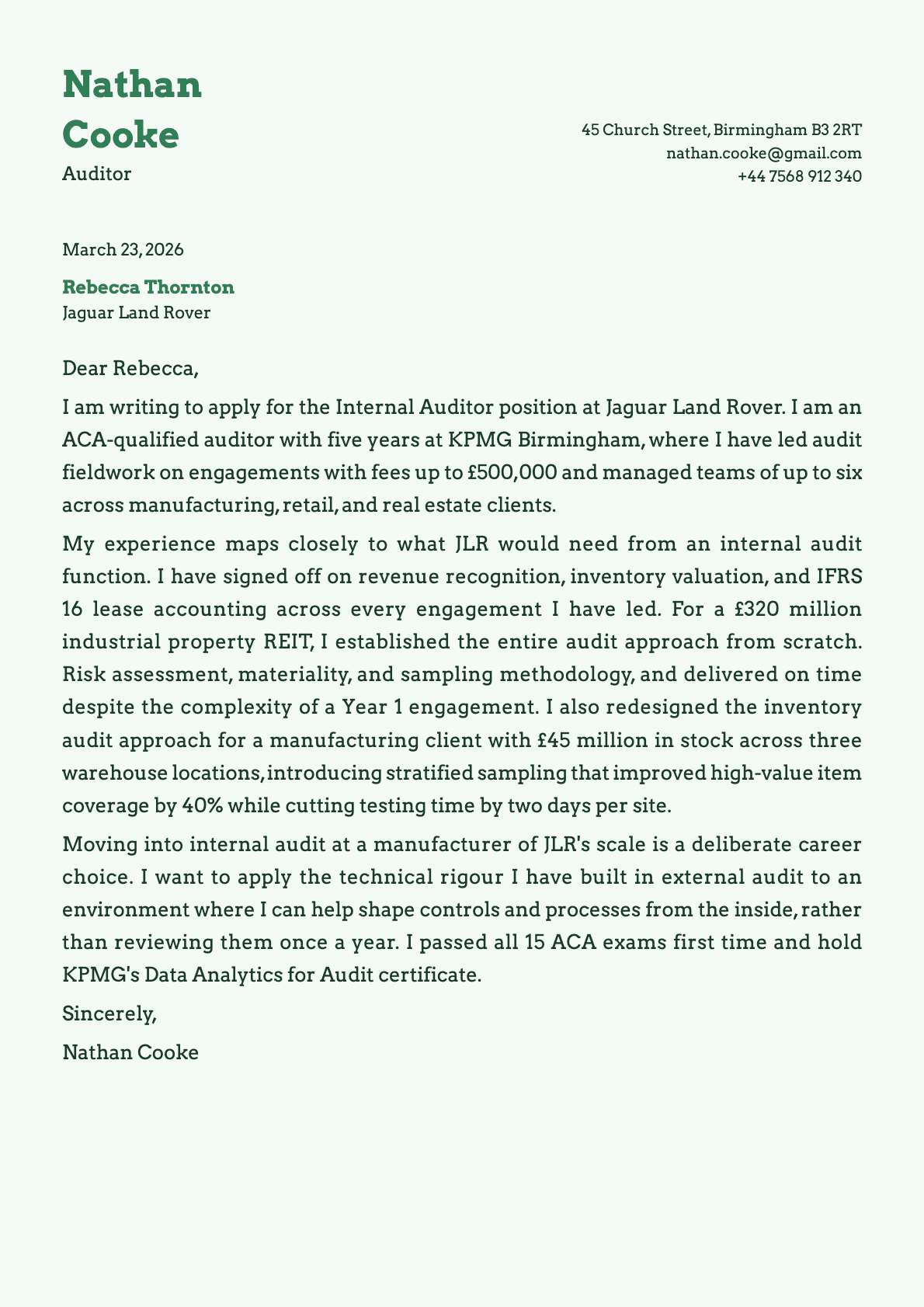
Auditor
An ACA-qualified auditor cover letter example targeting an internal audit role at Jaguar Land Rover.
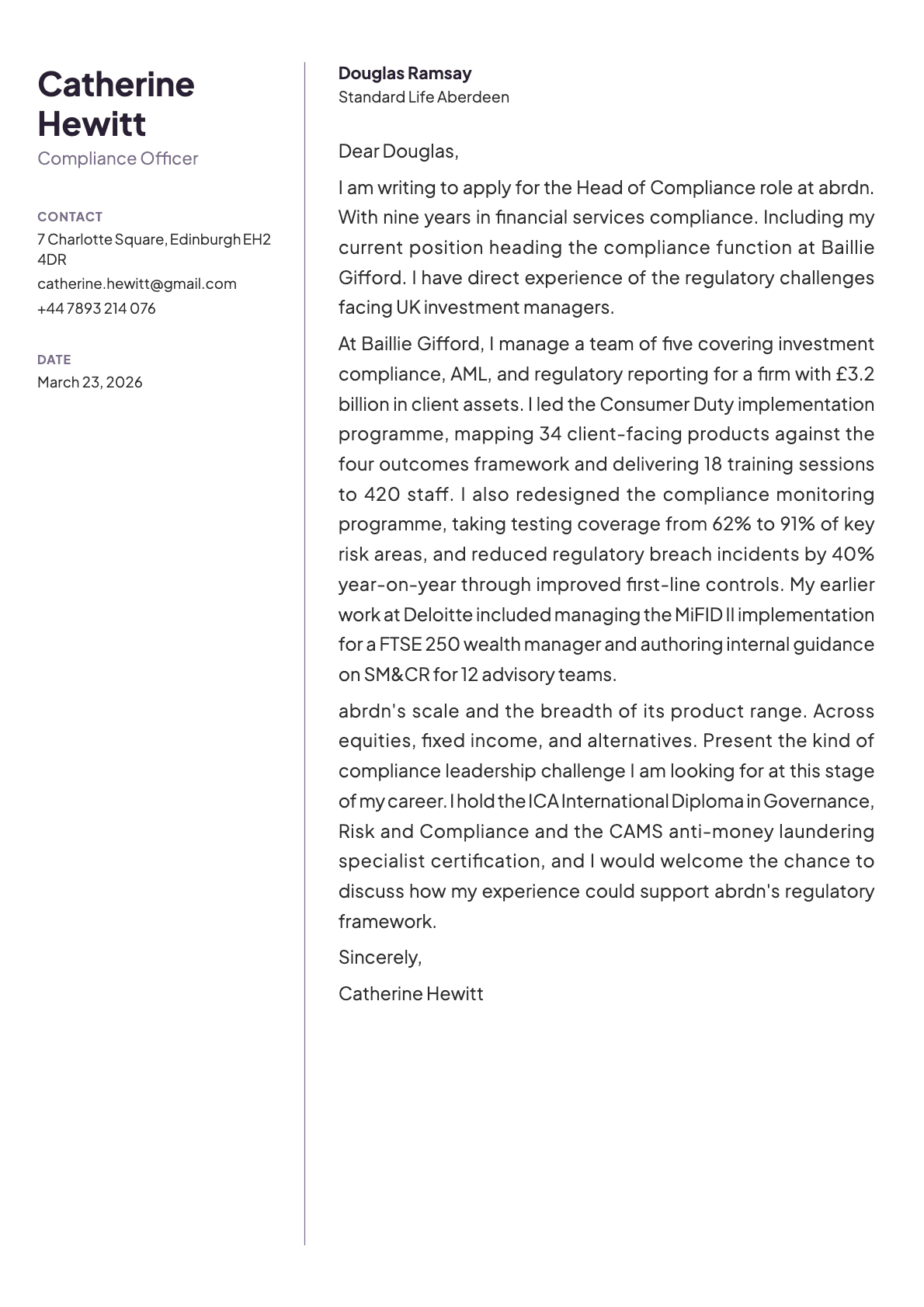
Compliance Officer
A compliance officer cover letter example for a senior role at abrdn.
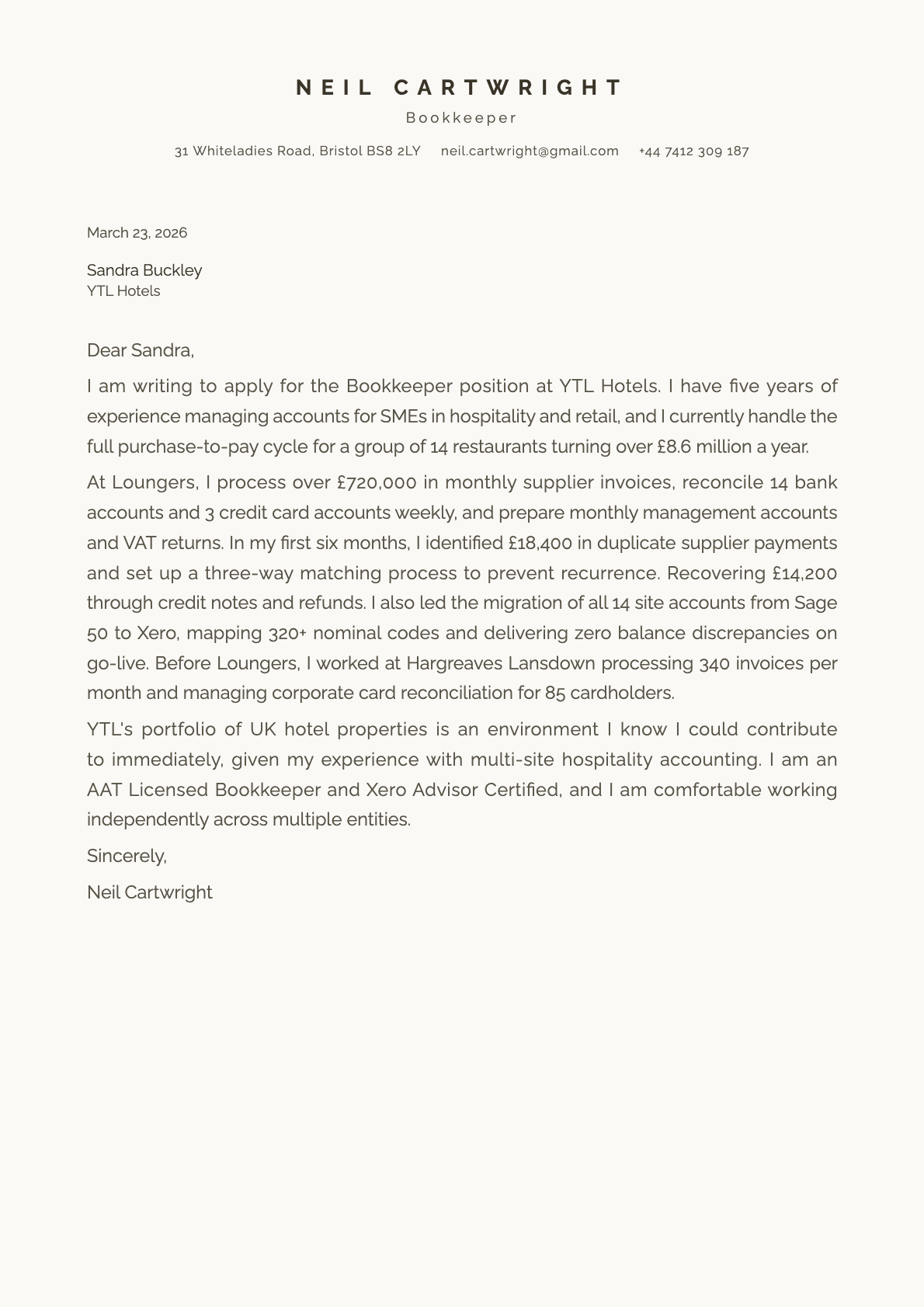
Bookkeeper
A bookkeeper cover letter example for a multi-site hospitality role at YTL Hotels.
Related articles

AI Is Screening Your Resume Before Any Human Sees It
AI screens most resumes before a human ever reads them. 97.4% of Fortune 500 companies run an ATS. This is what that means for you and what you can do about it.

The Best Resume Builders in 2026, Compared Honestly
Resume.io, Zety, Enhancv, Kickresume, Teal, and Laddro compared honestly: real pricing, free tiers, mobile apps, and where each tool wins. All prices checked in September 2026.

Burnout Recovery: A Real Timeline, Not 'Take a Bubble Bath'
55% of the U.S. workforce is burned out. Recovery takes 3 to 12 months. Here's what that actually looks like, stage by stage.