Accountant Cover Letter Example
An accountant cover letter example showing how to present IFRS expertise, audit coordination, and financial reporting skills when applying to a FTSE 100.

Laddro Team
Free to use. No account needed to start.
Free to use. No account needed to start.
What makes an accountant cover letter hard to get right
Accounting is a profession built on precision, yet most accountant cover letters are surprisingly vague. Candidates write about "strong attention to detail" and "excellent analytical skills" without offering a single number to prove it. The hiring manager at a financial services firm has seen hundreds of these. They all blend together.
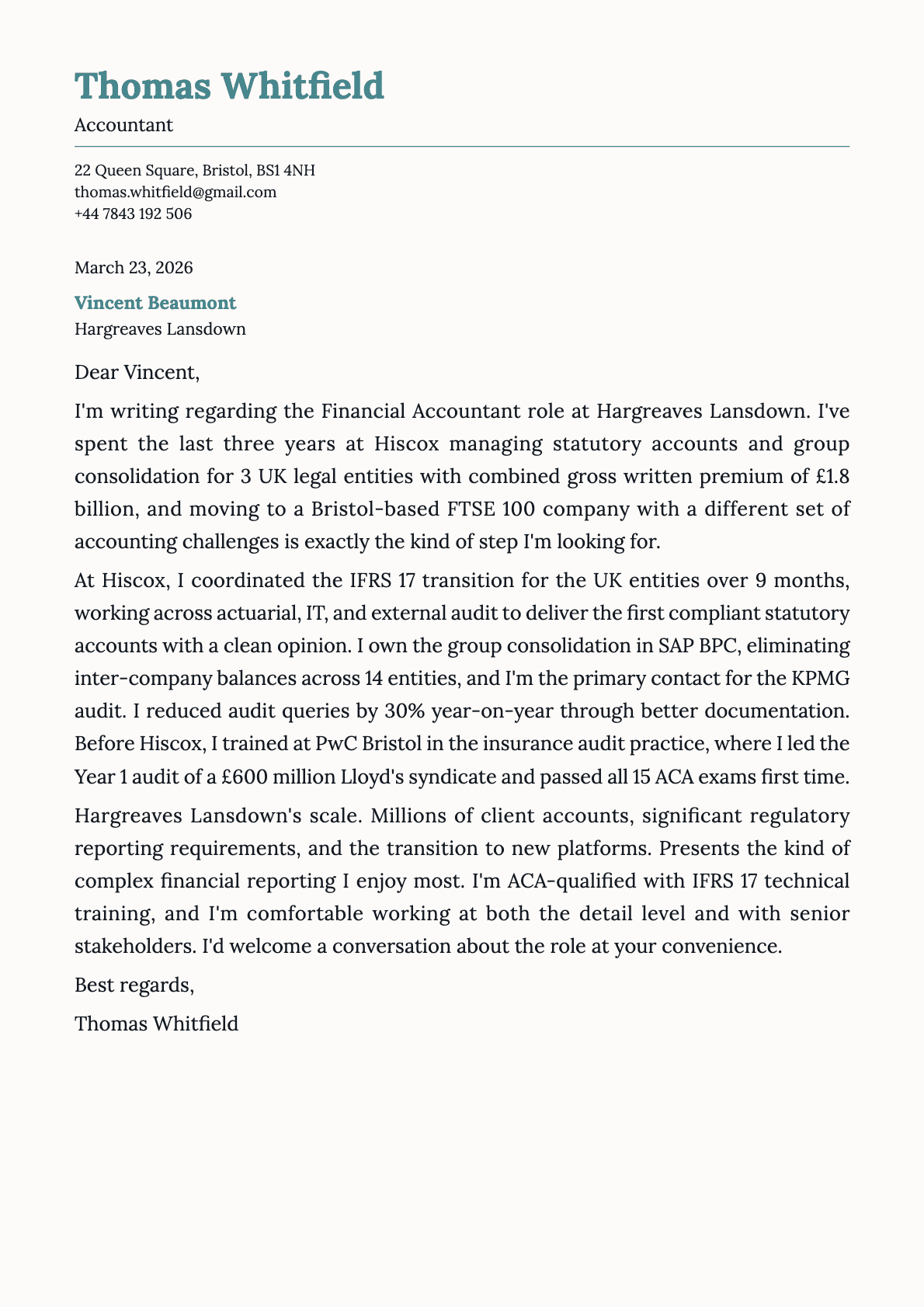
The cover letter that stands out does the opposite. It treats the application the way a good accountant treats a set of accounts: everything is specific, supported, and verifiable. This example from Thomas Whitfield, an ACA-qualified accountant applying to Hargreaves Lansdown, shows how.
Thomas currently works at Hiscox managing statutory accounts and group consolidation for three UK legal entities. He is applying for a Financial Accountant role at a FTSE 100 company in Bristol. His letter works because every claim has a number behind it.
Lead with your most relevant accomplishment
Thomas opens by naming the role and immediately establishing credibility. He does not start with "I am a dedicated accounting professional." He starts with what he does: managing statutory accounts for entities with combined gross written premium of 1.8 billion pounds.
That single detail tells the hiring manager three things. He works at a serious scale. He understands insurance accounting. And he is comfortable with the complexity that comes with regulatory financial reporting.
Your takeaway: Open with the accomplishment that is closest to what the target role requires. If the job involves group consolidation, lead with your consolidation experience. If it involves audit, lead with your audit track record.
Show technical depth through project work
The middle of Thomas's letter is where he differentiates himself from every other ACA-qualified candidate. He describes coordinating the IFRS 17 transition for UK entities over nine months, working across actuarial, IT, and external audit teams. He mentions owning the group consolidation in SAP BPC across 14 entities. He notes that he reduced audit queries by 30% year-on-year.
These are not generic skills. They are specific projects with measurable outcomes. The hiring manager can picture exactly what Thomas does at work, which makes it easy to imagine him in the new role.
Your takeaway: Pick two or three projects that demonstrate your technical range. For each one, include the scope (how many entities, how large the budget) and the result (clean audit opinion, reduced queries, delivered on time).
Connect your background to the target company
Thomas closes by naming what attracts him to Hargreaves Lansdown specifically: millions of client accounts, significant regulatory reporting requirements, and the transition to new platforms. This shows he has researched the company and understands its current challenges.
Compare that to a generic closing like "I would welcome the opportunity to contribute to your finance team." One shows genuine interest. The other could be sent to any company in the country.
What to include in your accountant cover letter
Based on this example, here is what works:
- Specific financial figures that demonstrate scale (revenue, premium, entities managed)
- Technical standards and systems mentioned in context (IFRS 17, SAP BPC, not just listed)
- Audit relationships and how you have improved them
- Professional qualifications stated briefly (ACA, ACCA, CIMA)
- A clear reason for wanting this particular company
Common mistakes to avoid
Do not list every accounting software you have ever used. Do not describe yourself as a "team player with strong communication skills." Do not repeat your CV in paragraph form. And do not open with the year you graduated. The hiring manager cares about what you can do now, not what you studied a decade ago.
How long should it be?
Thomas keeps his letter to about 280 words across three focused paragraphs. That is ideal. Accountants sometimes feel they need to be exhaustive, but a cover letter is not an annual report. Say enough to earn the interview and stop.
Final thoughts
A strong accountant cover letter proves that you can do more than process numbers. It shows that you understand the business context of those numbers, that you have delivered real improvements, and that you have thought carefully about why this role at this company makes sense for your career. Write it with the same rigour you would apply to a set of financial statements.
Was this cover letter example helpful?
Rate this example to help us create better content for you.
4.7 average from 142 ratingsBuild your own version
Open this layout in the builder and swap in your own details. It takes a few minutes.
Free to use. No account needed to start.
Related cover letter examples
Financial Analyst
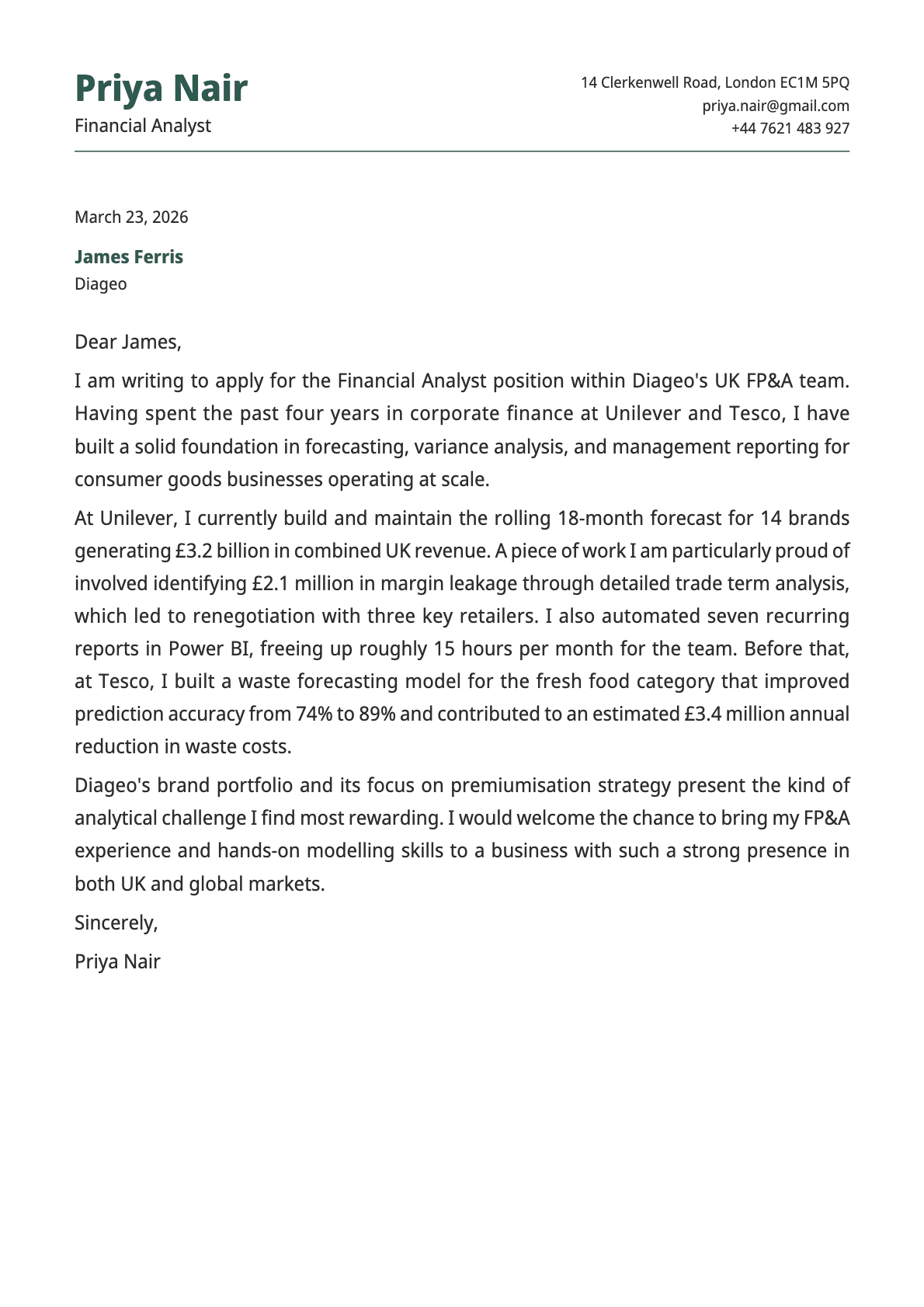
A financial analyst cover letter example targeting an FP&A role at Diageo. See how to present forecasting skills, variance analysis, and commercial impact.
Management Consultant
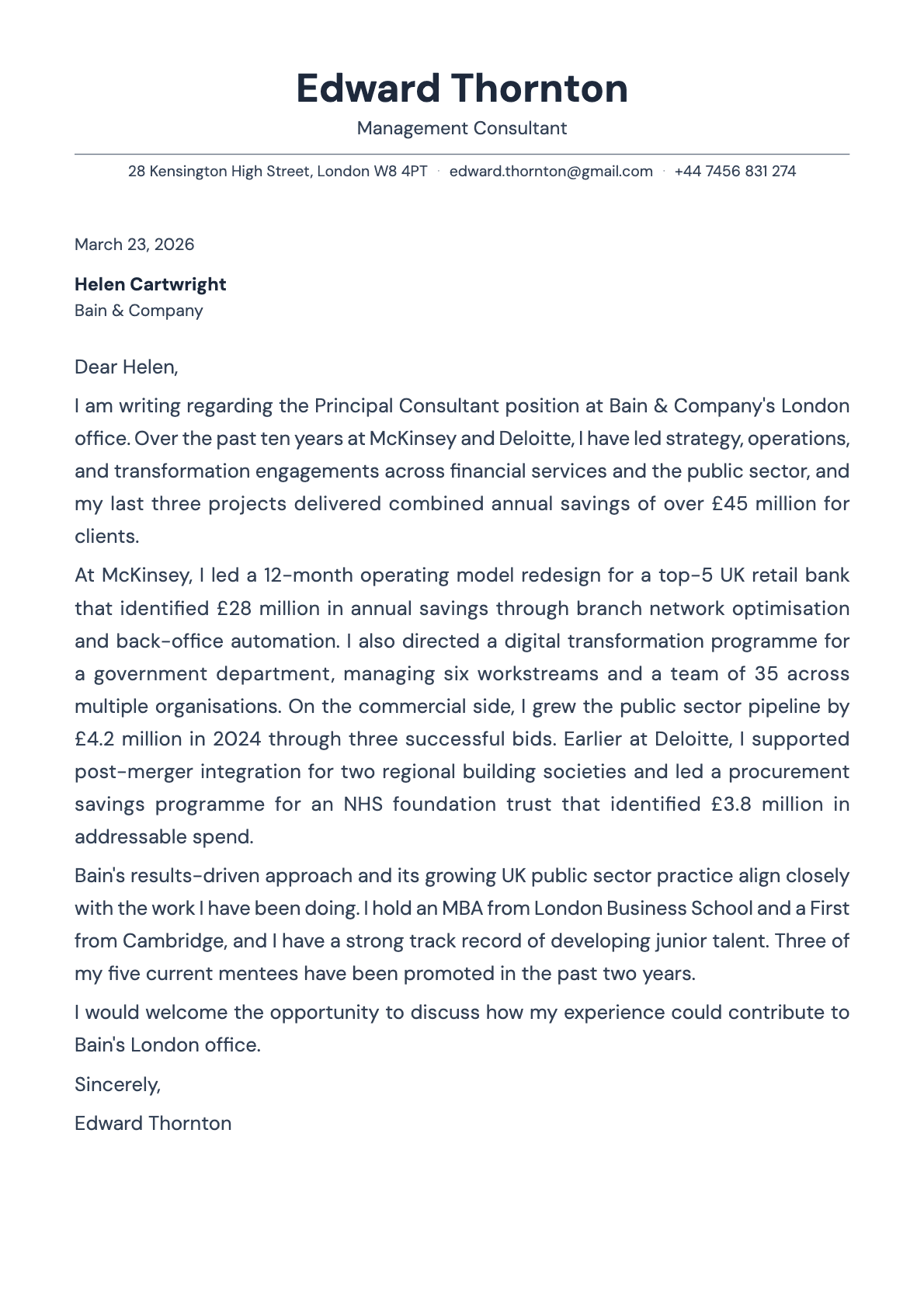
A management consultant cover letter example targeting Bain & Company. See how to present engagement results, team leadership, and business development.
Business Analyst
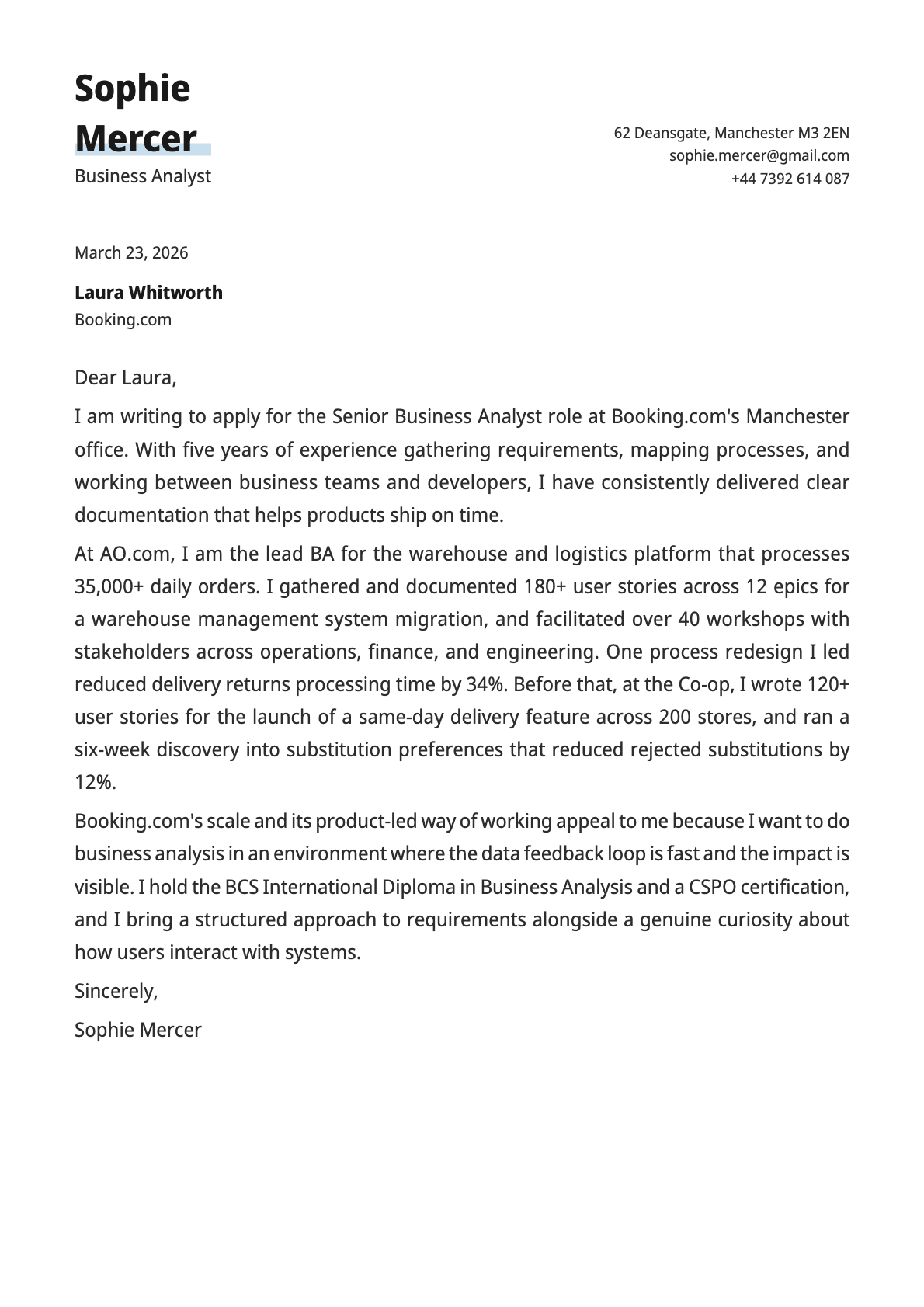
A business analyst cover letter example for a senior BA role at Booking.com.
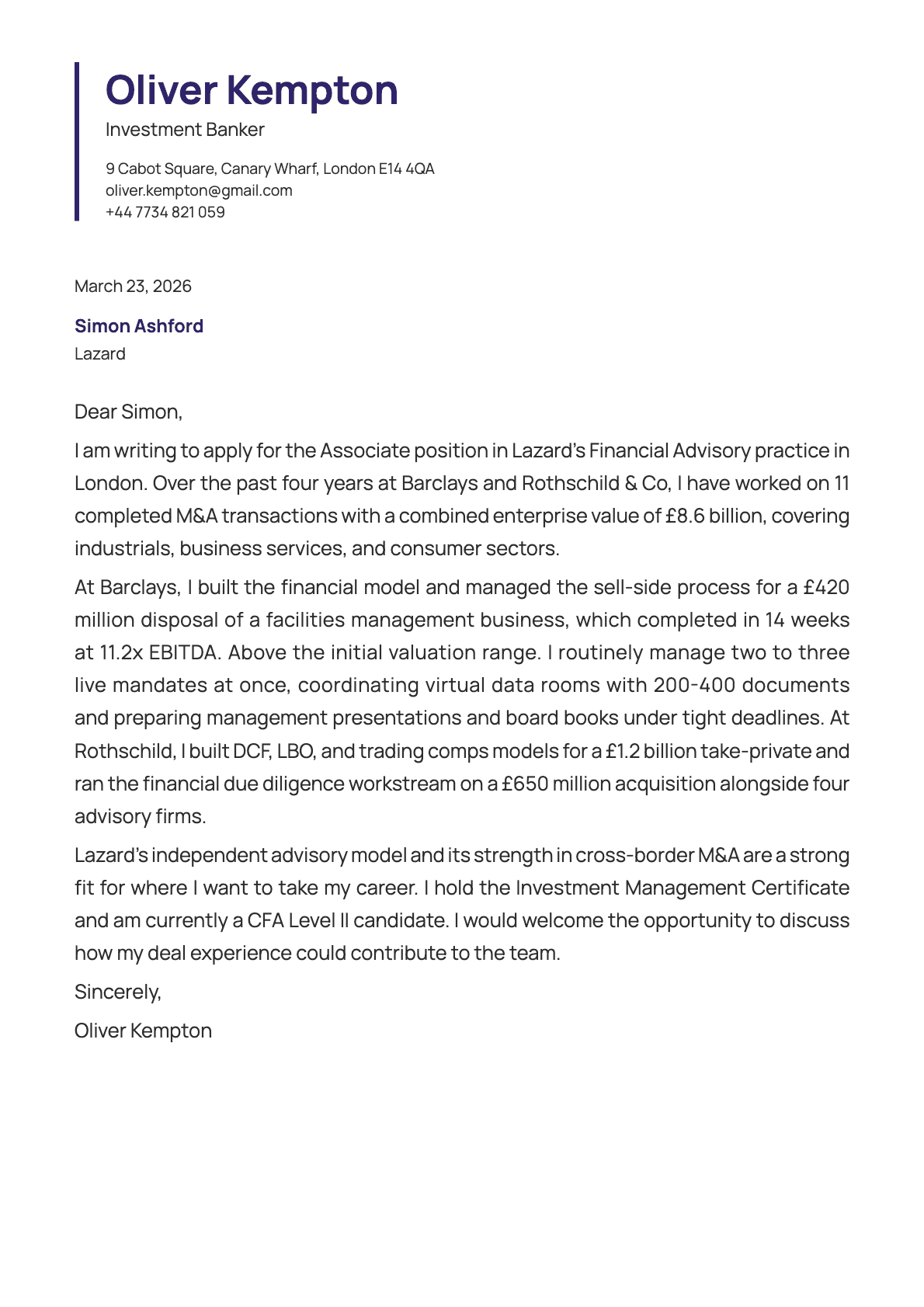
Investment Banker
An investment banking cover letter example targeting an associate role at Lazard.
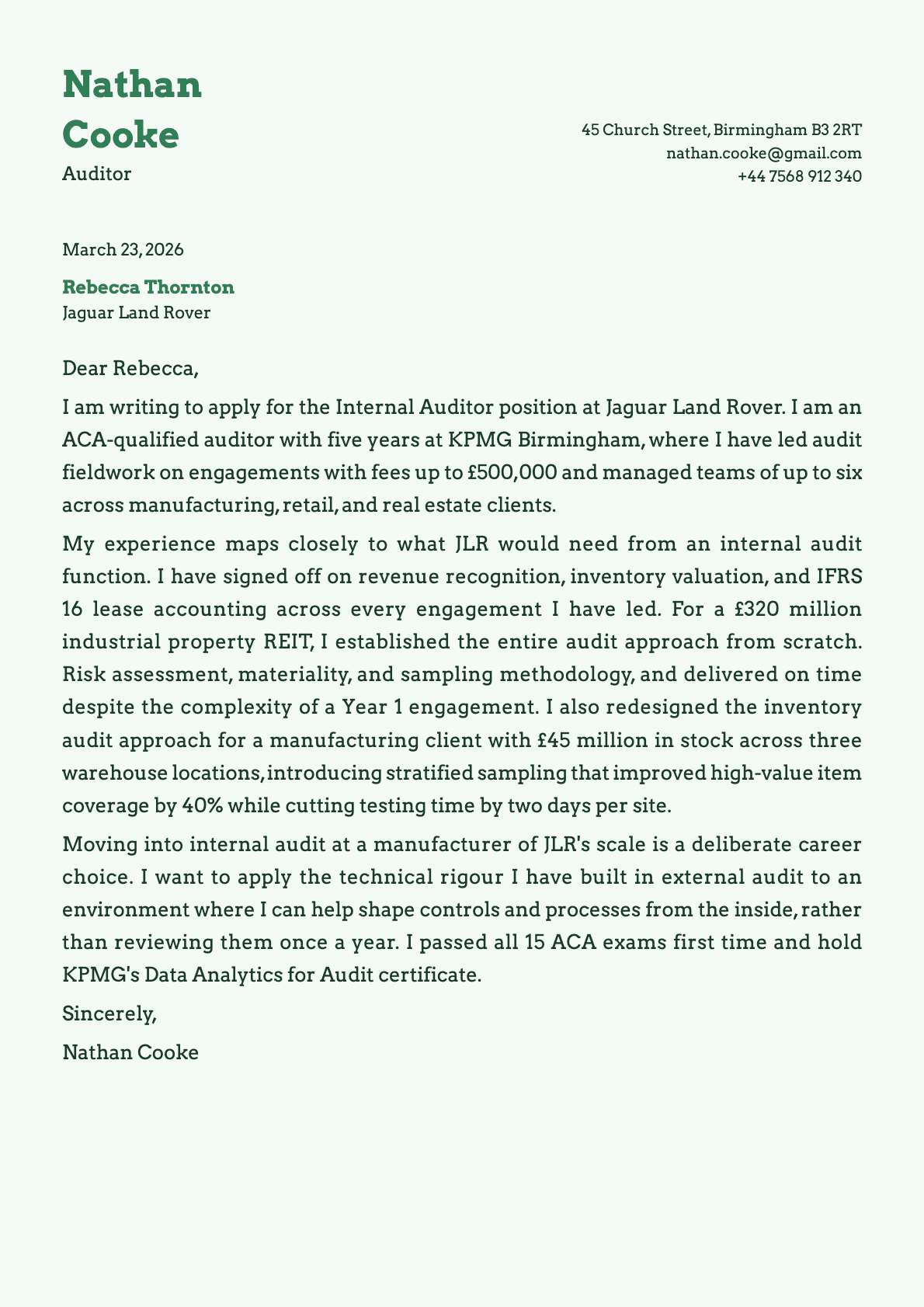
Auditor
An ACA-qualified auditor cover letter example targeting an internal audit role at Jaguar Land Rover.
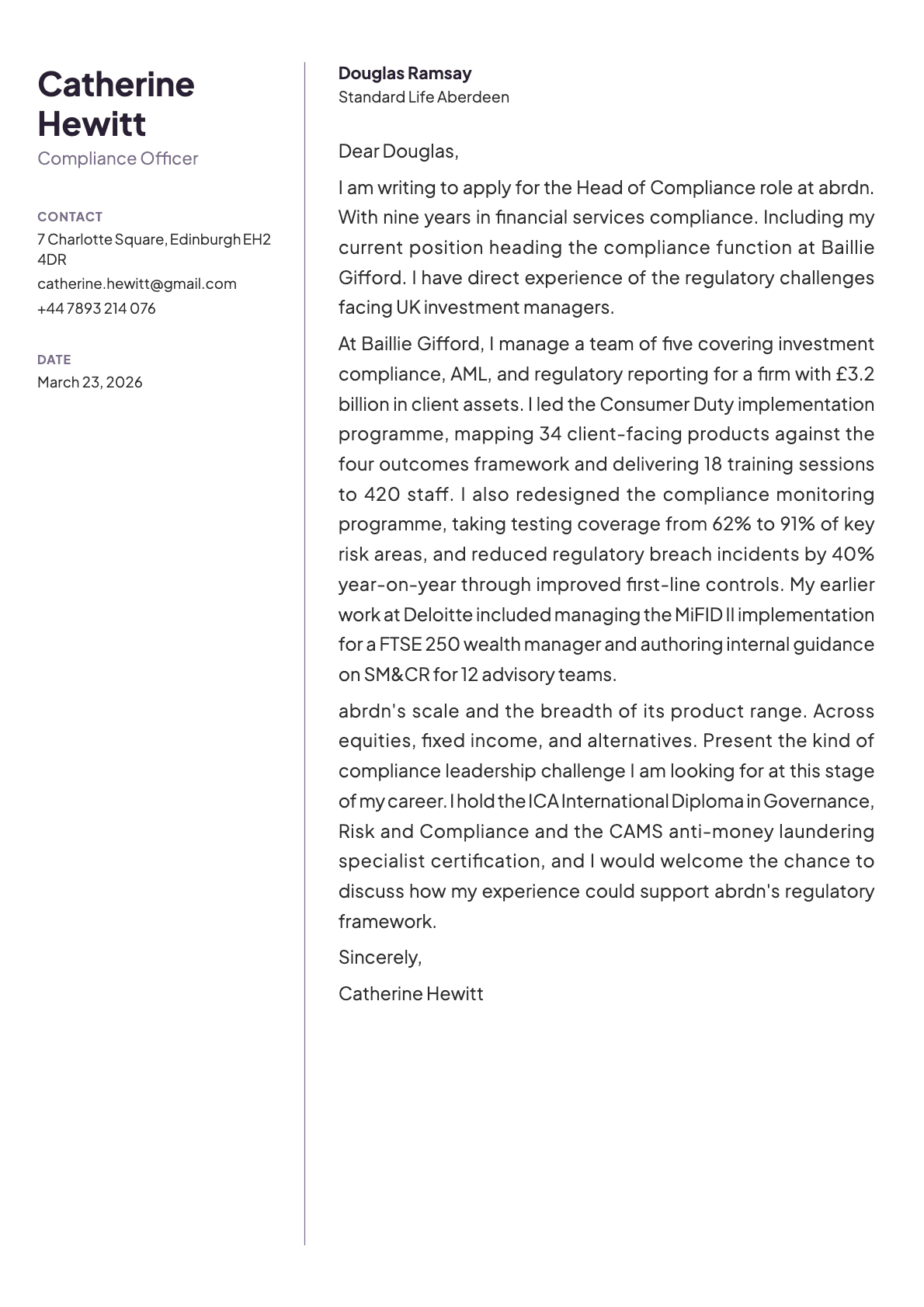
Compliance Officer
A compliance officer cover letter example for a senior role at abrdn.
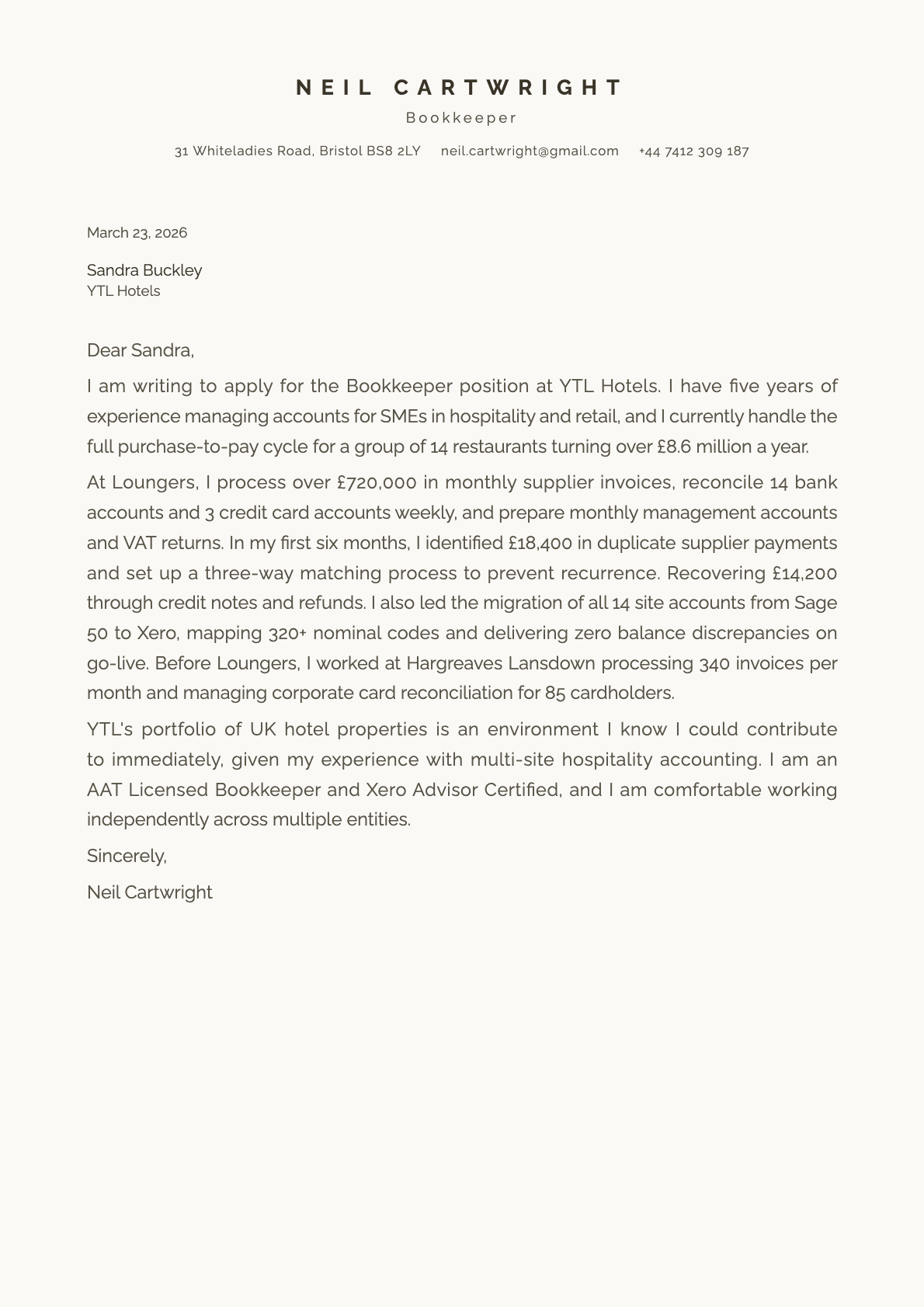
Bookkeeper
A bookkeeper cover letter example for a multi-site hospitality role at YTL Hotels.
Related articles

AI Is Screening Your Resume Before Any Human Sees It
AI screens most resumes before a human ever reads them. 97.4% of Fortune 500 companies run an ATS. This is what that means for you and what you can do about it.

The Best Resume Builders in 2026, Compared Honestly
Resume.io, Zety, Enhancv, Kickresume, Teal, and Laddro compared honestly: real pricing, free tiers, mobile apps, and where each tool wins. All prices checked in September 2026.

Burnout Recovery: A Real Timeline, Not 'Take a Bubble Bath'
55% of the U.S. workforce is burned out. Recovery takes 3 to 12 months. Here's what that actually looks like, stage by stage.