Investment Banker Cover Letter Example
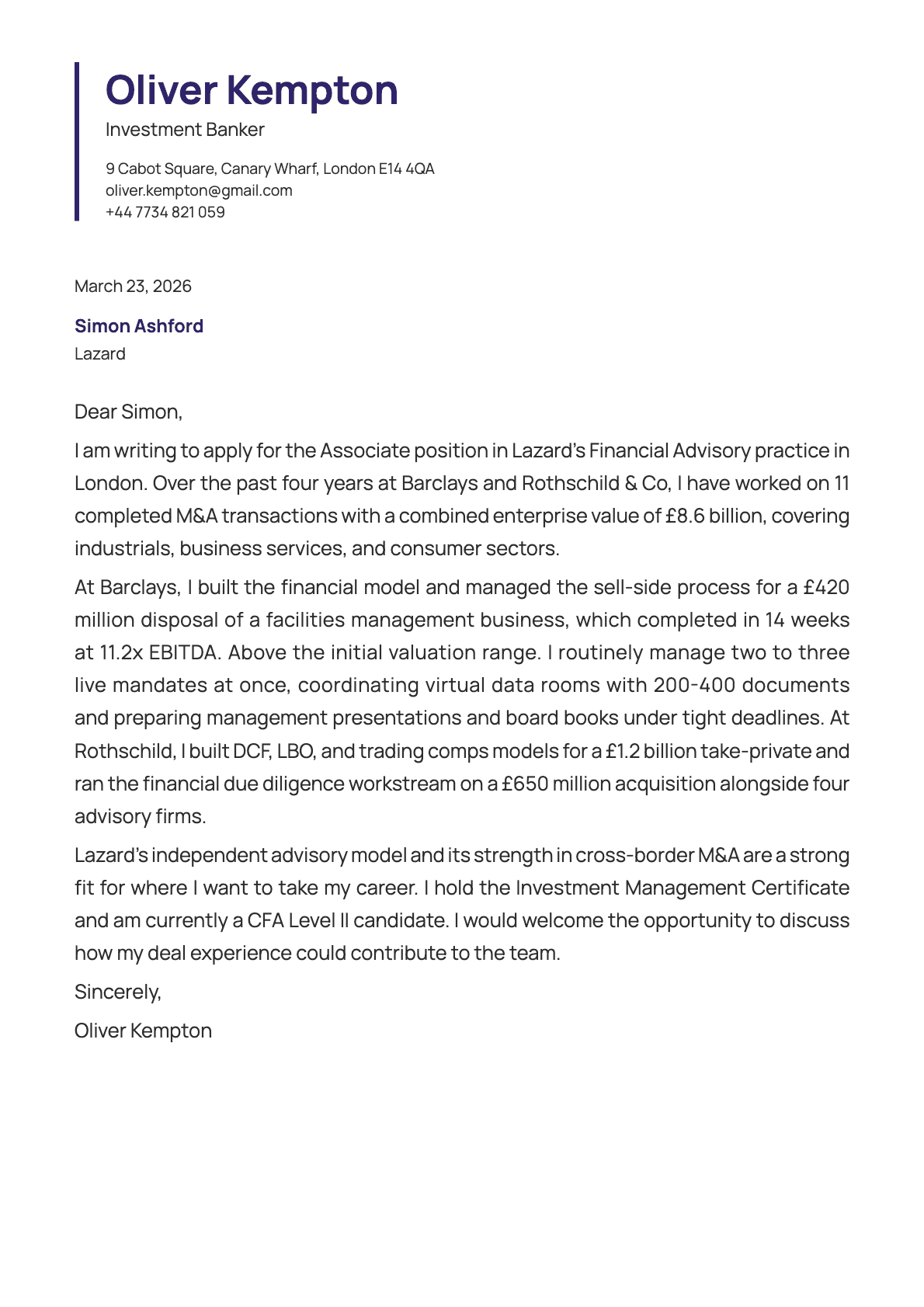
An investment banking cover letter example targeting an associate role at Lazard.

Laddro Team
Free to use. No account needed to start.
Free to use. No account needed to start.
Overview
Investment banking cover letters need to be precise, concise, and backed by deal evidence. The hiring managers reading these letters have usually spent years in the industry themselves. They will notice immediately if you pad your letter with soft language or fail to mention the specifics of your transaction experience. This is a profession where the numbers are the story.
This cover letter belongs to Oliver Kempton, an investment banker with four years at Barclays and Rothschild & Co, applying for an Associate role in Lazard's Financial Advisory practice. His letter works because it reads like a deal sheet in paragraph form. Every sentence either names a transaction, a valuation multiple, or a specific skill.
The opening: deal count and enterprise value
Oliver opens with a summary that a senior banker can evaluate in five seconds: 11 completed transactions, £8.6 billion combined enterprise value, covering industrials, business services, and consumer sectors.
Over the past four years at Barclays and Rothschild & Co, I have worked on 11 completed M&A transactions with a combined enterprise value of £8.6 billion, covering industrials, business services, and consumer sectors.
This is the right approach. In investment banking, your credibility comes from the deals you have worked on. The total count, the aggregate value, and the sector coverage give the reader a quick snapshot of your experience level. If you have worked on fewer deals, that is fine, but you still need to quantify what you have.
For your own letter: calculate your cumulative deal statistics before you start writing. Total number of completed transactions, combined enterprise value, and the sectors they covered. These are the numbers that anchor your credibility.
The body: deal details that show your contribution
The middle paragraph covers four transactions across two firms. The key here is that Oliver does not just list deals. He explains what he personally did on each one.
For the Barclays sell-side, he "built the financial model and managed the sell-side process." He notes the outcome (completed in 14 weeks, 11.2x EBITDA, above initial range). For the Rothschild take-private, he "built DCF, LBO, and trading comps models" and "ran the financial due diligence workstream." These are specific contributions, not vague participation claims.
He also includes an operational detail about managing virtual data rooms with 200-400 documents and handling multiple live mandates simultaneously. This signals that he can manage the logistical demands of the role, not just the analytical ones.
The important principle: always distinguish between deals you worked on and deals you led or had a significant individual contribution to. "Worked on" is fine for context, but hiring managers want to know what you personally built, managed, or delivered.
The closing: why this firm, plus credentials
Oliver's closing is direct. He connects Lazard's independent advisory model and cross-border M&A strength to his own career direction. This is effective because it shows he has thought about why Lazard specifically, not just any bank.
He then mentions the IMC and CFA Level II candidacy. In banking, professional qualifications signal commitment and technical credibility. If you hold or are pursuing the CFA, IMC, or similar certifications, include them.
What this letter does well
The letter is efficient. Every sentence carries information. There is no throat-clearing, no generic enthusiasm, and no padding. Oliver writes the way a good banker presents: clean, structured, and evidence-based.
The balance between Barclays and Rothschild examples is also smart. It shows he has experience at both a bulge bracket and a boutique advisory firm, which gives him a broader perspective that is relevant to Lazard's pure advisory model.
Mistakes to avoid in investment banking cover letters
Being vague about your deal experience. "Supported multiple M&A transactions" is not useful. Name the deal type (sell-side, buy-side, take-private), the enterprise value, the sector, and the outcome. If confidentiality prevents you from naming the client, describe the company in general terms (e.g., "a £420 million facilities management business").
Overemphasising technical skills without context. Saying you can build a DCF model is table stakes. What matters is the context: what deal was it for, how complex was the capital structure, and what decision did the model support?
Ignoring the firm's positioning. A letter for Lazard should acknowledge its independent advisory model. A letter for Goldman should reflect its full-service platform. Show that you understand what makes the firm different and why that matters to you.
Writing more than one page. Banking cover letters should be tight. Three paragraphs, no more. Senior bankers do not have time to read a full page of prose, and a concise letter demonstrates the communication discipline the job demands.
Was this cover letter example helpful?
Rate this example to help us create better content for you.
4.8 average from 118 ratingsBuild your own version
Open this layout in the builder and swap in your own details. It takes a few minutes.
Free to use. No account needed to start.
Related cover letter examples
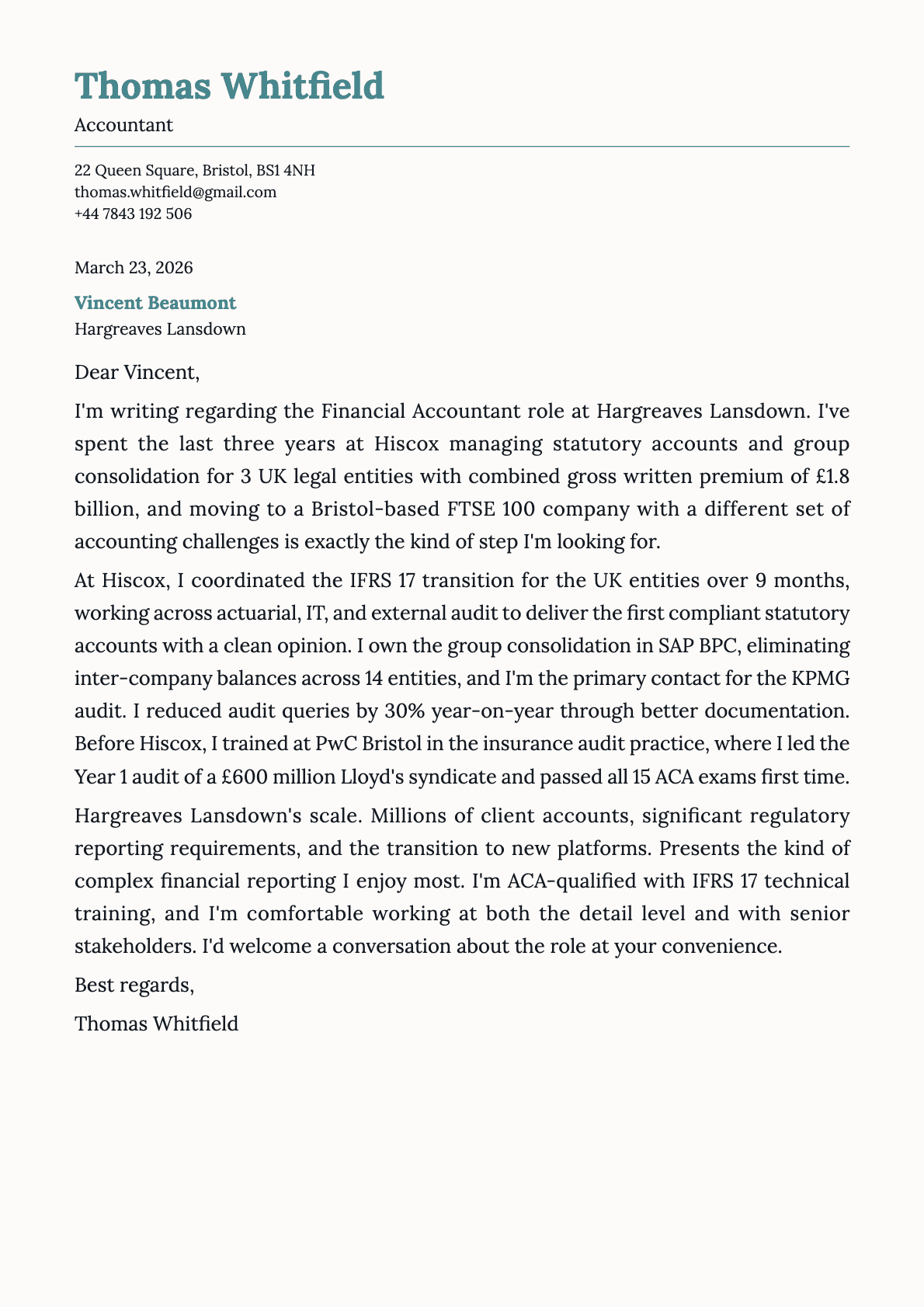
Accountant
An accountant cover letter example showing how to present IFRS expertise, audit coordination, and financial reporting skills when applying to a FTSE 100.
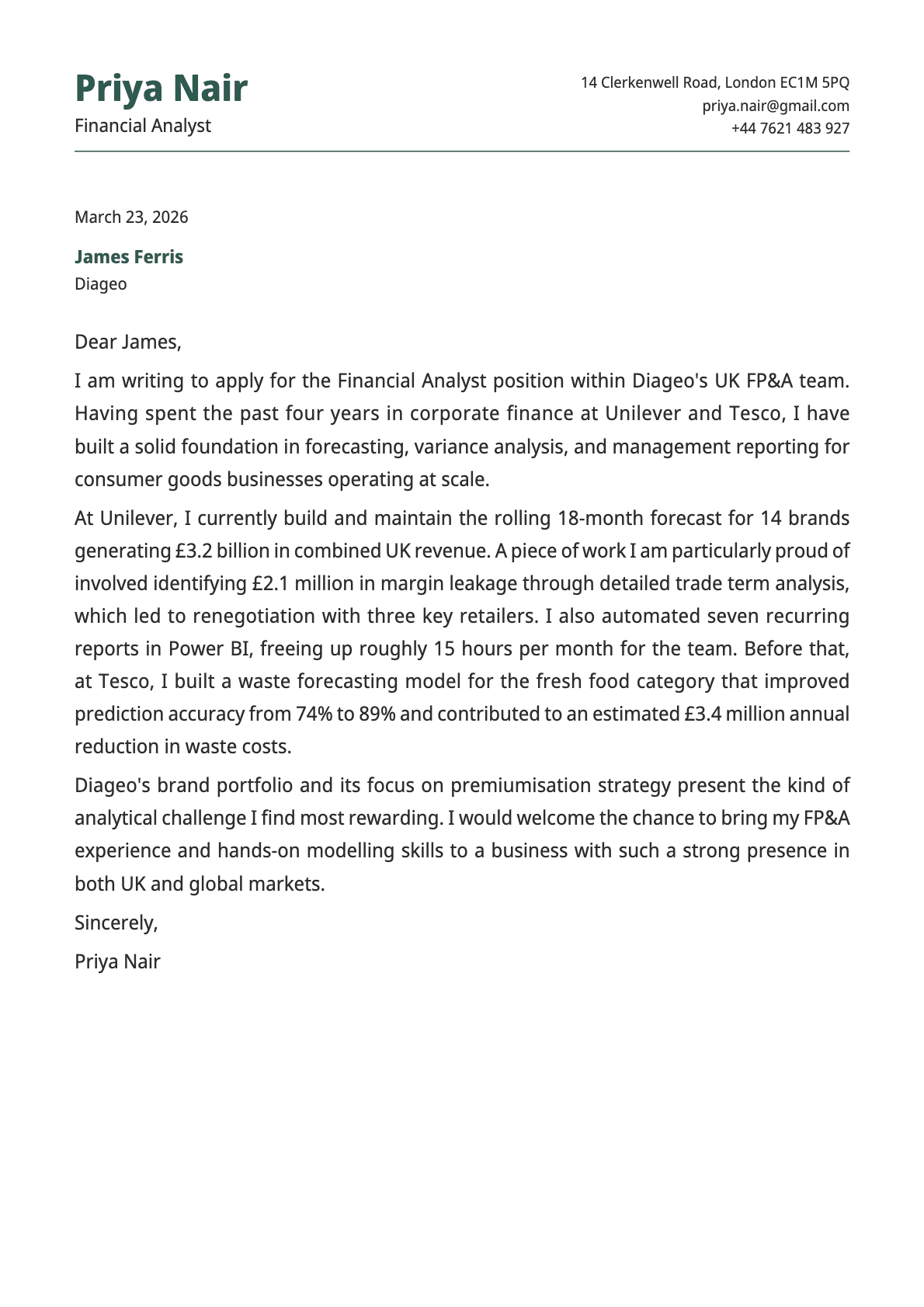
Financial Analyst
A financial analyst cover letter example targeting an FP&A role at Diageo. See how to present forecasting skills, variance analysis, and commercial impact.
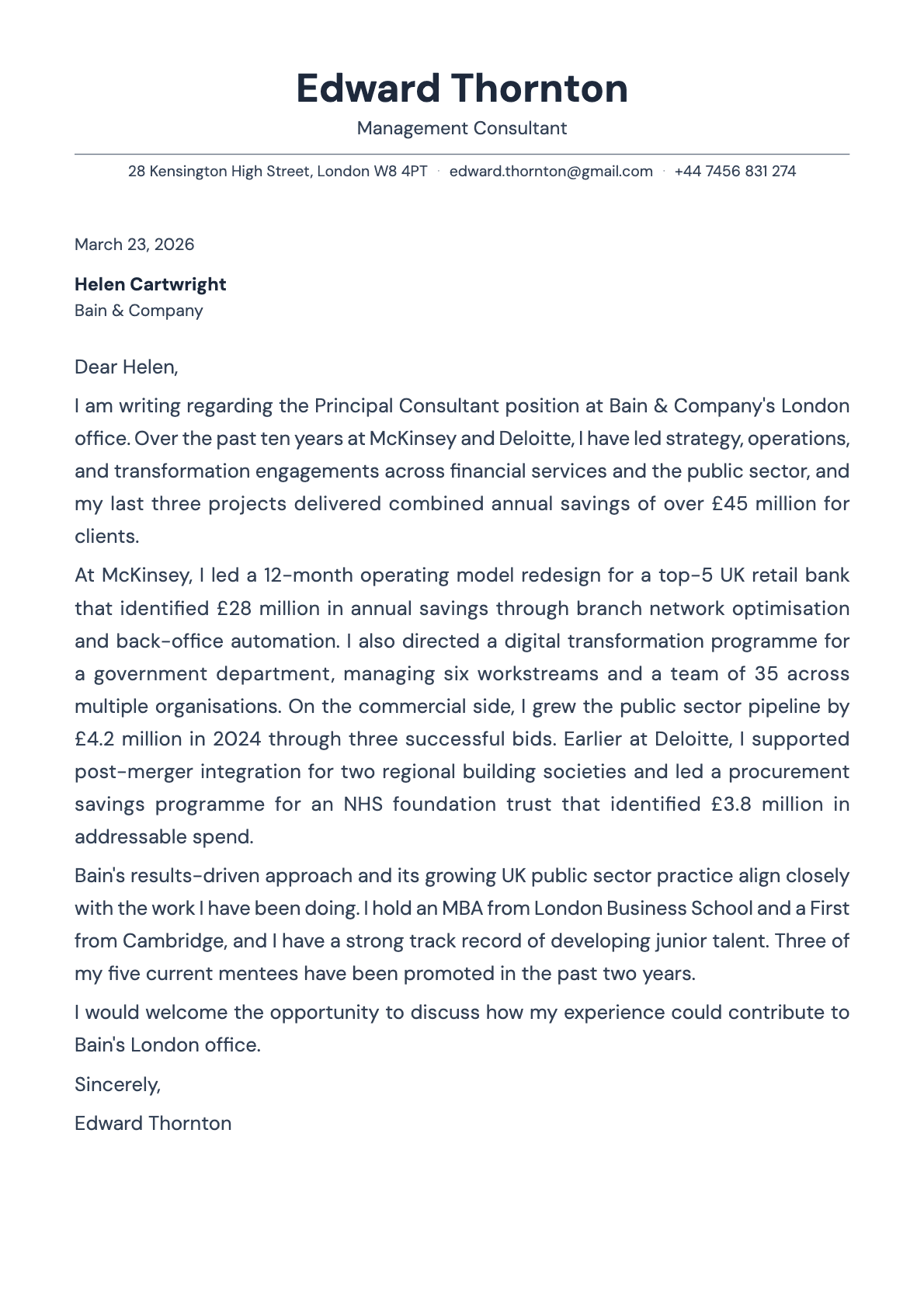
Management Consultant
A management consultant cover letter example targeting Bain & Company. See how to present engagement results, team leadership, and business development.
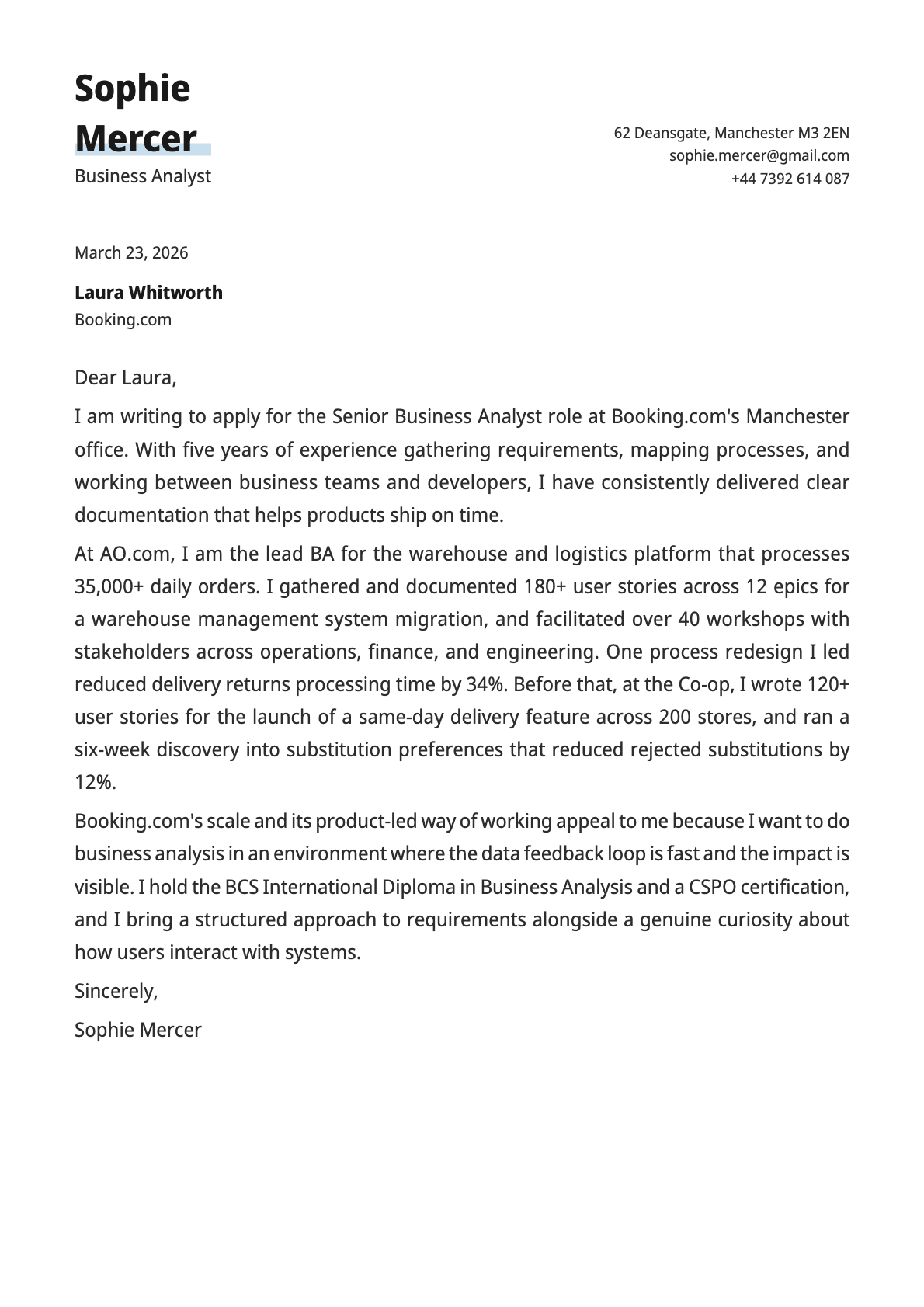
Business Analyst
A business analyst cover letter example for a senior BA role at Booking.com.
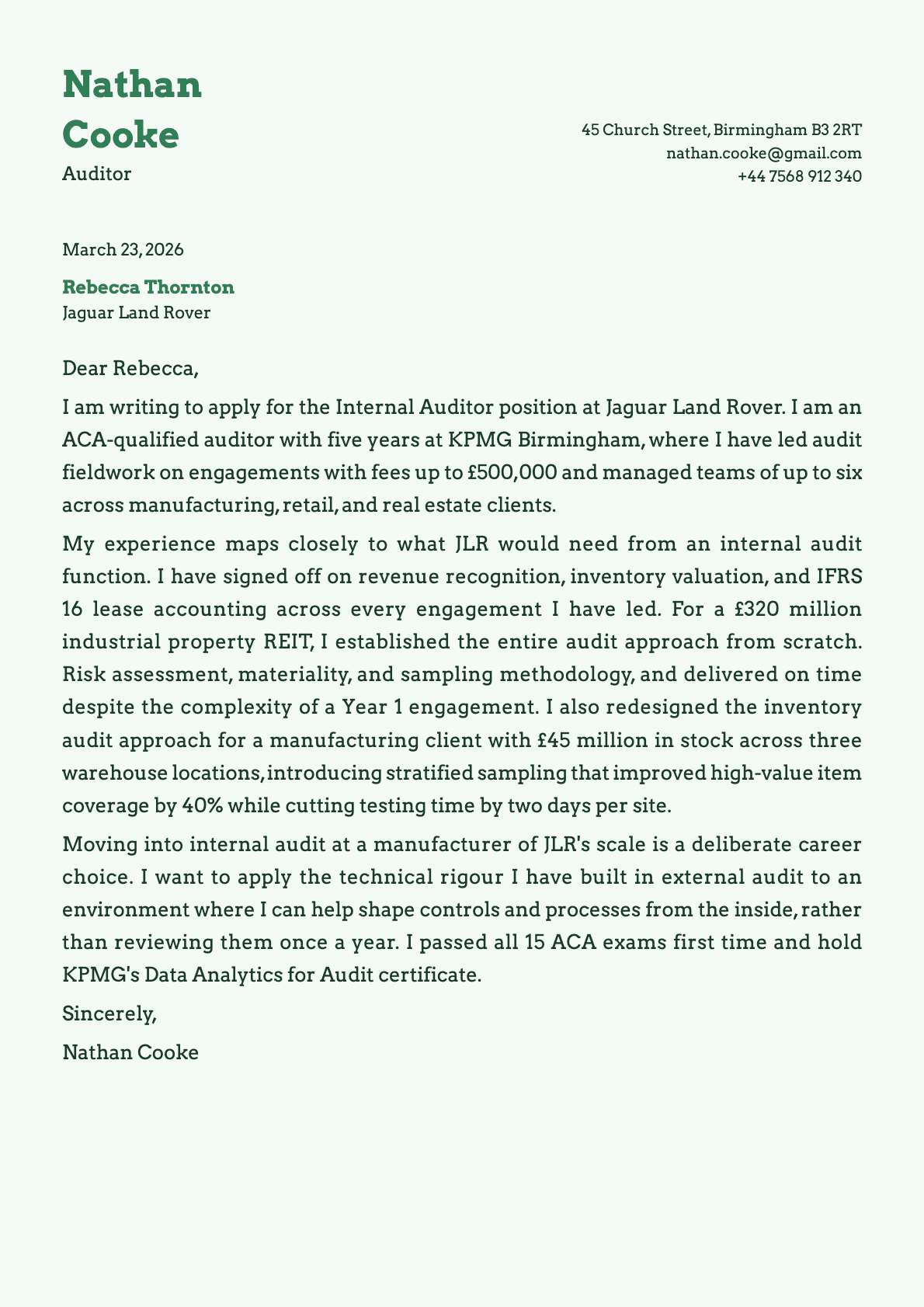
Auditor
An ACA-qualified auditor cover letter example targeting an internal audit role at Jaguar Land Rover.
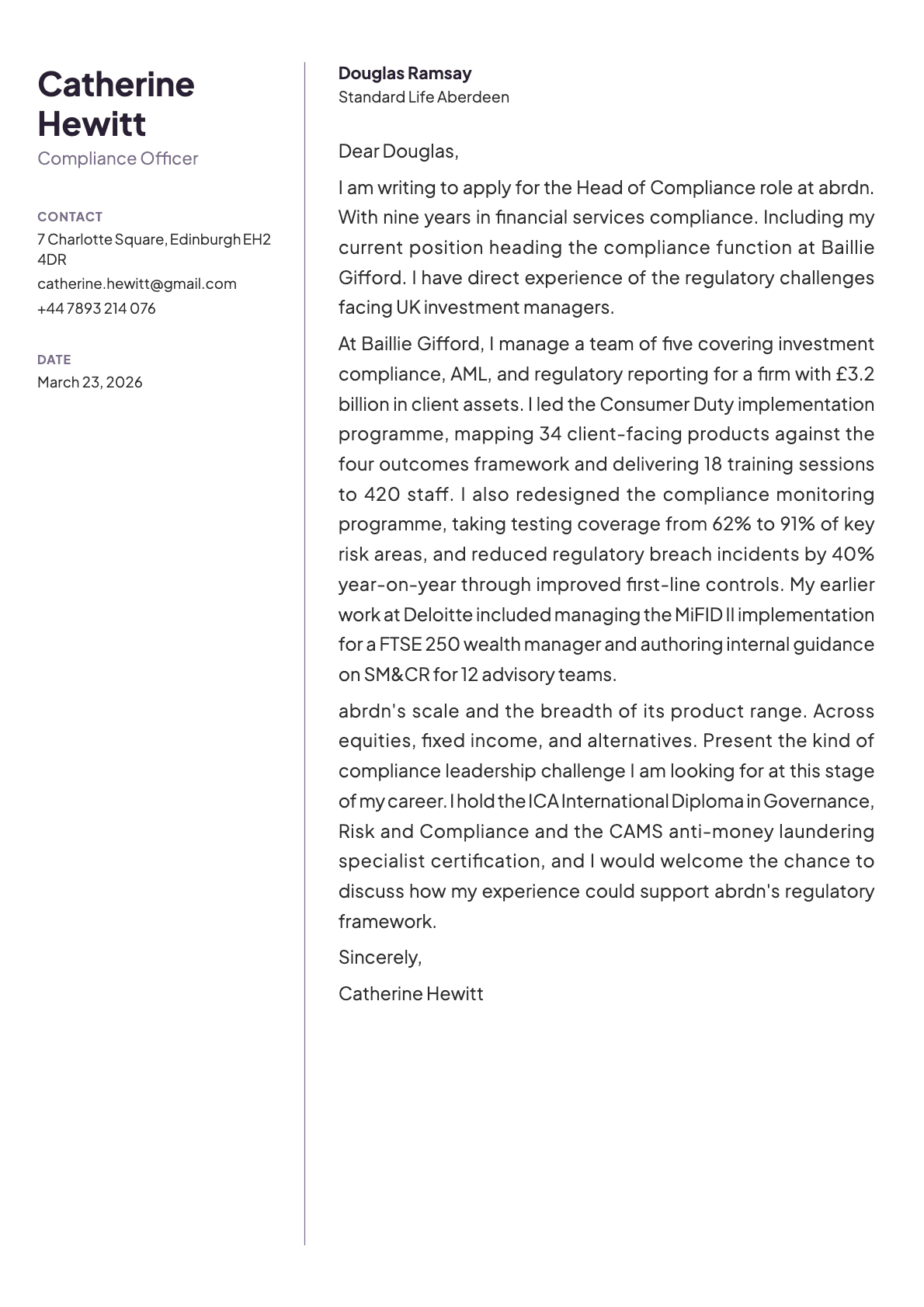
Compliance Officer
A compliance officer cover letter example for a senior role at abrdn.
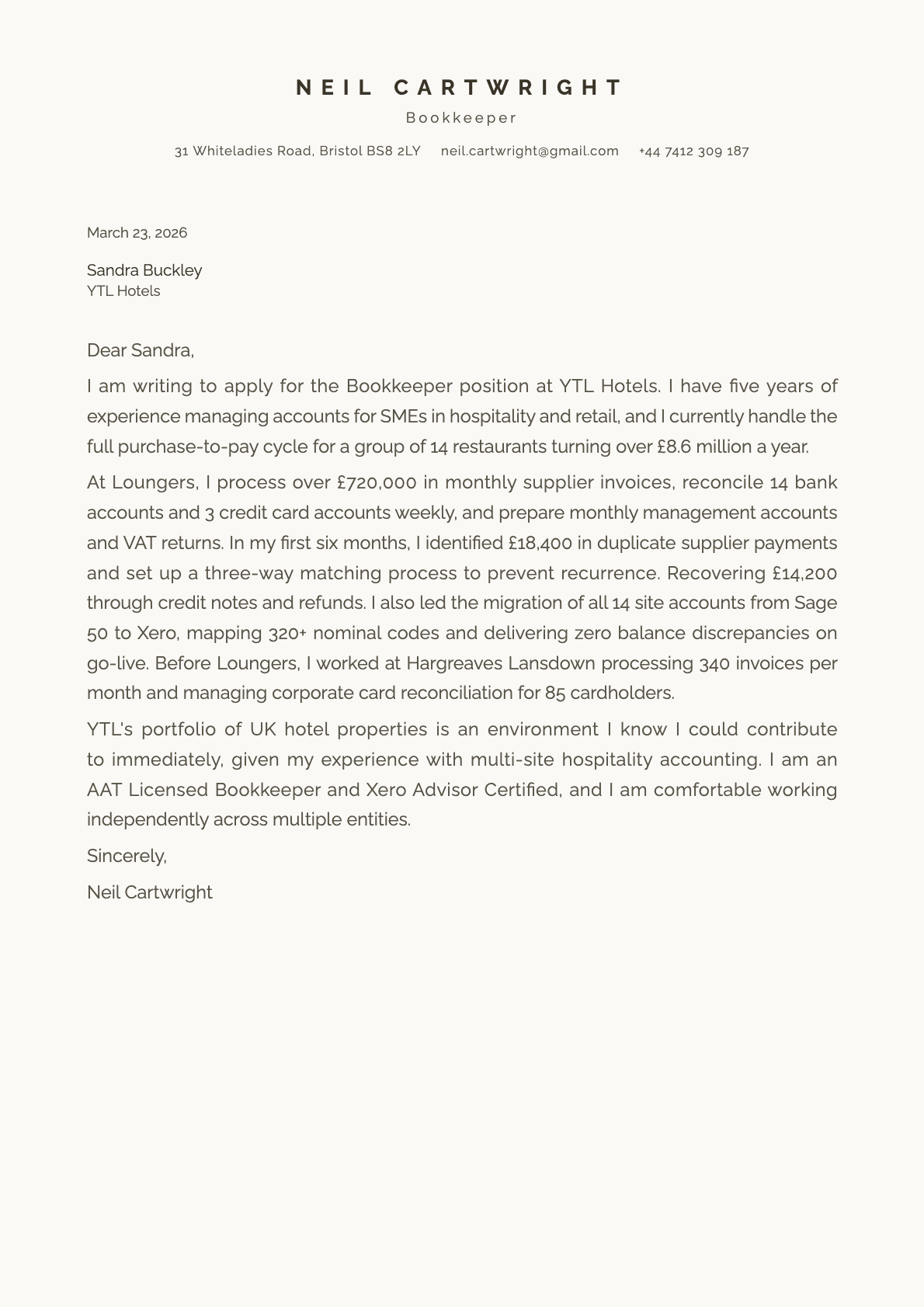
Bookkeeper
A bookkeeper cover letter example for a multi-site hospitality role at YTL Hotels.
Related articles

AI Is Screening Your Resume Before Any Human Sees It
AI screens most resumes before a human ever reads them. 97.4% of Fortune 500 companies run an ATS. This is what that means for you and what you can do about it.

The Best Resume Builders in 2026, Compared Honestly
Resume.io, Zety, Enhancv, Kickresume, Teal, and Laddro compared honestly: real pricing, free tiers, mobile apps, and where each tool wins. All prices checked in September 2026.

Burnout Recovery: A Real Timeline, Not 'Take a Bubble Bath'
55% of the U.S. workforce is burned out. Recovery takes 3 to 12 months. Here's what that actually looks like, stage by stage.