Financial Analyst Cover Letter Example
A financial analyst cover letter example targeting an FP&A role at Diageo. See how to present forecasting skills, variance analysis, and commercial impact.

Laddro Team
Free to use. No account needed to start.
Free to use. No account needed to start.
Overview
Financial analyst cover letters are often painfully generic. "I am a detail-oriented professional with strong analytical skills and a passion for finance." That sentence could belong to literally any candidate who has ever opened a spreadsheet. Hiring managers in FP&A teams want something different. They want to know the size of the numbers you work with, the tools you use, and whether you have ever found something that actually changed a business decision.
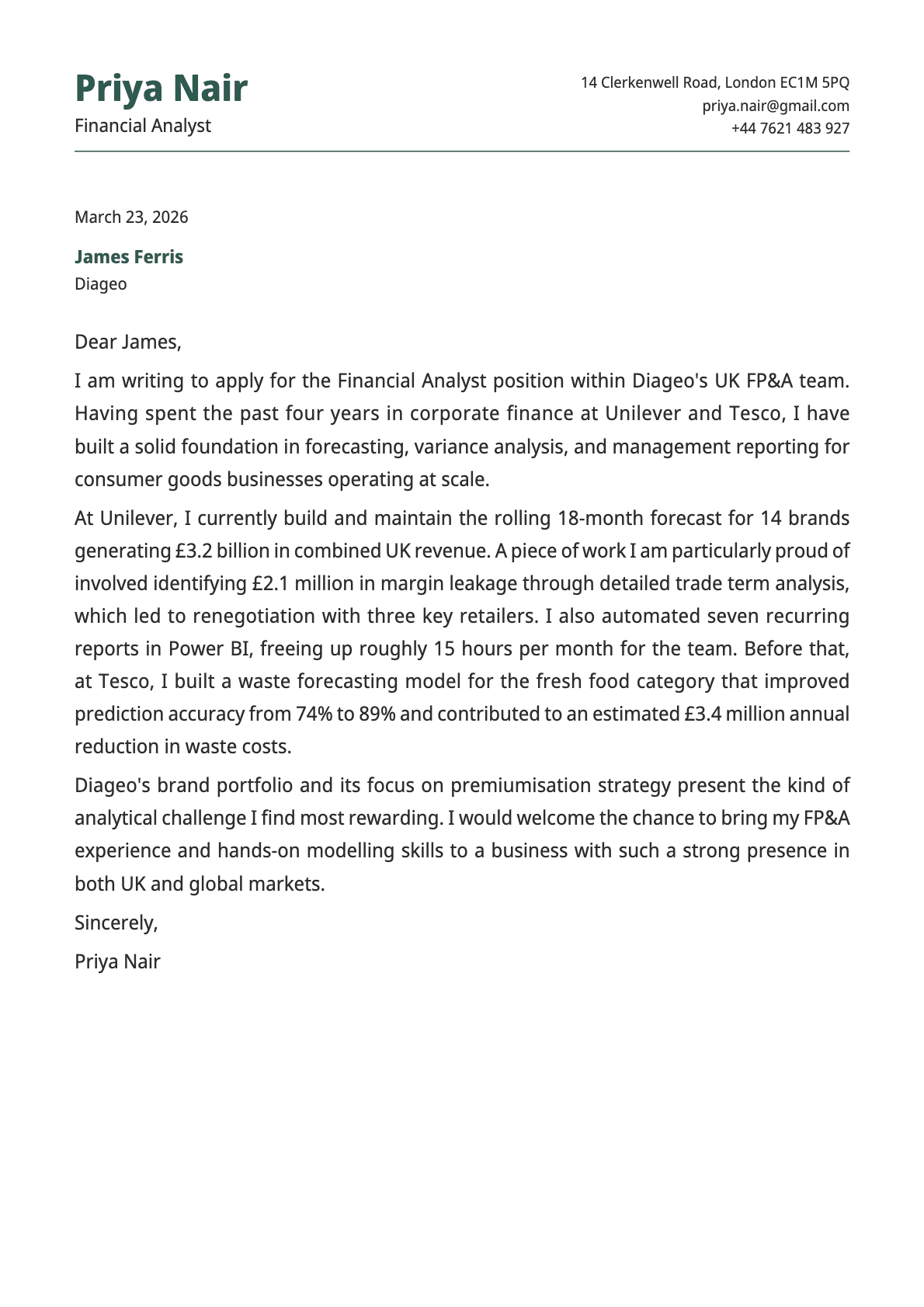
This cover letter belongs to Priya Nair, a financial analyst with four years at Unilever and Tesco, applying for an FP&A role at Diageo. What makes it effective is the specificity. She does not just say she does forecasting. She tells you she manages an 18-month rolling forecast across 14 brands generating £3.2 billion in UK revenue. That is a completely different statement.
Let us break down what works and what you can learn from it.
The opening: state your background in one sentence
Priya opens by naming the role, the company, and her relevant experience in a single paragraph. Four years in corporate finance at Unilever and Tesco, with a clear focus on forecasting, variance analysis, and management reporting.
I am writing to apply for the Financial Analyst position within Diageo's UK FP&A team. Having spent the past four years in corporate finance at Unilever and Tesco, I have built a solid foundation in forecasting, variance analysis, and management reporting for consumer goods businesses operating at scale.
Notice what she does not do. She does not open with a line about being keen about numbers. She does not explain what a financial analyst does. She walks straight in with the facts: here is the role, here is my background, here is why the two connect.
If you are applying for FP&A roles, name the specific FP&A activities you do (forecasting, variance analysis, budgeting, management reporting) rather than generic terms like "financial analysis." It shows you understand what the job actually involves day to day.
The body: lead with your best number
The middle paragraph is where Priya earns the interview. She gives three concrete examples from her current and previous roles, each one backed by a number that the reader can evaluate.
The standout is the margin leakage story. She identified £2.1 million in margin leakage through trade term analysis and it led to renegotiation with three retailers. That is not a routine task. That is the kind of finding that gets presented to a commercial director. It demonstrates that she does not just build models. She uses them to find things that matter.
The Power BI automation (seven reports, 15 hours saved per month) shows she improves processes. The Tesco waste forecasting model (prediction accuracy from 74% to 89%, £3.4 million annual cost reduction) shows she can build something from scratch that delivers a measurable result.
The lesson here is simple: pick two or three examples that show different skills. One that shows you found something (analytical ability), one that shows you built or improved something (technical ability), and one that shows the commercial result. Three bullets, three different angles.
Why this company: be specific or say nothing
The closing paragraph is short and purposeful. Priya connects her interest in Diageo to something specific about the business: the brand portfolio and premiumisation strategy. She is not saying "I admire your company." She is saying "I understand your strategic direction and I find the analytical challenge interesting."
This works because it shows she has actually researched Diageo. A generic closer like "I would love to join your team" does not add anything. A specific reference to a business strategy tells the reader that this letter was written for them.
Practical tip: Before you write your closing paragraph, spend 10 minutes reading the company's most recent annual report or investor presentation. Find one strategic theme (like premiumisation, international expansion, or digital transformation) and reference it in your letter. That one detail separates you from the candidates who sent the same letter to five companies.
What makes this letter work overall
Three things stand out. First, every claim is backed by a number. Revenue figures, margin savings, accuracy percentages, time saved. There is nothing vague. Second, the letter is short. Three paragraphs, no filler. Third, Priya writes with confidence but not arrogance. She does not oversell. She lets the numbers do the work.
If you are a financial analyst writing your own cover letter, start by listing the three most impressive things you have done in the last two years. Not your responsibilities. Your results. Then build your middle paragraph around those three things. Make sure at least one of them involves finding something that led to a business decision, because that is what separates a financial analyst from someone who just runs reports.
Common mistakes in financial analyst cover letters
Leading with soft skills. "I am a team player with excellent communication skills" tells the hiring manager nothing useful. Lead with your technical experience and let the tone of your writing demonstrate your communication skills.
Not naming your tools. If you use Power BI, Tableau, SQL, SAP, or advanced Excel (Power Query, VBA, financial modelling), name them. FP&A hiring managers are looking for specific technical capabilities, and these are the keywords that get your letter past initial screening.
Being vague about scale. "Managed a large budget" is meaningless. "Built and maintained an 18-month rolling forecast for 14 brands generating £3.2 billion in combined UK revenue" is a sentence that gets remembered. Always include the numbers.
Was this cover letter example helpful?
Rate this example to help us create better content for you.
4.8 average from 162 ratingsBuild your own version
Open this layout in the builder and swap in your own details. It takes a few minutes.
Free to use. No account needed to start.
Related cover letter examples
Accountant
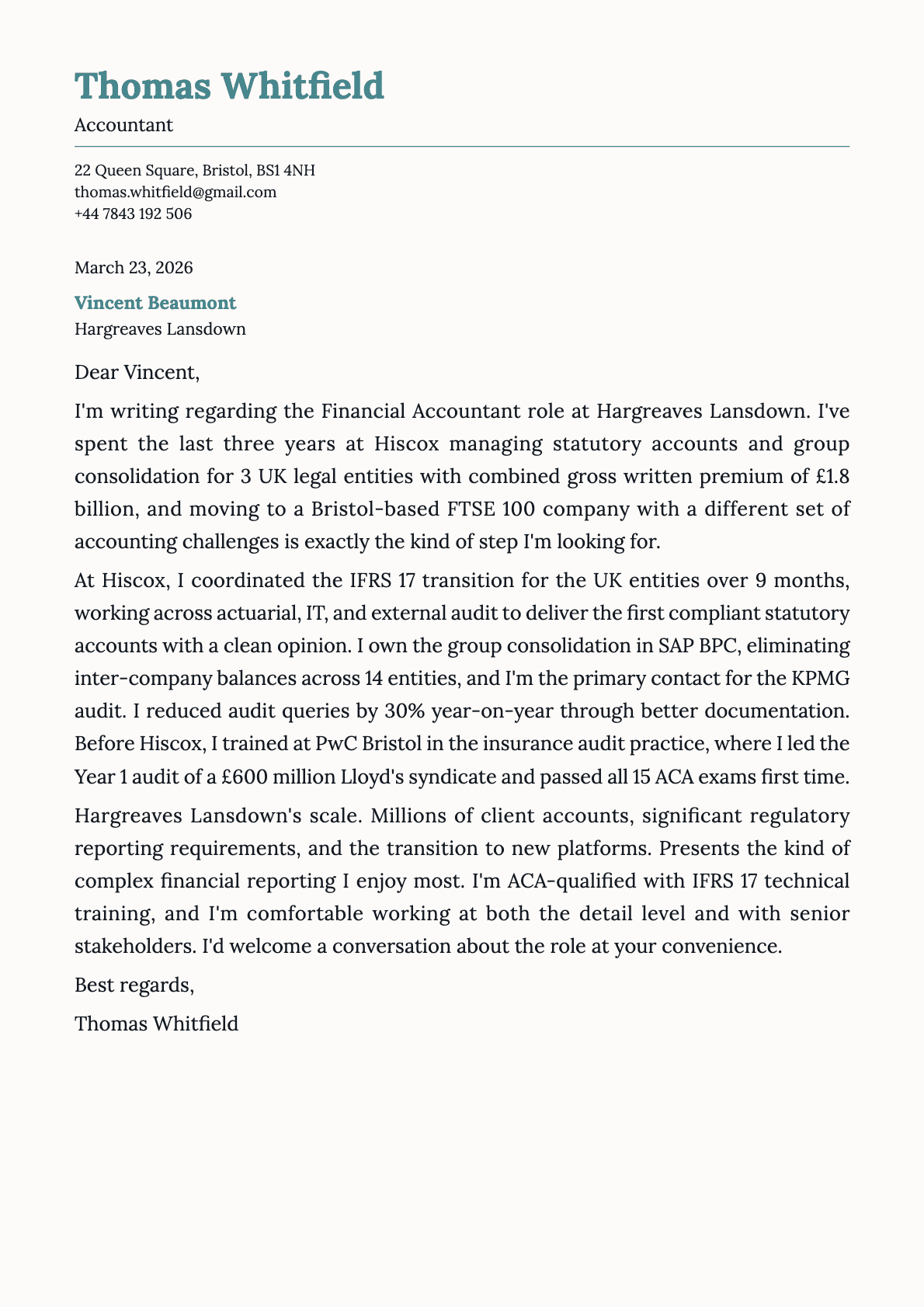
An accountant cover letter example showing how to present IFRS expertise, audit coordination, and financial reporting skills when applying to a FTSE 100.
Management Consultant
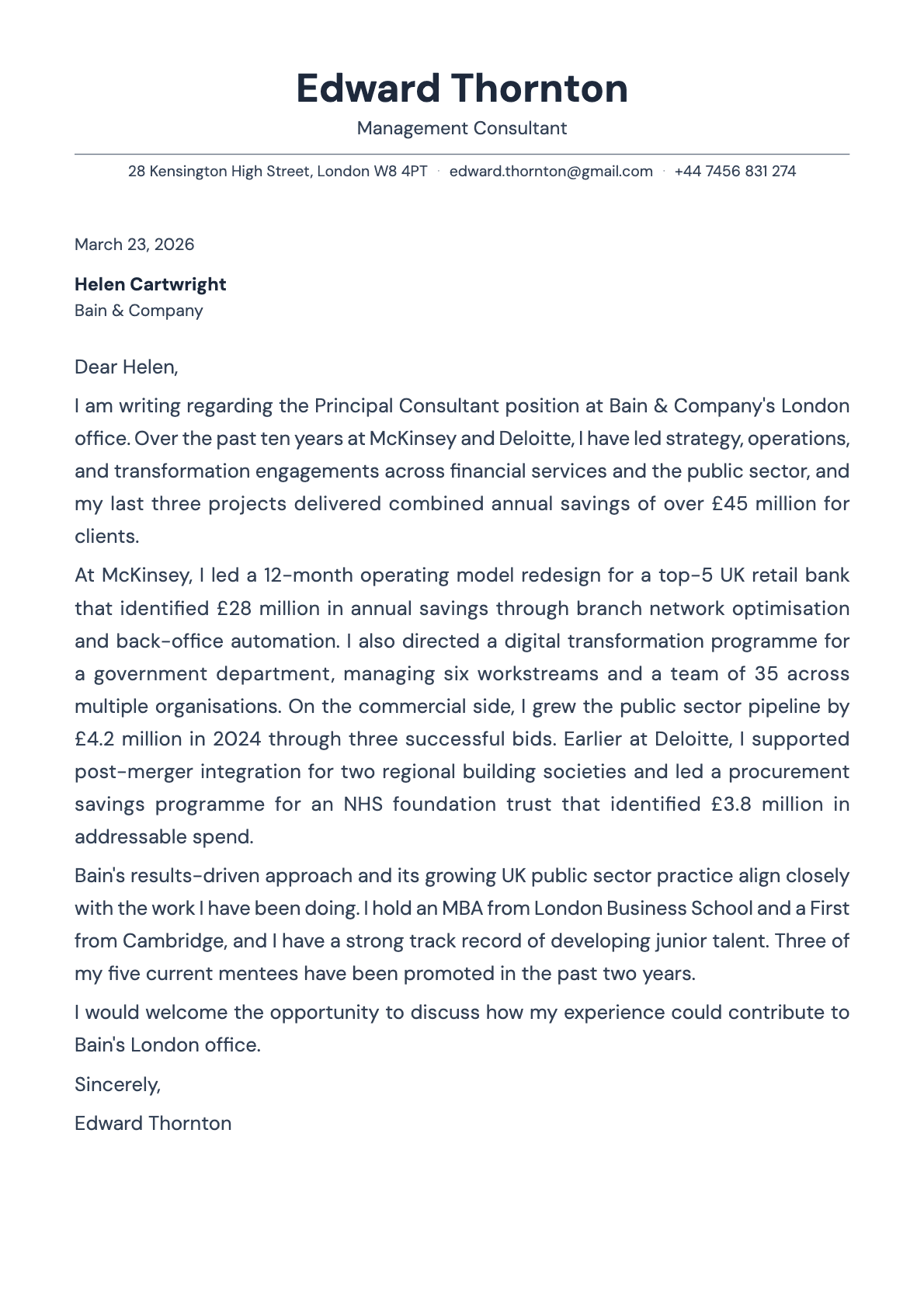
A management consultant cover letter example targeting Bain & Company. See how to present engagement results, team leadership, and business development.
Business Analyst
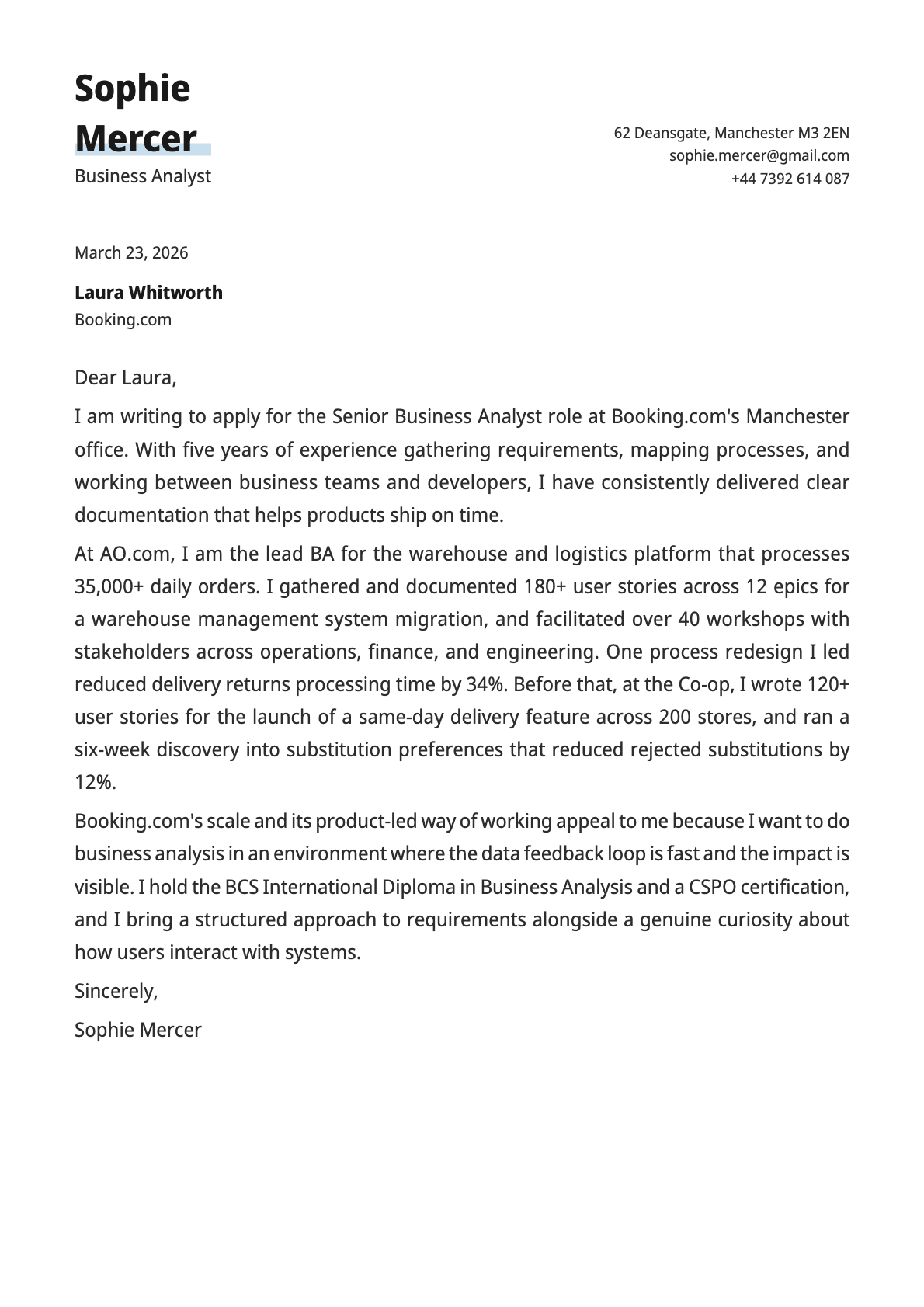
A business analyst cover letter example for a senior BA role at Booking.com.
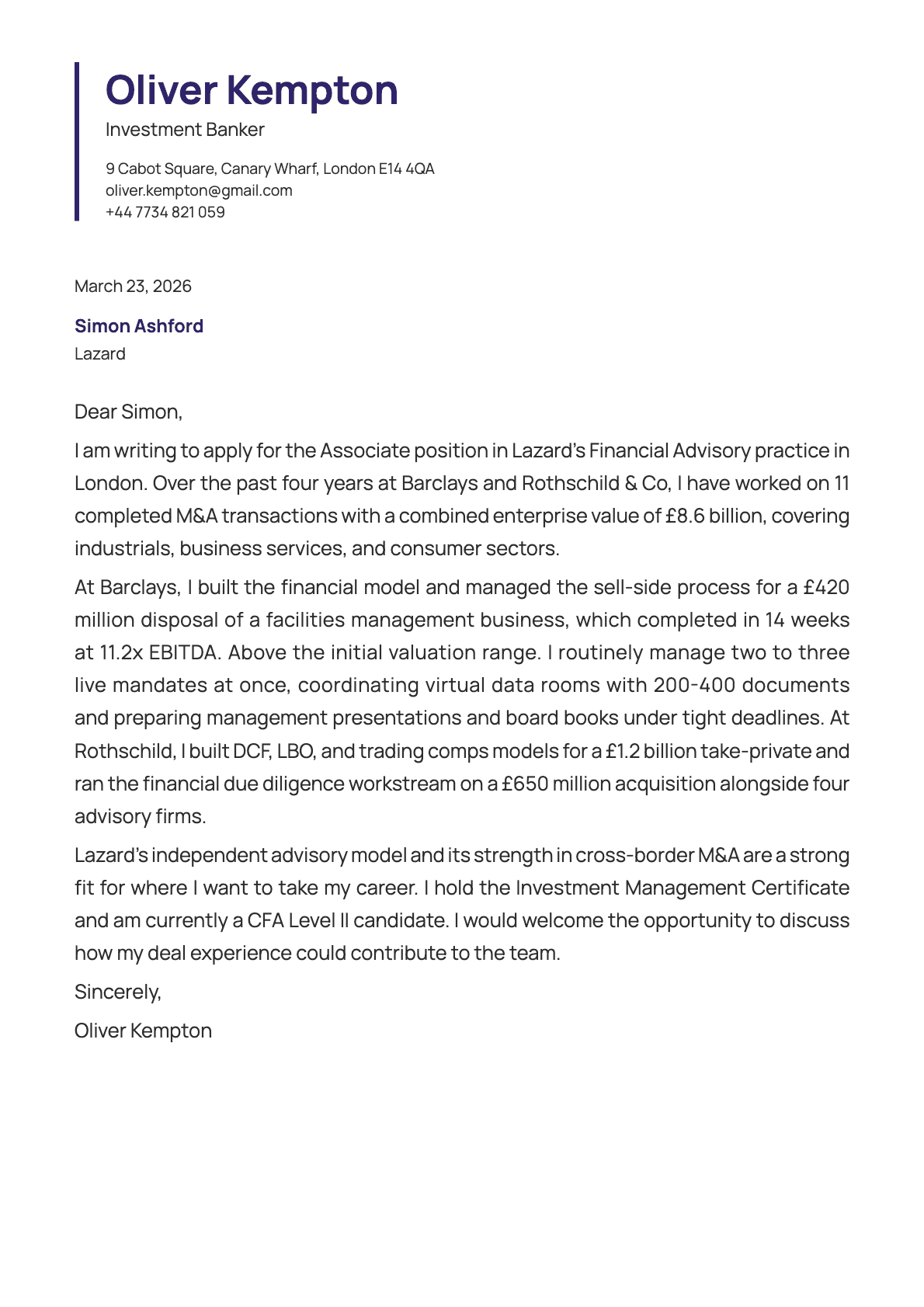
Investment Banker
An investment banking cover letter example targeting an associate role at Lazard.
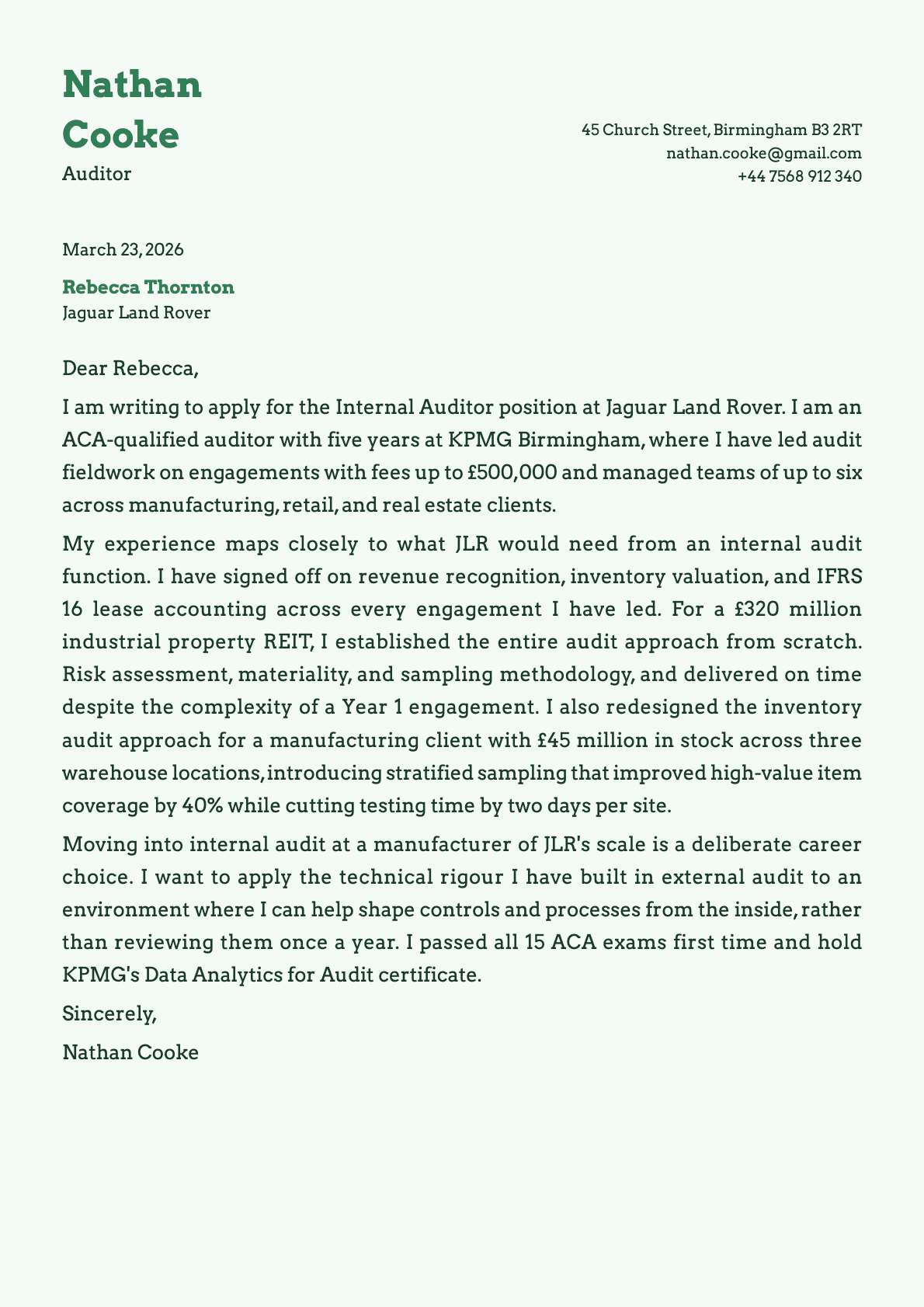
Auditor
An ACA-qualified auditor cover letter example targeting an internal audit role at Jaguar Land Rover.
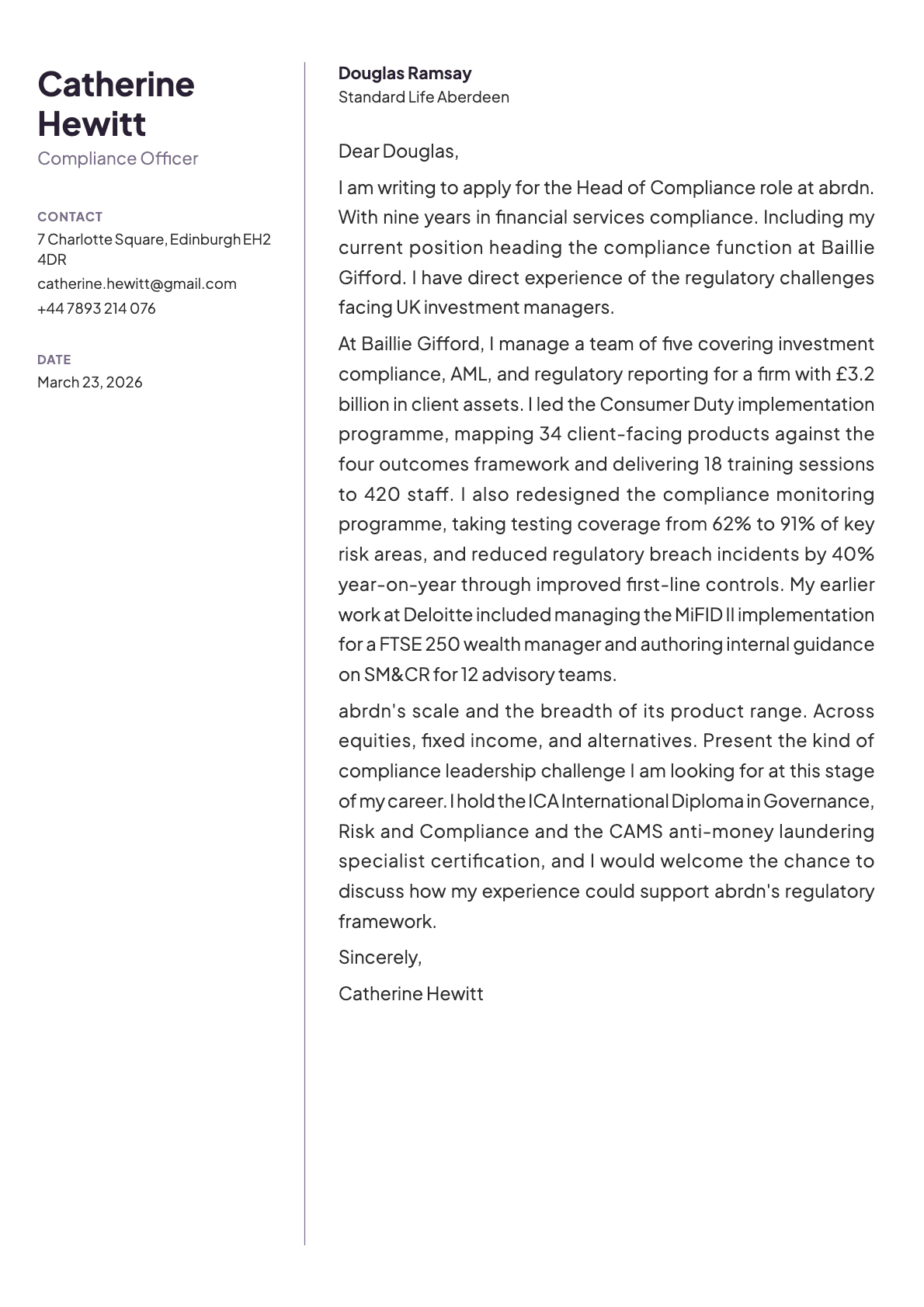
Compliance Officer
A compliance officer cover letter example for a senior role at abrdn.
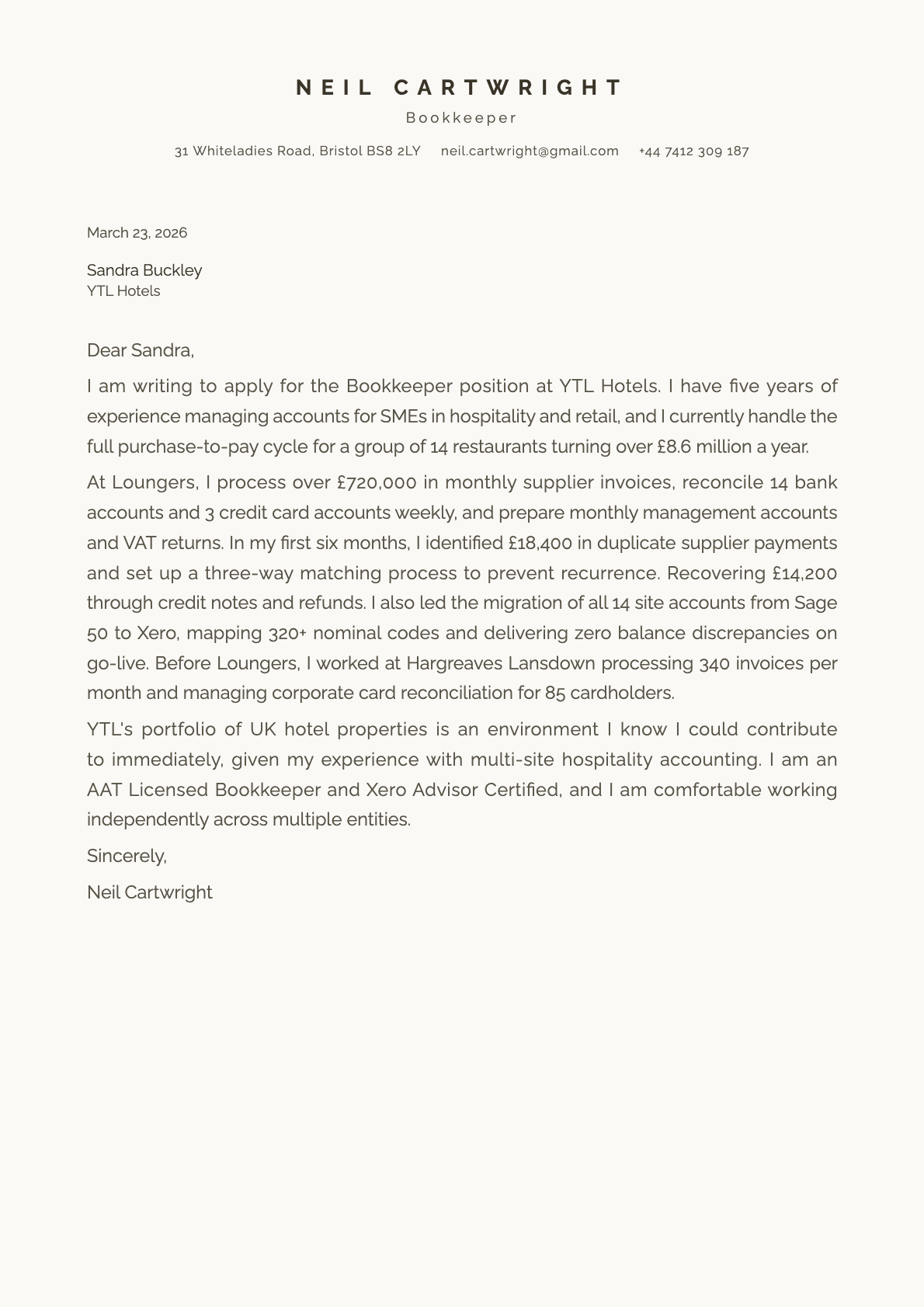
Bookkeeper
A bookkeeper cover letter example for a multi-site hospitality role at YTL Hotels.
Related articles

AI Is Screening Your Resume Before Any Human Sees It
AI screens most resumes before a human ever reads them. 97.4% of Fortune 500 companies run an ATS. This is what that means for you and what you can do about it.

The Best Resume Builders in 2026, Compared Honestly
Resume.io, Zety, Enhancv, Kickresume, Teal, and Laddro compared honestly: real pricing, free tiers, mobile apps, and where each tool wins. All prices checked in September 2026.

Burnout Recovery: A Real Timeline, Not 'Take a Bubble Bath'
55% of the U.S. workforce is burned out. Recovery takes 3 to 12 months. Here's what that actually looks like, stage by stage.