Graphic Designer Cover Letter Example
A graphic designer cover letter example targeting an in-house role at BrewDog.

Laddro Team
Free to use. No account needed to start.
Free to use. No account needed to start.
Overview
Graphic designer cover letters have a reputation for being afterthoughts. Many designers assume the portfolio does all the talking, so the letter gets a few generic lines about being creative and keen about design. That is a missed opportunity. The cover letter is your chance to show context that a portfolio cannot: the scale of your projects, the constraints you worked within, and the commercial impact of your design work.
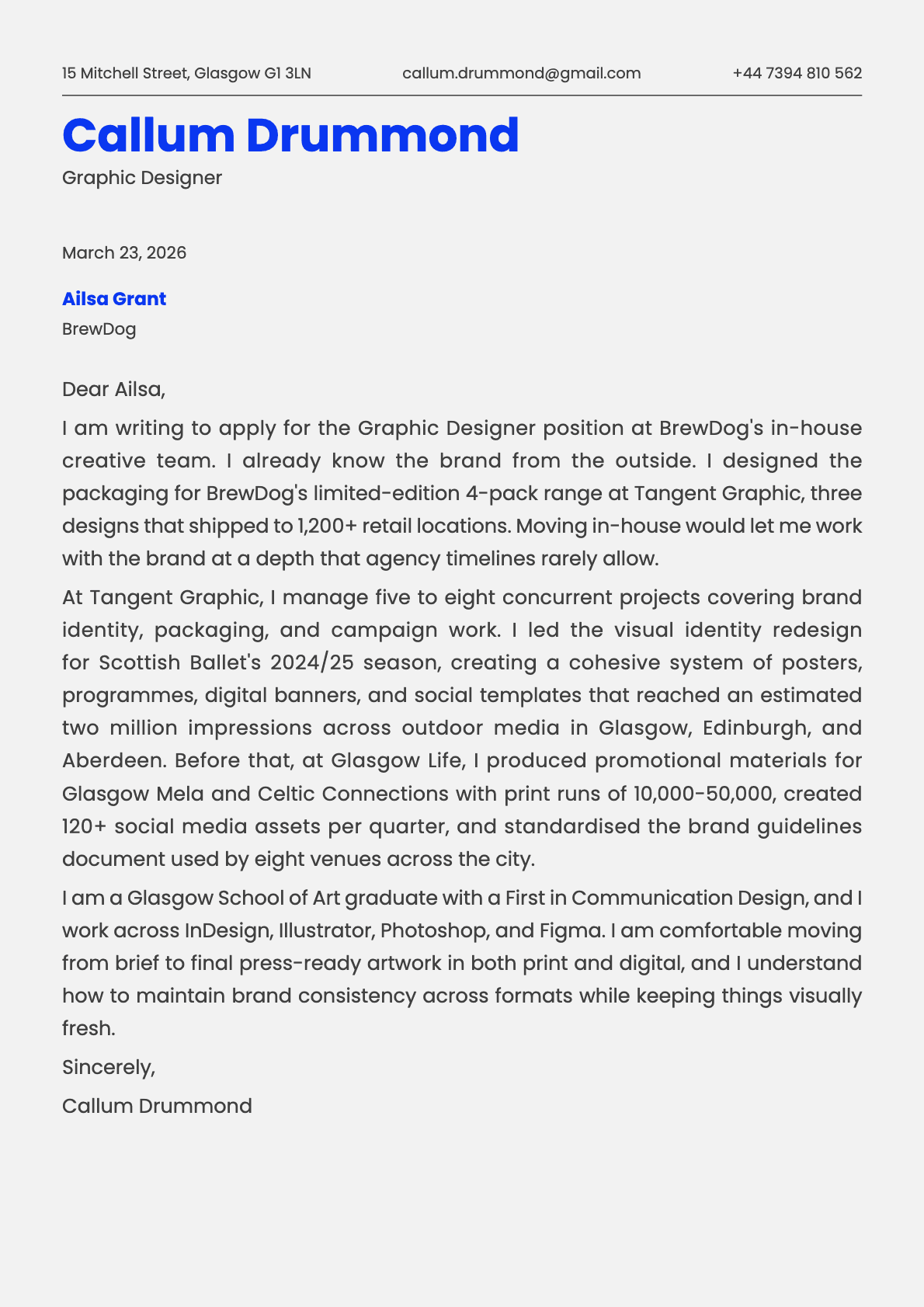
This cover letter belongs to Callum Drummond, a graphic designer at Tangent Graphic in Glasgow, applying for an in-house role at BrewDog. His letter works because he opens with a direct connection to the brand (he has already designed BrewDog packaging), then backs it up with the scope and scale of his broader work.
The opening: lead with the connection
Callum's opening is unusually strong because he has an existing relationship with the brand. He designed packaging for BrewDog's limited-edition 4-pack range at his agency, and three designs shipped to 1,200+ retail locations. He leads with this because it is the most relevant thing he can say.
I already know the brand from the outside. I designed the packaging for BrewDog's limited-edition 4-pack range at Tangent Graphic, three designs that shipped to 1,200+ retail locations.
This immediately separates him from every other applicant. He is not learning the brand. He has already worked with it. The retail distribution number (1,200+ locations) adds commercial weight to what could otherwise be dismissed as a small freelance project.
For your letter: if you have any existing connection to the company or its products, lead with it. Previous client work, brand collaborations, or even a personal project inspired by the brand. Any genuine connection is more compelling than a generic opening.
The body: scale, variety, and reach
The middle paragraph covers two roles with different types of work. At Tangent Graphic, he manages five to eight concurrent projects across brand identity, packaging, and campaigns. The Scottish Ballet case study is the standout: a visual identity redesign covering posters, programmes, digital banners, and social templates, reaching an estimated two million impressions across outdoor media.
At Glasgow Life, he handled high-volume production work. Print runs of 10,000-50,000, 120+ social media assets per quarter, and standardised brand guidelines across eight venues. This is a different type of design work, but it shows he can handle volume and consistency, which are exactly the skills an in-house role requires.
The lesson for designers: your cover letter should show range. Campaign work, production work, brand guidelines, packaging, digital, and print. In-house teams need designers who can move between different types of output without losing quality. Showing that range in your letter signals you can handle the breadth of work the role demands.
The closing: skills and production readiness
Callum's closing covers his education (Glasgow School of Art, First in Communication Design) and his software stack (InDesign, Illustrator, Photoshop, Figma). He then adds a practical statement: "I am comfortable moving from brief to final press-ready artwork in both print and digital."
That last point matters more than it might seem. Many designers can concept and create, but not all can produce finished files that go straight to print or to a developer. Stating that you can handle the full workflow, from brief to press-ready output, tells the hiring manager you will not create bottlenecks.
What makes this letter effective
The letter treats graphic design as a professional discipline with commercial outcomes, not just a creative pursuit. Print runs, retail locations, impression counts, and venue standardisation. These details show that Callum's work exists in the real world, at real scale, with real business impact.
The BrewDog connection in the opening is a model for how to personalise a cover letter. It is specific, relevant, and verifiable. Any hiring manager reading it will think: this person already knows our brand at a production level.
Mistakes graphic designers make in cover letters
Assuming the portfolio speaks for itself. It does not. The portfolio shows what you can create. The cover letter shows the context: the brief, the constraints, the scale, and the outcome. Hiring managers make decisions based on both.
Not mentioning production skills. Prepress knowledge, file preparation, colour management, and print specification are practical skills that separate production-ready designers from those who only work on screen. If you have these skills, state them.
Being vague about software. "Proficient in Adobe Creative Suite" is a minimum expectation, not a differentiator. Name the specific applications you use and, where relevant, your Figma or Sketch experience. If you have motion graphics skills (After Effects, Premiere Pro) or 3D capabilities, mention those too.
Leaving out the numbers. Print runs, distribution figures, audience reach, number of assets produced. These quantify your output and help the reader understand the scale of your work. A poster designed for a local event and a poster designed for a national campaign with 50,000 print run are very different achievements.
Focusing only on aesthetics. Good design solves problems. If your letter only talks about visual style and creative vision, you are missing the strategic dimension. Talk about the brief, the audience, and how your design decisions served the project's goals.
Was this cover letter example helpful?
Rate this example to help us create better content for you.
4.8 average from 185 ratingsBuild your own version
Open this layout in the builder and swap in your own details. It takes a few minutes.
Free to use. No account needed to start.
Related cover letter examples
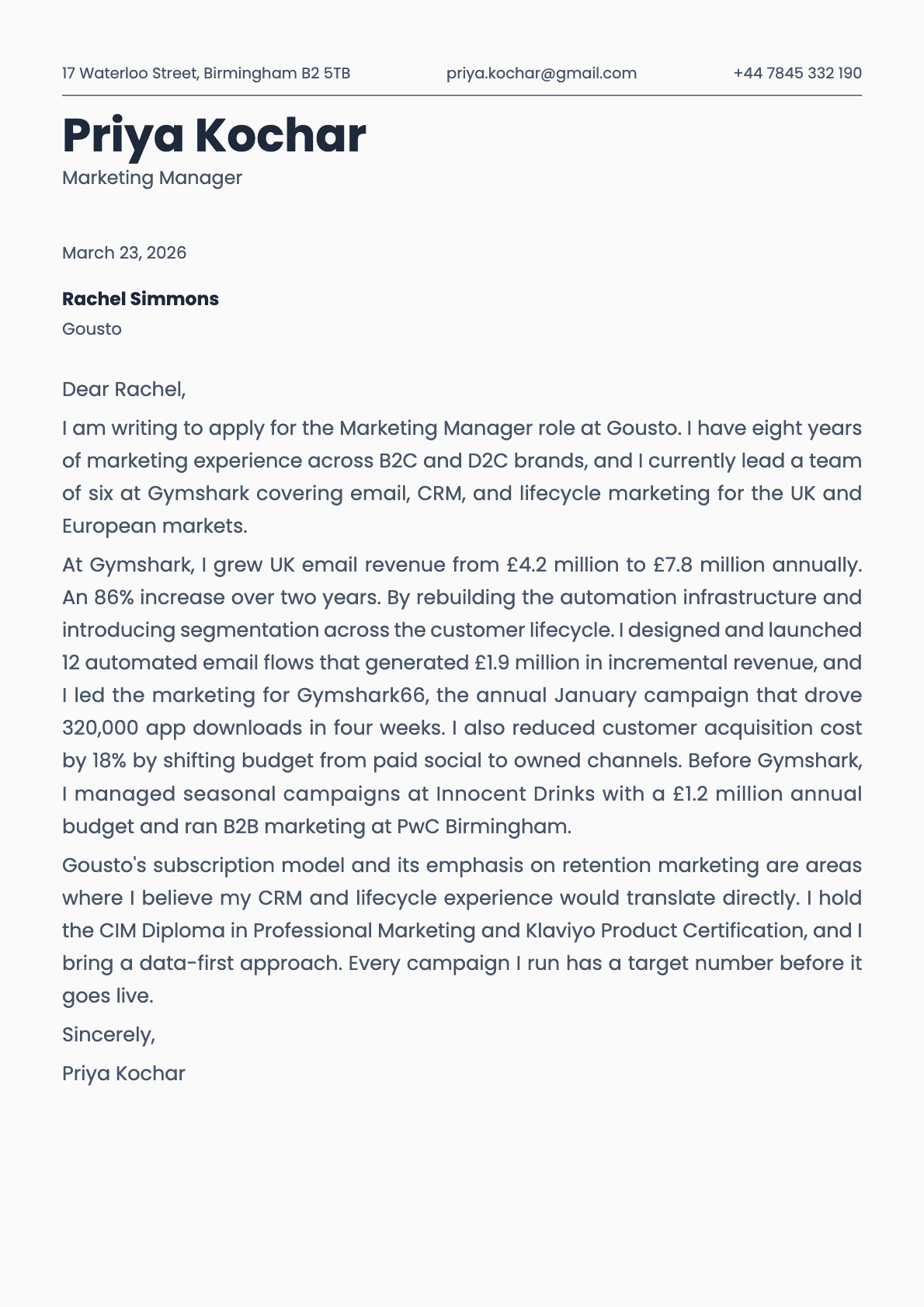
Marketing Manager
A marketing manager cover letter example targeting a D2C role at Gousto.
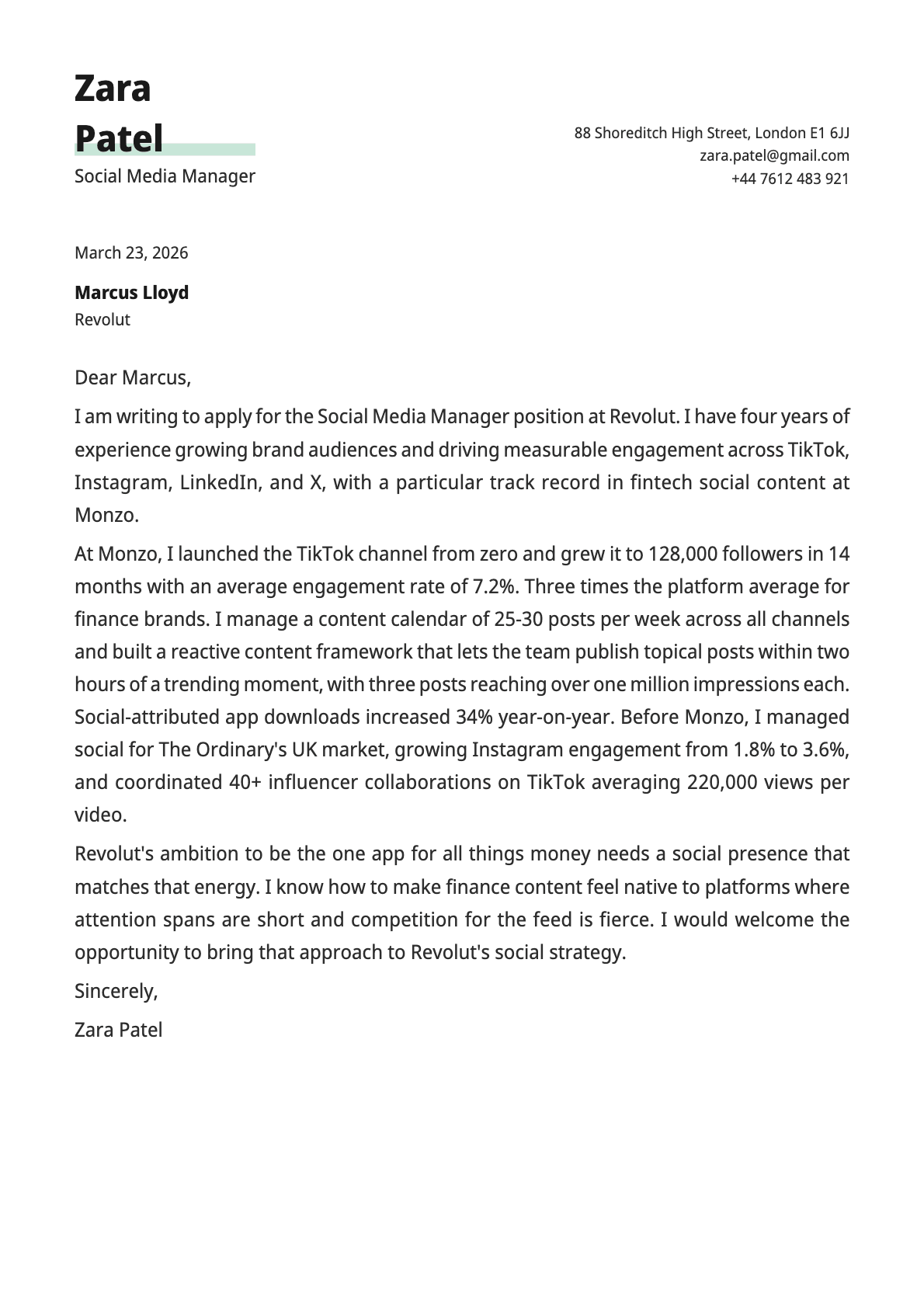
Social Media Manager
A social media manager cover letter example targeting Revolut.
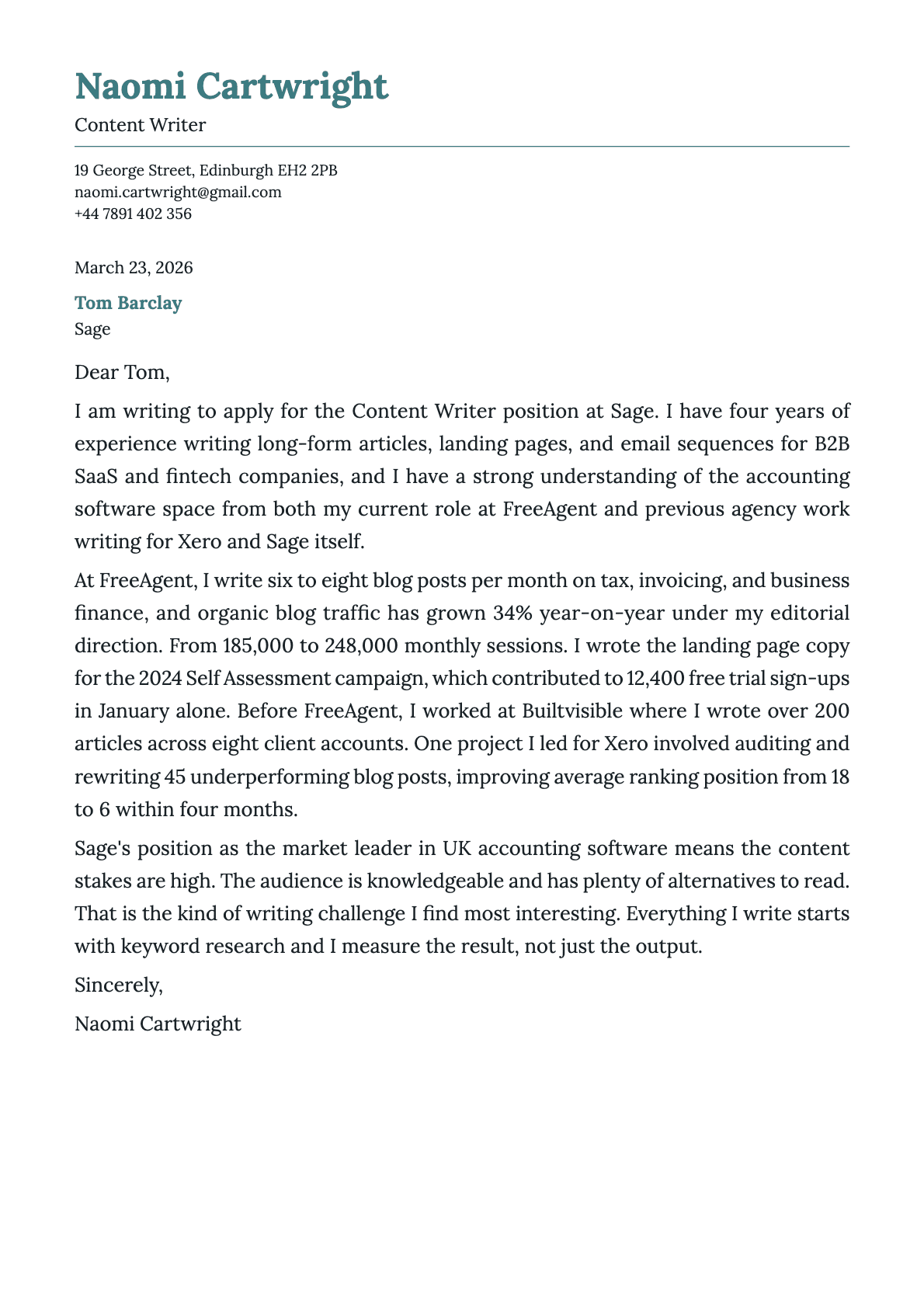
Content Writer
A content writer cover letter example targeting a B2B SaaS role at Sage.
SEO Specialist
An SEO specialist cover letter example targeting Comparethemarket.
Public Relations Manager
A PR manager cover letter example targeting Spotify.
Related articles
AI Is Screening Your Resume Before Any Human Sees It
AI screens most resumes before a human ever reads them. 97.4% of Fortune 500 companies run an ATS. This is what that means for you and what you can do about it.
The Best Resume Builders in 2026, Compared Honestly
Resume.io, Zety, Enhancv, Kickresume, Teal, and Laddro compared honestly: real pricing, free tiers, mobile apps, and where each tool wins. All prices checked in September 2026.

Burnout Recovery: A Real Timeline, Not 'Take a Bubble Bath'
55% of the U.S. workforce is burned out. Recovery takes 3 to 12 months. Here's what that actually looks like, stage by stage.