Graphic Designer Resume Example
A graphic designer resume example with agency and in-house experience in branding, packaging, and print.

Laddro Team
Free to use. No account needed to start.
Free to use. No account needed to start.
Overview
Graphic designers often assume the portfolio does all the talking. And yes, the portfolio matters. But when a creative director has 60 applications to get through, the resume is what decides who gets a portfolio review and who does not. A resume that says "experienced designer skilled in Adobe Creative Suite" tells them nothing they could not guess from the job title alone.
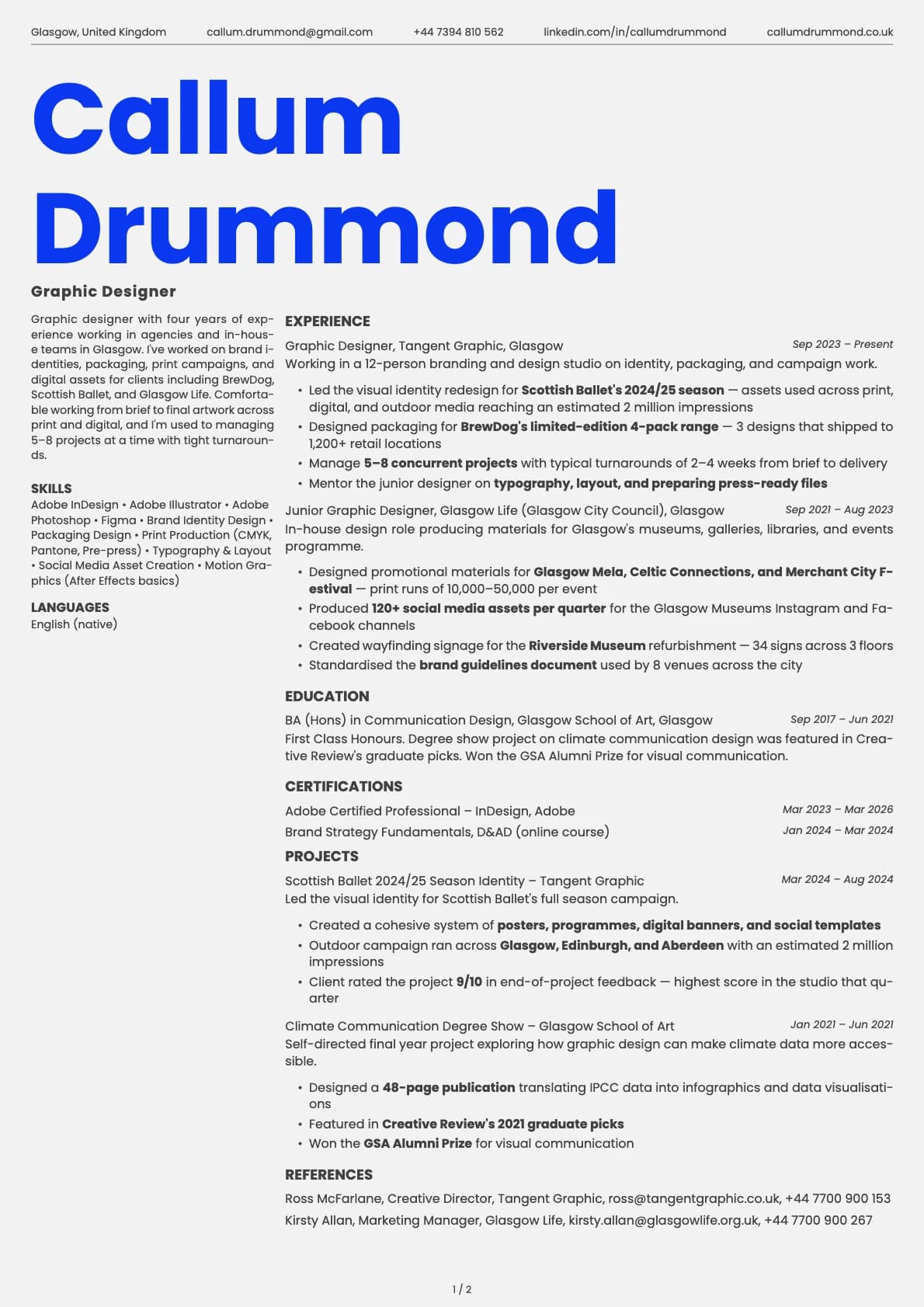
This resume belongs to Callum, a graphic designer with four years of experience working in Glasgow. He is currently at Tangent Graphic, a branding studio, where he has led visual identity work for Scottish Ballet and packaging for BrewDog. Before that, he was in-house at Glasgow Life, producing materials for the city's museums and festivals. The resume works because it names real clients, includes production numbers, and shows the kind of work he handles day to day.
Here is how to write a designer resume that gets read.
Your summary: what you design, for whom, and at what pace
Graphic design is a broad field. The person hiring for a packaging design role and the person hiring for a social media designer have very different needs. Your summary should make your specialty obvious.
From this resume:
I've worked on brand identities, packaging, print campaigns, and digital assets for clients including BrewDog, Scottish Ballet, and Glasgow Life. Comfortable working from brief to final artwork across print and digital, and I'm used to managing 5-8 projects at a time with tight turnarounds.
Three things land immediately: the types of design work, the recognisable client names, and the project volume. Managing 5-8 projects at once signals this person works fast and can juggle deadlines. That is something a creative director cares about more than your personal design philosophy.
For your summary: Name the types of design you do (brand identity, packaging, editorial, digital, motion). Name your best-known clients. Mention your typical workload or turnaround time.
Experience bullets: name the client, name the reach
In design, the client name carries weight. If you have worked on something for a recognisable brand, say so.
Led the visual identity redesign for Scottish Ballet's 2024/25 season. Assets used across print, digital, and outdoor media reaching an estimated 2 million impressions.
That bullet tells the recruiter: he led the project (not just executed), it was for a major arts organisation, it spanned multiple formats, and it reached 2 million people. That is very different from "designed a visual identity for a client."
Another example:
Designed packaging for BrewDog's limited-edition 4-pack range. 3 designs that shipped to 1,200+ retail locations.
Retail distribution numbers show real-world impact. Your design did not just get approved. It shipped. It sat on shelves. 1,200 locations is a real number that makes the work tangible.
The formula: Client name + What you designed + Where it appeared + Scale of distribution or reach.
Production volume matters
Design is not just about quality. Speed and volume are part of the job. This resume mentions them clearly:
Manage 5-8 concurrent projects with typical turnarounds of 2-4 weeks from brief to delivery
Produced 120+ social media assets per quarter for the Glasgow Museums Instagram and Facebook channels
If you produce a high volume of work (social assets, email templates, print collateral), include the numbers. A creative director reading "120+ social media assets per quarter" can immediately picture the pace of work.
For in-house roles especially, volume demonstrates that you can keep up with the demands of a busy marketing team. Not every project is a two-month brand identity. Most of the work is fast, iterative, and deadline-driven.
Skills: separate the tools from the disciplines
This resume lists tools (InDesign, Illustrator, Photoshop, Figma, After Effects) alongside disciplines (Brand Identity, Packaging Design, Typography & Layout, Print Production). That separation is useful because it shows both what software you use and what kinds of design problems you solve.
One important detail: "Print Production (CMYK, Pantone, Pre-press)." If you produce print-ready artwork, say so explicitly. Many junior designers only work in RGB for screen. Knowing your way around CMYK, Pantone spot colours, and pre-press checks is a skill that agencies and print houses value.
If you have motion graphics experience, even at a basic level, include it. "After Effects basics" is honest and still gives you a keyword match for roles that want some animation ability.
Your portfolio link belongs on your resume
This resume includes a personal website: callumdrummond.co.uk. For a designer, this is essential. The resume gets you shortlisted. The portfolio gets you the interview.
But here is the catch: the link only helps if the portfolio is current and curated. Three to five strong projects are better than fifteen mediocre ones. If the job you are applying for is a packaging role, make sure packaging work is near the top of your portfolio site.
If you do not have a personal site, a well-organised Behance page works. What does not work: a Dropbox link to a folder of assorted PDFs.
Education and awards: use them strategically
This resume highlights a First Class Honours from Glasgow School of Art and two awards: the Creative Review graduate feature and the GSA Alumni Prize. If you have awards or notable education achievements, include them. Design is one of the few fields where your degree show project and the school you attended can genuinely influence hiring decisions.
If you graduated from a less well-known programme, that is fine. Focus instead on any awards, exhibitions, or features your work has received.
Mistakes that designers make on their resumes
Relying entirely on the portfolio. Your resume is the first filter. If it says nothing specific about your work, some recruiters will not bother opening the portfolio link.
Listing software without showing what you did with it. "Proficient in Adobe Creative Suite" appears on every designer's resume. Tie each tool to a specific type of work. "Used InDesign to produce a 48-page publication" or "Built social templates in Figma for a quarterly asset pipeline."
No print production knowledge. If you are applying to an agency or any role that involves physical materials, you need to show you understand print. Mention Pantone references, pre-press processes, or print runs you have managed.
Ignoring the brand guidelines work. Producing or maintaining brand guidelines is a real skill. This resume mentions standardising a brand guidelines document used across 8 venues. That shows strategic thinking, not just execution.
Using a template that fights the content. Ironically, designers sometimes choose the most elaborate resume template. Your resume should be well-designed but legible. A good type hierarchy, clear sections, and enough white space. This resume uses Fern, which is clean and lets the content breathe.
One more thing
If you do any creative work outside of your day job, include it. This resume mentions a Risograph printing collective at the Glasgow Zine Library and a design club committee role. These are not job experience, but they show someone who is genuinely interested in design culture, not just clocking in and out. Creative directors notice that.
Build your own version
Open this layout in the builder and swap in your own details. It takes a few minutes.
Free to use. No account needed to start.
Was this resume example helpful?
Rate this example to help us create better content for you.
4.7 average from 163 ratingsRelated resume examples
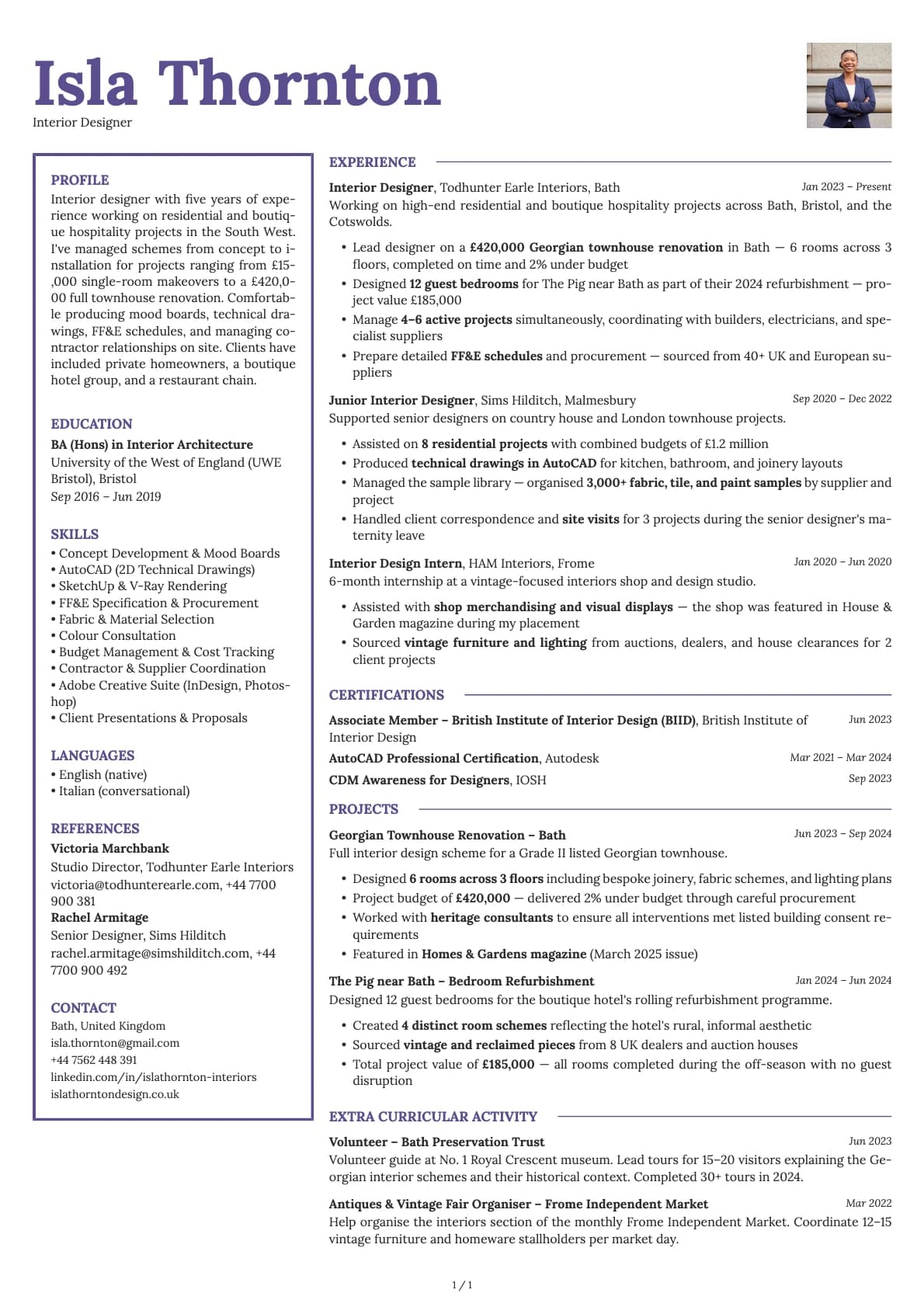
Interior Designer
An interior designer resume example with project budgets, client types, and FF&E details. See how to present residential and hospitality design experience.
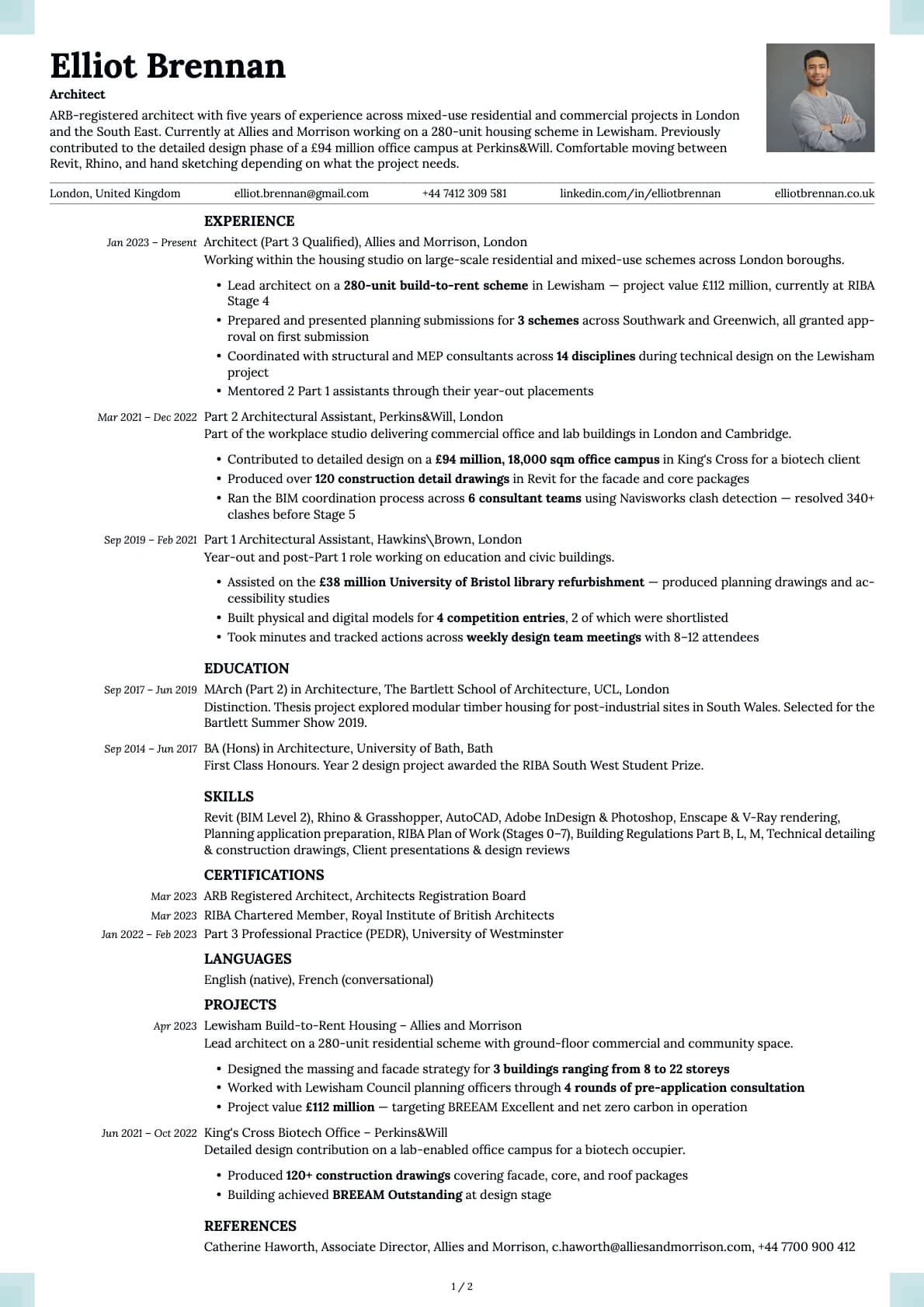
Architect
An ARB-registered architect resume example with RIBA Stage 4 project experience, BIM coordination.
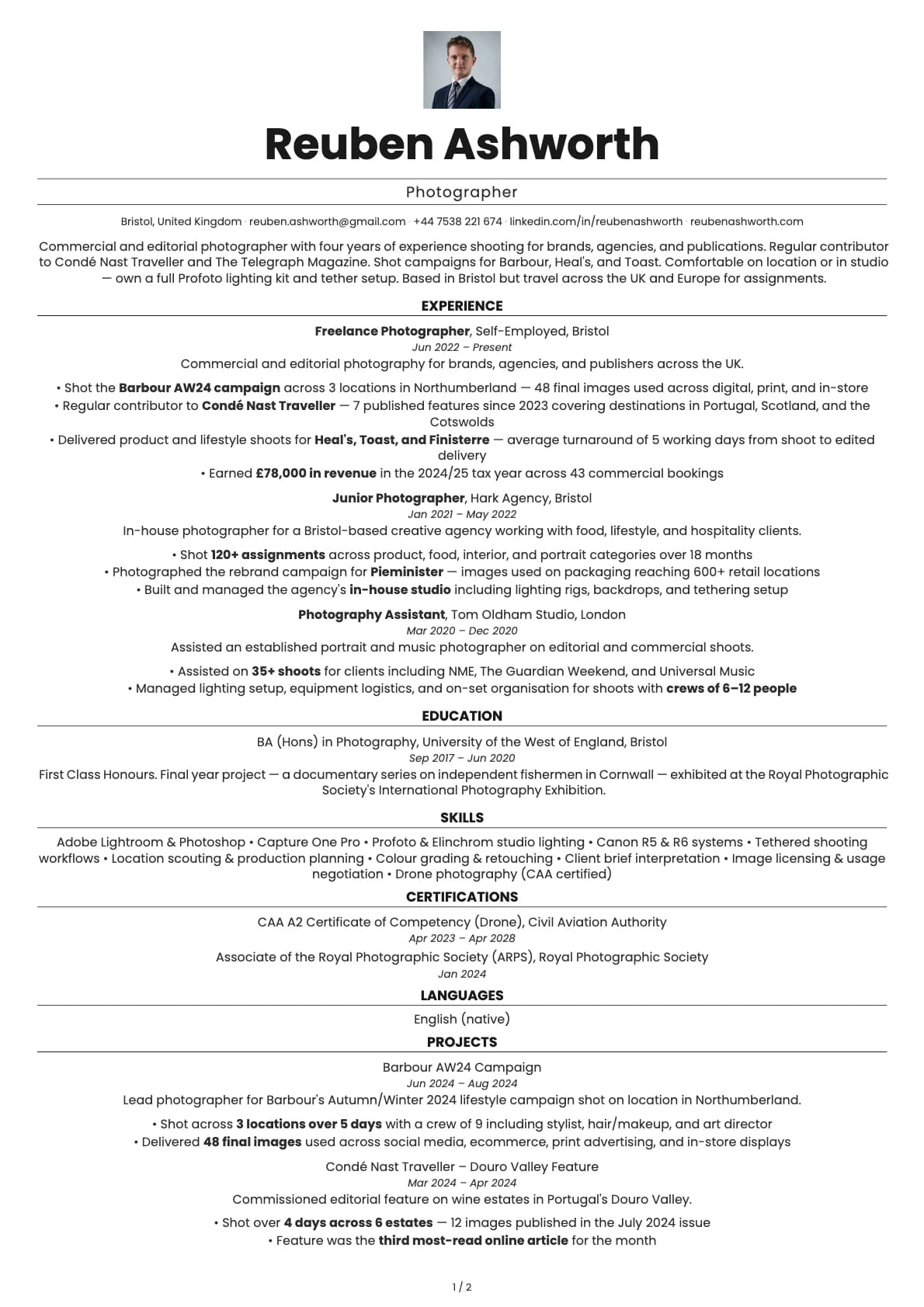
Photographer
A photographer resume example with commercial campaign work, editorial credits, and revenue figures from a freelance career.
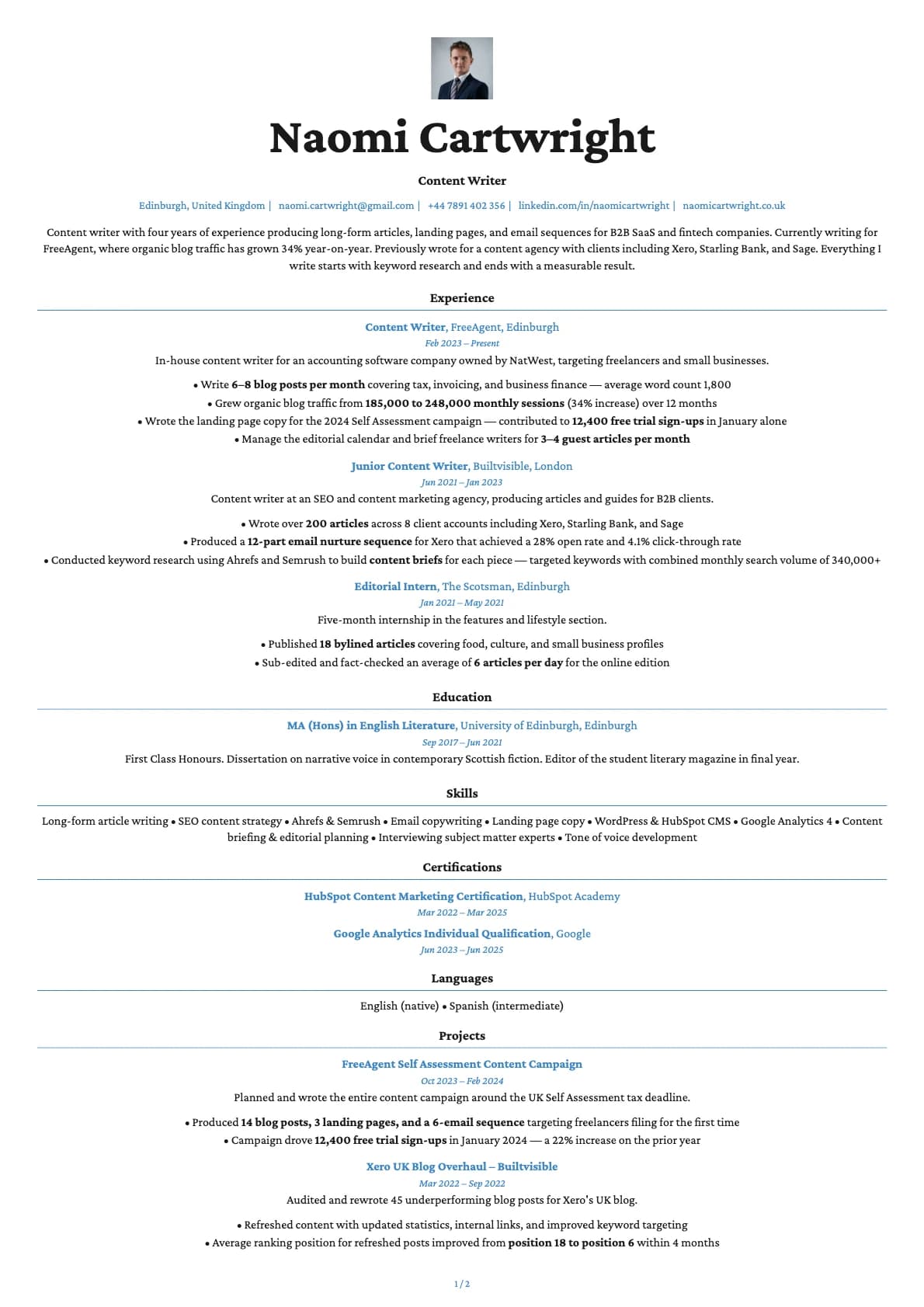
Content Writer
A content writer resume example with in-house and agency experience writing for FreeAgent, Xero, and Starling Bank.
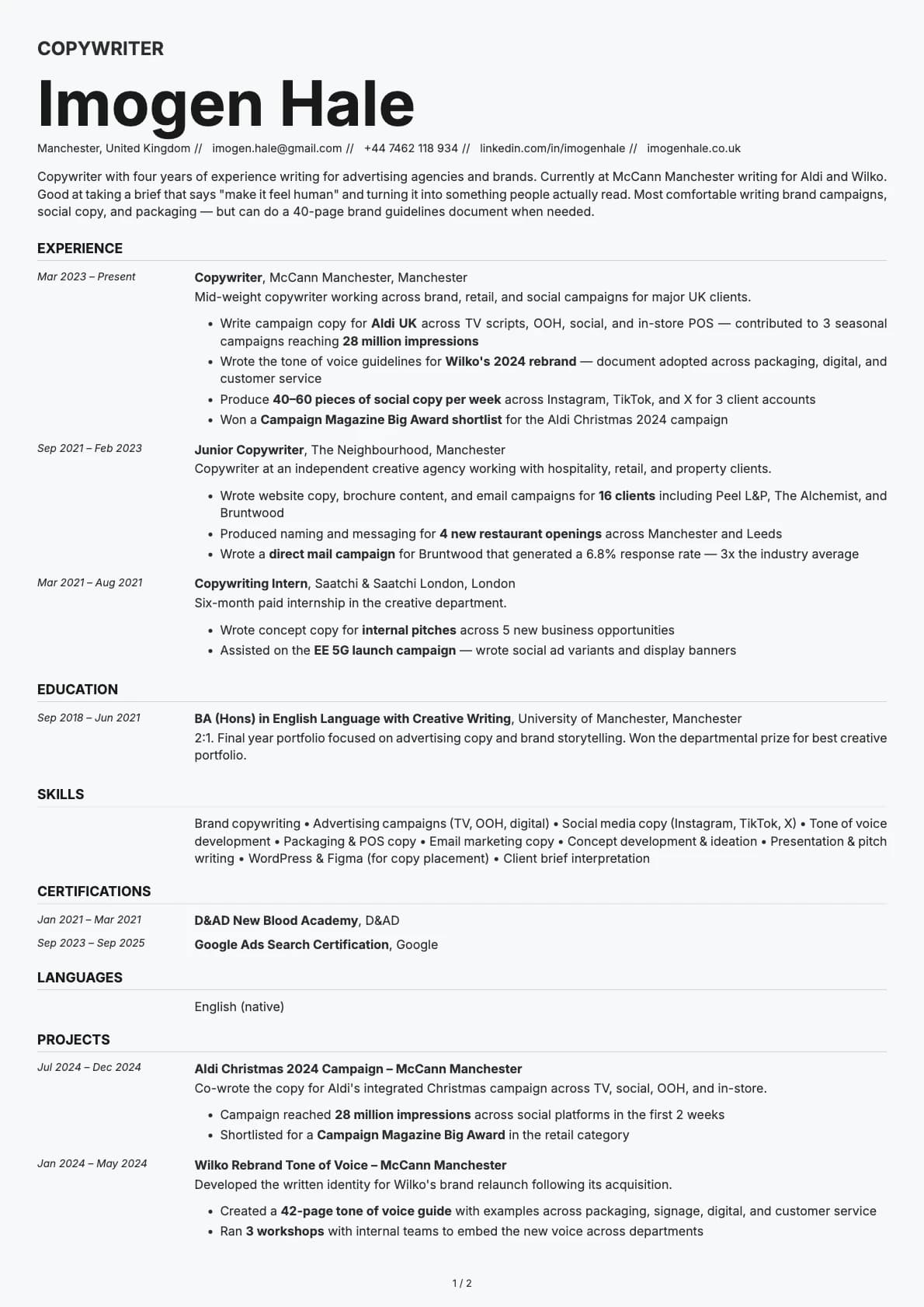
Copywriter
A copywriter resume example with McCann and Saatchi & Saatchi experience. See how to showcase your portfolio, campaign results, and tone of voice.
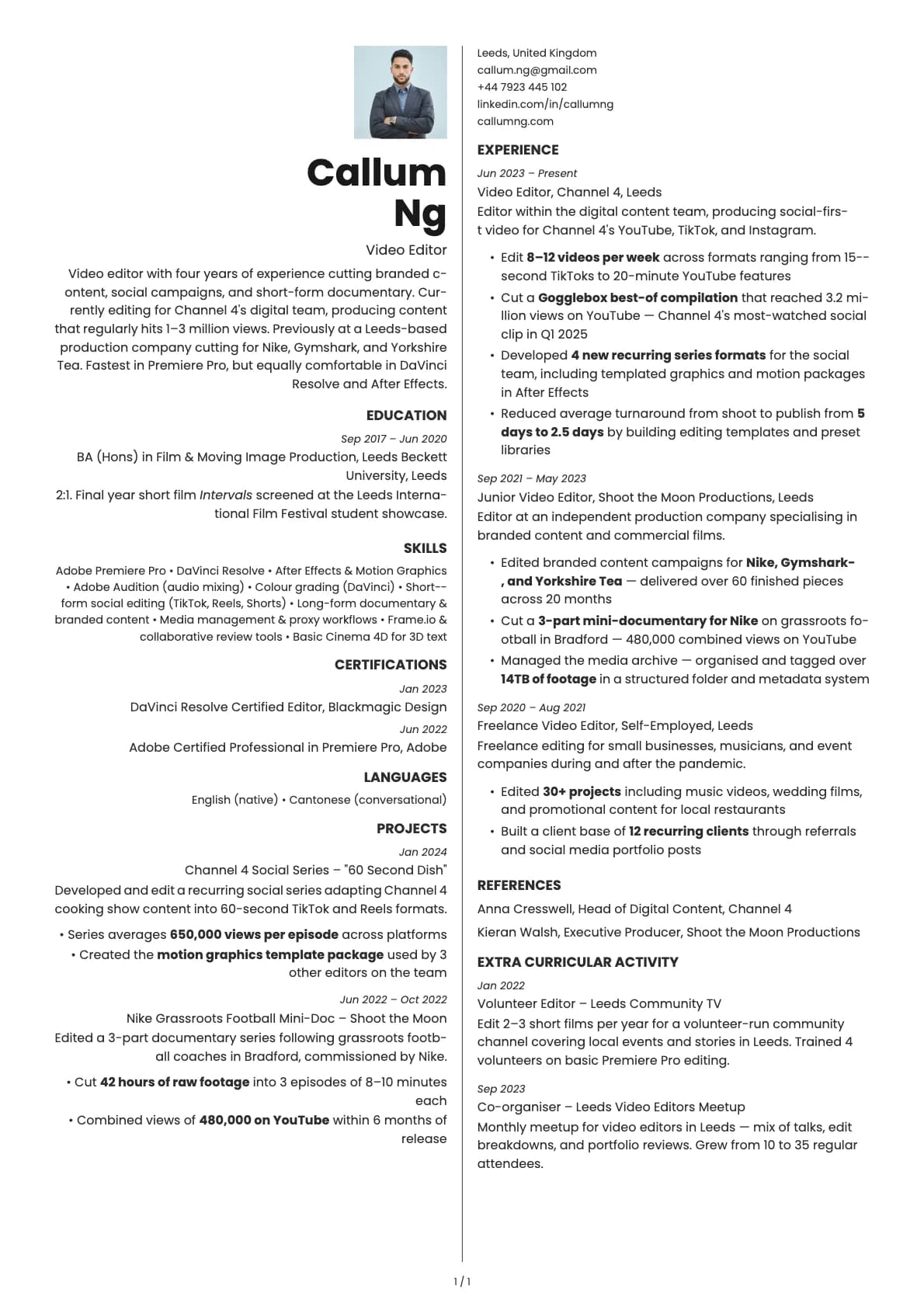
Video Editor
A video editor resume example with 4 years of experience cutting branded content and social video at Channel 4.
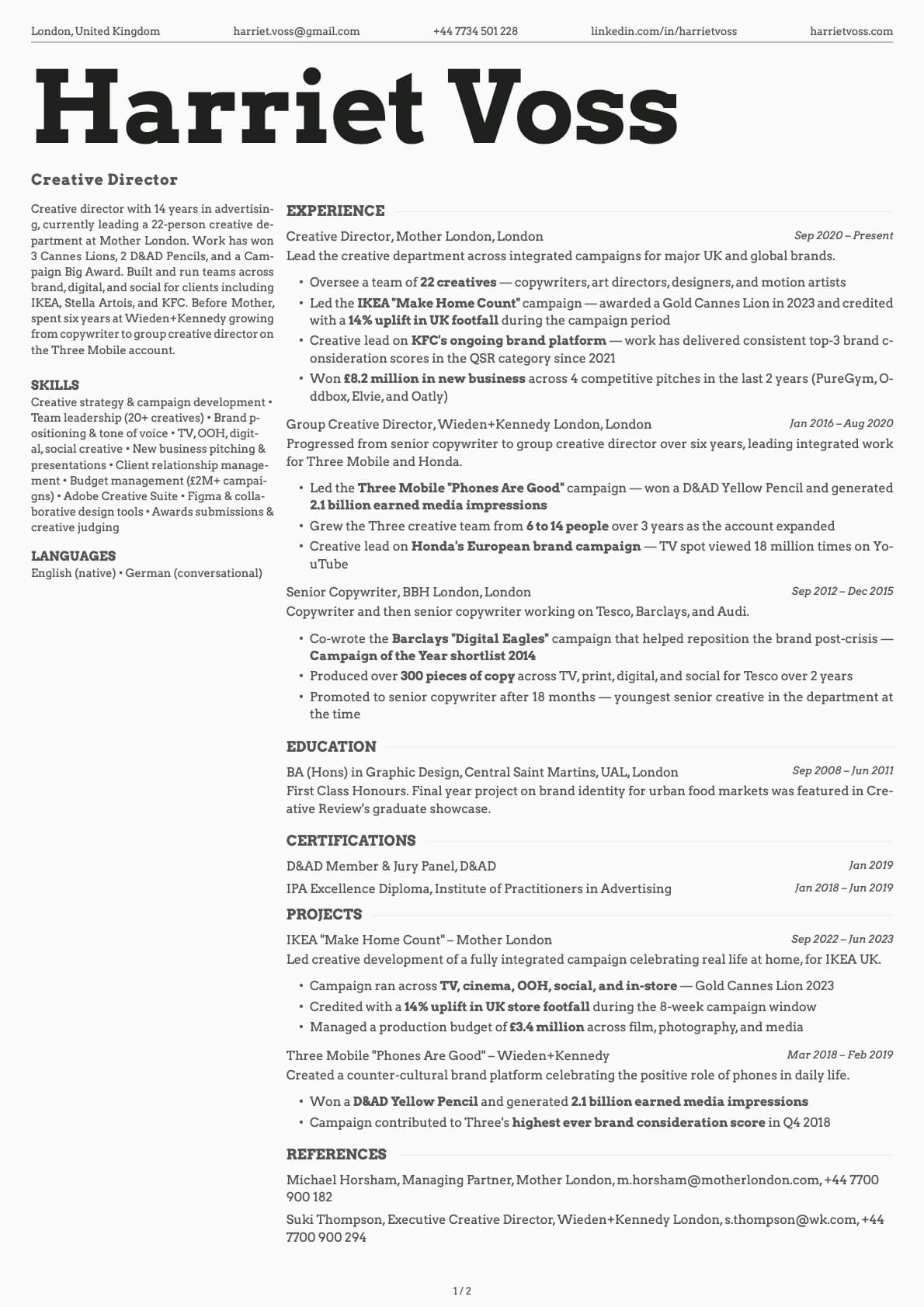
Creative Director
A creative director resume example with 14 years in advertising, Cannes Lions wins.
Related articles
AI Is Screening Your Resume Before Any Human Sees It
AI screens most resumes before a human ever reads them. 97.4% of Fortune 500 companies run an ATS. This is what that means for you and what you can do about it.

The Best Resume Builders in 2026, Compared Honestly
Resume.io, Zety, Enhancv, Kickresume, Teal, and Laddro compared honestly: real pricing, free tiers, mobile apps, and where each tool wins. All prices checked in September 2026.

Burnout Recovery: A Real Timeline, Not 'Take a Bubble Bath'
55% of the U.S. workforce is burned out. Recovery takes 3 to 12 months. Here's what that actually looks like, stage by stage.