SEO Specialist Cover Letter Example
An SEO specialist cover letter example targeting Comparethemarket.

Laddro Team
Free to use. No account needed to start.
Free to use. No account needed to start.
Overview
SEO specialist cover letters often read like a list of tools and techniques. "Experienced in technical SEO, on-page optimisation, and link building using Ahrefs, SEMrush, and Screaming Frog." That is a skills list, not a cover letter. What hiring managers want to see is what your SEO work actually achieved. Traffic growth, revenue impact, ranking improvements, and the strategic thinking behind your approach.
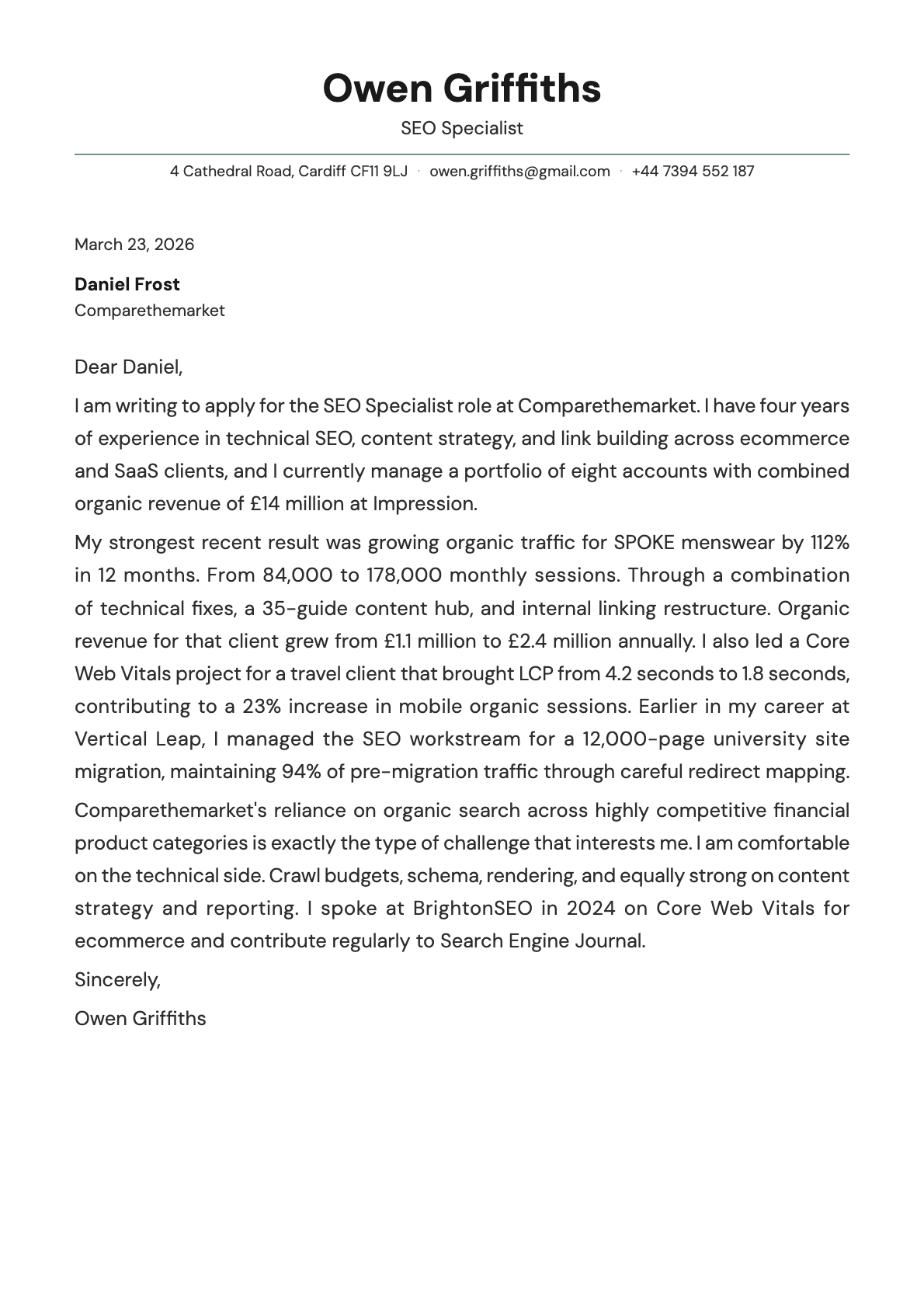
This cover letter belongs to Owen Griffiths, an SEO specialist with four years of experience at Impression and Vertical Leap, applying for a role at Comparethemarket. His letter works because every example connects an SEO activity to a measurable business outcome.
The opening: portfolio scale and revenue context
Owen opens with his experience level and immediately provides a commercial context for his work. He manages eight accounts with combined organic revenue of £14 million. That figure reframes SEO from a technical discipline to a revenue-driving channel.
Most SEO cover letters never mention revenue. They talk about traffic, rankings, and technical fixes. But hiring managers, especially at companies like Comparethemarket where organic search is a primary acquisition channel, care about what that traffic is worth. If you can attach a revenue figure to your SEO work, it changes the entire conversation.
For your letter: if you work at an agency, calculate the combined organic revenue across your client portfolio. If you work in-house, find out the revenue attributed to your organic search channel. This number should appear in your opening paragraph.
The body: one deep example, then supporting evidence
The middle paragraph leads with Owen's strongest case study: SPOKE menswear. Traffic growth of 112% (84,000 to 178,000 monthly sessions), organic revenue growth from £1.1 million to £2.4 million, and a clear description of what he did (technical fixes, content hub, internal linking restructure). This is a complete story in three sentences.
He then adds two supporting examples. The Core Web Vitals project (LCP from 4.2s to 1.8s, 23% increase in mobile organic sessions) shows technical depth. The university site migration (12,000 pages, 94% traffic retention) shows he can handle large-scale technical projects without causing damage.
The structure to follow: lead with your best case study and give it enough detail that the reader can evaluate both the challenge and the result. Then add one or two shorter examples that show different skills. This is more effective than listing five results with equal weight.
The closing: competitive context and industry presence
Owen's closing connects his skills to Comparethemarket's specific challenge: highly competitive financial product categories where organic search position directly impacts revenue. This shows he understands the business context, not just the technical requirements.
He then mentions speaking at BrightonSEO and contributing to Search Engine Journal. For SEO roles, industry presence is a genuine differentiator. It signals that you stay current with algorithm changes, share knowledge, and are recognised by peers.
If you have any industry presence, include it. Conference talks, published articles, podcast appearances, or community contributions all add credibility. If you do not have these yet, mentioning that you actively follow industry publications or participate in SEO communities is still worth including.
What makes this letter effective
Owen proves his SEO skills through results rather than claims. He does not say he is good at technical SEO. He describes reducing LCP from 4.2 seconds to 1.8 seconds and the traffic impact that followed. He does not say he is good at content strategy. He describes a 35-guide content hub that contributed to a 112% traffic increase.
The letter also covers the full spectrum of SEO work: technical (Core Web Vitals, migrations), content (content hubs), and the commercial outcome (revenue growth). This breadth is important because SEO specialist roles increasingly require all three.
Mistakes to avoid in SEO cover letters
Listing tools instead of results. "I use Ahrefs, SEMrush, Screaming Frog, and Google Search Console" tells the reader nothing about your skill level. Anyone can subscribe to these tools. What matters is what you did with them.
Talking about traffic without revenue context. Growing traffic by 100% sounds impressive, but if it was low-value informational traffic that never converted, it is less meaningful. Whenever possible, connect traffic growth to revenue or conversion outcomes.
Ignoring the technical side. Many SEO specialists focus their letters entirely on content and link building. If you have technical skills (site migrations, Core Web Vitals, JavaScript rendering, crawl budget optimisation), include them. Technical SEO is harder to find and often more valued.
Not addressing the company's competitive landscape. SEO does not exist in a vacuum. If you are applying to a company in a highly competitive organic space (financial comparison, travel, ecommerce), show that you understand the competitive dynamics and have experience winning in similar environments.
Was this cover letter example helpful?
Rate this example to help us create better content for you.
4.8 average from 127 ratingsBuild your own version
Open this layout in the builder and swap in your own details. It takes a few minutes.
Free to use. No account needed to start.
Related cover letter examples
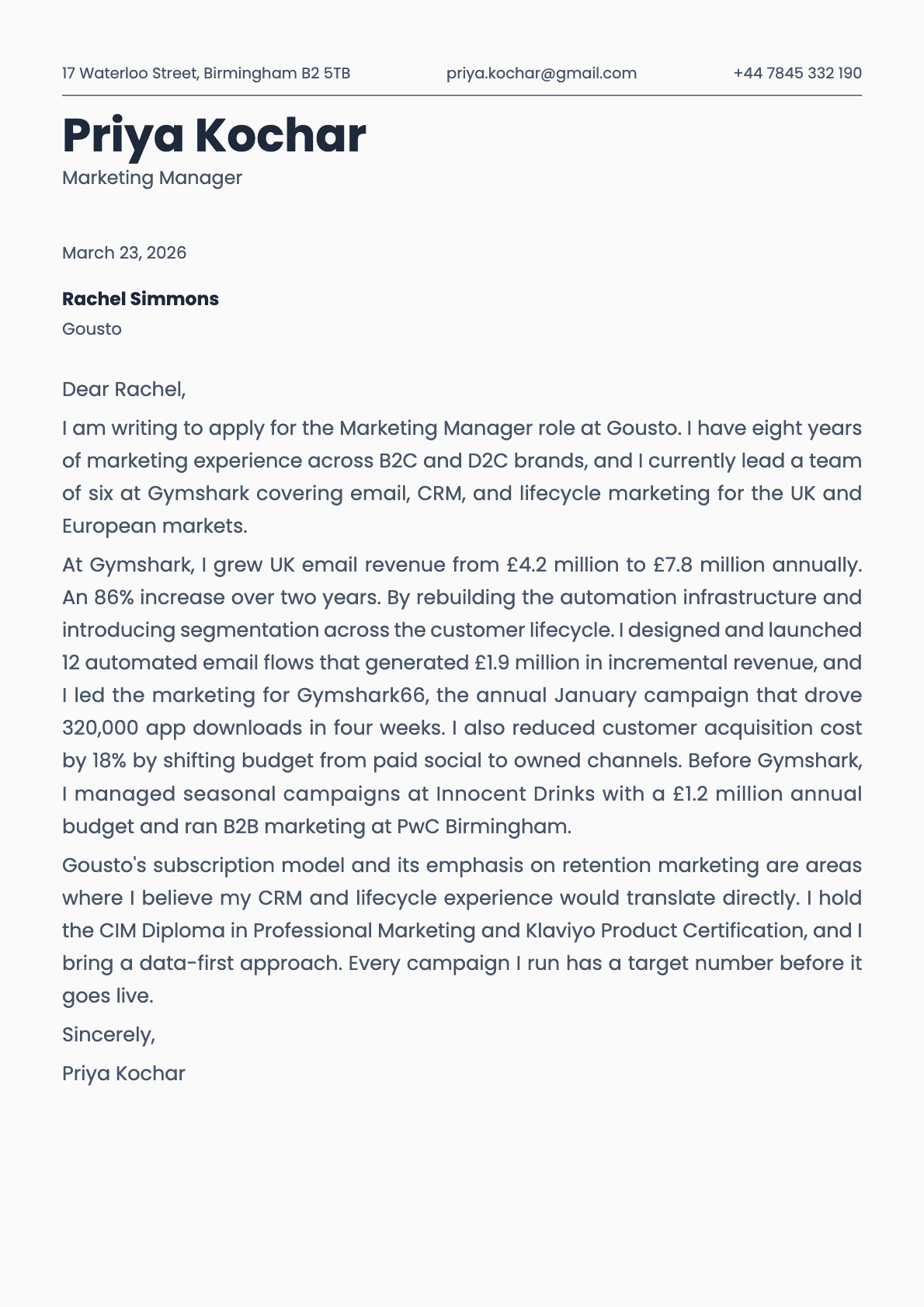
Marketing Manager
A marketing manager cover letter example targeting a D2C role at Gousto.
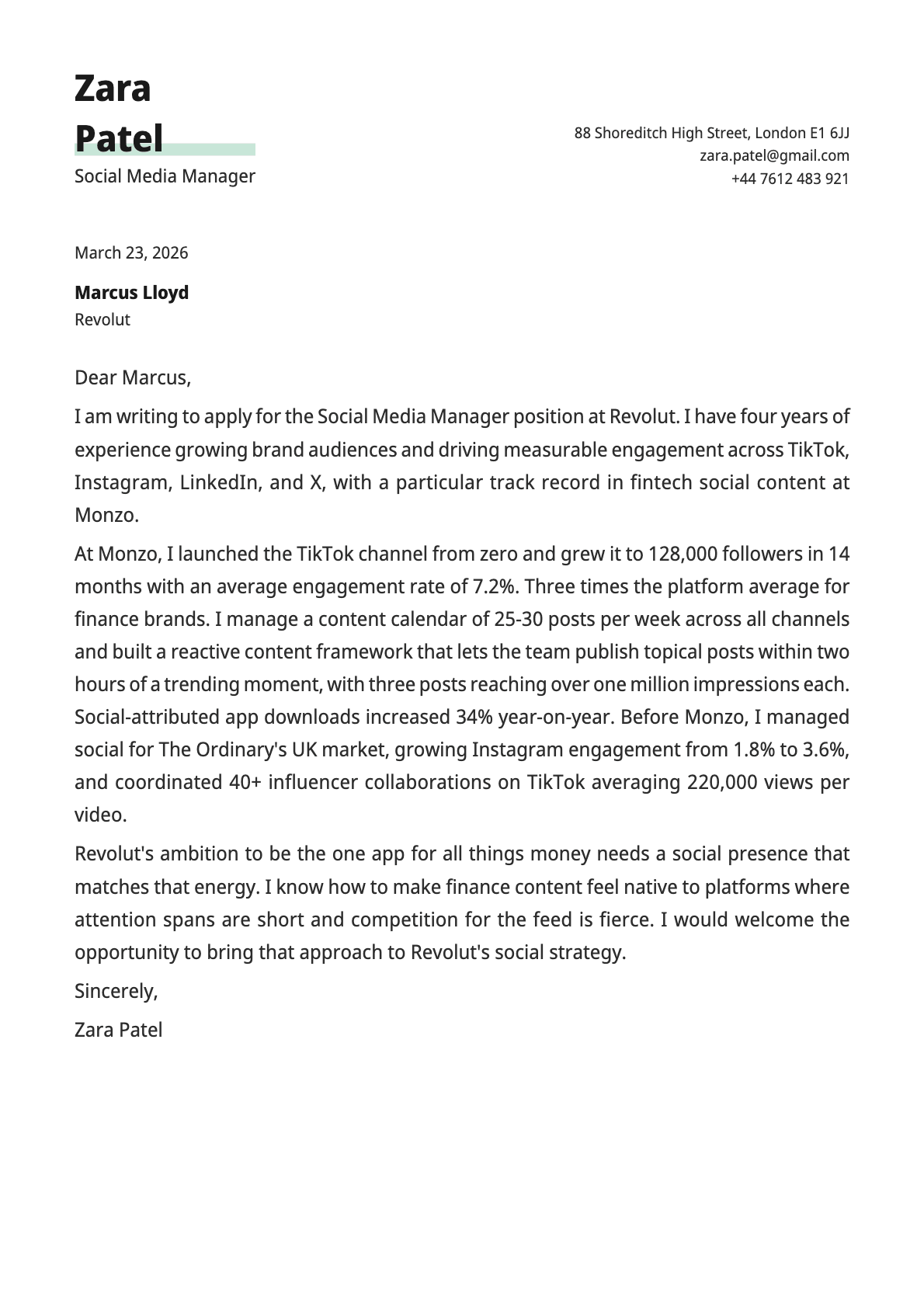
Social Media Manager
A social media manager cover letter example targeting Revolut.
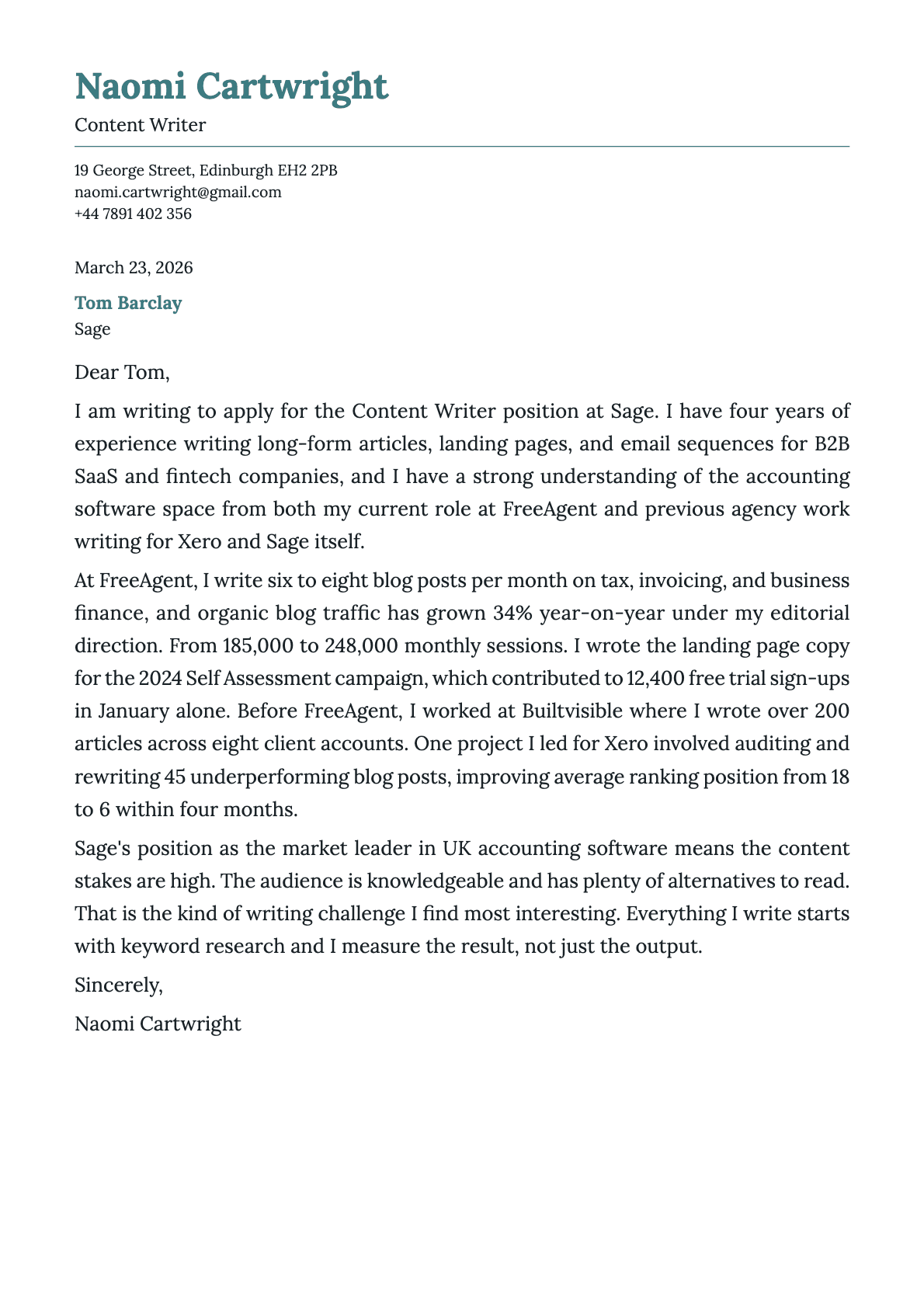
Content Writer
A content writer cover letter example targeting a B2B SaaS role at Sage.
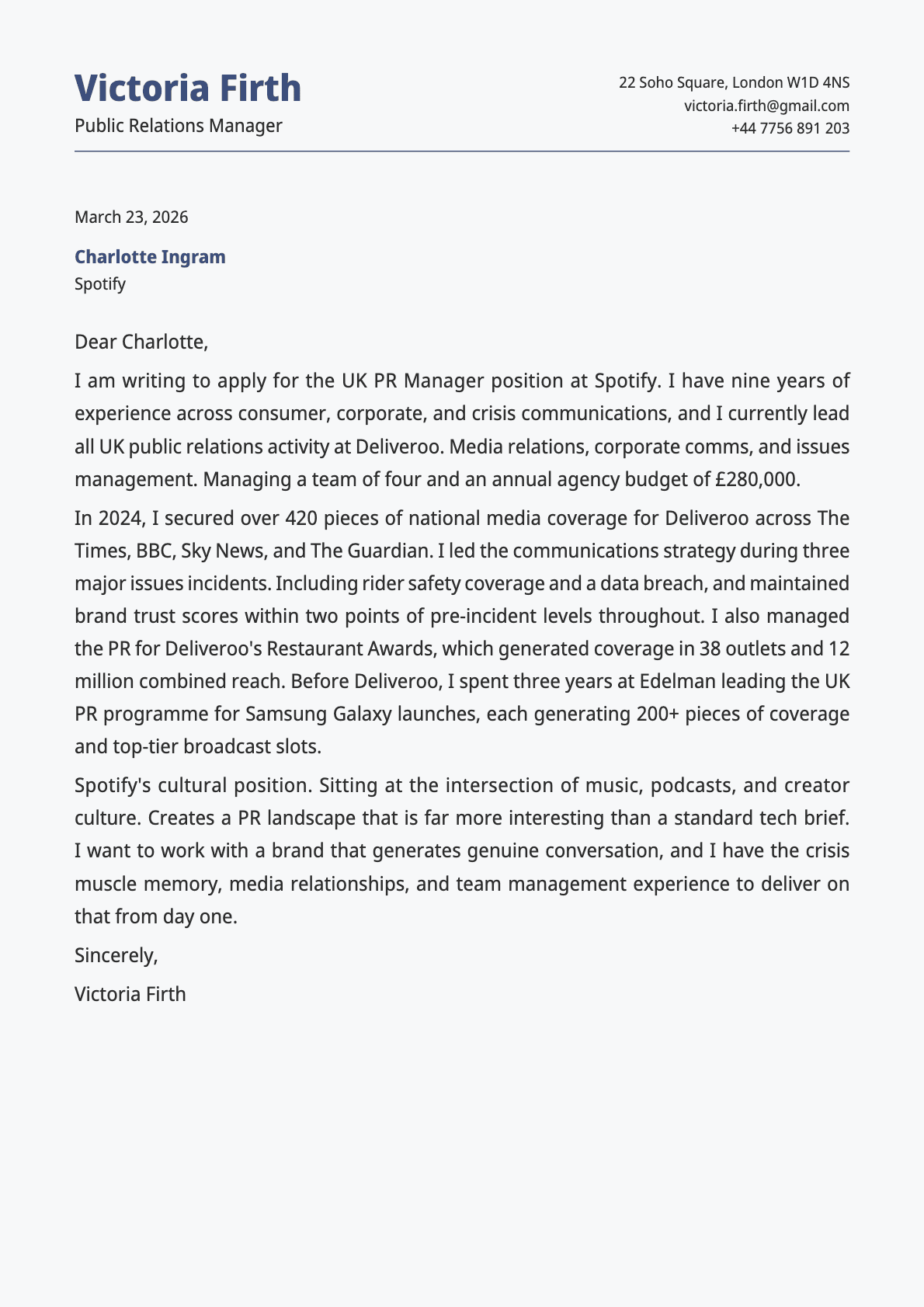
Public Relations Manager
A PR manager cover letter example targeting Spotify.
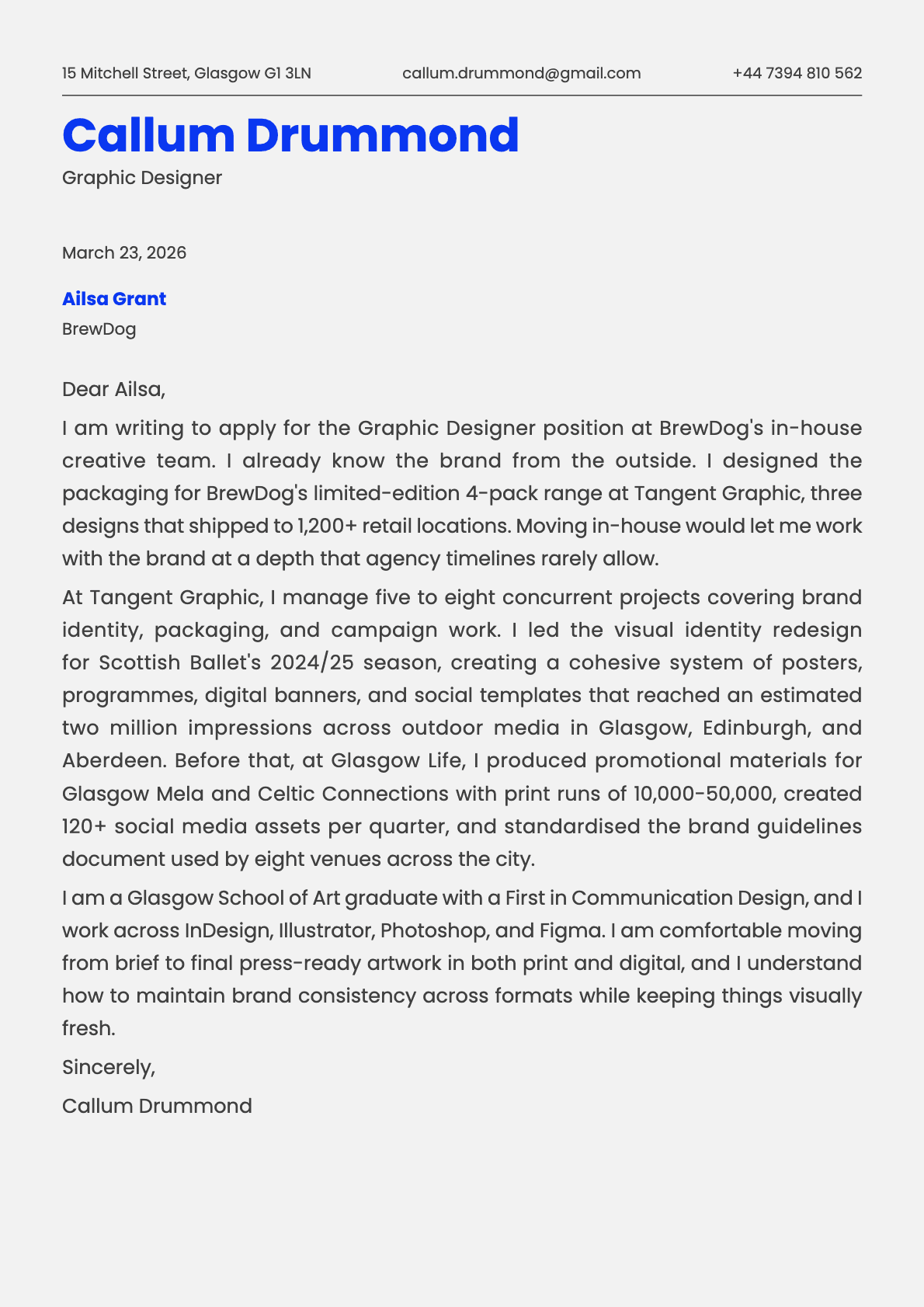
Graphic Designer
A graphic designer cover letter example targeting an in-house role at BrewDog.
Related articles

AI Is Screening Your Resume Before Any Human Sees It
AI screens most resumes before a human ever reads them. 97.4% of Fortune 500 companies run an ATS. This is what that means for you and what you can do about it.

The Best Resume Builders in 2026, Compared Honestly
Resume.io, Zety, Enhancv, Kickresume, Teal, and Laddro compared honestly: real pricing, free tiers, mobile apps, and where each tool wins. All prices checked in September 2026.

Burnout Recovery: A Real Timeline, Not 'Take a Bubble Bath'
55% of the U.S. workforce is burned out. Recovery takes 3 to 12 months. Here's what that actually looks like, stage by stage.