SEO Specialist Resume Example
An SEO specialist resume example with traffic growth numbers, technical audit results, and content strategy outcomes.

Laddro Team
Free to use. No account needed to start.
Free to use. No account needed to start.
Overview
SEO is one of those fields where everyone claims to be an expert. The job market is flooded with resumes that mention "keyword research" and "Google Analytics" but give no evidence of actual results. If you want a good agency or in-house role, your resume needs to prove that you have grown traffic, improved rankings, or increased revenue through organic search. Not that you know what those things are. That you have done them.
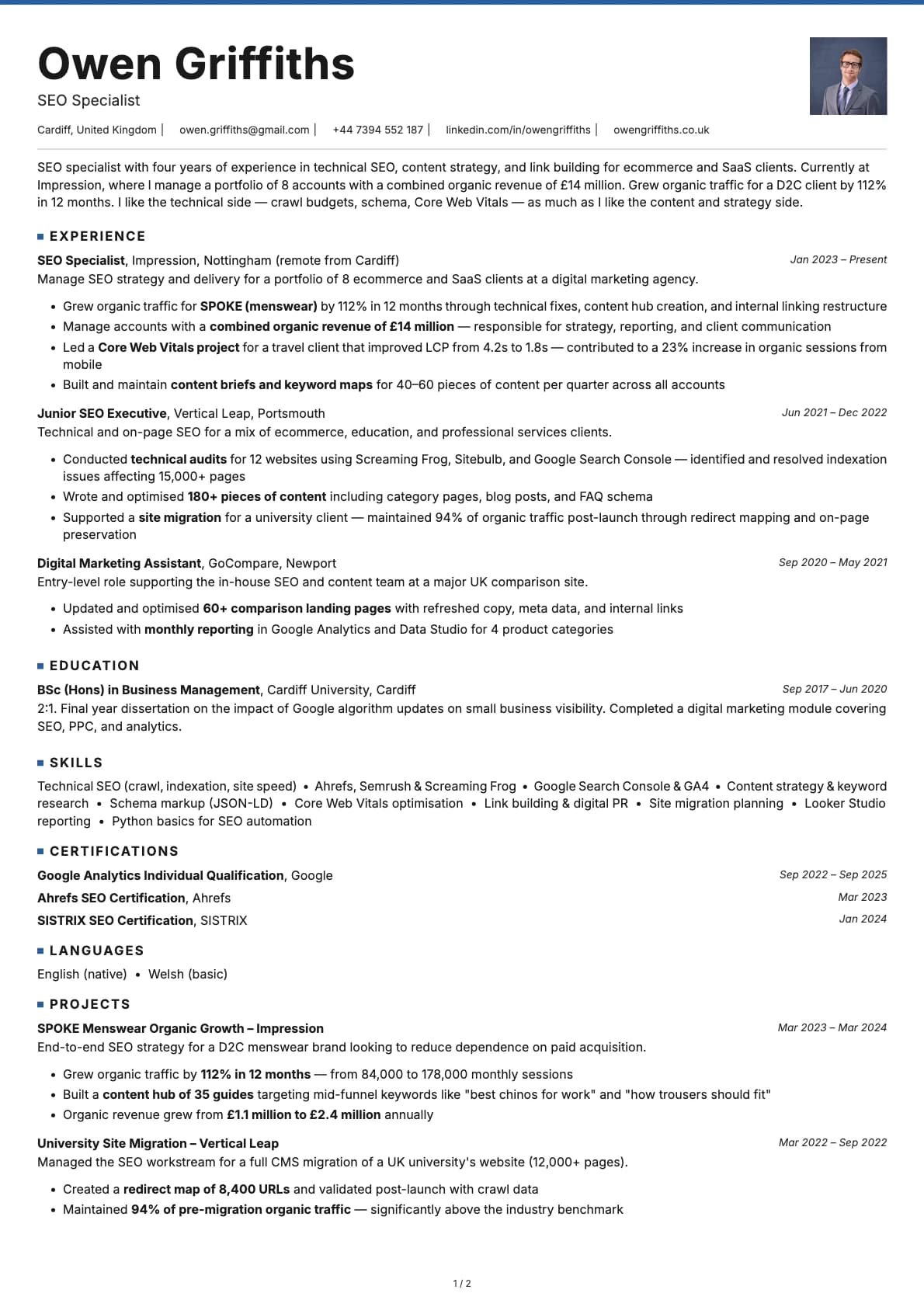
This resume belongs to Owen Griffiths, an SEO specialist in Cardiff with four years of experience. He currently works at Impression, managing a portfolio of 8 accounts with a combined organic revenue of £14 million. He grew organic traffic for a D2C menswear client by 112% in 12 months. Before Impression, he worked at Vertical Leap and started at GoCompare.
Let us go through what makes this resume work and how you can apply the same approach.
Lead with traffic and revenue numbers
An SEO resume without traffic numbers is like a developer resume without a tech stack. The first thing any hiring manager wants to know is: what did your work actually produce?
"Grew organic traffic for SPOKE (menswear) by 112% in 12 months through technical fixes, content hub creation, and internal linking restructure"
This bullet has everything. The client name (with permission, or use a description if NDA applies), the percentage growth, the timeframe, and the methods. That last part matters because it tells the reader you did not just get lucky with an algorithm update. You did specific things that caused specific results.
And the portfolio-level view:
"Manage accounts with a combined organic revenue of £14 million, responsible for strategy, reporting, and client communication"
Revenue attributed to organic search is the most powerful number an SEO can put on their resume. If you have access to revenue data (through GA4 ecommerce tracking, for example), use it.
Technical SEO is a differentiator
Many SEO professionals focus on content. Fewer can demonstrate technical ability. This resume does both:
"Led a Core Web Vitals project for a travel client that improved LCP from 4.2s to 1.8s, contributed to a 23% increase in organic sessions from mobile"
LCP (Largest Contentful Paint) is a specific Core Web Vital metric. Citing it by name, with the before-and-after numbers, shows genuine technical understanding. And linking it to a traffic outcome (23% increase in mobile sessions) shows the business impact.
From the Vertical Leap role:
"Conducted technical audits for 12 websites using Screaming Frog, Sitebulb, and Google Search Console, identified and resolved indexation issues affecting 15,000+ pages"
Name your tools. Screaming Frog, Sitebulb, Ahrefs, Semrush. These are not just resume keywords. They tell the hiring manager what your workflow looks like and whether you will fit into their existing tech stack.
Content strategy with numbers
Content is a big part of most SEO roles. But "wrote blog posts" is not a resume bullet. This is:
"Built and maintain content briefs and keyword maps for 40, 60 pieces of content per quarter across all accounts"
That shows scale and process. And from the Vertical Leap role:
"Wrote and optimised 180+ pieces of content including category pages, blog posts, and FAQ schema"
180 pieces. Multiple content types. FAQ schema (which shows technical awareness too). Always quantify your content work: how many pieces, what types, over what period.
Site migrations are worth highlighting
If you have been involved in a site migration, put it on your resume. Migrations are high-stakes, stressful projects where things can go very wrong. Successfully managing one is a genuine credential:
"Supported a site migration for a university client, maintained 94% of organic traffic post-launch through redirect mapping and on-page preservation"
94% traffic retention on a migration of 12,000+ pages is an excellent result. The industry benchmark is much lower. If you have migration experience with a good outcome, it belongs on your resume.
Tools and certifications
The skills section on this resume is well structured: technical SEO tools (Ahrefs, Semrush, Screaming Frog), analytics (GA4, Search Console, Looker Studio), and technical capabilities (schema markup, Core Web Vitals, Python for automation).
For certifications, the Google Analytics Individual Qualification and Ahrefs SEO Certification are both industry-recognized. They do not replace experience, but they show you have invested in formal training beyond just learning on the job.
If you contribute to industry publications or speak at conferences (this resume mentions BrightonSEO and Search Engine Journal), include those in an extracurricular or projects section. They build credibility and signal that you are active in the SEO community.
Mistakes SEO specialists make on resumes
Listing tools without outcomes. "Experience with Ahrefs and Semrush" tells the reader nothing. "Used Ahrefs to identify 340 link building opportunities, resulting in 85 new referring domains over 6 months" tells them everything.
Claiming rankings without context. "Ranked #1 for [keyword]" is only meaningful if you explain: how competitive was the keyword? What was the search volume? What did that ranking do for the business? A #1 ranking for a keyword with 50 monthly searches is very different from one with 50,000.
Ignoring the business outcome. Traffic is good. Revenue is better. Whenever possible, connect your SEO work to a business result: increased revenue, reduced cost per acquisition, or more leads.
Not differentiating between agency and in-house. Agency SEO and in-house SEO involve different skills. Agency work emphasizes managing multiple clients, communication, and reporting. In-house work emphasizes deeper technical ownership and cross-team collaboration. Make sure your resume reflects the type of role you are applying for.
One last thing
SEO changes constantly. Your resume should show that you keep up. Industry certifications, conference talks, published articles, or even a personal blog where you test things. The best SEO candidates are the ones who are always experimenting. Find a way to show that on your resume.
Build your own version
Open this layout in the builder and swap in your own details. It takes a few minutes.
Free to use. No account needed to start.
Was this resume example helpful?
Rate this example to help us create better content for you.
4.8 average from 163 ratingsRelated resume examples
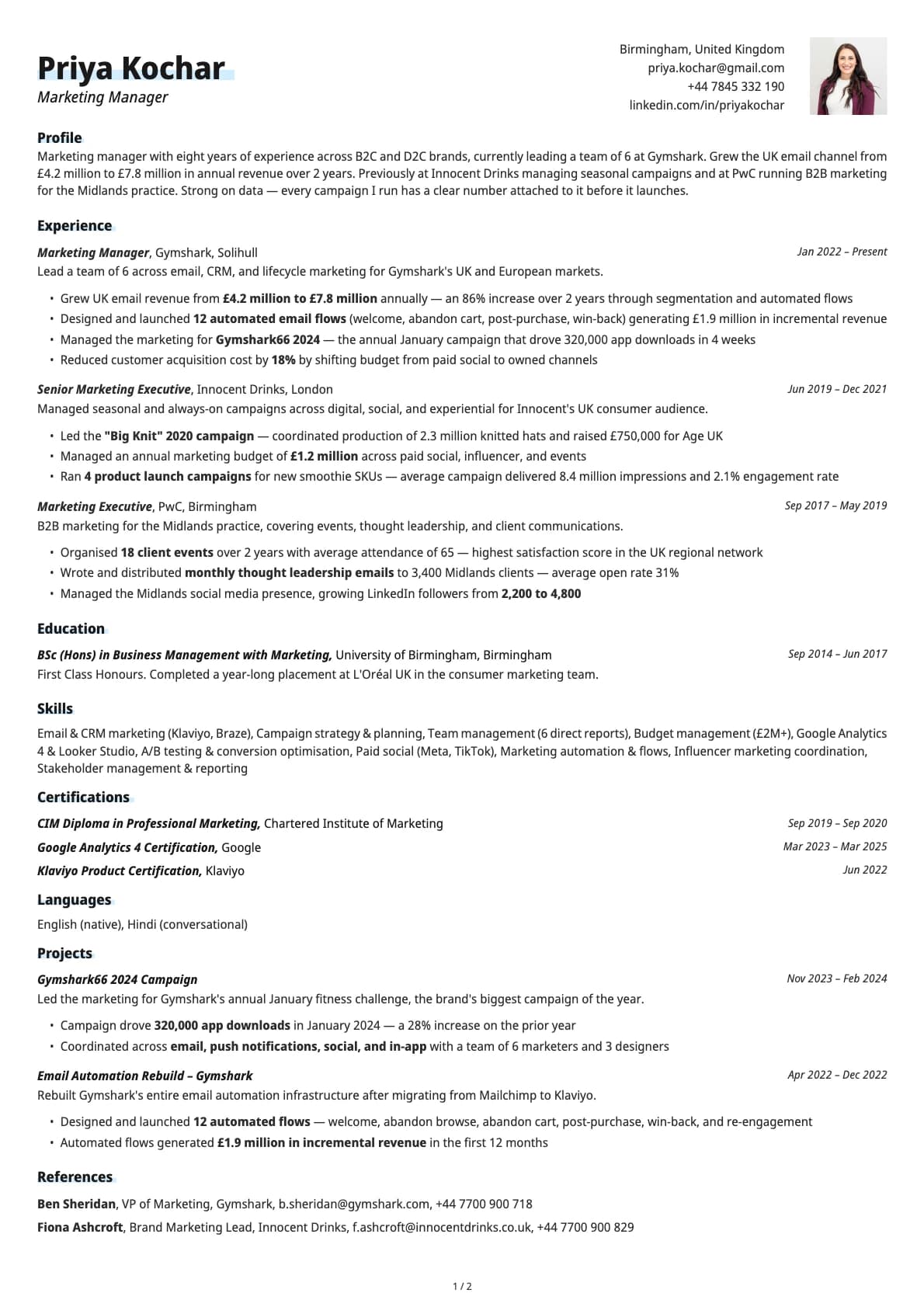
Marketing Manager
A marketing manager resume example with channel revenue growth, campaign results, and team management details.
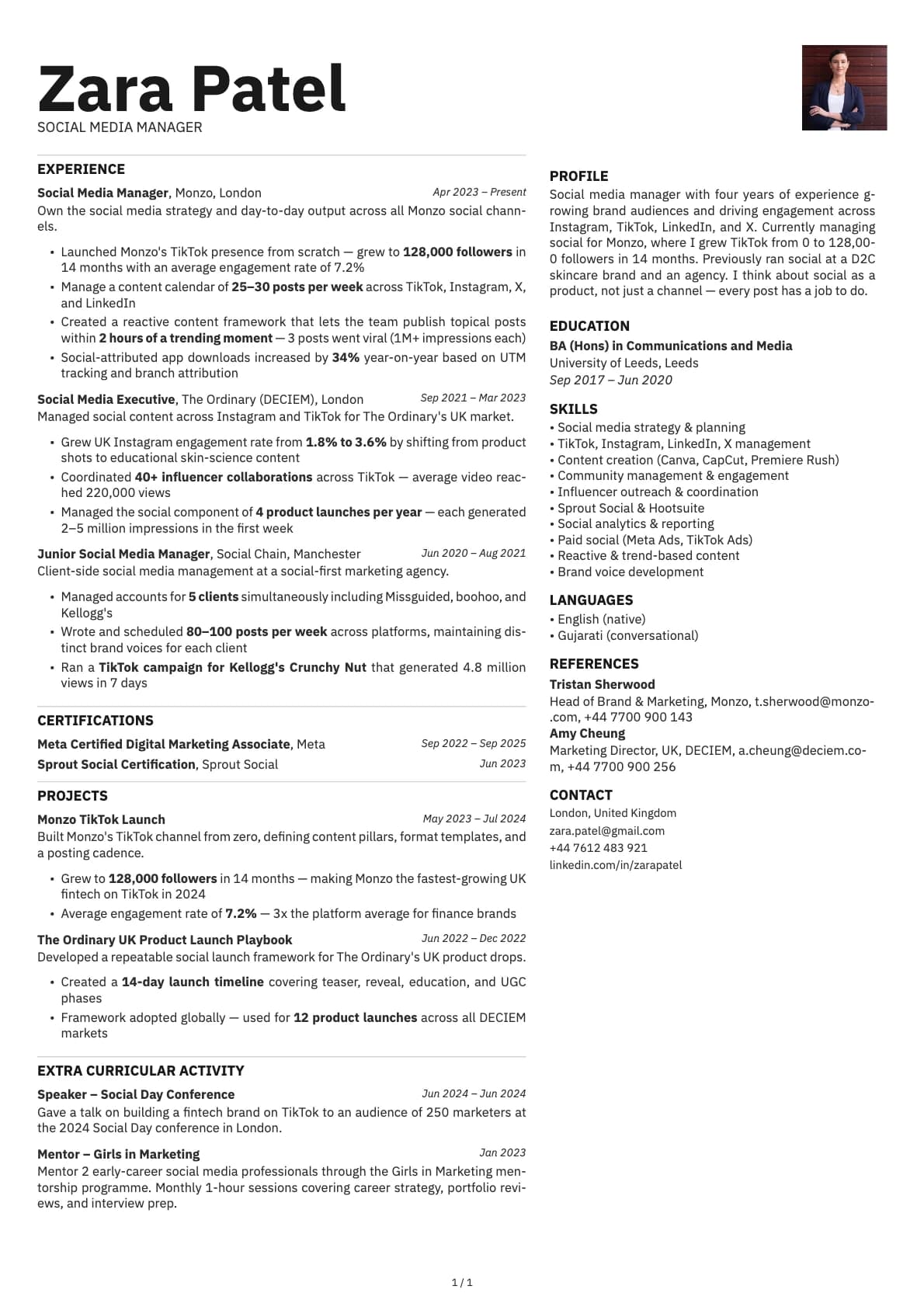
Social Media Manager
A social media manager resume example with follower growth, engagement rates, and campaign results.
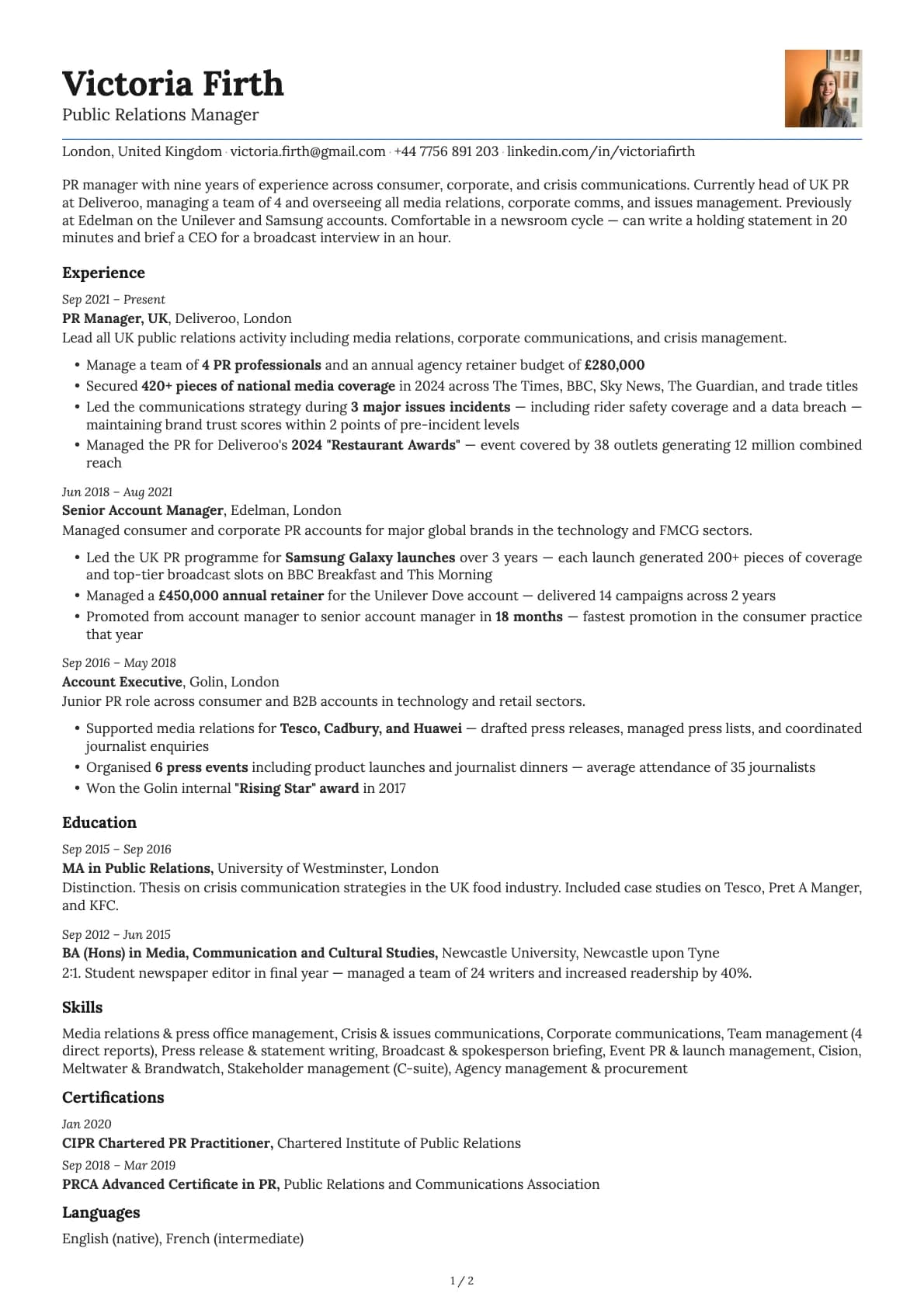
Public Relations Manager
A public relations manager resume example with media coverage numbers, crisis communications experience, and campaign reach from agency and in-house roles.
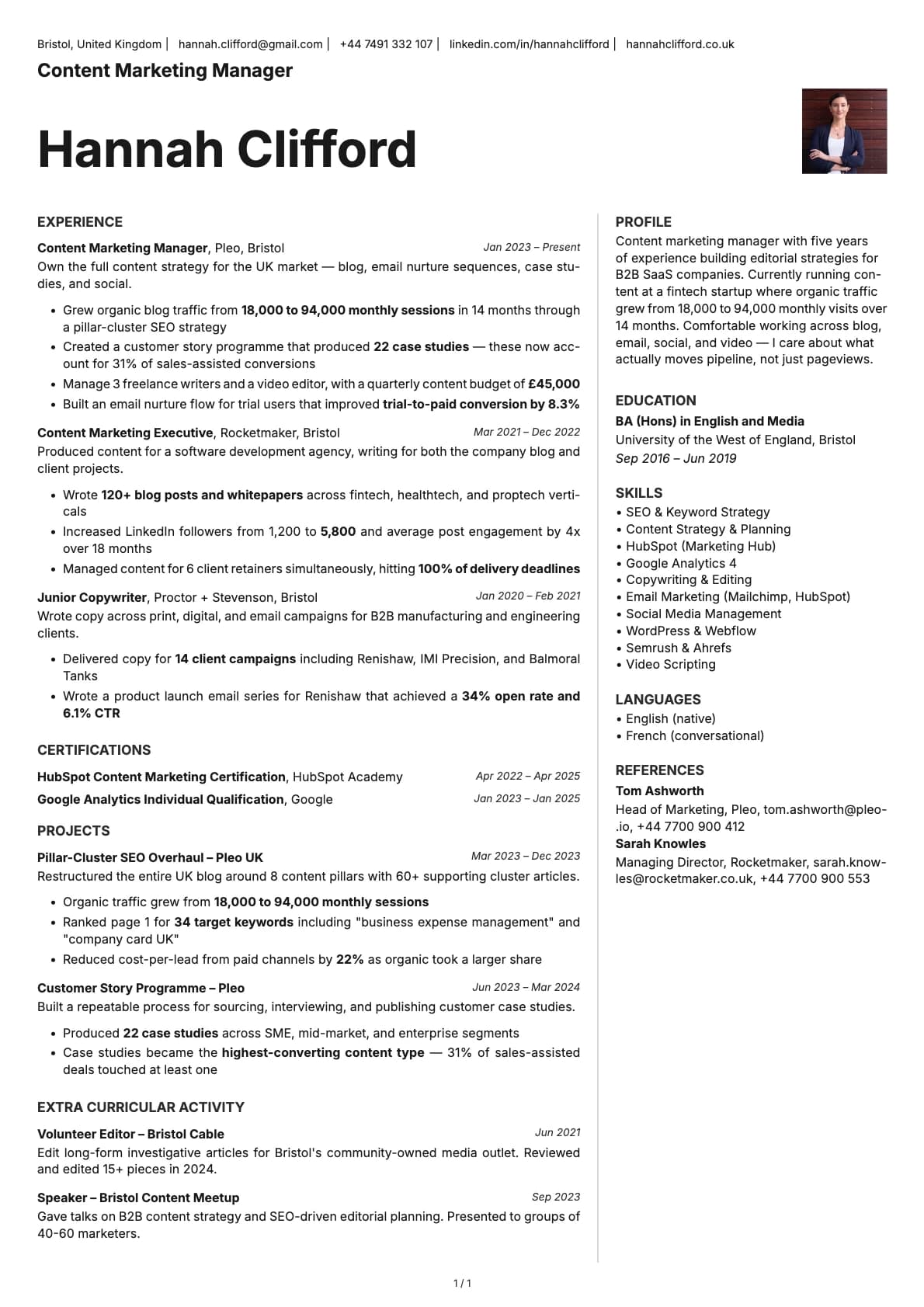
Content Marketing Manager
A content marketing manager resume example with B2B SaaS experience at Pleo.
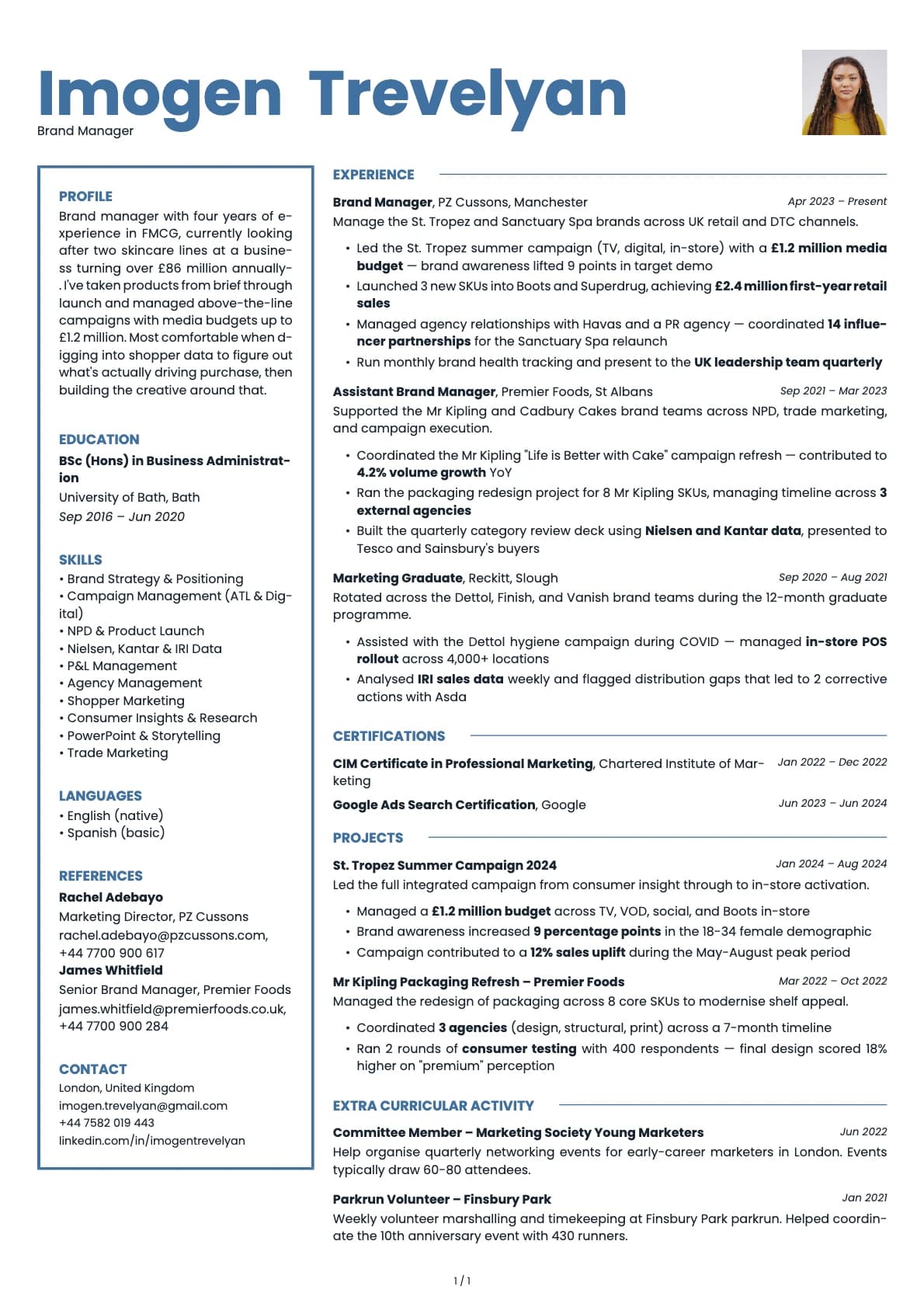
Brand Manager
A brand manager resume example from FMCG with campaign budgets, NPD launches, and Nielsen/Kantar data experience across PZ Cussons and Premier Foods.
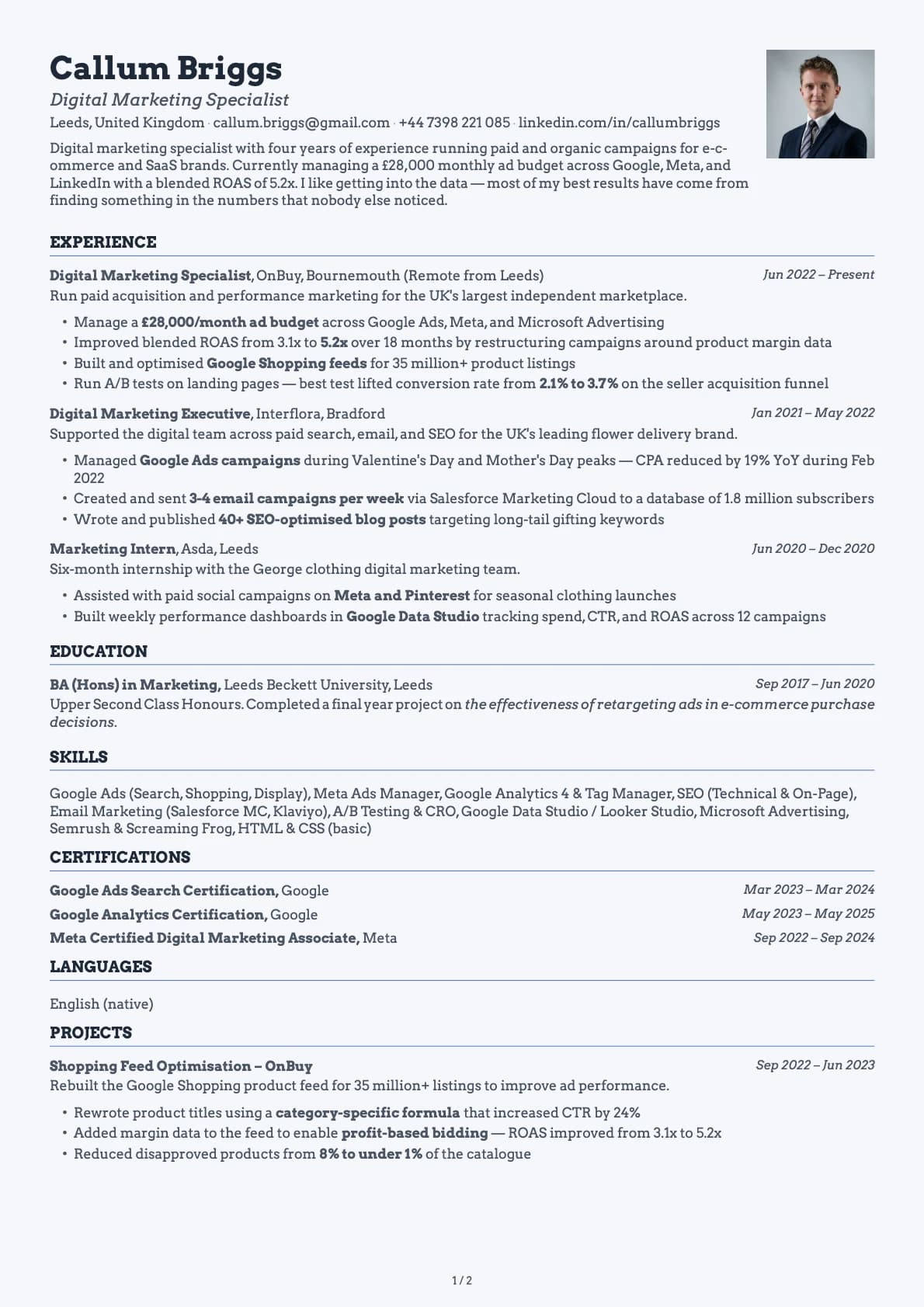
Digital Marketing Specialist
A digital marketing specialist resume example showing how to present campaign performance, ad spend management, and ROI numbers that recruiters actually.
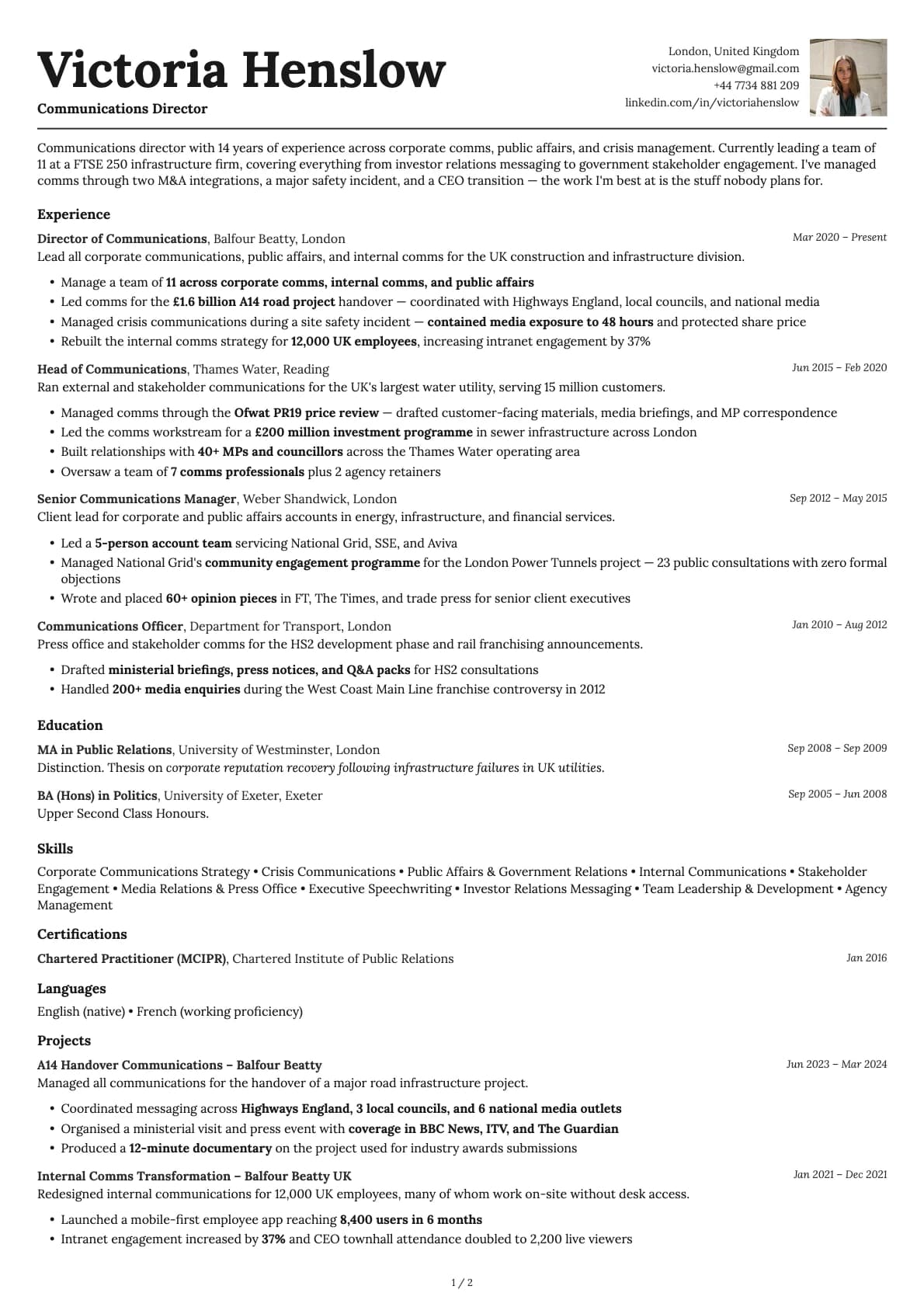
Communications Director
A communications director resume example with 14 years of experience across corporate comms, public affairs.
Related articles

AI Is Screening Your Resume Before Any Human Sees It
AI screens most resumes before a human ever reads them. 97.4% of Fortune 500 companies run an ATS. This is what that means for you and what you can do about it.

The Best Resume Builders in 2026, Compared Honestly
Resume.io, Zety, Enhancv, Kickresume, Teal, and Laddro compared honestly: real pricing, free tiers, mobile apps, and where each tool wins. All prices checked in September 2026.

Burnout Recovery: A Real Timeline, Not 'Take a Bubble Bath'
55% of the U.S. workforce is burned out. Recovery takes 3 to 12 months. Here's what that actually looks like, stage by stage.