Creative Director Resume Example
A creative director resume example with 14 years in advertising, Cannes Lions wins.

Laddro Team
Free to use. No account needed to start.
Free to use. No account needed to start.
Overview
A creative director resume is a strange document. You have spent years building a career where the work speaks for itself, and now you have to squeeze it onto a page. The temptation is to list every campaign, every award, every client. But that makes the resume harder to read, not more impressive.
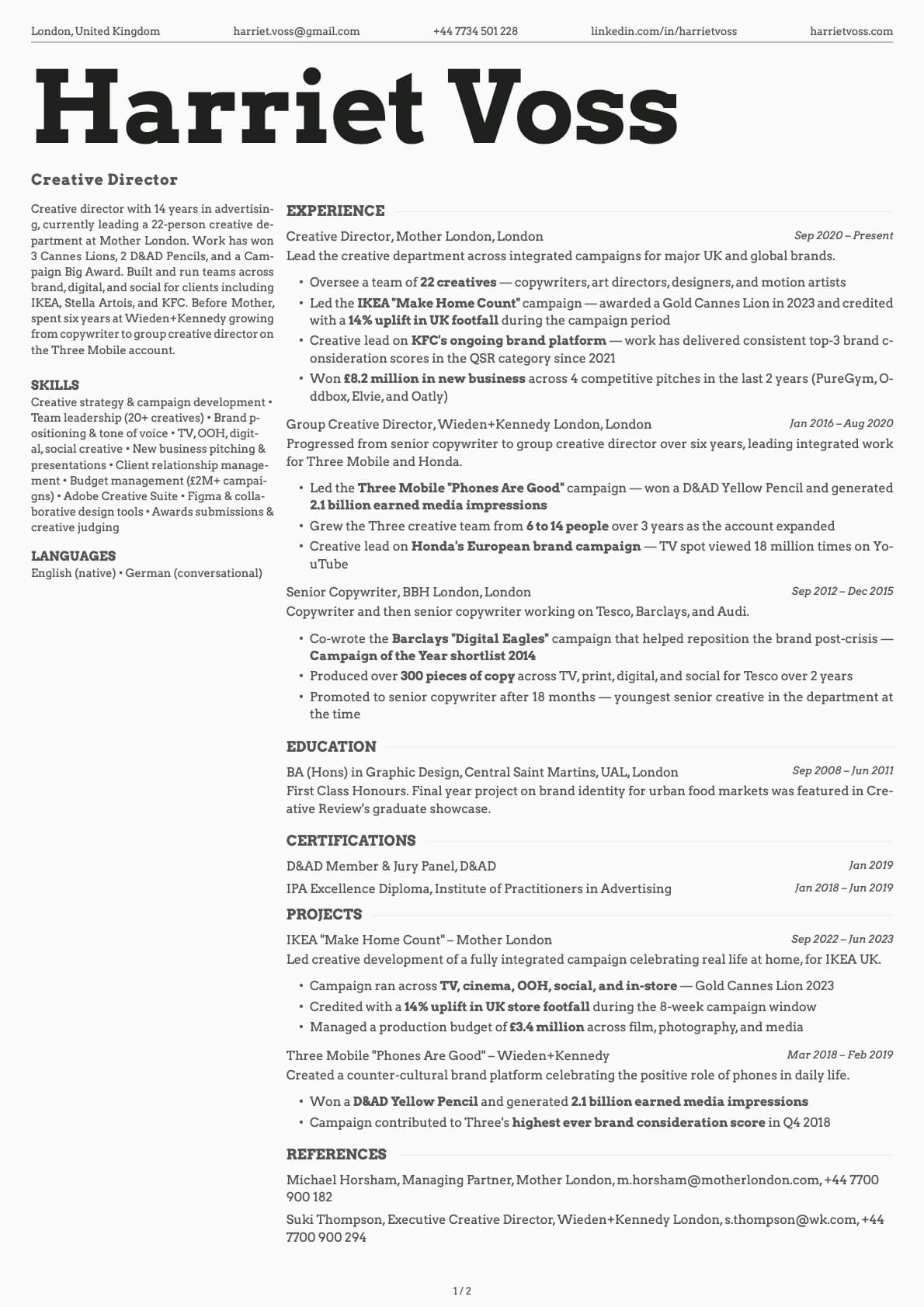
This resume belongs to a creative director with 14 years in advertising. She currently leads a 22-person creative department at Mother London, working on IKEA and KFC. Before that, she ran the Three Mobile account at Wieden+Kennedy. Her work has won 3 Cannes Lions and 2 D&AD Pencils. And the resume is still only one page.
Here is what she does right, and what you can copy.
Lead with scale, not job descriptions
At creative director level, nobody needs you to explain what a creative director does. They need to know: how big is your team, how big are your clients, and what has the work achieved?
Look at the summary:
Creative director with 14 years in advertising, currently leading a 22-person creative department at Mother London. Work has won 3 Cannes Lions, 2 D&AD Pencils, and a Campaign Big Award.
Three sentences. Team size, agency name, and the awards that prove the calibre of the work. No "visionary leader" language. No paragraph about creative philosophy. Just the facts that matter to someone deciding whether to interview you.
For your resume: Open with years of experience and current role. Then immediately give the most impressive proof point. For some people that is awards. For others it might be the size of the account you run or the revenue you have brought in.
Your experience section is about business impact
At this level, your bullets should not be about what you made. They should be about what happened because of what you made.
Here is a bullet from the Mother London role:
"Led the IKEA 'Make Home Count' campaign, awarded a Gold Cannes Lion in 2023 and credited with a 14% uplift in UK footfall during the campaign period"
Award plus business result. That is the formula for senior creative roles. The award tells the industry you are good. The footfall number tells the CEO you are useful.
And this one:
"Won £8.2 million in new business across 4 competitive pitches in the last 2 years (PureGym, Oddbox, Elvie, and Oatly)"
New business wins are gold on a creative director resume. Agencies live and die on pitches, and being able to name the clients you helped win shows you can sell ideas, not just have them.
Show your progression
The most convincing thing about this resume is the career arc. BBH as a junior copywriter, promoted to senior in 18 months. Then Wieden+Kennedy, growing from senior copywriter to group creative director over six years. Then Mother as creative director.
Each role is bigger than the last. The team sizes grow (from individual contributor to 6, to 14, to 22). The responsibility grows. This tells the reader this person has earned every step.
If your career has a similar trajectory, make it visible. Show the team size at each stage. Mention promotions. And if you progressed unusually fast, say so. This resume notes "youngest senior creative in the department at the time." That is a subtle but effective detail.
Awards: be selective
This person has won multiple Cannes Lions, D&AD Pencils, and a Campaign Big Award. But the resume does not have a long awards list. Instead, the awards are woven into the experience bullets where they belong, attached to the specific campaigns that earned them.
This is smarter than a separate awards section because it ties each award to a piece of work. A recruiter can see what you won AND what the campaign did. If you have a long list of awards, pick the 4-5 most prestigious ones and embed them in context. Delete the rest.
Skills at this level are about leadership
Notice the skills on this resume:
- Creative strategy and campaign development
- Team leadership (20+ creatives)
- New business pitching and presentations
- Budget management (£2M+ campaigns)
These are not "skills" in the traditional sense. They are proof of the scope you operate at. The parenthetical details (20+ creatives, £2M+ campaigns) do a lot of heavy lifting. They tell the reader exactly how senior this person is without requiring a separate explanation.
Mistakes that trip up senior creatives
Submitting without a portfolio. Even at creative director level, the hiring team wants to see the work. Make sure your website is linked and up to date. If the work is under NDA, describe the brief and result without showing the creative.
Writing too much. The more senior you are, the more you need to edit. This resume covers 14 years in three job entries. Each one has 3-4 bullets. That is enough. If a recruiter wants more detail, that is what the interview is for.
Ignoring the business side. Creative directors who only talk about awards and craft will lose out to those who can also talk about revenue, pitches won, and brand metrics. Include at least one commercial number per role.
Using a flashy template. You might expect a creative director to have the most designed resume in the stack. But most agencies use ATS systems for initial screening. A clean, readable layout like Fern (used here) gets through screening and still looks polished.
One final note
At creative director level, your resume is really just a door opener. The interview will be about your reel, your leadership style, and your point of view on the work. But the resume still needs to be tight, well-structured, and free of fluff. Write it the way you would edit a brief: cut everything that does not earn its place.
Build your own version
Open this layout in the builder and swap in your own details. It takes a few minutes.
Free to use. No account needed to start.
Was this resume example helpful?
Rate this example to help us create better content for you.
4.8 average from 98 ratingsRelated resume examples
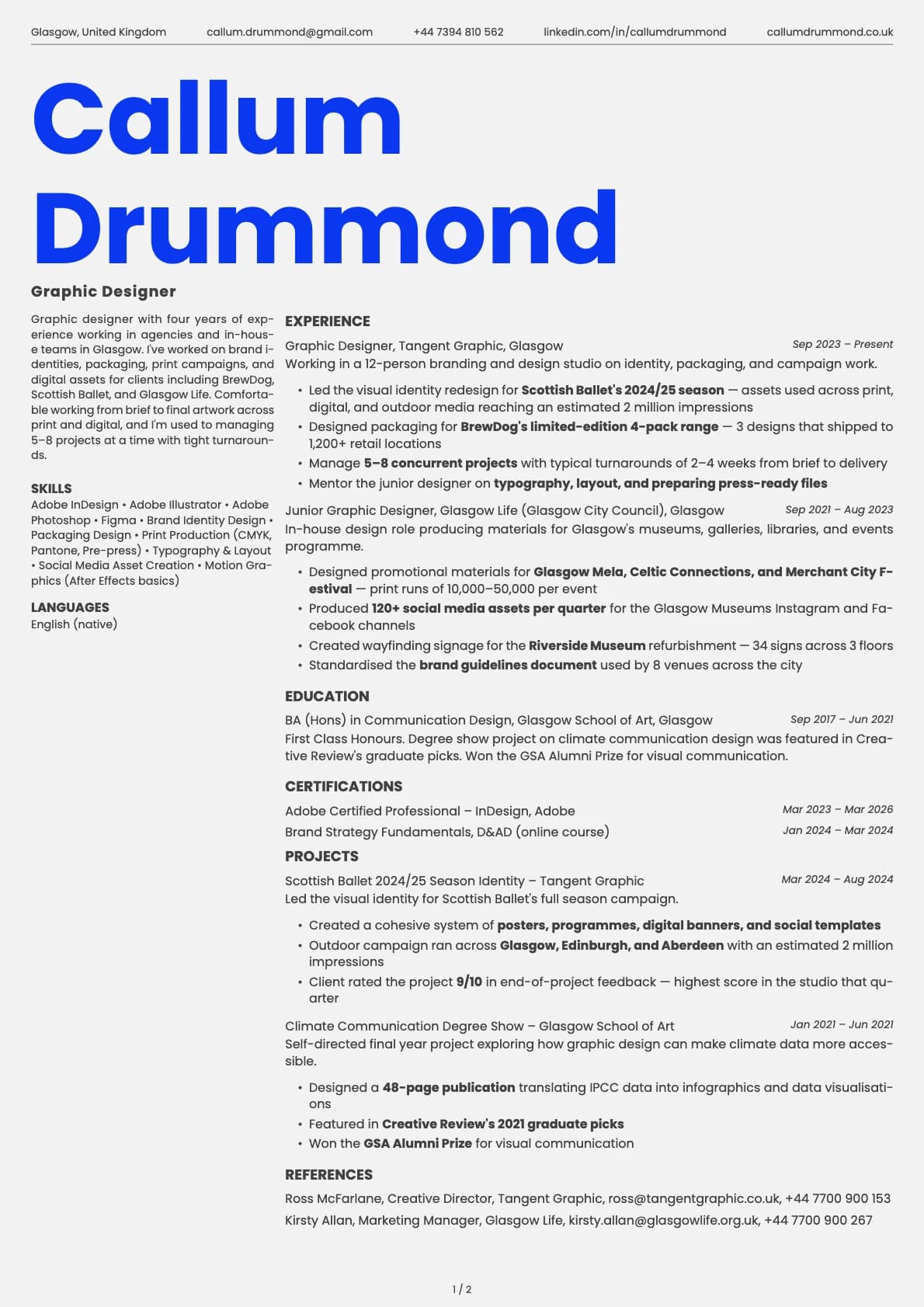
Graphic Designer
A graphic designer resume example with agency and in-house experience in branding, packaging, and print.
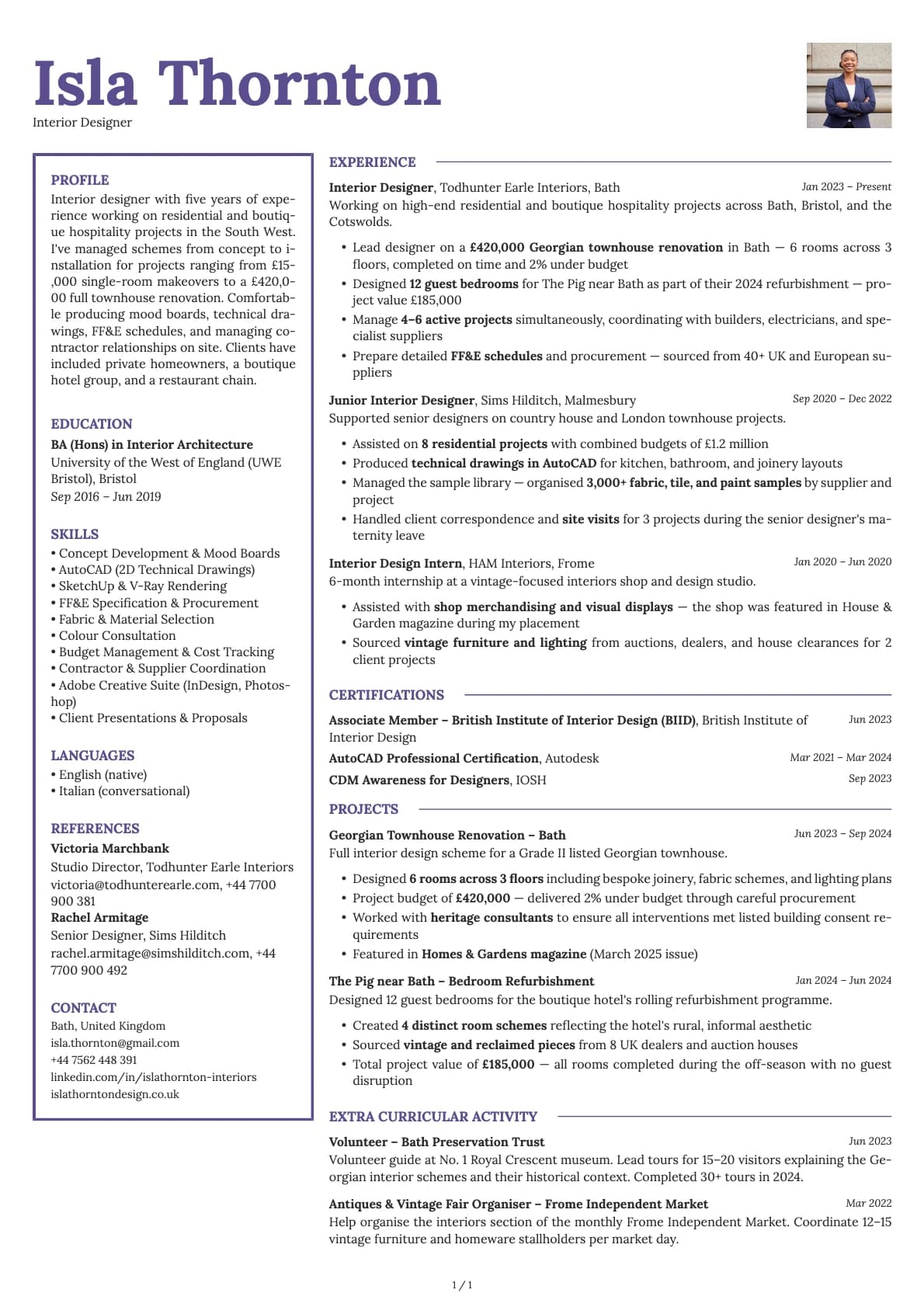
Interior Designer
An interior designer resume example with project budgets, client types, and FF&E details. See how to present residential and hospitality design experience.
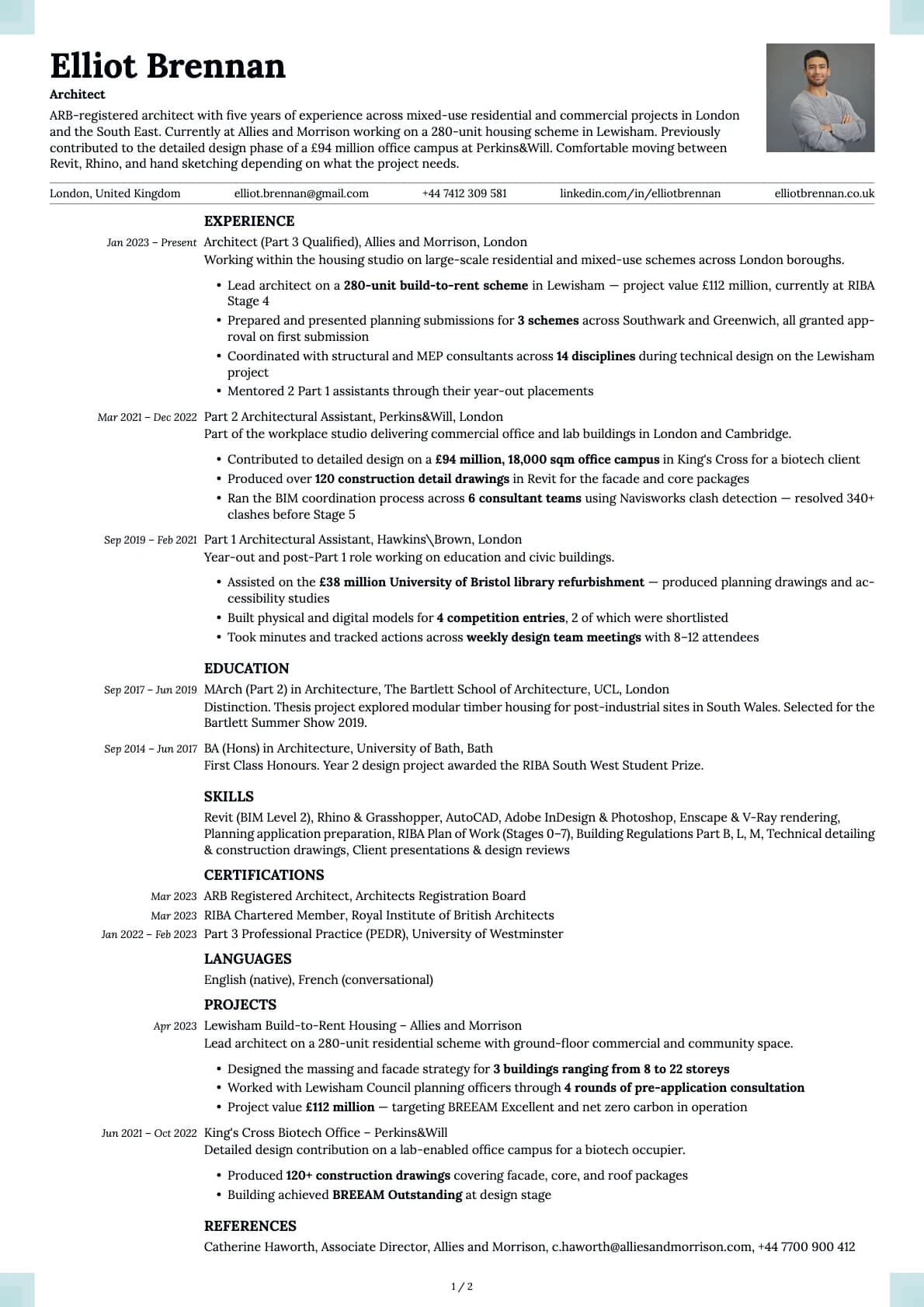
Architect
An ARB-registered architect resume example with RIBA Stage 4 project experience, BIM coordination.
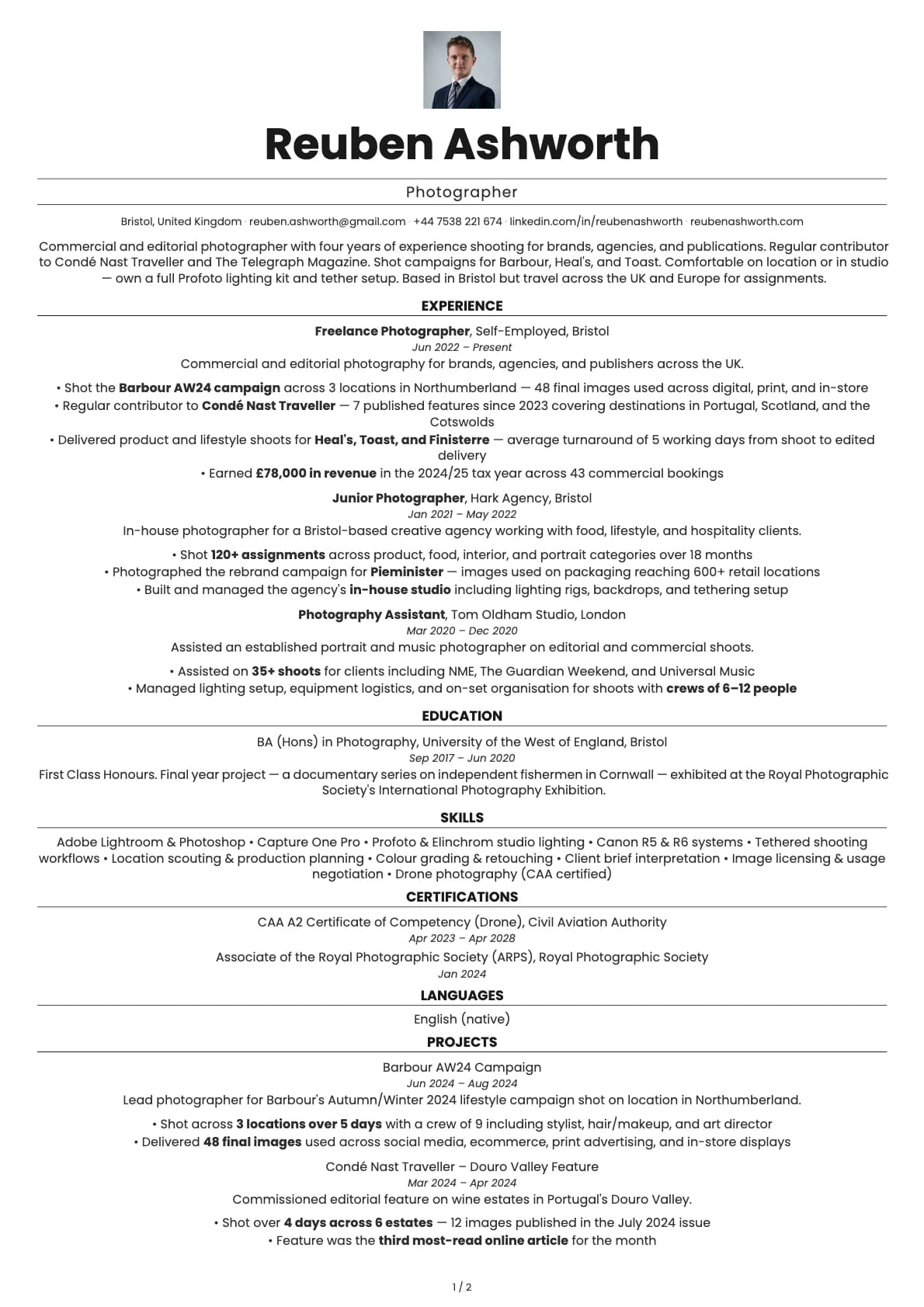
Photographer
A photographer resume example with commercial campaign work, editorial credits, and revenue figures from a freelance career.
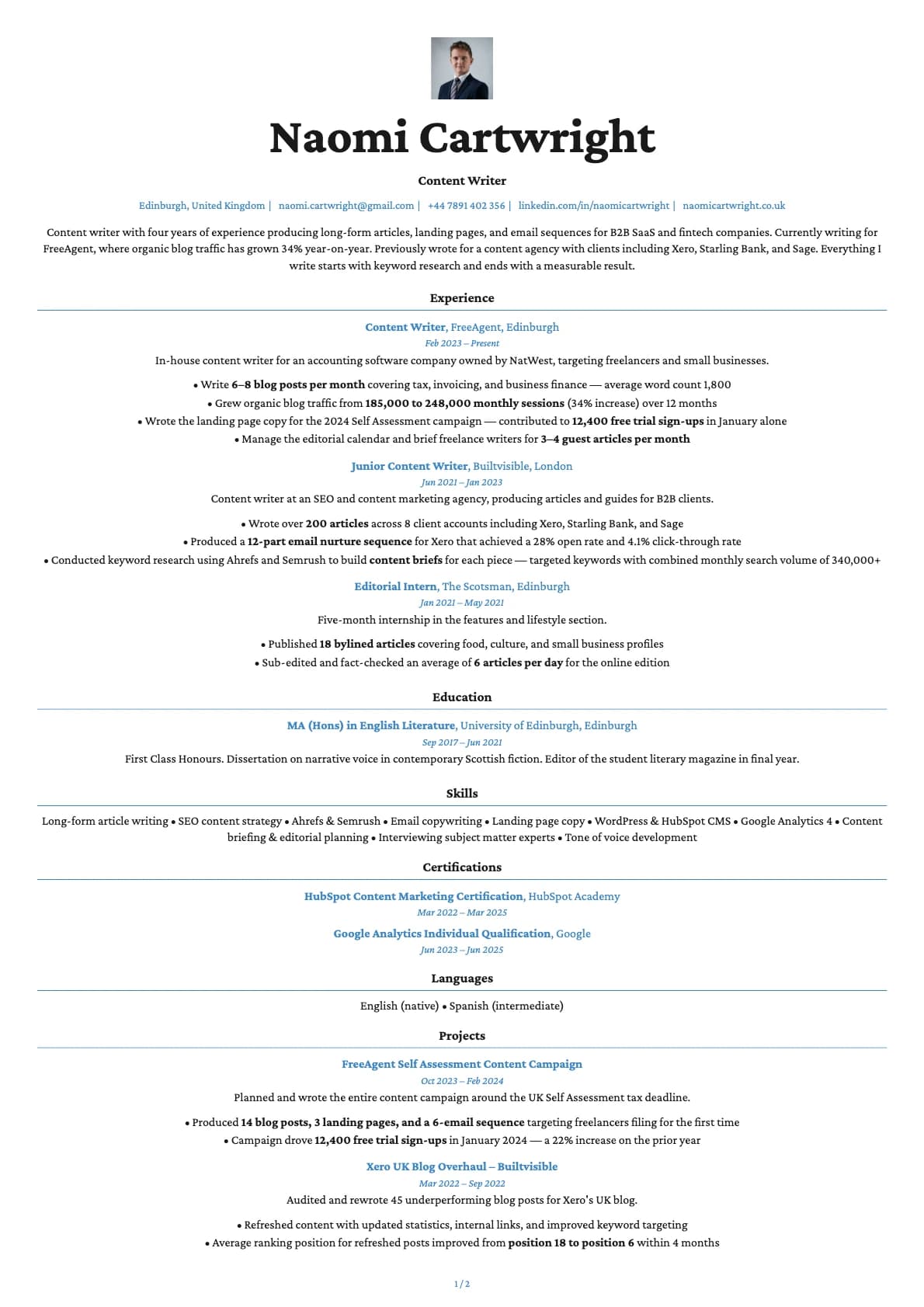
Content Writer
A content writer resume example with in-house and agency experience writing for FreeAgent, Xero, and Starling Bank.
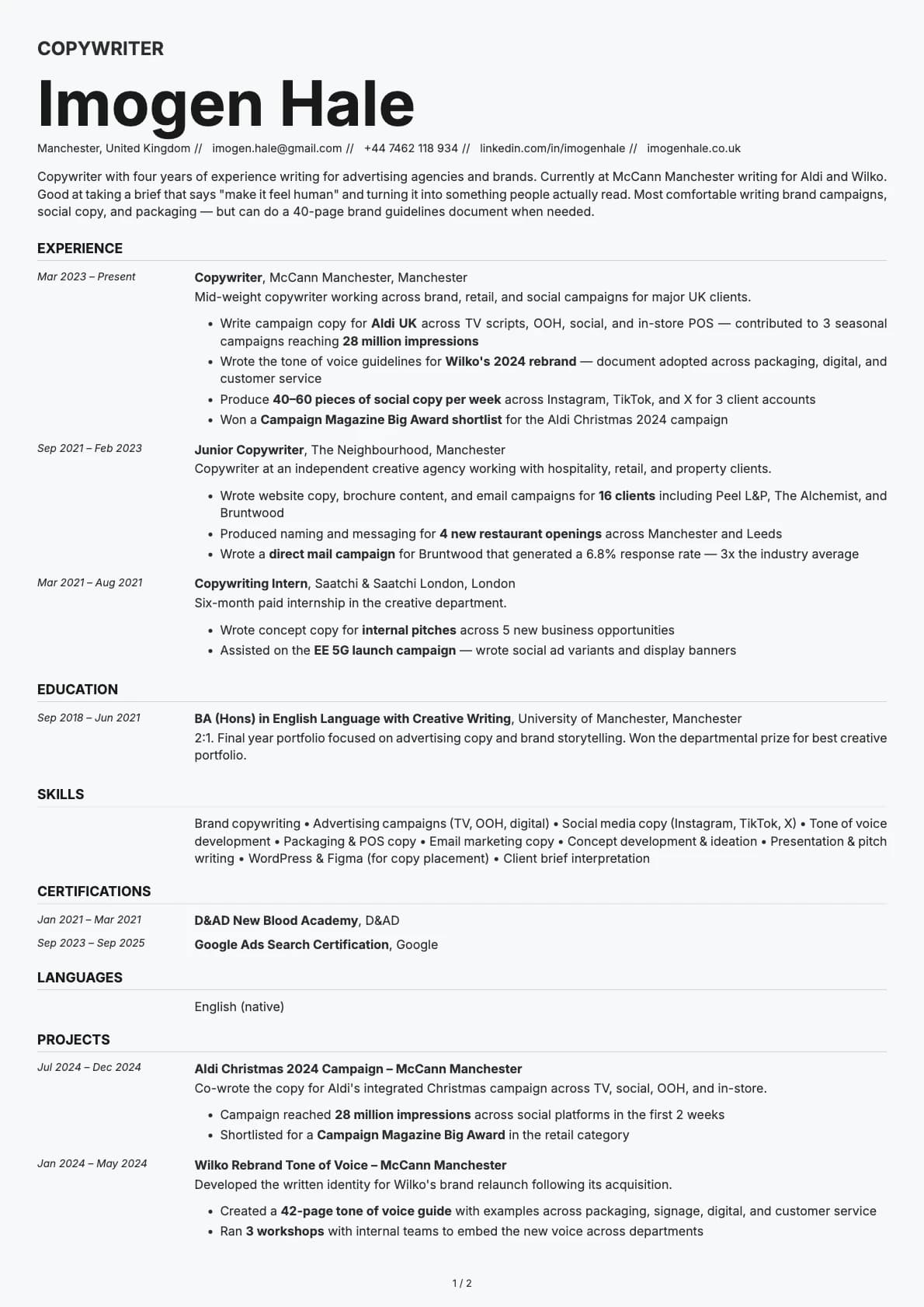
Copywriter
A copywriter resume example with McCann and Saatchi & Saatchi experience. See how to showcase your portfolio, campaign results, and tone of voice.
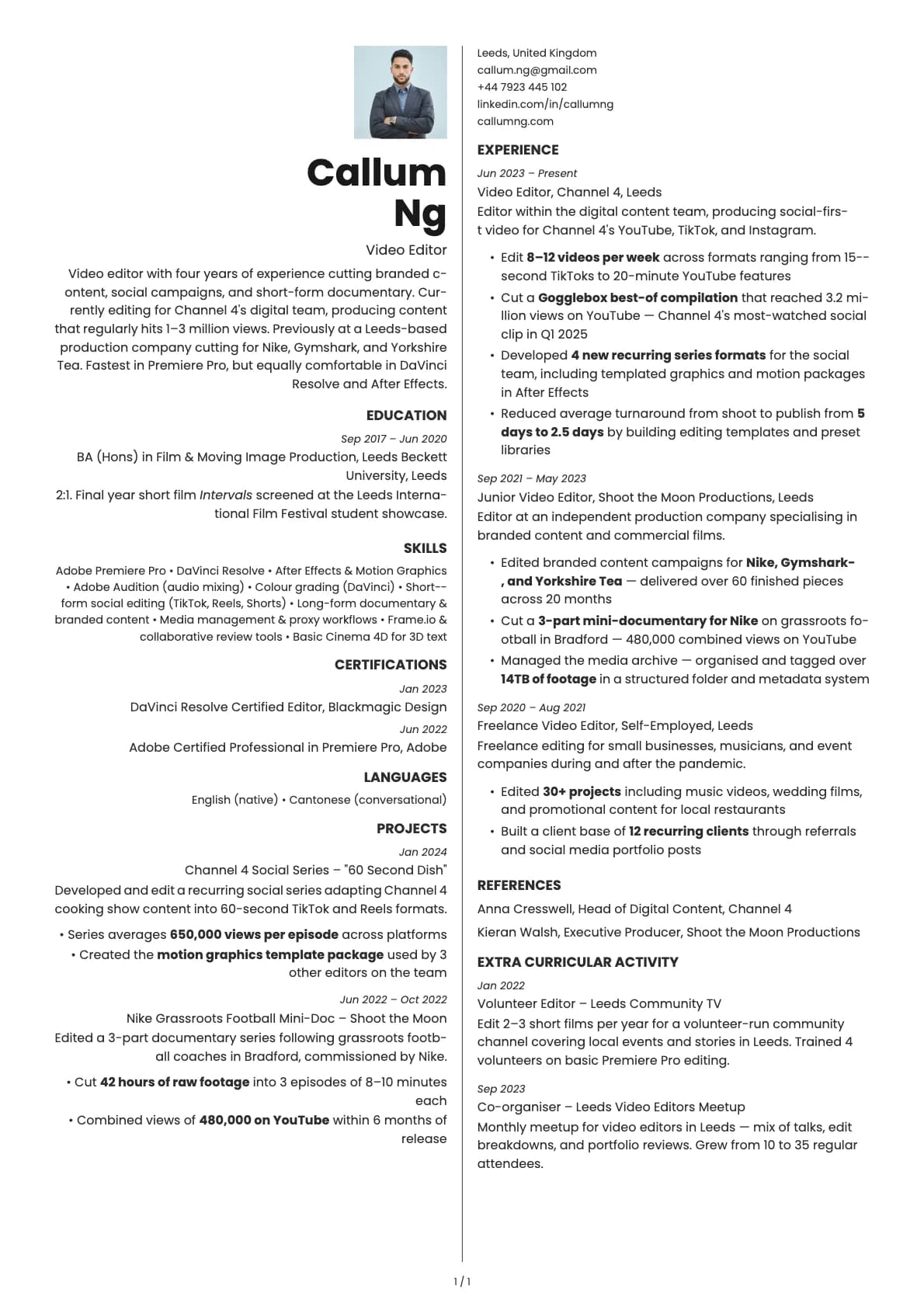
Video Editor
A video editor resume example with 4 years of experience cutting branded content and social video at Channel 4.
Related articles

AI Is Screening Your Resume Before Any Human Sees It
AI screens most resumes before a human ever reads them. 97.4% of Fortune 500 companies run an ATS. This is what that means for you and what you can do about it.

The Best Resume Builders in 2026, Compared Honestly
Resume.io, Zety, Enhancv, Kickresume, Teal, and Laddro compared honestly: real pricing, free tiers, mobile apps, and where each tool wins. All prices checked in September 2026.

Burnout Recovery: A Real Timeline, Not 'Take a Bubble Bath'
55% of the U.S. workforce is burned out. Recovery takes 3 to 12 months. Here's what that actually looks like, stage by stage.