Video Editor Resume Example
A video editor resume example with 4 years of experience cutting branded content and social video at Channel 4.

Laddro Team
Free to use. No account needed to start.
Free to use. No account needed to start.
Overview
Video editor resumes have a weird problem. Your best work is visual, but your resume is text. The temptation is to just list software (Premiere Pro, After Effects, DaVinci Resolve) and hope the hiring manager checks your showreel. But most applications go through a recruiter or ATS first, and they are scanning your resume, not watching your reel. If the resume does not convince them, the reel never gets seen.
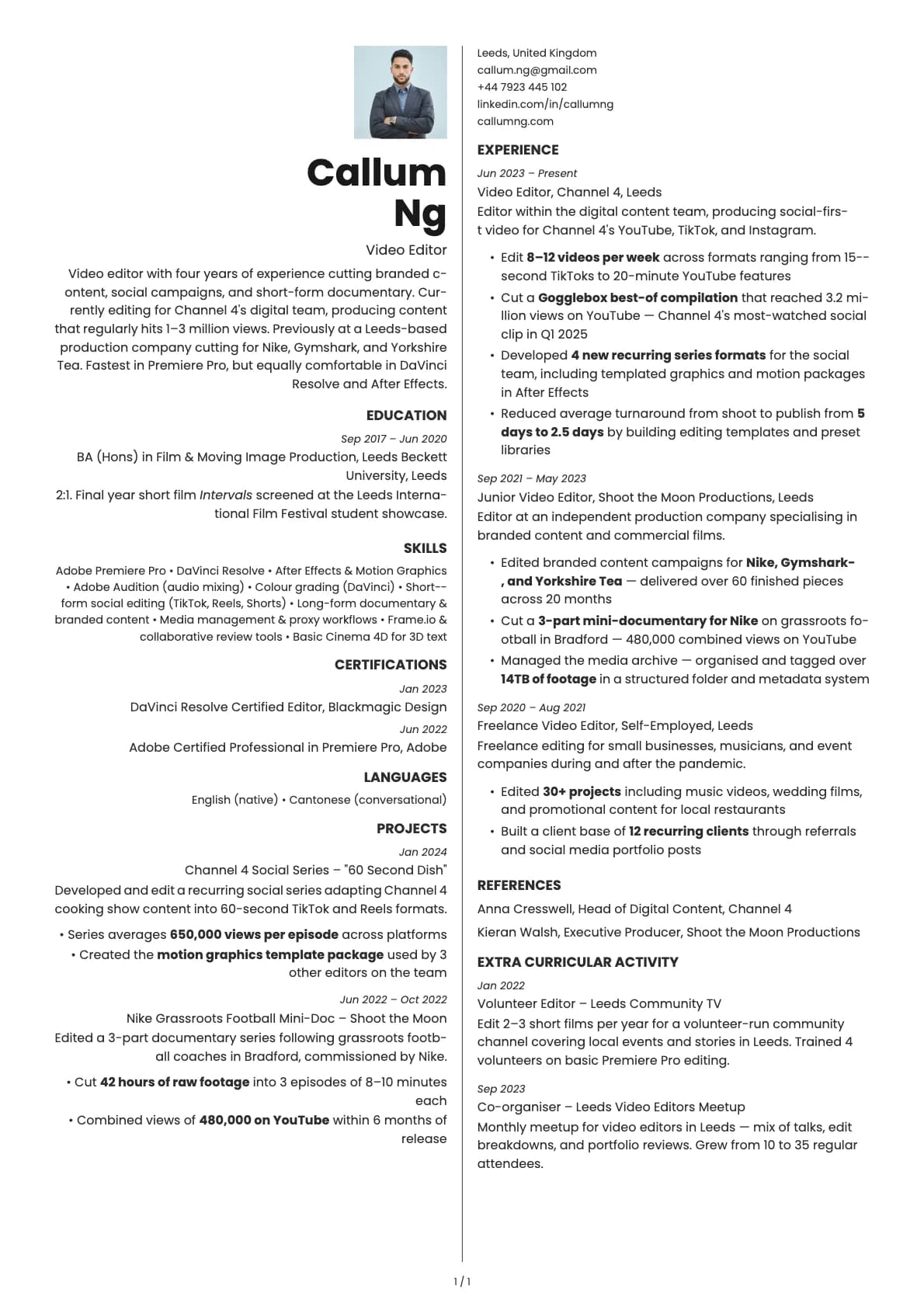
This resume belongs to Callum, a video editor at Channel 4 in Leeds with four years of experience. Before Channel 4, he edited branded content for Nike, Gymshark, and Yorkshire Tea at a production company, and before that he freelanced. His resume works because it treats video editing like a business. View counts, turnaround times, volume of output, and brand names. Not just "edited videos."
Here is how to write your video editor resume the same way.
Your summary: what you edit, for whom, and the scale
Here is Callum's summary:
Video editor with four years of experience cutting branded content, social campaigns, and short-form documentary. Currently editing for Channel 4's digital team, producing content that regularly hits 1-3 million views. Previously at a Leeds-based production company cutting for Nike, Gymshark, and Yorkshire Tea.
Three sentences. The hiring manager knows: his experience level, his content types (branded, social, documentary), his current employer (Channel 4), the typical performance of his work (1-3 million views), and his previous clients (Nike, Gymshark, Yorkshire Tea).
For yours: Name the types of content you edit. Name your biggest client or employer. Include a performance number if you have one (views, engagement, audience size). If you freelance, name your most recognisable clients. Brand names carry weight in this industry.
How to write experience bullets with real numbers
Most video editor resumes say "edited videos for social media." That could mean anything from cutting TikToks in CapCut to producing broadcast-quality content for a national channel. Specifics matter.
Callum's Channel 4 bullets:
Edit 8-12 videos per week across formats ranging from 15-second TikToks to 20-minute YouTube features
Cut a Gogglebox best-of compilation that reached 3.2 million views on YouTube. Channel 4's most-watched social clip in Q1 2025
The first bullet shows output volume and format range. The second names a specific piece of work with a verifiable view count. 3.2 million views is a number the recruiter can picture.
Reduced average turnaround from shoot to publish from 5 days to 2.5 days by building editing templates and preset libraries
This is an efficiency bullet. It shows Callum improved a process, not just completed it. Turnaround time is a real business metric in production environments, and cutting it in half is a significant operational improvement.
The formula: What you edited + The volume or scale + The result (views, engagement, turnaround, or client satisfaction).
Branded work and client names
In video editing, who you have worked for matters. Callum's production company role lists specific clients:
Edited branded content campaigns for Nike, Gymshark, and Yorkshire Tea. Delivered over 60 finished pieces across 20 months
Cut a 3-part mini-documentary for Nike on grassroots football in Bradford. 480,000 combined views on YouTube
Name the brands. Name the projects. If the work is publicly viewable, even better. Recruiters at production companies and in-house teams will recognise these names and immediately understand the quality level expected.
If you have done freelance work for smaller clients, you can still quantify it:
Edited 30+ projects including music videos, wedding films, and promotional content for local restaurants
Built a client base of 12 recurring clients through referrals and social media portfolio posts
The "recurring clients" detail is important for freelancers. It shows people came back, which means they were happy with the work.
Skills: separate your editing tools from your creative abilities
Callum's skills list includes both tools and capabilities: Premiere Pro, DaVinci Resolve, After Effects, colour grading, short-form social editing, long-form documentary, media management, and Frame.io.
A few notes on how to handle the skills section:
Name your primary NLE first. If you are fastest in Premiere Pro, say that. If you are a DaVinci editor, lead with DaVinci. Employers want to know your default tool.
Include colour grading if you do it. Many video editors colour grade their own work. If you do, specify the software (DaVinci is the standard). This is a differentiator, especially for production company roles.
Audio matters. Callum lists Adobe Audition for audio mixing. If you handle your own audio (mixing, sound design, voiceover editing), include it. Many smaller teams expect the editor to deliver a finished product, not just a picture lock.
Collaboration tools count. Frame.io is industry standard for client review. If you use it (or alternatives like Wipster, Vimeo Review, or Dropbox Replay), list it. It shows you can work in a professional review pipeline.
Portfolio and showreel: make it easy to find
Callum includes his personal website (callumng.com) in the resume header. For video editors, your showreel is your most important asset. But the resume needs to get you to the point where someone actually clicks the link.
Include your portfolio URL in the header. If your best work is on YouTube or Vimeo, you can link directly to it. Make sure the reel is current and starts with your strongest work. Recruiters typically watch 30-60 seconds before deciding.
Mistakes video editors make on their resumes
No view counts or performance data. "Edited social content for Channel 4" is fine. "Edited social content for Channel 4 that reached 3.2 million views" is much better. If you have access to analytics for your published work, use the numbers.
Software list without context. "Proficient in Premiere Pro, After Effects, DaVinci Resolve, Audition, Cinema 4D" is a list. It does not tell the recruiter what you actually do with those tools. Use the tools in your experience bullets where possible.
No mention of turnaround or volume. Production environments care about speed and consistency. If you edit 10 videos a week, say so. If you turned around a project in 24 hours, mention it. Speed is a real skill in this industry.
Ignoring media management. Callum organised and tagged 14TB of footage at Shoot the Moon. If you have managed large archives, built proxy workflows, or maintained organised project structures, that is worth including. Editors who are also reliable with media management are highly valued.
One more thing
Callum uses Amber, a template with some visual character that suits a creative role. For video editing positions, you have a bit more freedom with resume design than in corporate fields. But do not overdo it. The resume still needs to be readable, and if the company uses an ATS, it needs to parse cleanly.
If you are applying to a broadcaster or large production company, keep the template clean and let the work speak through numbers and brand names. If you are applying to a startup or creative agency, a slightly more visual template is fine. Match the template to the company culture, and always make sure your showreel link is impossible to miss.
Build your own version
Open this layout in the builder and swap in your own details. It takes a few minutes.
Free to use. No account needed to start.
Was this resume example helpful?
Rate this example to help us create better content for you.
4.7 average from 146 ratingsRelated resume examples
Graphic Designer
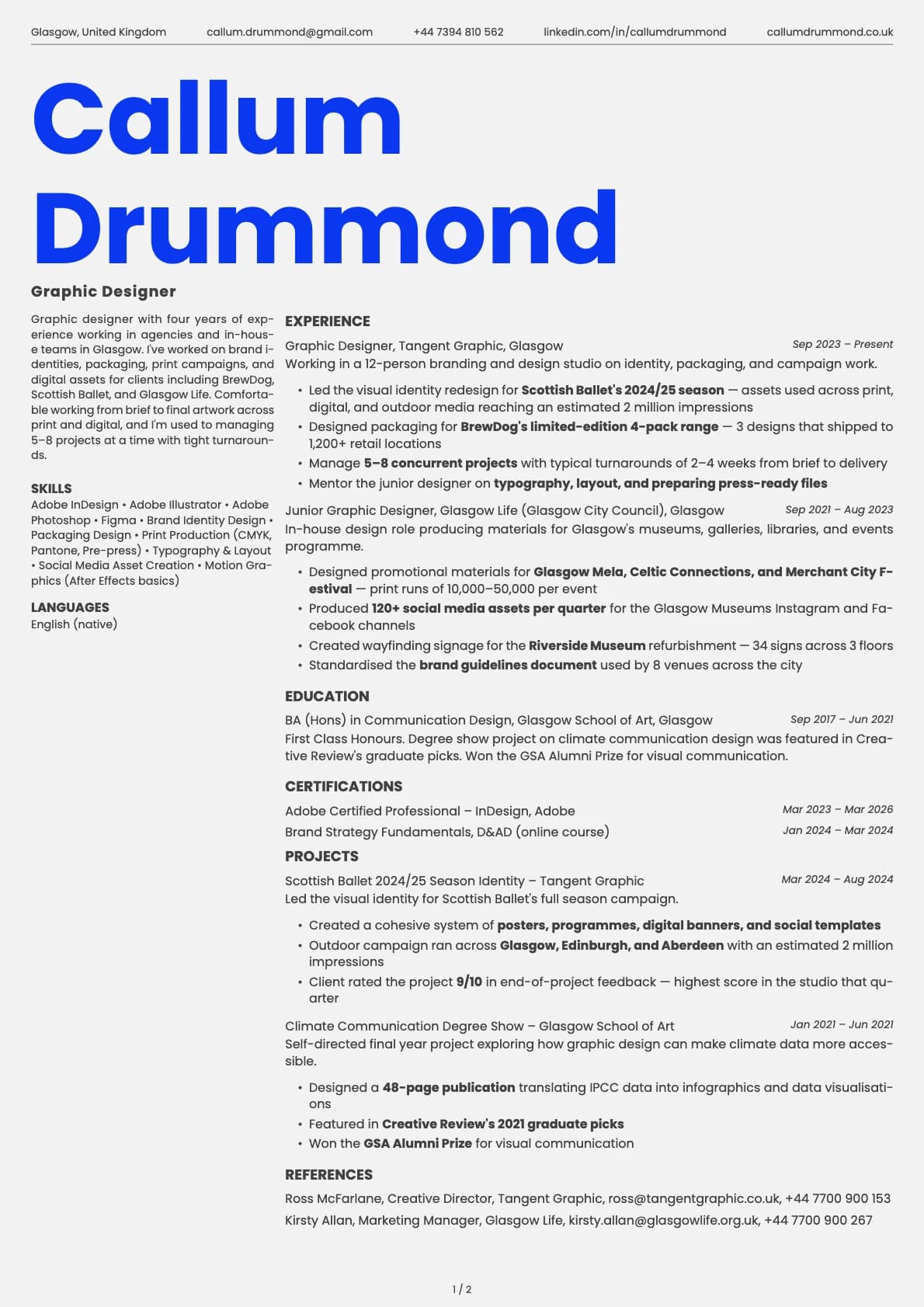
A graphic designer resume example with agency and in-house experience in branding, packaging, and print.
Interior Designer
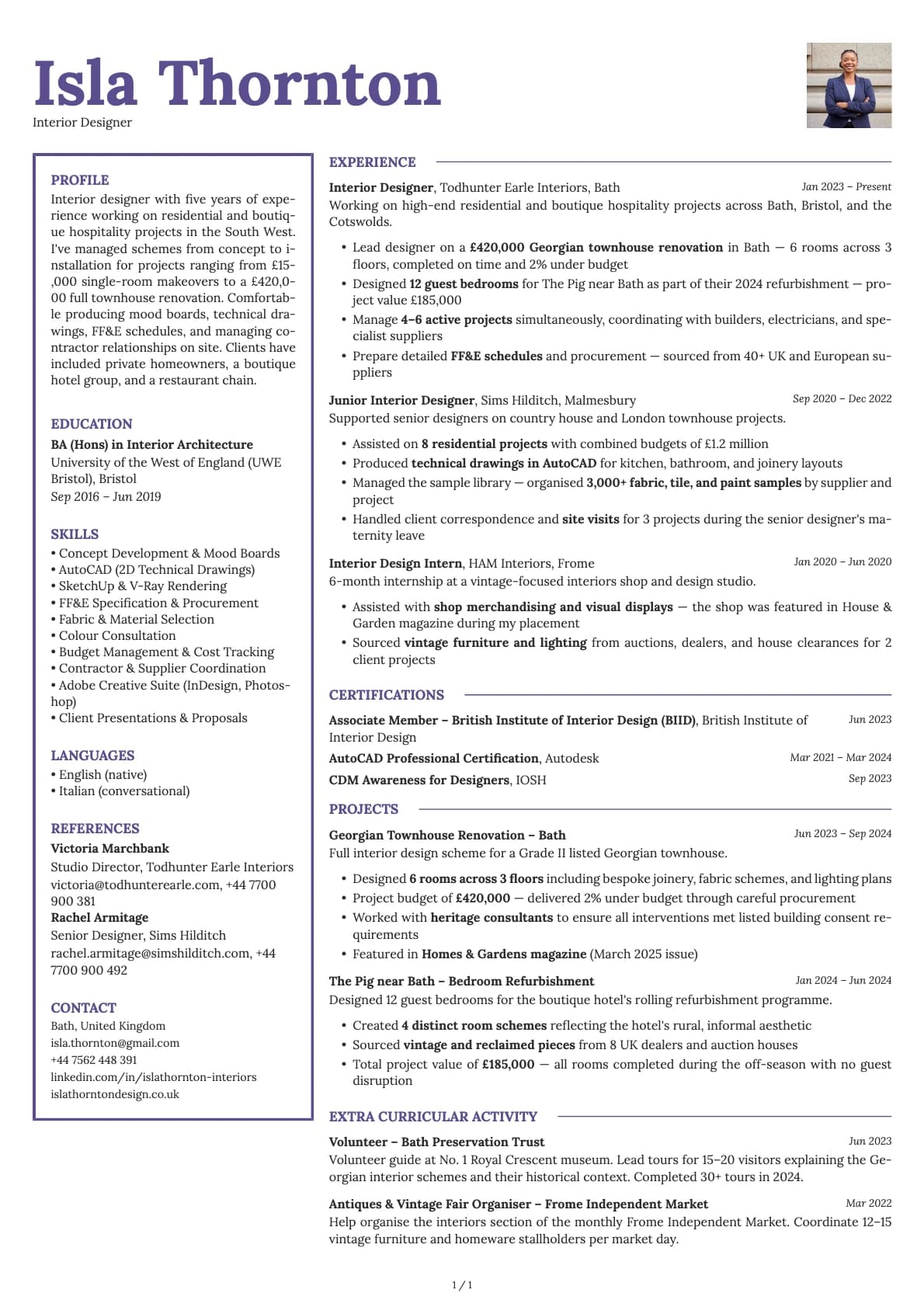
An interior designer resume example with project budgets, client types, and FF&E details. See how to present residential and hospitality design experience.
Architect
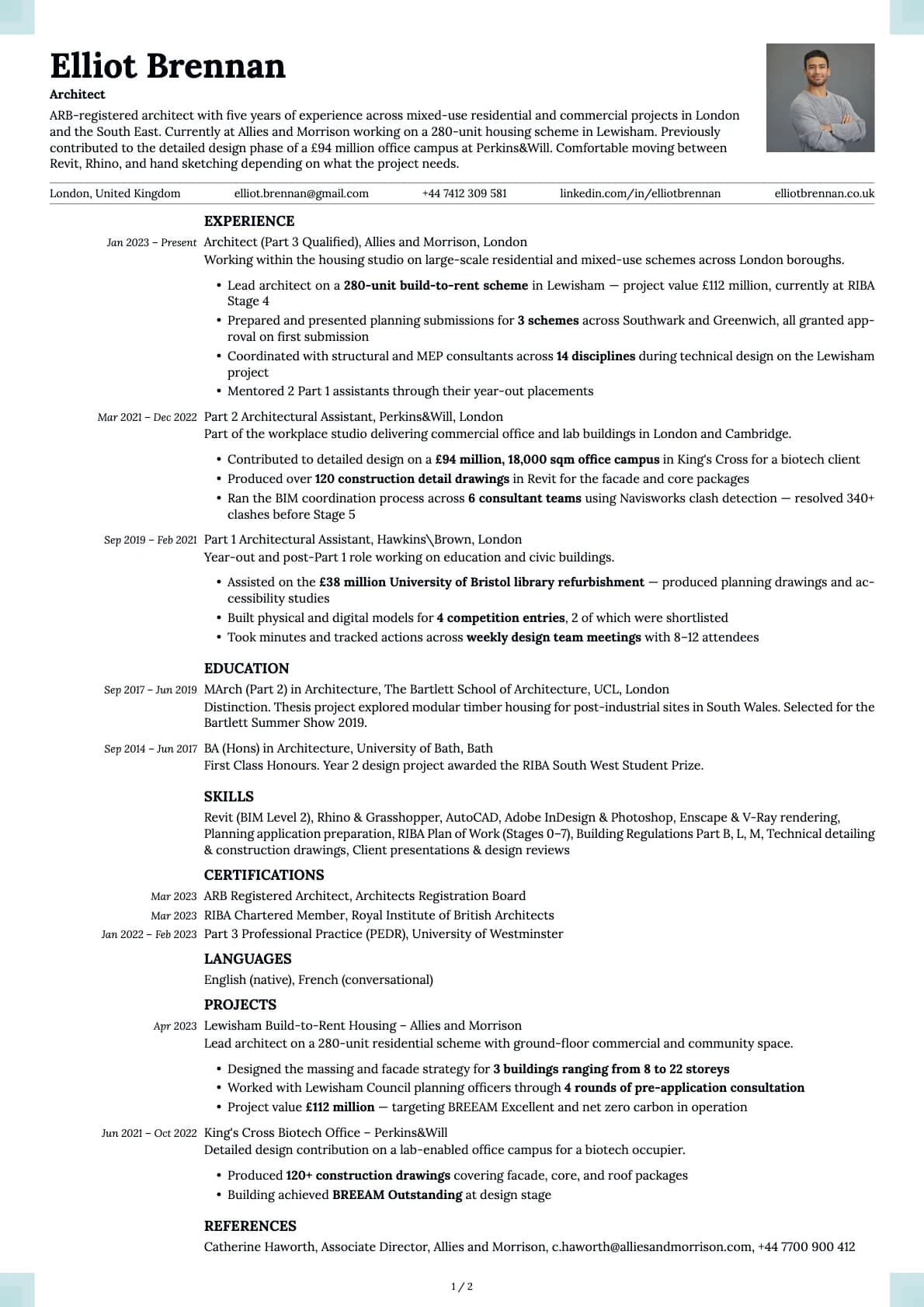
An ARB-registered architect resume example with RIBA Stage 4 project experience, BIM coordination.
Photographer
A photographer resume example with commercial campaign work, editorial credits, and revenue figures from a freelance career.
Content Writer
A content writer resume example with in-house and agency experience writing for FreeAgent, Xero, and Starling Bank.
Copywriter
A copywriter resume example with McCann and Saatchi & Saatchi experience. See how to showcase your portfolio, campaign results, and tone of voice.
Creative Director
A creative director resume example with 14 years in advertising, Cannes Lions wins.
Related articles

AI Is Screening Your Resume Before Any Human Sees It
AI screens most resumes before a human ever reads them. 97.4% of Fortune 500 companies run an ATS. This is what that means for you and what you can do about it.

The Best Resume Builders in 2026, Compared Honestly
Resume.io, Zety, Enhancv, Kickresume, Teal, and Laddro compared honestly: real pricing, free tiers, mobile apps, and where each tool wins. All prices checked in September 2026.

Burnout Recovery: A Real Timeline, Not 'Take a Bubble Bath'
55% of the U.S. workforce is burned out. Recovery takes 3 to 12 months. Here's what that actually looks like, stage by stage.