Special Education Teacher Resume Example
A special education teacher resume example with EHCP experience, intervention outcomes, and multi-agency collaboration.

Laddro Team
Free to use. No account needed to start.
Free to use. No account needed to start.
Overview
SEND teaching resumes have a challenge that mainstream teaching resumes do not. Your work is highly individual. You might be teaching 8 pupils, all with different EHCPs, different targets, and different communication methods. The standard "taught a class of 30 across the curriculum" format does not fit. But you still need to show impact in a way that a headteacher or SENCo can assess quickly.
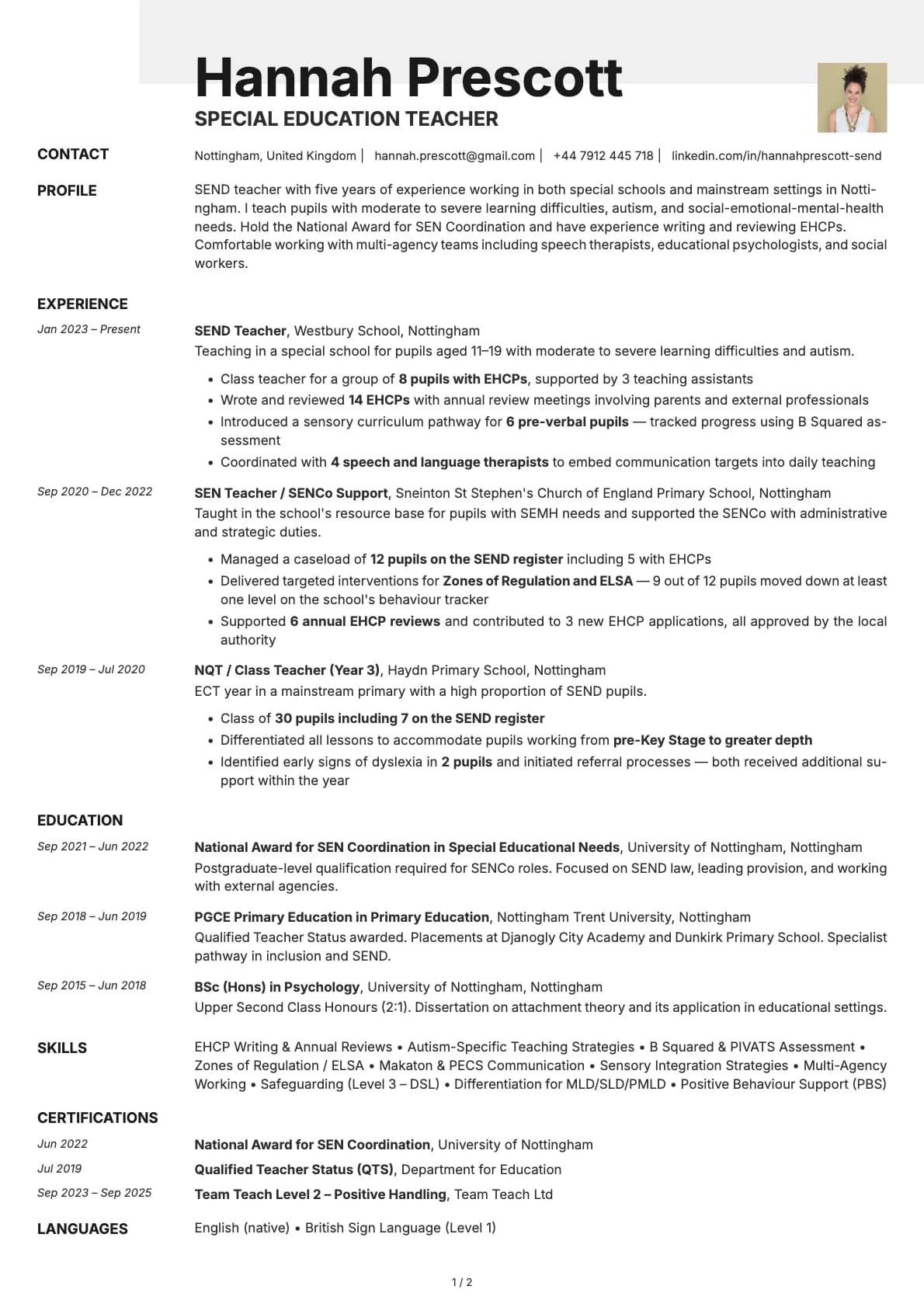
This resume belongs to Hannah Prescott, a SEND teacher in Nottingham with five years of experience. She currently teaches at Westbury School, a special school for pupils aged 11 to 19 with moderate to severe learning difficulties and autism. Before that, she worked in a mainstream primary's SEND resource base and did her ECT year in a mainstream classroom with a high proportion of SEND pupils.
What makes this resume effective is the specificity. EHCP numbers, assessment tools named, intervention outcomes measured. Let us go through it.
Your summary should name the need types you work with
SEND is enormous. A teacher who works with pupils with PMLD has a very different skill set from one who works with SEMH needs. Your summary needs to narrow it down:
"SEND teacher with five years of experience working in both special schools and mainstream settings in Nottingham. I teach pupils with moderate to severe learning difficulties, autism, and social-emotional-mental-health needs."
That tells the hiring panel exactly what your experience covers: MLD, SLD, autism, and SEMH. It also signals that you have worked in both special school and mainstream settings, which broadens your appeal.
Keep it practical: Qualification, years of experience, settings you have worked in, and the types of need you have addressed.
EHCPs are central to your resume
If you write, review, or contribute to EHCPs, it needs to be prominent. This is statutory work and it is one of the first things a headteacher or SENCo looks for:
"Wrote and reviewed 14 EHCPs with annual review meetings involving parents and external professionals"
Fourteen EHCPs. Annual reviews. Multi-agency involvement. That is a clear picture of someone who handles the paperwork and the meetings. From the mainstream role:
"Supported 6 annual EHCP reviews and contributed to 3 new EHCP applications, all approved by the local authority"
"All approved by the local authority" is a strong detail. EHCP applications are often rejected, so a 100% approval rate shows that the applications were well-written and well-evidenced.
Intervention outcomes with named frameworks
SEND teaching is all about targeted interventions. But your resume needs to show that your interventions worked. This means naming the framework and giving the outcome:
"Delivered targeted interventions for Zones of Regulation and ELSA, 9 out of 12 pupils moved down at least one level on the school's behaviour tracker"
Zones of Regulation and ELSA are recognized programmes. "9 out of 12 pupils" gives the success rate. "Moved down at least one level on the behaviour tracker" gives the measurable outcome.
From the sensory curriculum project:
"Introduced a sensory curriculum pathway for 6 pre-verbal pupils, tracked progress using B Squared assessment"
B Squared is a widely used assessment tool in special schools. Naming it shows you use formal assessment, not just professional judgement. If you use PIVATS, Earwig, Evidence for Learning, or any other SEND-specific assessment tool, name it on your resume.
Multi-agency collaboration
SEND teaching involves constant collaboration with external professionals. Show who you work with:
"Coordinated with 4 speech and language therapists to embed communication targets into daily teaching"
That is specific. Four therapists. Communication targets embedded into teaching. Not "worked with external agencies" but the actual work of translating therapy targets into classroom practice.
If you attend TAC (Team Around the Child) meetings, work with educational psychologists, liaise with CAMHS, or coordinate with occupational therapists, include it with the frequency and purpose.
Teaching assistants and team leadership
In special schools, you do not just teach. You lead a small team. This resume shows it:
"Class teacher for a group of 8 pupils with EHCPs, supported by 3 teaching assistants"
That line tells the panel: I manage a classroom team. From the sensory curriculum project:
"Trained 3 teaching assistants on using Intensive Interaction and sensory circuits"
Training TAs is part of the job, but many teachers do not include it on their resume. If you have trained, mentored, or managed support staff, write it up. It shows leadership.
Qualifications that matter
For SEND roles, the National Award for SEN Coordination is the gold standard if you are aiming for a SENCo position. This resume lists it. QTS is essential. And Team Teach Level 2 (positive handling) is important in special schools where physical intervention may be necessary.
Other qualifications worth listing: Makaton training, PECS training, BSL qualifications, sensory integration courses, and any diagnosis-specific training (autism, ADHD, dyslexia).
This resume also lists British Sign Language Level 1 in the languages section. That is a smart inclusion because it shows communication skills beyond spoken language.
Mistakes SEND teachers make on resumes
Being vague about need types. "Taught pupils with special educational needs" covers everything from dyslexia to PMLD. Be specific about the diagnoses and need types you have worked with.
Not mentioning assessment tools. If you use B Squared, PIVATS, Earwig, or any formal SEND assessment, name it. Schools that use these tools want staff who already know them.
Ignoring mainstream experience. If you have taught in mainstream before moving into special school (like Hannah), include it. It shows you understand both settings and can differentiate for a wide range of needs.
Skipping the ECT year. Your ECT year is where you learned to teach. If it included SEND experience, write it up properly:
"Class of 30 pupils including 7 on the SEND register"
"Identified early signs of dyslexia in 2 pupils and initiated referral processes, both received additional support within the year"
Those lines show early awareness and initiative, even in a junior role.
One last thought
SEND recruitment is often through the school directly or through specialist agencies. The person specification will list essential criteria like "experience writing EHCPs" or "knowledge of autism-specific strategies." Go through each criterion and make sure your resume addresses it with a specific example. In SEND recruitment, demonstrable experience with named conditions and named frameworks beats general teaching ability every time.
Build your own version
Open this layout in the builder and swap in your own details. It takes a few minutes.
Free to use. No account needed to start.
Was this resume example helpful?
Rate this example to help us create better content for you.
4.8 average from 104 ratingsRelated resume examples
Teacher
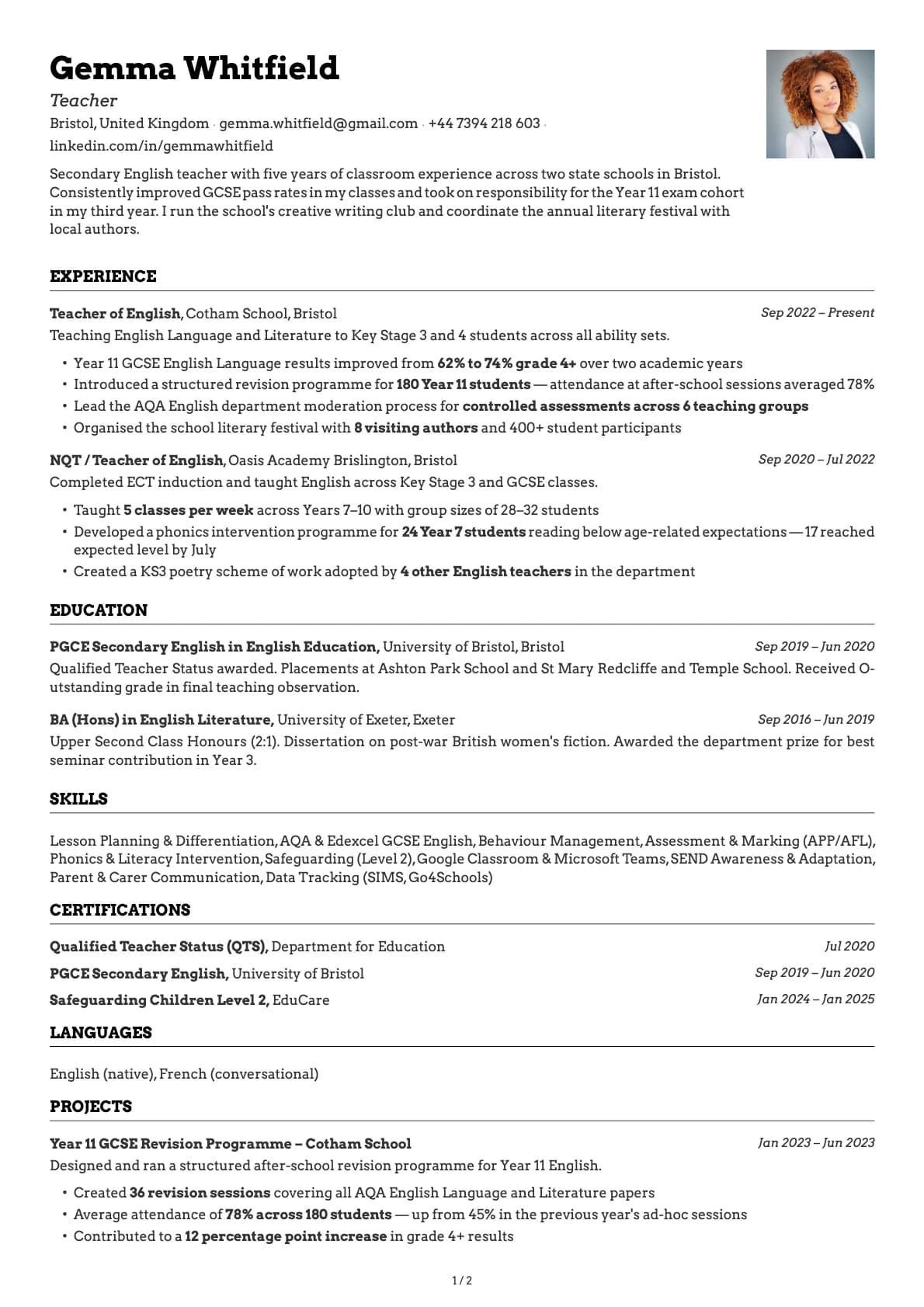
A secondary English teacher resume example with 5 years of experience and measurable GCSE results.
Substitute Teacher
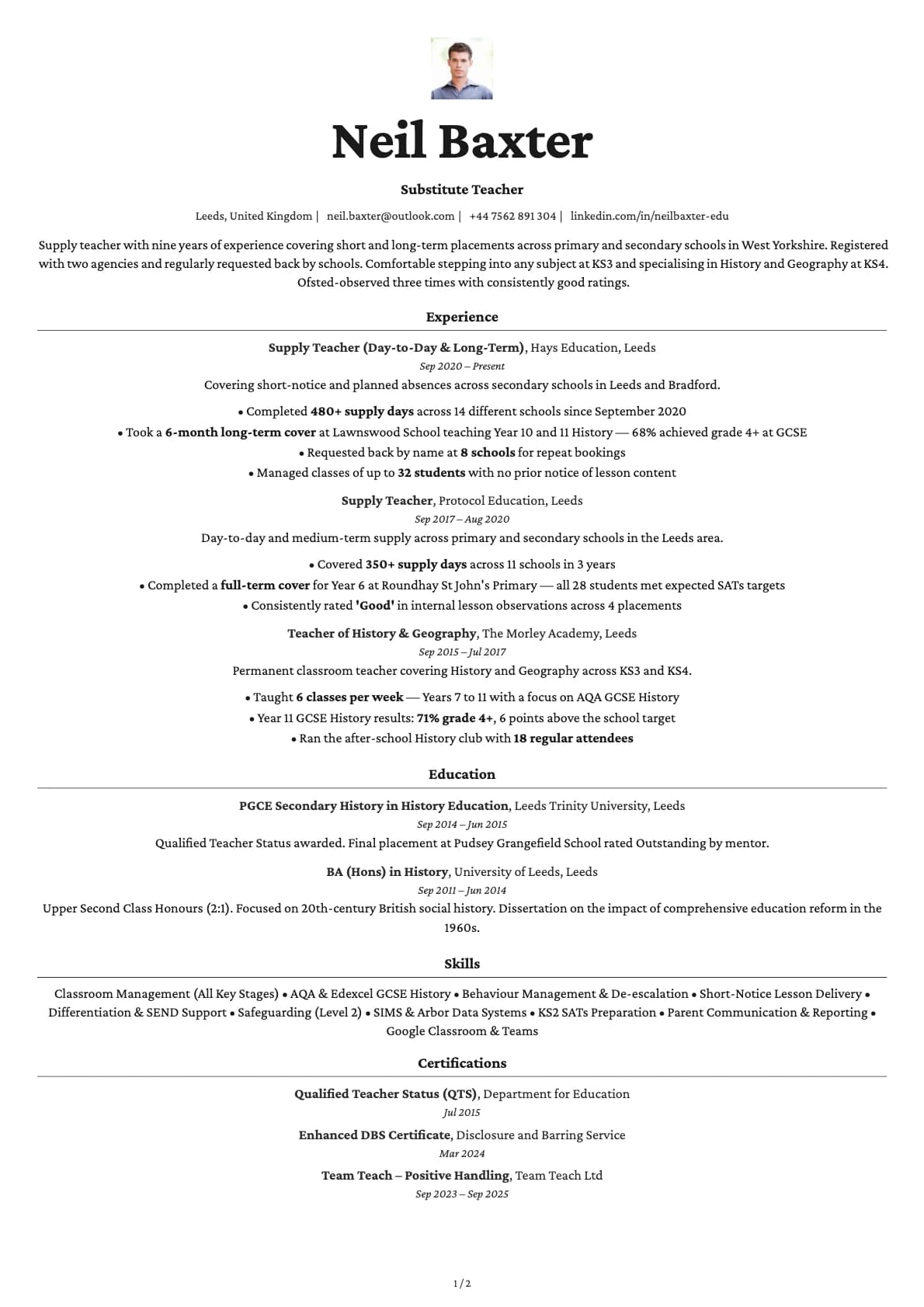
A substitute teacher resume example with 9 years of supply experience across primary and secondary schools.
Teaching Assistant
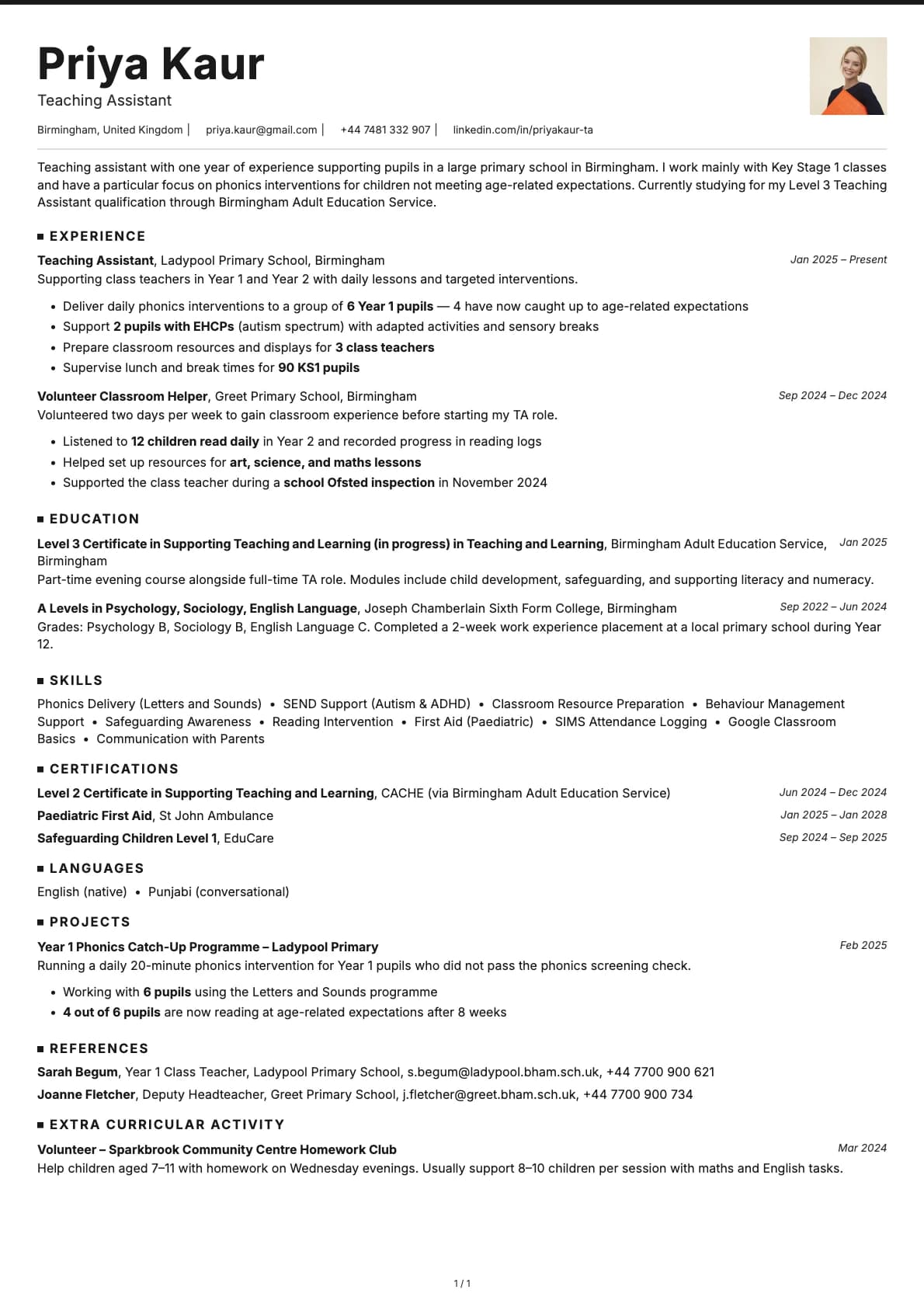
A teaching assistant resume example for an entry-level TA with phonics intervention experience and SEND support.
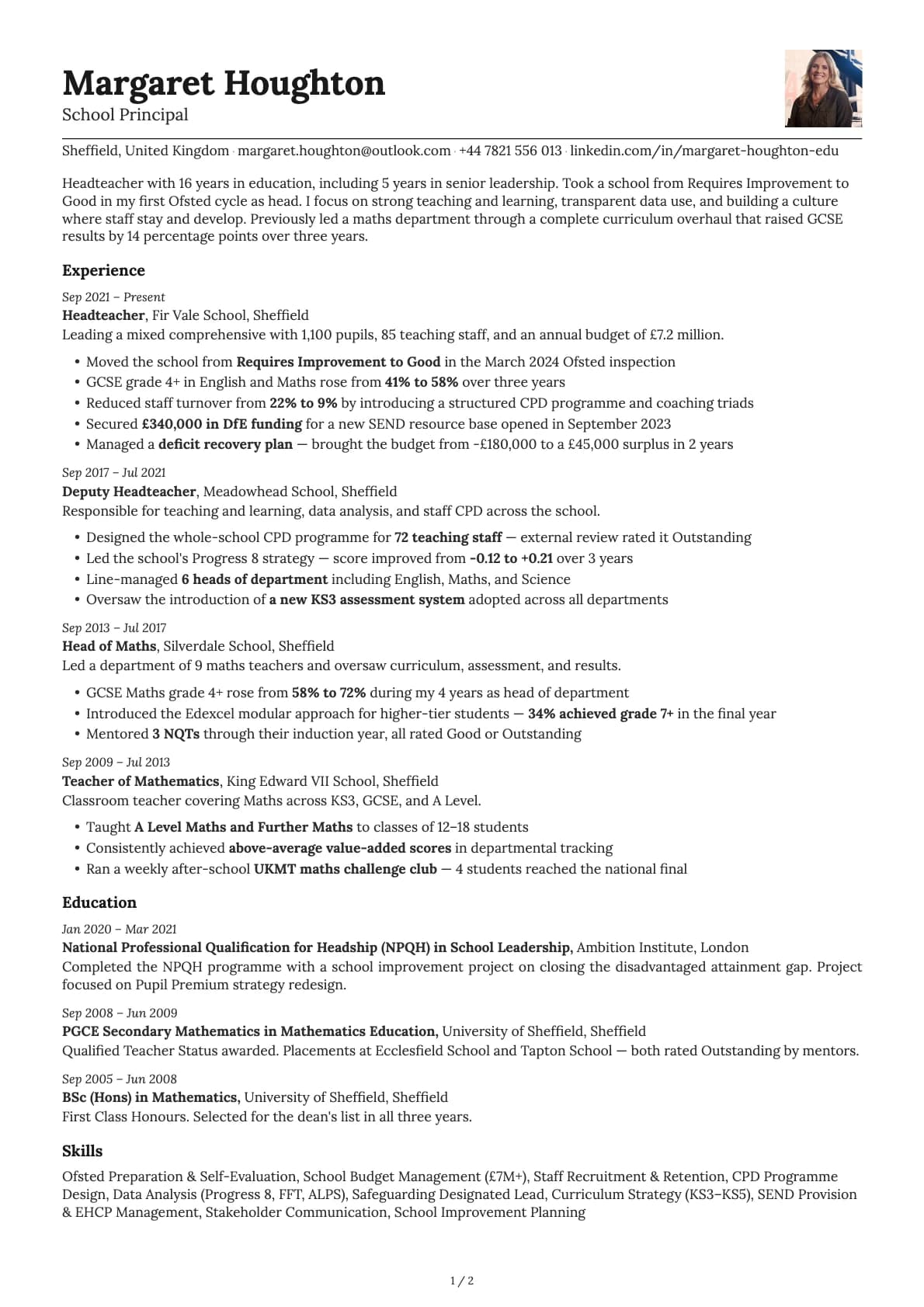
School Principal
A school principal resume example with Ofsted outcomes, GCSE results, and budget management.
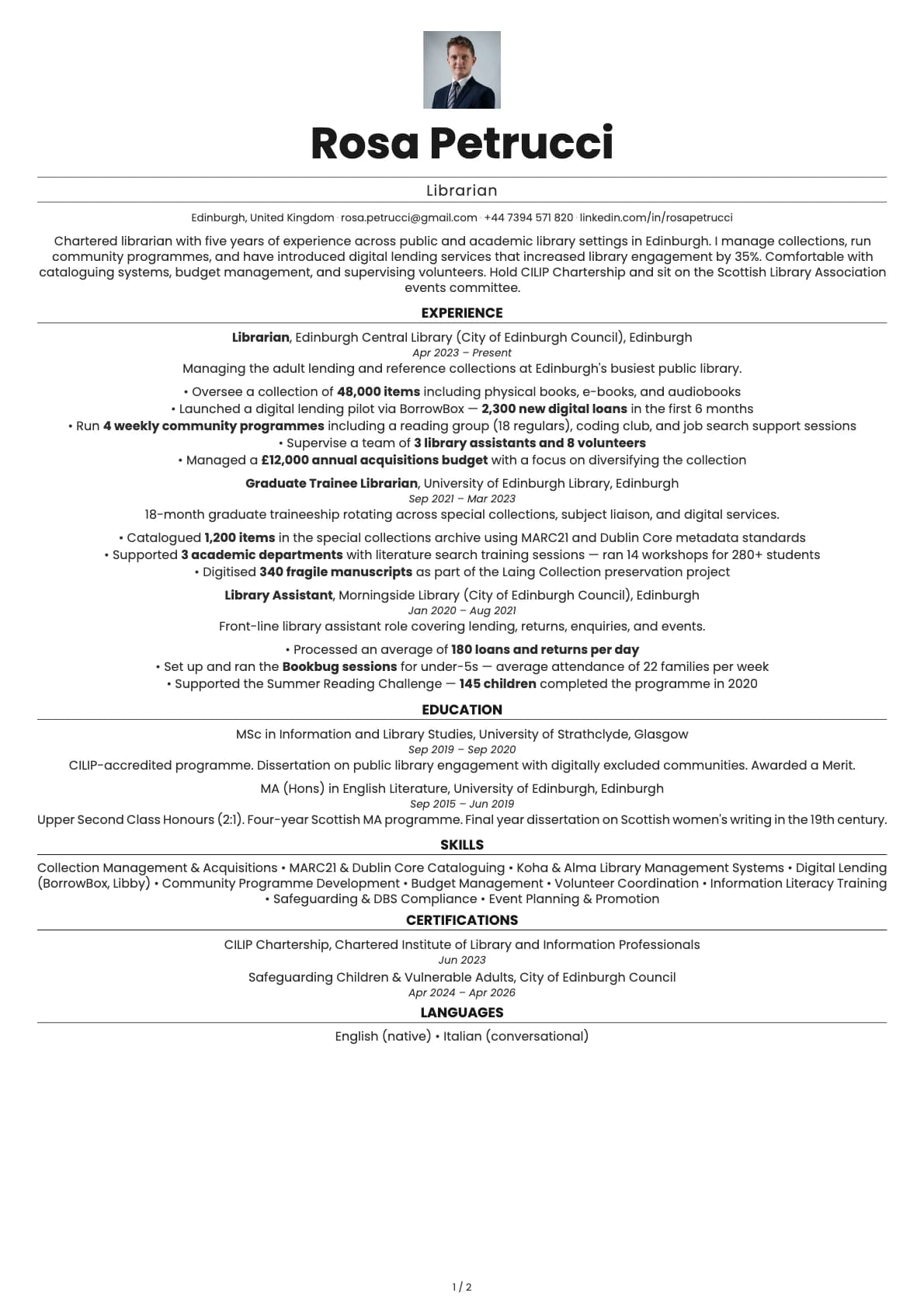
Librarian
A librarian resume example with community programme numbers, collection management specifics, and digital lending results.
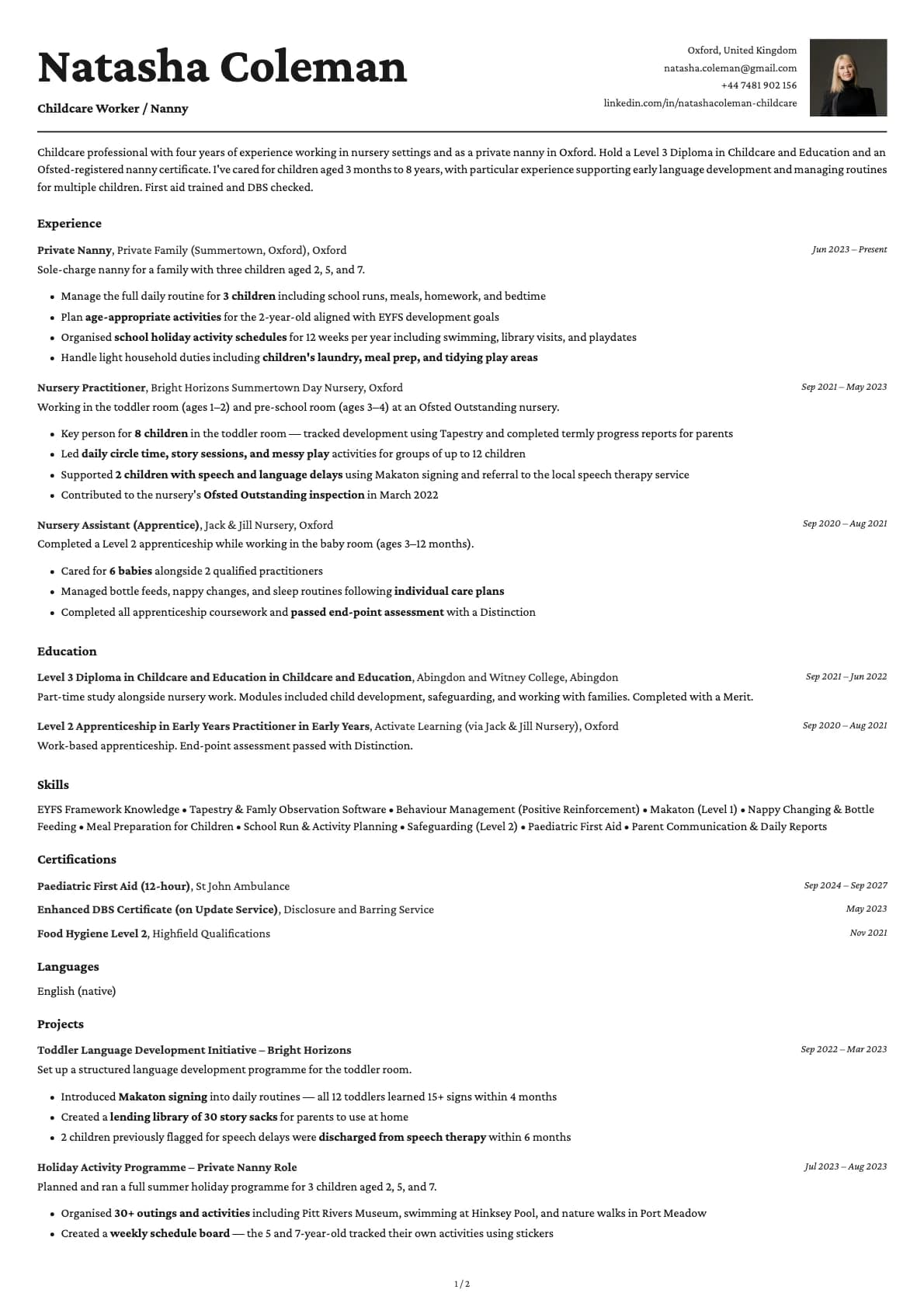
Childcare Worker / Nanny
A childcare worker resume example with nursery and private nanny experience.
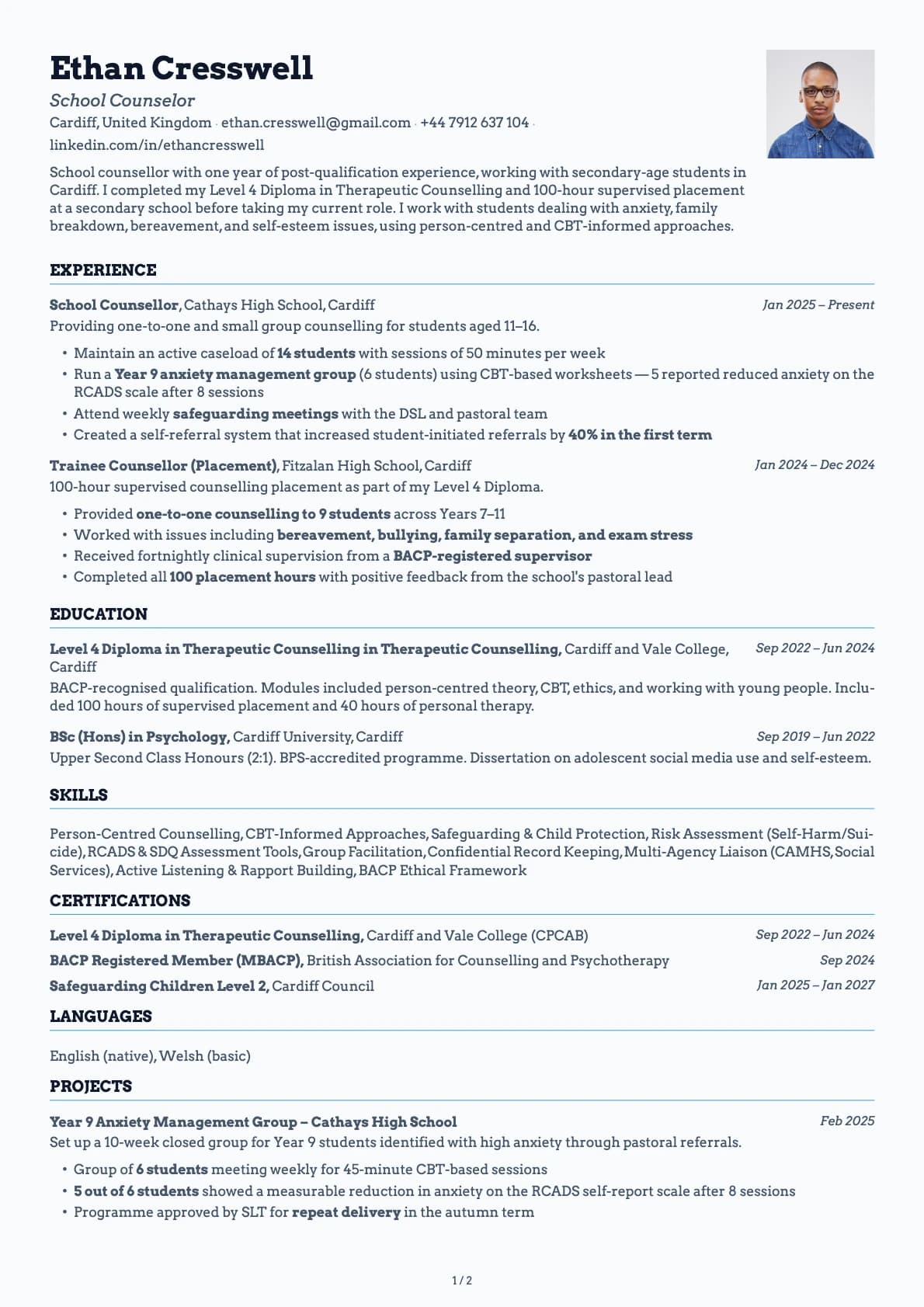
School Counselor
A school counselor resume example with caseload numbers, group therapy outcomes, and safeguarding experience.
Related articles

AI Is Screening Your Resume Before Any Human Sees It
AI screens most resumes before a human ever reads them. 97.4% of Fortune 500 companies run an ATS. This is what that means for you and what you can do about it.

The Best Resume Builders in 2026, Compared Honestly
Resume.io, Zety, Enhancv, Kickresume, Teal, and Laddro compared honestly: real pricing, free tiers, mobile apps, and where each tool wins. All prices checked in September 2026.

Burnout Recovery: A Real Timeline, Not 'Take a Bubble Bath'
55% of the U.S. workforce is burned out. Recovery takes 3 to 12 months. Here's what that actually looks like, stage by stage.