Substitute Teacher Resume Example
A substitute teacher resume example with 9 years of supply experience across primary and secondary schools.

Laddro Team
Free to use. No account needed to start.
Free to use. No account needed to start.
Overview
Writing a supply teacher resume is tricky. You might have worked in 14 different schools over three years. You cannot list them all individually. But if you just write "supply teacher at various schools," the person reading your resume has no way to judge what you have actually done.
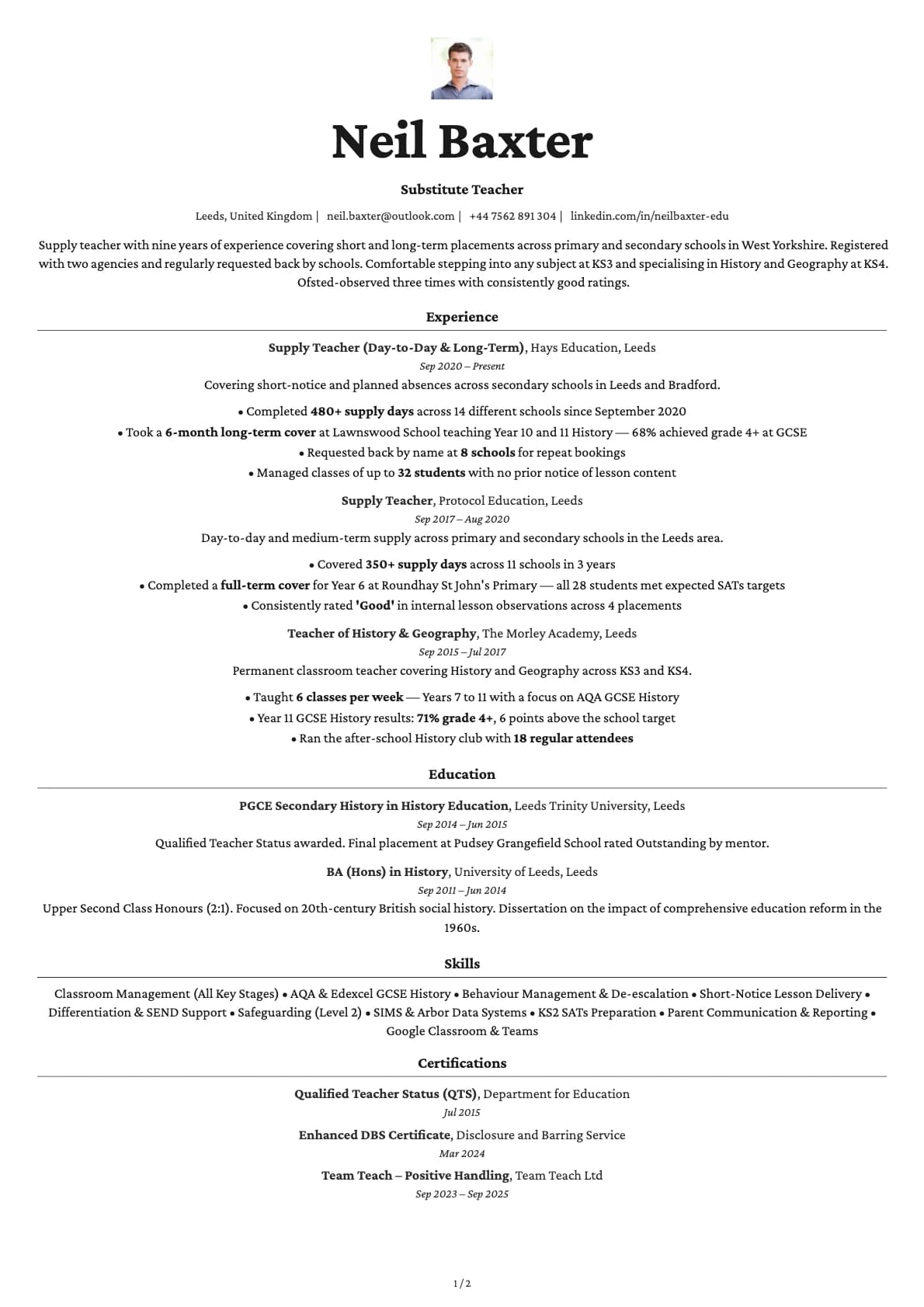
This resume belongs to Neil, a supply teacher with nine years of experience based in Leeds. He is registered with Hays Education, has completed over 830 supply days across primary and secondary schools, and specialises in History and Geography at KS4. What makes this resume work is the way it turns fragmented supply experience into a clear, credible story. Numbers, school names, GCSE results, and repeat bookings.
Here is how to do the same for your resume.
Your summary needs to prove reliability
Schools booking a supply teacher want to know two things. Can you control a classroom? And will you actually deliver learning, not just babysit?
Here is Neil's summary:
Supply teacher with nine years of experience covering short and long-term placements across primary and secondary schools in West Yorkshire. Registered with two agencies and regularly requested back by schools. Comfortable stepping into any subject at KS3 and specialising in History and Geography at KS4. Ofsted-observed three times with consistently good ratings.
The "requested back by schools" line is doing a lot of work here. It tells the recruiter that Neil is not just available. He is preferred. The Ofsted observation detail adds external validation that most supply teachers never think to mention.
For yours: State your years of supply experience, the key stages you cover, and any subject specialisms. If you are requested back by schools, say it. If you have been observed by Ofsted while on supply, absolutely include that.
How to structure fragmented experience
This is the hardest part of a supply teacher resume. Neil handles it by grouping his supply work under the agency name rather than listing each school placement separately.
Under Hays Education:
Completed 480+ supply days across 14 different schools since September 2020
Requested back by name at 8 schools for repeat bookings
Managed classes of up to 32 students with no prior notice of lesson content
This approach works because it shows volume and reliability in a few bullets. Then he highlights one specific long-term placement separately:
Took a 6-month long-term cover at Lawnswood School teaching Year 10 and 11 History. 68% achieved grade 4+ at GCSE
That GCSE result is gold. It proves he can do the full job, not just keep the class quiet for a day. If you have done any long-term cover with measurable outcomes, give it its own bullet point.
Include your permanent teaching experience
If you started as a permanent classroom teacher before moving to supply, include it. Neil spent two years at The Morley Academy before going to supply work:
Year 11 GCSE History results: 71% grade 4+, 6 points above the school target
Ran the after-school History club with 18 regular attendees
This section shows he is a trained, qualified teacher who chose supply rather than someone who could not hold a permanent post. That distinction matters to schools making bookings.
Skills that supply teachers should highlight
The skills section on a supply resume needs to show adaptability. Neil lists "Short-Notice Lesson Delivery" and "Classroom Management (All Key Stages)" alongside subject-specific skills like "AQA & Edexcel GCSE History."
He also includes school data systems. SIMS and Arbor are the two main ones used in UK schools. If you can log into SIMS and take a register without asking for help, that is a genuine advantage for day-to-day supply. List the systems you know.
Safeguarding is also important. Neil has Level 2 Safeguarding and Team Teach (Positive Handling) certification. Schools check for these before confirming bookings, so having them visible on your resume removes a potential blocker.
Certifications: keep them current
For supply teachers, three things matter most:
- QTS (or equivalent). This goes first.
- Enhanced DBS. Make sure the date is recent. An expired DBS is a red flag.
- Safeguarding training. Level 2 minimum. Some schools require Level 3.
Neil also has Team Teach certification for positive handling, which is increasingly required for SEND-inclusive schools. If you have any behaviour management training (Team Teach, MAPA, CPI), include it with the expiry date.
Mistakes supply teachers make on their resumes
Listing every school placement separately. If you have worked in 14 schools, listing them all makes your resume impossible to read. Group supply work under the agency and pull out your best placements as highlights.
No measurable outcomes. "Delivered lessons across KS3 and KS4" is not a resume bullet. It is a job description. Did your students meet their targets? Did a head of department ask for you specifically? Did you get observed and rated? Use those details.
Forgetting to mention DBS status. Schools cannot book you without a valid DBS. If yours is current, put it on the resume. If it is on the update service, mention that too.
Not showing subject depth. If you can teach a subject to exam level, say so explicitly. "Delivered the full AQA History syllabus for 3 exam classes" is much stronger than "covered History lessons."
One more thing
If you are applying directly to a school for a long-term cover or a permanent position after years of supply, tailor your resume to that specific school. Mention any previous placements there. Reference the exam board they use. If you know the school uses SIMS, list it in your skills.
Supply teaching is a credibility game. Every detail that shows you can walk into a classroom cold and deliver real learning makes you a more attractive booking.
Build your own version
Open this layout in the builder and swap in your own details. It takes a few minutes.
Free to use. No account needed to start.
Was this resume example helpful?
Rate this example to help us create better content for you.
4.7 average from 98 ratingsRelated resume examples
Teacher
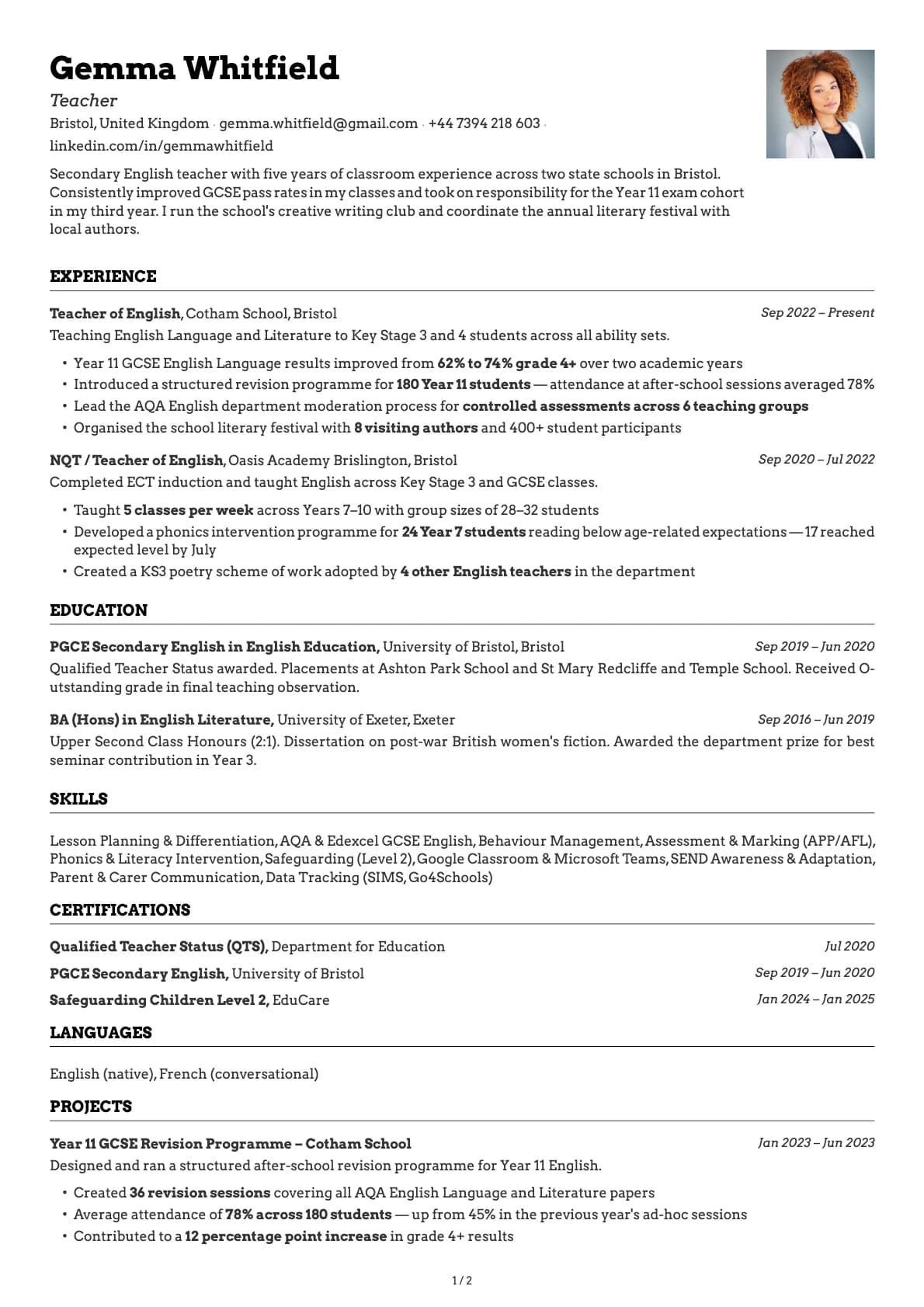
A secondary English teacher resume example with 5 years of experience and measurable GCSE results.
Teaching Assistant
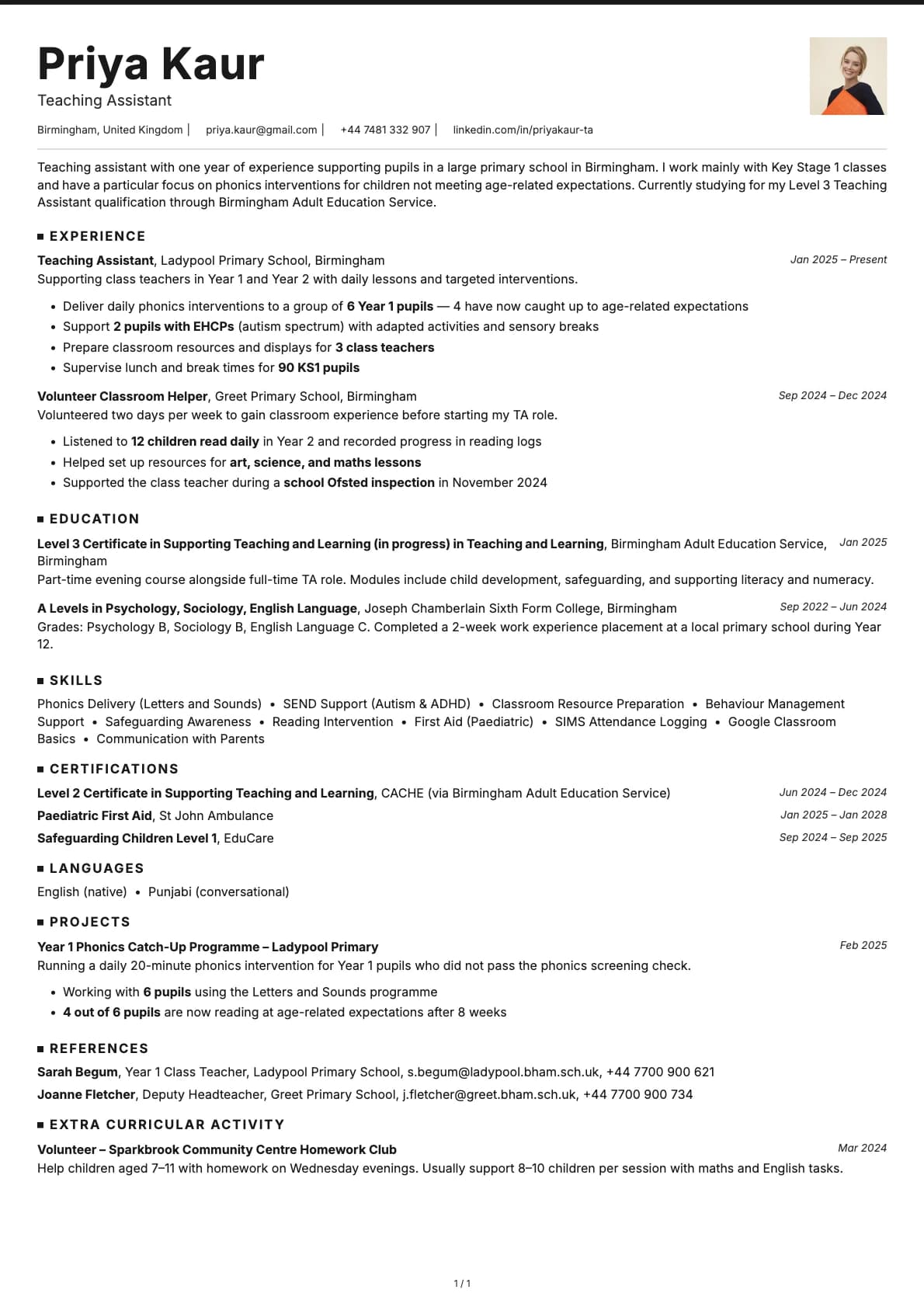
A teaching assistant resume example for an entry-level TA with phonics intervention experience and SEND support.
School Principal
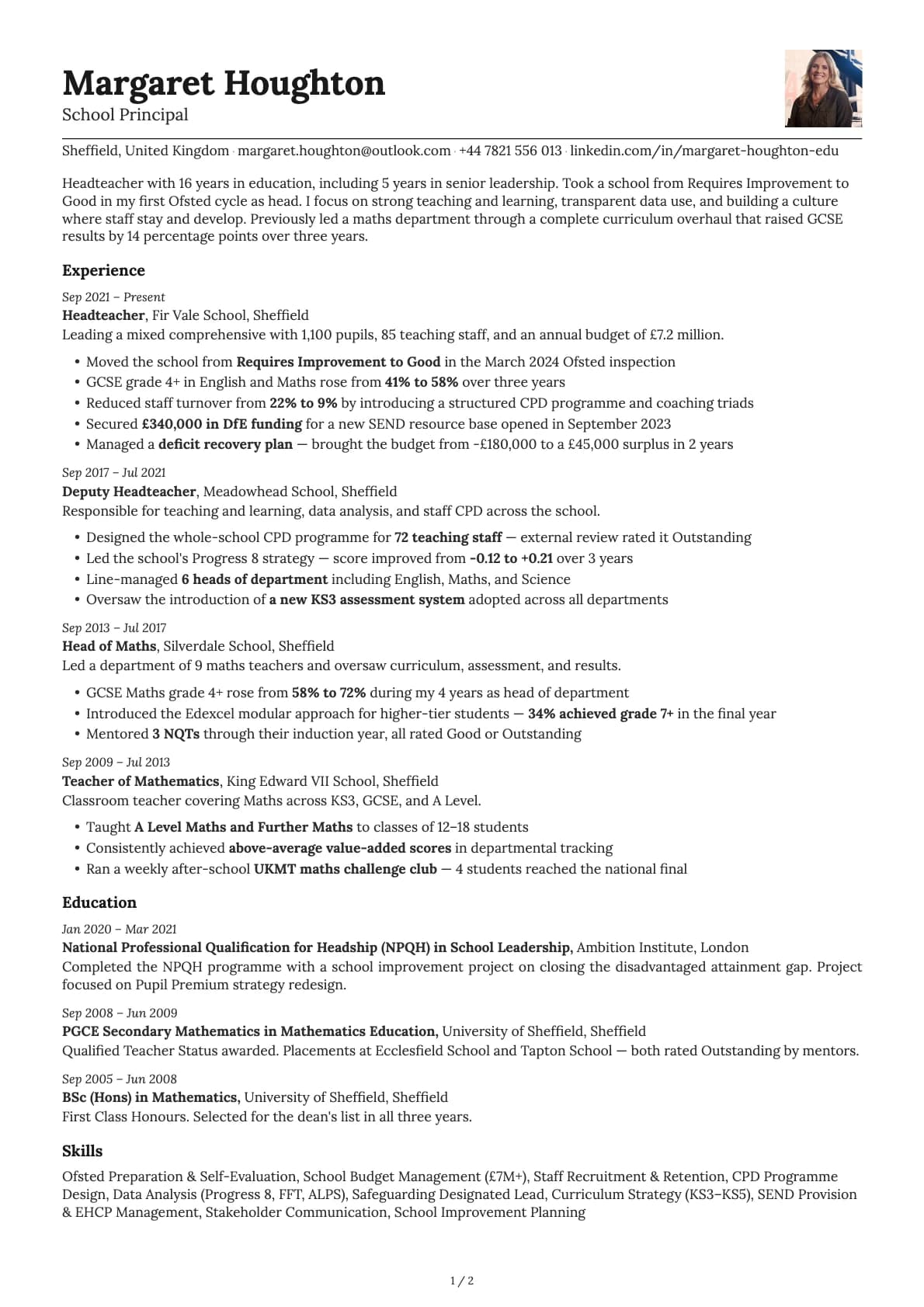
A school principal resume example with Ofsted outcomes, GCSE results, and budget management.
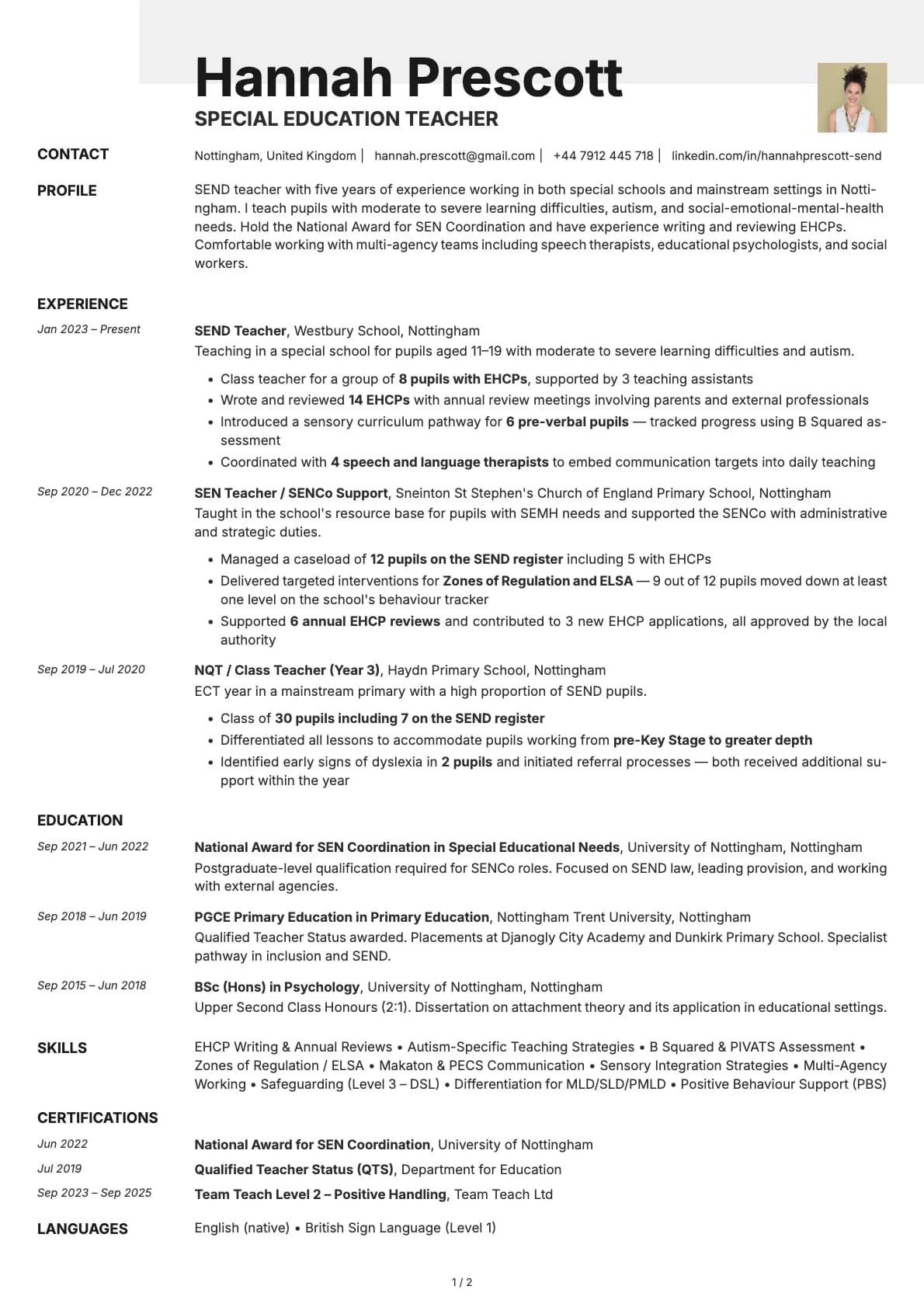
Special Education Teacher
A special education teacher resume example with EHCP experience, intervention outcomes, and multi-agency collaboration.
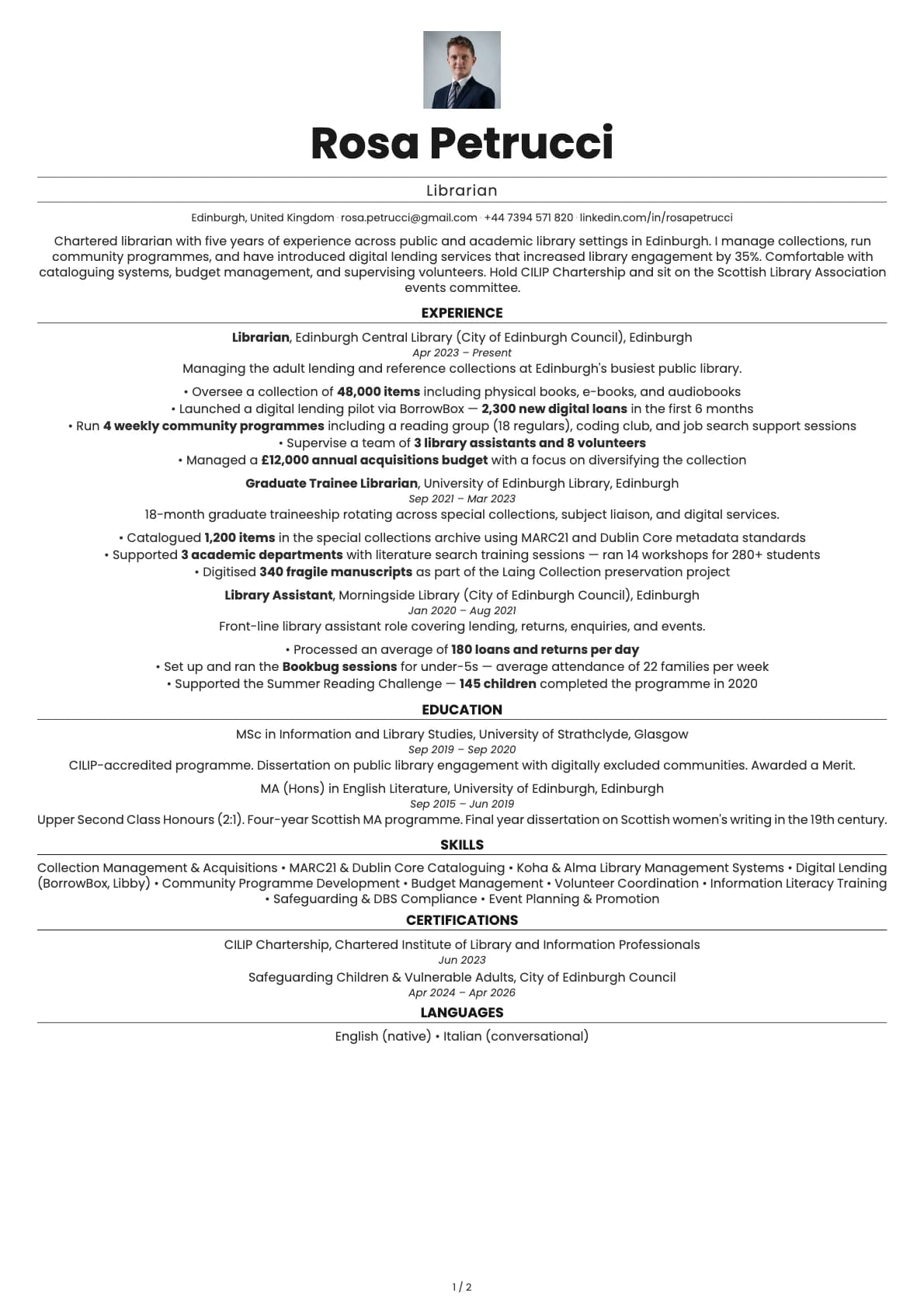
Librarian
A librarian resume example with community programme numbers, collection management specifics, and digital lending results.
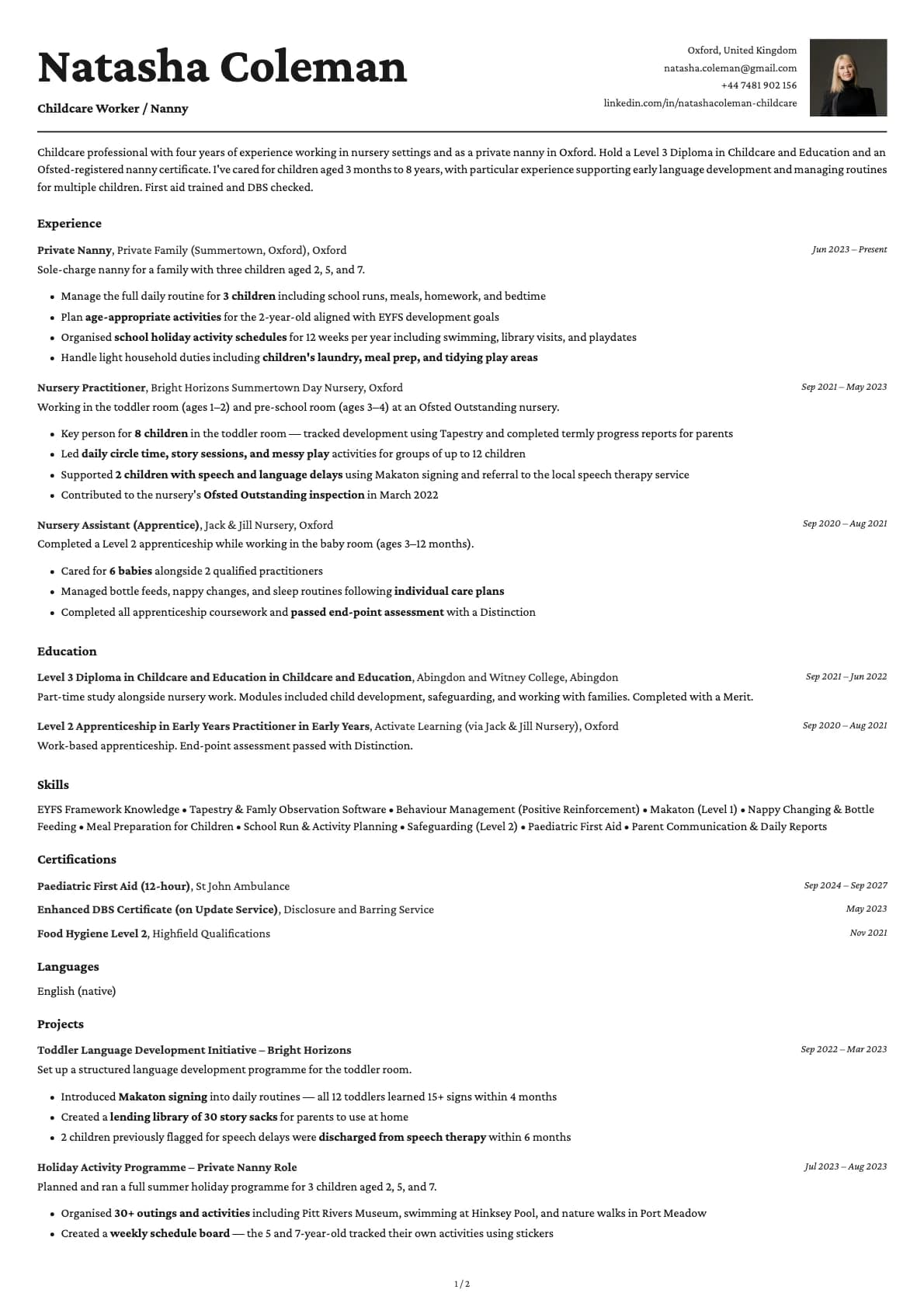
Childcare Worker / Nanny
A childcare worker resume example with nursery and private nanny experience.
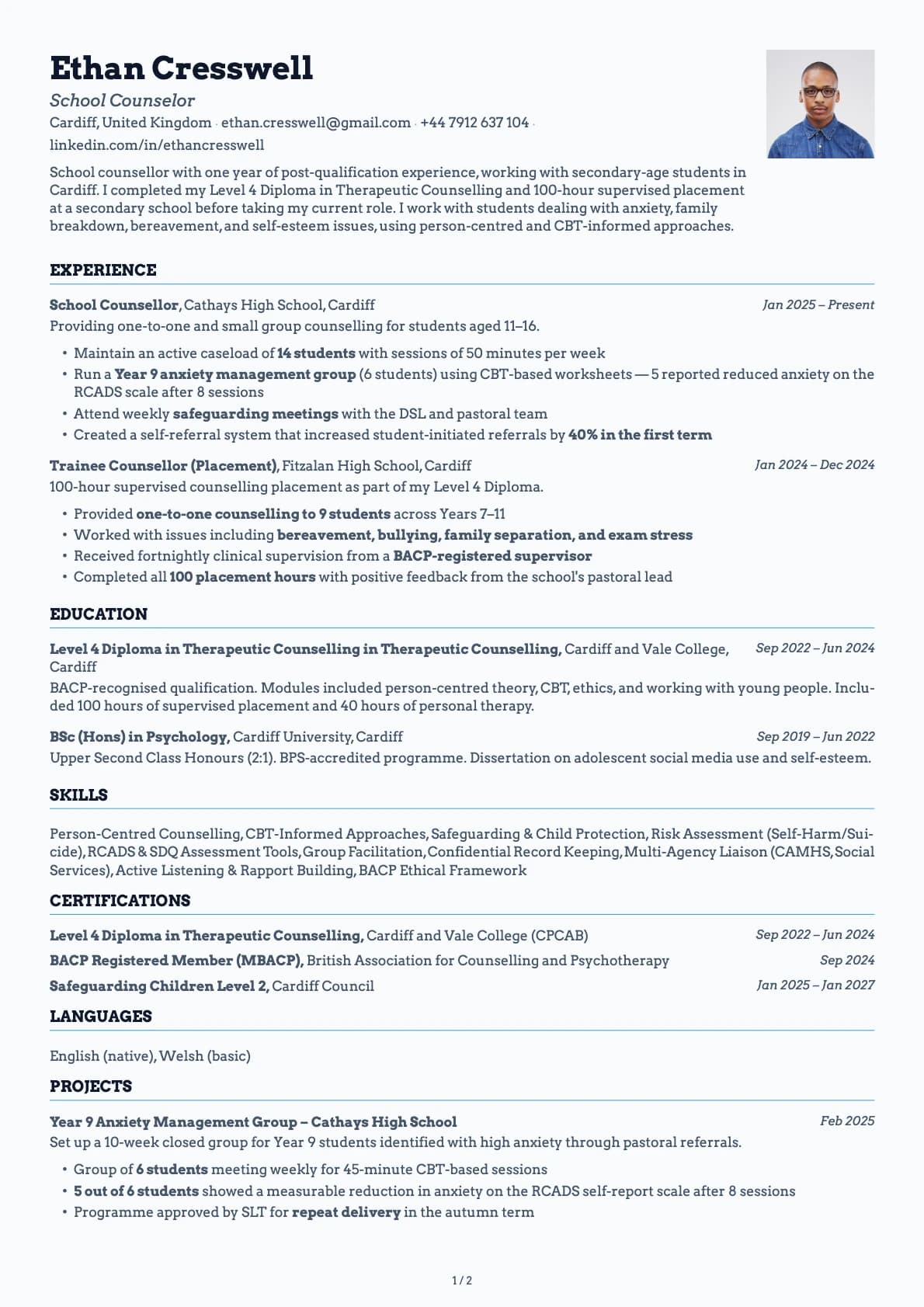
School Counselor
A school counselor resume example with caseload numbers, group therapy outcomes, and safeguarding experience.
Related articles

AI Is Screening Your Resume Before Any Human Sees It
AI screens most resumes before a human ever reads them. 97.4% of Fortune 500 companies run an ATS. This is what that means for you and what you can do about it.

The Best Resume Builders in 2026, Compared Honestly
Resume.io, Zety, Enhancv, Kickresume, Teal, and Laddro compared honestly: real pricing, free tiers, mobile apps, and where each tool wins. All prices checked in September 2026.

Burnout Recovery: A Real Timeline, Not 'Take a Bubble Bath'
55% of the U.S. workforce is burned out. Recovery takes 3 to 12 months. Here's what that actually looks like, stage by stage.