Teacher Resume Example
A secondary English teacher resume example with 5 years of experience and measurable GCSE results.

Laddro Team
Free to use. No account needed to start.
Free to use. No account needed to start.
Overview
Teacher resumes have a built-in disadvantage. Every teacher plans lessons, marks work, manages behaviour, and communicates with parents. If your resume only describes those things, you sound exactly like every other applicant. The headteacher reading your application has probably taught the same subject. They know what the job involves. What they want to see is what you specifically brought to the school.
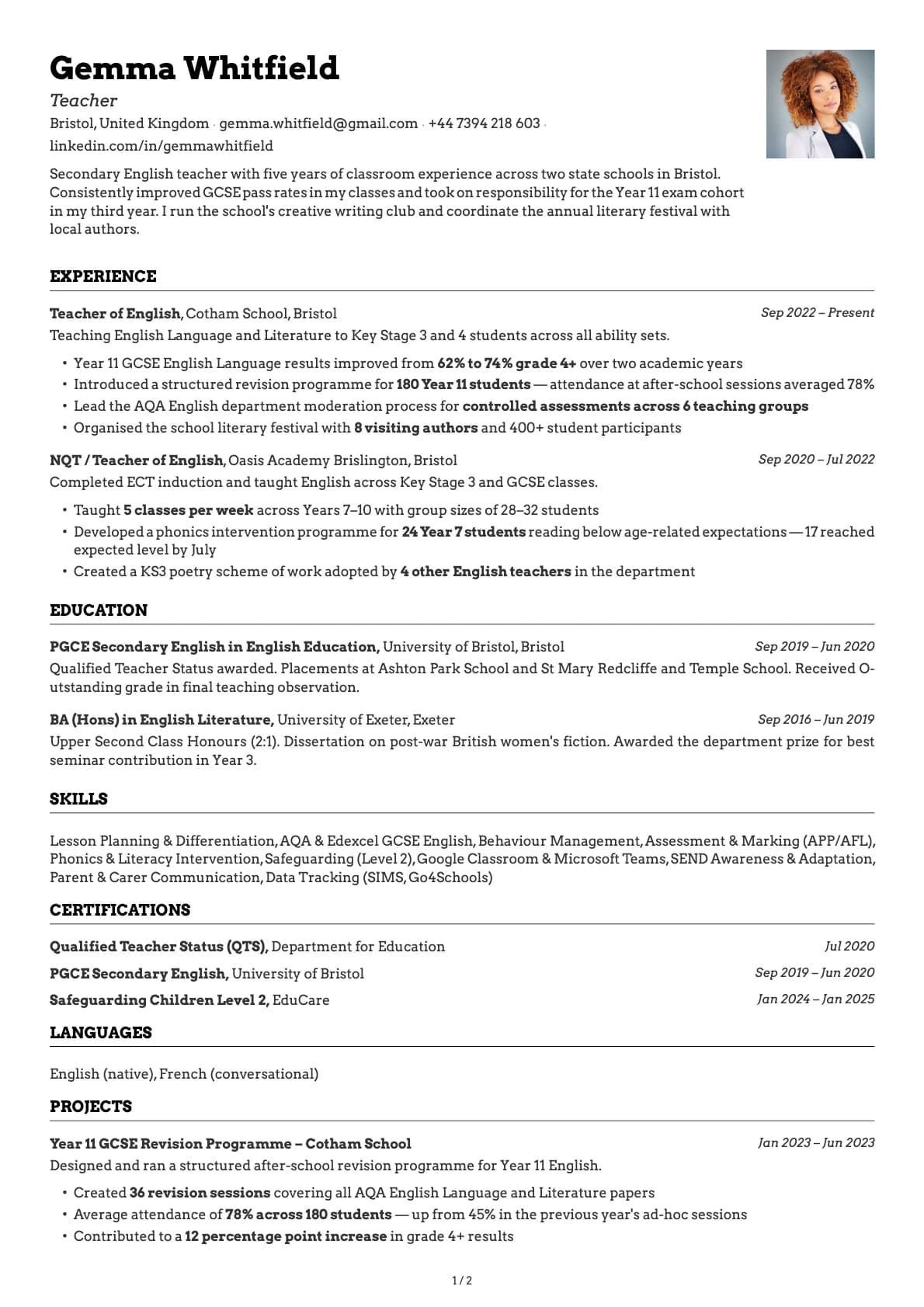
This resume belongs to Gemma, a secondary English teacher with five years of experience across two state schools in Bristol. She currently teaches at Cotham School, where she has improved GCSE pass rates, designed a revision programme, and organised a literary festival. Her resume works because it is built on numbers, student outcomes, and specific contributions to the school community.
Here is how to write yours with the same approach.
Your summary: subject, experience, and one standout result
Here is Gemma's summary:
Secondary English teacher with five years of classroom experience across two state schools in Bristol. Consistently improved GCSE pass rates in my classes and took on responsibility for the Year 11 exam cohort in my third year. I run the school's creative writing club and coordinate the annual literary festival with local authors.
This tells the headteacher: subject (English), experience level (5 years), that she handles exam classes (Year 11), and that she contributes beyond the classroom (club and festival). No fluff, no generic claims about being "dedicated to student success."
For yours: Name your subject and key stage. State how many years and how many schools. Then mention one concrete achievement or contribution. Keep it to three or four sentences.
How to write your experience section with real numbers
The biggest mistake on teacher resumes is writing bullets that describe the role rather than your personal impact. "Taught English to KS3 and KS4 classes" is just a job description. Every English teacher at that school could write the same line.
Here is what Gemma writes instead:
Year 11 GCSE English Language results improved from 62% to 74% grade 4+ over two academic years
That is a 12-point improvement with a before and after. The headteacher can see exactly what happened during her time teaching that cohort. Even if you feel like your results are average, framing them this way is more useful than omitting them entirely.
Another strong bullet:
Introduced a structured revision programme for 180 Year 11 students. Attendance at after-school sessions averaged 78%
The attendance number is smart. It proves the programme was not just created but actually worked. Students showed up. If you run any extra sessions, track the attendance and use it.
Your NQT/ECT years still count
Gemma's earlier role at Oasis Academy Brislington shows her ECT work:
Developed a phonics intervention programme for 24 Year 7 students reading below age-related expectations. 17 reached expected level by July
That is 71% of the group hitting target. You do not need to calculate the percentage for the reader, but having the raw numbers (24 students, 17 met target) lets them do the maths themselves. If you ran any intervention groups during your ECT years, the results belong on your resume.
Created a KS3 poetry scheme of work adopted by 4 other English teachers in the department
This bullet shows a contribution beyond your own classroom. When other teachers use your resources, that is worth mentioning because it demonstrates departmental influence even at an early career stage.
Skills: match them to the person specification
Gemma's skills list includes "AQA & Edexcel GCSE English," "Assessment & Marking (APP/AFL)," and "Data Tracking (SIMS, Go4Schools)." These are specific and scannable.
A few things to note:
- Name the exam boards you know. If the school uses AQA and you have AQA experience, that is a direct match.
- Include school data systems. SIMS, Go4Schools, Bromcom, Arbor. If you can use them, list them.
- Safeguarding is expected. But listing your level (Level 2, Level 3) shows you are current.
- SEND awareness matters. If you have SEND experience or training, include it. Many schools require evidence of adaptive practice.
Extra-curricular contributions: do not skip this
Teaching applications in the UK almost always ask about contributions to the wider school. Gemma runs a creative writing club (25 students, 3 had work published) and coordinates a literary festival (8 visiting authors, 400+ students).
If you coach a sport, run a club, lead trips, organise events, or mentor students outside of lessons, include it with numbers. "Run the Year 9 football team" is fine. "Coach the Year 9 football team, 22 students, reached the Bristol schools semi-final" is better.
Mistakes teachers make on their resumes
No exam results. If you teach an exam class and your results are decent, put them on your resume. If you do not include them, the headteacher will wonder why. If your results were below target, focus on progress measures or intervention outcomes instead.
Generic behaviour management claims. "Strong behaviour management skills" is not evidence. If you have a specific strategy that works, name it. If you have been observed and rated, include the rating.
Ignoring the person specification. Teaching job applications are scored against the person spec. If it says "experience of teaching mixed-ability classes," that phrase needs to appear. If it says "evidence of raising attainment," your GCSE bullet needs to clearly show a rise.
Too much education detail. Your PGCE and QTS matter. Your A-level grades do not (unless you are an NQT). Keep education brief.
One more thing
Gemma's resume uses Emerald, a clean single-column template. For teaching applications submitted through platforms like TES, eTeach, or directly to schools, ATS compatibility matters less than in corporate sectors. But a clean layout still helps the headteacher find information quickly during shortlisting.
If you are writing a supporting statement alongside your resume (which most UK teaching applications require), do not repeat the resume word for word. Use the resume for facts and numbers. Use the statement to explain your teaching philosophy and why you want that specific school.
Build your own version
Open this layout in the builder and swap in your own details. It takes a few minutes.
Free to use. No account needed to start.
Was this resume example helpful?
Rate this example to help us create better content for you.
4.8 average from 187 ratingsRelated resume examples
Substitute Teacher
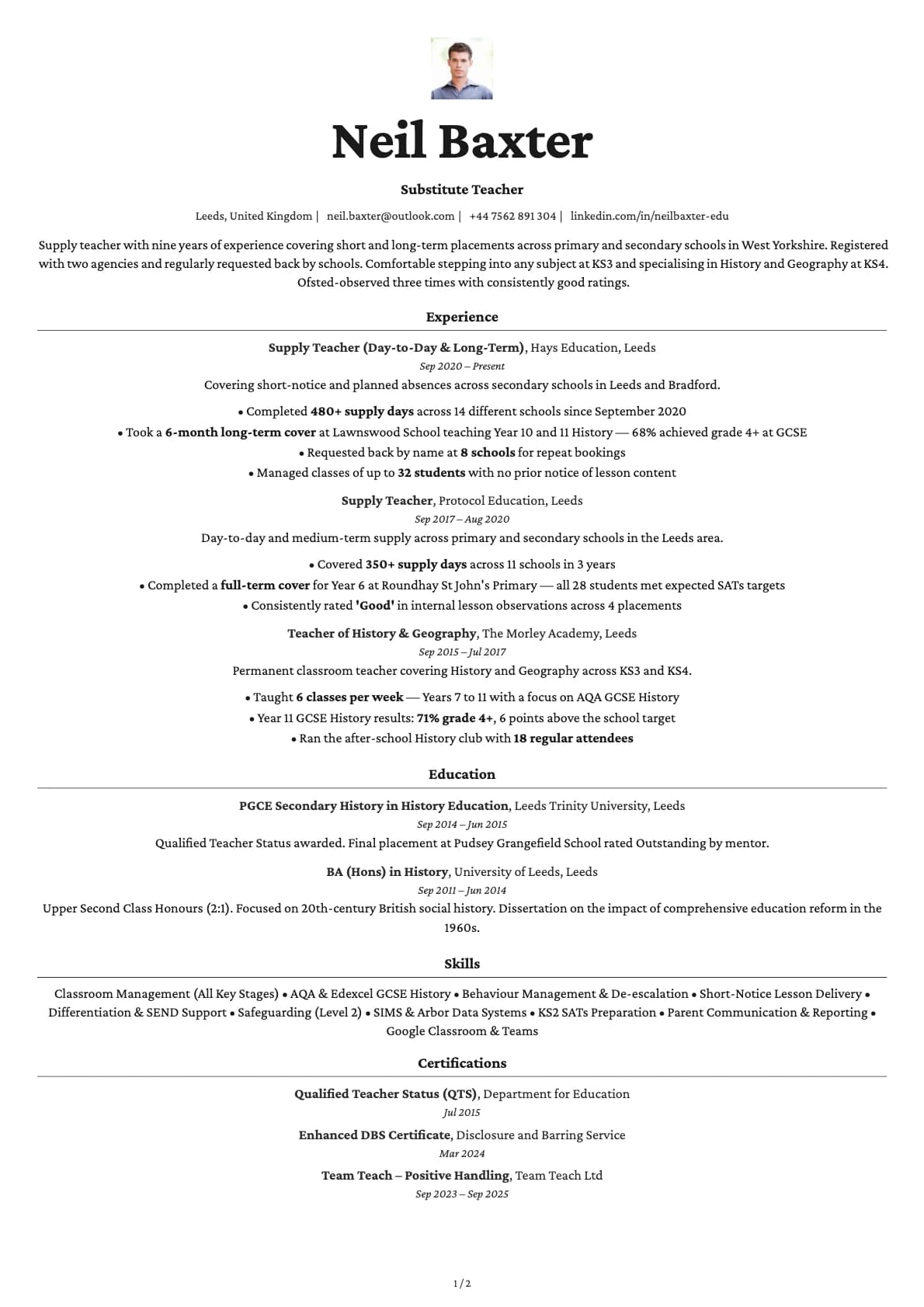
A substitute teacher resume example with 9 years of supply experience across primary and secondary schools.
Teaching Assistant
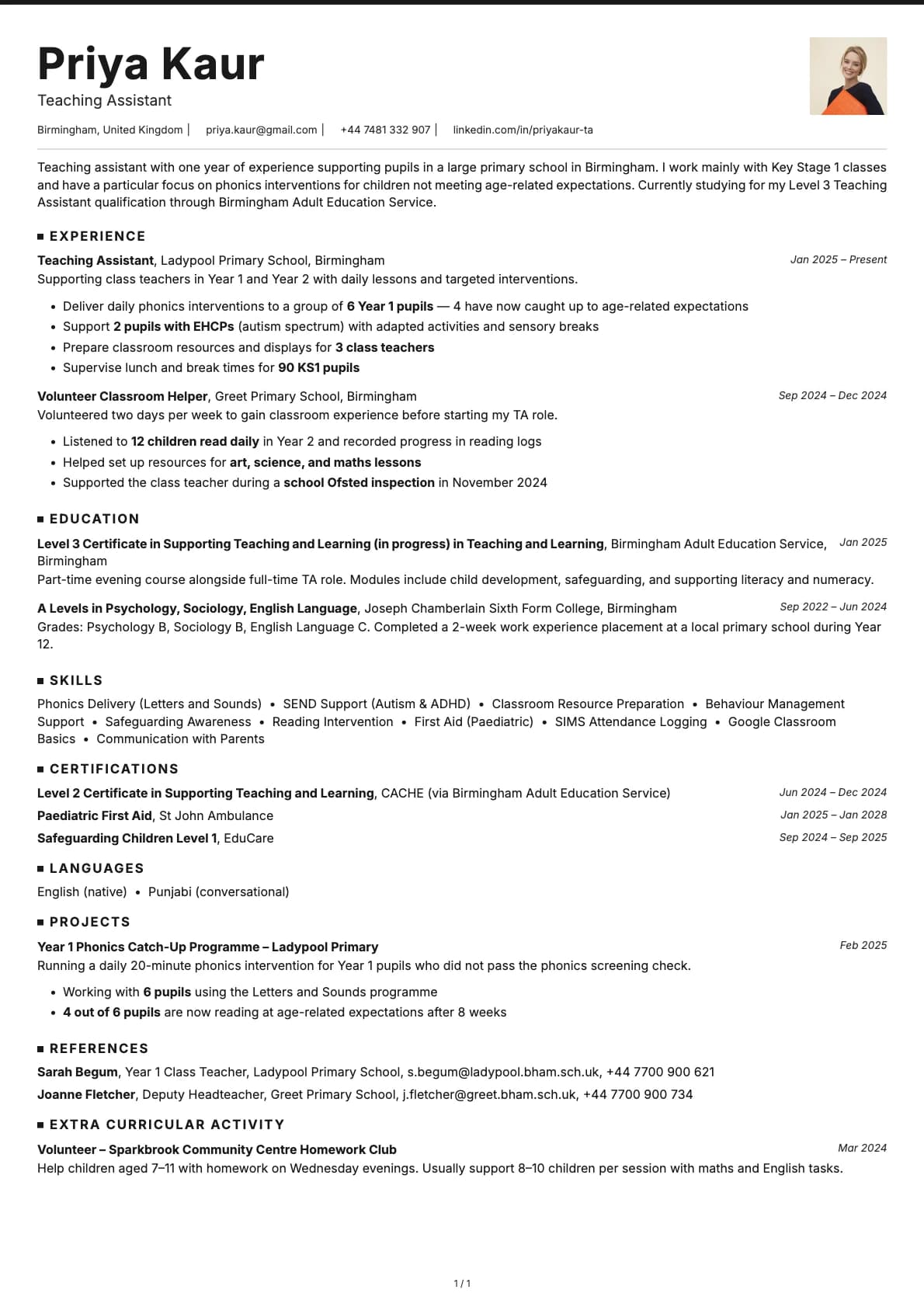
A teaching assistant resume example for an entry-level TA with phonics intervention experience and SEND support.
School Principal
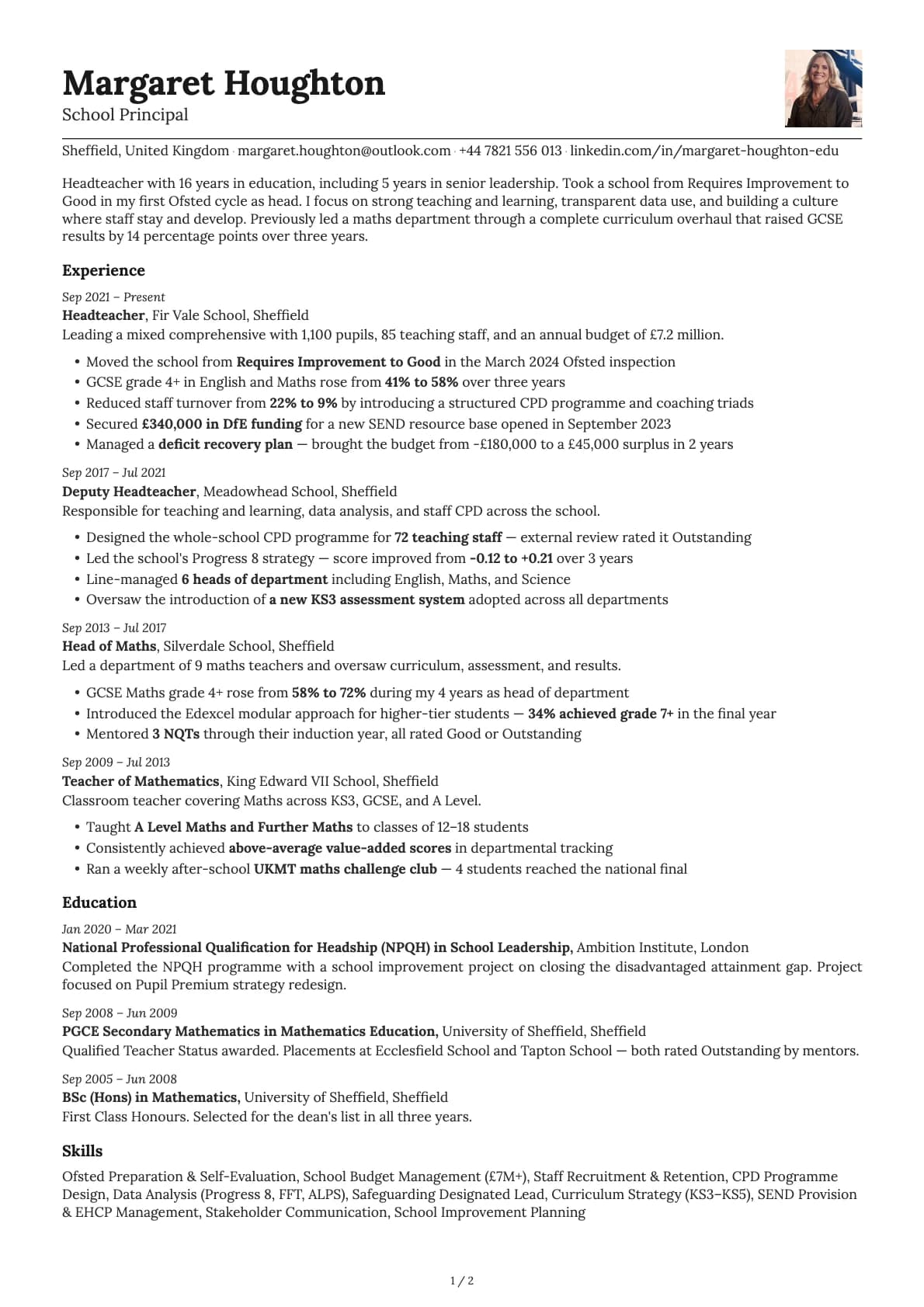
A school principal resume example with Ofsted outcomes, GCSE results, and budget management.
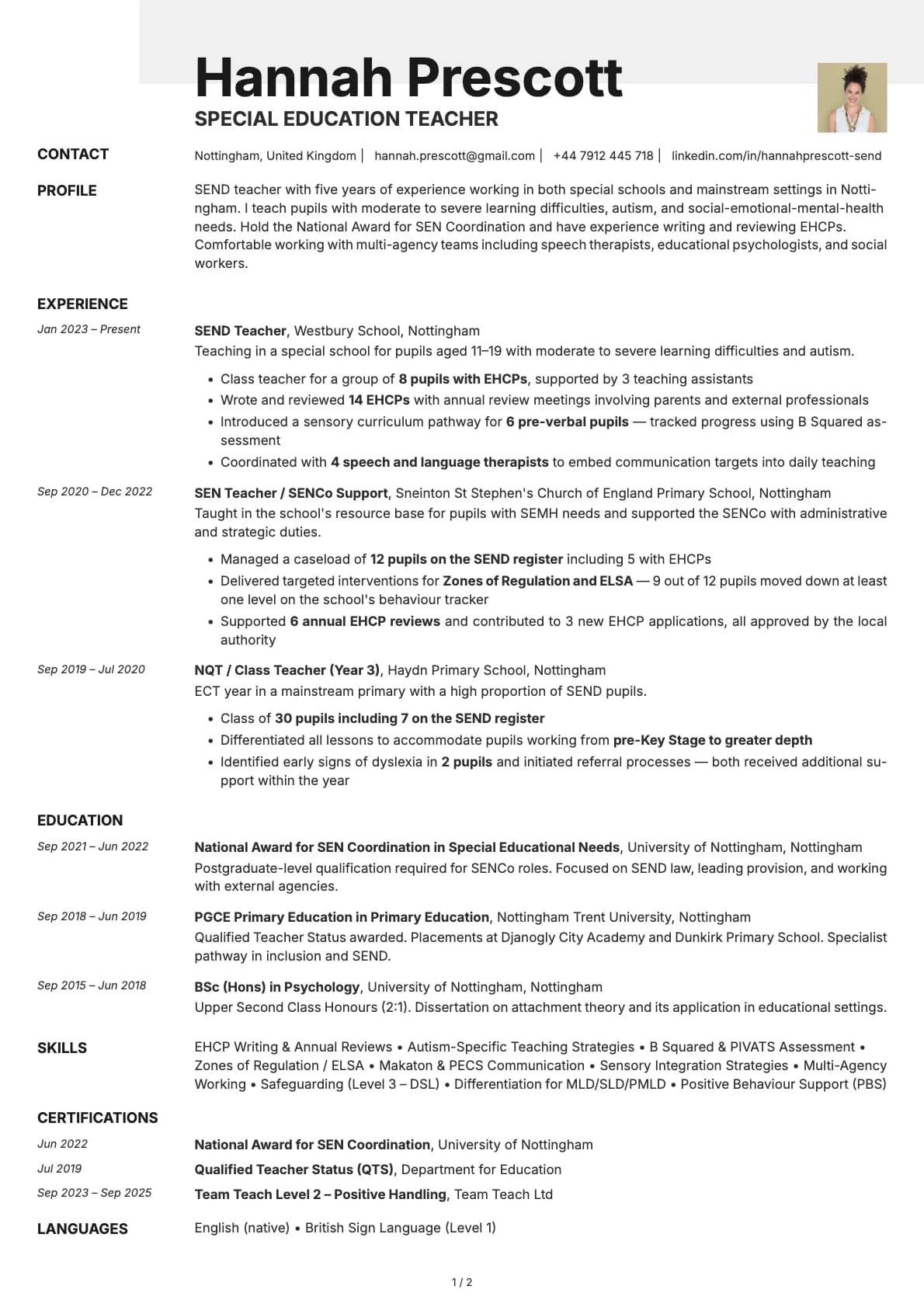
Special Education Teacher
A special education teacher resume example with EHCP experience, intervention outcomes, and multi-agency collaboration.
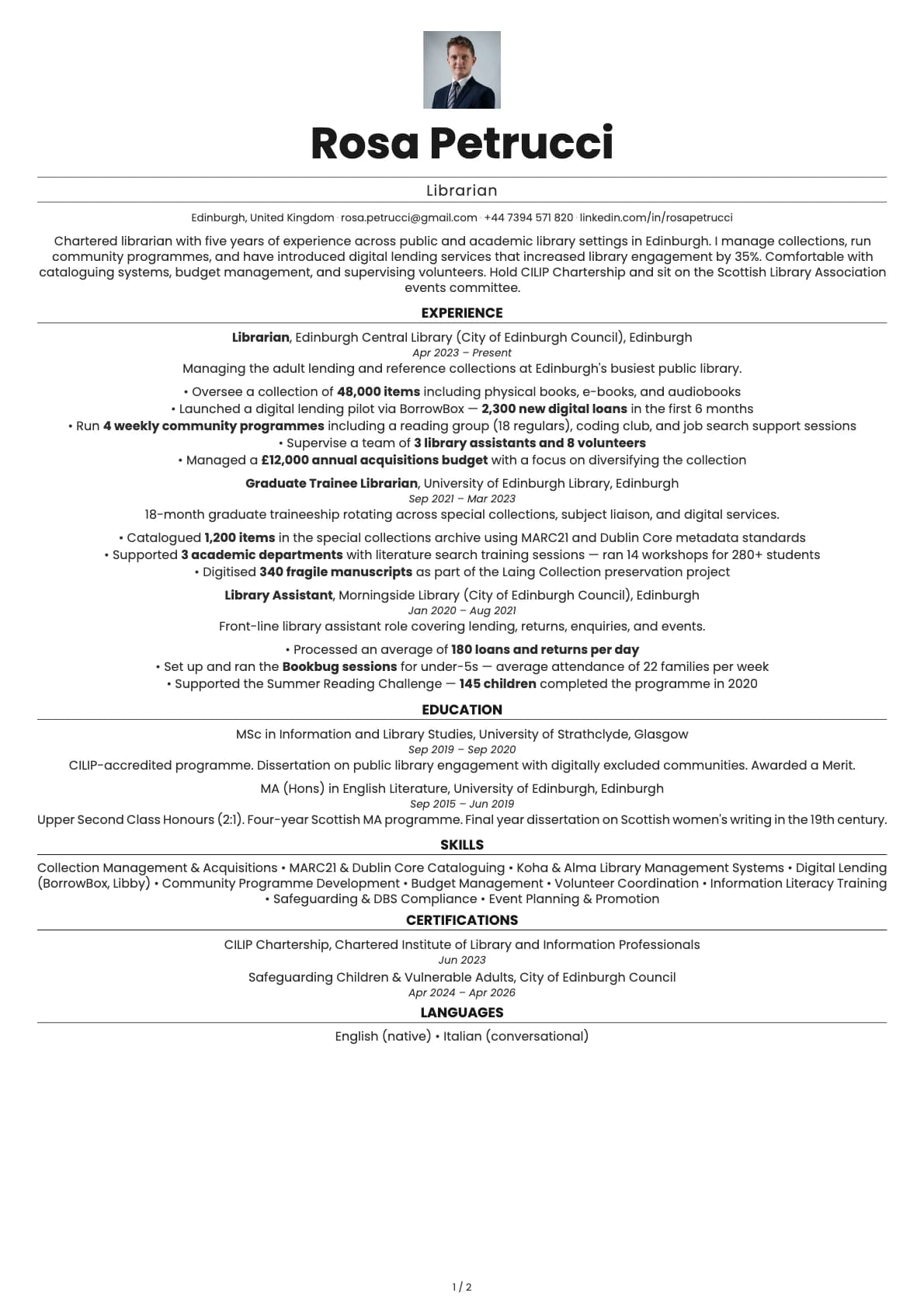
Librarian
A librarian resume example with community programme numbers, collection management specifics, and digital lending results.
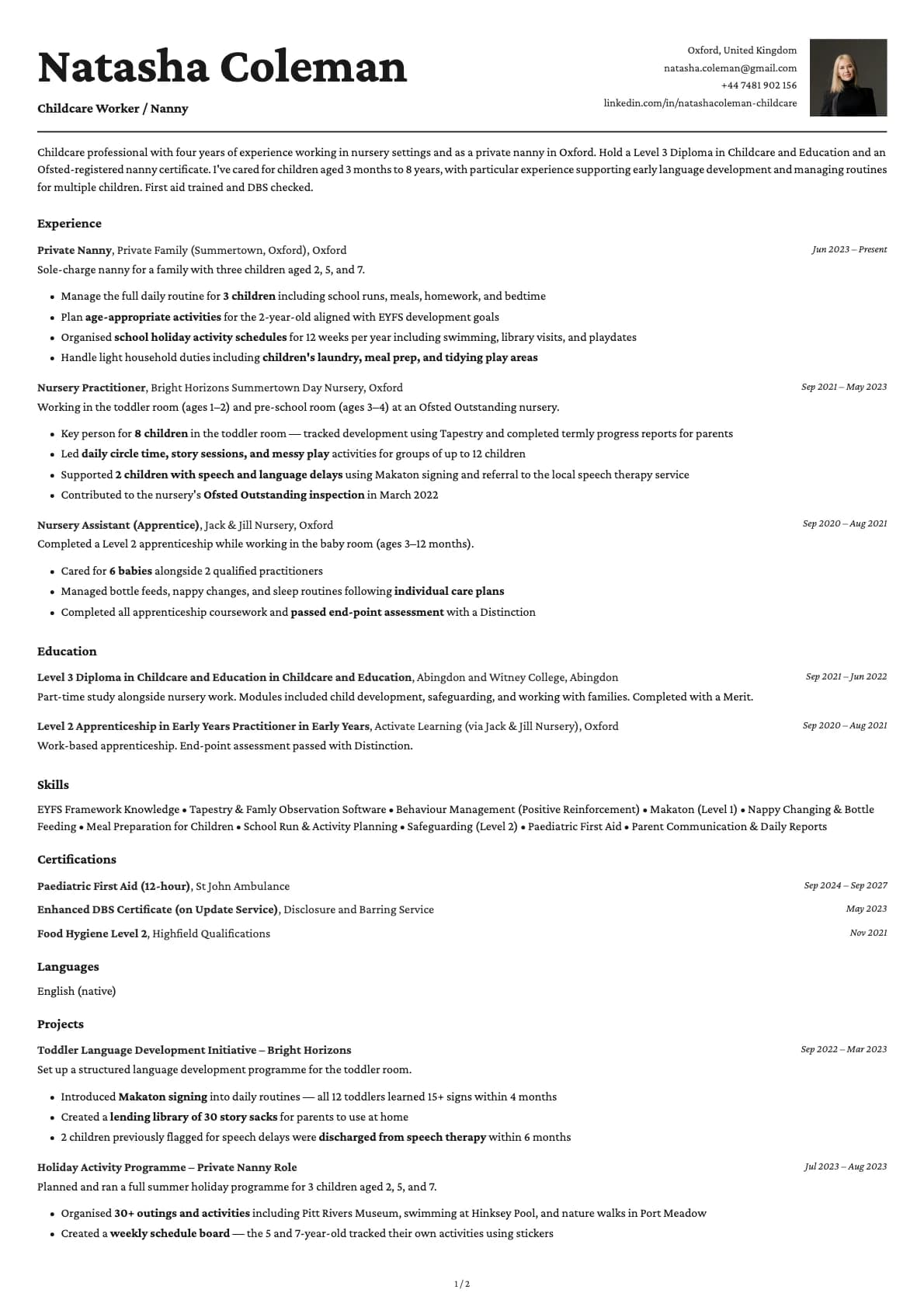
Childcare Worker / Nanny
A childcare worker resume example with nursery and private nanny experience.
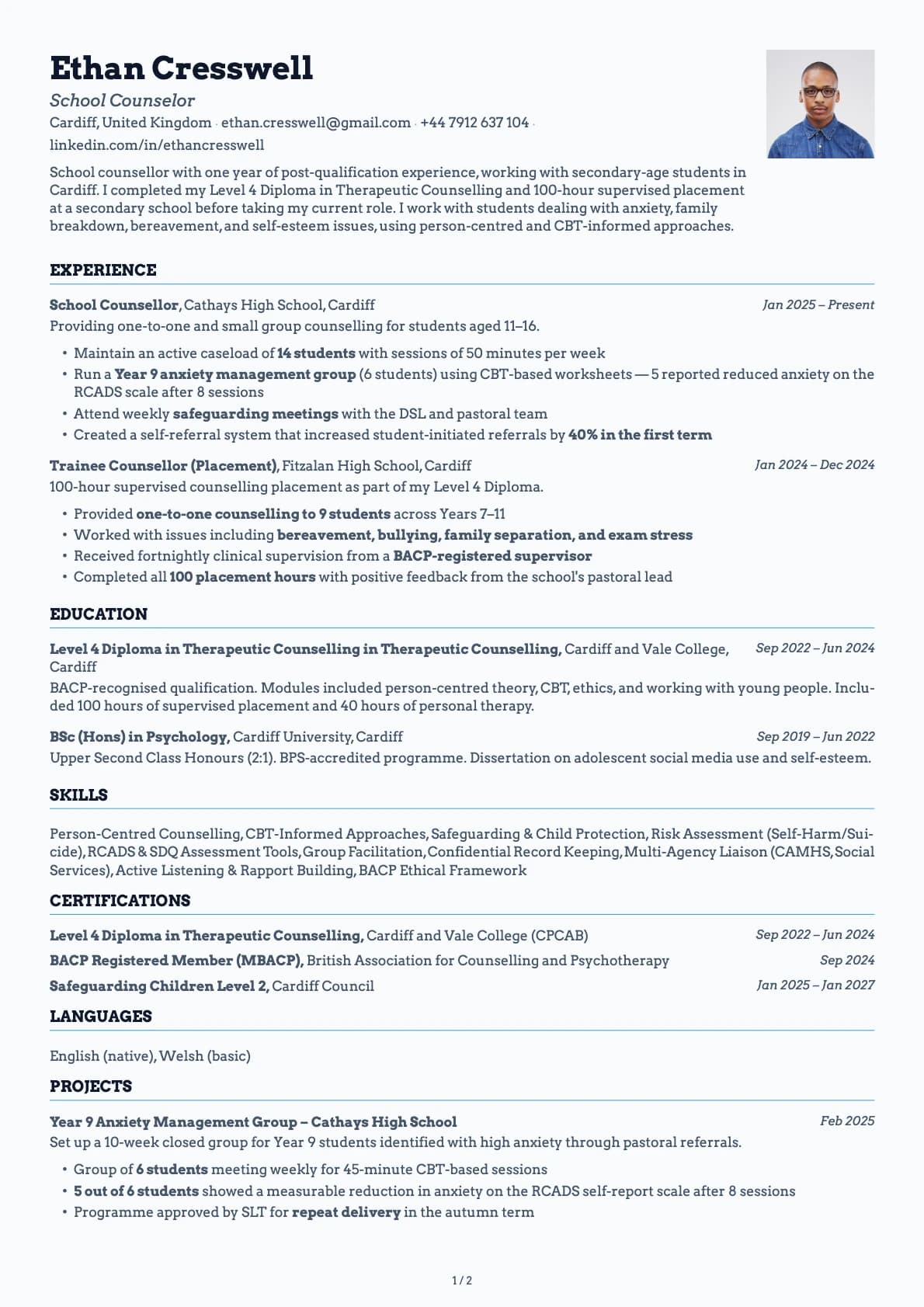
School Counselor
A school counselor resume example with caseload numbers, group therapy outcomes, and safeguarding experience.
Related articles

AI Is Screening Your Resume Before Any Human Sees It
AI screens most resumes before a human ever reads them. 97.4% of Fortune 500 companies run an ATS. This is what that means for you and what you can do about it.

The Best Resume Builders in 2026, Compared Honestly
Resume.io, Zety, Enhancv, Kickresume, Teal, and Laddro compared honestly: real pricing, free tiers, mobile apps, and where each tool wins. All prices checked in September 2026.

Burnout Recovery: A Real Timeline, Not 'Take a Bubble Bath'
55% of the U.S. workforce is burned out. Recovery takes 3 to 12 months. Here's what that actually looks like, stage by stage.