
Overview
Physiotherapy resumes run into the same problem as most healthcare CVs. Everyone describes the job rather than what they did in it. "Provided physiotherapy treatment to MSK outpatients" is technically accurate, but it tells the hiring manager nothing they did not already know from reading your job title.
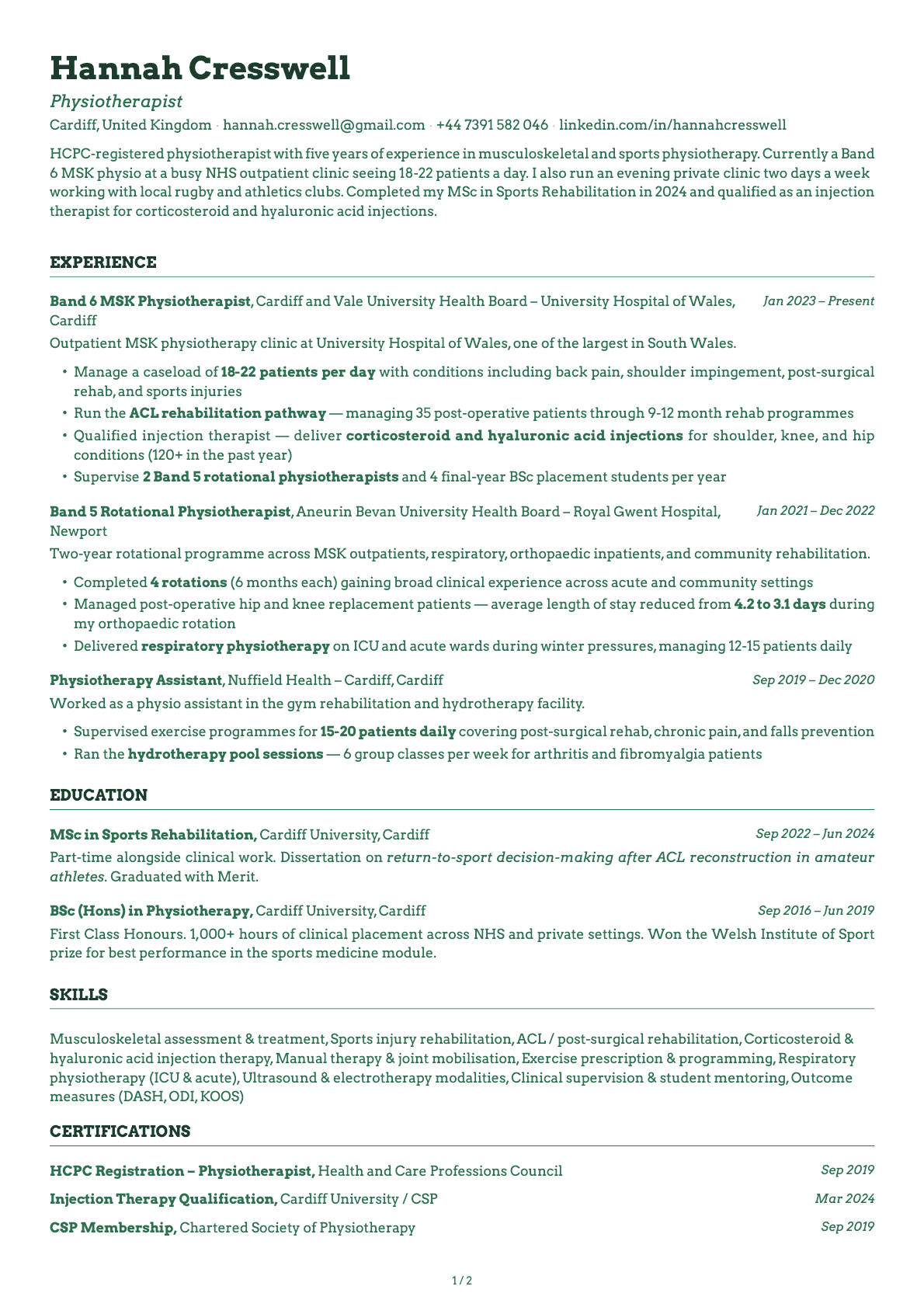
This resume belongs to Hannah Cresswell, a Band 6 MSK physiotherapist at University Hospital of Wales in Cardiff. She sees 18-22 patients a day, runs an ACL rehabilitation pathway, delivers injection therapy, and supervises Band 5 physios and placement students. She also has an MSc in Sports Rehabilitation and works privately with local rugby and athletics clubs.
The resume works because every bullet has a number or a specific detail attached. Let us go through it.
Lead with your registration and specialty
For NHS physio roles, the hiring panel needs three things in the first few seconds: your HCPC status, your band, and your clinical area.
Hannah opens with: "HCPC-registered physiotherapist with five years of experience in musculoskeletal and sports physiotherapy." That covers all three. Then she adds her current caseload (18-22 patients a day), her advanced skill (injection therapy), and her supervision responsibilities.
For your CV: State your HCPC registration, band level, and specialty first. Then name your current workplace and one or two numbers that show the scale of your work. Four sentences maximum.
How to write your clinical experience
Physiotherapy hiring panels score your CV against a person specification. Each bullet needs to match a criterion. Here is how to structure them.
Caseload and scope
"Manage a caseload of 18-22 patients per day with conditions including back pain, shoulder impingement, post-surgical rehab, and sports injuries"
This one sentence tells the panel: high volume, mixed caseload, confident working across common MSK presentations. If you are in outpatients, your daily patient numbers are one of your best data points.
Advanced clinical skills
"Qualified injection therapist, deliver corticosteroid and hyaluronic acid injections for shoulder, knee, and hip conditions (120+ in the past year)"
Extended scope roles and advanced skills are increasingly valued. If you can prescribe, inject, request imaging, or work as a first contact practitioner, make it prominent. Name the skill, the body areas, and the volume.
Supervision and mentoring
"Supervise 2 Band 5 rotational physiotherapists and 4 final-year BSc placement students per year"
From Band 6 upward, supervision is expected. But "supervise junior staff" is too vague. Name the number of staff, their grade or year, and the type of supervision (clinical, educational, rotational).
Rotational posts: make each rotation count
If you have done a rotational programme, the panel wants to see that you gained genuine clinical breadth. Hannah's Band 5 role mentions four rotations (MSK outpatients, respiratory, orthopaedic inpatients, community) and then pulls out specifics from two of them:
"Managed post-operative hip and knee replacement patients, average length of stay reduced from 4.2 to 3.1 days during my orthopaedic rotation"
"Delivered respiratory physiotherapy on ICU and acute wards during winter pressures, managing 12-15 patients daily"
Each bullet shows a different clinical setting with different demands. If you rotated through four departments, pick the two most relevant to the role you are applying for and write them up with detail. One strong bullet per rotation beats four vague ones.
Projects and quality improvement
Hannah includes two project entries. The ACL rehabilitation pathway she developed and a QI project that reduced post-operative length of stay.
The ACL pathway is strong because it shows clinical leadership:
"Created a phase-based protocol with objective return-to-sport criteria at each stage"
"Currently managing 35 patients through the pathway, 89% meeting return-to-sport benchmarks at 9 months"
The length of stay project shows measurable impact:
"Introduced a day-zero mobilisation protocol, patients seen by physio within 4 hours of surgery"
"Average length of stay reduced from 4.2 to 3.1 days over 6 months"
If you have developed a pathway, led a group class, set up a new service, or contributed to an audit, write it up using the same structure: what was the problem, what did you do, and what changed.
Skills: match the person specification
Hannah's skills section mixes clinical skills (MSK assessment, manual therapy, injection therapy) with technical skills (ultrasound modalities, outcome measures like DASH, ODI, KOOS) and soft skills that are actually specific (clinical supervision, exercise prescription).
If the job listing mentions specific outcome measures, treatment approaches, or clinical systems, make sure those exact terms appear on your CV. NHS shortlisting panels are often matching keywords against the person spec, especially for Band 6 and 7 roles.
Mistakes physiotherapists make on their CVs
Not stating your band level. NHS recruiters filter by band immediately. "Physiotherapist" could be Band 5, 6, or 7. Write "Band 6 MSK Physiotherapist" in full.
Listing conditions instead of what you did about them. "Treated patients with lower back pain, shoulder injuries, and post-surgical conditions" describes your caseload, not your contribution. Try: "Managed a caseload of 20 patients daily, delivering manual therapy, exercise prescription, and injection therapy for MSK conditions."
Forgetting outcome measures. If you use DASH, ODI, KOOS, EQ-5D, or any other standardised measure, list them. It shows you practice evidence-based care and it is a free keyword match.
Ignoring private or sports work. If you do any private clinic, sports team, or pitch-side work alongside your NHS role, include it. It shows breadth and initiative, and many Band 7 roles value experience across NHS and private settings.
One more thing
Read the person specification before you submit. Every NHS physiotherapy job has one. If the spec says "experience in injection therapy," those words need to appear in your CV. If it says "evidence of clinical supervision," do not just say you supervised people. Name how many, what grade, and what the outcome was. The shortlisting panel is scoring your CV line by line against their criteria. Make their job easy.