Medical Assistant Resume Example
A medical assistant resume example with patient contact numbers, clinical skills, and GP surgery experience.

Laddro Team
Free to use. No account needed to start.
Free to use. No account needed to start.
Overview
Medical assistant and healthcare assistant resumes tend to be short on detail and long on generic phrases. "Provided excellent patient care" and "assisted clinical staff" appear on almost every one. The problem is that every HCA does those things. Your resume needs to show the specific clinical tasks you perform, the volume of patients you handle, and the systems you use.
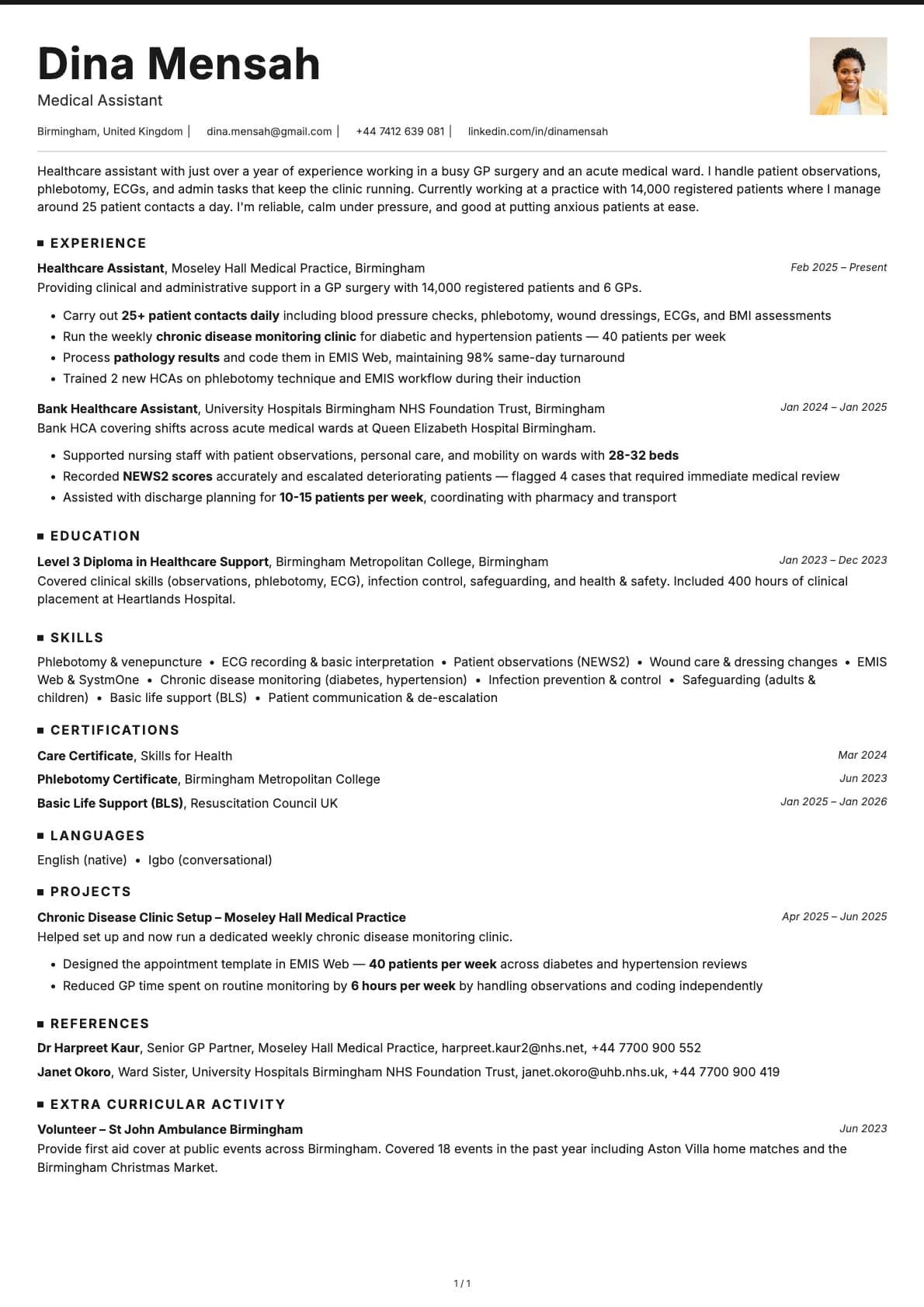
This resume belongs to Dina Mensah, a healthcare assistant with just over a year of experience. She currently works at a GP surgery with 14,000 registered patients, handling around 25 patient contacts a day. Before that, she worked as a bank HCA on acute medical wards at Queen Elizabeth Hospital Birmingham. She is early in her career, but the resume is packed with specifics that make her stand out from other applicants at the same level.
Let us look at what she does well and how you can apply the same techniques.
Your summary needs clinical detail, not personality traits
The most common mistake on HCA resumes is opening with personality. "I am a caring, hardworking individual who enjoys helping people." Every applicant says this. It takes up space without adding information.
Here is Dina's summary:
Healthcare assistant with just over a year of experience working in a busy GP surgery and an acute medical ward. I handle patient observations, phlebotomy, ECGs, and admin tasks that keep the clinic running. Currently working at a practice with 14,000 registered patients where I manage around 25 patient contacts a day.
She names her clinical skills (phlebotomy, ECGs, observations), her setting (GP surgery and acute ward), and her daily workload (25 patient contacts, 14,000 registered patients). A hiring manager can picture her working day in seconds.
Your formula: Name your settings (GP, hospital ward, community), list 3 or 4 clinical tasks you perform independently, and give a number that shows your workload.
How to write experience bullets for clinical roles
Clinical roles are easy to quantify if you think about your shift. How many patients do you see? What procedures do you perform? What systems do you use? What happened because of your work?
Look at these bullets from Dina's GP surgery role:
"Carry out 25+ patient contacts daily including blood pressure checks, phlebotomy, wound dressings, ECGs, and BMI assessments"
"Run the weekly chronic disease monitoring clinic for diabetic and hypertension patients. 40 patients per week"
"Process pathology results and code them in EMIS Web, maintaining 98% same-day turnaround"
The first bullet shows daily volume and the range of clinical tasks. The second shows she runs a clinic independently (not just assists). The third shows she handles admin accurately and quickly.
The pattern: Clinical task + volume or frequency + the standard you maintain.
Even if you are newly qualified, you can quantify your work. "Supported nursing staff with patient observations and personal care on wards with 28-32 beds" gives the recruiter a sense of your ward experience.
Hospital and GP experience are both valuable. Frame them differently.
Dina has both acute hospital and primary care experience. She writes about them differently because the skills they demonstrate are different.
Her hospital role emphasises acuity and escalation:
"Recorded NEWS2 scores accurately and escalated deteriorating patients. Flagged 4 cases that required immediate medical review"
Her GP role emphasises independence and clinic management:
"Run the weekly chronic disease monitoring clinic for diabetic and hypertension patients"
If you have worked in both settings, highlight what each one shows. Hospital work demonstrates that you can handle high-acuity patients and work in fast-moving teams. GP work demonstrates independence, patient relationships, and clinical admin.
Skills: list your clinical competencies and your systems
This resume lists phlebotomy, ECG recording, NEWS2, wound care, and chronic disease monitoring alongside EMIS Web and SystmOne. Both categories matter.
Clinical competencies tell the hiring manager what tasks you can perform. Systems tell them whether you will need training on their software. Many GP surgeries and trusts list their clinical system in the job posting. If you already know it, that is a genuine advantage.
Include your safeguarding level and BLS certification in the skills or certifications section. They are often listed as essential on the person specification.
Certifications: Care Certificate comes first
If you have completed your Care Certificate, list it prominently. It is the baseline standard for healthcare support workers in England, and many employers require it.
Dina lists her Care Certificate, Phlebotomy Certificate, and BLS certification. All three are directly relevant. If you have additional competencies (cannulation, catheterisation, wound closure strips), list them too. Each one expands the range of tasks you can be asked to do, which makes you more useful to the practice.
Mistakes that cost interviews
Not naming your clinical skills. "Assisted with patient care" could mean anything from helping someone walk to performing an ECG. Name the specific procedures you are trained to do.
Forgetting to mention patient volumes. "Worked in a busy GP surgery" is vague. "Worked in a GP surgery with 14,000 registered patients, managing 25 contacts per day" is concrete.
Leaving out the clinical system. EMIS Web, SystmOne, Careflow, Lorenzo. Whichever one you use, list it. It is a free keyword match and a practical selling point.
Using a colourful or creative template. NHS and private healthcare employers use ATS systems that struggle with sidebars and graphics. This resume uses Graphite, a simple single-column layout that parses cleanly.
One more thing
If you are applying to NHS roles through NHS Jobs or Trac, the application form matters as much as the resume. But attaching a well-structured resume still helps because it gives the shortlisting panel a quick overview. Make sure the clinical skills on your resume match the essential criteria in the person specification. If they say "phlebotomy competency," make sure "phlebotomy" appears on your resume. Word for word.
Build your own version
Open this layout in the builder and swap in your own details. It takes a few minutes.
Free to use. No account needed to start.
Was this resume example helpful?
Rate this example to help us create better content for you.
4.7 average from 134 ratingsRelated resume examples
Registered Nurse
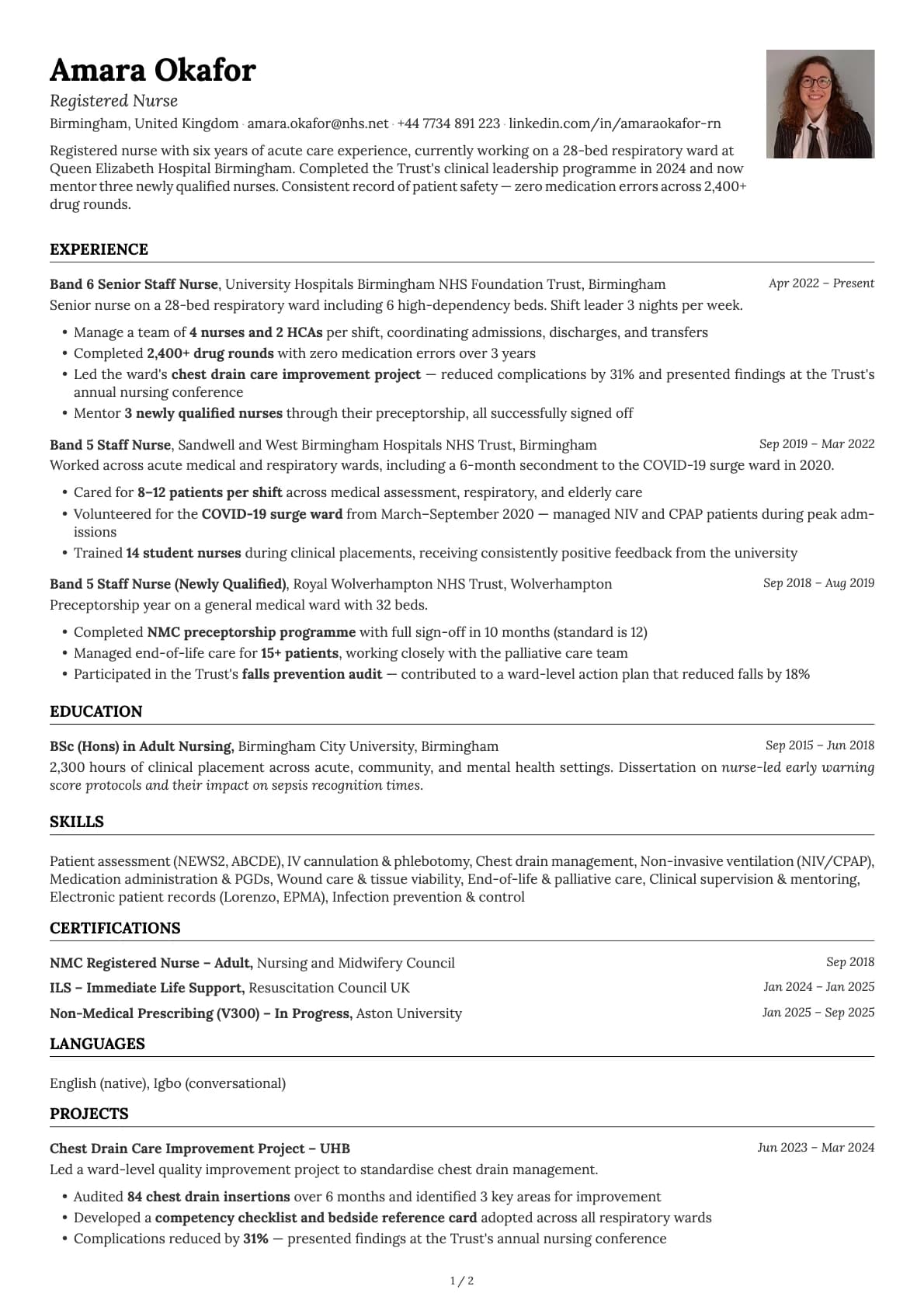
A registered nurse resume example with 6 years of acute care experience at NHS hospitals.
Pharmacist
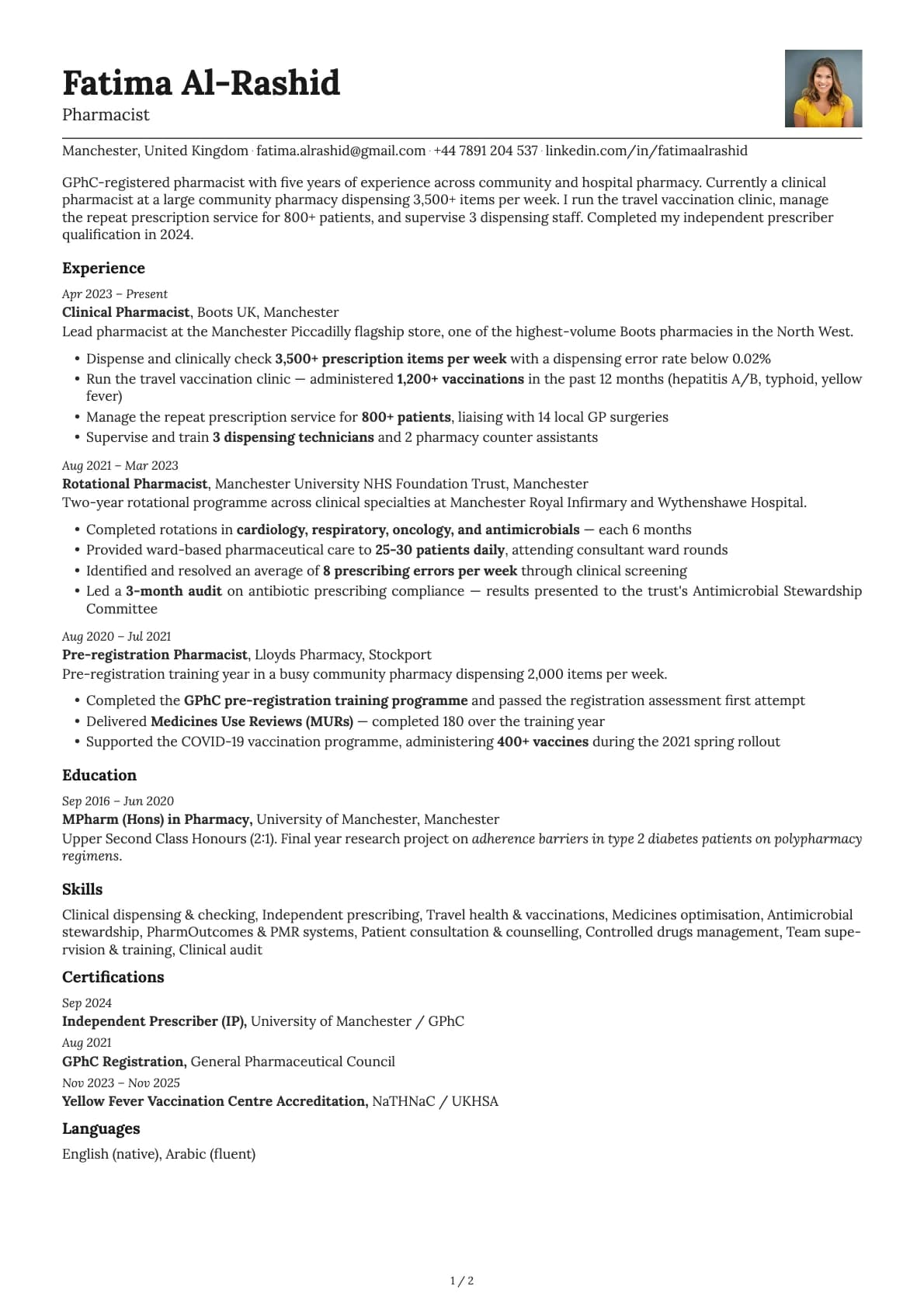
A pharmacist resume example with community and hospital experience, clinical audit results, and vaccination clinic numbers.
Physician
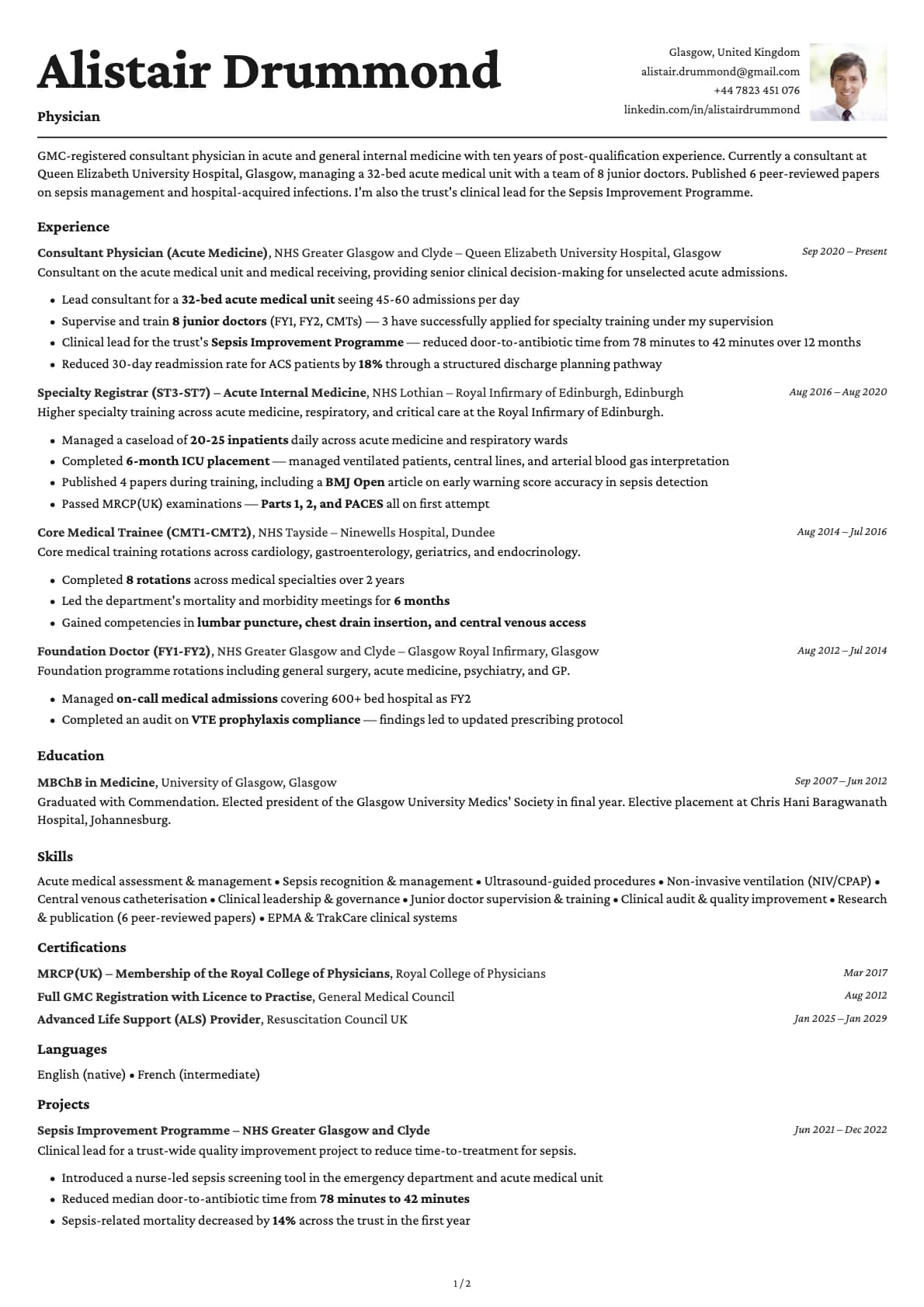
A physician resume example from a consultant in acute medicine with quality improvement projects, publications, and clinical leadership.
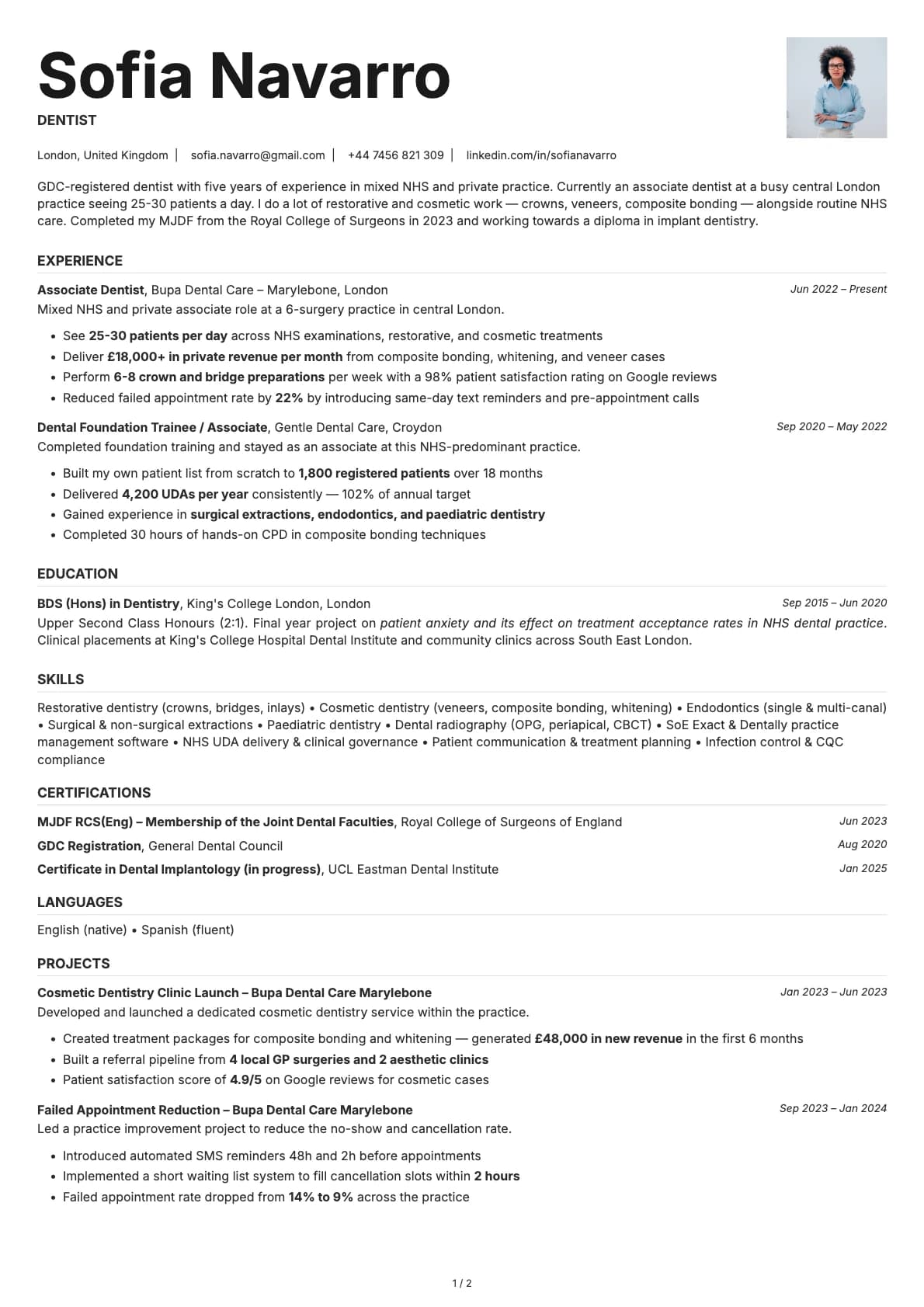
Dentist
A dentist resume example with mixed NHS and private practice experience in London.
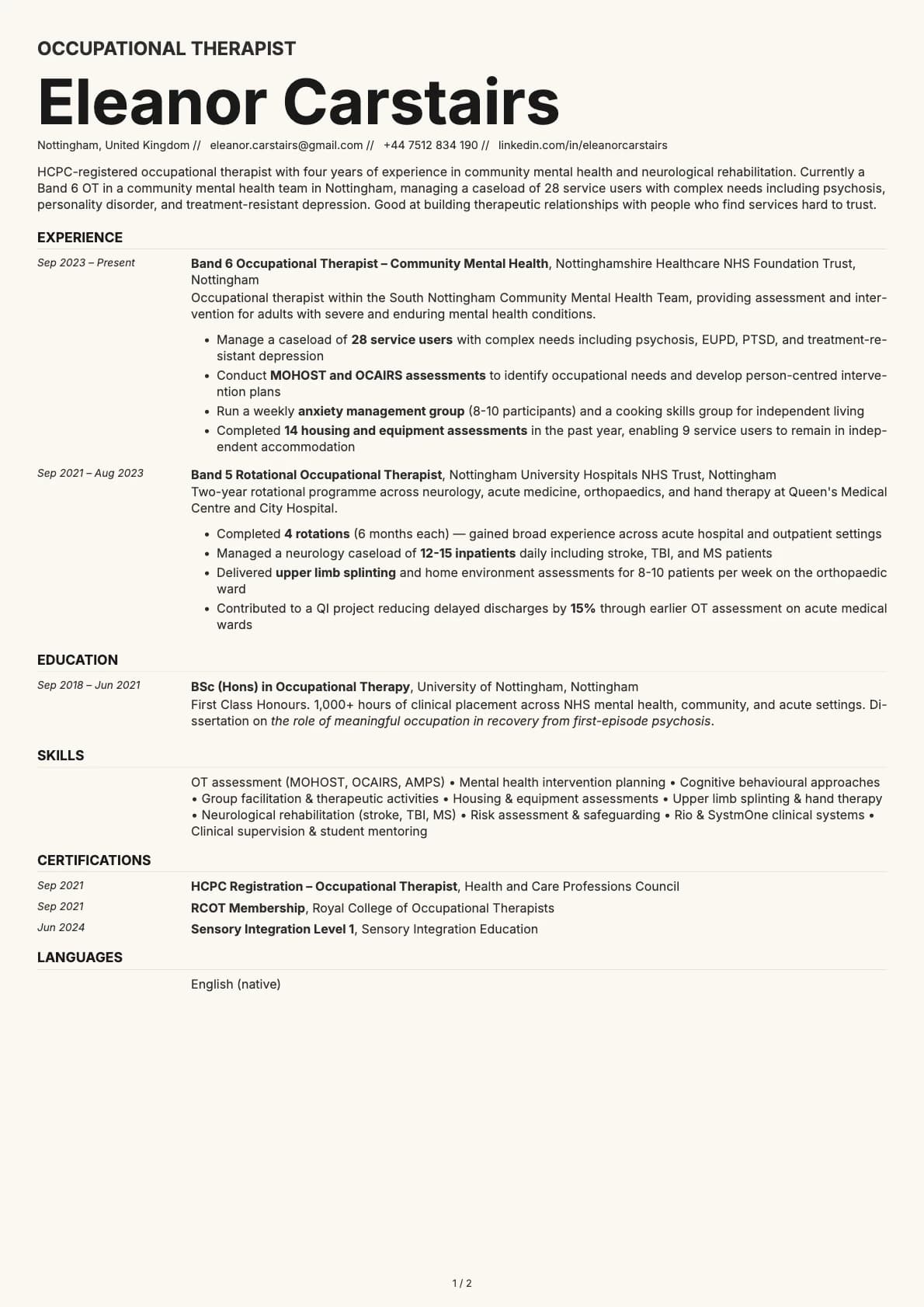
Occupational Therapist
An occupational therapist resume example with caseload details, OT assessment tools, and QI project outcomes.
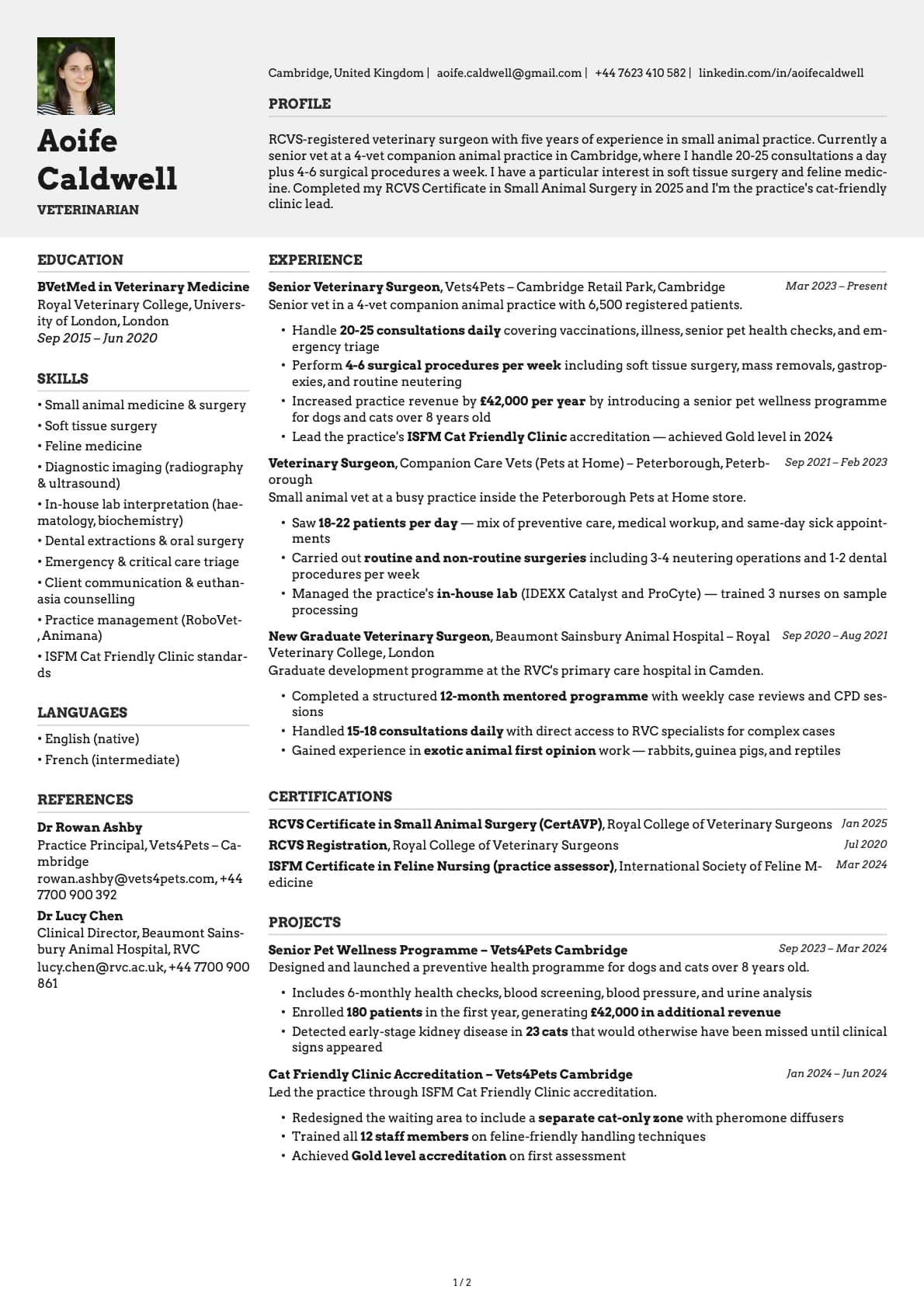
Veterinarian
A veterinarian resume example with 5 years of small animal practice experience.
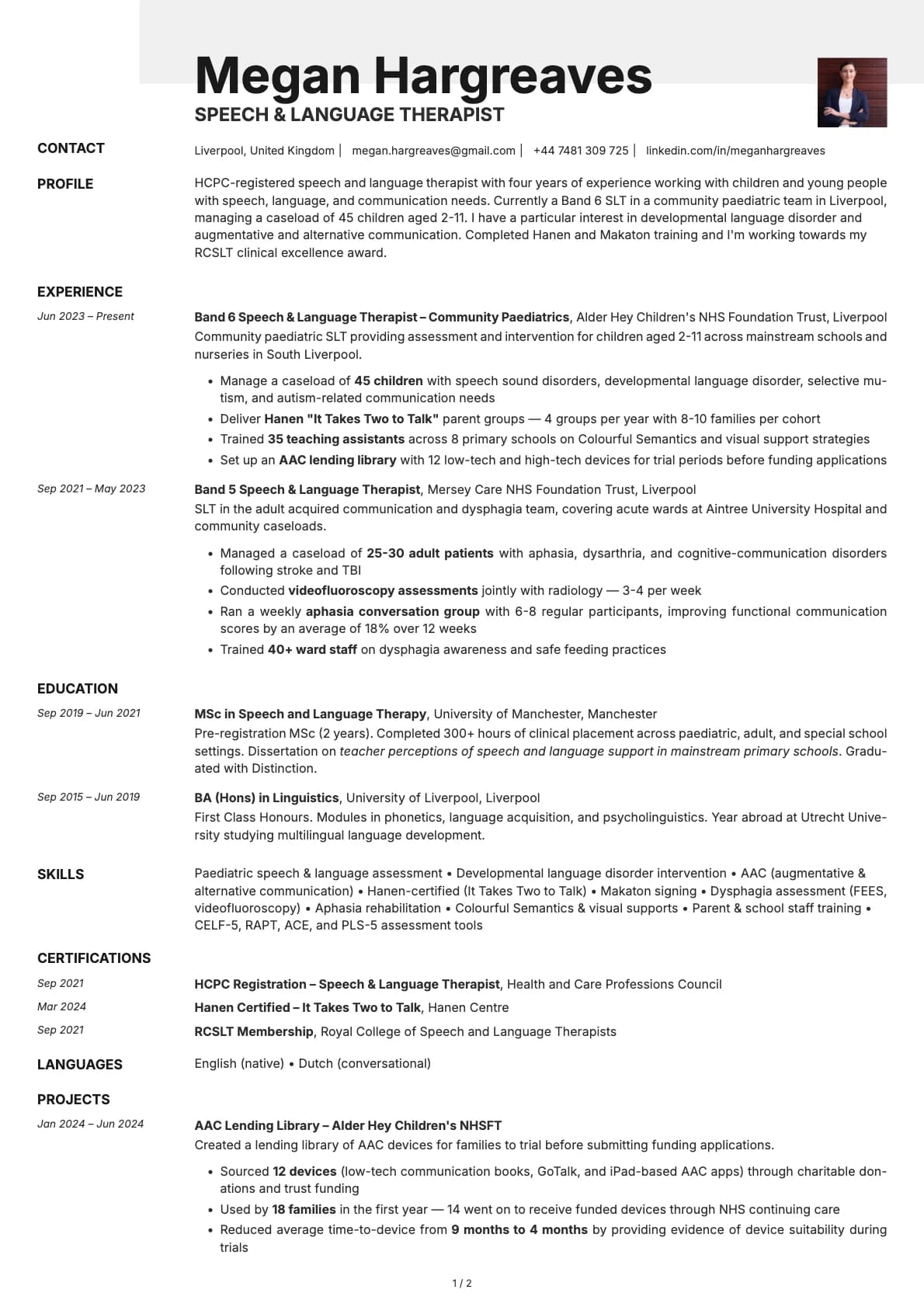
Speech & Language Therapist
A speech and language therapist resume example with paediatric and adult caseload experience across NHS trusts.
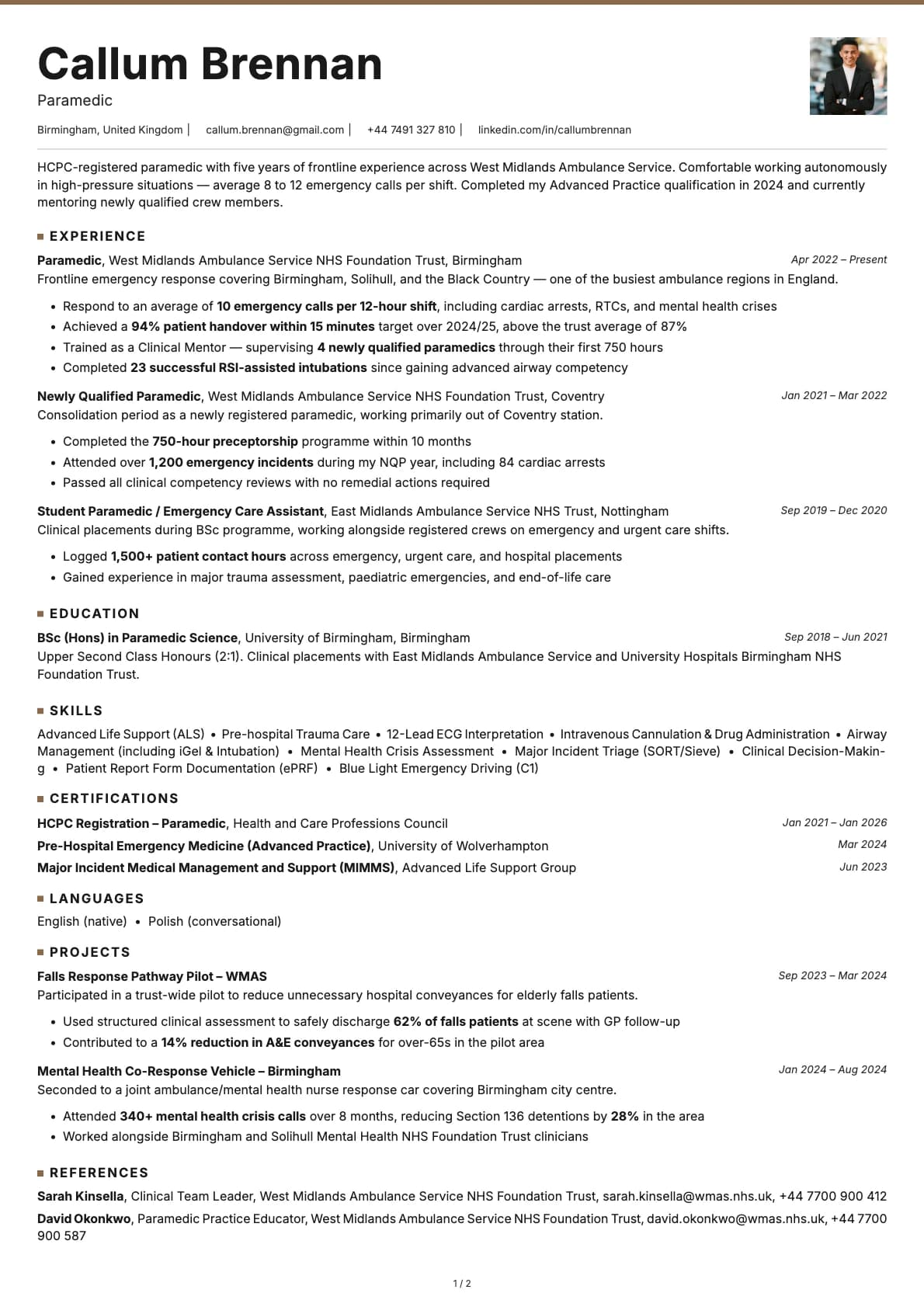
Paramedic
A paramedic resume example with call volumes, clinical competencies, and mentoring experience.
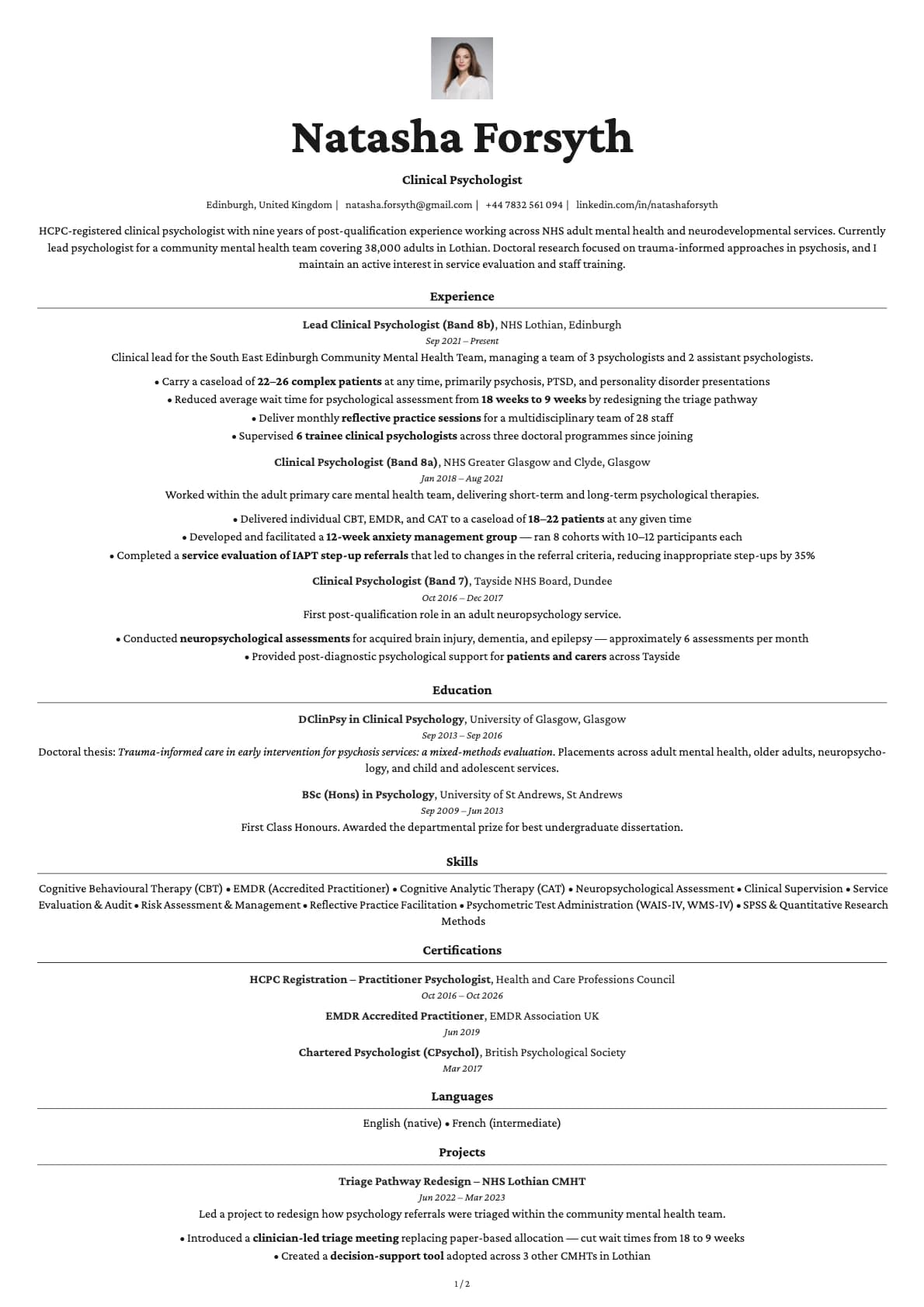
Clinical Psychologist
A clinical psychologist resume example with 9 years of NHS experience across community mental health and neuropsychology.
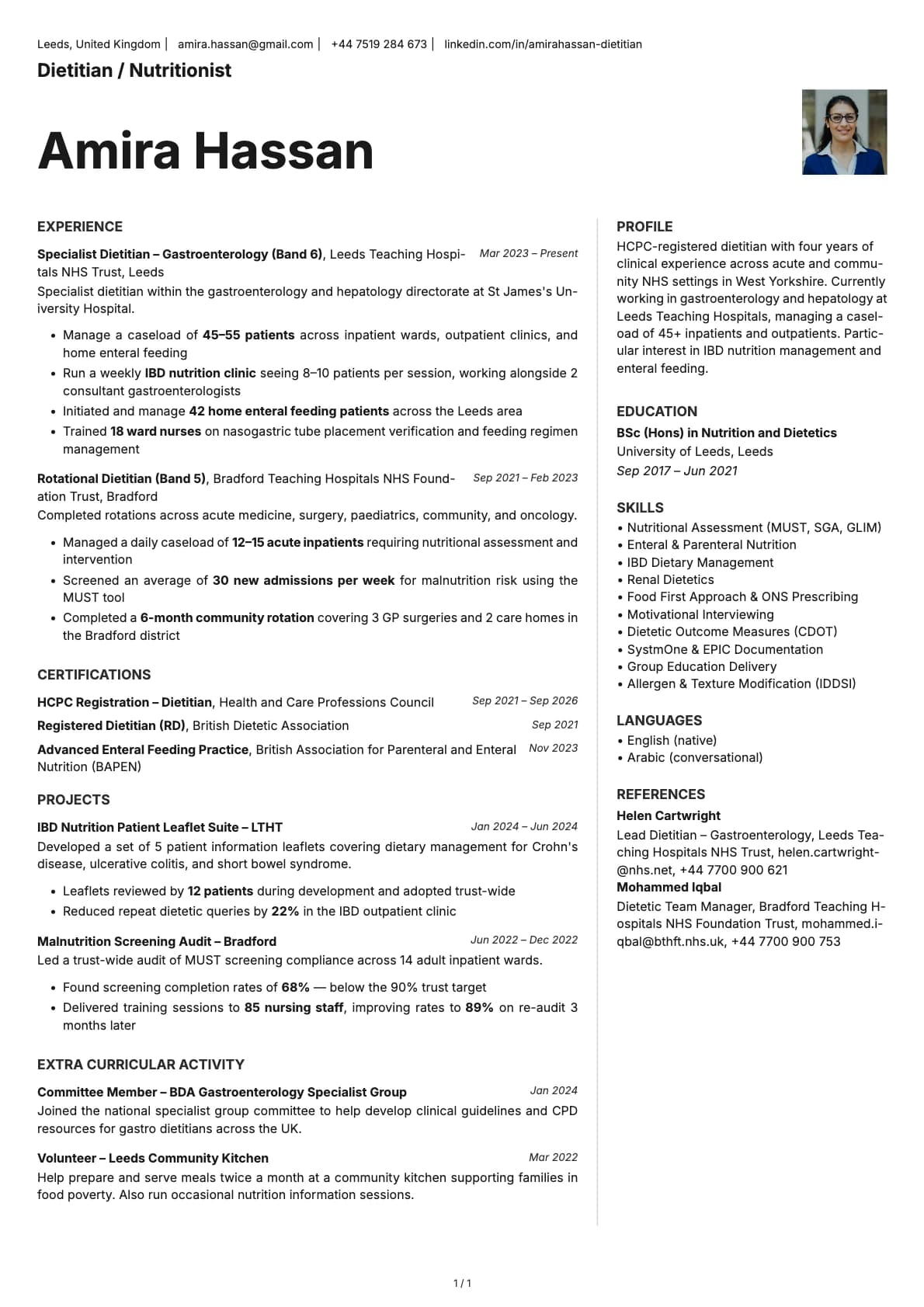
Dietitian / Nutritionist
A dietitian resume example with NHS clinical experience in gastroenterology and community nutrition.
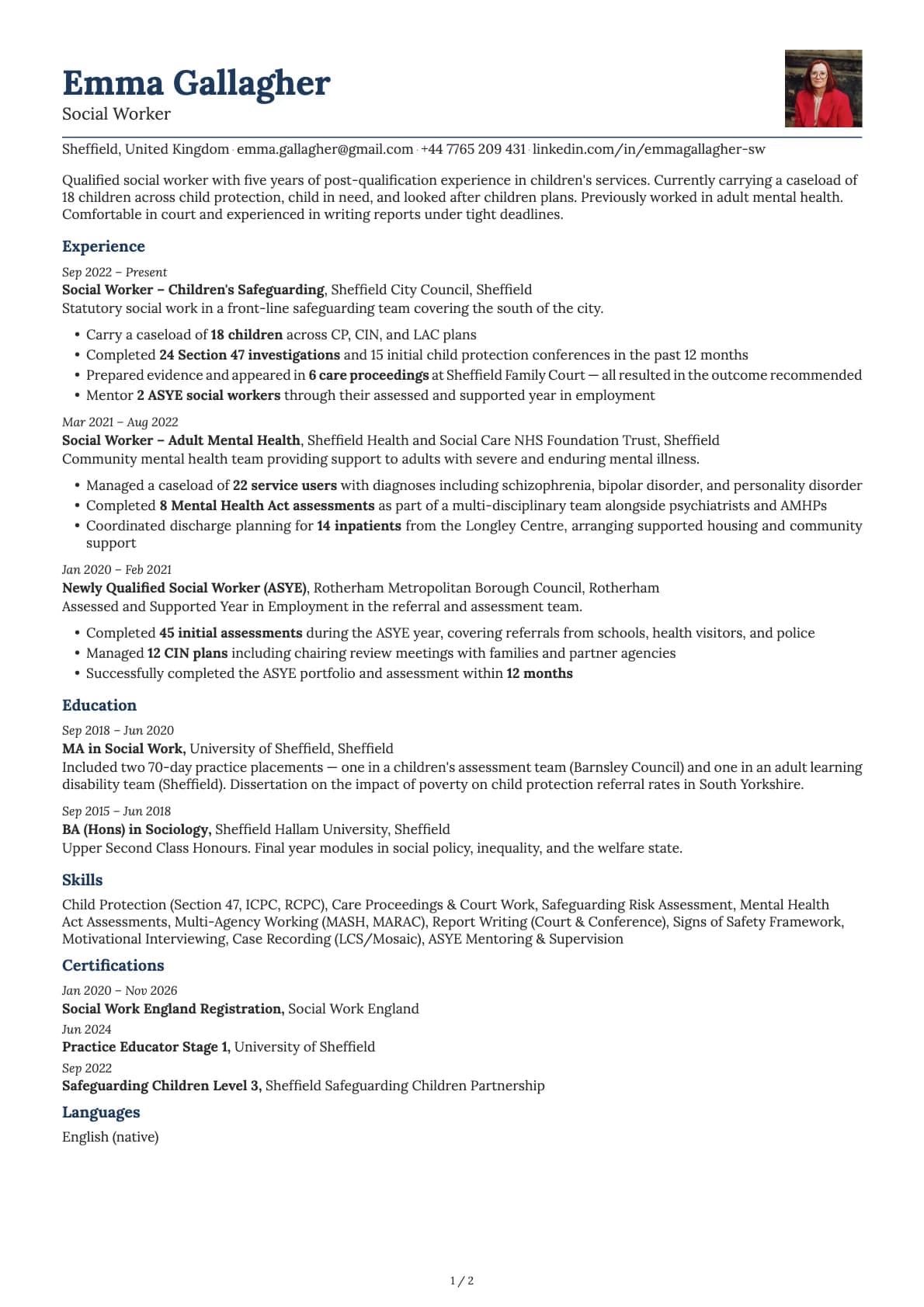
Social Worker
A social worker resume example with caseload numbers, court work, and multi-agency experience.
Dental Hygienist
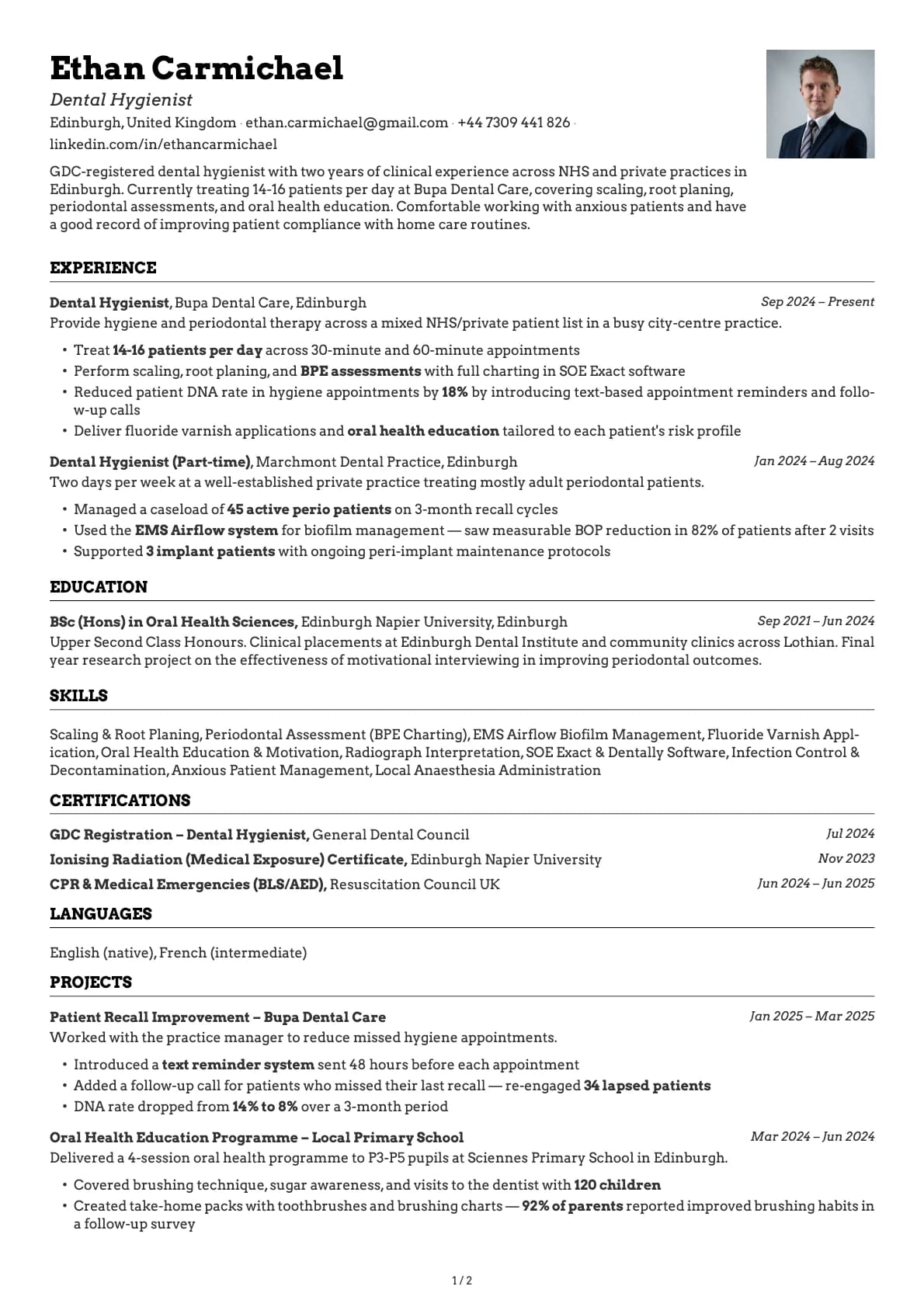
A dental hygienist resume example with NHS and private practice experience in Edinburgh.
Related articles

AI Is Screening Your Resume Before Any Human Sees It
AI screens most resumes before a human ever reads them. 97.4% of Fortune 500 companies run an ATS. This is what that means for you and what you can do about it.

The Best Resume Builders in 2026, Compared Honestly
Resume.io, Zety, Enhancv, Kickresume, Teal, and Laddro compared honestly: real pricing, free tiers, mobile apps, and where each tool wins. All prices checked in September 2026.

Burnout Recovery: A Real Timeline, Not 'Take a Bubble Bath'
55% of the U.S. workforce is burned out. Recovery takes 3 to 12 months. Here's what that actually looks like, stage by stage.