Dietitian Resume Example
A dietitian resume example with NHS clinical experience in gastroenterology and community nutrition.

Laddro Team
Free to use. No account needed to start.
Free to use. No account needed to start.
Overview
Dietitian resumes in the NHS have a specific problem. The job is complex. You assess patients, plan interventions, manage enteral feeding, run clinics, train nursing staff, and audit screening compliance. But most dietitian resumes reduce all of that to "provided nutritional assessment and advice to patients." That tells a recruiting manager nothing they do not already know.
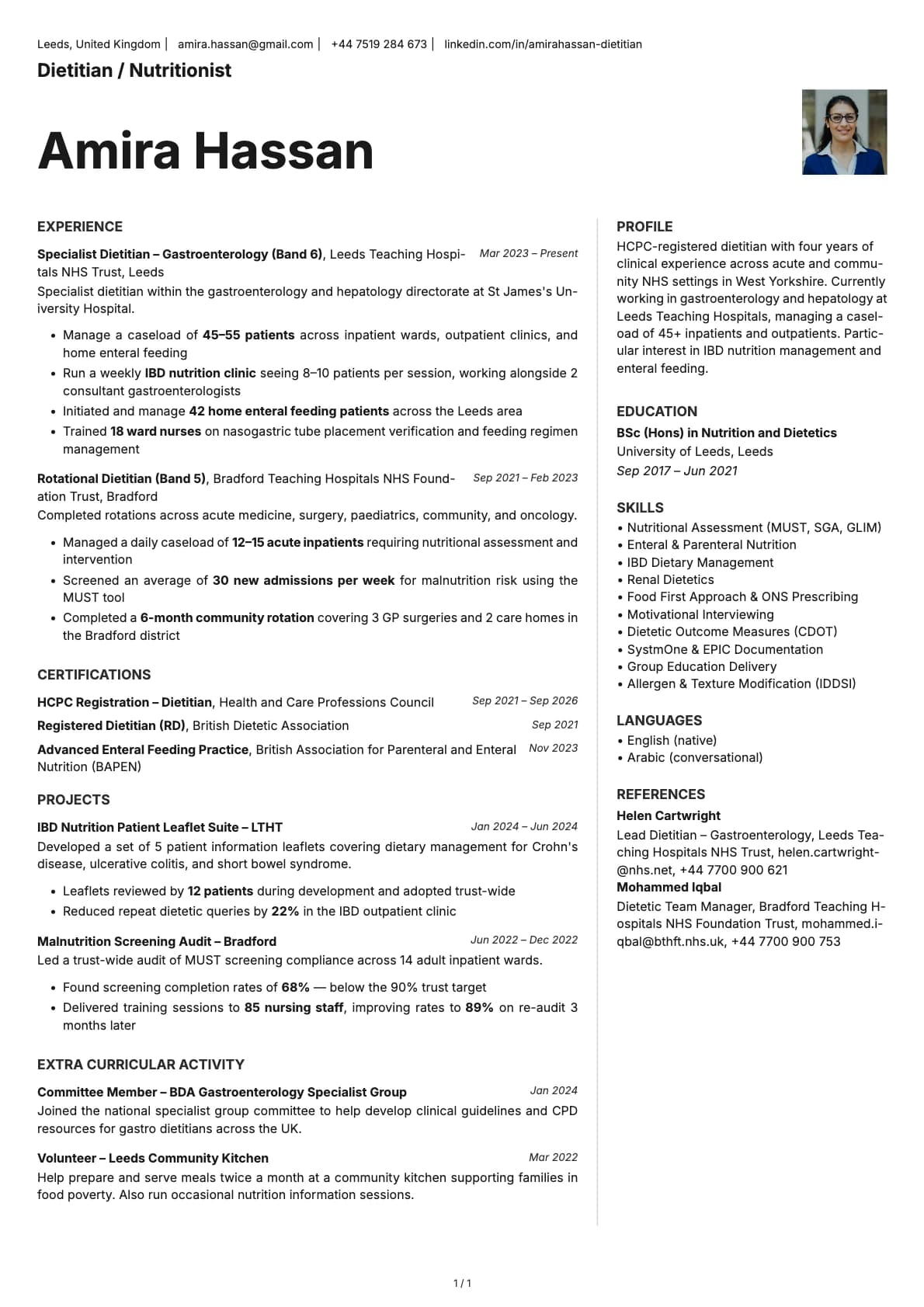
This resume belongs to a Band 6 specialist dietitian with four years of experience in gastroenterology and hepatology at Leeds Teaching Hospitals. Before that, she completed rotations across acute medicine, surgery, paediatrics, community, and oncology at Bradford. The resume works because every bullet includes a caseload number, a clinical detail, or a measurable outcome.
Summary: band, specialty, and caseload
An NHS dietitian summary should answer four questions immediately: What band are you? What is your specialty? Where do you work? What is the scale of your caseload?
Here is this resume's approach:
HCPC-registered dietitian with four years of clinical experience across acute and community NHS settings in West Yorkshire. Currently working in gastroenterology and hepatology at Leeds Teaching Hospitals, managing a caseload of 45+ inpatients and outpatients.
HCPC registration first. Then specialty, trust name, and caseload size. No mention of being "dedicated" or "caring about patient outcomes." Every dietitian cares about patient outcomes. What differentiates you is the specifics of where and how you work.
For yours: Start with "HCPC-registered dietitian" and then state your band, specialty, and current trust. Include your caseload number. If you work across multiple settings (inpatient, outpatient, community), mention all of them.
Experience: caseloads and clinical scope
Dietitian experience bullets should paint a picture of your daily clinical work. How many patients do you see? What conditions do you manage? What interventions do you initiate?
Look at these bullets from the Band 6 role:
"Manage a caseload of 45-55 patients across inpatient wards, outpatient clinics, and home enteral feeding"
"Run a weekly IBD nutrition clinic seeing 8-10 patients per session, working alongside 2 consultant gastroenterologists"
"Initiated and manage 42 home enteral feeding patients across the Leeds area"
Each one gives specific numbers and clinical context. The IBD clinic bullet shows multidisciplinary working. The home enteral feeding figure shows independent caseload management. A recruiting manager can immediately picture this person's role and complexity level.
The formula: Setting + patient group + caseload size + any specific interventions or clinics you run.
Rotational roles: pick the highlights
If you have completed Band 5 rotations, you do not need to describe every single one. Pick the details that show your clinical volume and any specific achievements.
This resume handles the Bradford rotations with three focused bullets:
"Managed a daily caseload of 12-15 acute inpatients requiring nutritional assessment and intervention"
"Screened an average of 30 new admissions per week for malnutrition risk using the MUST tool"
"Completed a 6-month community rotation covering 3 GP surgeries and 2 care homes"
The daily caseload and weekly screening numbers show pace. The community rotation detail shows breadth. That is enough to cover 18 months of rotational work without writing a paragraph for each placement.
Skills: assessment tools and specialist knowledge
A dietitian's skills section should include assessment tools, specialist clinical areas, and documentation systems. Here is what this resume lists:
- Nutritional Assessment (MUST, SGA, GLIM)
- Enteral and Parenteral Nutrition
- IBD Dietary Management
- SystmOne and EPIC Documentation
- IDDSI (texture modification)
Naming the specific assessment tools (MUST, SGA, GLIM) is important because different trusts use different frameworks. If you are trained in multiple assessment methods, list them all.
The documentation systems matter too. SystmOne and EPIC are the two most common NHS clinical systems. If the trust you are applying to uses the same system you already know, that is a real advantage. Always check the job listing and match your skills section to their system if possible.
Training and teaching
At Band 6 and above, teaching is part of the job. This resume shows it clearly:
"Trained 18 ward nurses on nasogastric tube placement verification and feeding regimen management"
Training nursing staff is a specific, valuable skill that goes beyond individual patient care. It shows clinical knowledge and the ability to communicate with other healthcare professionals.
If you have trained students, nurses, HCAs, or other staff, include the number of people trained and the topic. Even at Band 5 level, if you supported student dietitians on placement, that counts.
Audits and quality improvement
The malnutrition screening audit on this resume is a perfect example of how to show clinical leadership:
"Found screening completion rates of 68%, below the 90% trust target"
"Delivered training sessions to 85 nursing staff, improving rates to 89% on re-audit 3 months later"
Problem identified, action taken, result measured. That is the structure for any audit or QI project. For Band 6 and Band 7 applications, having at least one audit on your resume is almost expected. If you do not have one, look for opportunities now. Even a small audit on your own ward will give you something concrete to write about.
Mistakes NHS dietitian resumes make
Not stating your band level. NHS recruiters filter by band. If your title just says "Dietitian," they have to guess. Write "Specialist Dietitian (Band 6)" or "Rotational Dietitian (Band 5)" in full.
Vague caseload descriptions. "Managed a patient caseload" is too generic. Include the number (45-55 patients), the settings (inpatient, outpatient, community), and the conditions (IBD, renal, oncology).
Forgetting HCPC registration. Your HCPC registration should be listed in the certifications section with the current dates. It is the first thing a recruiter checks for any dietitian application.
No mention of MDT working. Dietitians work closely with doctors, nurses, speech and language therapists, and pharmacists. If you work in a multidisciplinary team, say so. "Working alongside 2 consultant gastroenterologists" on this resume signals effective MDT collaboration without over-explaining.
Listing CPD but not applying it. Saying you completed an enteral feeding course is fine. Saying you then managed 42 home enteral feeding patients is better. Connect your training to your practice wherever possible.
One more tip
If you are applying for a specialist Band 6 or Band 7 post, tailor your resume to the person specification. If the spec says "experience with inflammatory bowel disease," make sure those exact words appear in your resume. If it says "evidence of audit activity," your audit section needs to be prominent. NHS shortlisting is often done against a checklist. Make it easy for the panel to tick every box.
Build your own version
Open this layout in the builder and swap in your own details. It takes a few minutes.
Free to use. No account needed to start.
Was this resume example helpful?
Rate this example to help us create better content for you.
4.7 average from 82 ratingsRelated resume examples
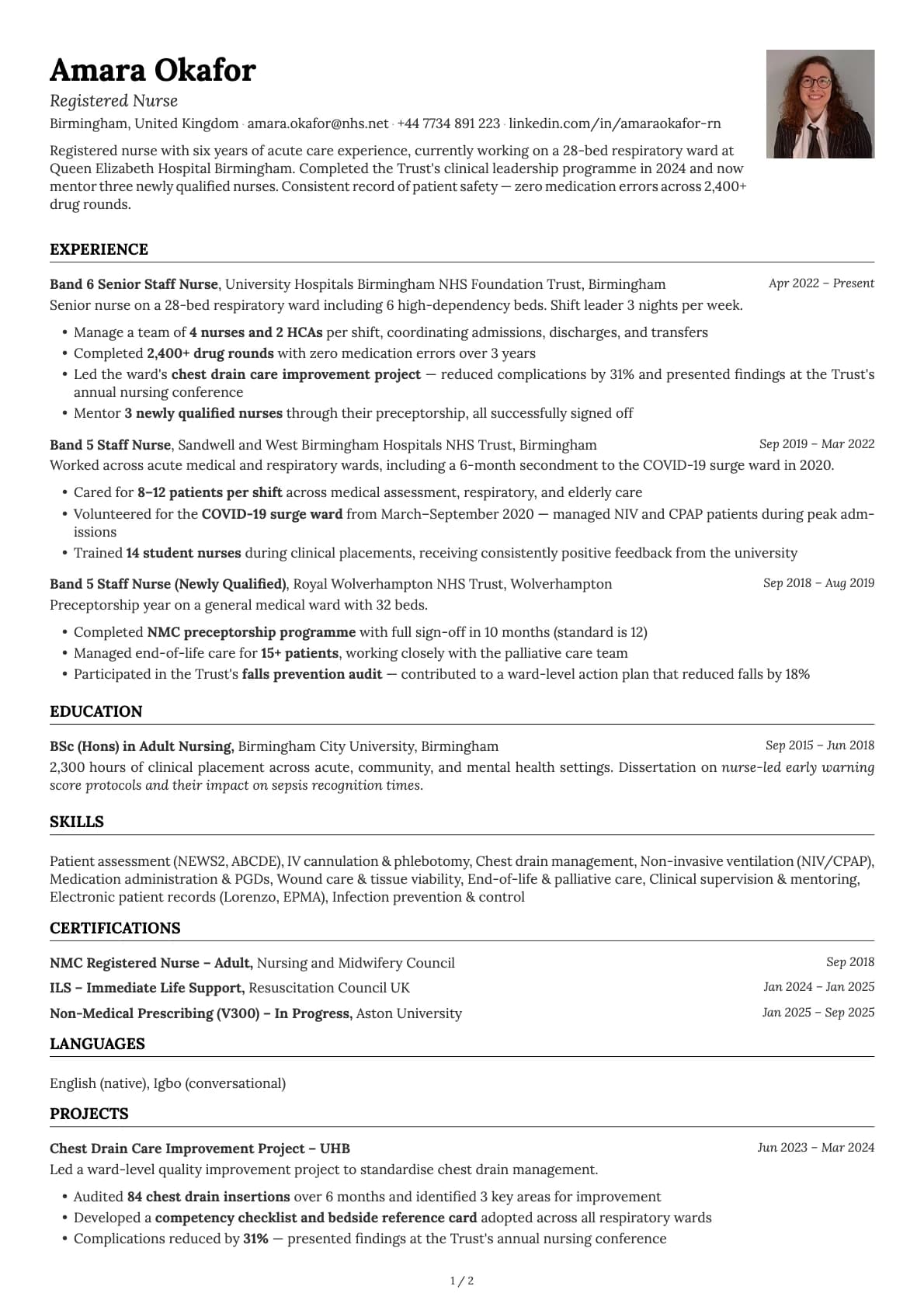
Registered Nurse
A registered nurse resume example with 6 years of acute care experience at NHS hospitals.
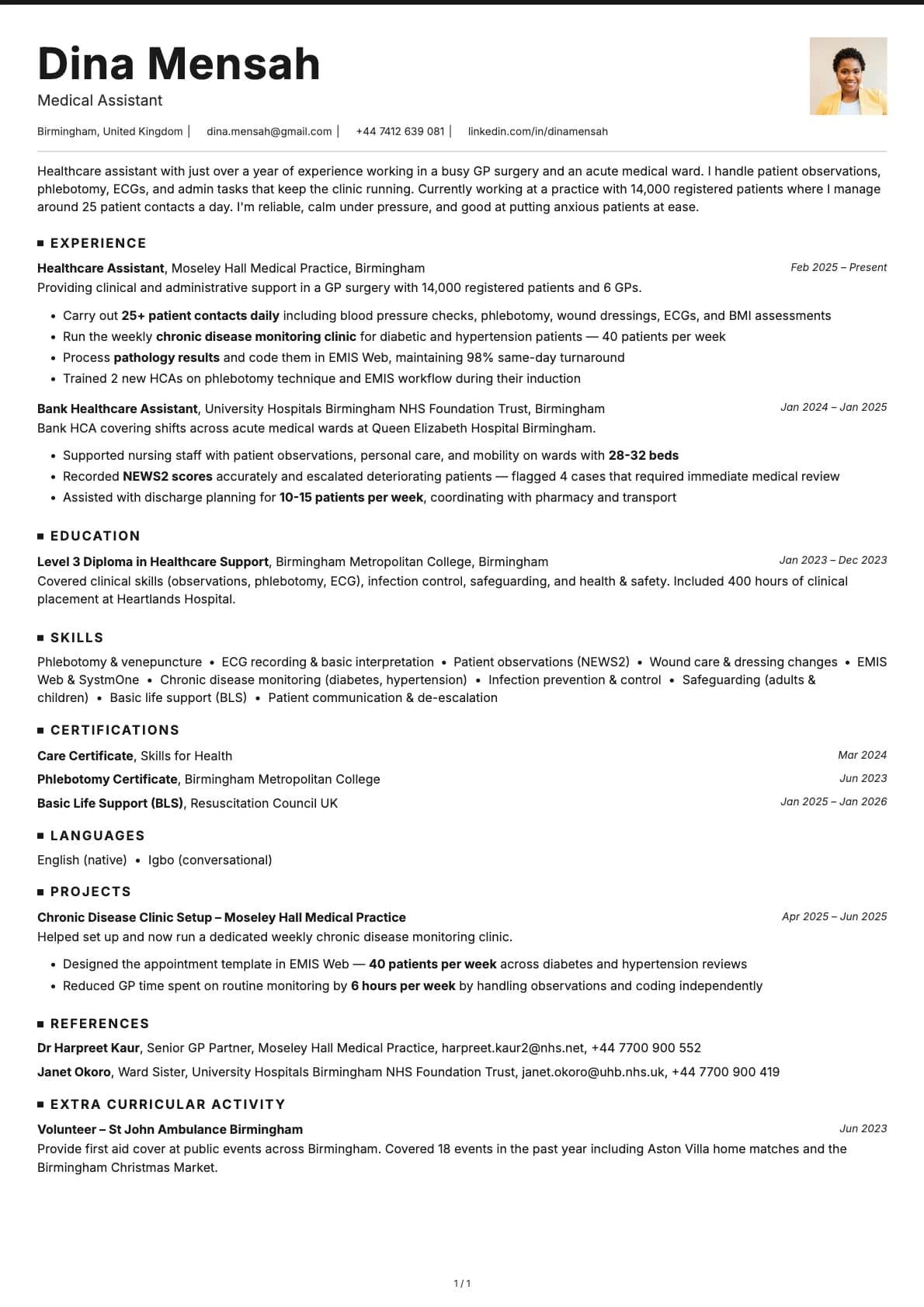
Medical Assistant
A medical assistant resume example with patient contact numbers, clinical skills, and GP surgery experience.
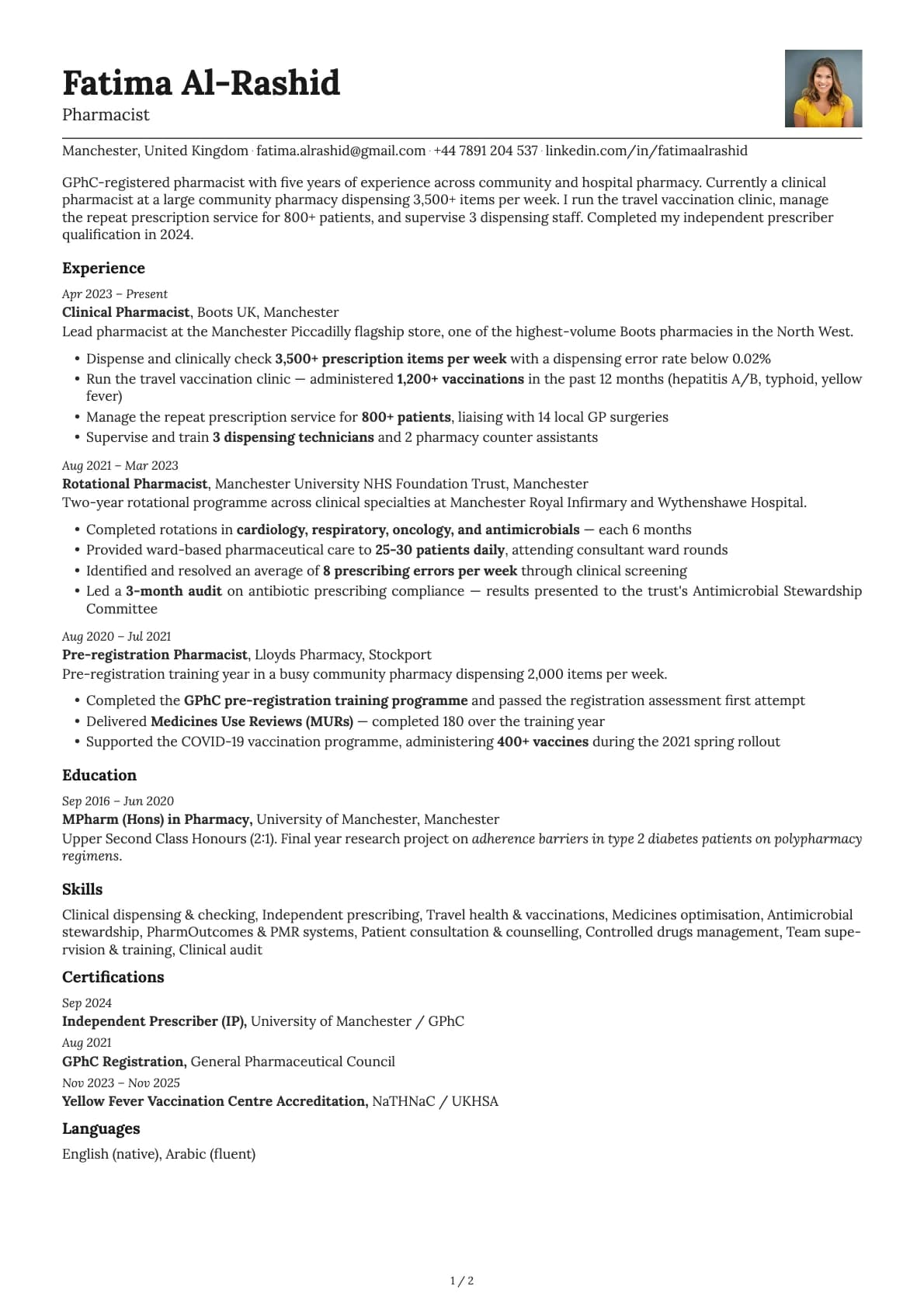
Pharmacist
A pharmacist resume example with community and hospital experience, clinical audit results, and vaccination clinic numbers.
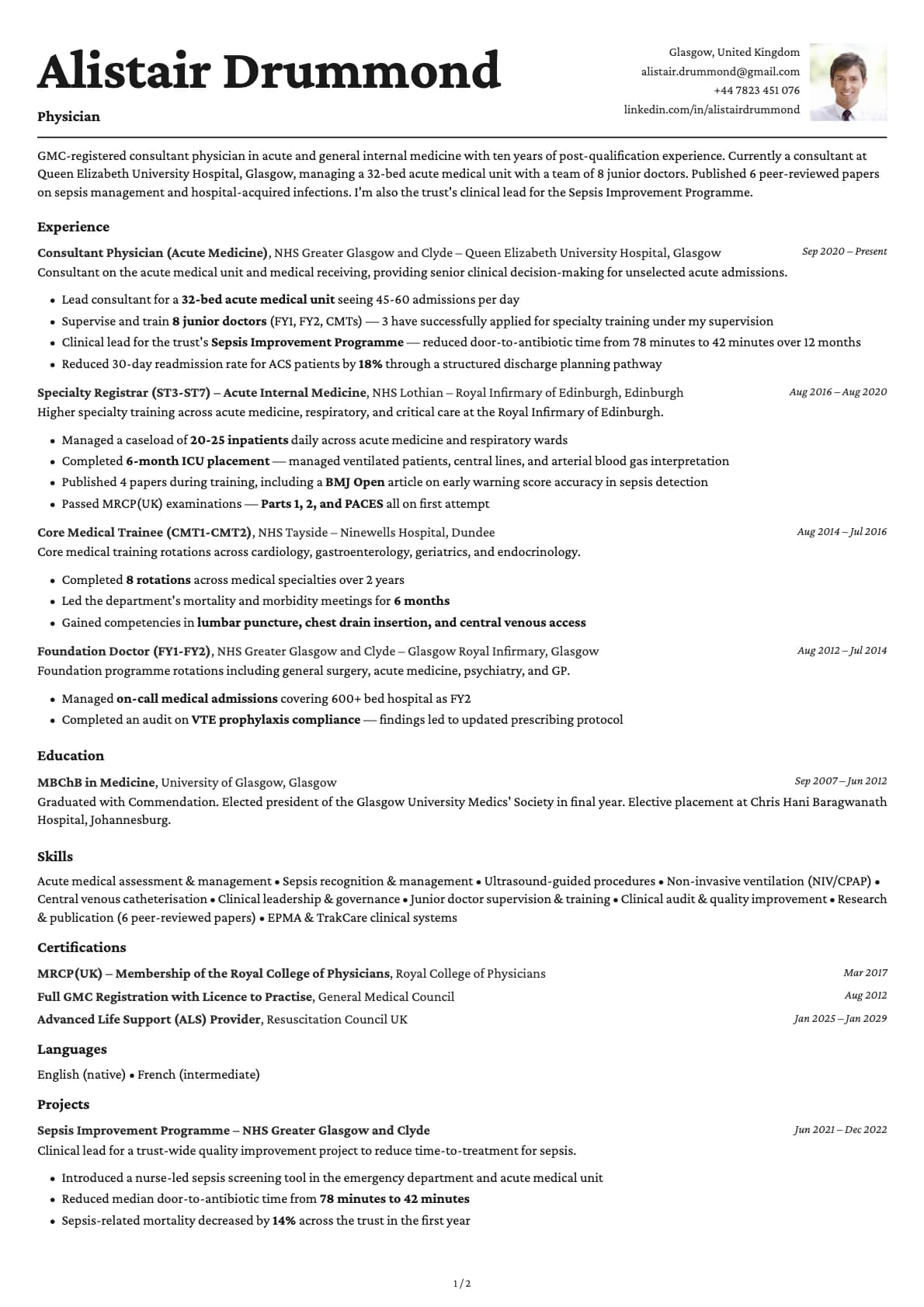
Physician
A physician resume example from a consultant in acute medicine with quality improvement projects, publications, and clinical leadership.
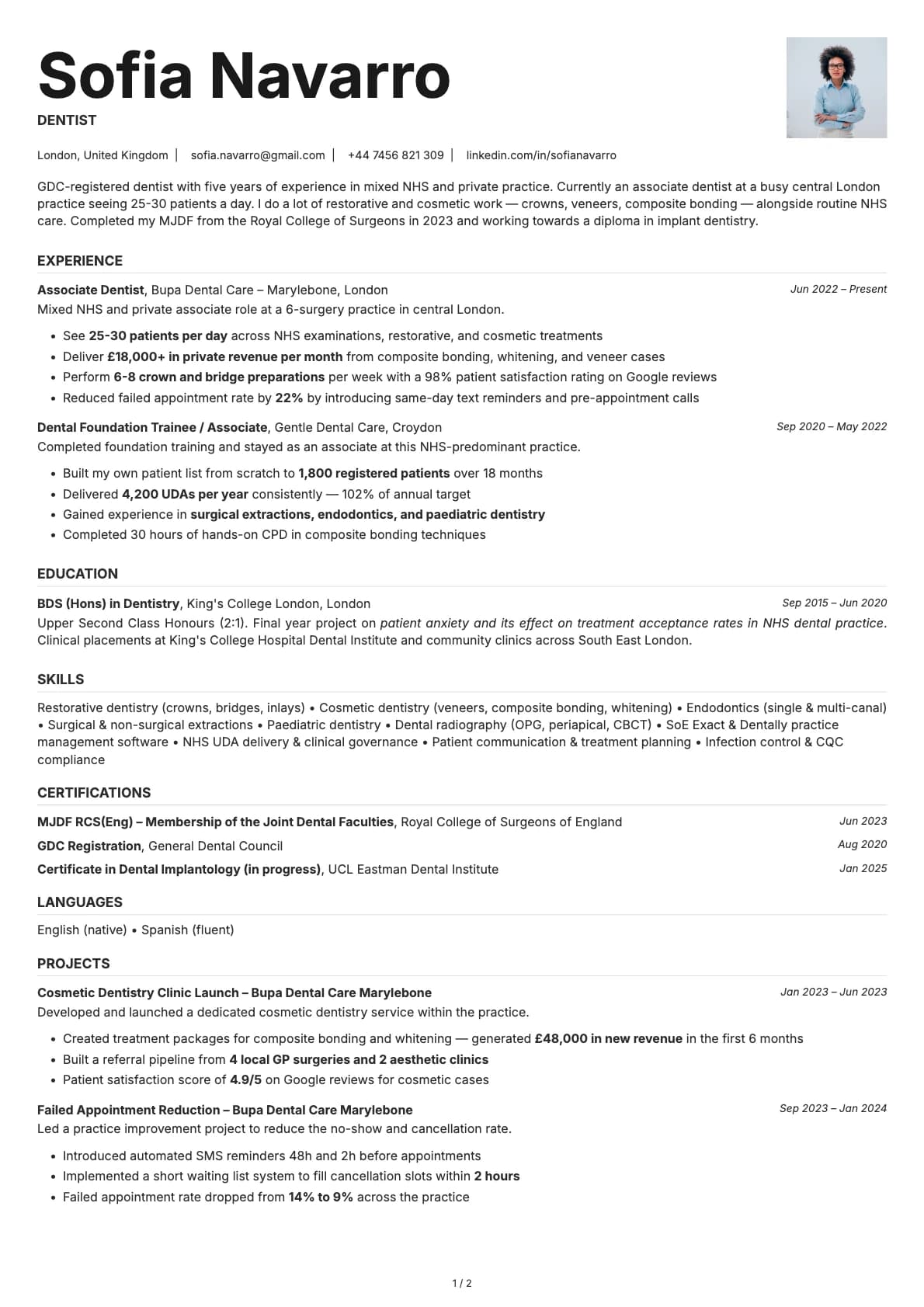
Dentist
A dentist resume example with mixed NHS and private practice experience in London.
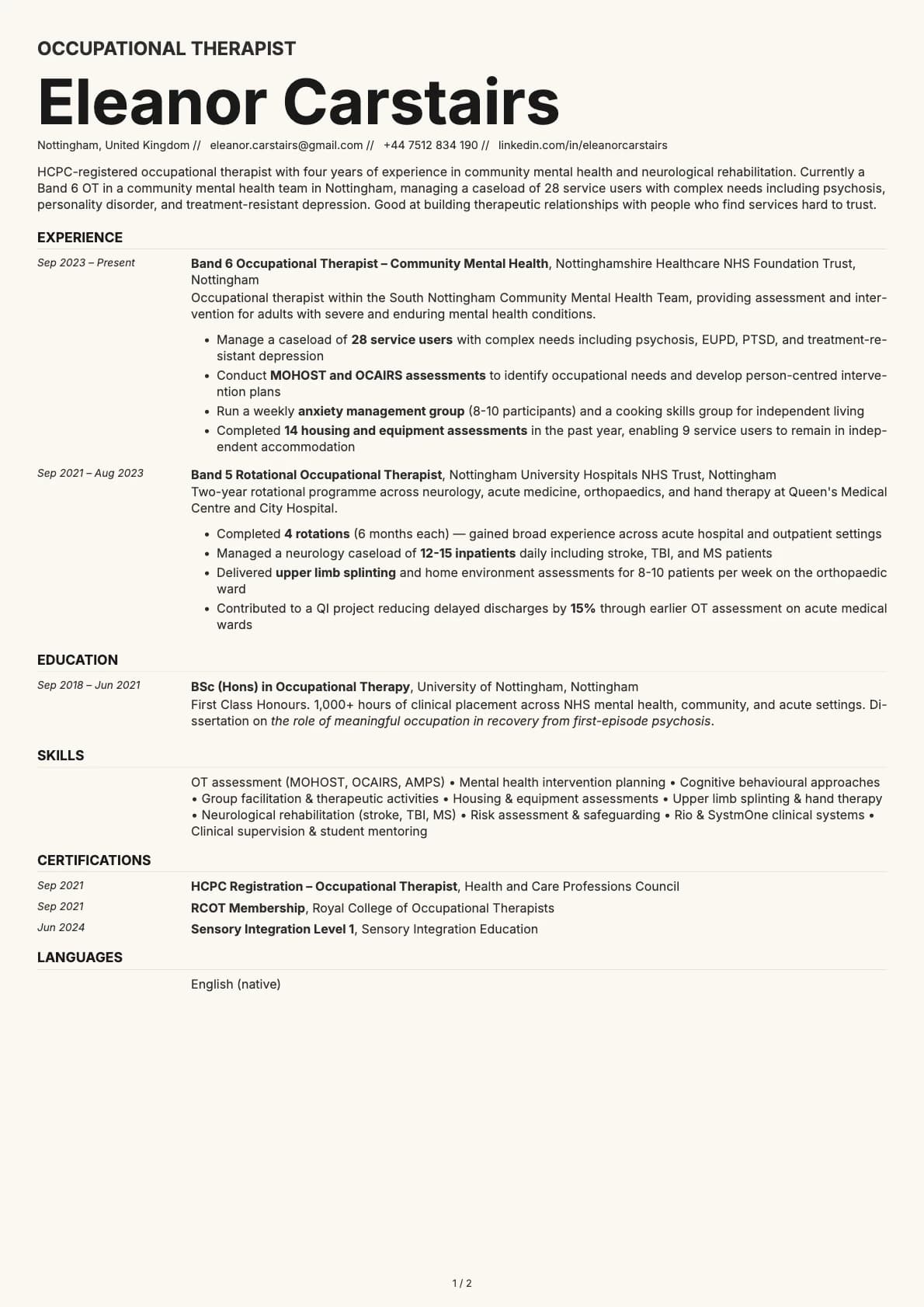
Occupational Therapist
An occupational therapist resume example with caseload details, OT assessment tools, and QI project outcomes.
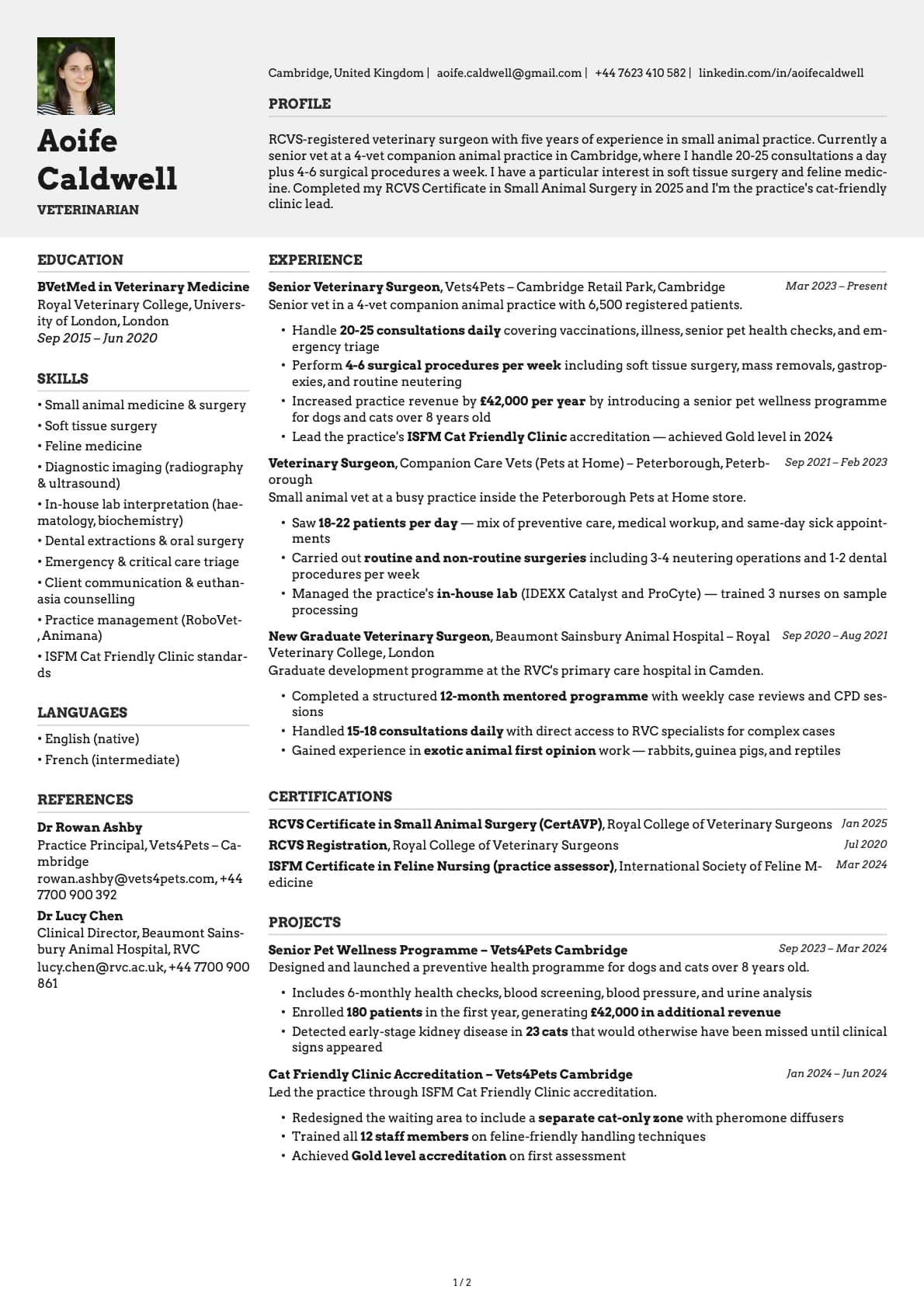
Veterinarian
A veterinarian resume example with 5 years of small animal practice experience.
Speech & Language Therapist
A speech and language therapist resume example with paediatric and adult caseload experience across NHS trusts.
Paramedic
A paramedic resume example with call volumes, clinical competencies, and mentoring experience.
Clinical Psychologist
A clinical psychologist resume example with 9 years of NHS experience across community mental health and neuropsychology.
Social Worker
A social worker resume example with caseload numbers, court work, and multi-agency experience.
Dental Hygienist
A dental hygienist resume example with NHS and private practice experience in Edinburgh.
Related articles

AI Is Screening Your Resume Before Any Human Sees It
AI screens most resumes before a human ever reads them. 97.4% of Fortune 500 companies run an ATS. This is what that means for you and what you can do about it.

The Best Resume Builders in 2026, Compared Honestly
Resume.io, Zety, Enhancv, Kickresume, Teal, and Laddro compared honestly: real pricing, free tiers, mobile apps, and where each tool wins. All prices checked in September 2026.

Burnout Recovery: A Real Timeline, Not 'Take a Bubble Bath'
55% of the U.S. workforce is burned out. Recovery takes 3 to 12 months. Here's what that actually looks like, stage by stage.