Paramedic Resume Example
A paramedic resume example with call volumes, clinical competencies, and mentoring experience.

Laddro Team
Free to use. No account needed to start.
Free to use. No account needed to start.
Overview
Paramedic resumes need to do something that most other healthcare resumes do not: they need to show you can make clinical decisions alone, under pressure, with no backup in the room. Every paramedic responds to emergencies. That is the job. Your resume needs to show how many calls you handle, what clinical competencies you hold, and how you perform against the standards your trust measures.
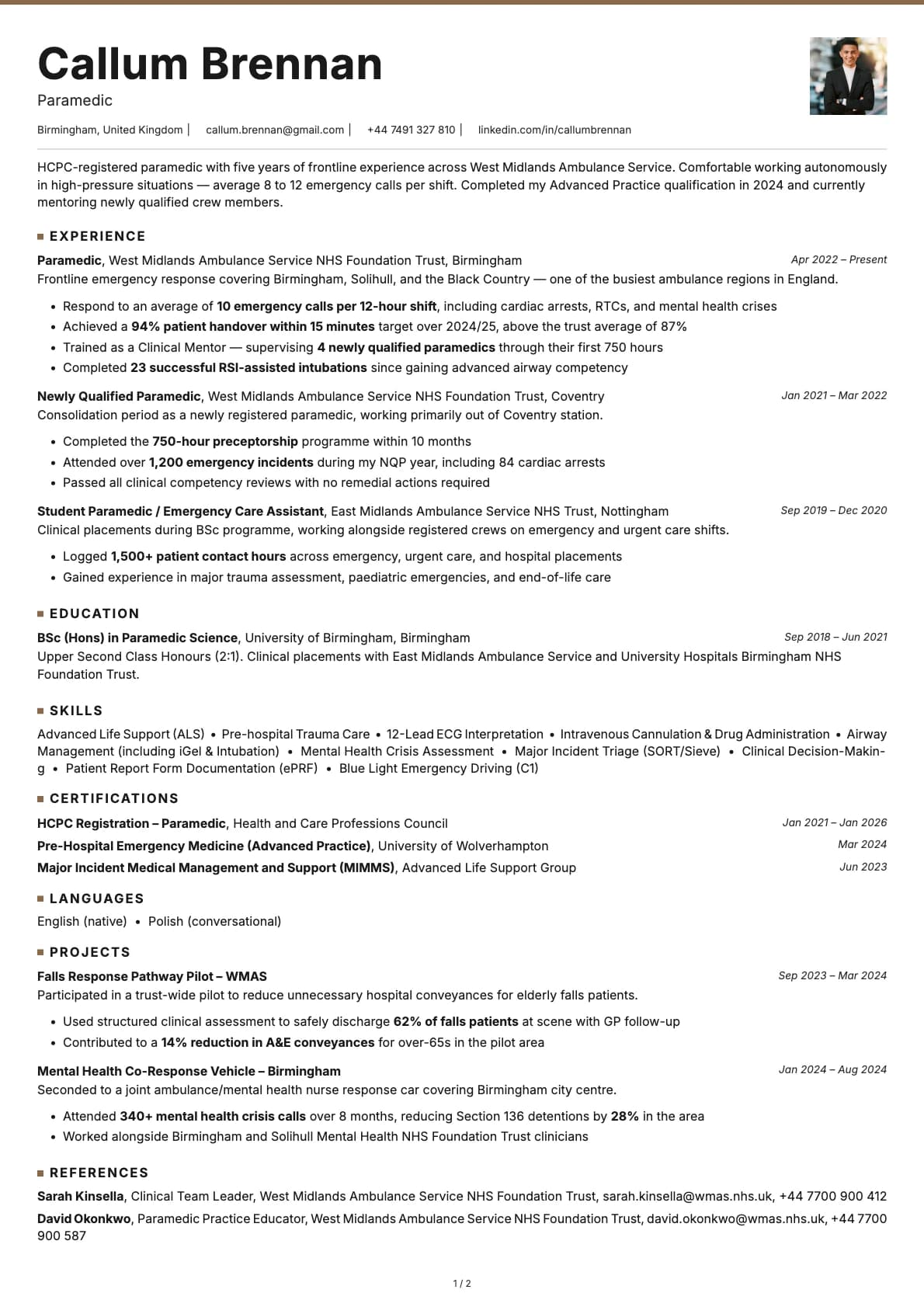
This resume belongs to Callum Brennan, an HCPC-registered paramedic with five years of frontline experience at West Midlands Ambulance Service. He averages 10 emergency calls per 12-hour shift, achieved a 94% patient handover within 15 minutes (above the trust average of 87%), and has completed 23 RSI-assisted intubations. He also mentors newly qualified crew members.
Let us go through what this resume does right and how to apply the same approach to yours.
Your summary should state your registration, your service, and your shift volume
Ambulance trusts want to know three things fast: Are you HCPC registered? Where do you work now? And how busy is your patch?
Here is Callum's summary:
HCPC-registered paramedic with five years of frontline experience across West Midlands Ambulance Service. Comfortable working autonomously in high-pressure situations. Average 8 to 12 emergency calls per shift. Completed my Advanced Practice qualification in 2024 and currently mentoring newly qualified crew members.
Four short sentences. Registration, service, call volume, advanced qualification, and mentoring. No "dedicated healthcare professional who thrives under pressure." Just the facts a clinical team leader needs to see.
Your formula: HCPC status + years on the road + your ambulance trust + average calls per shift + any advanced qualifications or mentoring roles.
How to write experience bullets for frontline work
Paramedic experience bullets need to show three things: your daily workload, your clinical performance against measurable targets, and any specialist competencies you hold.
Look at these bullets:
"Respond to an average of 10 emergency calls per 12-hour shift, including cardiac arrests, RTCs, and mental health crises"
"Achieved a 94% patient handover within 15 minutes target over 2024/25, above the trust average of 87%"
"Completed 23 successful RSI-assisted intubations since gaining advanced airway competency"
The first bullet establishes daily volume and case mix. The second gives a performance metric against a trust target. The third shows a specialist clinical skill with a count.
The formula: Clinical activity + volume or frequency + performance against target or competency count.
If you do not have advanced airway skills or specialist secondments, you can still quantify your work. "Attended over 1,200 emergency incidents during my NQP year, including 84 cardiac arrests" is a strong line because it shows volume and the specific high-acuity calls you have handled.
Your NQP year matters more than you think
If you are newly qualified or within your first two years, your preceptorship period is your main selling point. Do not gloss over it.
Look at how Callum handles his NQP role:
"Completed the 750-hour preceptorship programme within 10 months"
"Attended over 1,200 emergency incidents during my NQP year, including 84 cardiac arrests"
"Passed all clinical competency reviews with no remedial actions required"
Three bullets that tell the reader: he completed preceptorship on time, he handled a high volume of incidents, and his clinical competency was clean. If you are in this phase of your career, these are the three things to focus on.
Specialist projects show clinical development
The two projects on this resume are both strong because they show Callum working beyond standard emergency response:
"Used structured clinical assessment to safely discharge 62% of falls patients at scene with GP follow-up"
"Attended 340+ mental health crisis calls over 8 months, reducing Section 136 detentions by 28% in the area"
The falls pathway work shows clinical decision-making that keeps patients out of A&E when safe to do so. The mental health co-response work shows he can operate in a joint team with mental health clinicians. Both are increasingly important in ambulance services.
If you have participated in any pilot programme, pathway trial, or specialist response team, include it. These roles show you are developing beyond core practice.
Skills: list your clinical competencies in order of relevance
This resume lists ALS, pre-hospital trauma care, 12-lead ECG interpretation, IV cannulation, airway management, mental health crisis assessment, major incident triage, and blue light driving (C1). All of these are clinical competencies that a hiring manager can verify.
Order matters. Put your most advanced or specialist skills first. If you have ALS, that goes before BLS. If you have advanced airway management (iGel, intubation), list the specific devices. If you drive on blue lights, include your C1 category.
One thing many paramedics forget: electronic patient report forms. If you use ePRF, name the system. Trusts that use the same platform will see it as an advantage.
Certifications: HCPC first, then advanced qualifications
Callum lists his HCPC registration first, then his Advanced Practice qualification, then MIMMS. That order is correct: legal registration, then clinical advancement, then specialist courses.
If your HCPC registration has a renewal date, make sure it is current. An expired registration is not just a red flag. It is a legal disqualification. If you hold MIMMS, PHTLS, or any other specialist certificate, include the issuing body and date.
Mistakes that hurt paramedic applications
Not stating your call volume. "Worked as a frontline paramedic" is assumed from the job title. "Respond to 10 emergency calls per 12-hour shift" tells the recruiter your workload.
Ignoring performance metrics. If your trust measures handover times, response times, or see-and-treat rates, and you perform above average, put it on your resume. "94% handover within 15 minutes against an 87% trust average" is a standout bullet.
Forgetting your mentoring role. If you supervise NQPs, student paramedics, or new crew members, include it with the number of people you have mentored. It is evidence of leadership even if you do not hold a formal leadership title.
Using a creative template. NHS ambulance trusts recruit through Trac and NHS Jobs. Fancy formatting breaks in these systems. This resume uses Graphite, a clean single-column layout. Keep it simple.
One more thing
If you are applying for roles at a different trust, check their Clinical Performance Indicators. Each trust measures slightly different things. Tailor your performance bullets to match the metrics that matter at the trust you are applying to. If they measure see-and-treat rates, include yours. If they focus on cardiac arrest survival, mention your arrest attendance numbers. Speak their language.
Build your own version
Open this layout in the builder and swap in your own details. It takes a few minutes.
Free to use. No account needed to start.
Was this resume example helpful?
Rate this example to help us create better content for you.
4.8 average from 147 ratingsRelated resume examples
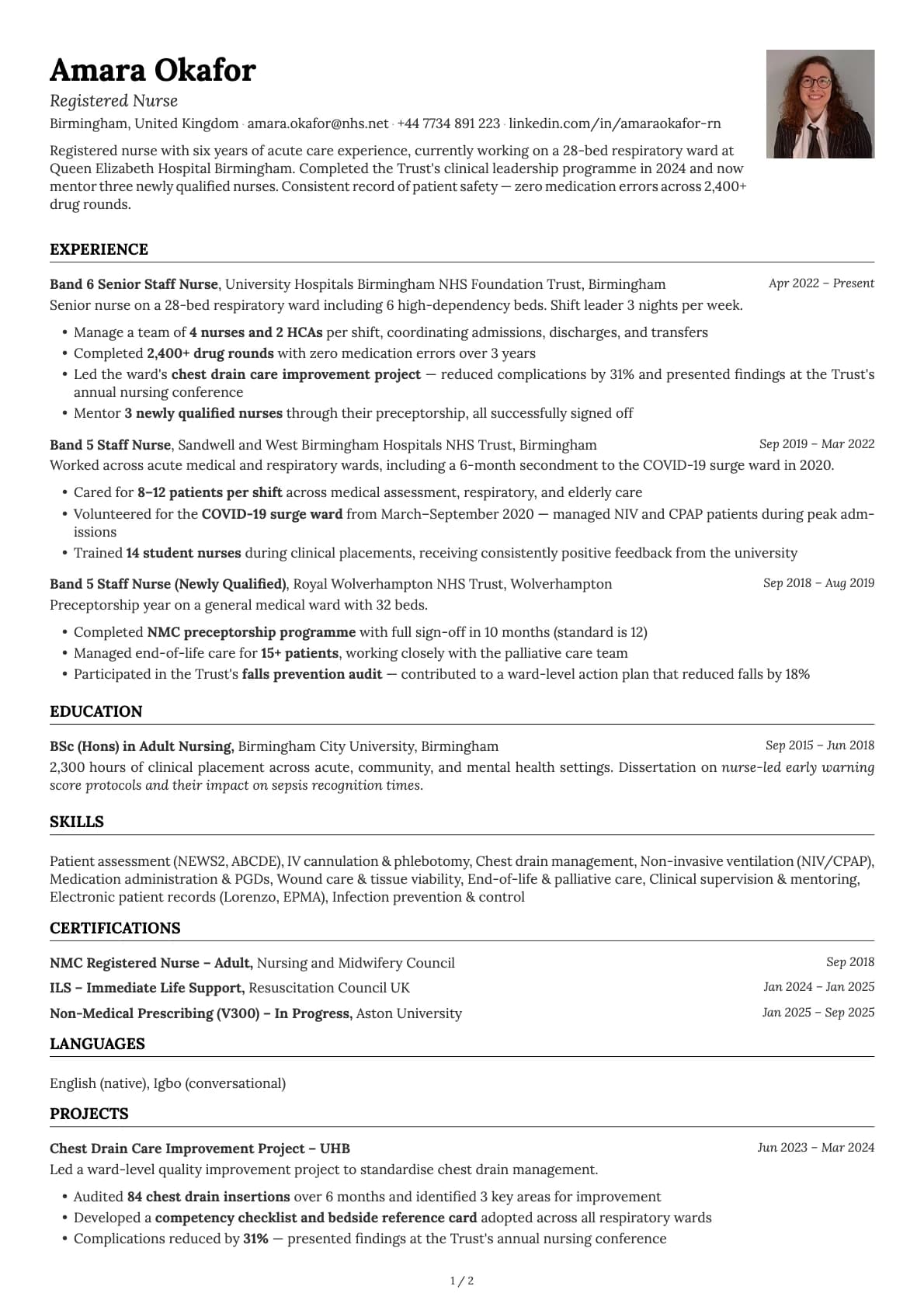
Registered Nurse
A registered nurse resume example with 6 years of acute care experience at NHS hospitals.
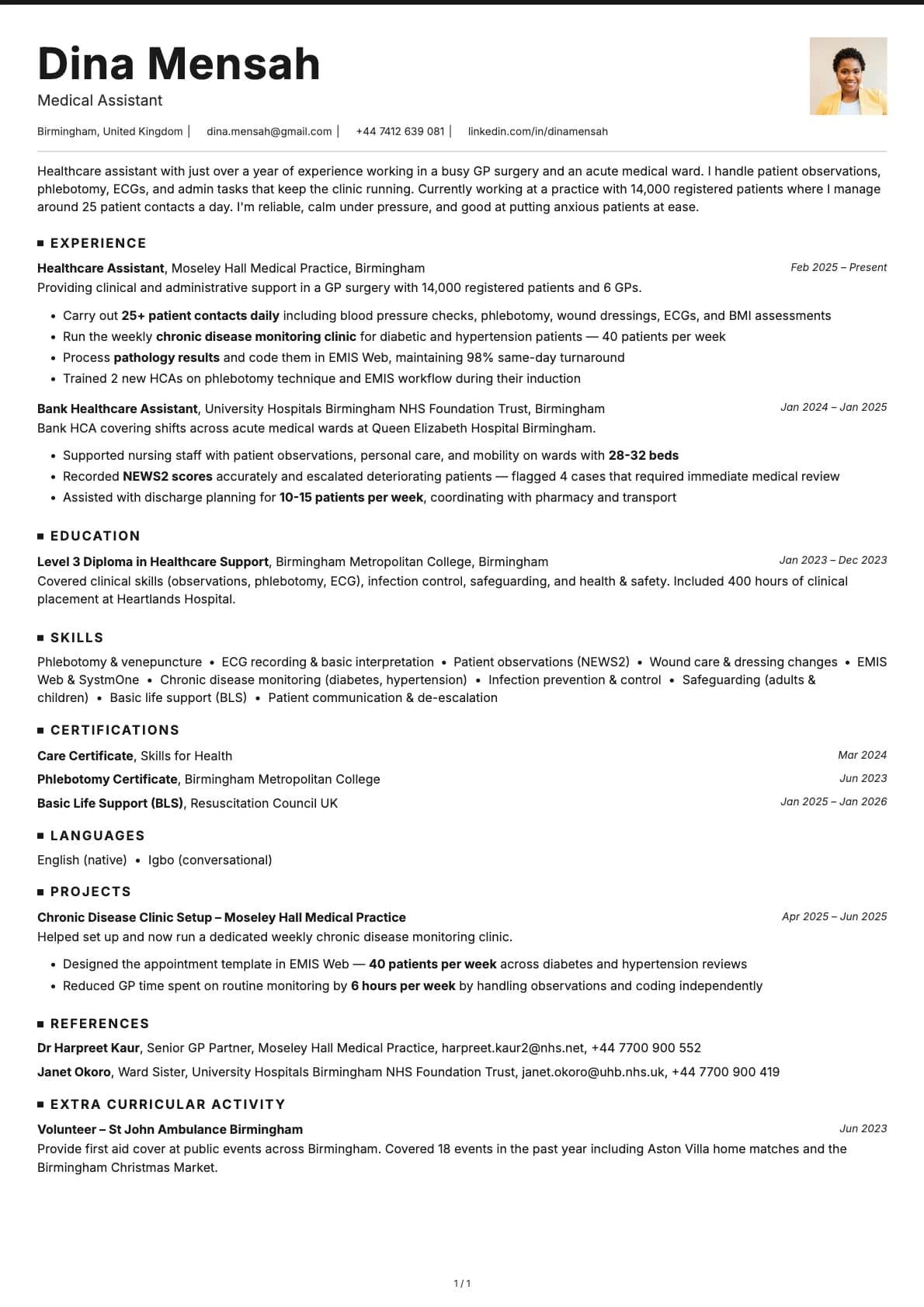
Medical Assistant
A medical assistant resume example with patient contact numbers, clinical skills, and GP surgery experience.
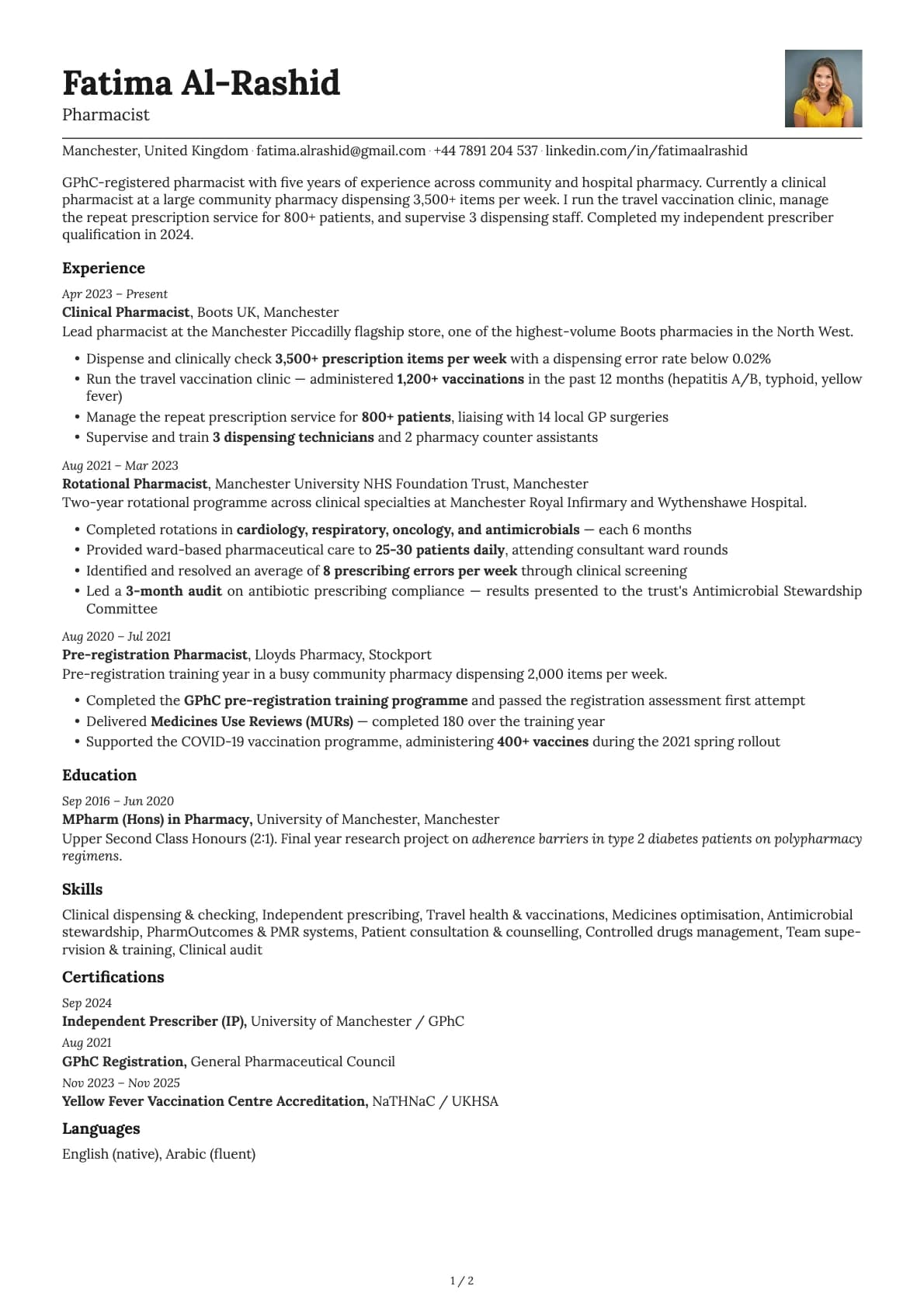
Pharmacist
A pharmacist resume example with community and hospital experience, clinical audit results, and vaccination clinic numbers.
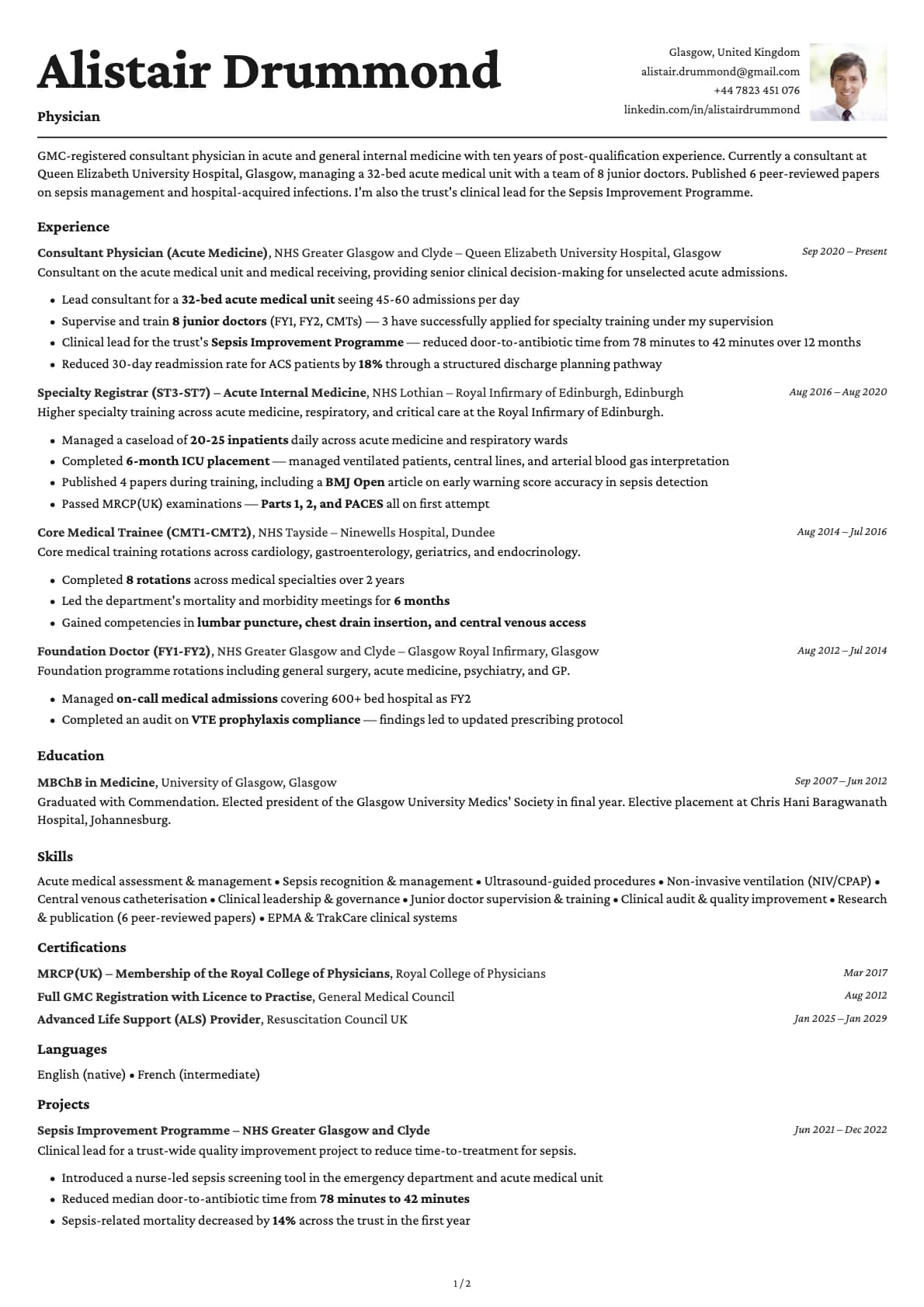
Physician
A physician resume example from a consultant in acute medicine with quality improvement projects, publications, and clinical leadership.
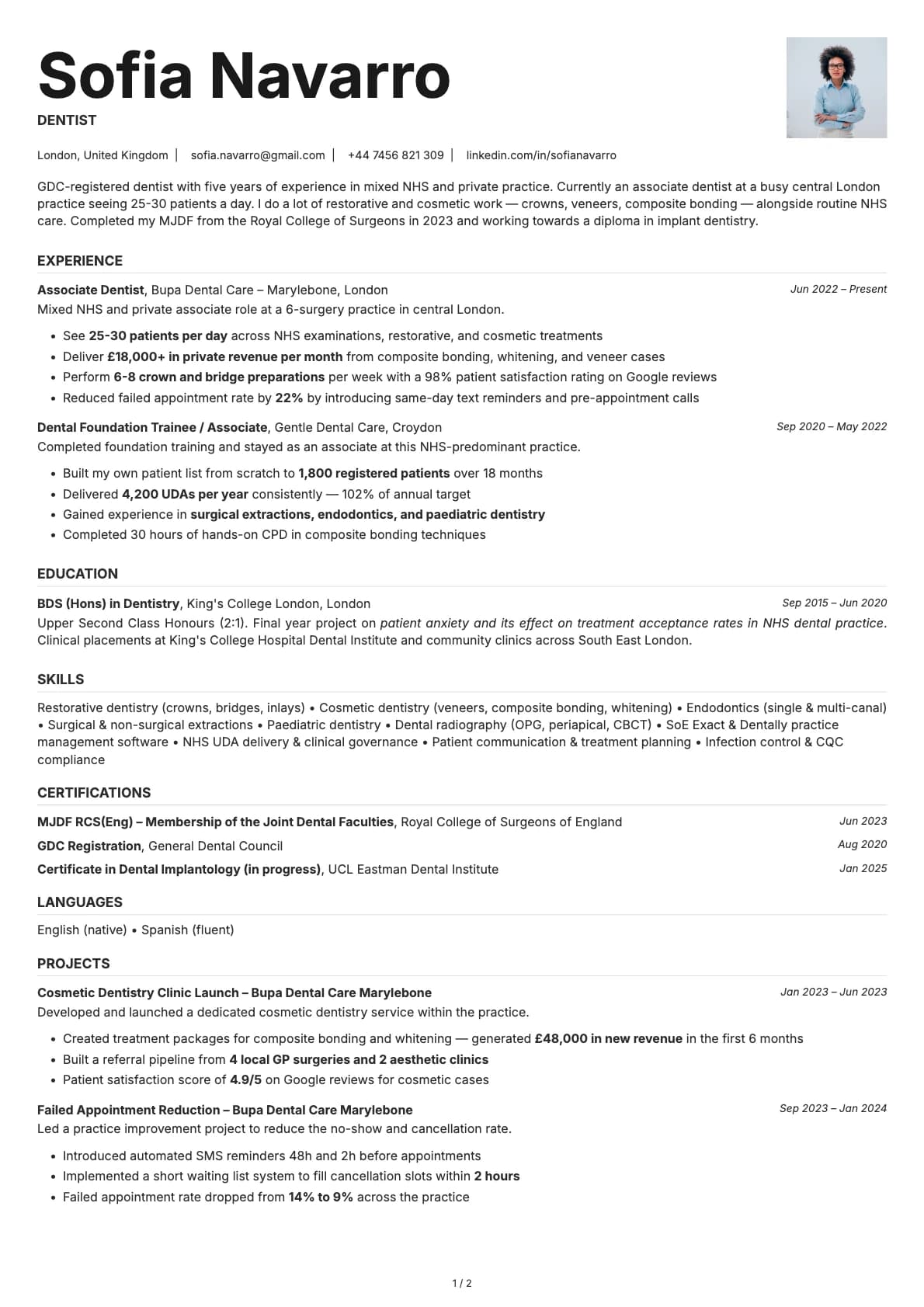
Dentist
A dentist resume example with mixed NHS and private practice experience in London.
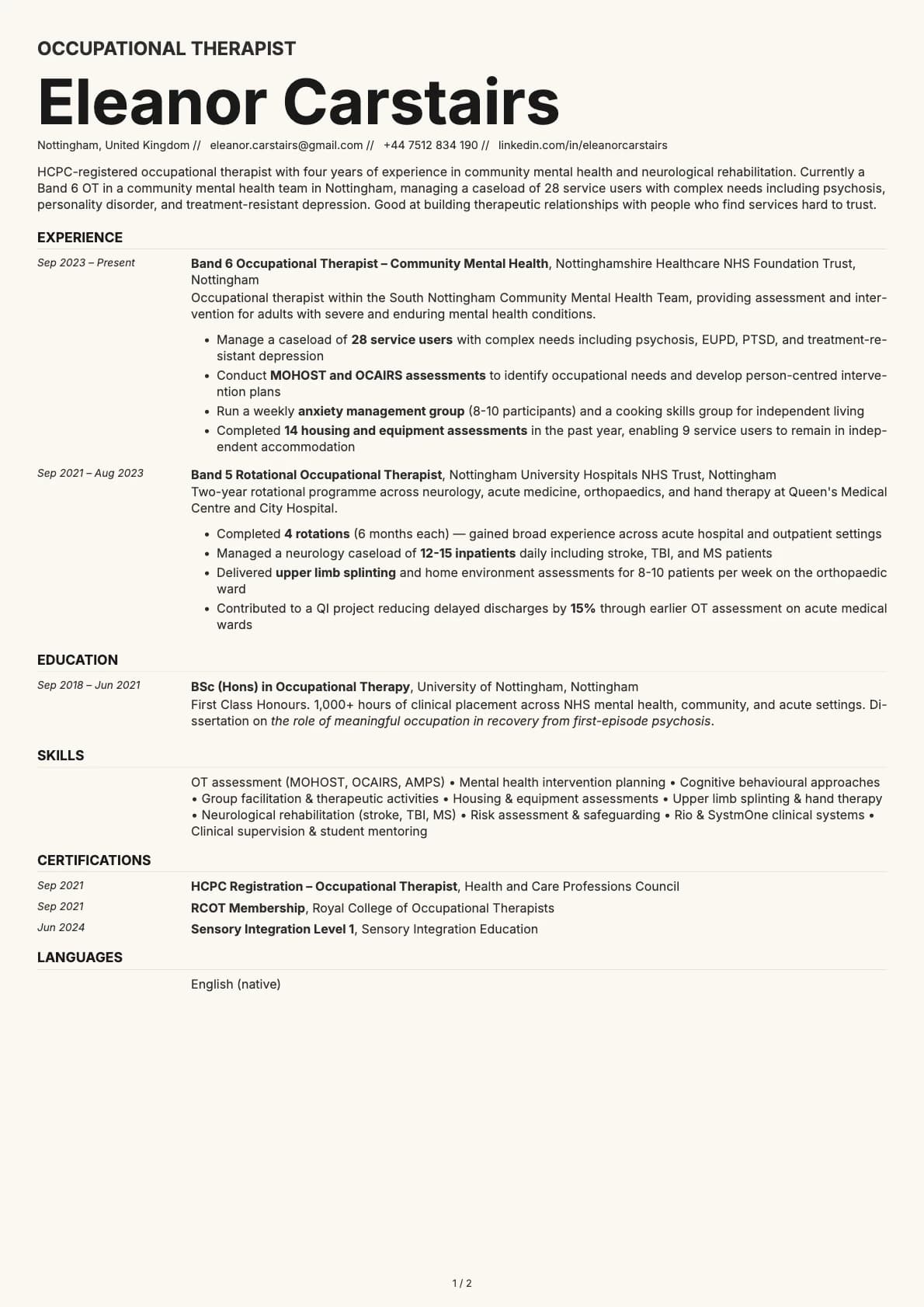
Occupational Therapist
An occupational therapist resume example with caseload details, OT assessment tools, and QI project outcomes.
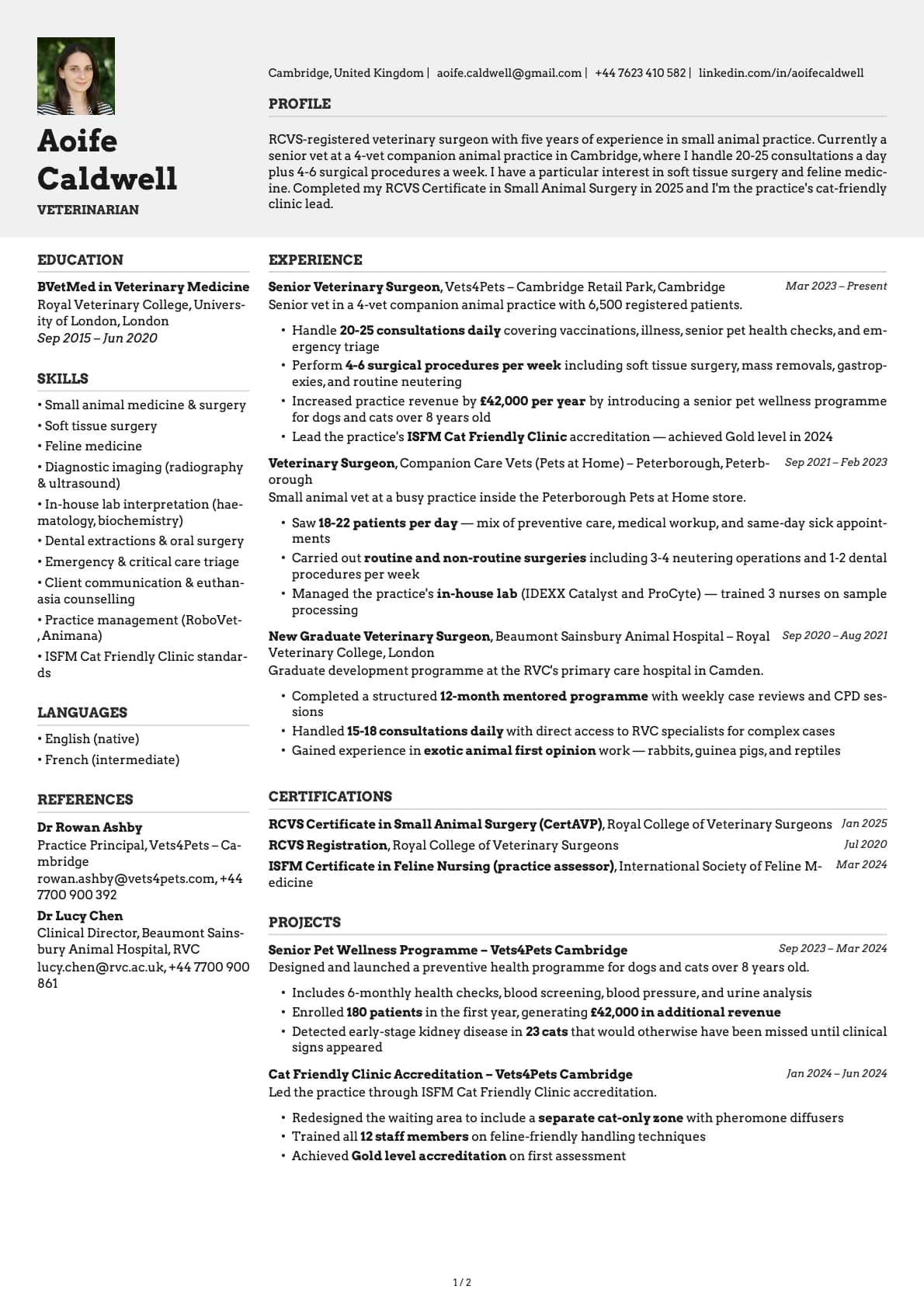
Veterinarian
A veterinarian resume example with 5 years of small animal practice experience.
Speech & Language Therapist
A speech and language therapist resume example with paediatric and adult caseload experience across NHS trusts.
Clinical Psychologist
A clinical psychologist resume example with 9 years of NHS experience across community mental health and neuropsychology.
Dietitian / Nutritionist
A dietitian resume example with NHS clinical experience in gastroenterology and community nutrition.
Social Worker
A social worker resume example with caseload numbers, court work, and multi-agency experience.
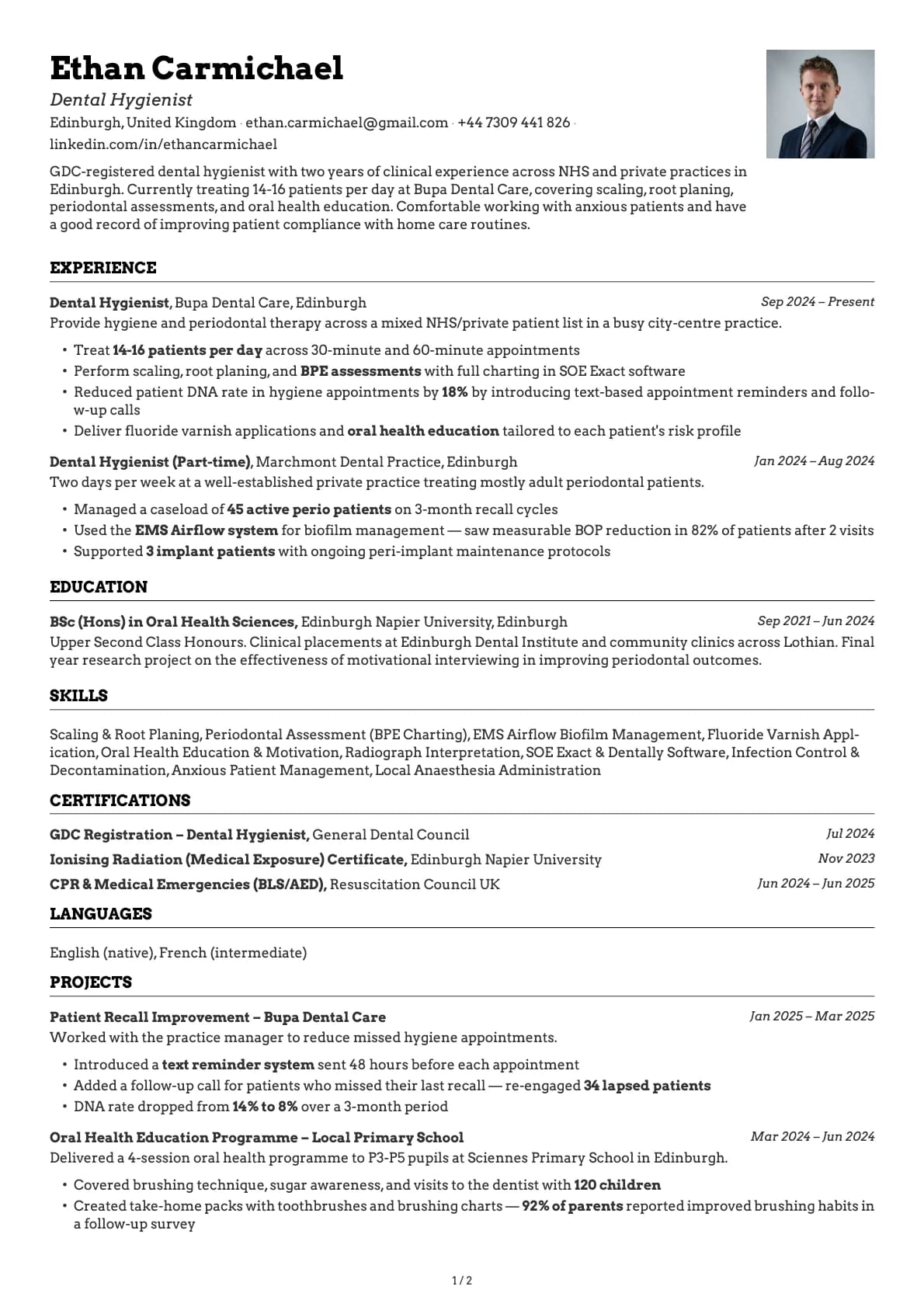
Dental Hygienist
A dental hygienist resume example with NHS and private practice experience in Edinburgh.
Related articles

AI Is Screening Your Resume Before Any Human Sees It
AI screens most resumes before a human ever reads them. 97.4% of Fortune 500 companies run an ATS. This is what that means for you and what you can do about it.

The Best Resume Builders in 2026, Compared Honestly
Resume.io, Zety, Enhancv, Kickresume, Teal, and Laddro compared honestly: real pricing, free tiers, mobile apps, and where each tool wins. All prices checked in September 2026.

Burnout Recovery: A Real Timeline, Not 'Take a Bubble Bath'
55% of the U.S. workforce is burned out. Recovery takes 3 to 12 months. Here's what that actually looks like, stage by stage.