Physician Resume Example
A physician resume example from a consultant in acute medicine with quality improvement projects, publications, and clinical leadership.

Laddro Team
Free to use. No account needed to start.
Free to use. No account needed to start.
Overview
Physician CVs are long documents. That is normal for medicine. But length does not mean you should write everything in paragraph form and hope the panel finds the important bits. The best medical CVs are structured so that a clinical director or appointments committee can score you against the person specification in minutes.
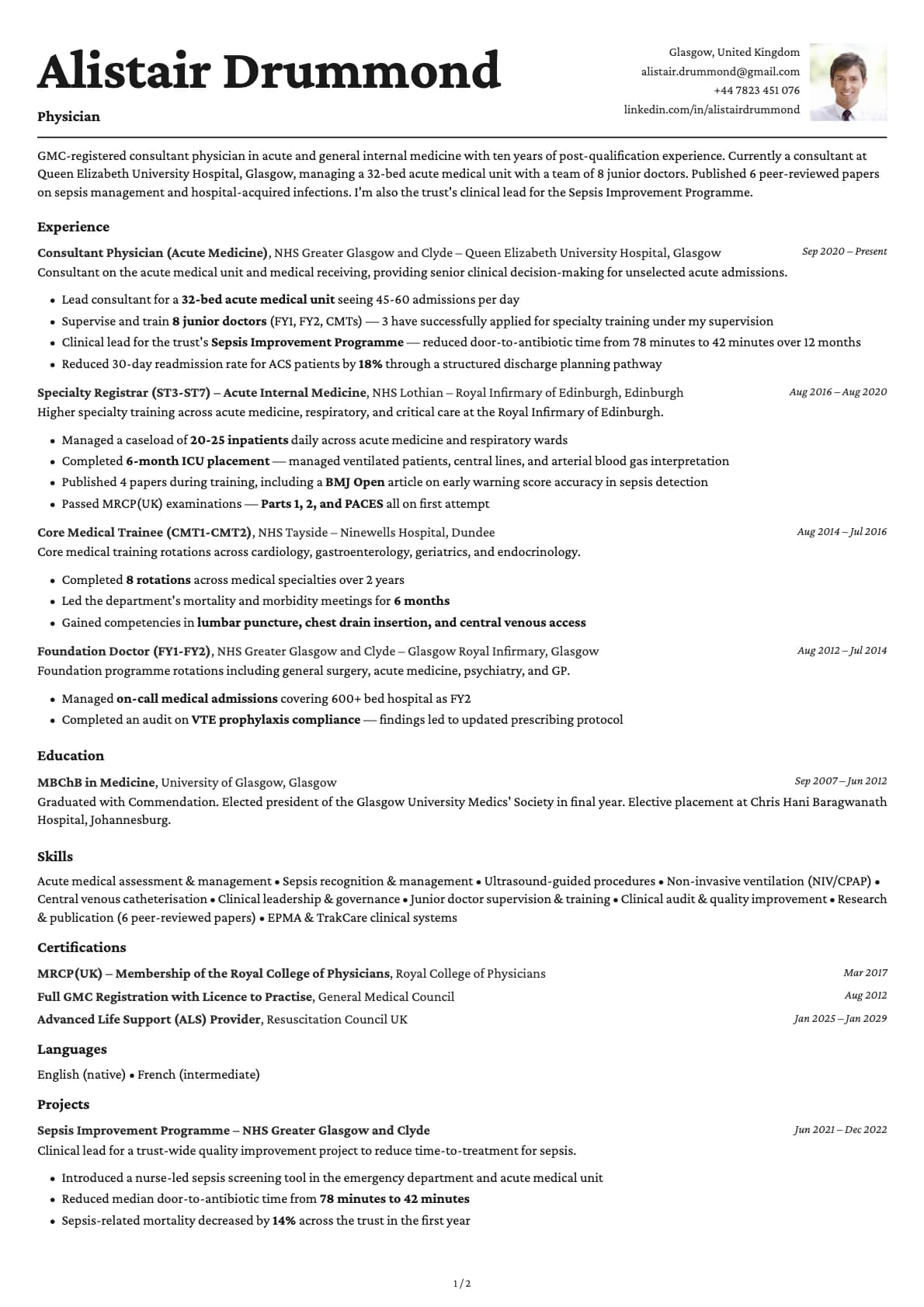
This resume belongs to Dr Alistair Drummond, a consultant physician in acute and general internal medicine at Queen Elizabeth University Hospital in Glasgow. He has ten years of post-qualification experience, supervises eight junior doctors, and leads the trust's Sepsis Improvement Programme. He also has six peer-reviewed papers and passed all MRCP exams on first attempt.
Let us go through what this CV does well and what you can apply to yours.
Start with your registration and specialty
Physician summaries should lead with your GMC registration status and specialty. Do not make the reader hunt for this. It is the first thing any NHS appointments panel checks.
Alistair's summary opens with: "GMC-registered consultant physician in acute and general internal medicine with ten years of post-qualification experience." Immediately, the reader knows his registration, his specialty, and his seniority.
Then he adds specifics: 32-bed acute medical unit, team of 8 junior doctors, 6 peer-reviewed papers, and a named improvement programme. Four data points that tell the panel exactly who they are dealing with.
For your CV: Lead with your registration body and specialty. Add your current role and the most impressive fact about it. If you have publications, state the count. Keep it to four or five sentences.
How to write your clinical experience
Medical CVs need to show clinical scope, leadership, and impact. Each job entry should cover all three.
Clinical scope
"Lead consultant for a 32-bed acute medical unit seeing 45-60 admissions per day"
One sentence and the reader knows: large unit, high admission volume, he is the lead. Compare that with "provided clinical care on the acute medical unit." Same role, completely different impression.
For every post you list, include the unit size, patient volume, and acuity level. If you cover on-call for a 600-bed hospital, say so. These numbers are how panels judge whether your experience matches the role they are filling.
Leadership
"Supervise and train 8 junior doctors (FY1, FY2, CMTs), 3 have successfully applied for specialty training under my supervision"
This shows both supervision scope and outcome. It is not just "supervise juniors." It names the grades and shows that his trainees have progressed. If you are applying for consultant or senior registrar posts, evidence of educational supervision is almost always on the person specification.
Clinical impact
"Clinical lead for the trust's Sepsis Improvement Programme, reduced door-to-antibiotic time from 78 minutes to 42 minutes over 12 months"
"Reduced 30-day readmission rate for ACS patients by 18% through a structured discharge planning pathway"
These bullets are powerful because they show system-level thinking. You treated the patient, yes. But you also changed how the hospital treats patients. If you have been involved in any quality improvement work, pathway redesign, or guideline development, this is where it goes.
Training posts: show the progression
For registrar and core training posts, the panel wants to see breadth (what rotations did you do) and depth (what did you actually achieve in each one).
Look at how Alistair handles his registrar years at Edinburgh:
"Completed 6-month ICU placement, managed ventilated patients, central lines, and arterial blood gas interpretation"
"Published 4 papers during training, including a BMJ Open article on early warning score accuracy in sepsis detection"
"Passed MRCP(UK) examinations, Parts 1, 2, and PACES all on first attempt"
Each bullet shows a different dimension: clinical competency, academic output, and exam performance. If you are still in training, focus on procedural competencies gained, any audits or research completed, and exam results.
Publications and quality improvement
For consultant posts, publications and QI projects are often scored separately on the person specification. Alistair has a dedicated project entry for his Sepsis Improvement Programme:
"Introduced a nurse-led sepsis screening tool in the emergency department and acute medical unit"
"Sepsis-related mortality decreased by 14% across the trust in the first year"
And a research project:
"Analysed 2,400 patient records over 18 months"
"Published in BMJ Open, findings contributed to updated Scottish sepsis screening guidance"
If you have publications, list them. If you have audit results, include the numbers. If your QI work influenced trust policy or national guidance, say so explicitly. Panels score this highly, especially at consultant level.
Certifications for physicians
Three things must appear: GMC registration with licence to practise, your MRCP (or equivalent college membership), and your current ALS/ILS status. Alistair has all three listed clearly.
If your ALS certificate has a renewal date coming up, list the current valid date. An expired life support certificate is an avoidable problem that can delay your start date.
Mistakes physicians make on their CVs
Writing in paragraphs. Long paragraphs are hard to score. Use bullet points for your experience so the panel can match each one against the person specification quickly.
Not stating exam attempts. If you passed MRCP (or any postgraduate exam) on first attempt, say so. "Passed PACES first attempt" is a strong signal. If you did not pass first time, just list the qualification without mentioning attempts.
Vague QI descriptions. "Involved in a quality improvement project" is not enough. Name the project, state the problem, describe what you did, and give the result. Panels score this on specificity.
Missing teaching evidence. If the person spec asks for educational supervision, you need named examples. How many trainees? What grades? Did they progress? "Supervise junior doctors" is too vague for a consultant application.
One more thing
Medical CVs are scored documents. The panel is not reading your CV for pleasure. They are matching your bullets against a checklist. Before you submit, print out the person specification and check every essential and desirable criterion against your CV. If the spec says "evidence of clinical audit," the word "audit" needs to appear. If it says "experience in acute medicine," do not call it "general medicine" on your CV. Match their language exactly.
Build your own version
Open this layout in the builder and swap in your own details. It takes a few minutes.
Free to use. No account needed to start.
Was this resume example helpful?
Rate this example to help us create better content for you.
4.9 average from 178 ratingsRelated resume examples
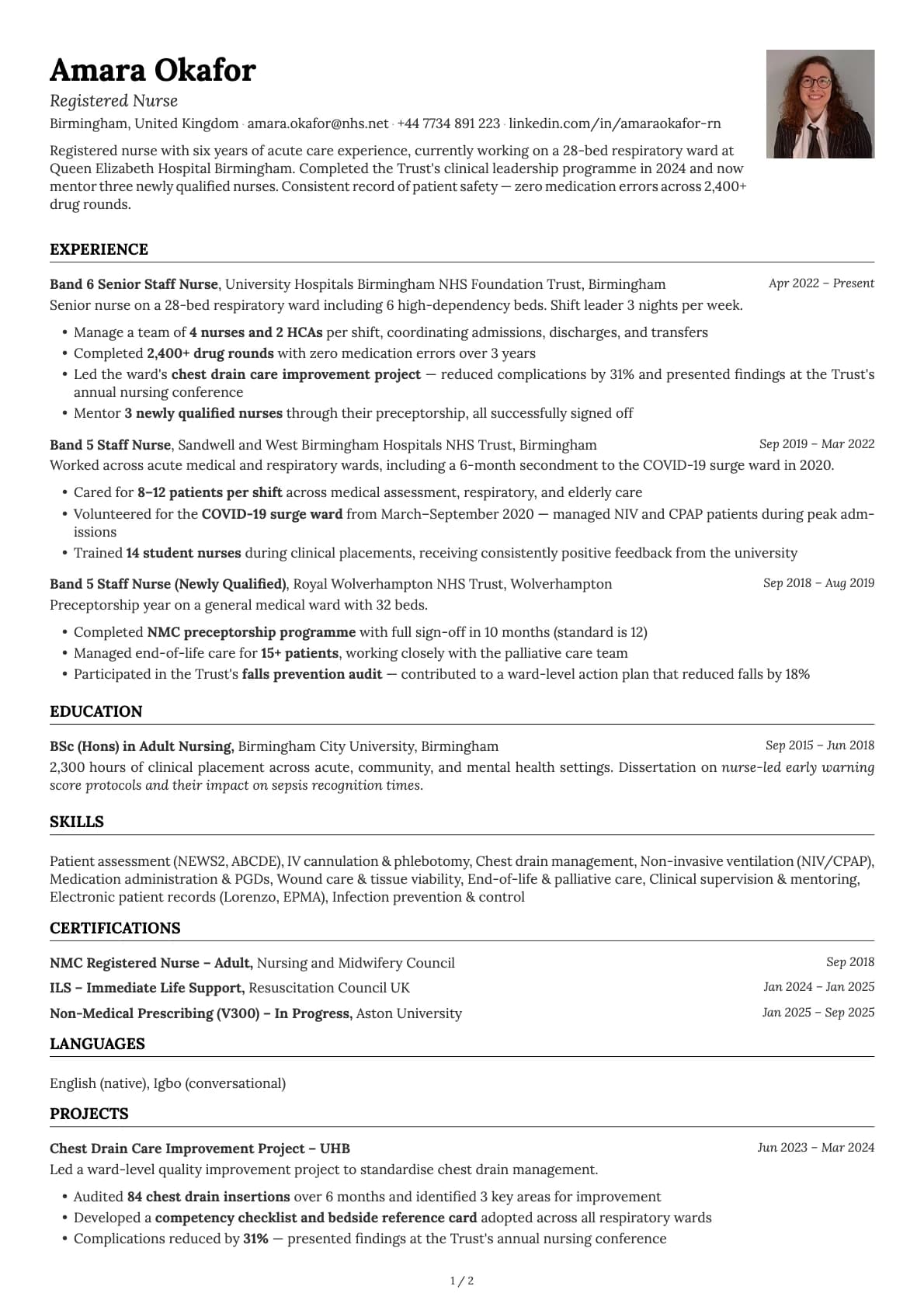
Registered Nurse
A registered nurse resume example with 6 years of acute care experience at NHS hospitals.
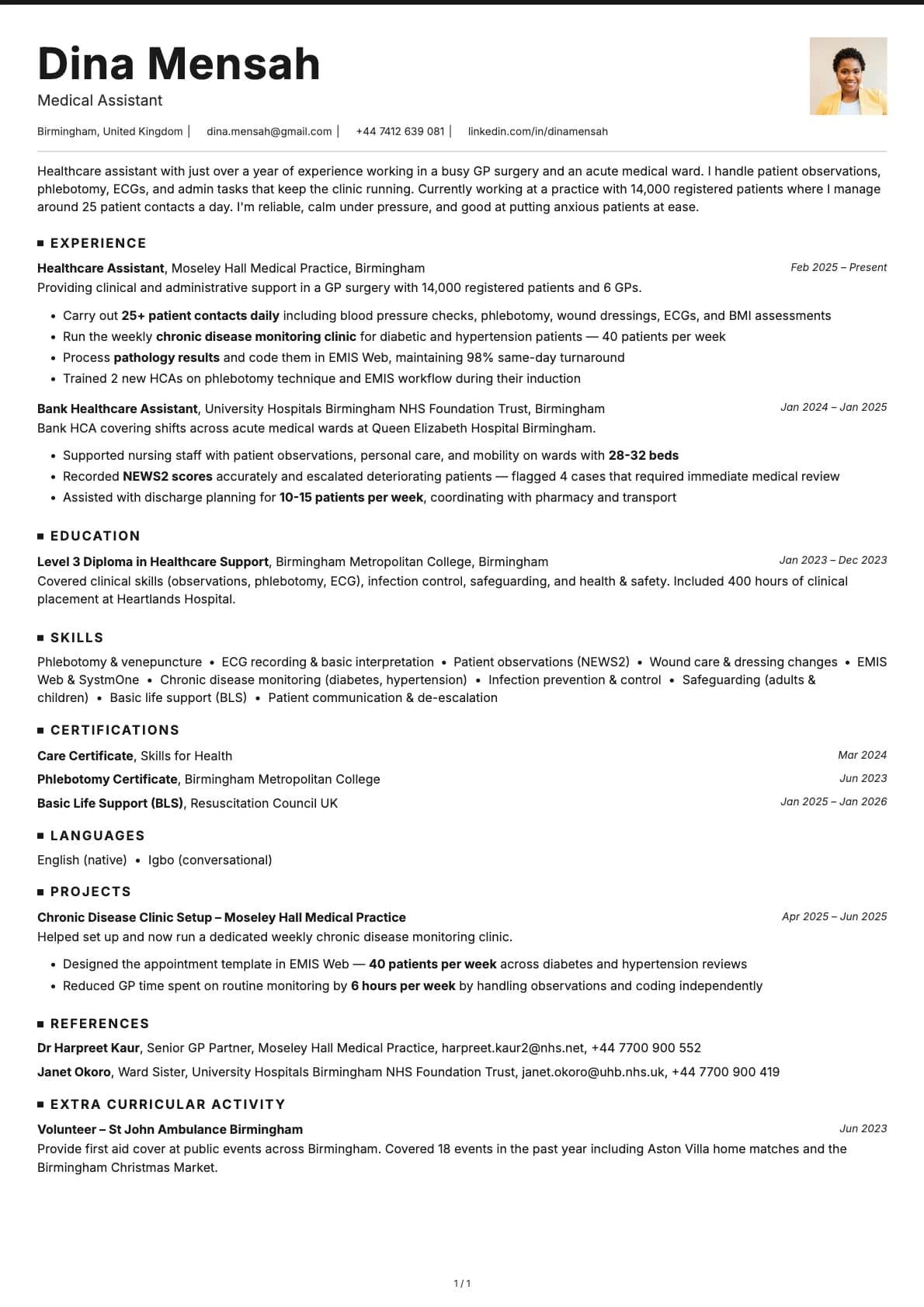
Medical Assistant
A medical assistant resume example with patient contact numbers, clinical skills, and GP surgery experience.
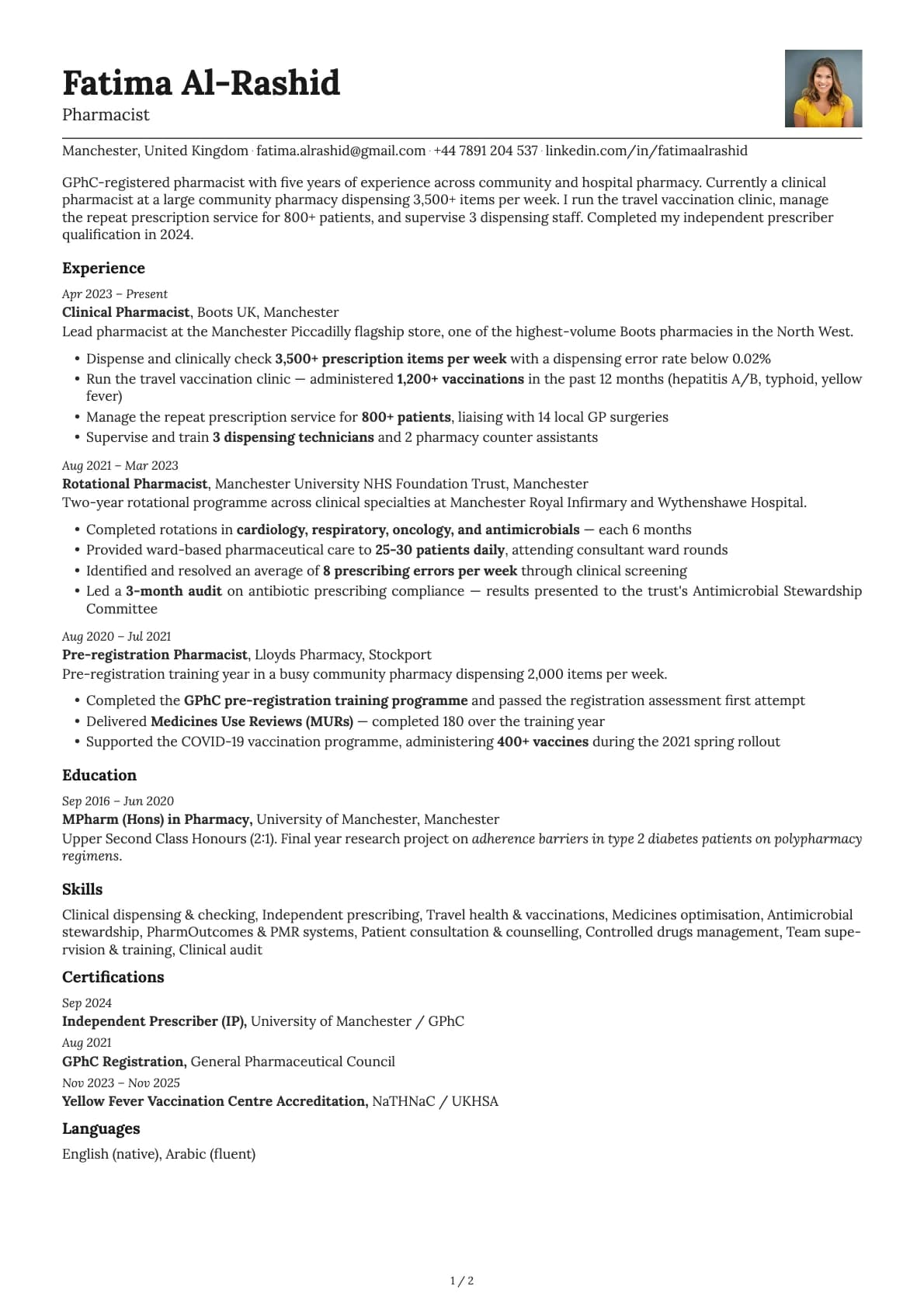
Pharmacist
A pharmacist resume example with community and hospital experience, clinical audit results, and vaccination clinic numbers.
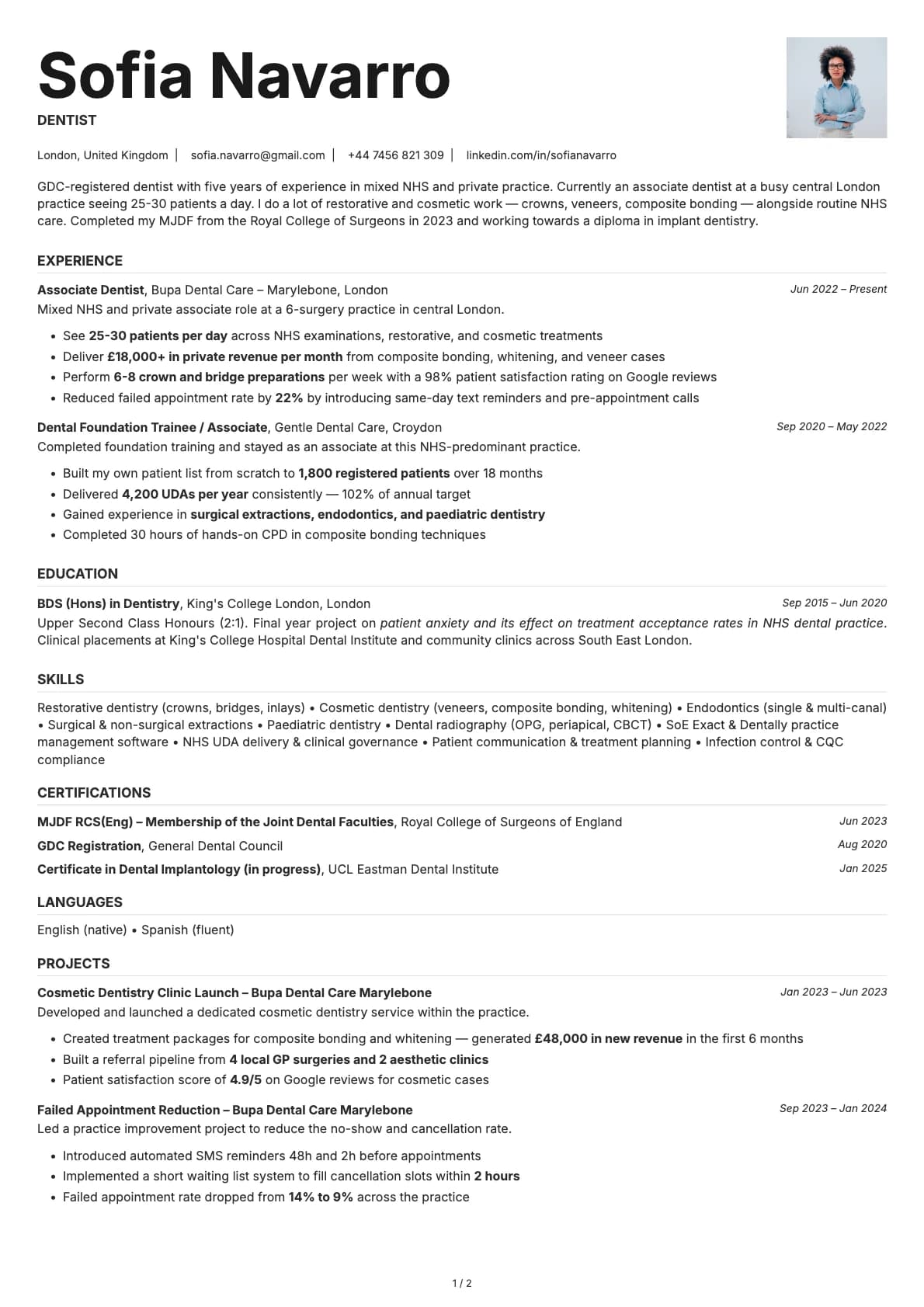
Dentist
A dentist resume example with mixed NHS and private practice experience in London.
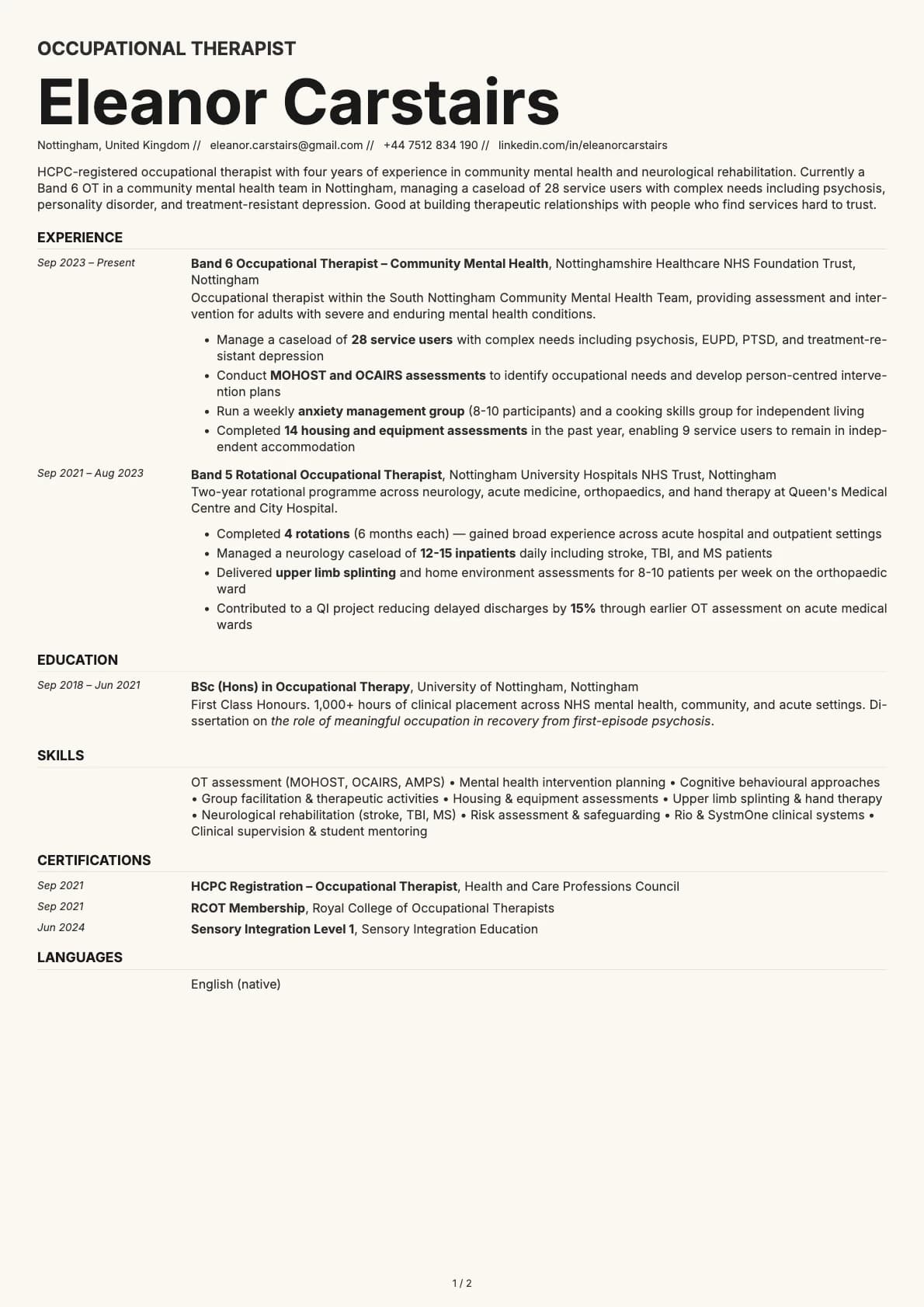
Occupational Therapist
An occupational therapist resume example with caseload details, OT assessment tools, and QI project outcomes.
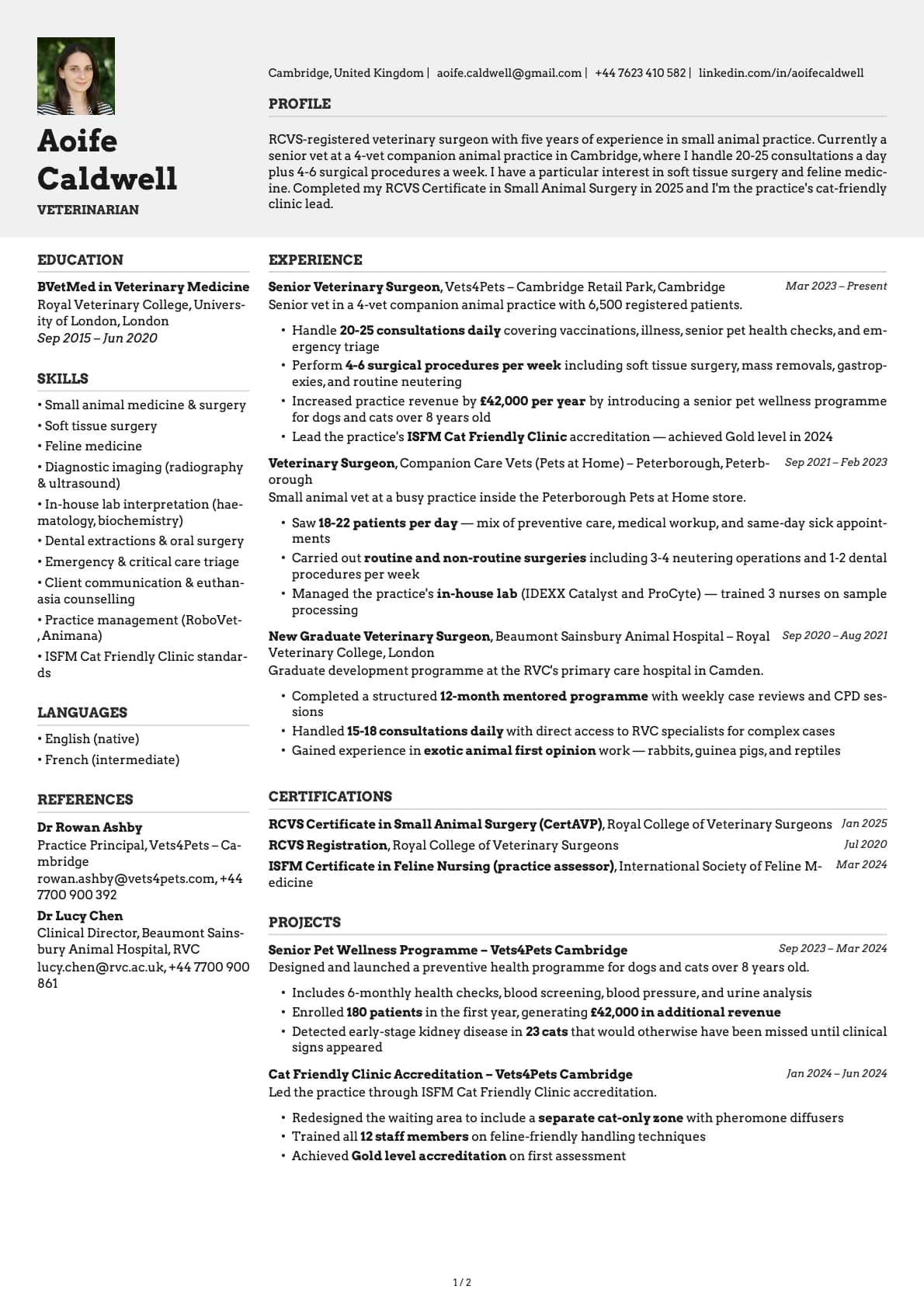
Veterinarian
A veterinarian resume example with 5 years of small animal practice experience.
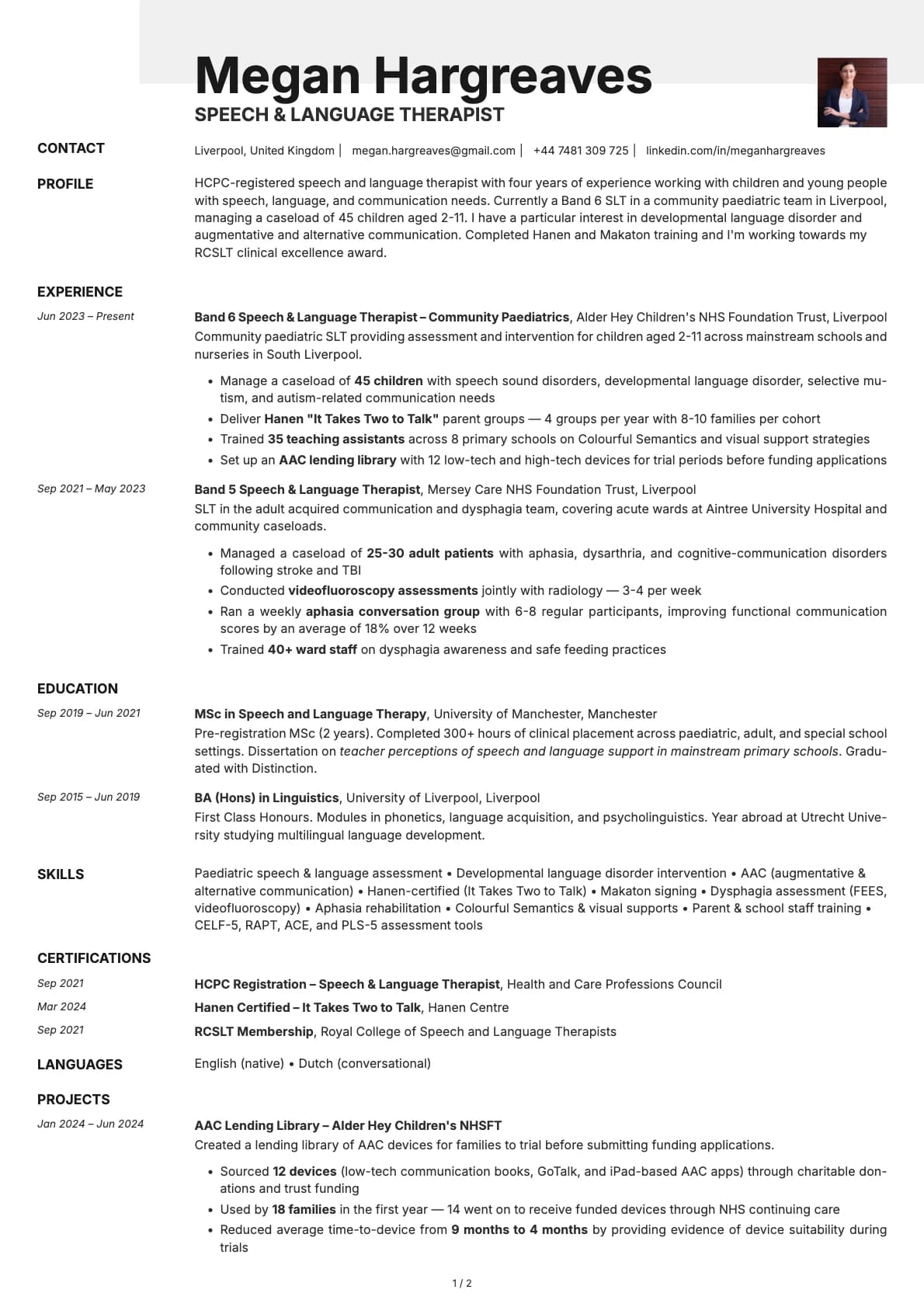
Speech & Language Therapist
A speech and language therapist resume example with paediatric and adult caseload experience across NHS trusts.
Paramedic
A paramedic resume example with call volumes, clinical competencies, and mentoring experience.
Clinical Psychologist
A clinical psychologist resume example with 9 years of NHS experience across community mental health and neuropsychology.
Dietitian / Nutritionist
A dietitian resume example with NHS clinical experience in gastroenterology and community nutrition.
Social Worker
A social worker resume example with caseload numbers, court work, and multi-agency experience.
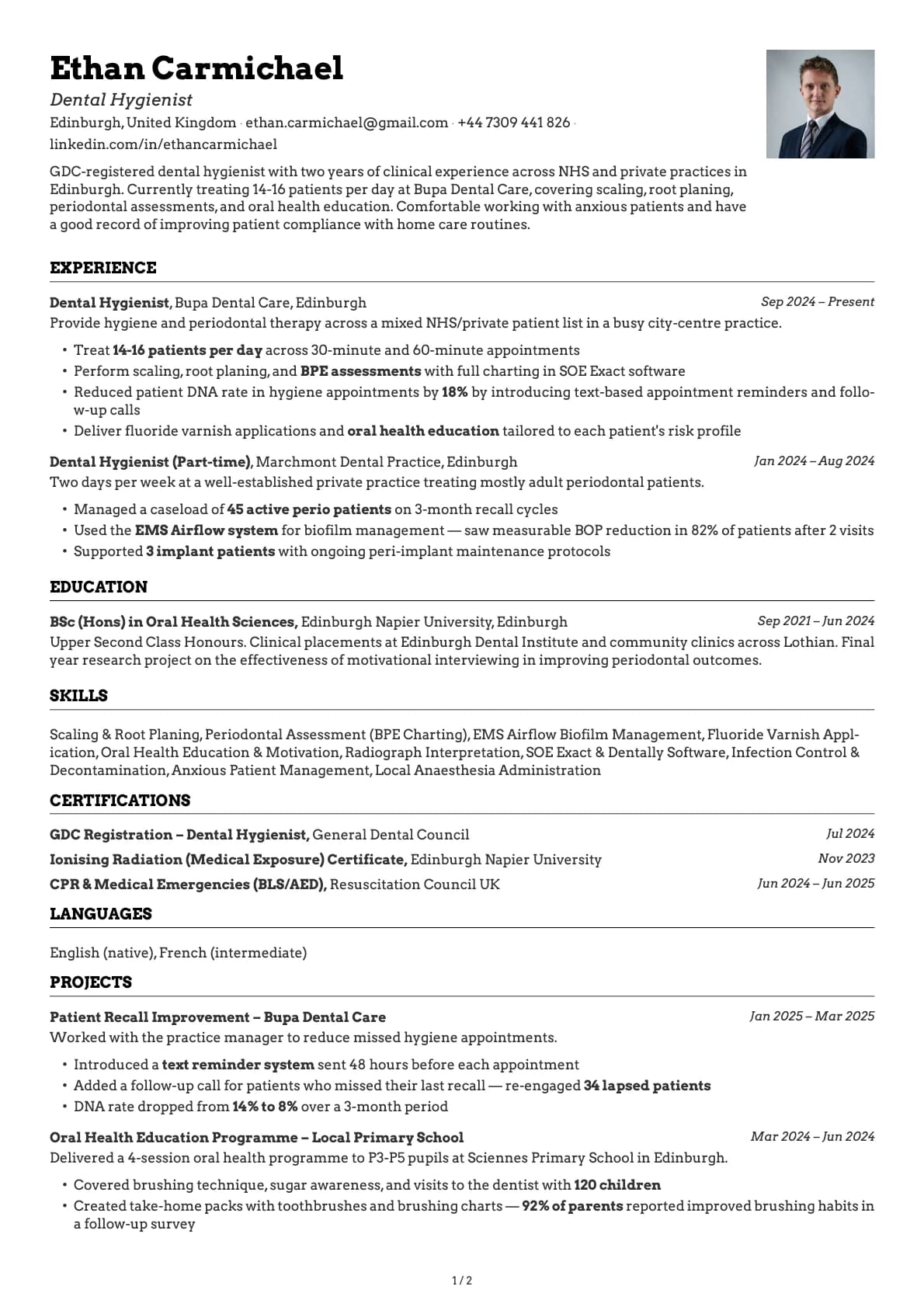
Dental Hygienist
A dental hygienist resume example with NHS and private practice experience in Edinburgh.
Related articles

AI Is Screening Your Resume Before Any Human Sees It
AI screens most resumes before a human ever reads them. 97.4% of Fortune 500 companies run an ATS. This is what that means for you and what you can do about it.

The Best Resume Builders in 2026, Compared Honestly
Resume.io, Zety, Enhancv, Kickresume, Teal, and Laddro compared honestly: real pricing, free tiers, mobile apps, and where each tool wins. All prices checked in September 2026.

Burnout Recovery: A Real Timeline, Not 'Take a Bubble Bath'
55% of the U.S. workforce is burned out. Recovery takes 3 to 12 months. Here's what that actually looks like, stage by stage.