Marketing Manager Resume Example
A marketing manager resume example with channel revenue growth, campaign results, and team management details.

Laddro Team
Free to use. No account needed to start.
Free to use. No account needed to start.
Overview
Marketing manager resumes are full of campaigns that sound impressive but say nothing. "Managed multi-channel marketing campaigns across digital and social" could be written by anyone with a Hootsuite login. What the hiring manager actually wants to know is: did the campaign make money? How much? And can you prove it?
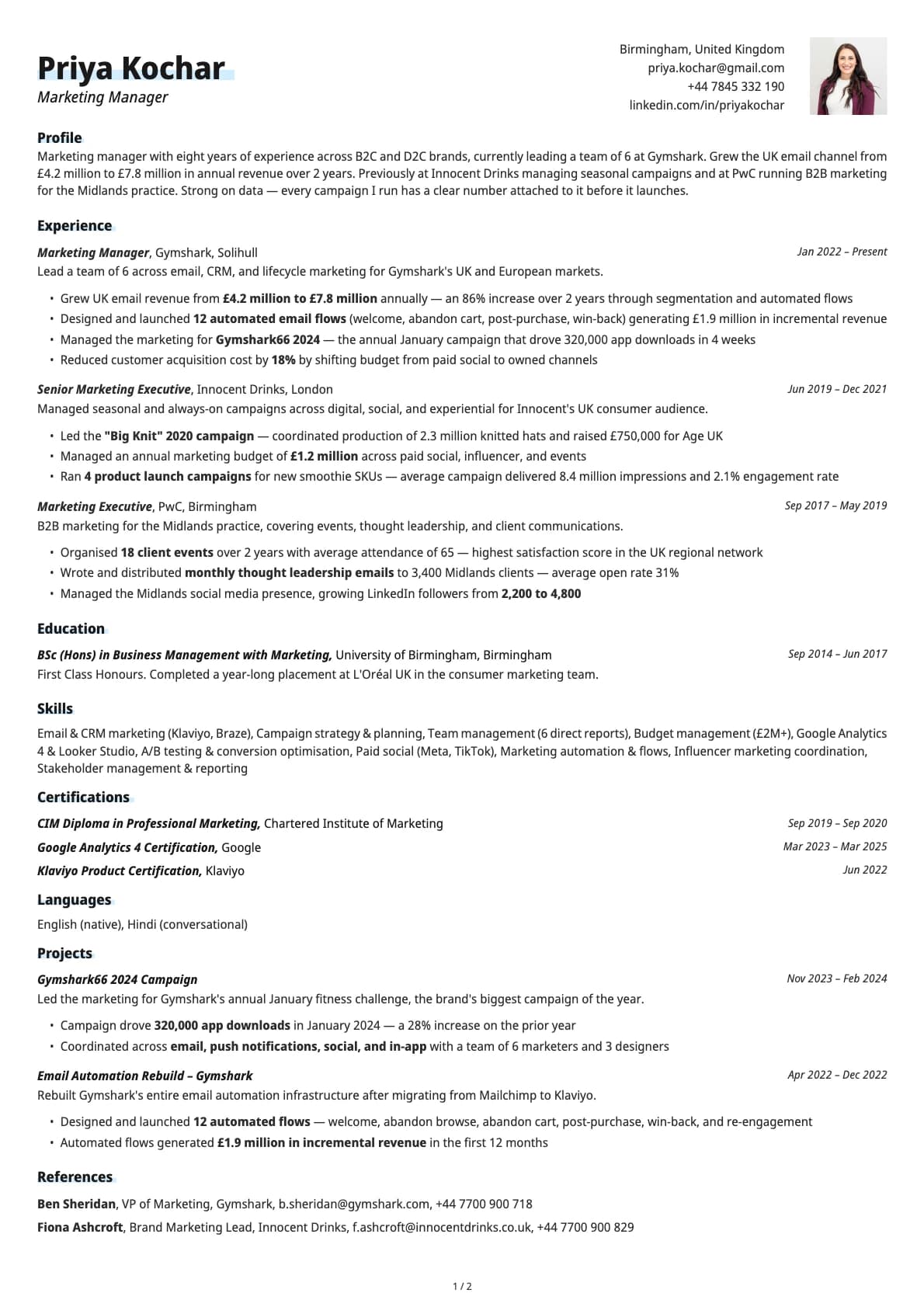
This resume belongs to Priya Kochar, a marketing manager with eight years of experience. She currently leads a team of 6 at Gymshark and previously worked at Innocent Drinks and PwC. What sets this resume apart is that almost every bullet has a revenue figure, a percentage, or a concrete campaign result attached to it. She grew the UK email channel from £4.2 million to £7.8 million. That is the kind of line that gets you an interview.
Let us go through what works and how to apply it to your own resume.
Your summary should lead with revenue, not adjectives
Most marketing resumes open with something like "creative marketing professional with a track record of delivering engaging campaigns." That tells the reader nothing. Everyone thinks their campaigns are engaging.
Here is Priya's summary:
Marketing manager with eight years of experience across B2C and D2C brands, currently leading a team of 6 at Gymshark. Grew the UK email channel from £4.2 million to £7.8 million in annual revenue over 2 years.
Two sentences. The first establishes scope (B2C and D2C, team of 6, Gymshark). The second gives a concrete revenue result. The reader immediately knows this person measures their work in pounds, not impressions.
Your version: Name your current company and team size, then state your single biggest revenue or growth number. If you do not own a revenue number directly, use the closest metric: leads generated, conversion rate improvement, or cost reduction.
How to write campaign bullets that actually mean something
The trick with marketing resumes is connecting activity to outcome. "Managed the email programme" is activity. "Grew email revenue by 86% through segmentation and automated flows" is outcome.
Look at these bullets from the Gymshark role:
"Designed and launched 12 automated email flows (welcome, abandon cart, post-purchase, win-back) generating £1.9 million in incremental revenue"
"Managed the marketing for Gymshark66 2024. The annual January campaign drove 320,000 app downloads in 4 weeks"
"Reduced customer acquisition cost by 18% by shifting budget from paid social to owned channels"
Each one follows the same structure: what she did, the specifics of how, and what happened as a result. The first bullet names the exact flows. The second names the specific campaign. The third shows strategic thinking about channel mix.
The formula: Action + channel or tactic + measurable result.
If you managed a campaign that generated impressions but not direct revenue, that is okay. "Ran 4 product launch campaigns for new smoothie SKUs. Average campaign delivered 8.4 million impressions and 2.1% engagement rate" is still a strong bullet because the numbers are specific.
Showing career progression across different types of marketing
Priya's career moves from B2B marketing at PwC to consumer brand work at Innocent to D2C at Gymshark. This could look scattered, but she frames each role to show a clear skill being developed.
At PwC: events and thought leadership. At Innocent: campaign management and budget ownership. At Gymshark: team leadership and revenue ownership.
If your career crosses B2B and B2C, or agency and in-house, do not worry about it looking disjointed. Just make sure each role shows progression in responsibility. Going from "organised 18 client events" to "led a team of 6 managing £2M+ in budget" tells a clear growth story.
Skills: be specific about your tools
This resume lists "Klaviyo, Braze" for email and CRM, "Meta, TikTok" for paid social, and "Google Analytics 4 & Looker Studio" for reporting. That specificity matters.
Marketing tools change constantly, and employers want to know which ones you already know. "Email marketing" is too vague. "Klaviyo" tells them you can build flows and segments on day one. If you use HubSpot, Salesforce Marketing Cloud, or any other platform, name it.
One thing Priya does well: she lists team management (6 direct reports) and budget management (£2M+) as skills. If you manage people or money, include the numbers. They help recruiters filter you into the right level of role.
Certifications that actually help
Priya lists her CIM Diploma, Google Analytics 4 certification, and Klaviyo Product Certification. All three are directly relevant to her daily work.
In marketing, platform-specific certifications (Google, Meta, HubSpot, Klaviyo) carry real weight because they prove you know the tool, not just the theory. If you have any, list them. The CIM qualification is especially valuable in the UK because many senior marketing roles list it as desirable.
Mistakes that hurt marketing manager resumes
Leading with impressions instead of revenue. Impressions are easy to inflate and hard to verify. If you can connect your work to revenue, leads, or cost savings, lead with those. Use impressions only when revenue attribution is not possible.
Listing every channel you have ever touched. If you mention SEO, PPC, email, social, influencer, events, PR, content, and partnerships, the recruiter does not know what you are actually good at. Pick the 3 or 4 channels where you have the strongest results and go deep.
Vague team management claims. "Led a cross-functional team" could mean anything. "Led a team of 6 across email, CRM, and lifecycle marketing" is clear and specific.
Ignoring the budget. Marketing managers are expected to manage money. If you owned a budget, state the amount. "Managed an annual marketing budget of £1.2 million" immediately tells the recruiter your level.
One more thing
If you are applying to a D2C or e-commerce brand, make sure your resume speaks their language. They care about CAC, LTV, retention, and owned channels. If you are applying to a B2B company, emphasize pipeline contribution, MQLs, and event ROI. Same skills, different framing. Match the metrics to the business model.
Build your own version
Open this layout in the builder and swap in your own details. It takes a few minutes.
Free to use. No account needed to start.
Was this resume example helpful?
Rate this example to help us create better content for you.
4.8 average from 203 ratingsRelated resume examples
Social Media Manager
A social media manager resume example with follower growth, engagement rates, and campaign results.
Public Relations Manager
A public relations manager resume example with media coverage numbers, crisis communications experience, and campaign reach from agency and in-house roles.
SEO Specialist
An SEO specialist resume example with traffic growth numbers, technical audit results, and content strategy outcomes.
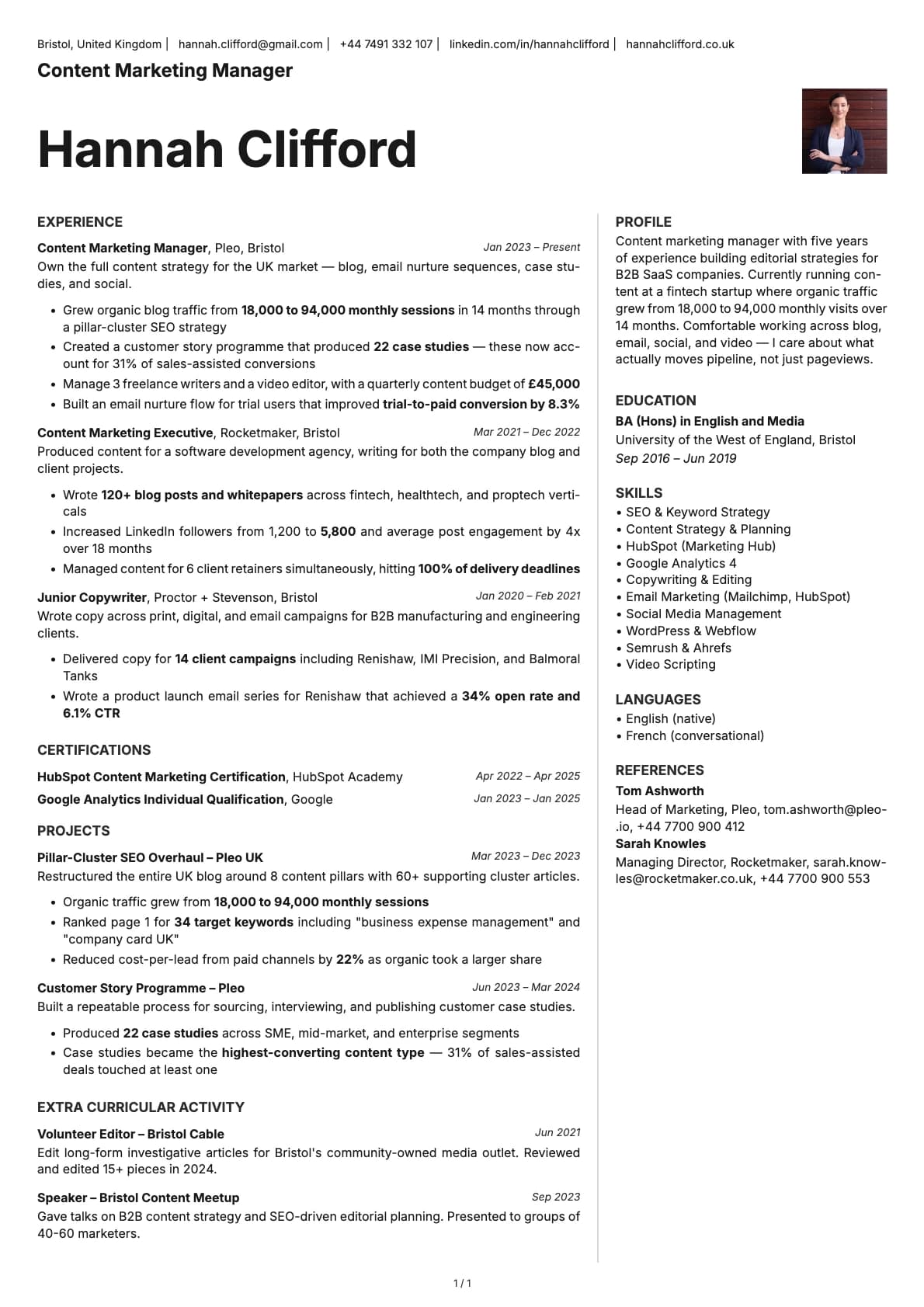
Content Marketing Manager
A content marketing manager resume example with B2B SaaS experience at Pleo.
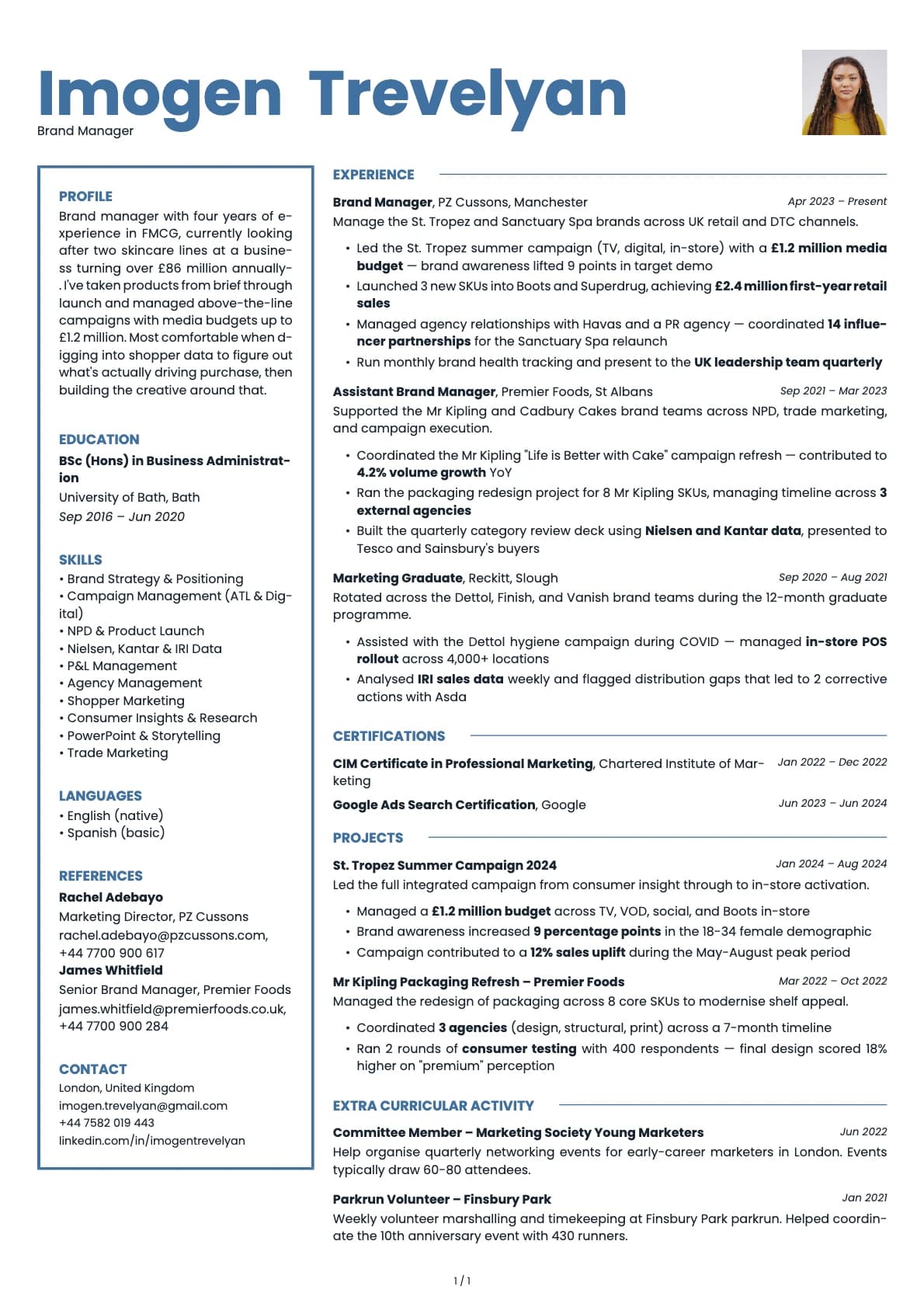
Brand Manager
A brand manager resume example from FMCG with campaign budgets, NPD launches, and Nielsen/Kantar data experience across PZ Cussons and Premier Foods.
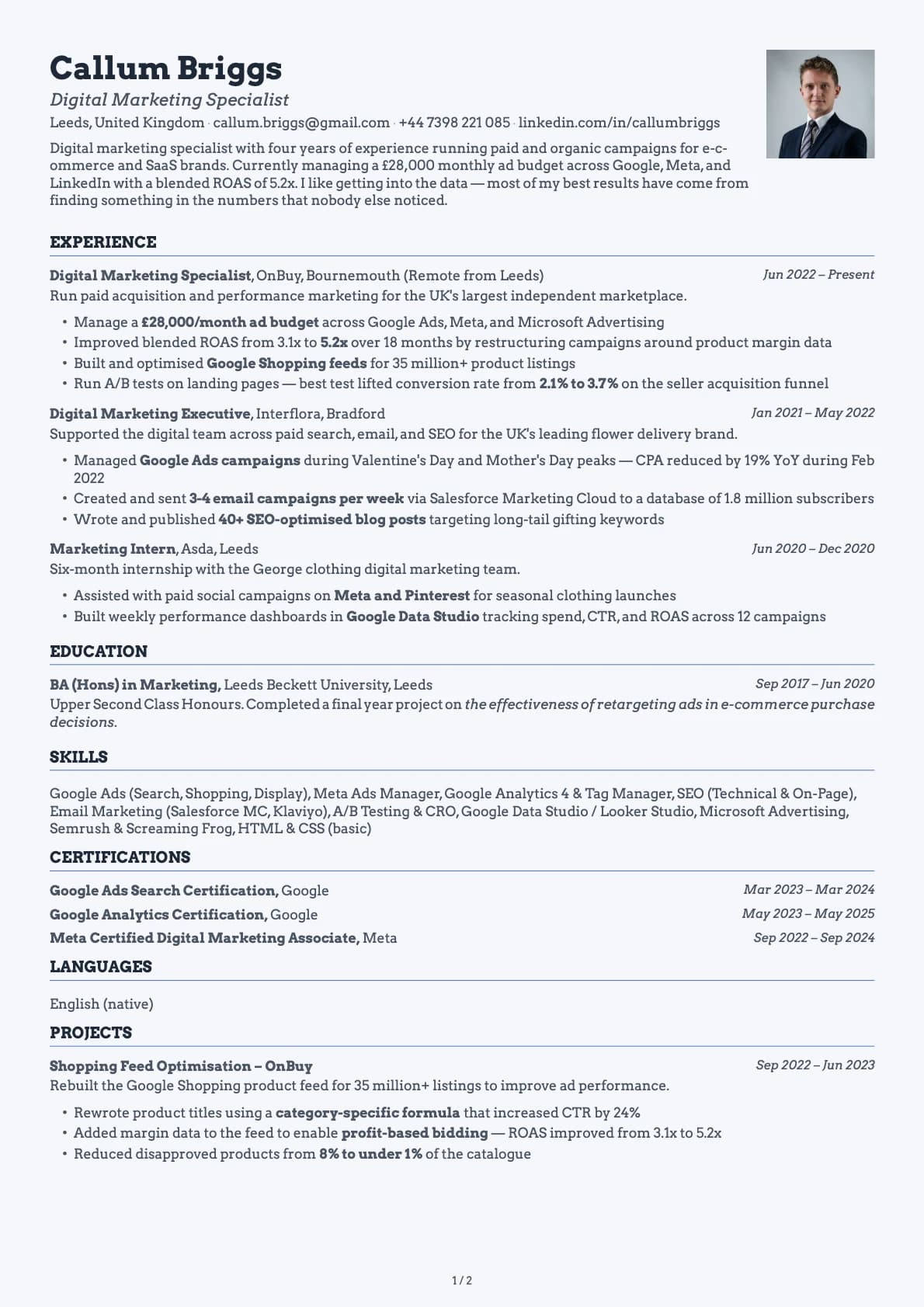
Digital Marketing Specialist
A digital marketing specialist resume example showing how to present campaign performance, ad spend management, and ROI numbers that recruiters actually.
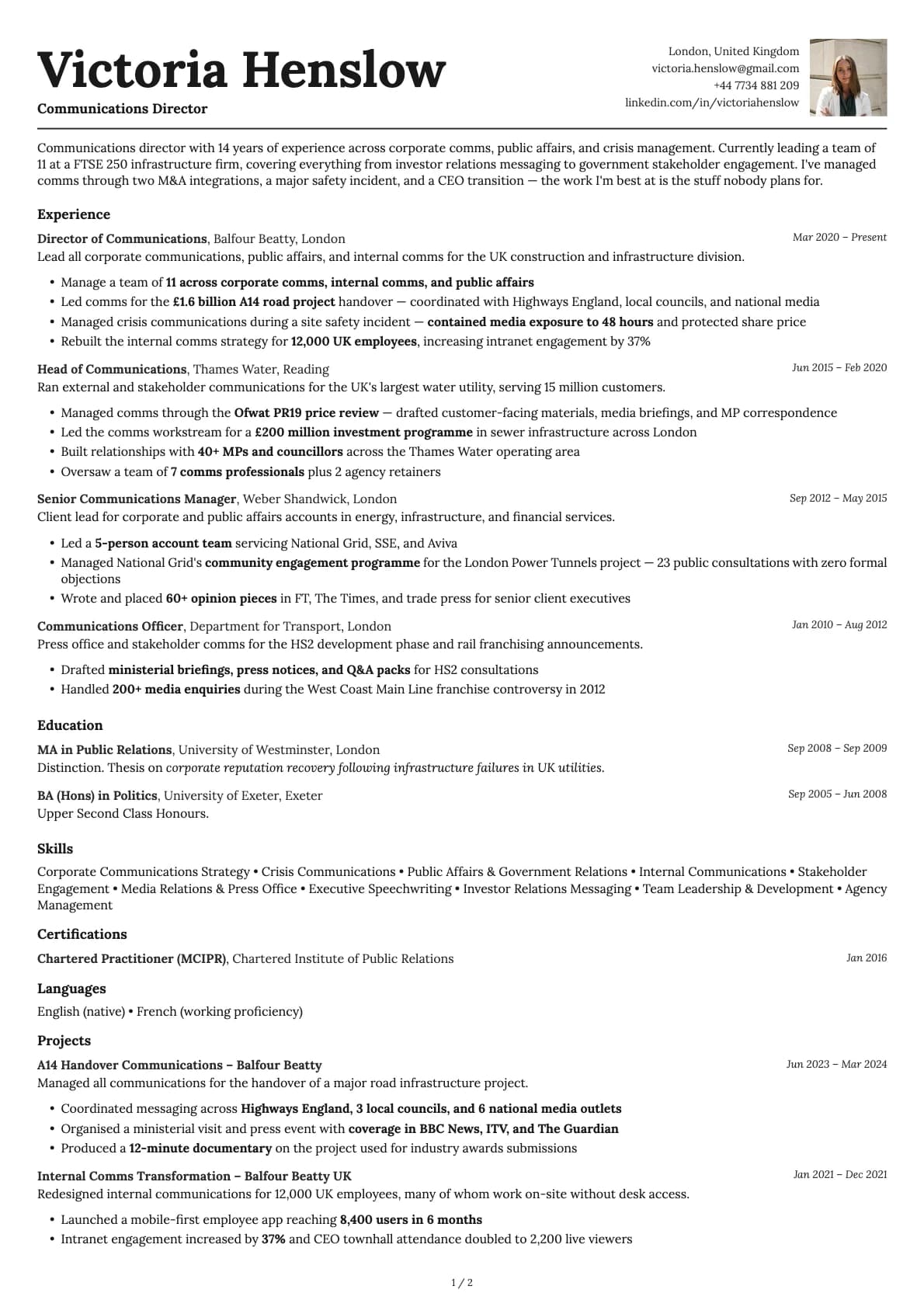
Communications Director
A communications director resume example with 14 years of experience across corporate comms, public affairs.
Related articles

AI Is Screening Your Resume Before Any Human Sees It
AI screens most resumes before a human ever reads them. 97.4% of Fortune 500 companies run an ATS. This is what that means for you and what you can do about it.

The Best Resume Builders in 2026, Compared Honestly
Resume.io, Zety, Enhancv, Kickresume, Teal, and Laddro compared honestly: real pricing, free tiers, mobile apps, and where each tool wins. All prices checked in September 2026.

Burnout Recovery: A Real Timeline, Not 'Take a Bubble Bath'
55% of the U.S. workforce is burned out. Recovery takes 3 to 12 months. Here's what that actually looks like, stage by stage.