Social Media Manager Resume Example
A social media manager resume example with follower growth, engagement rates, and campaign results.

Laddro Team
Free to use. No account needed to start.
Free to use. No account needed to start.
Overview
Social media manager resumes are strange. You work in a field where your output is extremely public (anyone can check your follower count, your engagement rate, or your last 50 posts) but your resume still has to prove you are good at it. Plenty of people can run a brand account. Far fewer can grow one, measure the impact, and tie it back to business results.
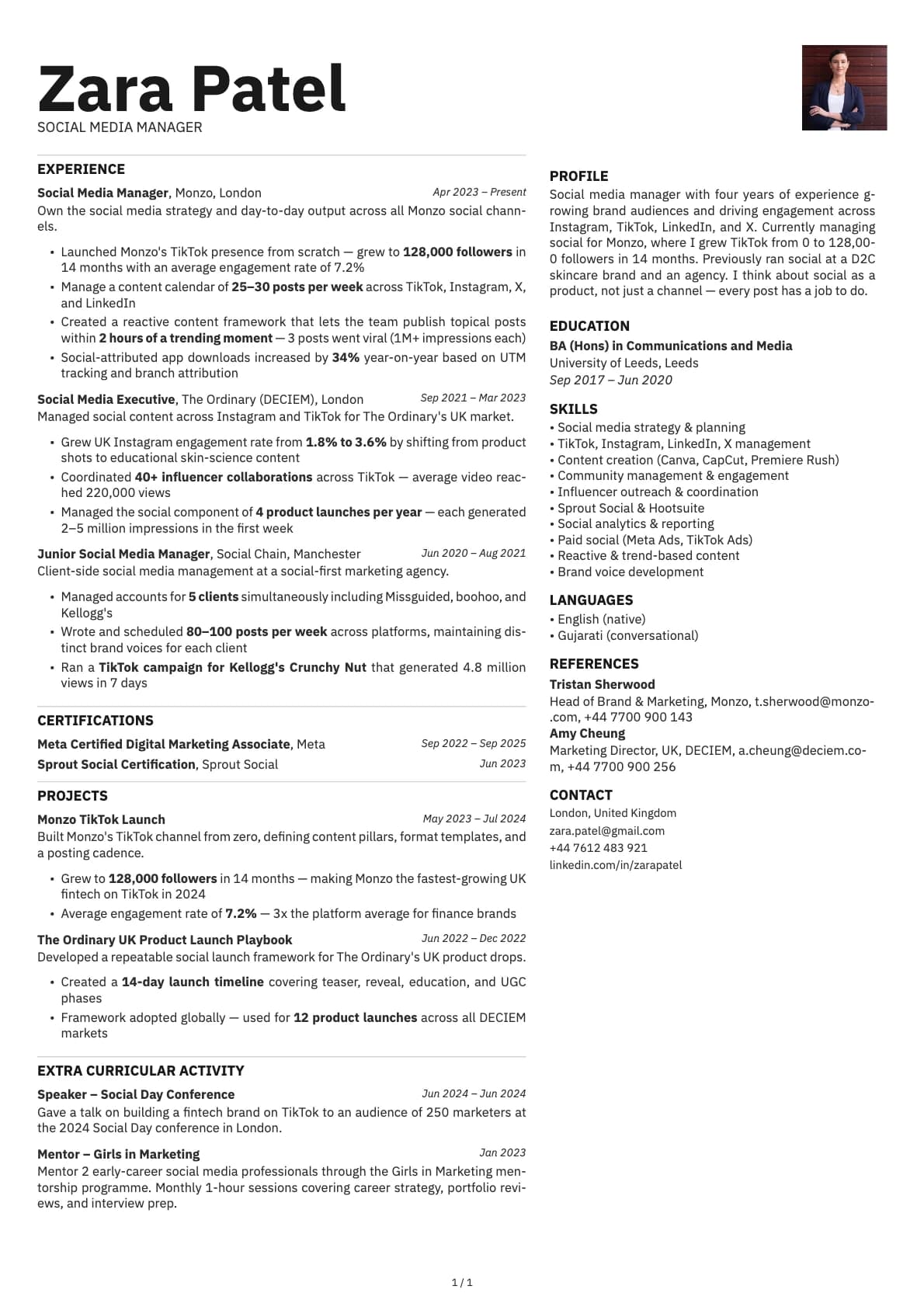
This resume belongs to Zara Patel, a social media manager in London with four years of experience. She currently manages social for Monzo, where she grew TikTok from 0 to 128,000 followers in 14 months. Before that, she ran social for The Ordinary (DECIEM) and worked client-side at Social Chain, managing accounts for brands like Missguided and Kellogg's.
What makes this resume work is that every line connects a creative action to a measurable outcome. Let us break down how you can do the same.
Follower growth is your headline number
For social media, audience growth is the simplest proof that your work is effective. This resume leads with:
"Launched Monzo's TikTok presence from scratch, grew to 128,000 followers in 14 months with an average engagement rate of 7.2%"
Two numbers in one bullet: follower count and engagement rate. The engagement rate is important because anyone can buy followers. A 7.2% engagement rate on TikTok (when the average for finance brands is around 2-3%) proves the audience is real and interested.
If you have grown an account, always state the starting point and the ending point. "Grew from 0 to 128,000" is much more impressive than just "managed an account with 128,000 followers." The delta is what matters.
Volume and consistency
Managing social media at scale is a real skill. It is not just posting. It is planning, creating, scheduling, reviewing, and responding across multiple platforms every single day:
"Manage a content calendar of 25, 30 posts per week across TikTok, Instagram, X, and LinkedIn"
That tells the hiring manager: this person can handle high-volume output across four platforms simultaneously. From the Social Chain entry:
"Managed accounts for 5 clients simultaneously including Missguided, boohoo, and Kellogg's"
"Wrote and scheduled 80, 100 posts per week across platforms, maintaining distinct brand voices for each client"
80 to 100 posts per week across five different brands. That shows an ability to switch between brand voices quickly and work at agency speed. If you have managed multiple accounts at once, include the client names (if allowed) and the volume.
Connect social to business outcomes
Follower counts and engagement rates are good. But what hiring managers really want to see is business impact:
"Social-attributed app downloads increased by 34% year-on-year based on UTM tracking and branch attribution"
That connects social media directly to a business KPI (app downloads) and explains how it was measured (UTM and branch attribution). If you can tie your work to revenue, sign-ups, traffic, or any business metric, it immediately elevates your resume.
From The Ordinary role:
"Managed the social component of 4 product launches per year, each generated 2, 5 million impressions in the first week"
Launch campaigns with impression counts show you can drive attention when it matters most. If your work supported specific campaigns, product drops, or events, include the results.
Reactive content and trend response
Being able to respond quickly to trends is a skill that many brands want but few can execute well:
"Created a reactive content framework that lets the team publish topical posts within 2 hours of a trending moment, 3 posts went viral (1M+ impressions each)"
This is a great resume bullet because it shows process (a framework, a 2-hour turnaround), not just luck (a post went viral). The hiring manager learns that Zara built a system that makes reactive content reliable, not random.
Influencer collaboration
Influencer work is a significant part of many social media roles. This resume includes:
"Coordinated 40+ influencer collaborations across TikTok, average video reached 220,000 views"
40 collaborations gives scale. The average view count gives a quality benchmark. If you manage influencer relationships, include the number of collaborations, the platforms, and the average performance.
Tools and platforms to list
Social media managers should list both the platforms they manage and the tools they use. This resume includes Sprout Social, Hootsuite, Canva, CapCut, Premiere Rush, and Meta Ads. If you use scheduling tools, analytics platforms, design software, or ad managers, name them. A hiring manager who uses Sprout Social wants someone who already knows Sprout Social.
Mistakes social media managers make on resumes
Leading with personal social media. Your personal TikTok following is not the same as growing a brand account. Unless your personal account is directly relevant to the role (and very large), keep the focus on brand work.
Listing platforms without results. "Managed Instagram, TikTok, and LinkedIn" is just a list of apps. "Grew UK Instagram engagement rate from 1.8% to 3.6% by shifting from product shots to educational skin-science content" is a result.
Ignoring paid social. Many social media manager roles include a paid component. If you have run Meta Ads, TikTok Ads, or LinkedIn Sponsored Content, include it with spend figures and ROAS if possible.
No mention of brand voice. "Maintaining distinct brand voices for each client" is on this resume because it is a real skill. If you have developed tone of voice guidelines or maintained a brand voice across channels, include it.
One more thing
Your resume is important, but your portfolio matters just as much. Link to case studies, screenshots, or a personal website that shows your best work. When a hiring manager is deciding between two candidates with similar experience, the one who can show the actual posts and their performance will win. If you do not have a portfolio yet, start building one now. Screenshot your best-performing posts with the analytics visible.
Build your own version
Open this layout in the builder and swap in your own details. It takes a few minutes.
Free to use. No account needed to start.
Was this resume example helpful?
Rate this example to help us create better content for you.
4.8 average from 187 ratingsRelated resume examples
Marketing Manager
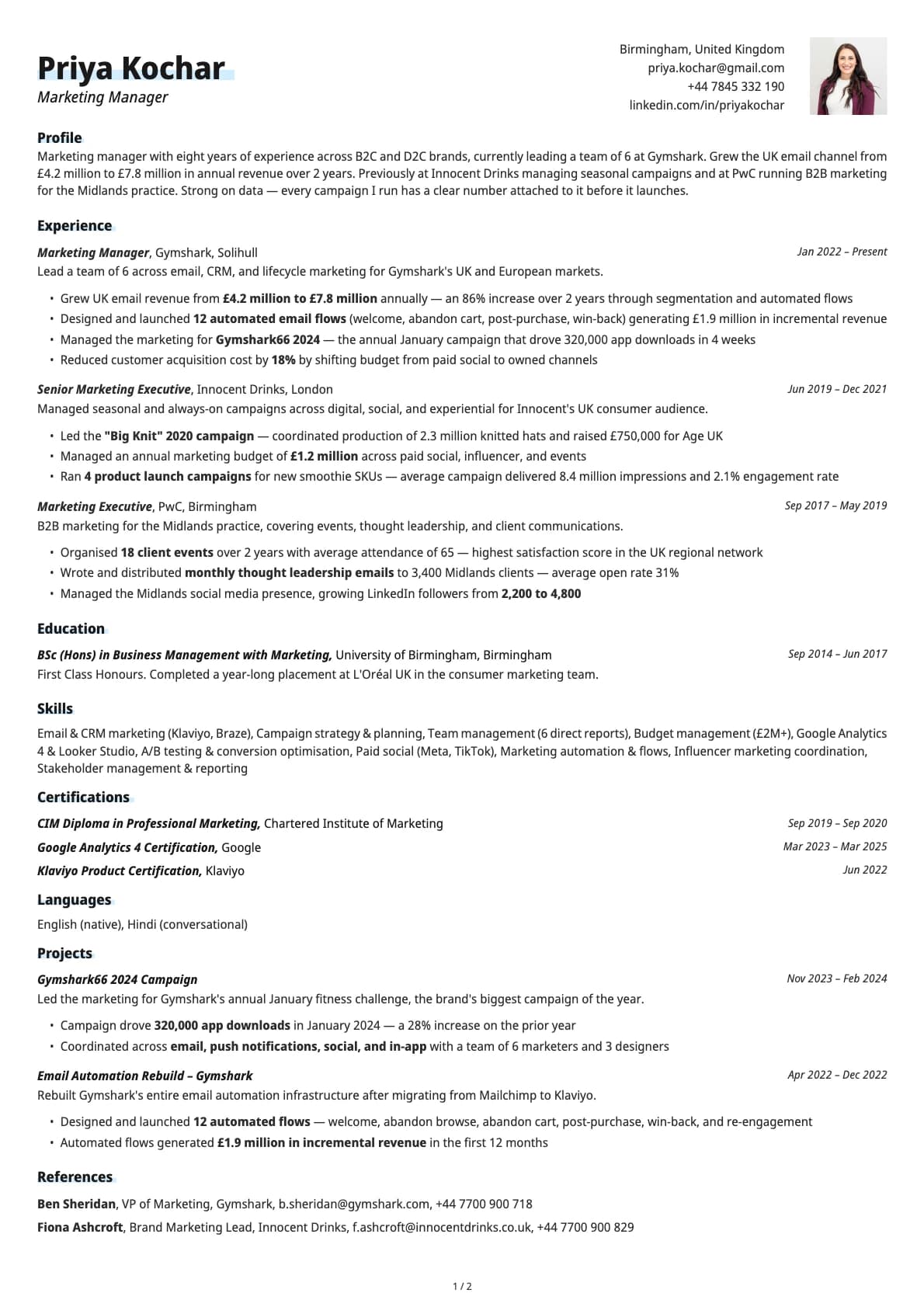
A marketing manager resume example with channel revenue growth, campaign results, and team management details.
Public Relations Manager
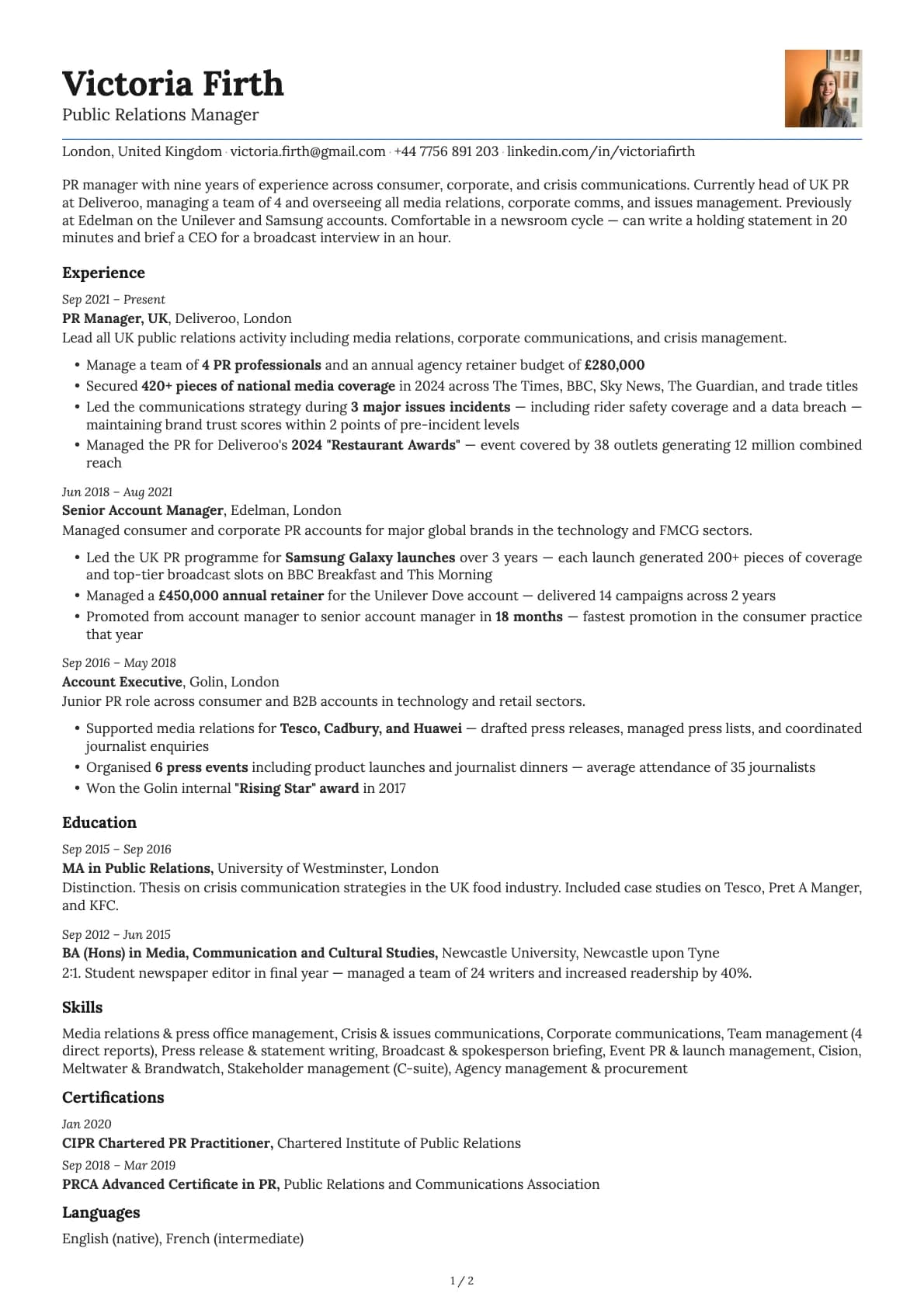
A public relations manager resume example with media coverage numbers, crisis communications experience, and campaign reach from agency and in-house roles.
SEO Specialist
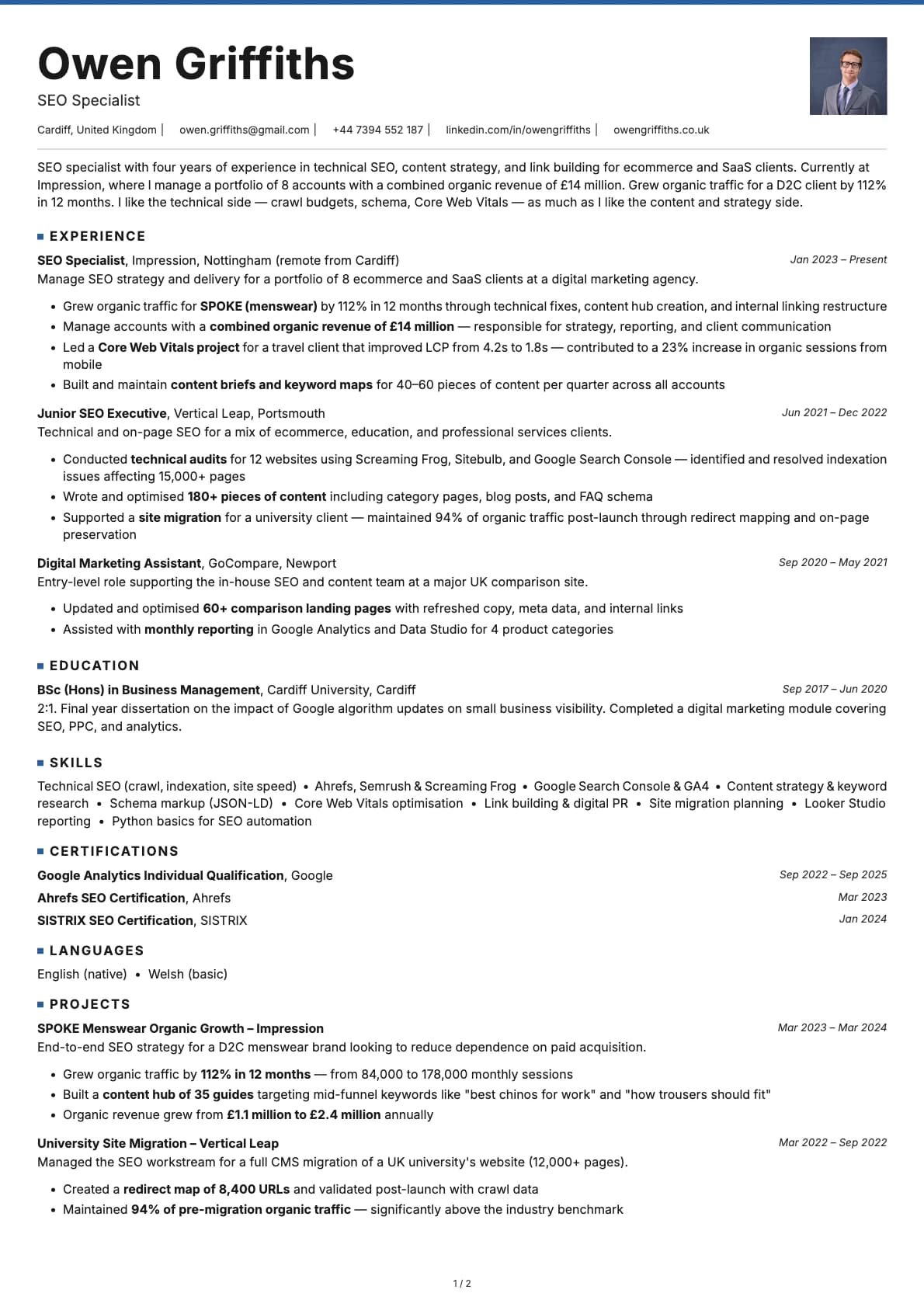
An SEO specialist resume example with traffic growth numbers, technical audit results, and content strategy outcomes.
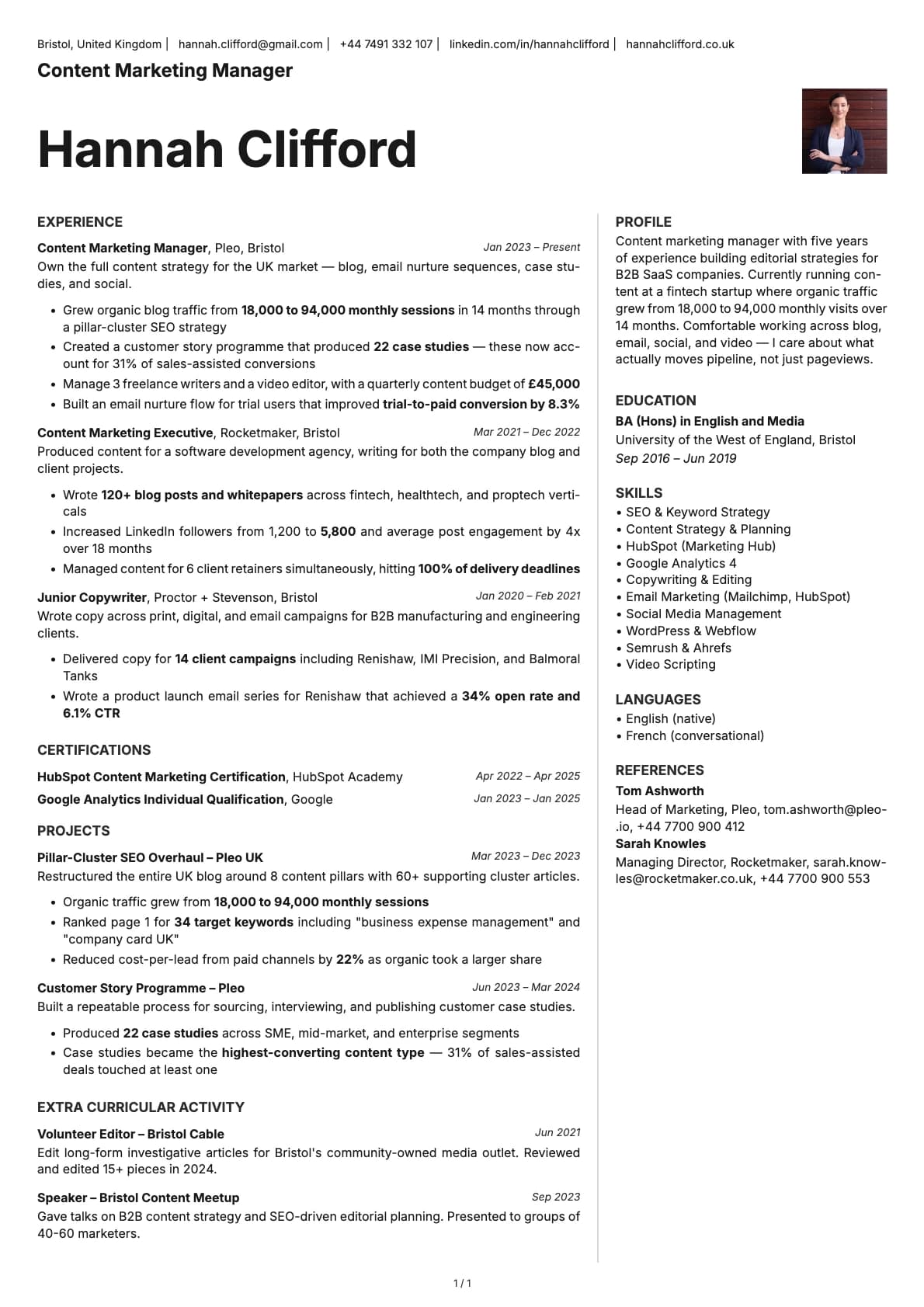
Content Marketing Manager
A content marketing manager resume example with B2B SaaS experience at Pleo.
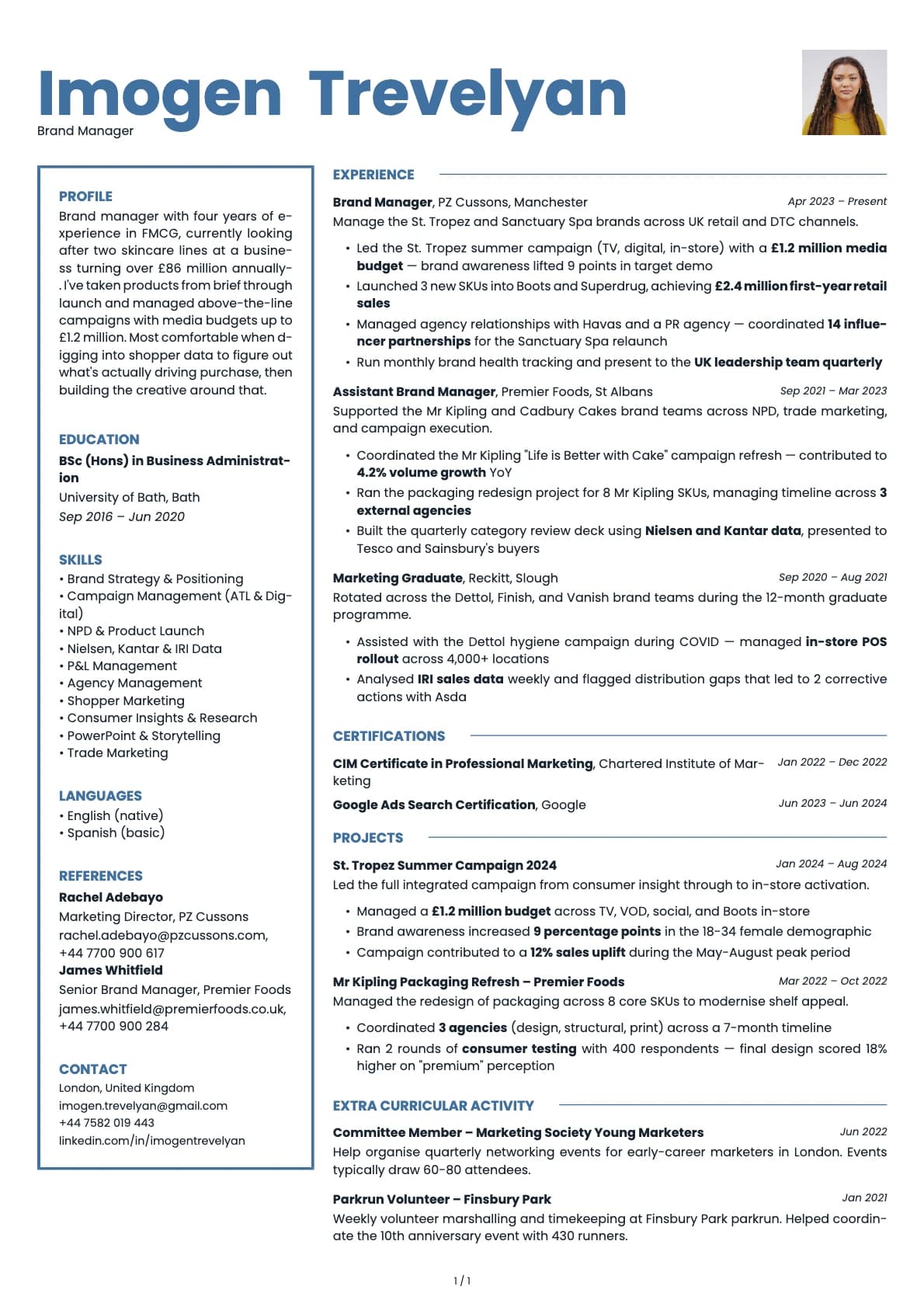
Brand Manager
A brand manager resume example from FMCG with campaign budgets, NPD launches, and Nielsen/Kantar data experience across PZ Cussons and Premier Foods.
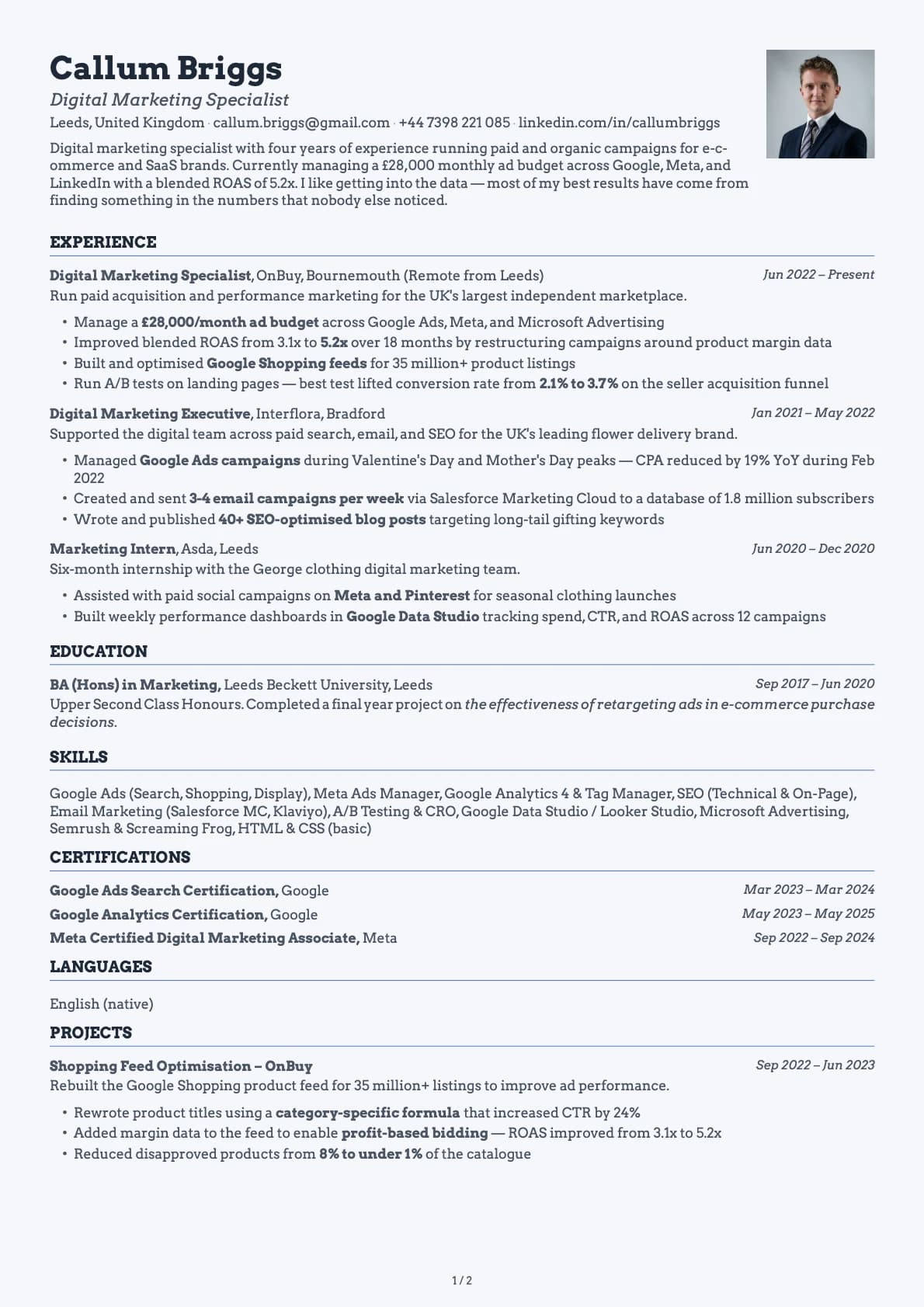
Digital Marketing Specialist
A digital marketing specialist resume example showing how to present campaign performance, ad spend management, and ROI numbers that recruiters actually.
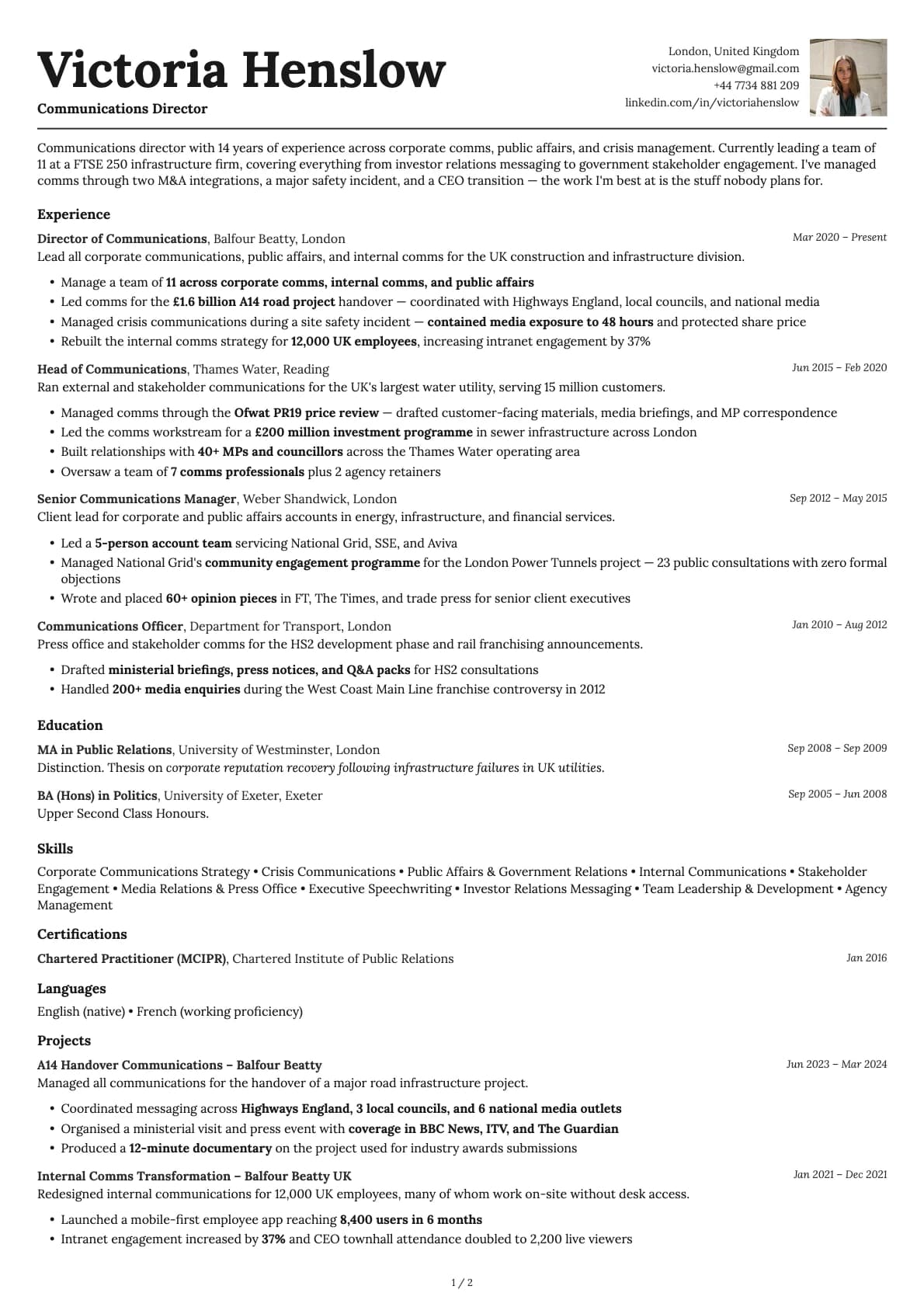
Communications Director
A communications director resume example with 14 years of experience across corporate comms, public affairs.
Related articles

AI Is Screening Your Resume Before Any Human Sees It
AI screens most resumes before a human ever reads them. 97.4% of Fortune 500 companies run an ATS. This is what that means for you and what you can do about it.

The Best Resume Builders in 2026, Compared Honestly
Resume.io, Zety, Enhancv, Kickresume, Teal, and Laddro compared honestly: real pricing, free tiers, mobile apps, and where each tool wins. All prices checked in September 2026.

Burnout Recovery: A Real Timeline, Not 'Take a Bubble Bath'
55% of the U.S. workforce is burned out. Recovery takes 3 to 12 months. Here's what that actually looks like, stage by stage.