Digital Marketing Specialist Resume Example
A digital marketing specialist resume example showing how to present campaign performance, ad spend management, and ROI numbers that recruiters actually.

Laddro Team
Free to use. No account needed to start.
Free to use. No account needed to start.
Overview
Digital marketing resumes have a unique advantage over most other professions: almost everything you do is measurable. Click-through rates, ROAS, cost per acquisition, conversion rates. You have the numbers. The problem is that most people either bury them in long paragraphs or leave them out entirely and write vague bullets like "managed social media campaigns."
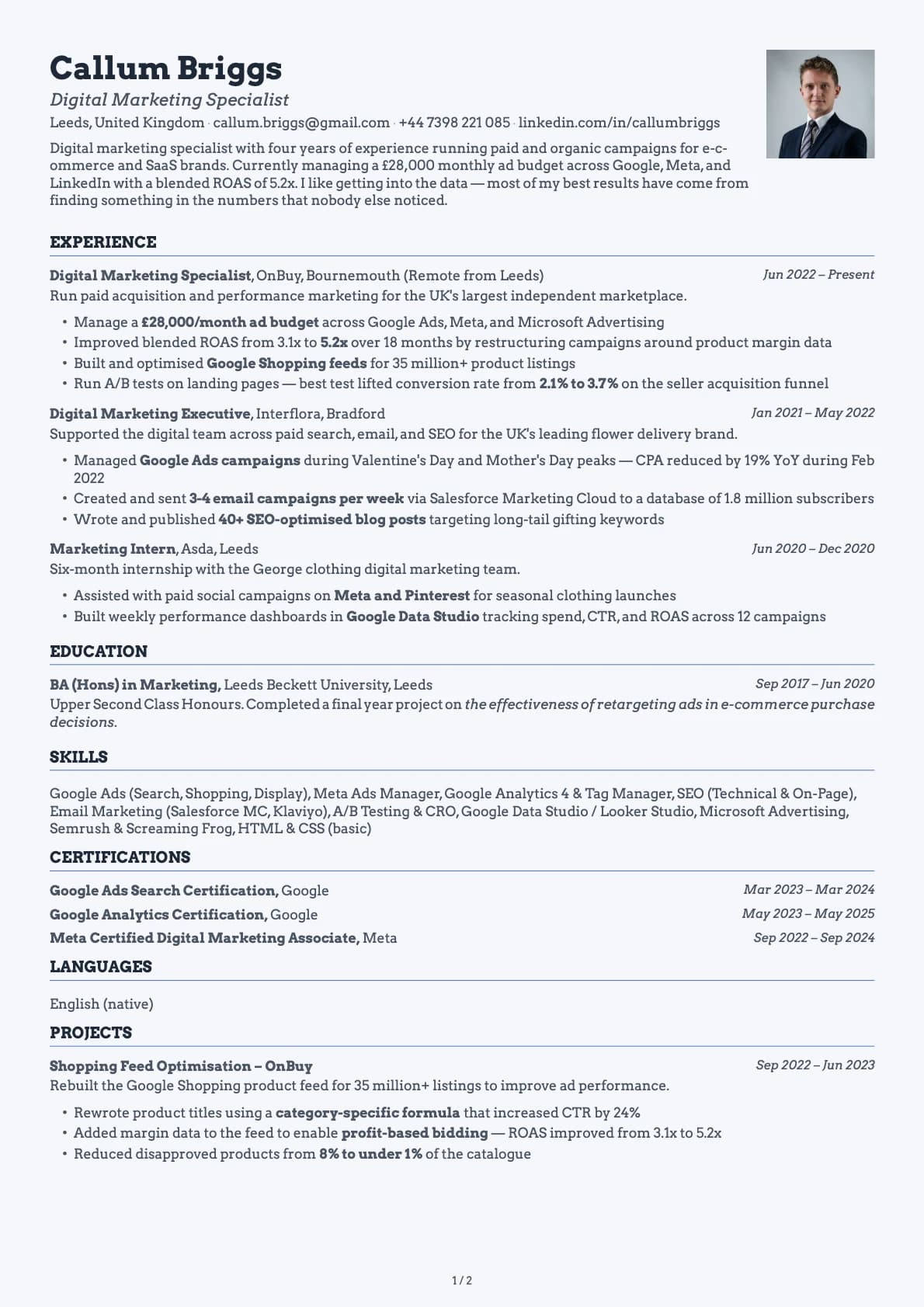
This resume belongs to Callum, a digital marketing specialist with four years of experience. He currently runs paid acquisition at OnBuy, the UK's largest independent marketplace. Before that, he worked on digital campaigns at Interflora and did a marketing internship at Asda. The resume works because it treats marketing like a numbers game, which is exactly what it is.
Let us walk through what makes this resume effective and what you should copy for yours.
Lead with your budget and your ROAS
The first thing a hiring manager wants to know about a digital marketer is: how much money have you been trusted with, and what did you do with it?
Look at the summary from this resume:
Digital marketing specialist with four years of experience running paid and organic campaigns for e-commerce and SaaS brands. Currently managing a £28,000 monthly ad budget across Google, Meta, and LinkedIn with a blended ROAS of 5.2x.
Two numbers in two sentences. Budget size and return. That tells the recruiter more than three paragraphs about your "strategic marketing expertise" ever could.
Formula for your summary: State your experience level, the channels you work across, the budget you manage, and your best performance metric. That is it. Four things.
Writing experience bullets that prove your impact
The biggest mistake digital marketers make on their resumes is describing the task instead of the result. "Managed Google Ads campaigns" is a task. Here is what a result looks like:
Improved blended ROAS from 3.1x to 5.2x over 18 months by restructuring campaigns around product margin data
That bullet tells you three things: the starting point (3.1x), the end point (5.2x), and how he got there (restructuring around margin data). A hiring manager can immediately picture what this person would do on their team.
Here is another strong one:
Best test lifted conversion rate from 2.1% to 3.7% on the seller acquisition funnel
Before and after numbers are powerful in marketing resumes. If you ran an A/B test, do not just say you ran it. Say what the original number was and what it became.
The formula: What you did + What changed + By how much. Use percentages, multipliers, or absolute numbers. If you do not have exact figures, use approximations. "Approximately" or "around" is fine. Better than nothing.
How to handle your early career roles
Not every role will have huge budget numbers. Look at how this resume handles the internship at Asda:
Built weekly performance dashboards in Google Data Studio tracking spend, CTR, and ROAS across 12 campaigns
No massive revenue figure. But it shows someone who was already thinking about measurement and reporting as an intern. That matters. It tells the recruiter this person has always been data-minded, not just now that they have a senior title.
For the Interflora role, the resume uses seasonal context:
Managed Google Ads campaigns during Valentine's Day and Mother's Day peaks. CPA reduced by 19% YoY during Feb 2022
Seasonal peaks are specific to the role and show the candidate can handle high-pressure, high-spend periods. If you have worked in e-commerce or retail marketing, mention the peak periods by name.
Skills: list the platforms, not the buzzwords
This resume lists 10 skills. They are almost all platform-specific: Google Ads, Meta Ads Manager, GA4, Salesforce MC, Semrush. Not a single one is "strategic thinking" or "team collaboration."
In digital marketing, your skills section is essentially your tool stack. Recruiters and ATS systems are scanning for specific platform names. If the job ad says "experience with Google Ads and Klaviyo," those exact words need to appear on your resume.
One useful thing this resume does: it adds context in parentheses. "Google Ads (Search, Shopping, Display)" is much better than just "Google Ads" because it tells the recruiter which campaign types you actually know.
Certifications that matter (and ones that do not)
This resume includes the Google Ads Search Certification, Google Analytics Certification, and Meta Certified Digital Marketing Associate. These are all free or low-cost, but they are worth listing because they are recognised by employers and ATS systems.
One thing to watch: certification expiry dates. The Google Ads cert here expired in 2024. If yours has lapsed, either renew it before applying or remove it from your resume. An expired cert is worse than none because it suggests you stopped keeping current.
If you are earlier in your career, the Google certifications are a good way to fill space and show initiative. But do not list 15 of them. Two or three relevant ones are enough. HubSpot Academy certificates, for example, carry less weight at most agencies than Google or Meta certs.
Projects section: show the full story
The projects section is where you can expand on your best work without making your experience bullets too long. This resume highlights the Shopping Feed Optimisation project at OnBuy:
Rewrote product titles using a category-specific formula that increased CTR by 24%. Added margin data to the feed to enable profit-based bidding. ROAS improved from 3.1x to 5.2x.
That is a full case study in three lines. Problem, method, result. If you have a campaign or project you are proud of, give it its own section and walk through the process.
Mistakes that sink marketing resumes
Listing channels without context. "Experience with Google Ads, Facebook, TikTok, LinkedIn, Pinterest" tells the recruiter nothing. Did you spend £500 or £50,000? Did you run one campaign or fifty? Always attach a number or scope.
Using marketing buzzwords on your own resume. If you would cringe seeing "synergise cross-channel touchpoints" in someone else's copy, do not put it on your resume. Write like a human.
Ignoring the SEO and content side. If you have done any content work, include it. The Interflora bullet about "40+ SEO-optimised blog posts" shows range beyond just paid media.
Forgetting freelance or side work. This resume mentions freelance PPC consulting for two small local businesses. That shows initiative and breadth, even though the budgets are small.
One last thing
Digital marketing is one of the few fields where your personal online presence can help your application. If you have a portfolio site, a well-maintained LinkedIn with case studies, or even a strong Twitter/X presence in the marketing community, include the links. But only if they are good. A half-finished portfolio site does more harm than a missing one.
Build your own version
Open this layout in the builder and swap in your own details. It takes a few minutes.
Free to use. No account needed to start.
Was this resume example helpful?
Rate this example to help us create better content for you.
4.7 average from 142 ratingsRelated resume examples
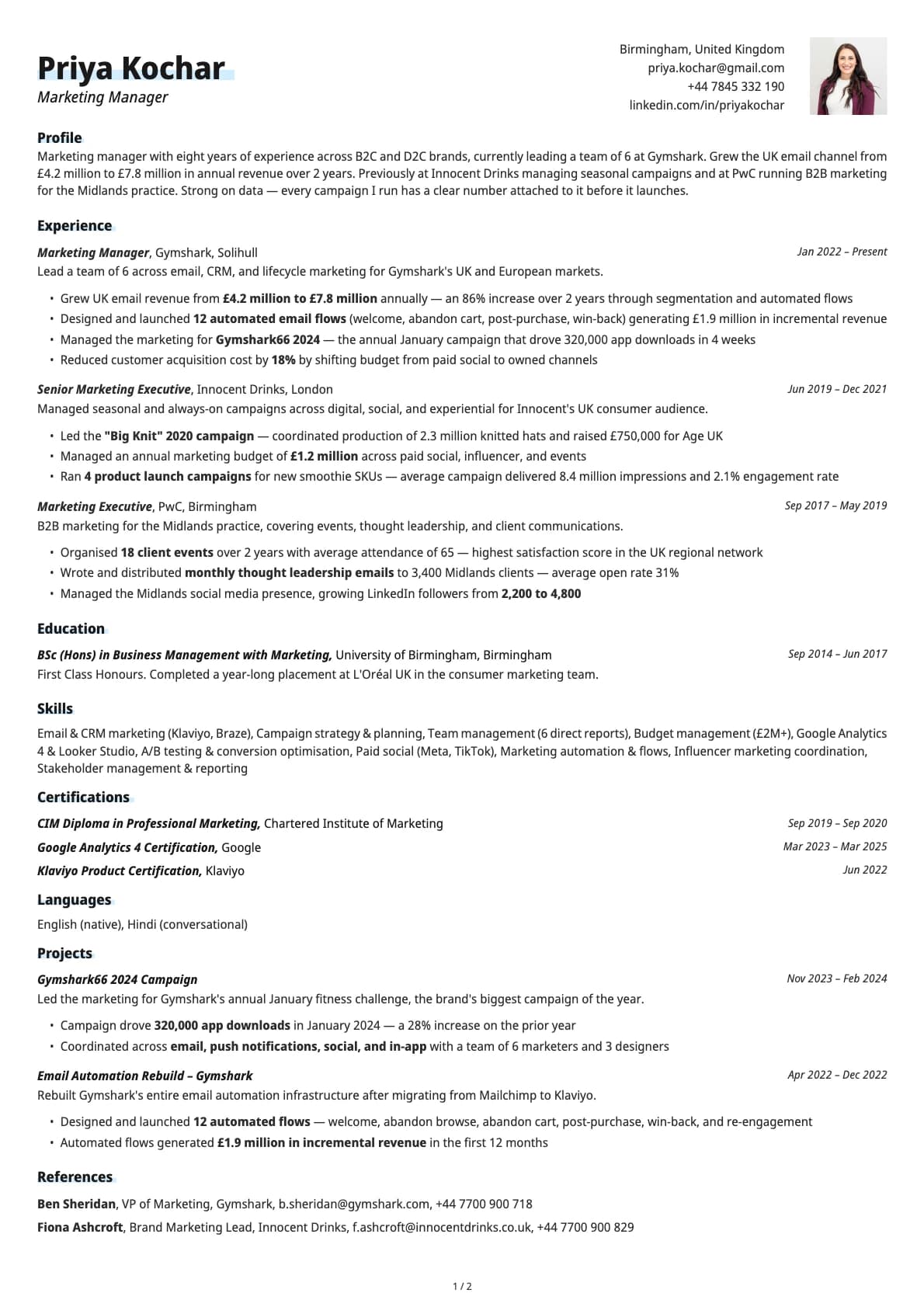
Marketing Manager
A marketing manager resume example with channel revenue growth, campaign results, and team management details.
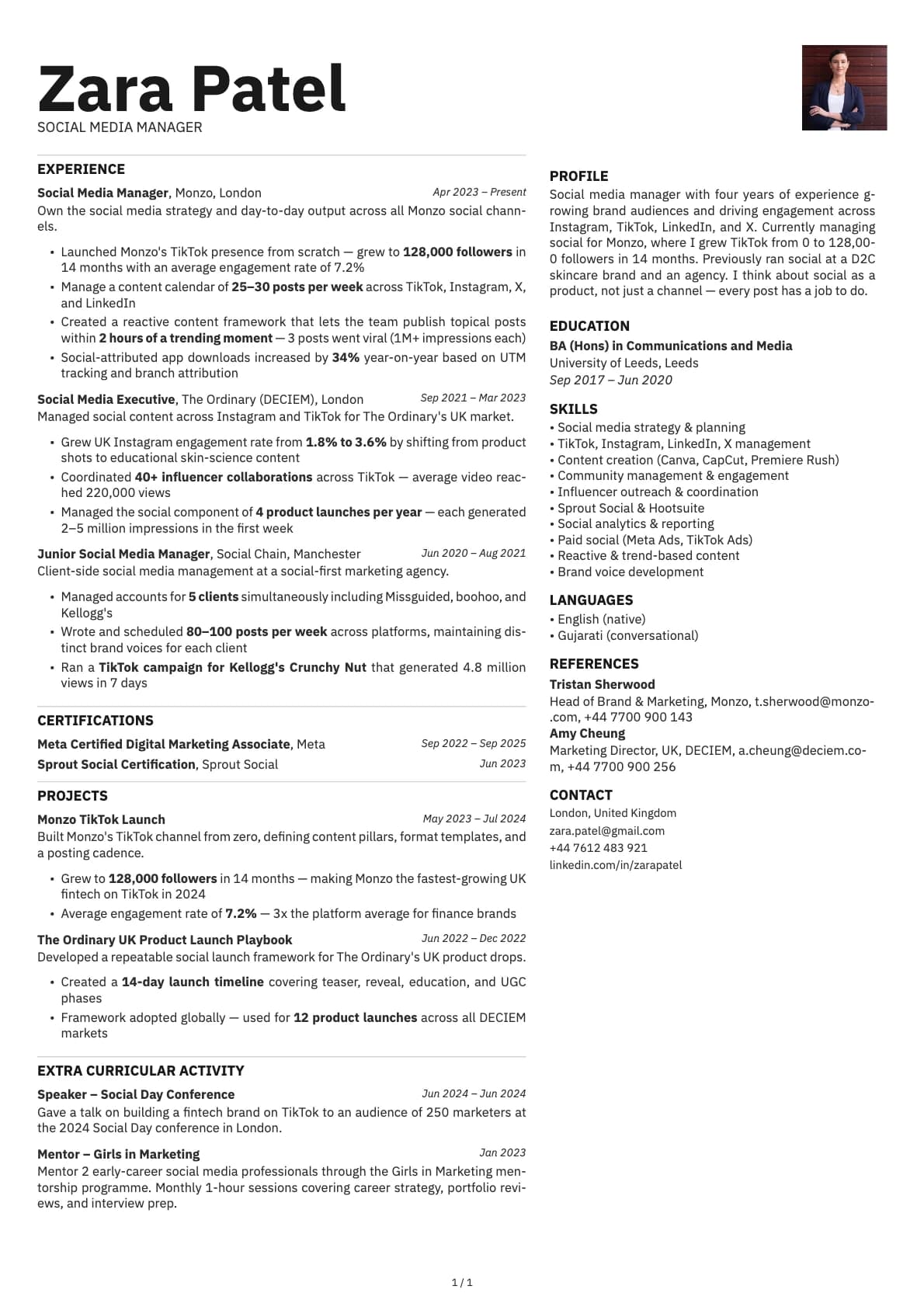
Social Media Manager
A social media manager resume example with follower growth, engagement rates, and campaign results.
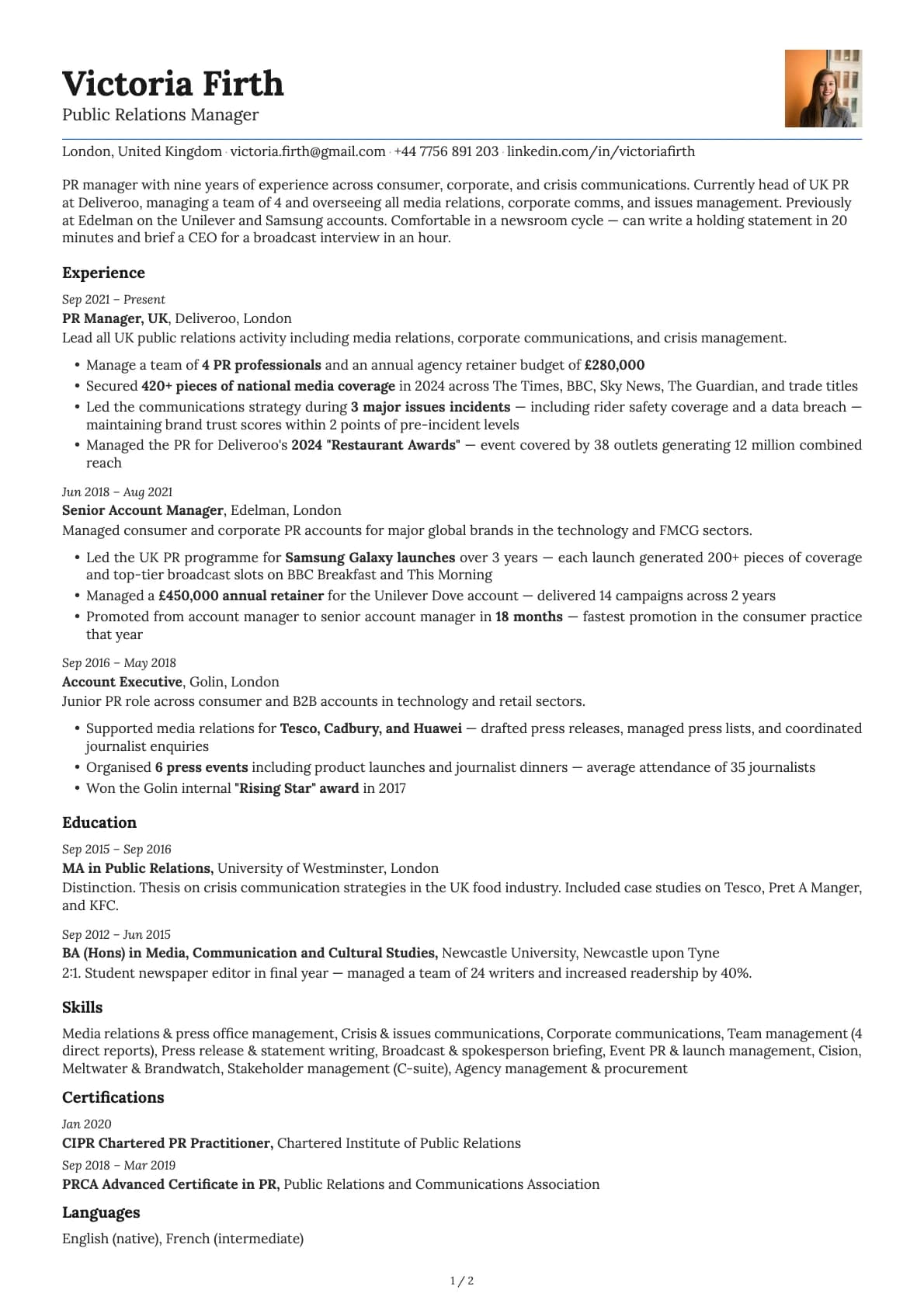
Public Relations Manager
A public relations manager resume example with media coverage numbers, crisis communications experience, and campaign reach from agency and in-house roles.
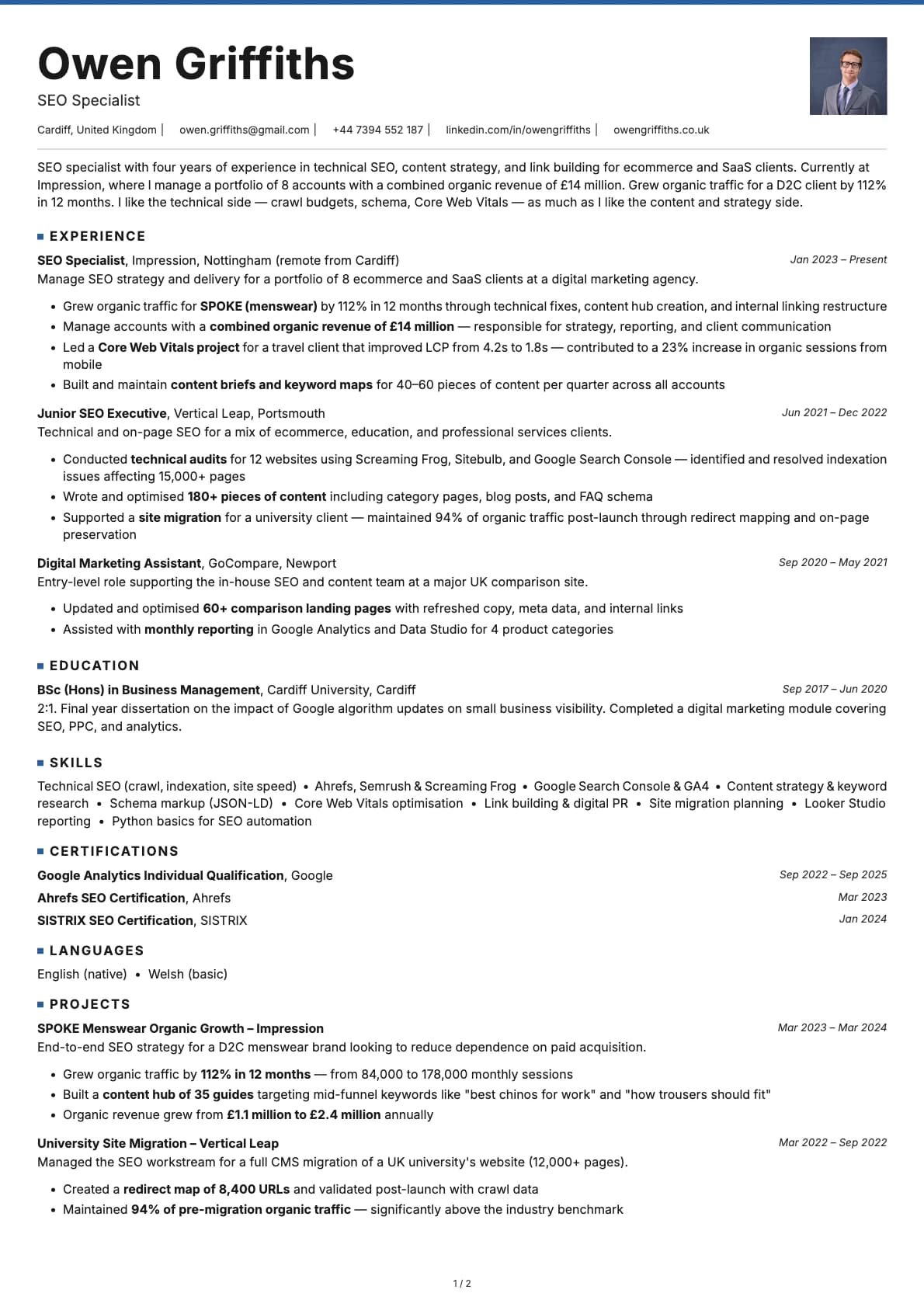
SEO Specialist
An SEO specialist resume example with traffic growth numbers, technical audit results, and content strategy outcomes.
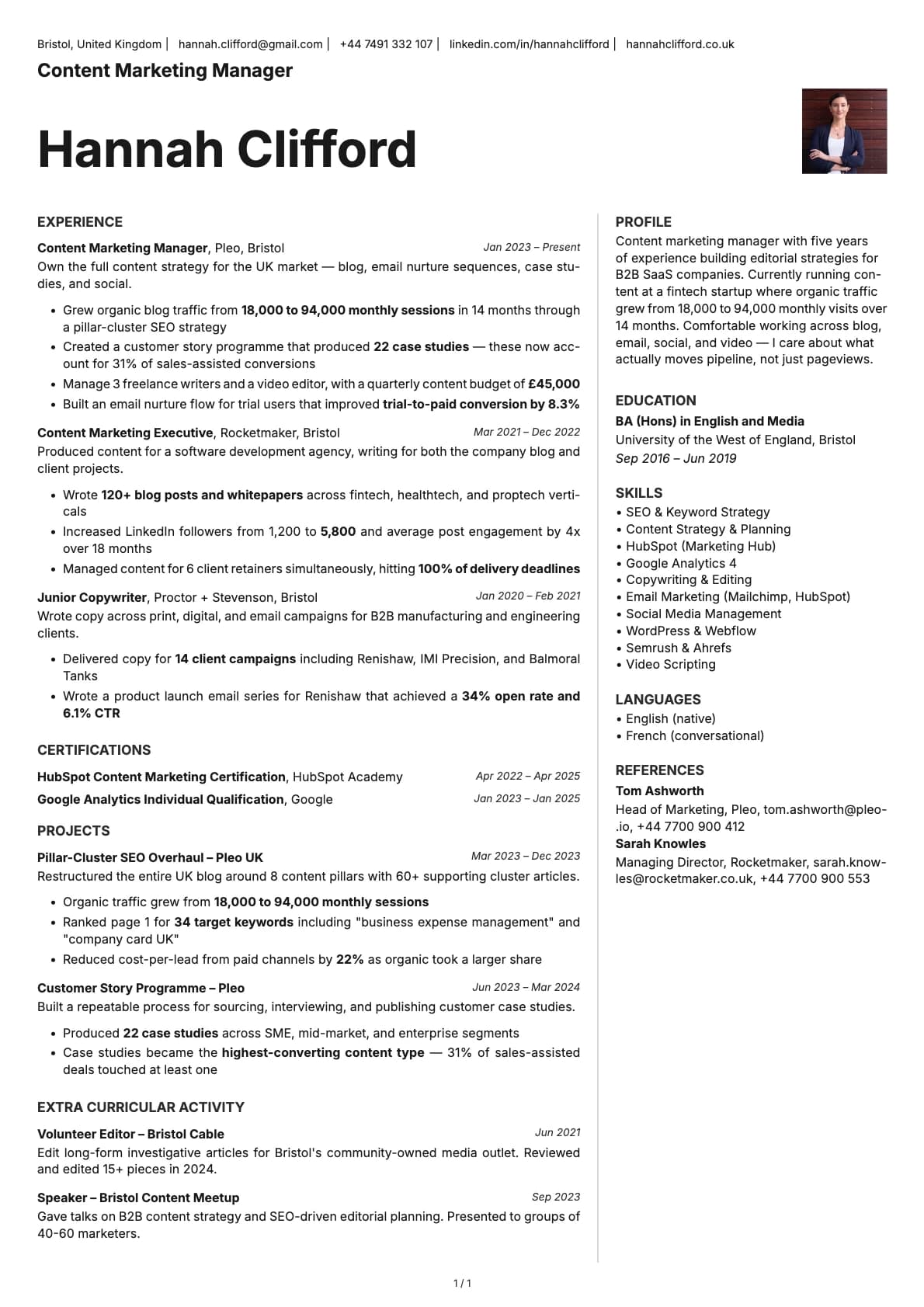
Content Marketing Manager
A content marketing manager resume example with B2B SaaS experience at Pleo.
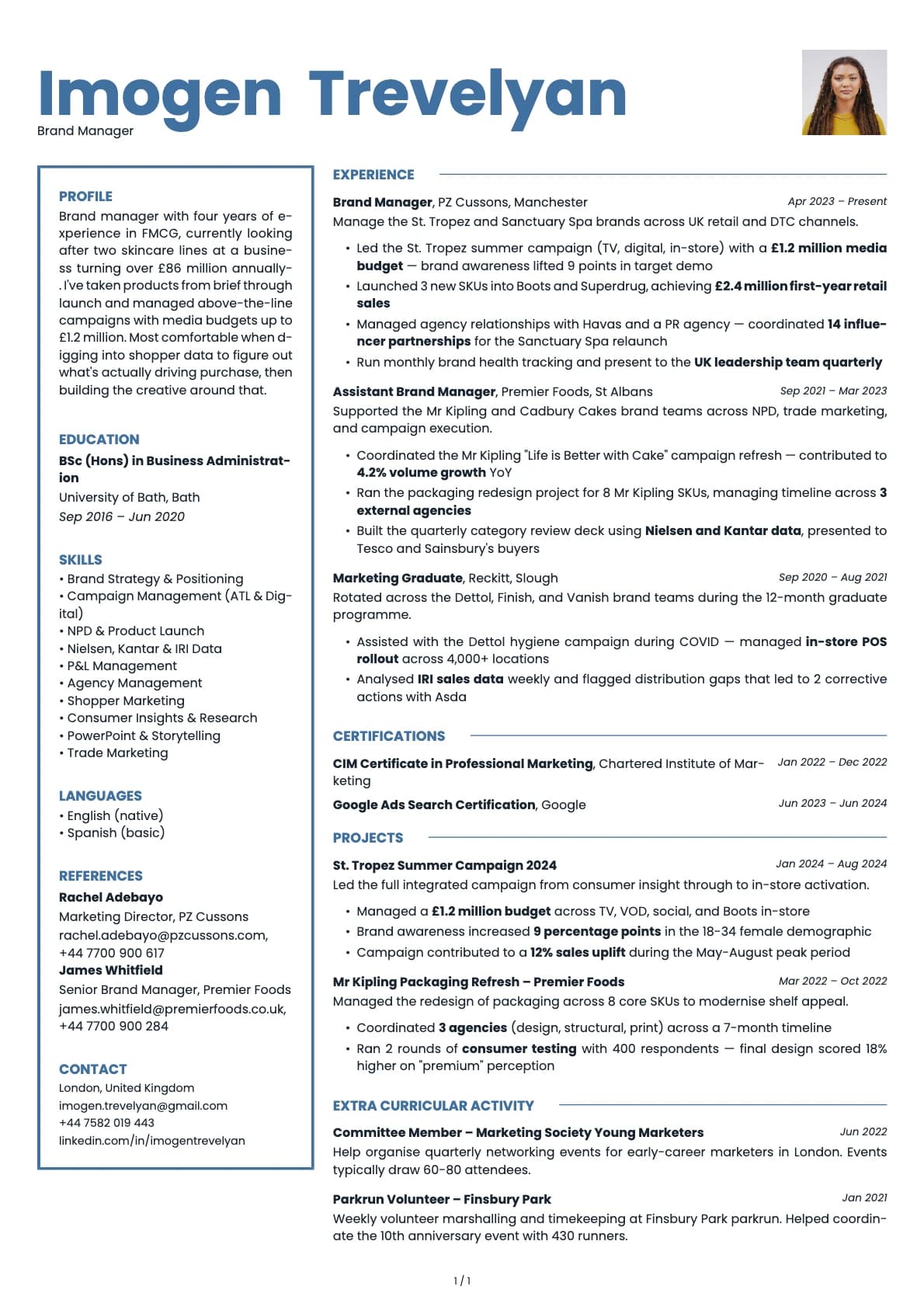
Brand Manager
A brand manager resume example from FMCG with campaign budgets, NPD launches, and Nielsen/Kantar data experience across PZ Cussons and Premier Foods.
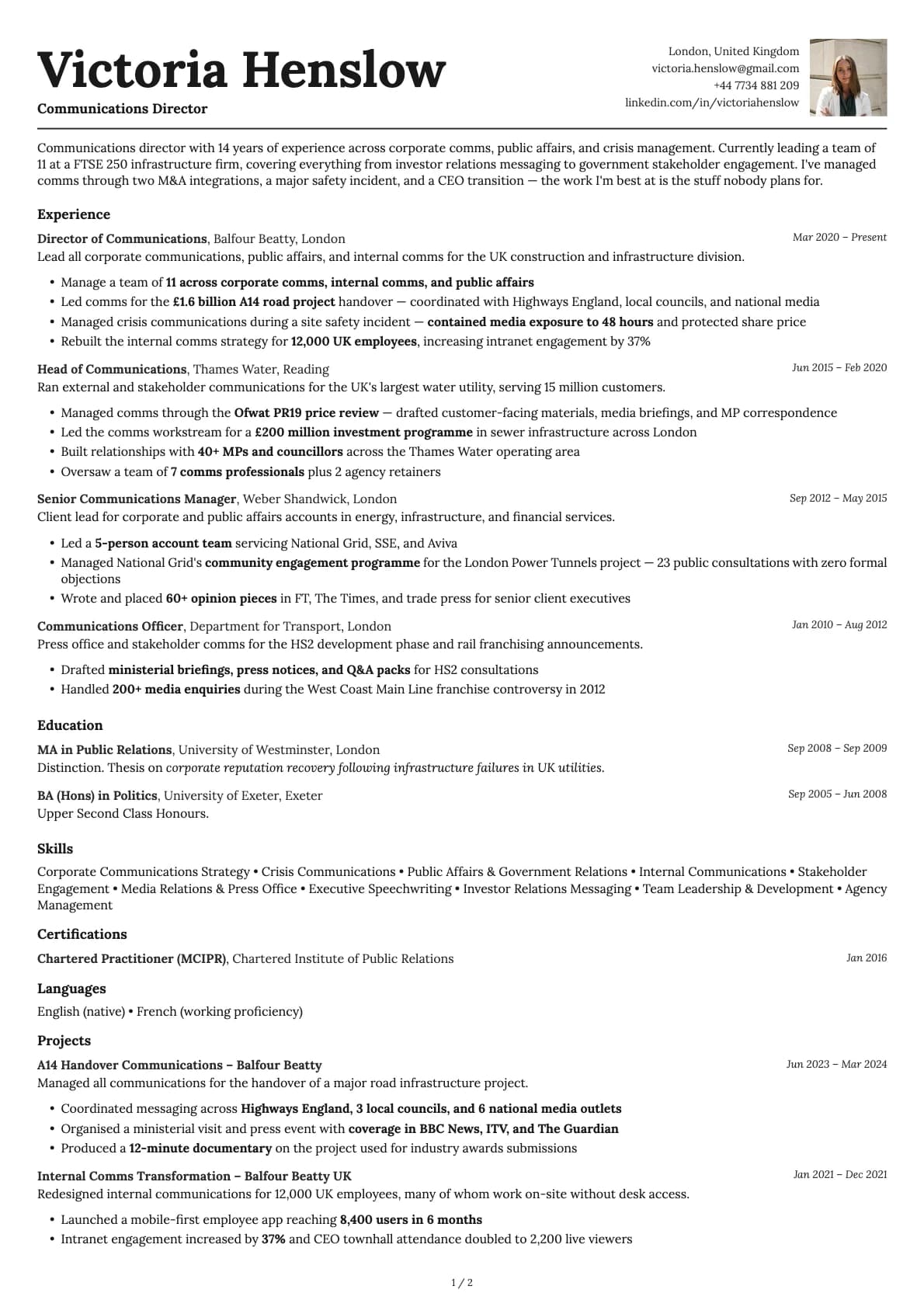
Communications Director
A communications director resume example with 14 years of experience across corporate comms, public affairs.
Related articles

AI Is Screening Your Resume Before Any Human Sees It
AI screens most resumes before a human ever reads them. 97.4% of Fortune 500 companies run an ATS. This is what that means for you and what you can do about it.

The Best Resume Builders in 2026, Compared Honestly
Resume.io, Zety, Enhancv, Kickresume, Teal, and Laddro compared honestly: real pricing, free tiers, mobile apps, and where each tool wins. All prices checked in September 2026.

Burnout Recovery: A Real Timeline, Not 'Take a Bubble Bath'
55% of the U.S. workforce is burned out. Recovery takes 3 to 12 months. Here's what that actually looks like, stage by stage.