Public Relations Manager Resume Example
A public relations manager resume example with media coverage numbers, crisis communications experience, and campaign reach from agency and in-house roles.

Laddro Team
Free to use. No account needed to start.
Free to use. No account needed to start.
Overview
PR resumes often read like press releases about the person writing them. Full of impressive-sounding language but light on actual evidence. "Developed and executed integrated communications strategies that elevated brand visibility." What does that even mean? How much coverage? What publications? What happened during a crisis?
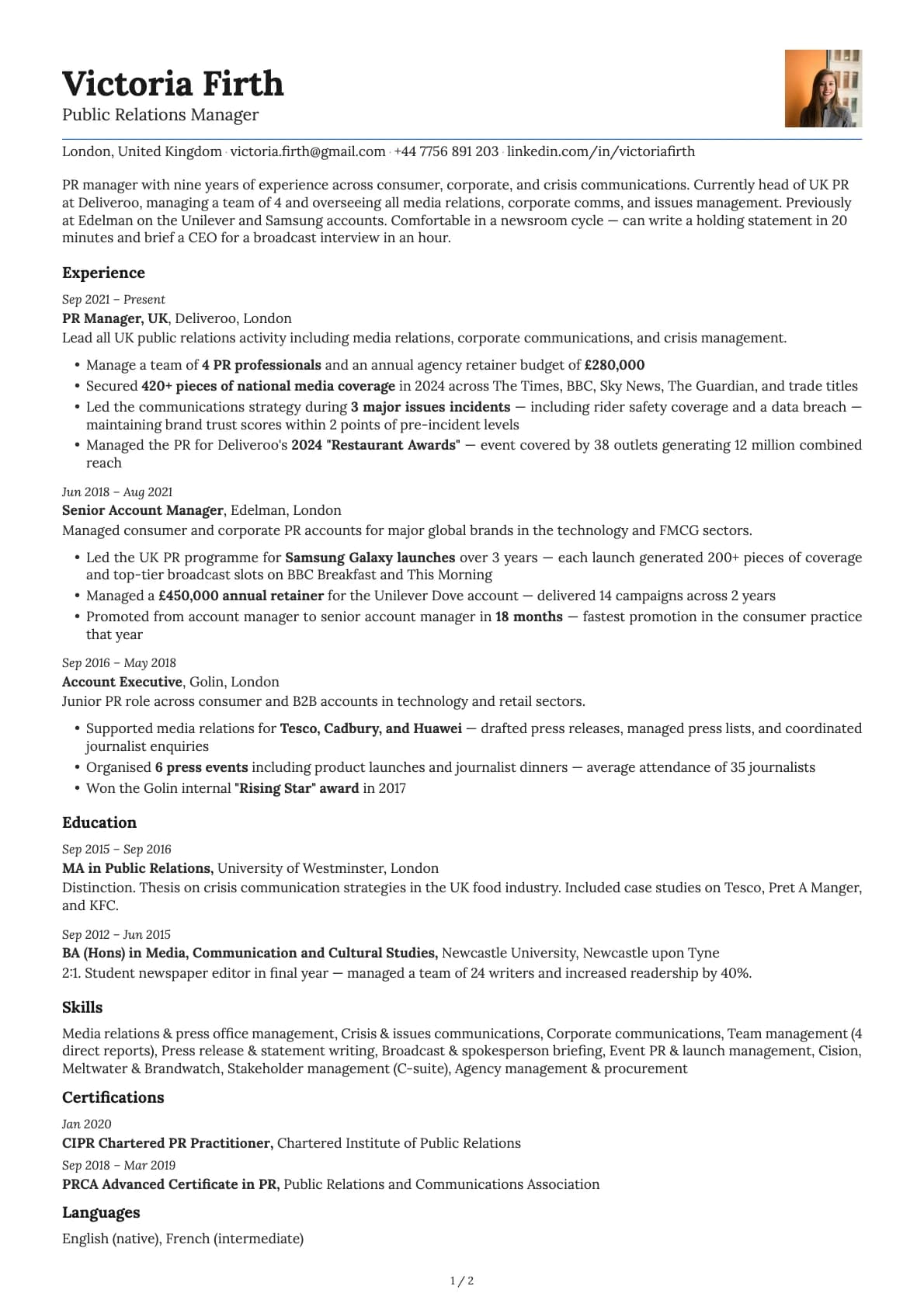
This resume belongs to Victoria Firth, a PR manager with nine years of experience. She runs UK PR at Deliveroo, managing a team of four and an agency retainer budget of £280,000. Before that, she spent over three years at Edelman working on Samsung and Unilever accounts. She started at Golin handling Tesco, Cadbury, and Huawei.
What makes this resume work is that every claim has a number next to it. Coverage counts, reach figures, budget sizes, team numbers. Let us break it down.
Your summary should read like a credentials line
In PR, your credibility comes from two things: who you have worked for and what you have handled. Victoria's summary hits both:
"Currently head of UK PR at Deliveroo, managing a team of 4 and overseeing all media relations, corporate comms, and issues management. Previously at Edelman on the Unilever and Samsung accounts."
Then she adds a practical detail: "Comfortable in a newsroom cycle, can write a holding statement in 20 minutes and brief a CEO for a broadcast interview in an hour."
That second line is smart. It does not just say she handles crisis comms. It gives a specific image of how fast she works under pressure. Any VP of Comms reading this immediately knows she can handle a breaking story.
For yours: Name your current company, team size, and biggest accounts. Then add one sentence about your working style or speed. Skip any line that could appear on any PR professional's resume.
How to write experience bullets in PR
PR work is hard to quantify. But it is not impossible. The trick is to think in terms of coverage volume, reach, budget, and outcomes.
Coverage volume
"Secured 420+ pieces of national media coverage in 2024 across The Times, BBC, Sky News, The Guardian, and trade titles"
This is the most basic PR metric, but most people forget to include it. How many pieces of coverage did you generate last year? If you can name specific outlets, even better.
Campaign reach
"Managed the PR for Deliveroo's 2024 'Restaurant Awards', event covered by 38 outlets generating 12 million combined reach"
Reach is not a perfect metric, but hiring managers still want to see it. If you ran a campaign, how many people did it reach? How many outlets covered it? How many social mentions did it generate?
Crisis and issues management
"Led the communications strategy during 3 major issues incidents, including rider safety coverage and a data breach, maintaining brand trust scores within 2 points of pre-incident levels"
Crisis communications experience is one of the hardest things to put on a resume. You cannot share confidential details, but you can reference the type of incident and the outcome. Victoria mentions three incidents, names two categories (rider safety, data breach), and gives the result (trust scores stayed stable). That is enough to show she has real crisis experience without breaking any confidentiality.
Budget and team management
"Manage a team of 4 PR professionals and an annual agency retainer budget of £280,000"
If you manage people or budgets, include the numbers. "Team management experience" is vague. "Team of 4 and £280,000 budget" is concrete.
Agency experience: name the accounts
If you have worked at an agency, the accounts you worked on ARE your resume. Victoria lists Samsung Galaxy launches (200+ coverage pieces each), the Unilever Dove account (£450,000 annual retainer, 14 campaigns), and names like Tesco, Cadbury, and Huawei at Golin.
If you worked on a recognisable brand, name it. Art directors, VPs of Comms, and CMOs make snap judgments based on the accounts listed on your resume. "Consumer accounts in the technology sector" is forgettable. "Samsung Galaxy launches" is not.
Also note that Victoria includes her promotion speed: "Promoted from account manager to senior account manager in 18 months, fastest promotion in the consumer practice that year." If you were promoted quickly, say so. It adds evidence of performance beyond the work itself.
Skills: tools matter as much as abilities
Victoria lists Cision, Meltwater, and Brandwatch alongside more traditional PR skills. These media monitoring and measurement tools are used daily in most PR roles. If you know how to use them, list them. They are keyword matches that ATS systems and hiring managers scan for.
She also lists "Broadcast & spokesperson briefing" and "Agency management & procurement" as distinct skills. These are specific enough to be useful. Compare them with "excellent communication skills" (which every PR person claims) and you can see why specificity wins.
Certifications: CIPR Chartered status matters
Victoria holds CIPR Chartered PR Practitioner status and a PRCA Advanced Certificate. In the UK PR industry, CIPR Chartered status is the most recognised professional qualification. If you have it, list it. If you are working towards it, include it as in progress.
For senior roles, some companies use CIPR membership as a shortlisting criterion. It is not always essential, but it is often desirable, and having it removes any doubt.
Mistakes PR professionals make on their resumes
No coverage numbers. If you cannot quantify your coverage, the reader has no way to assess your impact. Even rough numbers are better than none. "Generated 150+ pieces of coverage" is credible and useful. "Generated significant media interest" is not.
Describing the strategy without the outcome. "Developed a multi-channel communications strategy" is the start of a bullet, not the end. What happened because of it? How many people saw it? Did sales move? Did brand scores change?
Not mentioning crisis experience. If you have handled a crisis, say so. You do not need to name the company or share confidential details. But referencing the type of incident and the outcome tells the hiring manager you have been tested.
Ignoring measurement. PR is increasingly data-driven. If you track AVE, share of voice, sentiment, or brand tracking scores, mention the tools and frameworks you use. "Evaluated campaign success" is empty. "Tracked share of voice and sentiment using Brandwatch, reporting monthly to the CMO" is specific.
One more thing
PR hiring managers read fast. They skim headlines and numbers, just like they skim media coverage. Structure your resume the same way you would structure a press release: put the most newsworthy information first, back it up with facts, and keep it tight. If your resume reads like the kind of writing you would send to a journalist, you are doing it right.
Build your own version
Open this layout in the builder and swap in your own details. It takes a few minutes.
Free to use. No account needed to start.
Was this resume example helpful?
Rate this example to help us create better content for you.
4.7 average from 112 ratingsRelated resume examples
Marketing Manager
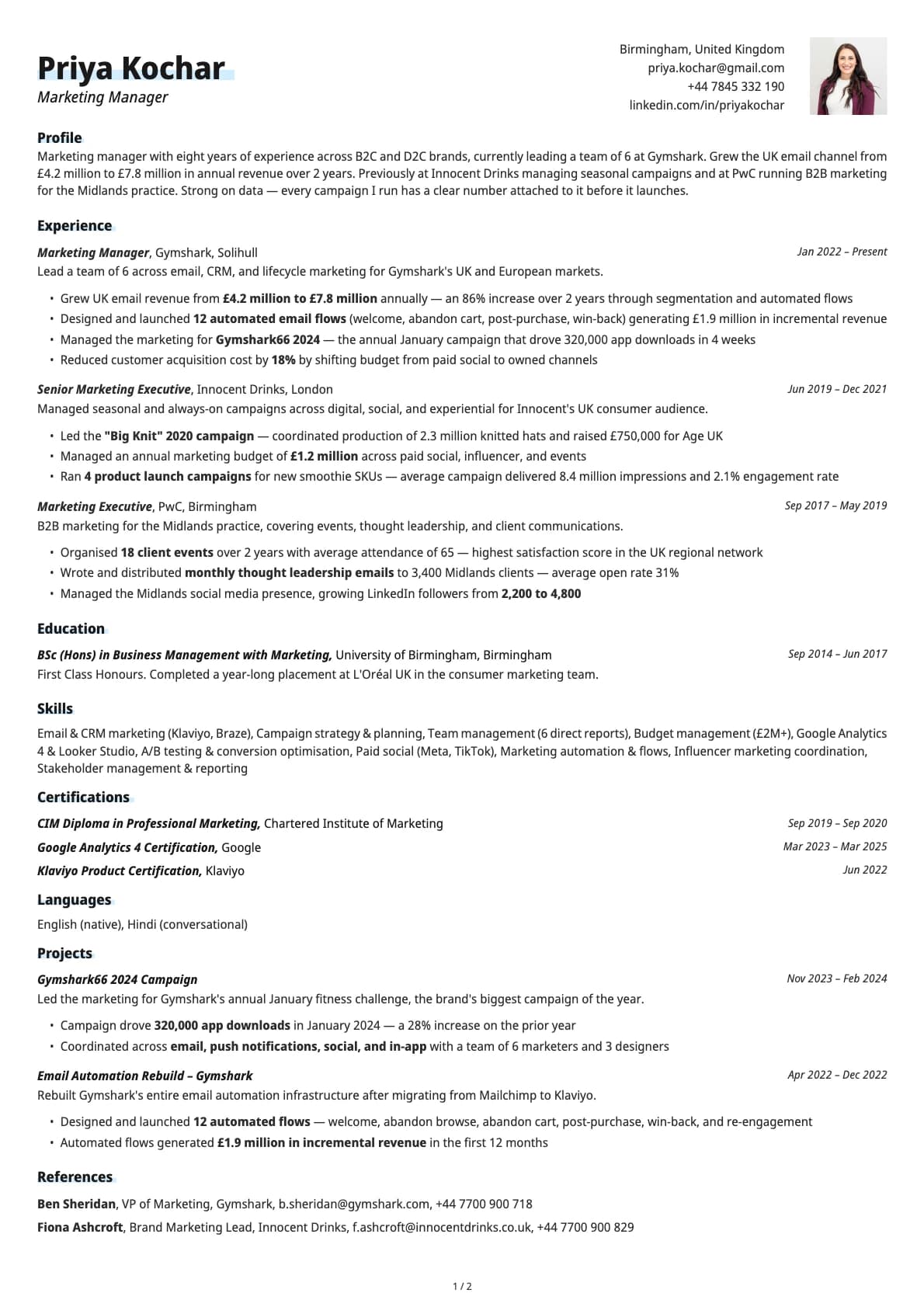
A marketing manager resume example with channel revenue growth, campaign results, and team management details.
Social Media Manager
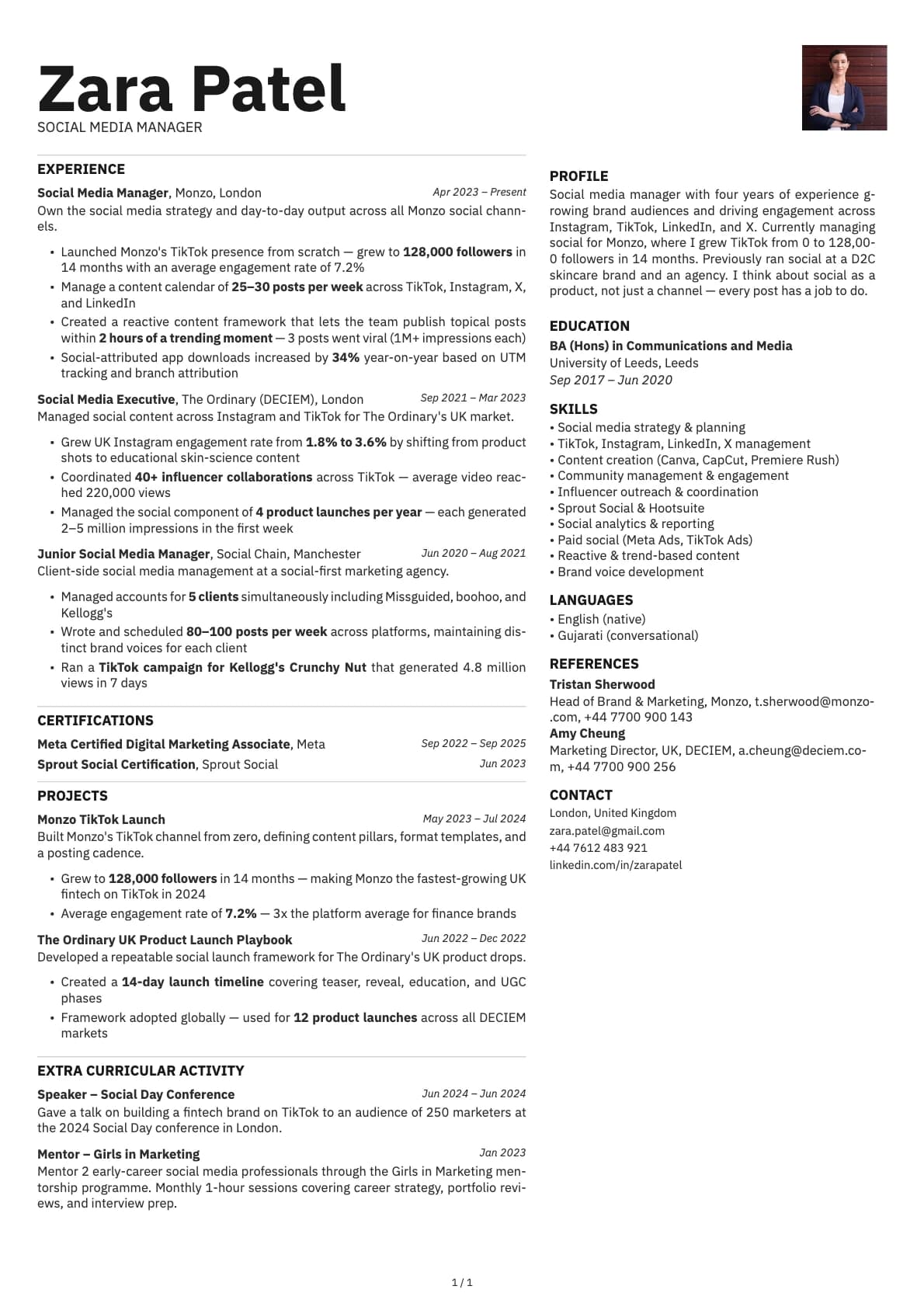
A social media manager resume example with follower growth, engagement rates, and campaign results.
SEO Specialist
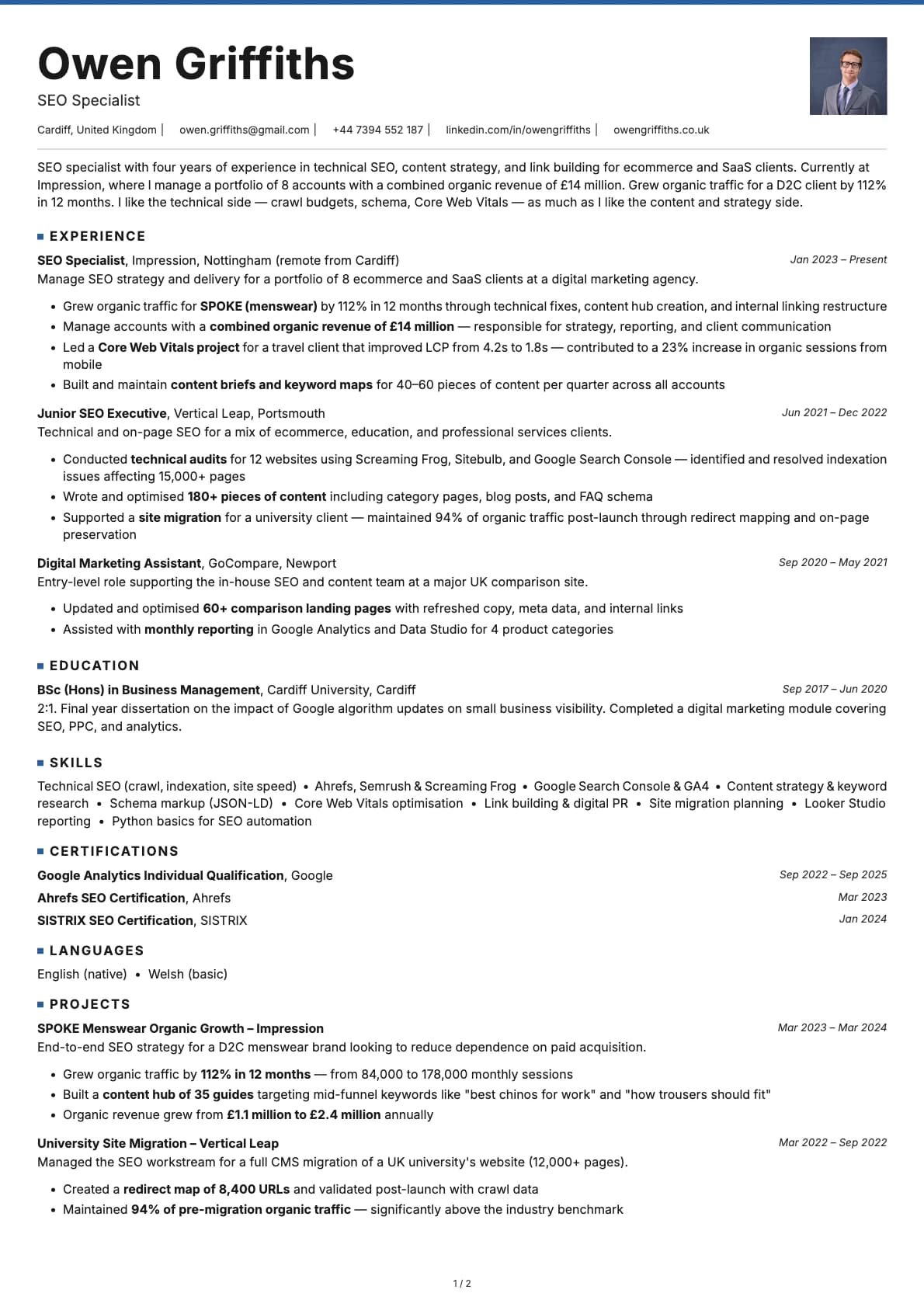
An SEO specialist resume example with traffic growth numbers, technical audit results, and content strategy outcomes.
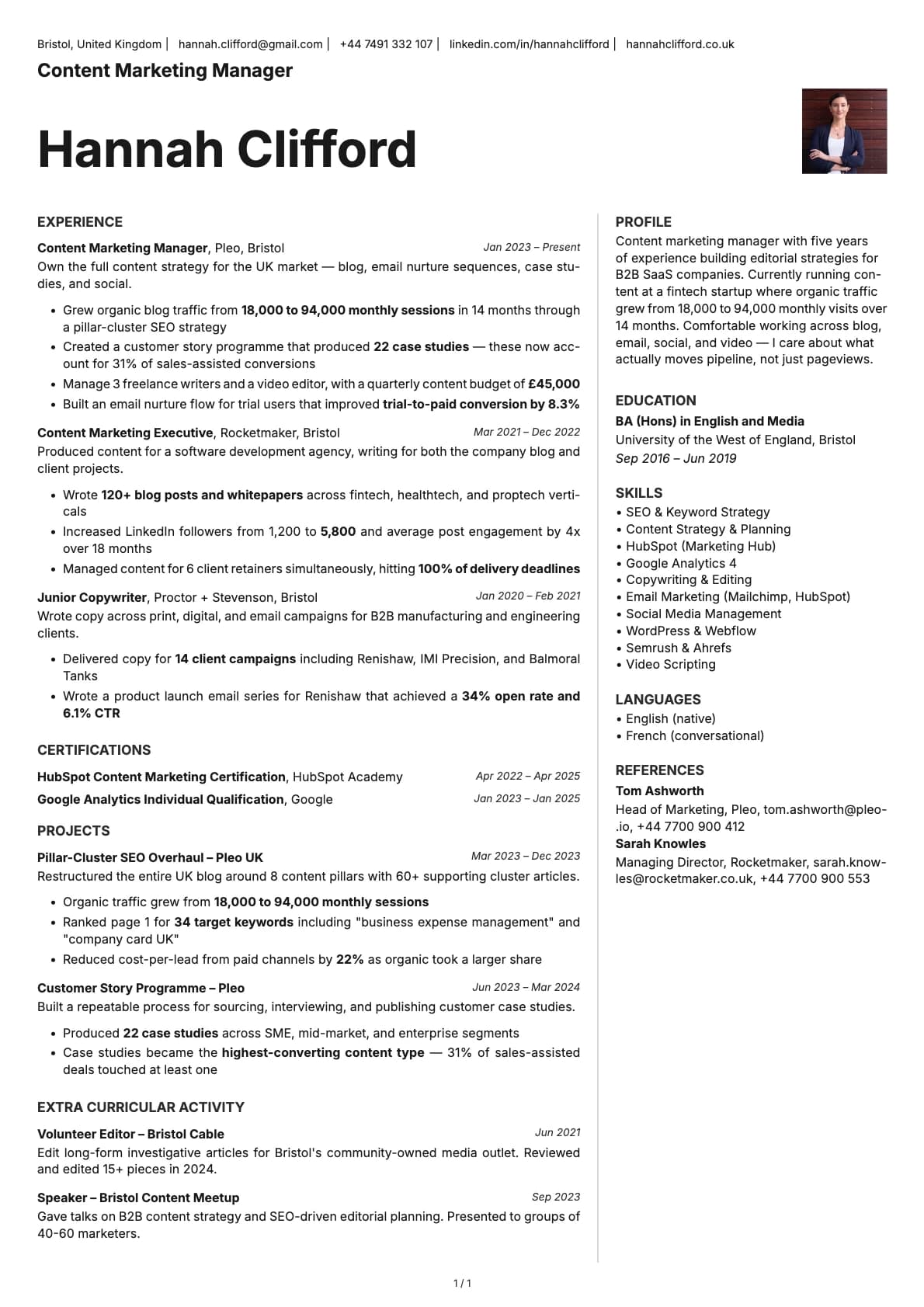
Content Marketing Manager
A content marketing manager resume example with B2B SaaS experience at Pleo.
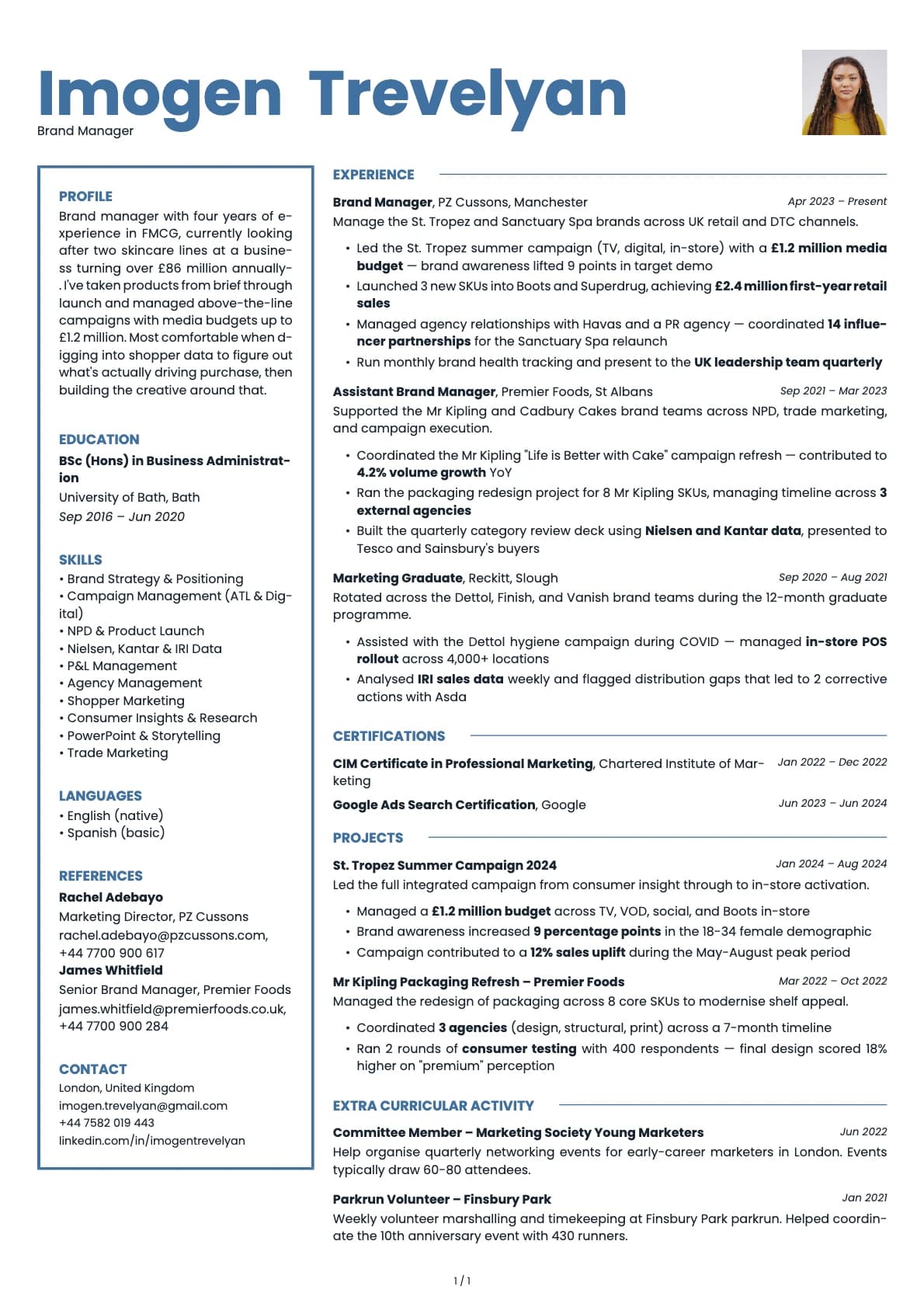
Brand Manager
A brand manager resume example from FMCG with campaign budgets, NPD launches, and Nielsen/Kantar data experience across PZ Cussons and Premier Foods.
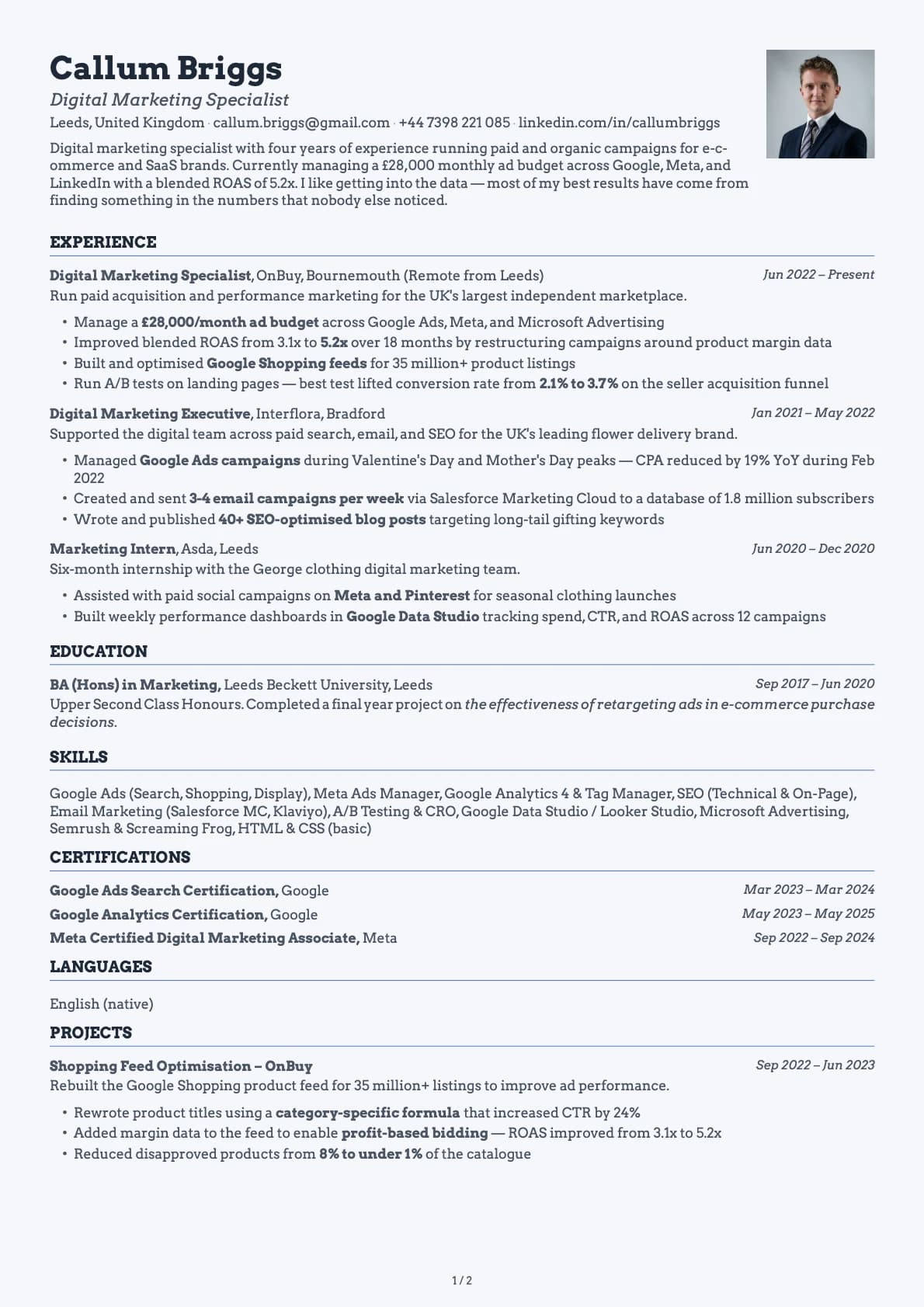
Digital Marketing Specialist
A digital marketing specialist resume example showing how to present campaign performance, ad spend management, and ROI numbers that recruiters actually.
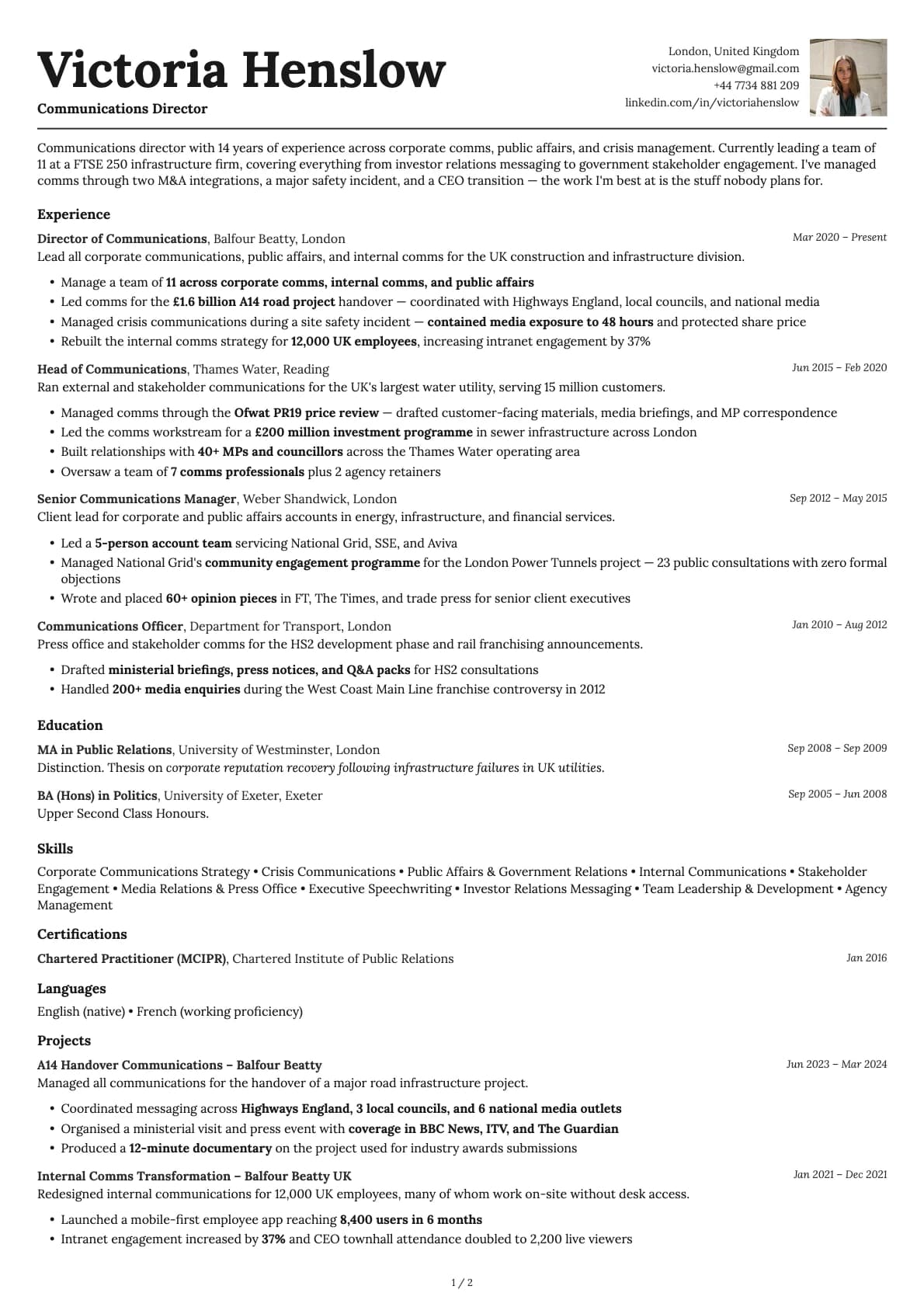
Communications Director
A communications director resume example with 14 years of experience across corporate comms, public affairs.
Related articles

AI Is Screening Your Resume Before Any Human Sees It
AI screens most resumes before a human ever reads them. 97.4% of Fortune 500 companies run an ATS. This is what that means for you and what you can do about it.

The Best Resume Builders in 2026, Compared Honestly
Resume.io, Zety, Enhancv, Kickresume, Teal, and Laddro compared honestly: real pricing, free tiers, mobile apps, and where each tool wins. All prices checked in September 2026.

Burnout Recovery: A Real Timeline, Not 'Take a Bubble Bath'
55% of the U.S. workforce is burned out. Recovery takes 3 to 12 months. Here's what that actually looks like, stage by stage.