Data Analyst Cover Letter Example
A data analyst cover letter example showing how to present analytical projects, business impact, and your ability to turn messy data into real decisions.

Laddro Team
Free to use. No account needed to start.
Free to use. No account needed to start.
What hiring managers want from a data analyst cover letter
Data analyst roles attract a lot of applications from people who know SQL and can make a chart in Tableau. That is the baseline. What separates a good cover letter from a forgettable one is showing that your analysis actually changed a decision. Not just that you ran queries, but that your queries mattered.
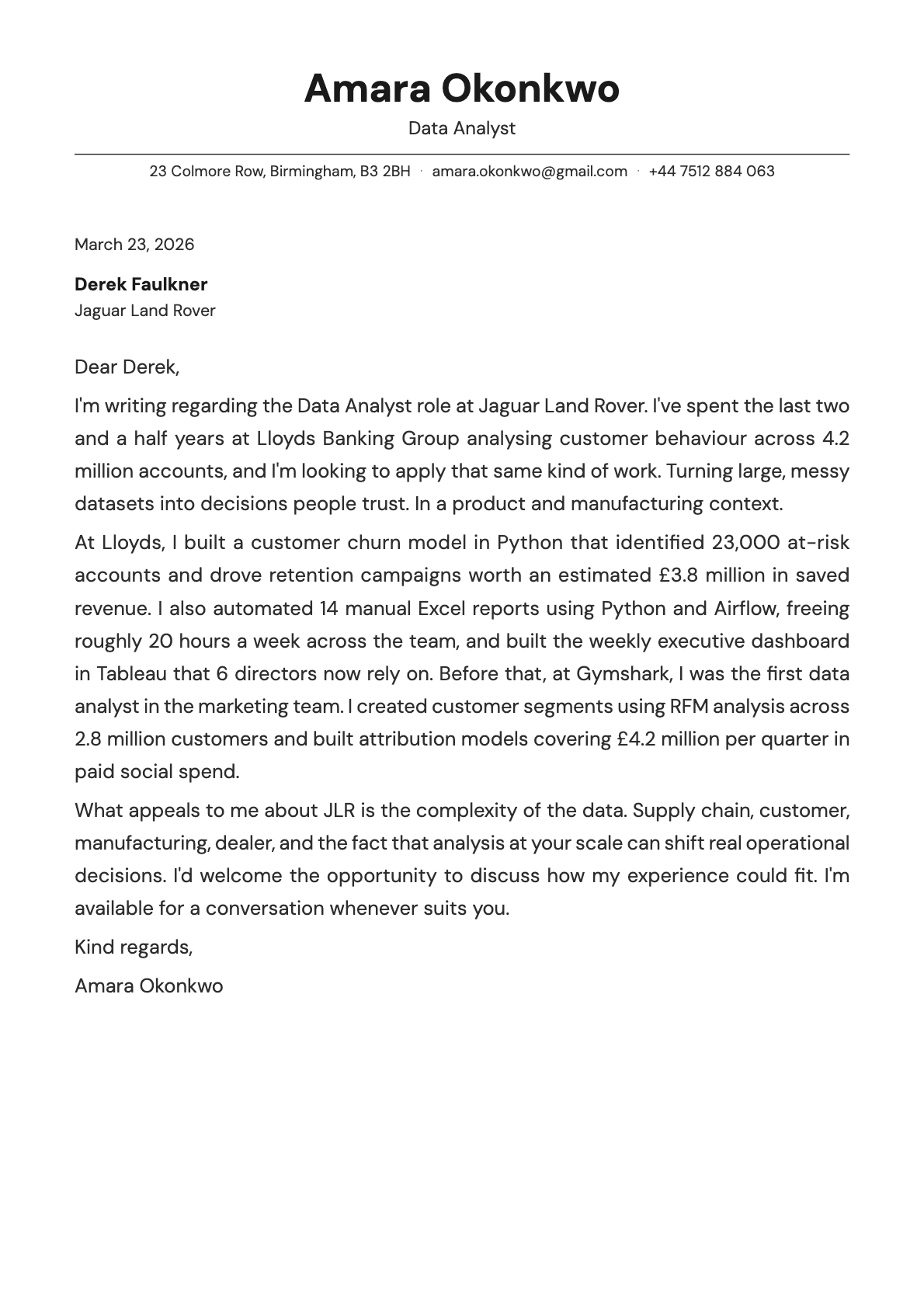
This example comes from Amara Okonkwo, a data analyst at Lloyds Banking Group applying to Jaguar Land Rover. She has analyzed customer behavior across 4.2 million accounts and previously built the first data function at Gymshark's marketing team.
Frame your work as business impact, not technical tasks
Amara does not start with "I am a skilled data analyst with experience in Python and SQL." She starts with what she does: analyzing customer behavior across 4.2 million accounts. Then she immediately explains what she wants to do next: apply that same approach in a product and manufacturing context.
Her standout accomplishment is a customer churn model that identified 23,000 at-risk accounts and drove retention campaigns worth an estimated 3.8 million pounds in saved revenue. That one sentence tells the hiring manager everything: she builds models, they work in production, and they generate measurable business value.
Your takeaway: Lead with the business outcome, not the tool. "Built a churn model that saved 3.8M" beats "developed a gradient-boosted classification model using scikit-learn."
Show you can automate and scale
One of the most valuable things a data analyst can do is eliminate manual work. Amara mentions automating 14 manual Excel reports using Python and Airflow, freeing roughly 20 hours a week across the team. That is not just a technical accomplishment. It shows she thinks about process and efficiency, not just individual analyses.
She also built the weekly executive dashboard in Tableau that 6 directors rely on. That detail matters because it shows her work reaches senior stakeholders, not just other analysts.
Tailor the letter to the company's data challenges
Amara closes by calling out what makes JLR's data interesting: supply chain, customer, manufacturing, and dealer data all in one place. She is not just saying "I like cars." She is identifying the specific analytical complexity that makes this role different from her current one.
This is the part most candidates skip. They write a generic closing about wanting to "grow in a challenging environment." But naming the actual data challenges tells the hiring manager you understand the job.
Structuring your data analyst cover letter
- Opening: What you analyze now, at what scale, and why this company's data interests you
- Middle: Two or three projects with outcomes (revenue saved, time freed, decisions influenced)
- Closing: What makes this company's data landscape specifically interesting to you
Tools to mention (and how)
Do not list tools in a vacuum. Instead of "proficient in Python, SQL, Tableau, and Airflow," say "automated 14 reports using Python and Airflow" or "built executive dashboards in Tableau used by 6 directors." The tool becomes part of the story instead of a keyword dump.
Final thoughts
A great data analyst cover letter proves you do not just analyze data. You use it to change how the business operates. Show the models you built, the time you saved, and the decisions your work influenced. That is what gets you the interview.
Was this cover letter example helpful?
Rate this example to help us create better content for you.
4.8 average from 163 ratingsBuild your own version
Open this layout in the builder and swap in your own details. It takes a few minutes.
Free to use. No account needed to start.
Related cover letter examples
Software Engineer
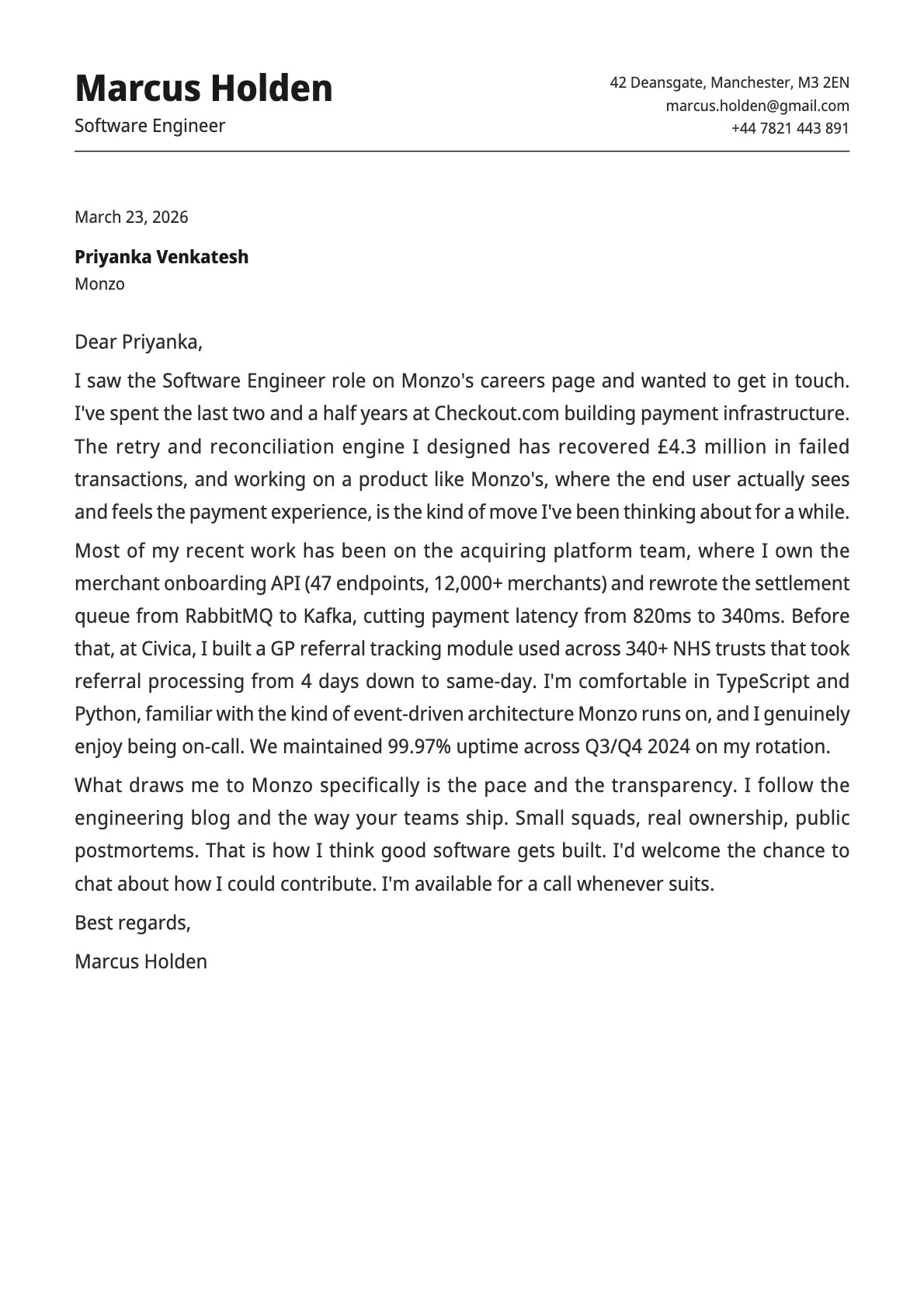
A software engineer cover letter example with practical tips on addressing the hiring manager, showing technical impact.
Frontend Developer
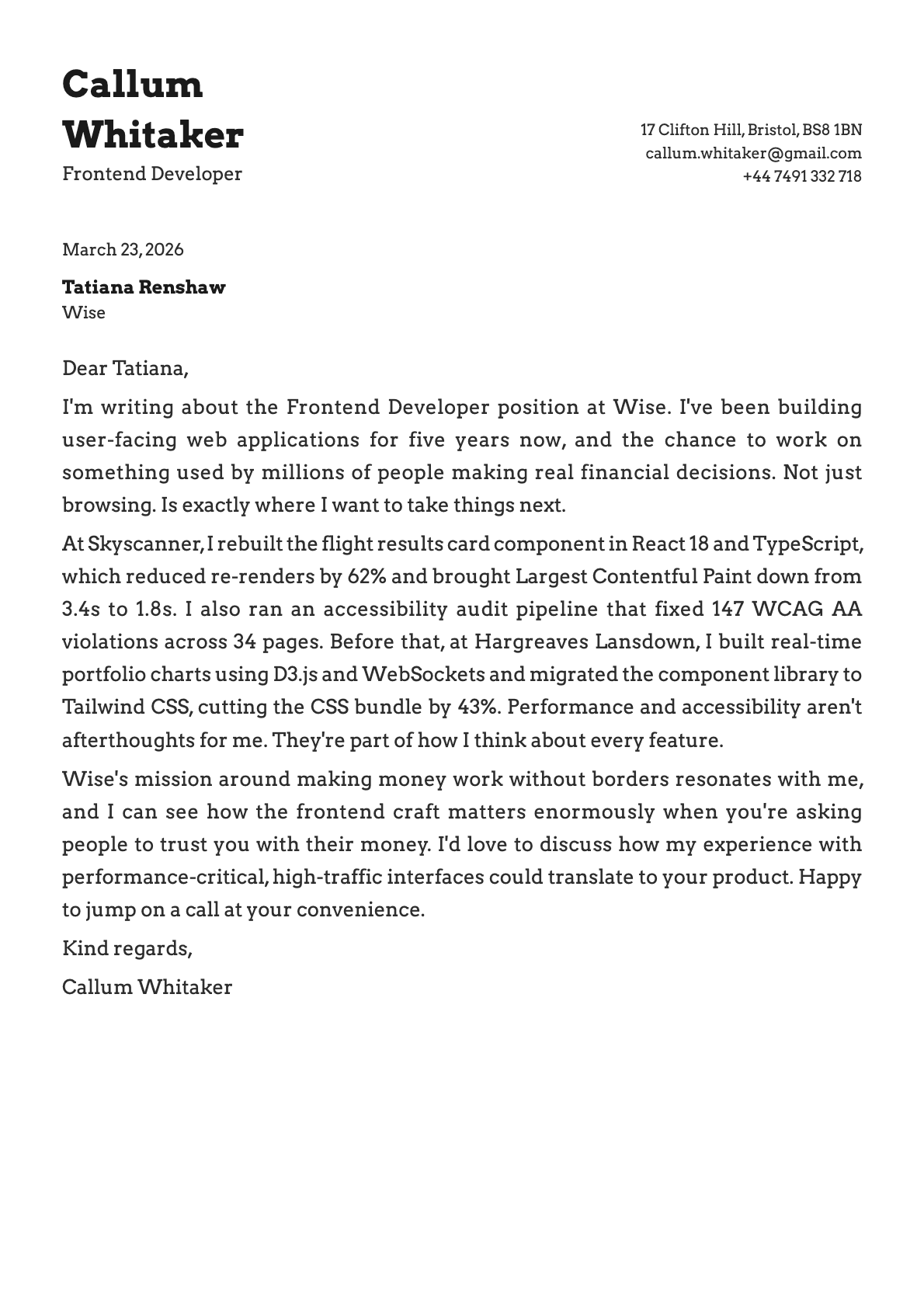
A frontend developer cover letter example showing how to highlight performance wins, accessibility work, and why you want a specific company.
Backend Developer
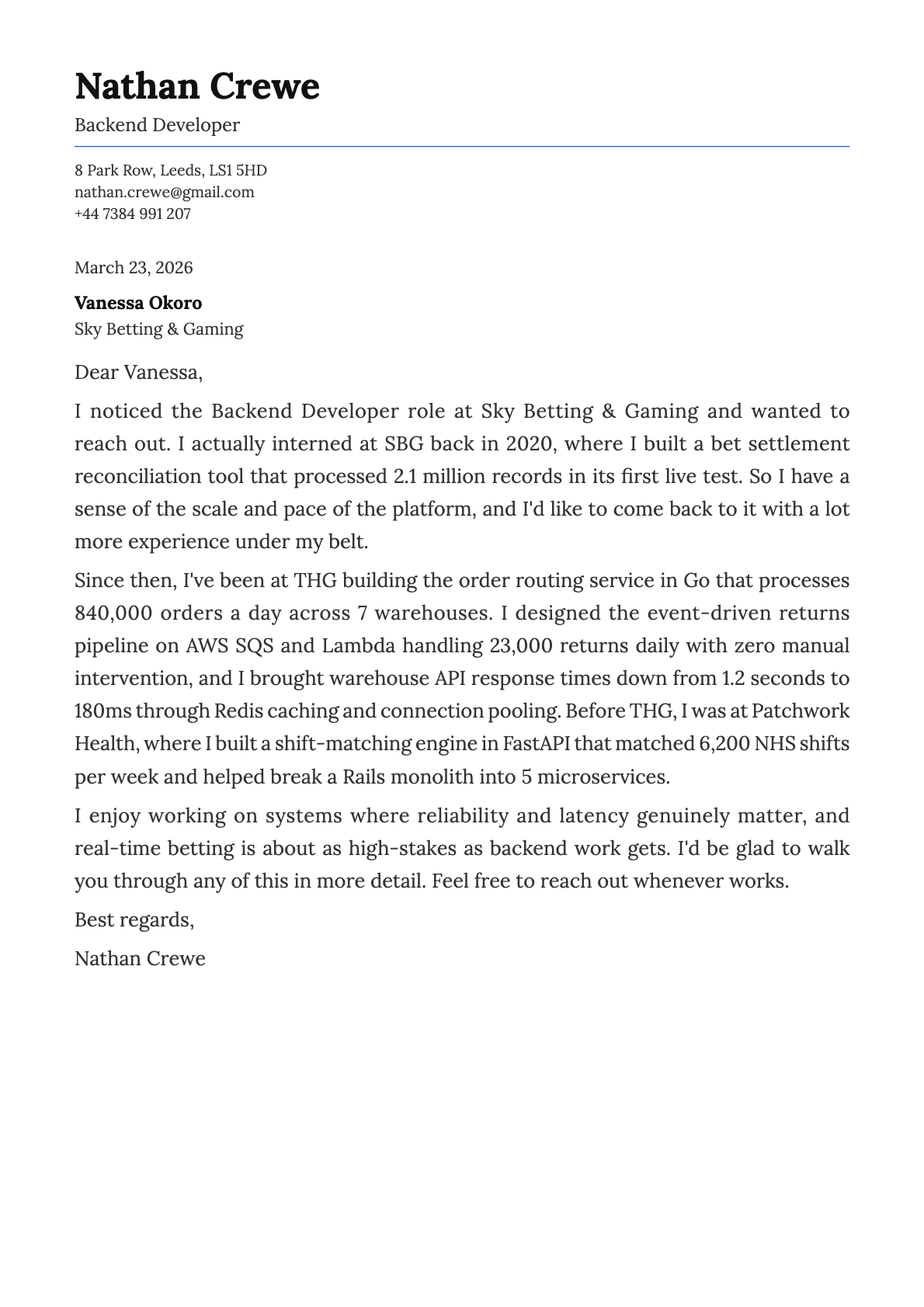
A backend developer cover letter example that shows how to present system design, throughput numbers, and reliability metrics to land an interview.
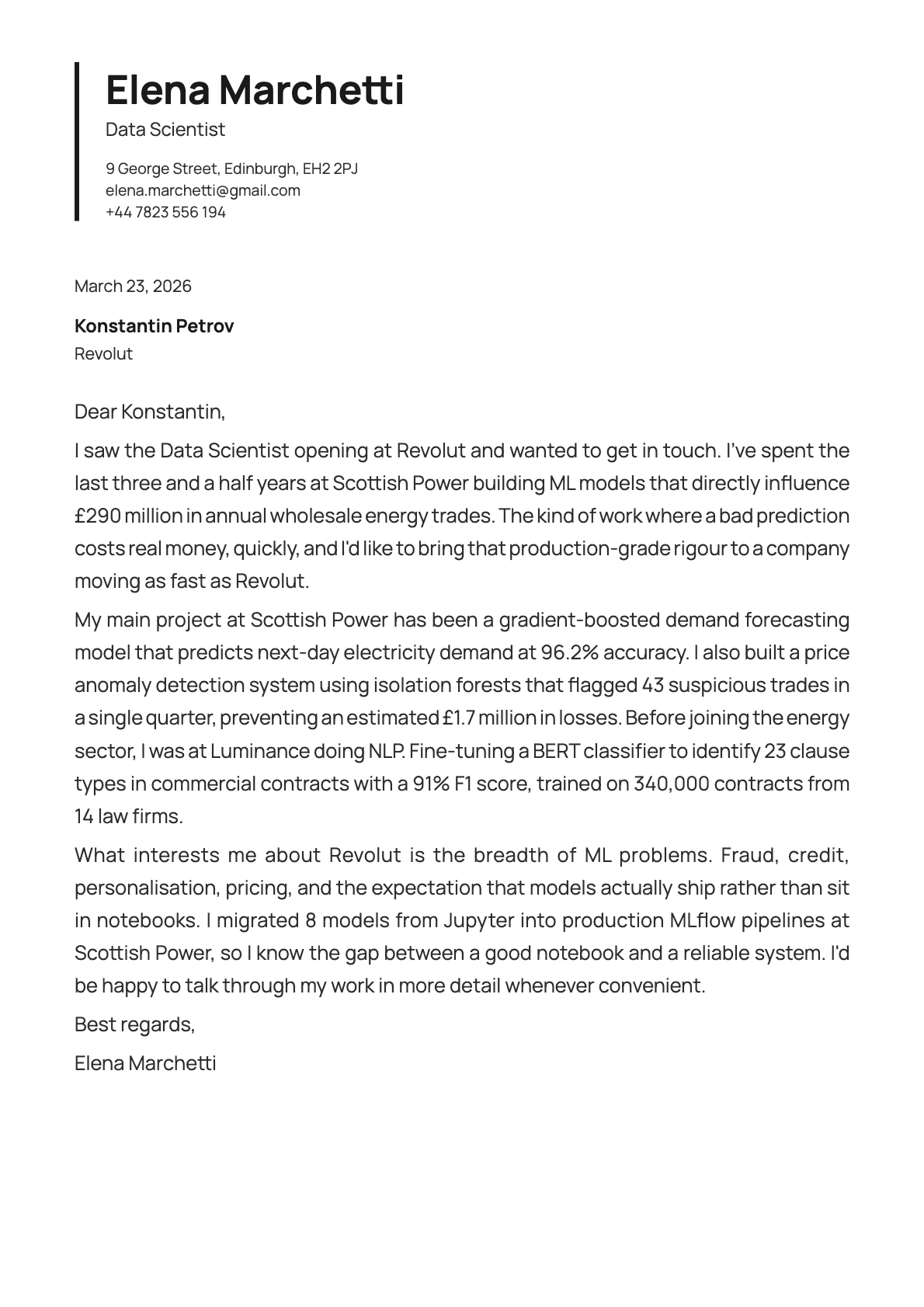
Data Scientist
A data scientist cover letter example showing how to present ML models, production deployments, and measurable outcomes to impress hiring managers.
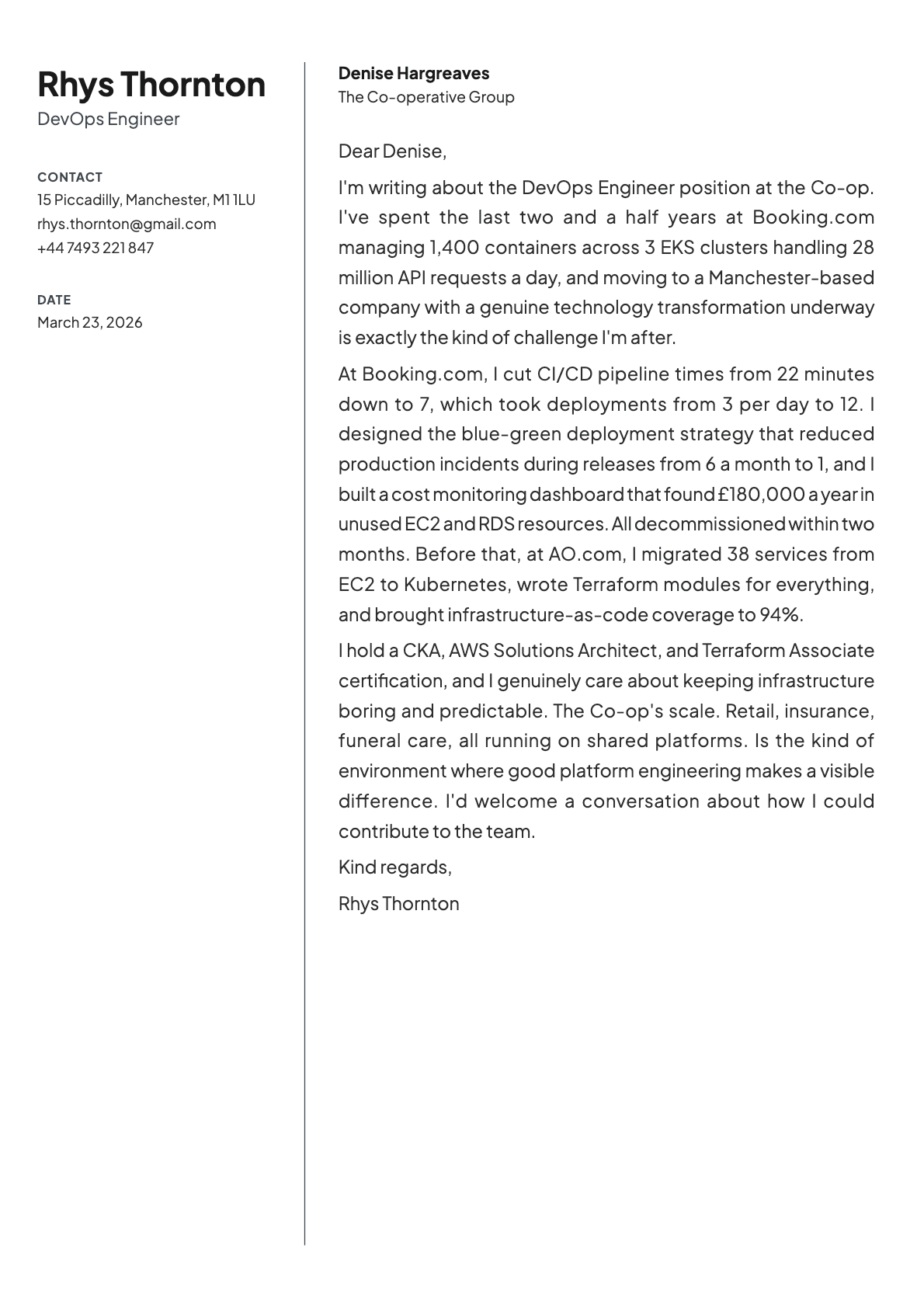
DevOps Engineer
A DevOps engineer cover letter example showing how to present infrastructure wins, CI/CD improvements, and cost savings that hiring managers care about.
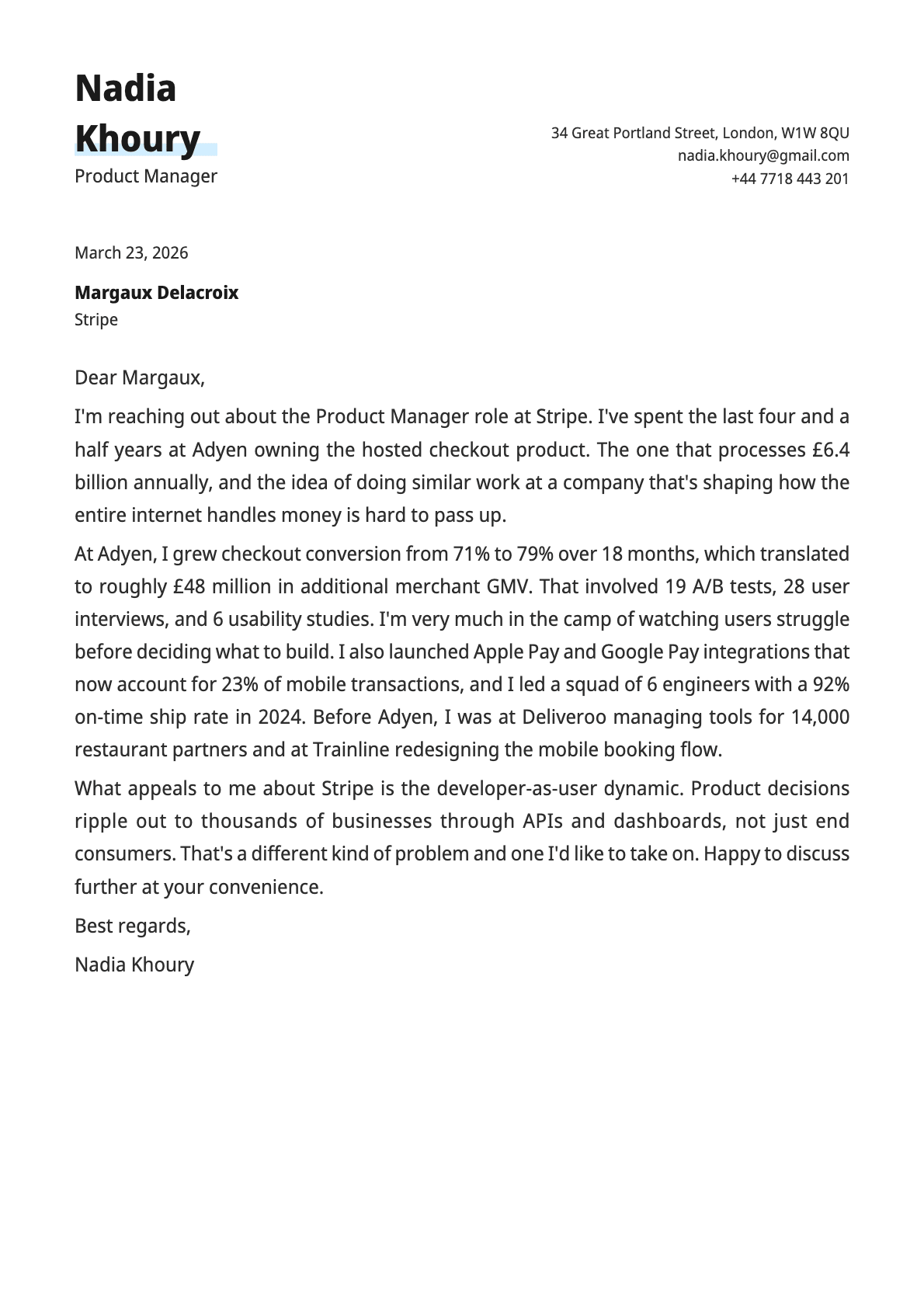
Product Manager
A product manager cover letter example showing how to present conversion improvements, A/B testing, and squad leadership when applying to a payments.
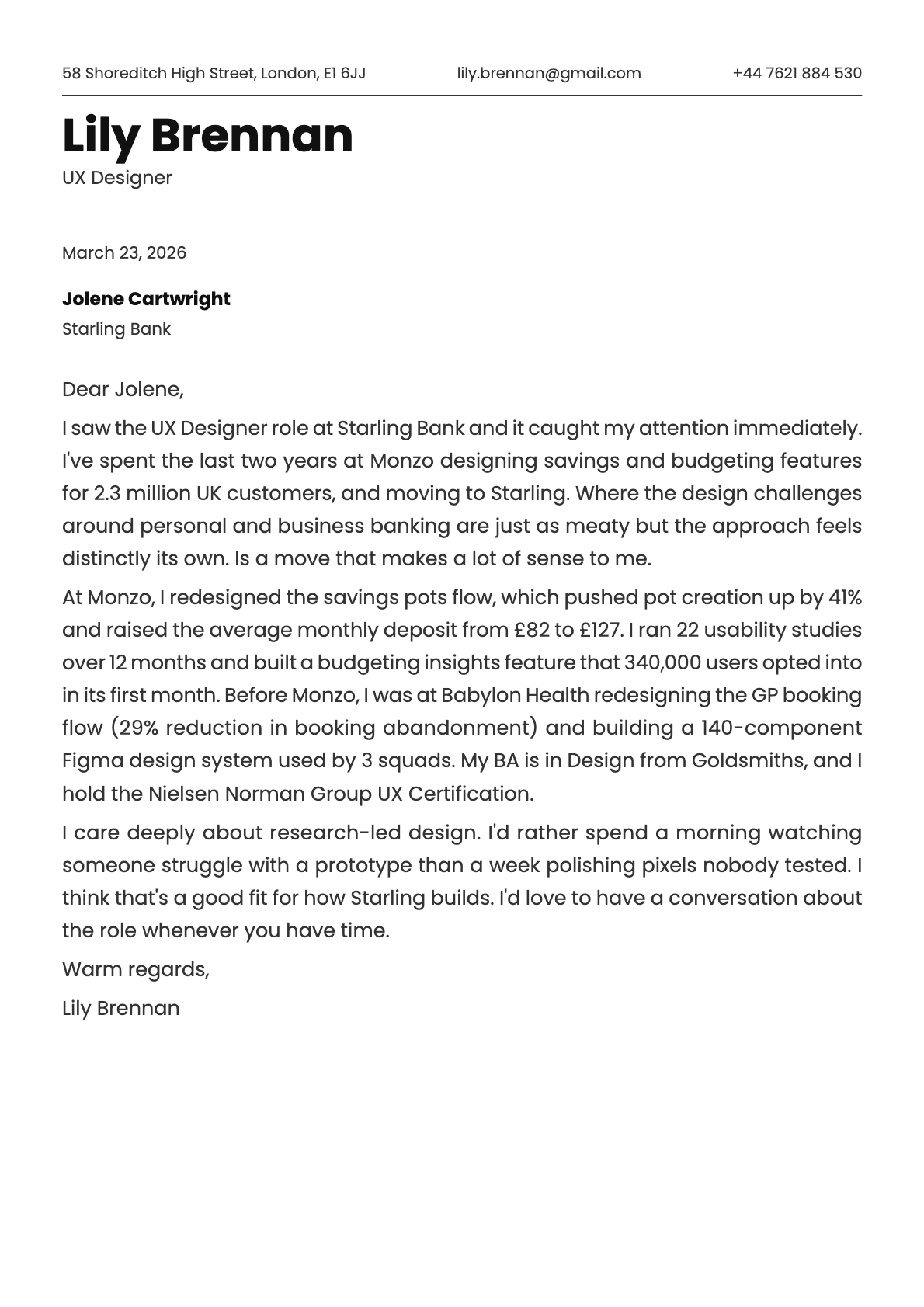
UX Designer
A UX designer cover letter example showing how to present usability research, conversion improvements, and design system work when applying to a digital.
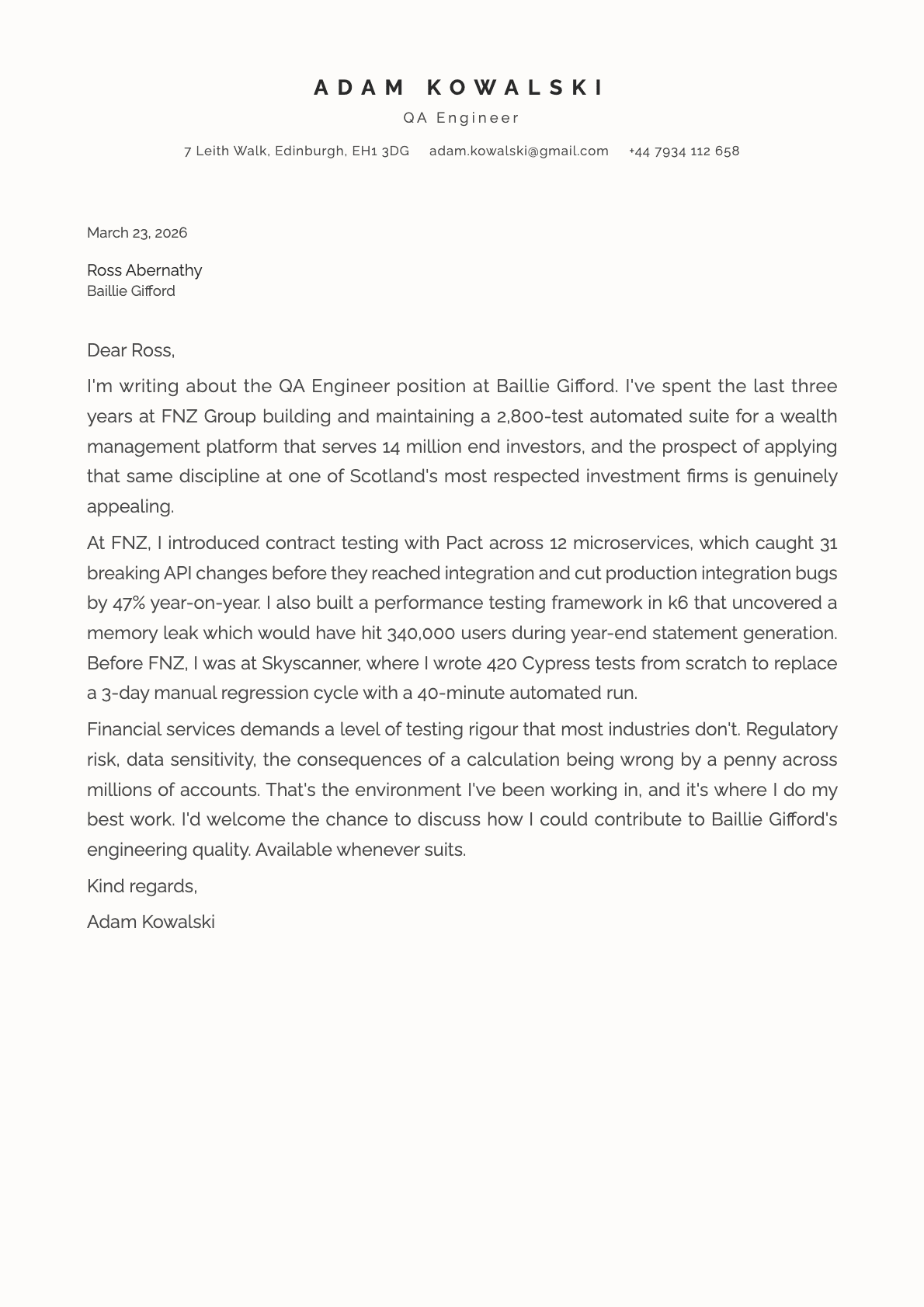
QA Engineer
A QA engineer cover letter example showing how to present automated testing frameworks, contract testing, and quality metrics for a financial services.
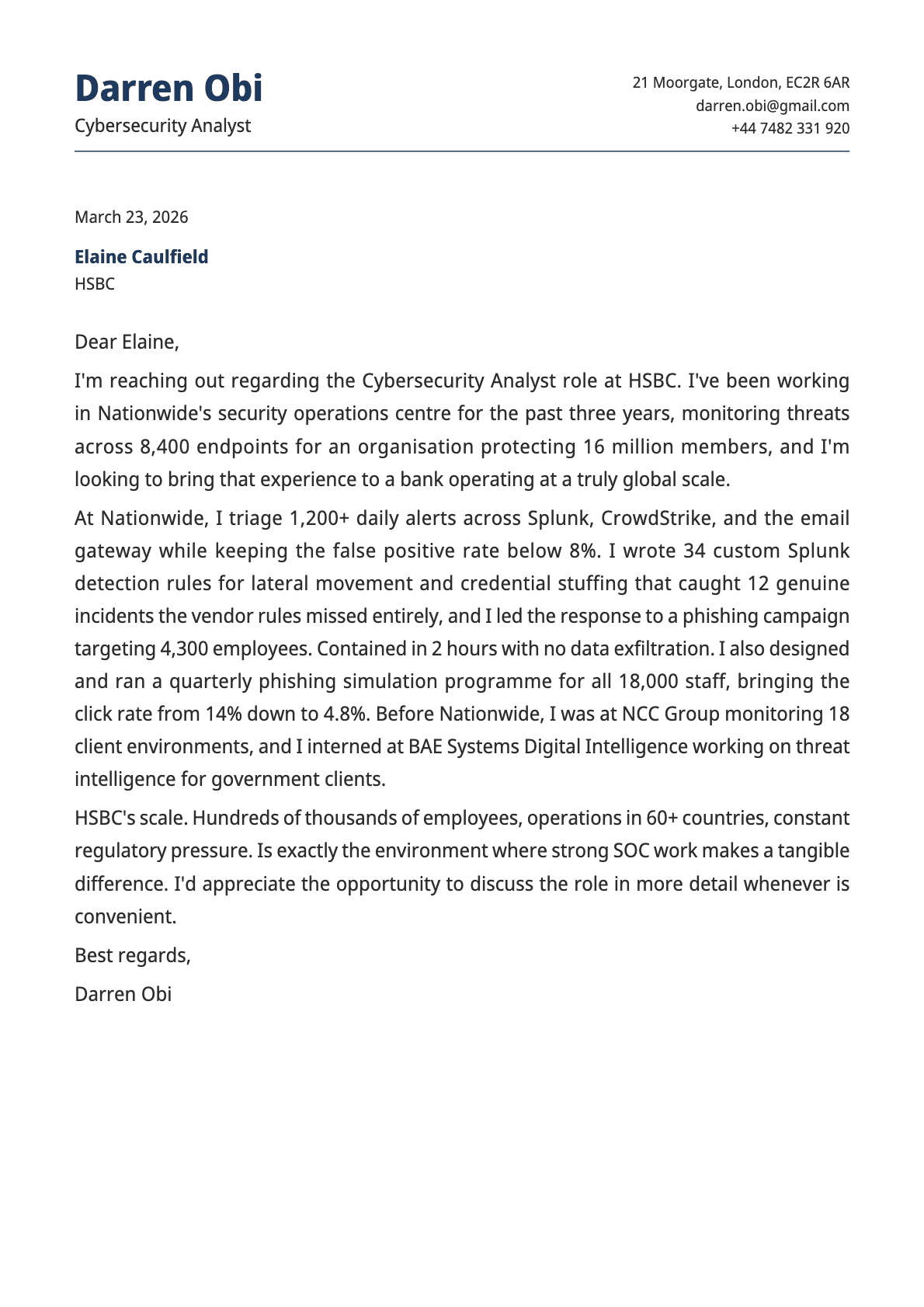
Cybersecurity Analyst
A cybersecurity analyst cover letter example showing how to present SOC experience, threat detection skills, and incident response work for a financial.
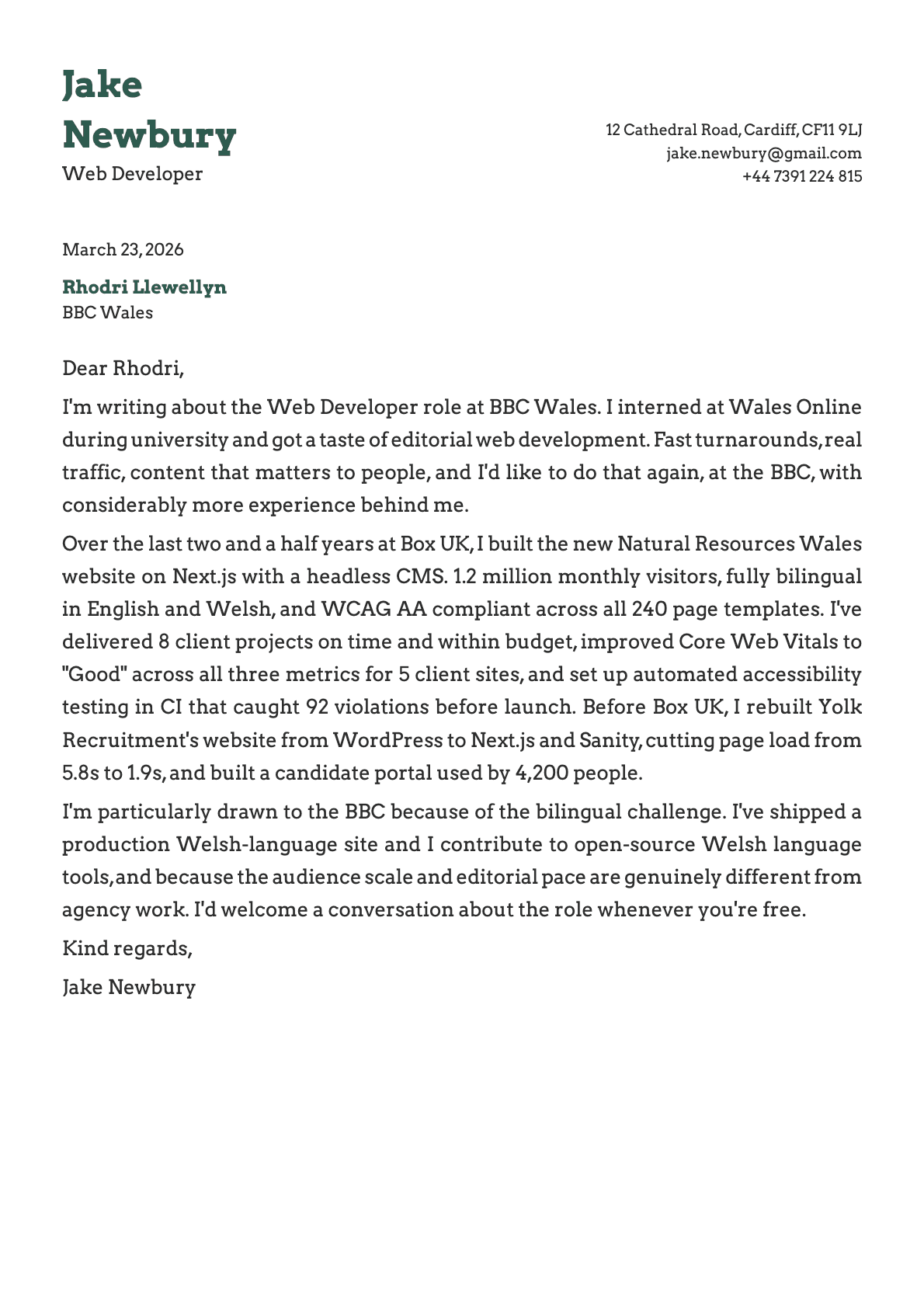
Web Developer
A web developer cover letter example showing how to present Next.js projects, accessibility compliance.
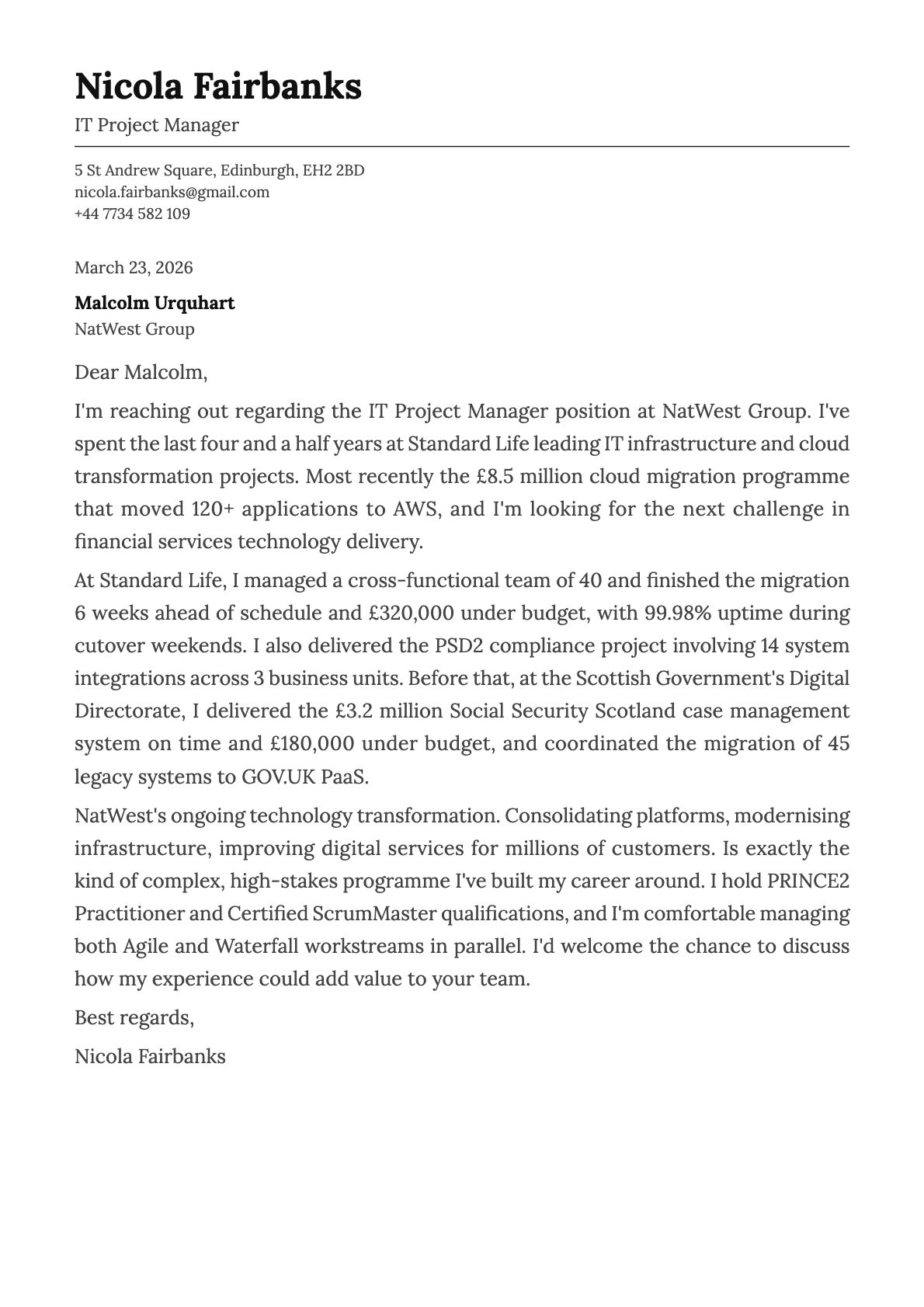
IT Project Manager
An IT project manager cover letter example showing how to present cloud migration experience, budget management.
Related articles

AI Is Screening Your Resume Before Any Human Sees It
AI screens most resumes before a human ever reads them. 97.4% of Fortune 500 companies run an ATS. This is what that means for you and what you can do about it.

ATS Resume Checker: How to Format a CV That Gets Past the Filters
Run the free copy and paste test to see what an ATS actually reads on your CV, then fix the tables, columns and headings that quietly get you filtered out.

The Best Resume Builders in 2026, Compared Honestly
Resume.io, Zety, Enhancv, Kickresume, Teal, and Laddro compared honestly: real pricing, free tiers, mobile apps, and where each tool wins. All prices checked in September 2026.