IT Project Manager Resume Example
An IT project manager resume example with cloud migration, programme budgets up to £8.5 million, and PRINCE2/Scrum certifications.

Laddro Team
Free to use. No account needed to start.
Free to use. No account needed to start.
Overview
IT project manager resumes have one job: prove you can deliver. Not plan, not coordinate, not facilitate. Deliver. A hiring manager wants to see projects that finished on time, on budget, and without major incidents. Everything else is secondary.
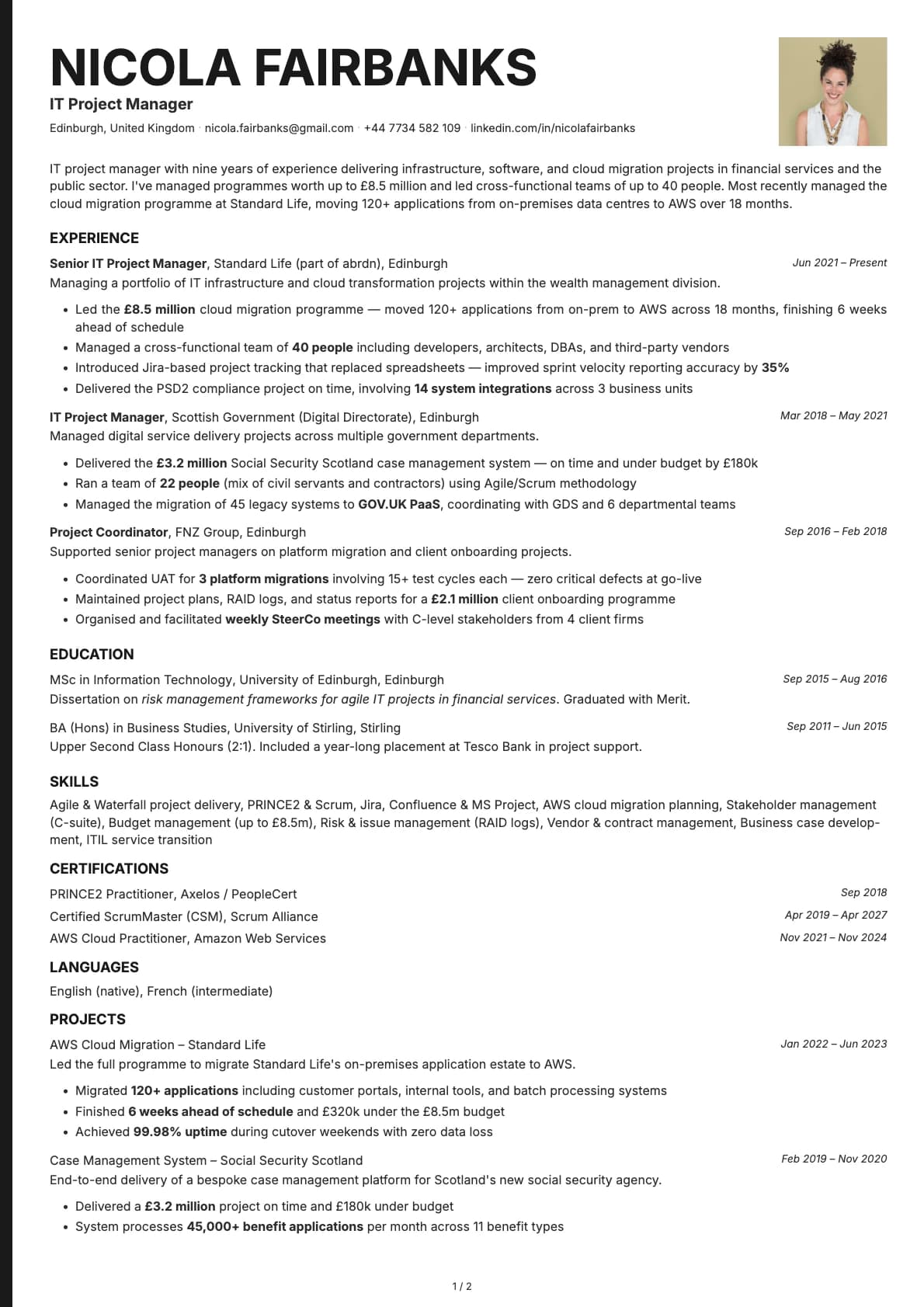
This resume belongs to Nicola, a Senior IT Project Manager at Standard Life in Edinburgh. She has nine years of experience across financial services and the public sector. Her headline project is an 8.5 million cloud migration programme that moved 120+ applications to AWS and finished six weeks ahead of schedule. Before Standard Life, she managed digital delivery at the Scottish Government and coordinated platform migrations at FNZ Group.
Let us break down what this resume does well and how you can apply it.
The summary: scope, scale, and your biggest win
A project manager summary needs to answer three questions fast. What kind of projects do you manage? How big are they? And what is the most impressive thing you have delivered?
Nicola's:
IT project manager with nine years of experience delivering infrastructure, software, and cloud migration projects in financial services and the public sector. I've managed programmes worth up to £8.5 million and led cross-functional teams of up to 40 people. Most recently managed the cloud migration programme at Standard Life, moving 120+ applications from on-premises data centres to AWS over 18 months.
Three sentences. She covers project types (infrastructure, software, cloud), industries (financial services, public sector), budget scale (8.5 million), team size (40), and her current programme. The recruiter knows immediately whether she is right for their role.
Your formula: Project types you manage + industries + biggest budget + largest team + your current or most recent headline project.
Experience bullets: delivered, not managed
The word "managed" is overused on PM resumes. It tells the reader you were there, not that the project was successful. Replace "managed" with specific outcomes.
From Nicola's current role:
"Led the £8.5 million cloud migration programme, moved 120+ applications from on-prem to AWS across 18 months, finishing 6 weeks ahead of schedule"
"Introduced Jira-based project tracking that replaced spreadsheets, improved sprint velocity reporting accuracy by 35%"
"Delivered the PSD2 compliance project on time, involving 14 system integrations across 3 business units"
Every bullet has a result. Ahead of schedule. 35% improvement. On time. The budget is named. The number of applications, integrations, and business units are specific.
From the Scottish Government role:
"Delivered the £3.2 million Social Security Scotland case management system, on time and under budget by £180k"
On time AND under budget. That is the dream bullet for any PM resume. If you have ever delivered a project under budget, calculate the savings and include it.
The pattern: What was delivered + budget + timeline result + one specific metric.
How to present your methodology
IT project managers get asked about methodology in every interview. Your resume should pre-answer the question.
Nicola's skills list includes "Agile & Waterfall project delivery" and "PRINCE2 & Scrum." Her experience bullets show both: the Scottish Government role used Agile/Scrum with a 22-person team, while the cloud migration involved a more structured programme approach.
Do not just list methodologies in your skills section. Show them in action. "Ran a team of 22 people using Agile/Scrum methodology" is better than "experienced in Agile." The reader can see you actually used it on a real project, not just passed a certification exam.
Certifications: PRINCE2 is baseline, add more
Nicola holds PRINCE2 Practitioner, Certified ScrumMaster, and AWS Cloud Practitioner. PRINCE2 is the minimum expected certification for IT PMs in the UK. If you do not have it, get it. CSM shows Agile capability. The AWS Cloud Practitioner is smart because it shows technical awareness for cloud projects.
If you manage projects in a specific domain (cloud, security, data), consider a domain-specific certification. It signals that you understand what your team is actually building, not just how to run a stand-up meeting.
One detail: Nicola's CSM has a renewal date (2027). Including renewal dates shows you keep your certifications current. Lapsed certifications can raise questions.
The projects section: go deep on your best delivery
Nicola's projects section expands on two headline achievements. The AWS migration at Standard Life (120+ applications, 6 weeks ahead, 320K under budget, 99.98% uptime during cutover). And the case management system for Social Security Scotland (3.2 million, on time, 180K under budget, processes 45,000+ benefit applications per month).
This section lets you tell a fuller story than your experience bullets allow. Use it for your 1-2 strongest projects. Include the before and after, the team size, the budget, and what the system does now that it is live.
Handling the step up from coordinator to manager
Nicola's earlier role at FNZ Group was a project coordinator position. She does not hide it or inflate it. The bullets focus on what she contributed: coordinating UAT with zero critical defects, maintaining RAID logs, and running SteerCo meetings with C-level stakeholders.
If your career started in coordination or PMO support, show the progression. What did you do as a coordinator that prepared you for managing your own projects? Facilitating SteerCo meetings, maintaining project plans, and running test cycles are all legitimate stepping stones.
Mistakes IT project managers make on their resumes
No budget figures. This is the number one mistake. If you do not include the budget, the reader assumes it was small. Always name the budget, even if the project was modest. A well-delivered 200K project is still a win.
Listing tools without context. "Jira" in your skills section is fine. "Introduced Jira-based project tracking that replaced spreadsheets and improved reporting accuracy by 35%" is much better. Show the impact of the tool, not just its name.
Too much methodology, not enough delivery. Hiring managers do not care how many certifications you have if you have not delivered a project on time. Lead with outcomes. The certifications back up your credibility, but they are not the main story.
Ignoring the business context. "Migrated 120 applications to AWS" is good. But knowing it was for a wealth management firm and that it achieved 99.98% uptime during cutover is what gives it weight. Always include enough business context for the reader to understand why the project mattered.
One more thing
IT project management is moving towards a hybrid of technical knowledge and delivery skills. If you understand the technology your team is building (cloud architecture, APIs, databases), show it. Nicola's AWS Cloud Practitioner certification does this subtly. It tells the reader she is not just tracking timelines. She actually understands the work.
Build your own version
Open this layout in the builder and swap in your own details. It takes a few minutes.
Free to use. No account needed to start.
Was this resume example helpful?
Rate this example to help us create better content for you.
4.8 average from 143 ratingsRelated resume examples
Software Engineer
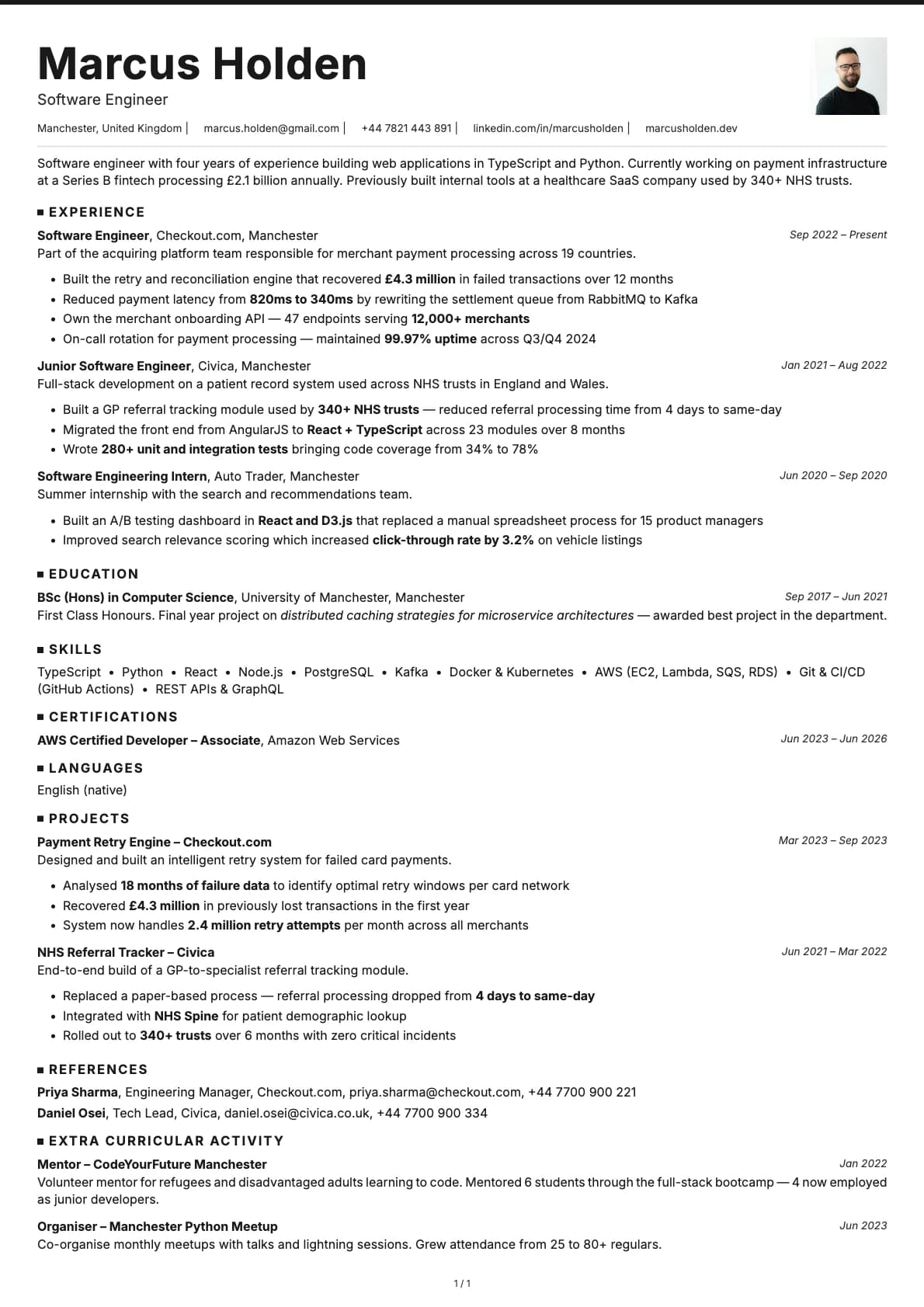
A software engineer resume example with practical tips on how to write your tech stack, quantify your impact, and get past ATS screening.
Frontend Developer
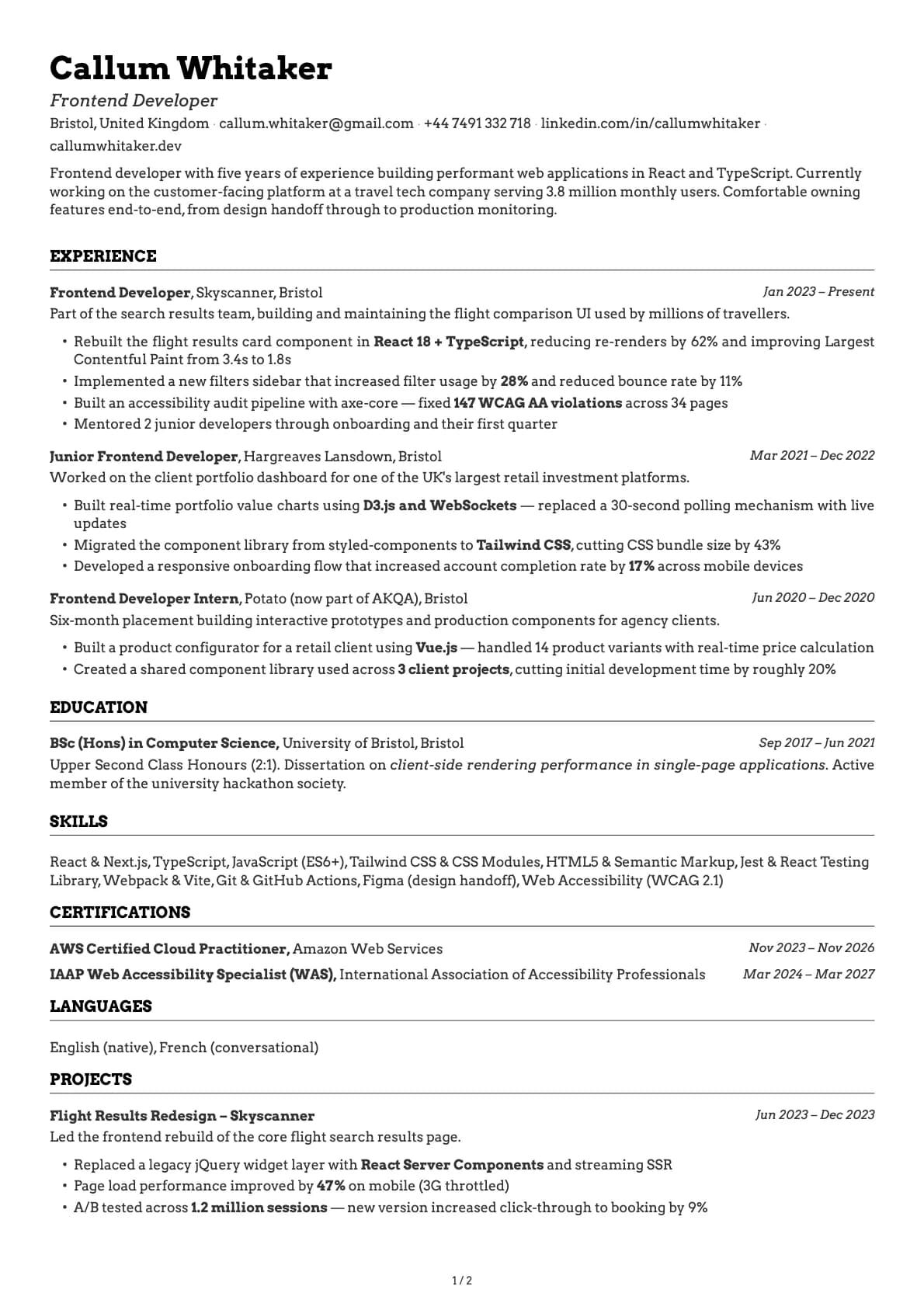
A frontend developer resume example with React and TypeScript experience at Skyscanner and Hargreaves Lansdown.
Backend Developer
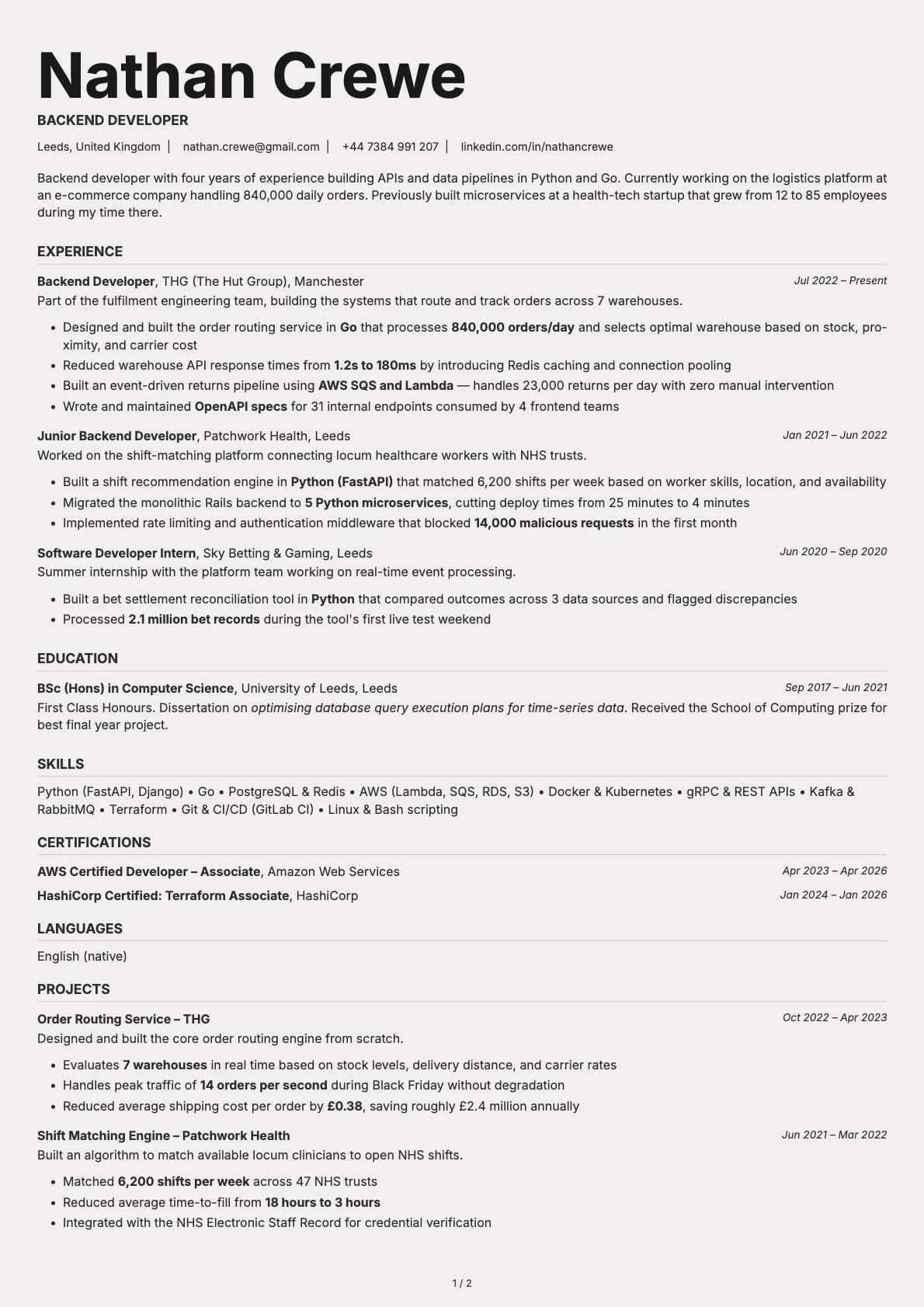
A backend developer resume example with Go and Python experience, system throughput numbers, and infrastructure projects across e-commerce and health-tech.
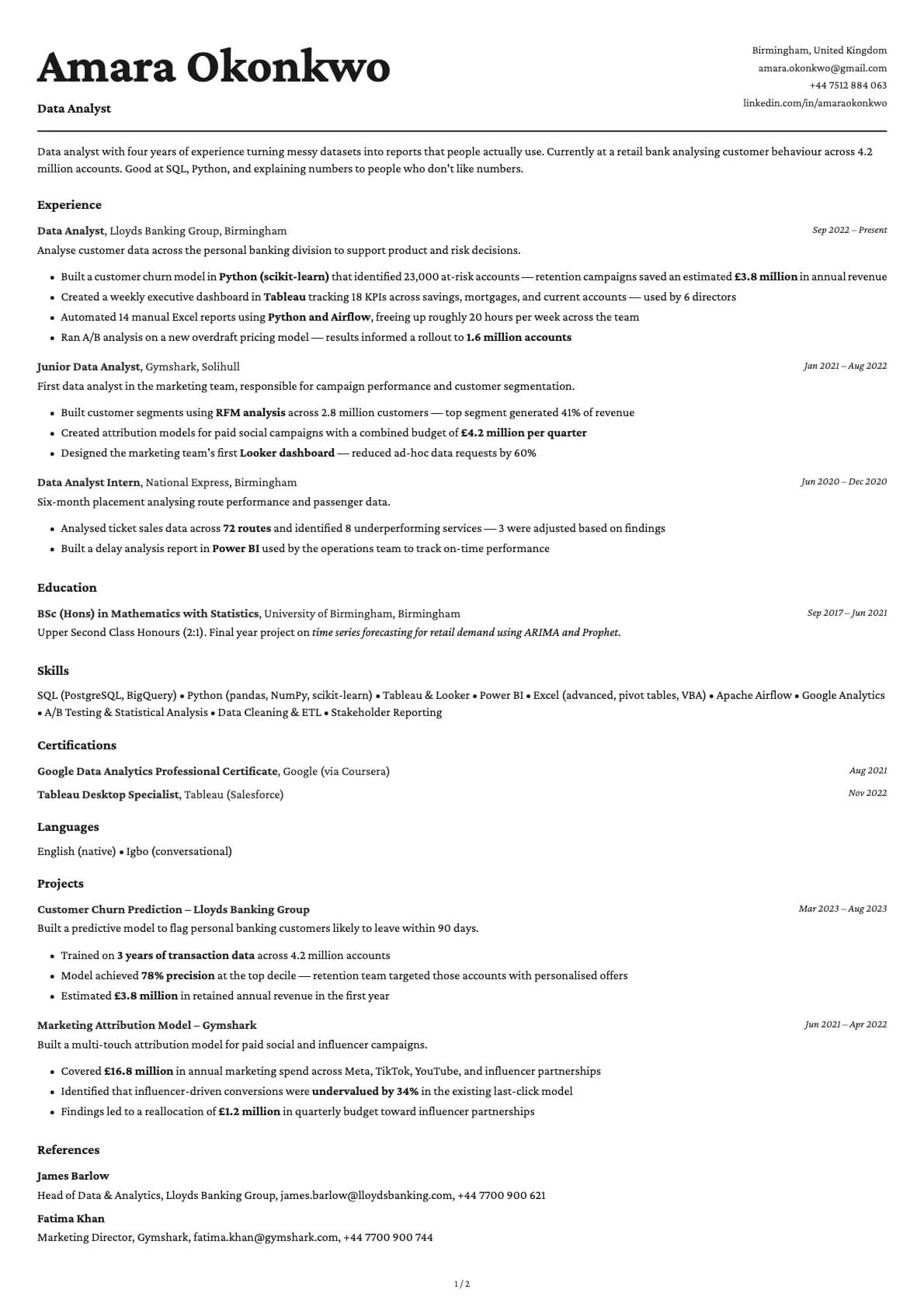
Data Analyst
A data analyst resume example with experience at Lloyds Banking Group and Gymshark.
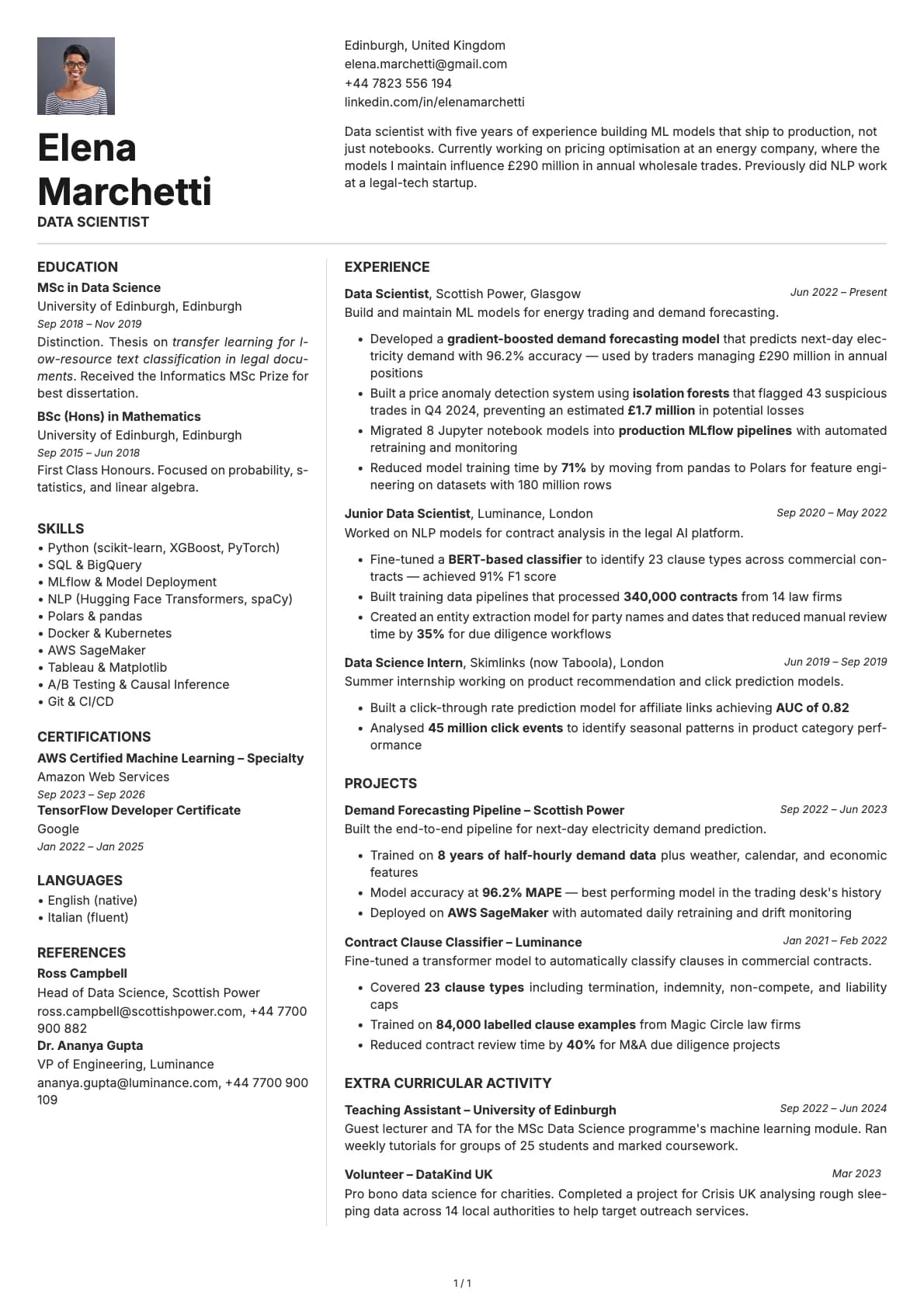
Data Scientist
A data scientist resume example with ML production experience at Scottish Power and NLP work at Luminance.
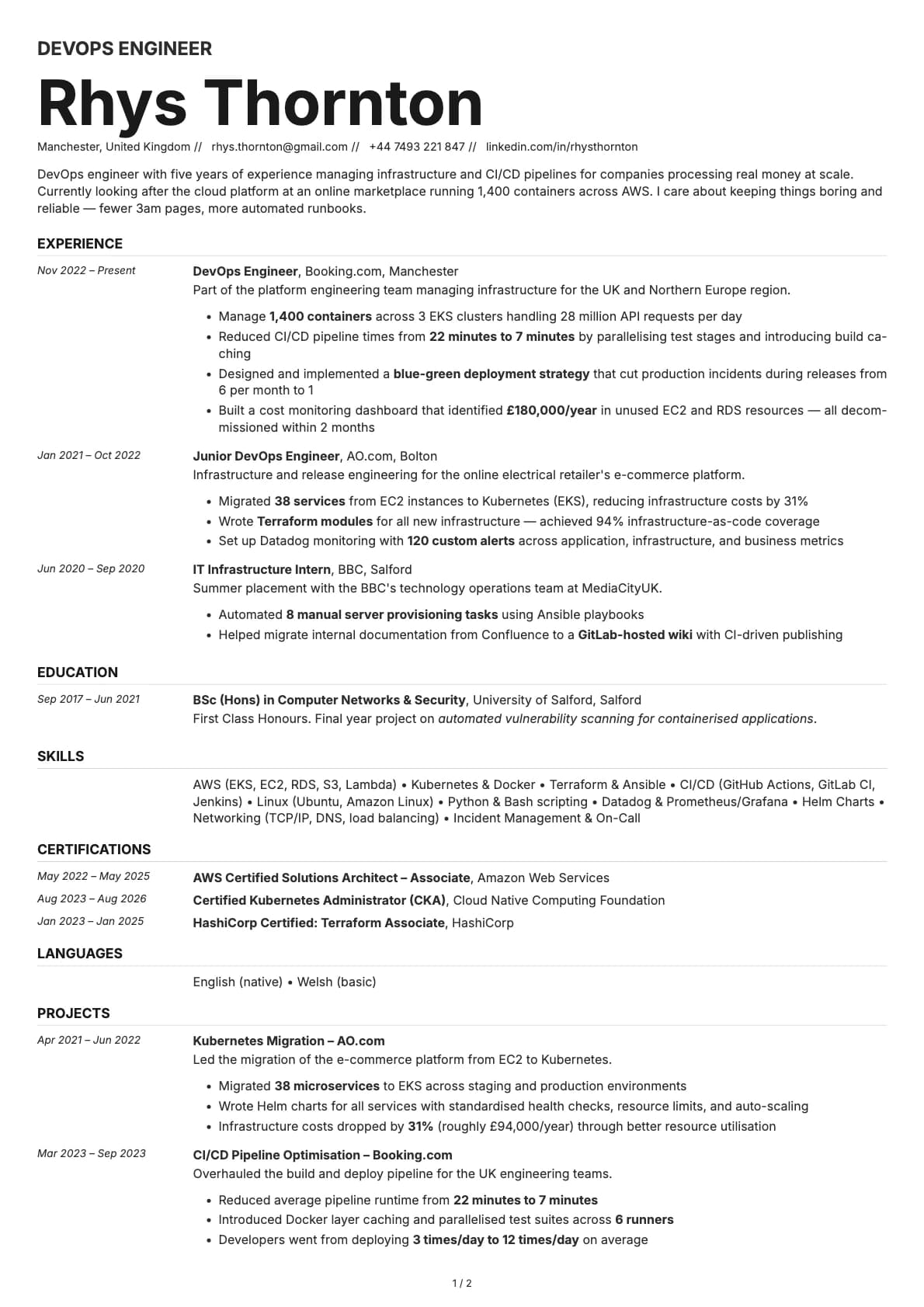
DevOps Engineer
A DevOps engineer resume example with infrastructure experience at Booking.com and AO.com.
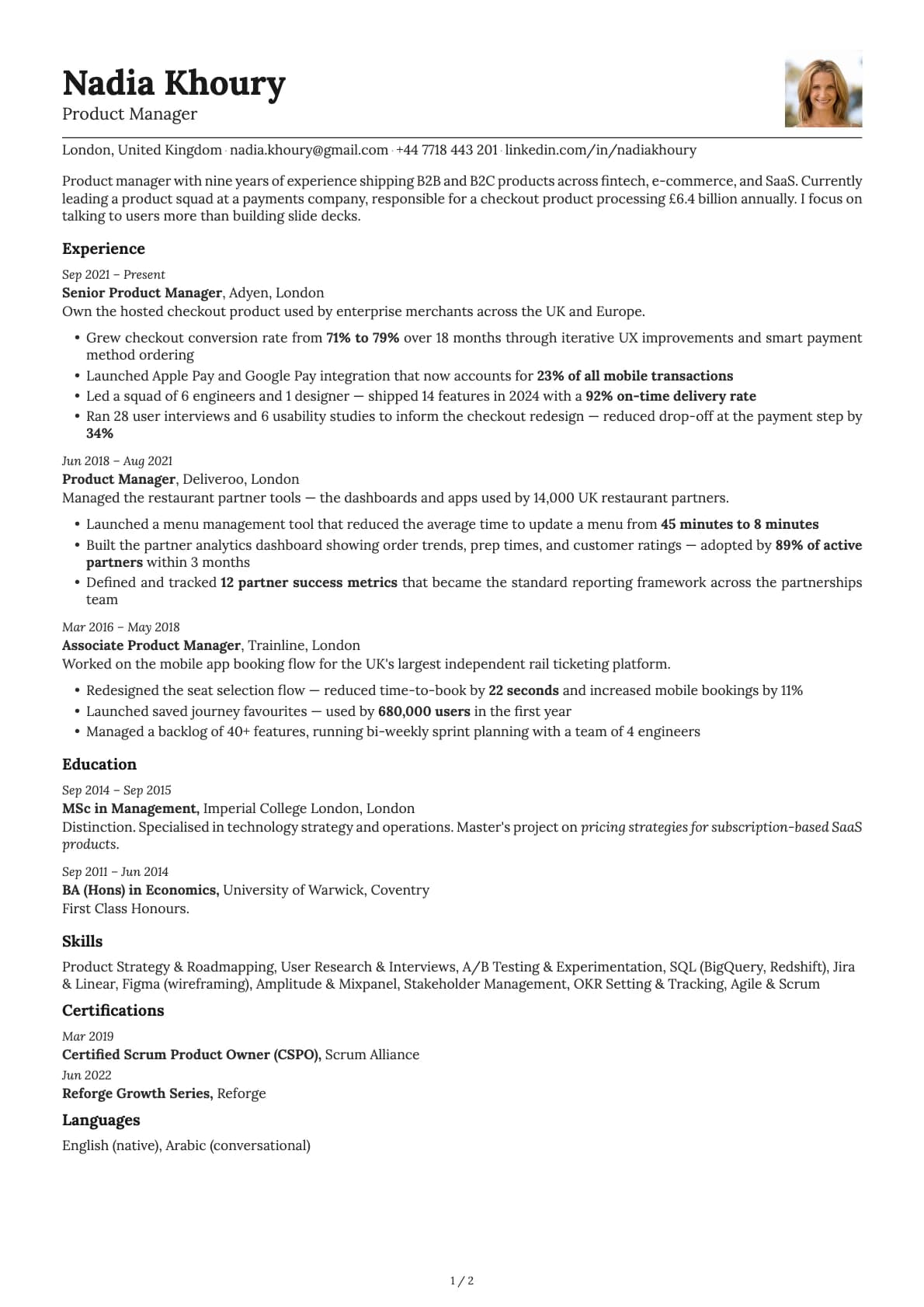
Product Manager
A product manager resume example showing how to present user research, conversion metrics, and feature launches with real business outcomes.
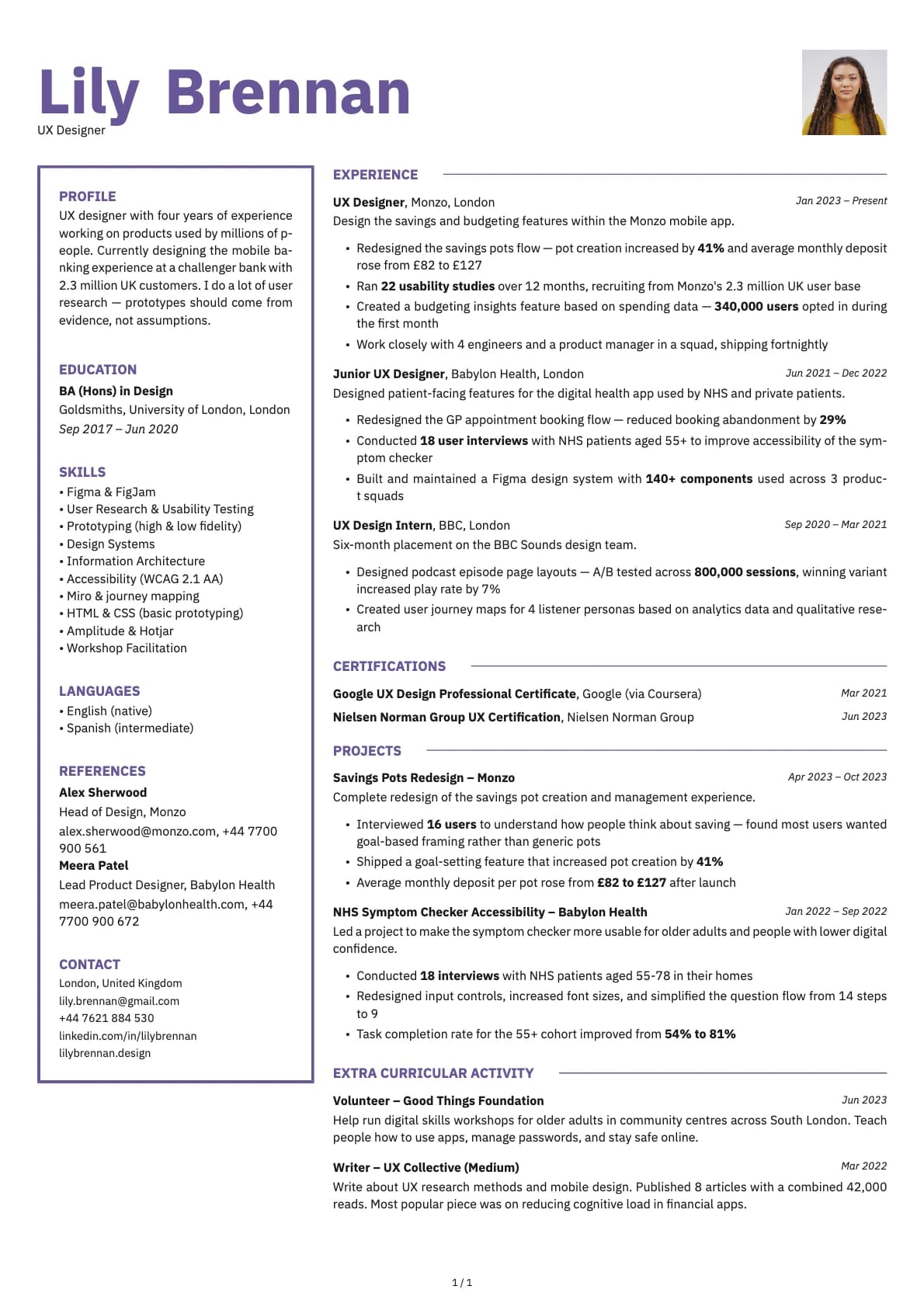
UX Designer
A UX designer resume example with 4 years of product design experience at Monzo and Babylon Health.
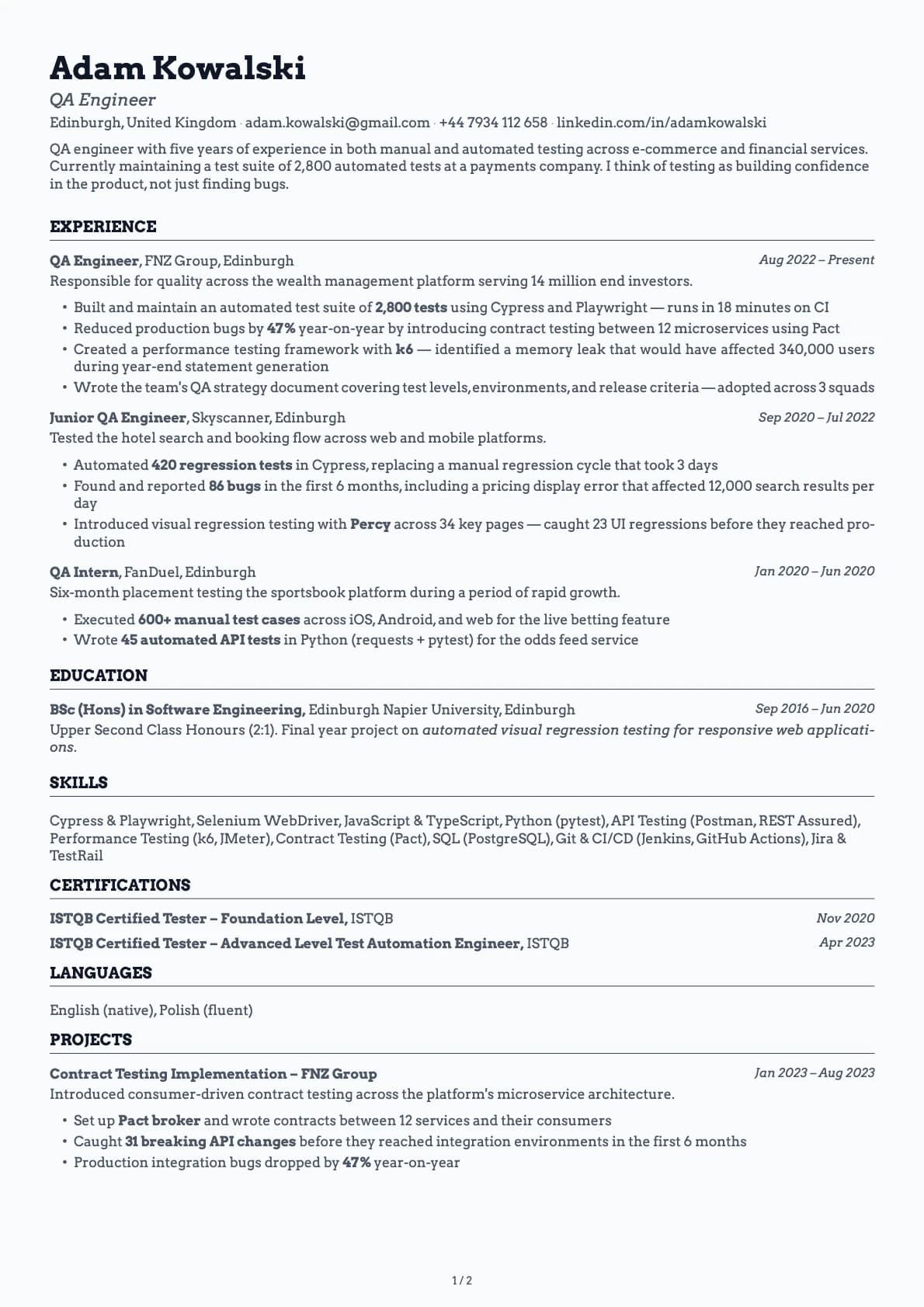
QA Engineer
A QA engineer resume example with automated test suite numbers, production bug reduction, and contract testing implementation details.
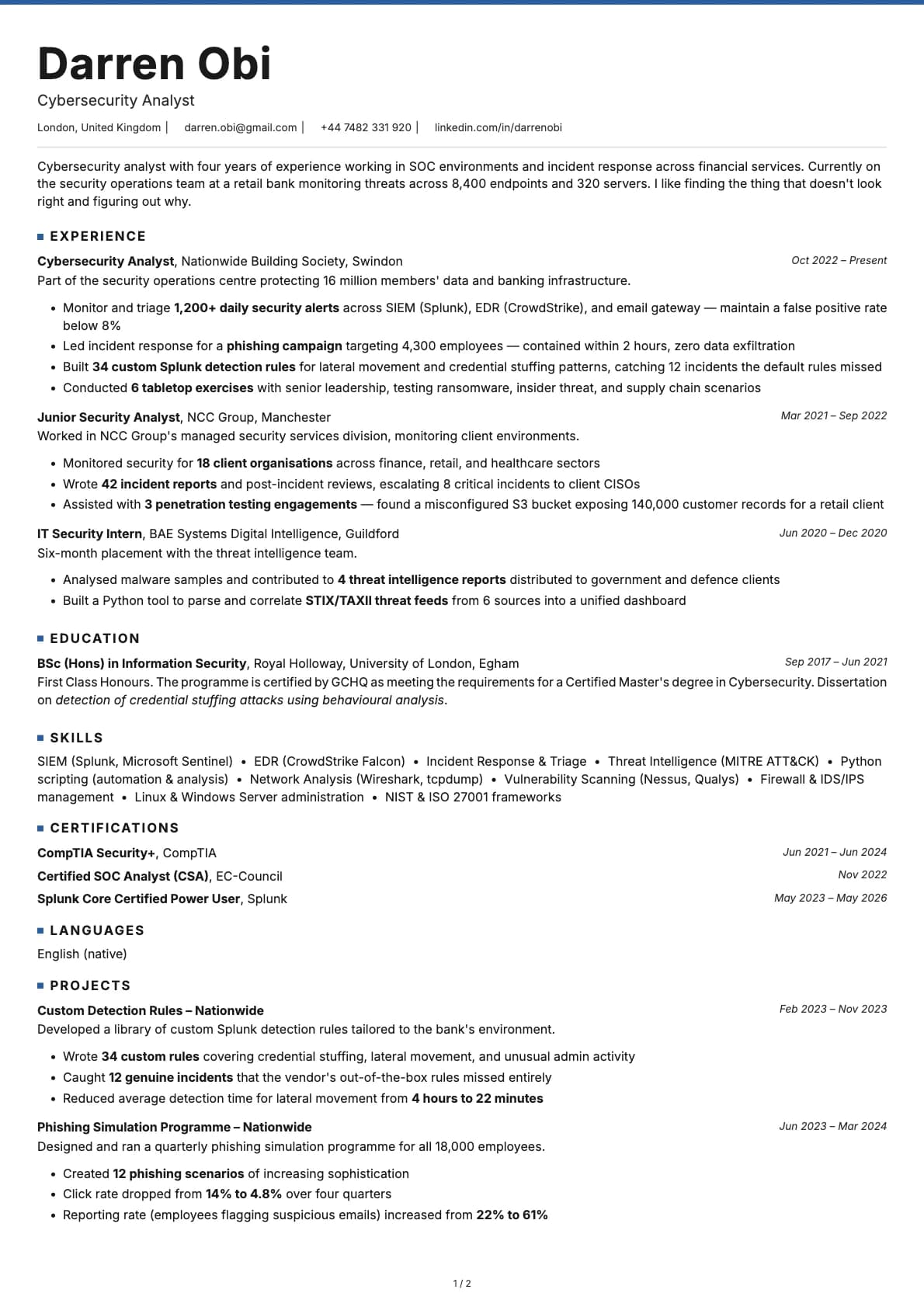
Cybersecurity Analyst
A cybersecurity analyst resume example with SOC experience at Nationwide and NCC Group.
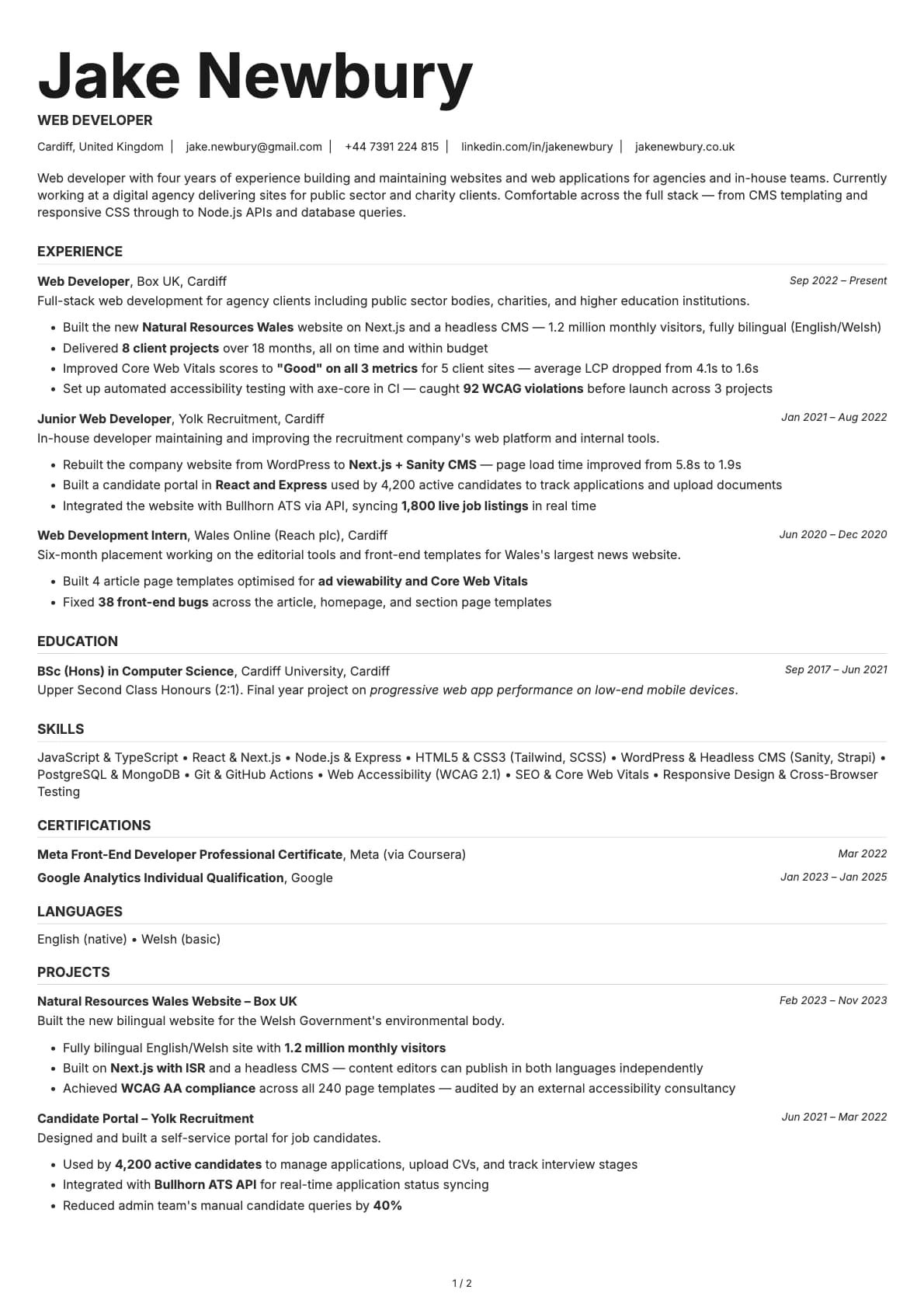
Web Developer
A web developer resume example with agency and in-house experience building Next.js sites, improving Core Web Vitals, and delivering accessible public.
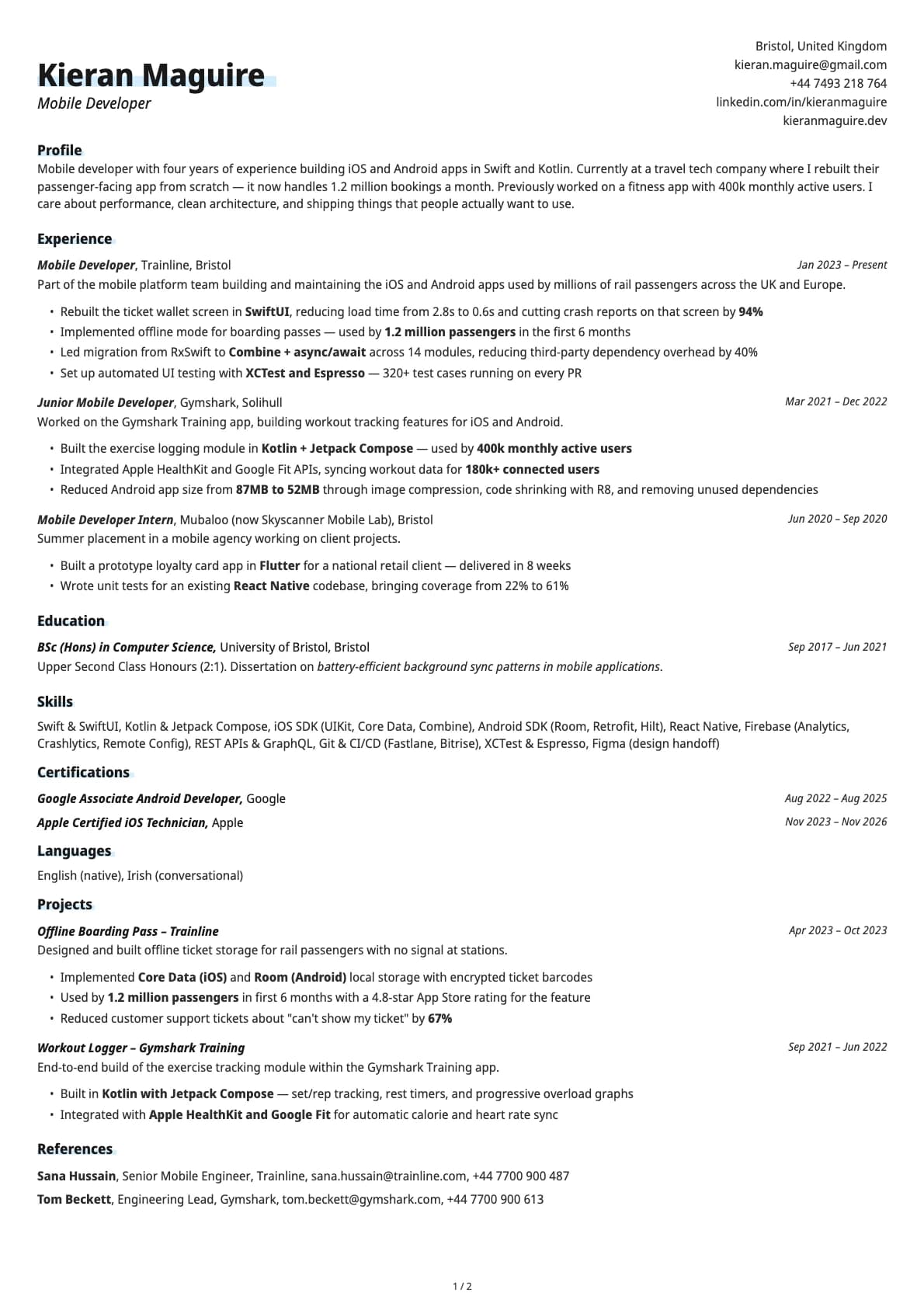
Mobile Developer
A mobile developer resume example with iOS and Android experience, performance metrics, and real app user numbers.
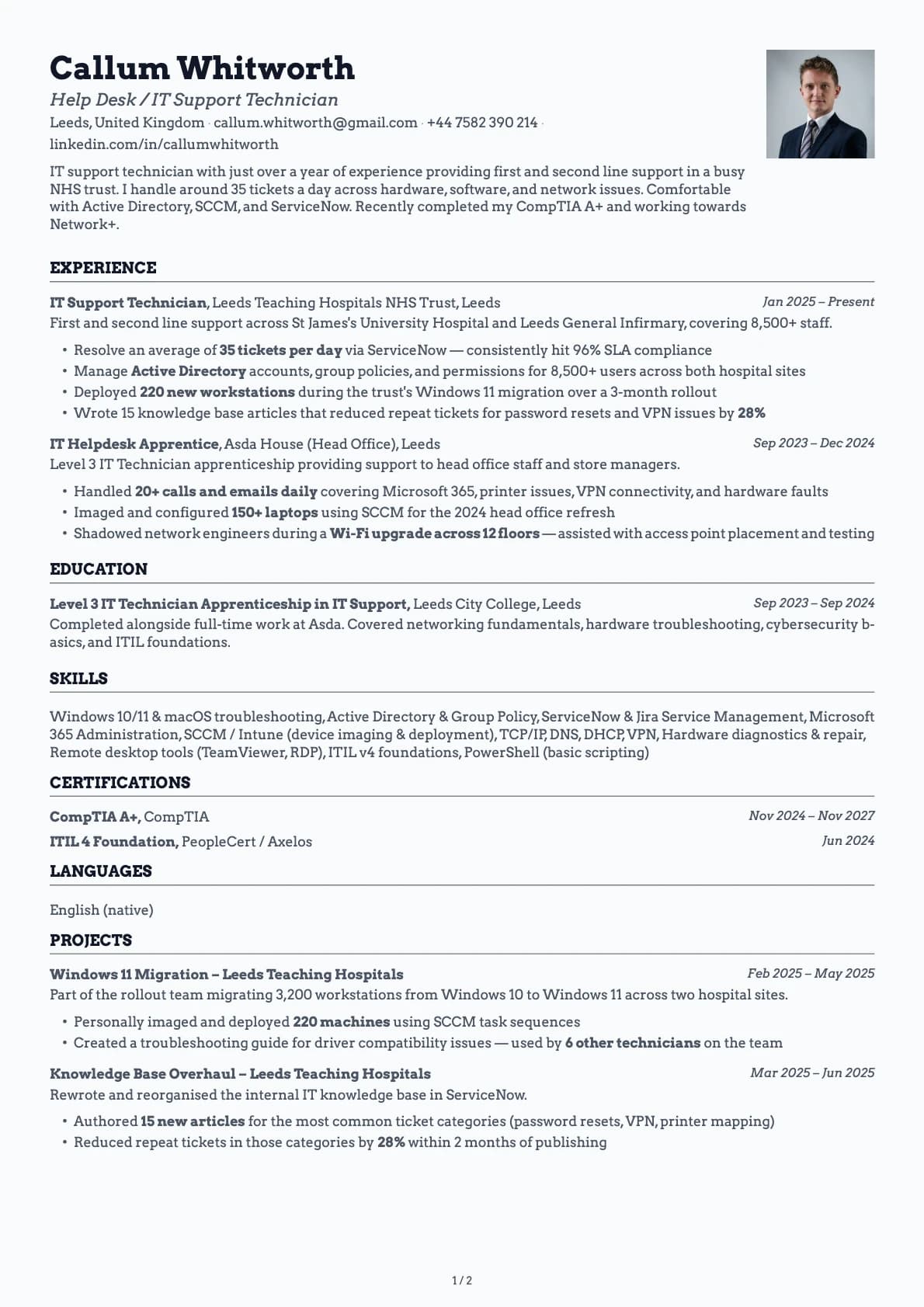
Help Desk / IT Support Technician
A help desk technician resume example with NHS IT support experience.
Related articles

AI Is Screening Your Resume Before Any Human Sees It
AI screens most resumes before a human ever reads them. 97.4% of Fortune 500 companies run an ATS. This is what that means for you and what you can do about it.

ATS Resume Checker: How to Format a CV That Gets Past the Filters
Run the free copy and paste test to see what an ATS actually reads on your CV, then fix the tables, columns and headings that quietly get you filtered out.

The Best Resume Builders in 2026, Compared Honestly
Resume.io, Zety, Enhancv, Kickresume, Teal, and Laddro compared honestly: real pricing, free tiers, mobile apps, and where each tool wins. All prices checked in September 2026.