Product Manager Resume Example
A product manager resume example showing how to present user research, conversion metrics, and feature launches with real business outcomes.

Laddro Team
Free to use. No account needed to start.
Free to use. No account needed to start.
Overview
Product manager resumes have a credibility problem. Everyone claims they "drove product strategy" and "worked cross-functionally with engineering." Those phrases appear on every PM resume and they tell the hiring manager nothing. What actually moves a PM resume from the "maybe" pile to the "interview" pile is evidence. Specific metrics, specific user research methods, specific outcomes.
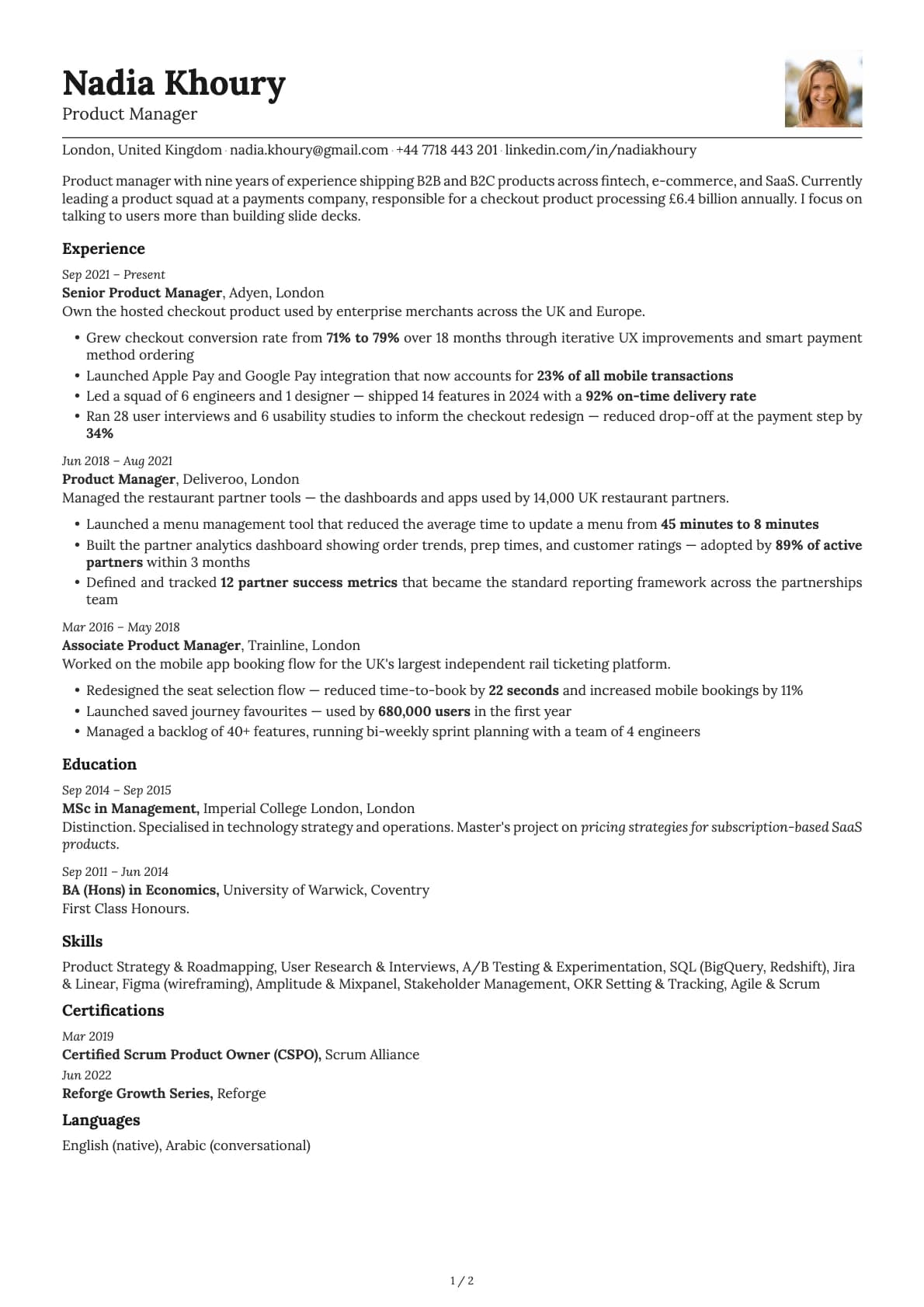
This resume belongs to Nadia Khoury, a senior product manager with nine years of experience at Adyen, Deliveroo, and Trainline. She currently owns a checkout product that processes £6.4 billion annually, and she grew its conversion rate from 71% to 79%. Before that, she built the restaurant partner analytics dashboard at Deliveroo that hit 89% adoption within three months.
Let us break down what makes this resume effective and how you can use the same approach.
Your summary needs a number, not a mission statement
Too many PM resumes open with "Product leader who thrives at the intersection of business and technology." That is meaningless. It could describe anyone in any role at any company.
Nadia's summary gets specific fast: "Currently leading a product squad at a payments company, responsible for a checkout product processing £6.4 billion annually." One sentence and the reader knows: she is at a payments company, she owns a product with real scale, and the number is large enough to be memorable.
Then she adds a line about her working style: "I focus on talking to users more than building slide decks." That is a strong statement because it tells the hiring manager how she operates. It is opinionated. Most PM summaries are not.
For yours: Name the product you own and its most impressive metric (revenue, users, transactions, conversion rate). Then add one sentence about how you work. Delete anything that could appear on any other PM's resume.
How to write experience bullets as a PM
Product managers do not build things directly. You define what to build, decide the priority, and measure the result. Your bullets need to reflect that loop.
Here is a bad PM bullet:
"Worked with engineering to improve the checkout experience"
Here is the same work written properly:
"Grew checkout conversion rate from 71% to 79% over 18 months through iterative UX improvements and smart payment method ordering"
The second version has a before-and-after metric, a timeframe, and a description of the approach. That is everything a hiring manager needs.
Three types of PM bullets that work:
Outcome-first: "Launched Apple Pay and Google Pay integration that now accounts for 23% of all mobile transactions." Start with what shipped, end with the impact.
Research-driven: "Ran 28 user interviews and 6 usability studies to inform the checkout redesign, reduced drop-off at the payment step by 34%." This shows you do not just guess. You talk to users and the decisions are backed by evidence.
Delivery-focused: "Led a squad of 6 engineers and 1 designer, shipped 14 features in 2024 with a 92% on-time delivery rate." Sometimes the hiring manager wants to know you can ship consistently, not just have big ideas.
Earlier roles: show the career arc
Nadia's resume tells a clear story. She started at Trainline as an associate PM managing a backlog and running sprints. Then she moved to Deliveroo where she owned a product area and defined metrics. Now she is at Adyen running a squad and owning a product that processes billions.
The progression is: execute, then define, then lead. If your career follows a similar arc, make sure the resume reflects it. Your earlier roles should focus on execution (shipped features, ran sprints). Your middle roles should show ownership (defined metrics, ran research). Your current role should show leadership and impact.
Look at her Trainline bullet: "Redesigned the seat selection flow, reduced time-to-book by 22 seconds and increased mobile bookings by 11%." That is a junior PM bullet. Small scope, clear impact. It does not try to sound like a VP of Product wrote it.
Skills: be specific about your tools
Nadia lists SQL (BigQuery, Redshift), Figma, Amplitude, Mixpanel, Jira, and Linear. She does not list "data analysis" or "stakeholder management" as skills. Instead, she names the exact tools she uses.
This matters for two reasons. First, many companies filter resumes by tool names. Second, listing the actual tool instead of the category shows you really use it. Anyone can claim "data analysis." Listing BigQuery and Amplitude says you write your own queries and check your own dashboards.
If you use SQL, name the flavour. If you use a specific analytics tool, list it. If you can wireframe in Figma, include it.
Mistakes product managers make on their resumes
Writing about process instead of outcomes. "Ran sprint planning and maintained the product backlog" describes what you did every Tuesday morning. It does not tell anyone what resulted from it. Always connect the process to an outcome.
No user research evidence. If you interviewed users, tested prototypes, or ran experiments, say so with numbers. "Conducted 34 partner interviews across London, Manchester, and Birmingham" is specific and credible. "Gathered user feedback" is not.
Listing every framework you have heard of. OKRs, Jobs to Be Done, Lean Startup, Design Thinking, North Star Metrics. If you list all of them, the reader assumes you name-drop frameworks instead of actually doing the work. Pick the ones you genuinely use and let your experience bullets demonstrate the others.
Claiming ownership you did not have. If you were one PM on a team of five, do not say you "led the product." Say what you specifically owned. Hiring managers interview you about everything on your resume, and vague claims fall apart fast.
One more thing
PM hiring is moving toward evidence-based evaluation. More companies now ask for case studies, metrics presentations, or take-home exercises. Your resume is the setup for all of that. If your resume says you grew conversion by 8 points, you will be asked how. If it says you ran 28 user interviews, you will be asked what you learned. Make sure every claim on your resume is something you can walk through in detail during the interview.
Build your own version
Open this layout in the builder and swap in your own details. It takes a few minutes.
Free to use. No account needed to start.
Was this resume example helpful?
Rate this example to help us create better content for you.
4.8 average from 203 ratingsRelated resume examples
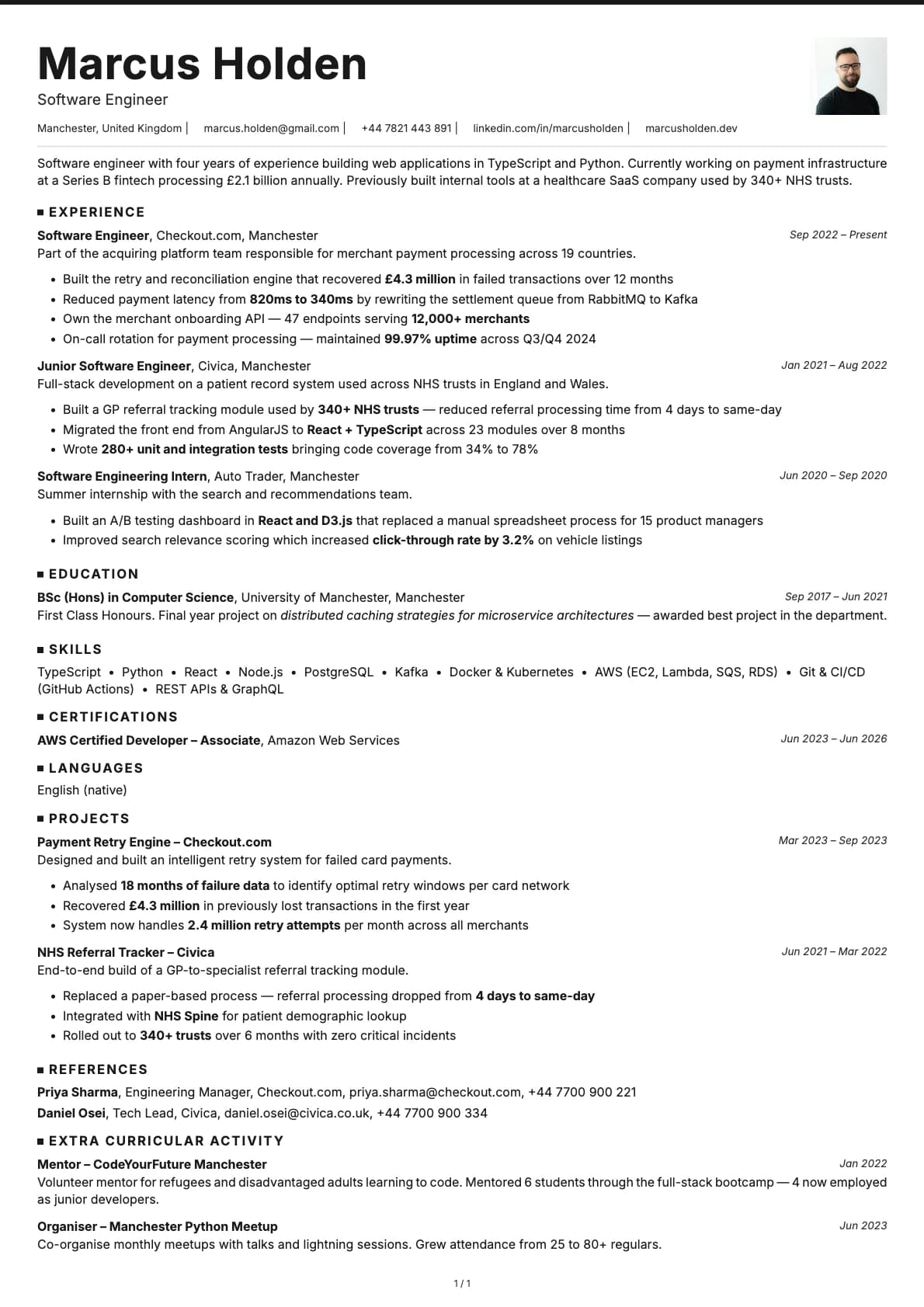
Software Engineer
A software engineer resume example with practical tips on how to write your tech stack, quantify your impact, and get past ATS screening.
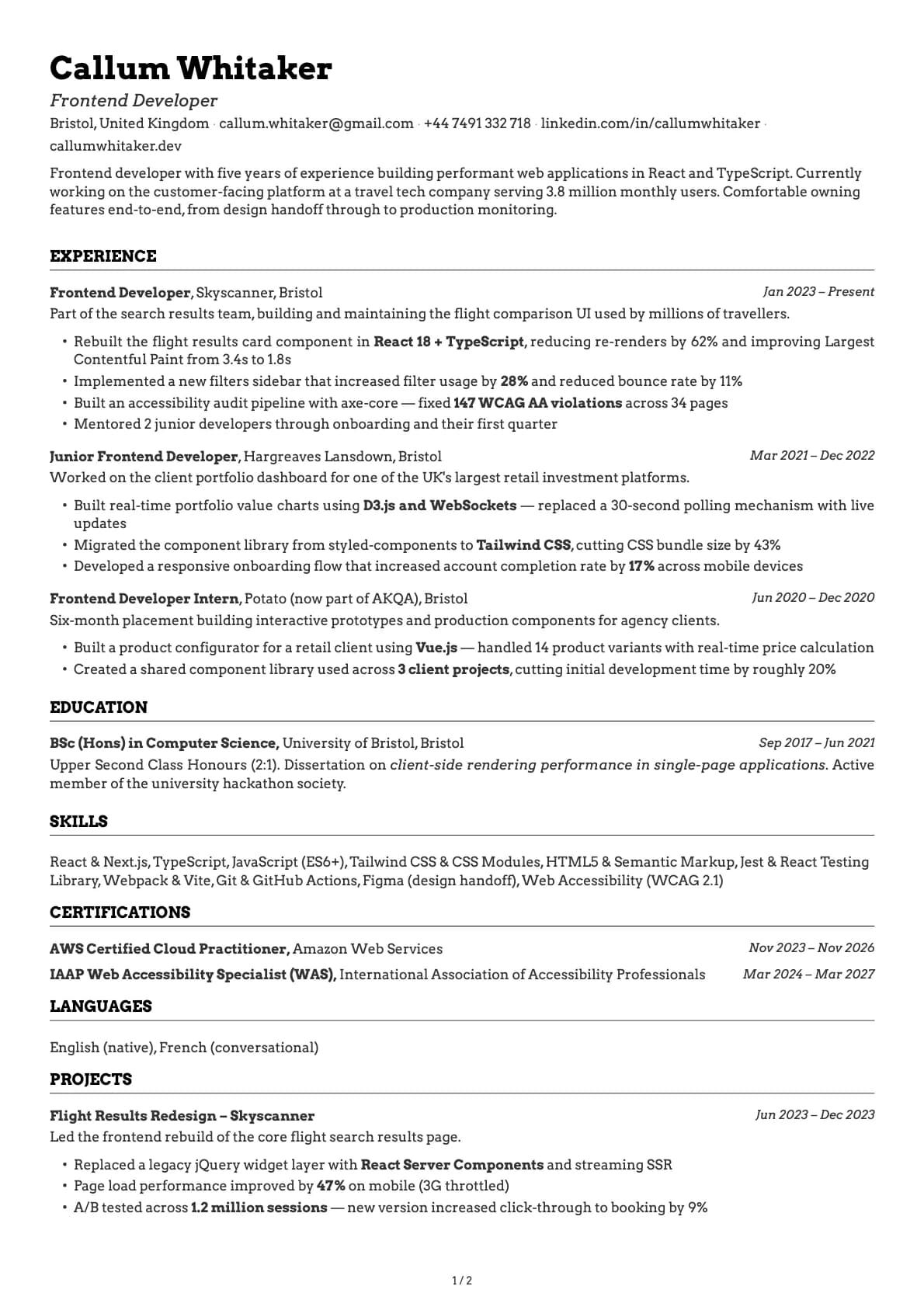
Frontend Developer
A frontend developer resume example with React and TypeScript experience at Skyscanner and Hargreaves Lansdown.
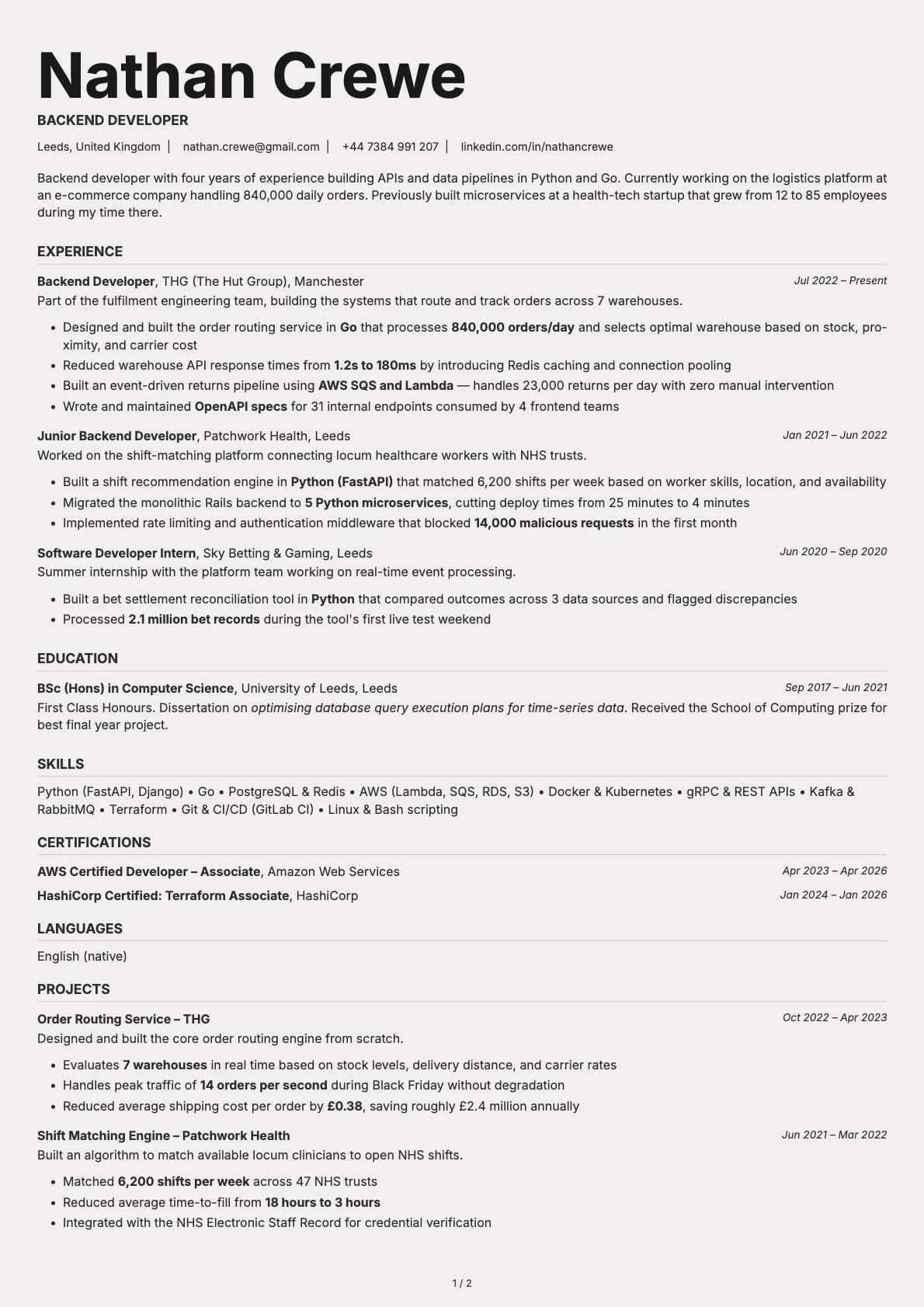
Backend Developer
A backend developer resume example with Go and Python experience, system throughput numbers, and infrastructure projects across e-commerce and health-tech.
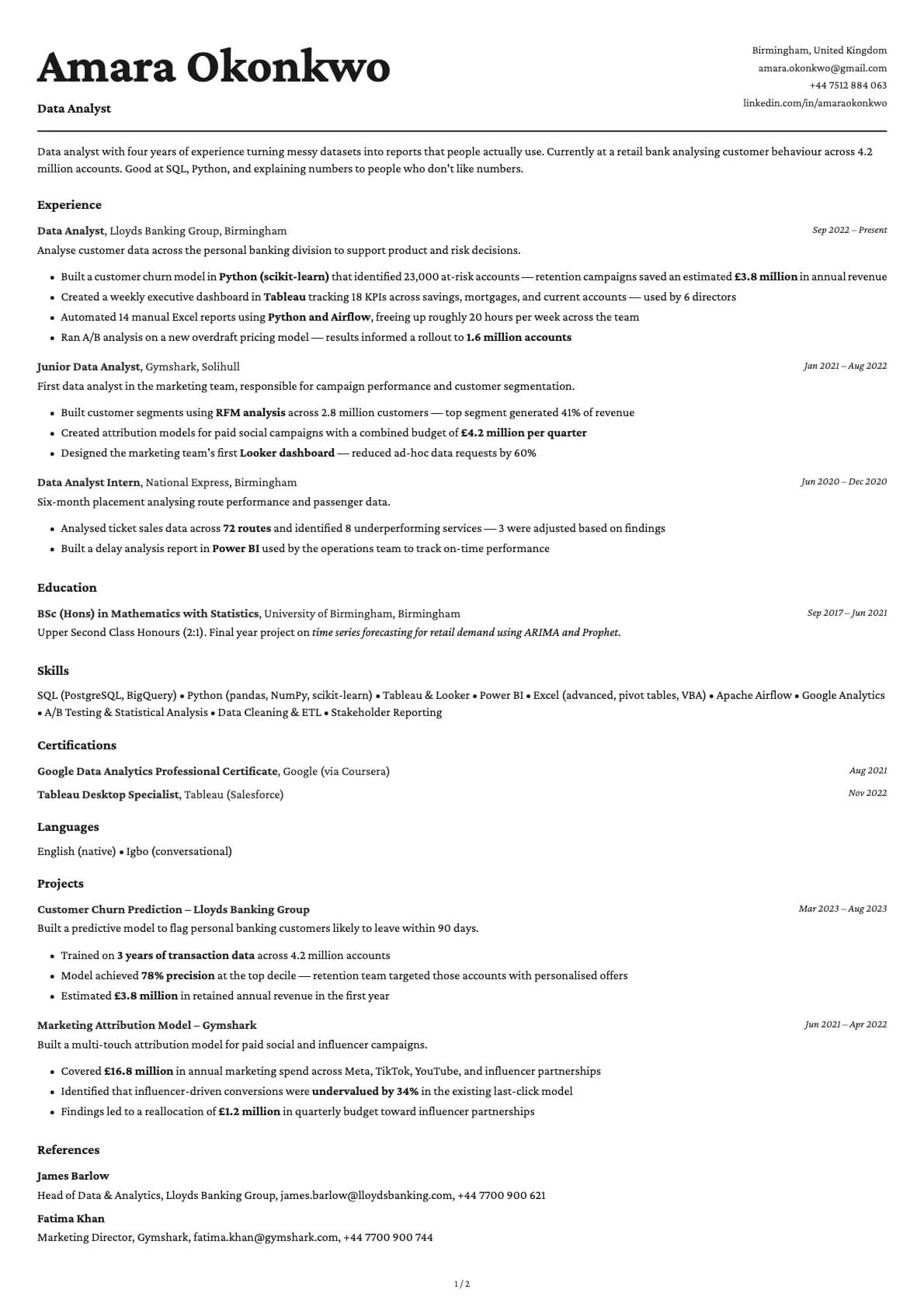
Data Analyst
A data analyst resume example with experience at Lloyds Banking Group and Gymshark.
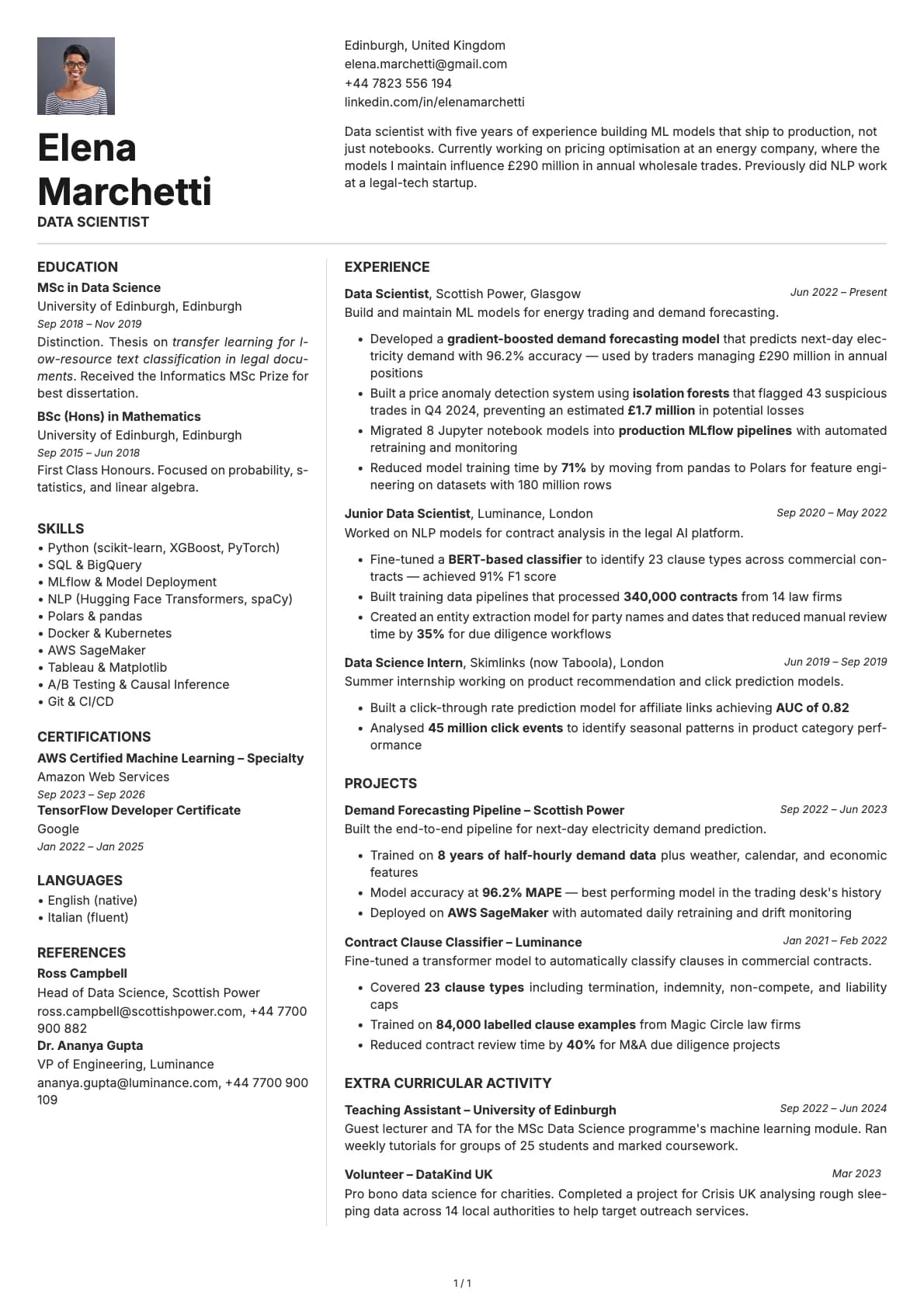
Data Scientist
A data scientist resume example with ML production experience at Scottish Power and NLP work at Luminance.
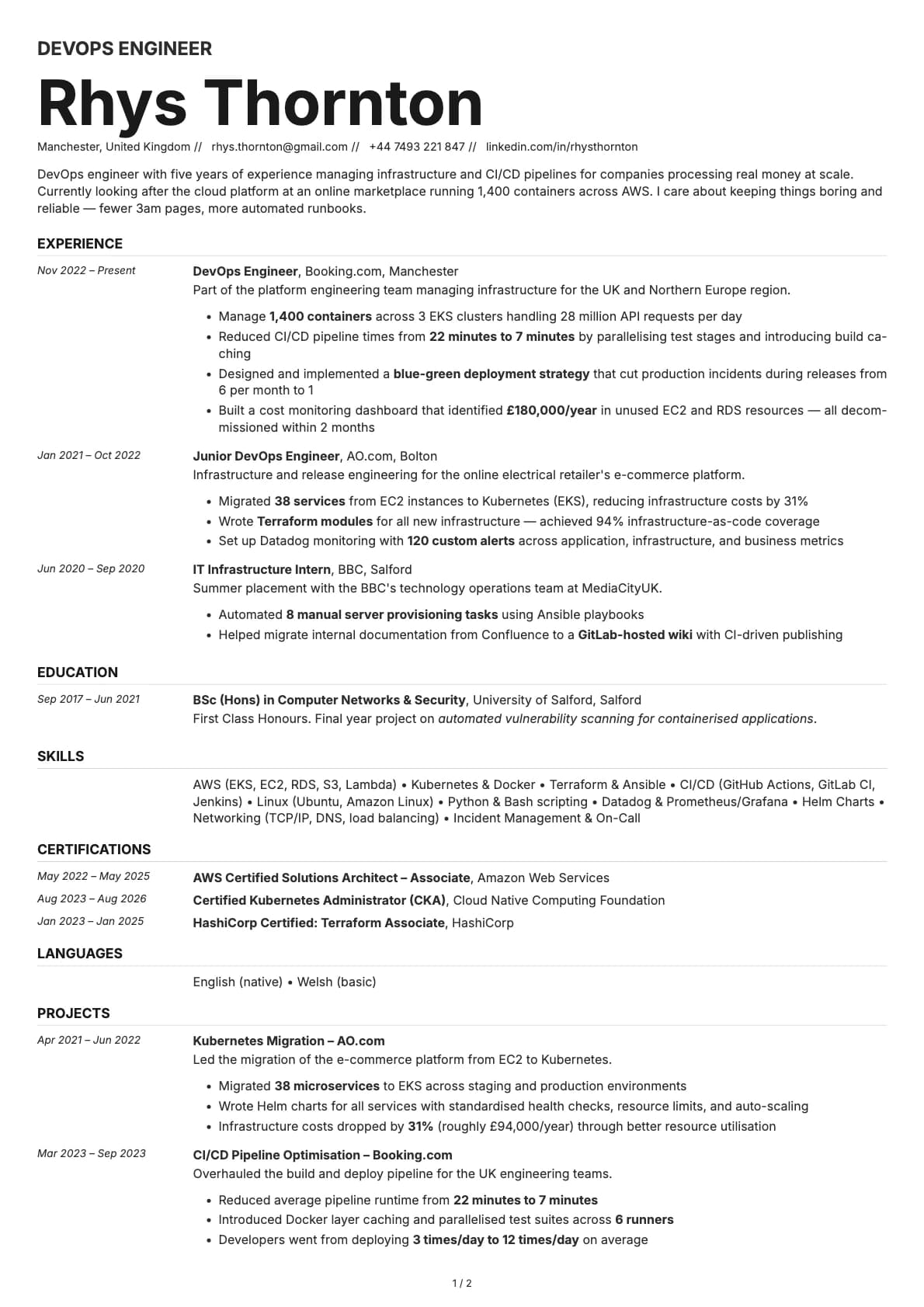
DevOps Engineer
A DevOps engineer resume example with infrastructure experience at Booking.com and AO.com.
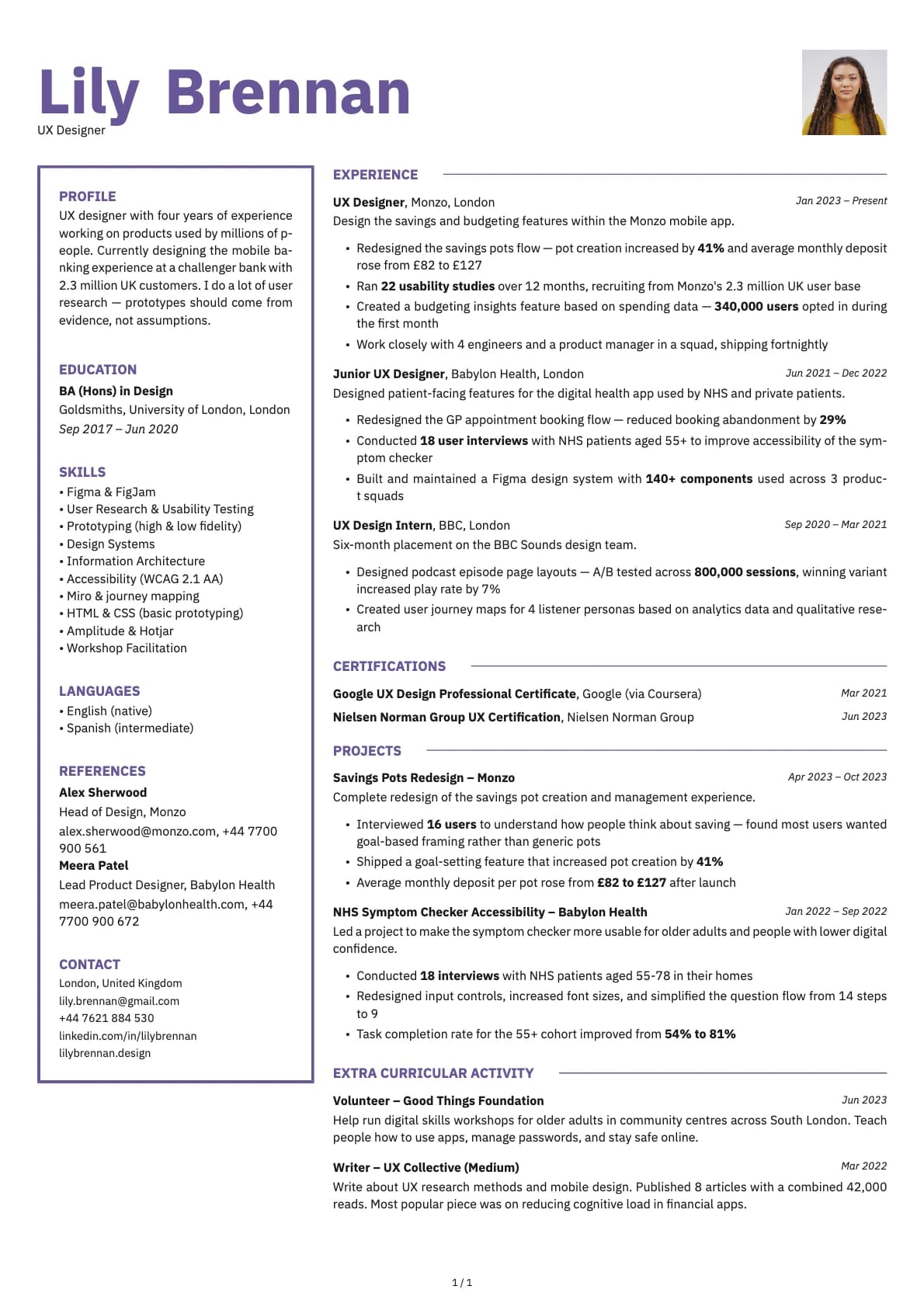
UX Designer
A UX designer resume example with 4 years of product design experience at Monzo and Babylon Health.
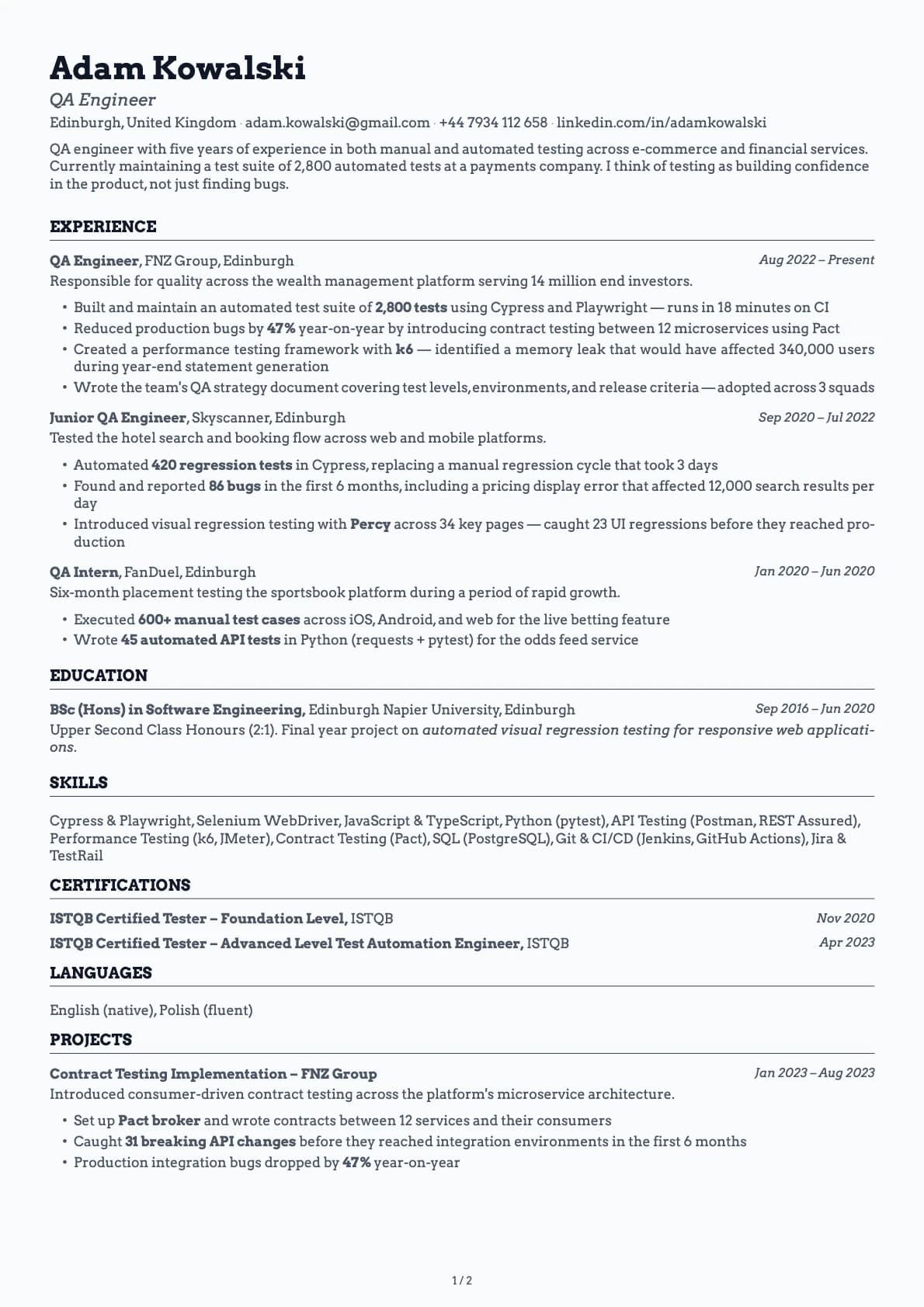
QA Engineer
A QA engineer resume example with automated test suite numbers, production bug reduction, and contract testing implementation details.
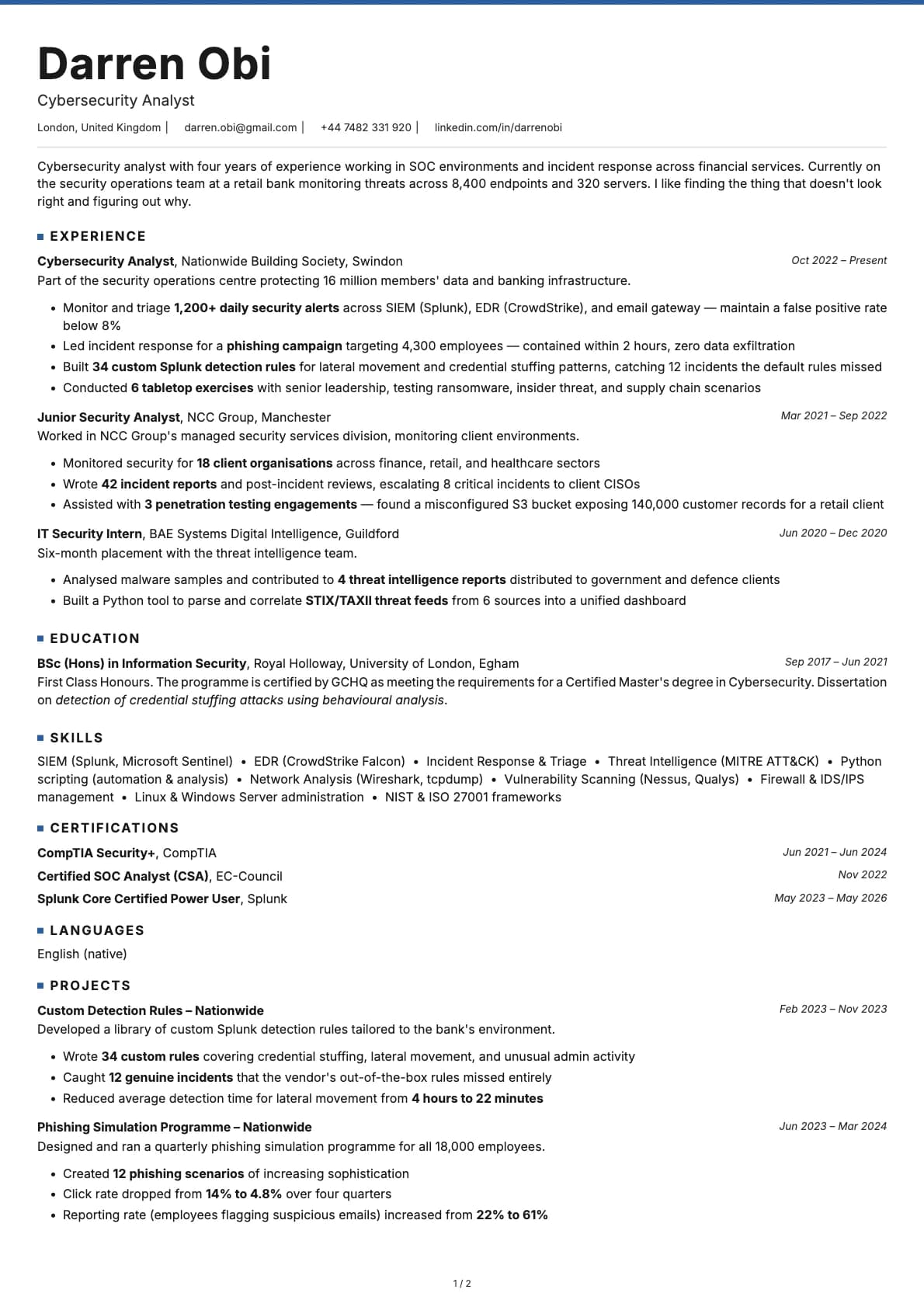
Cybersecurity Analyst
A cybersecurity analyst resume example with SOC experience at Nationwide and NCC Group.
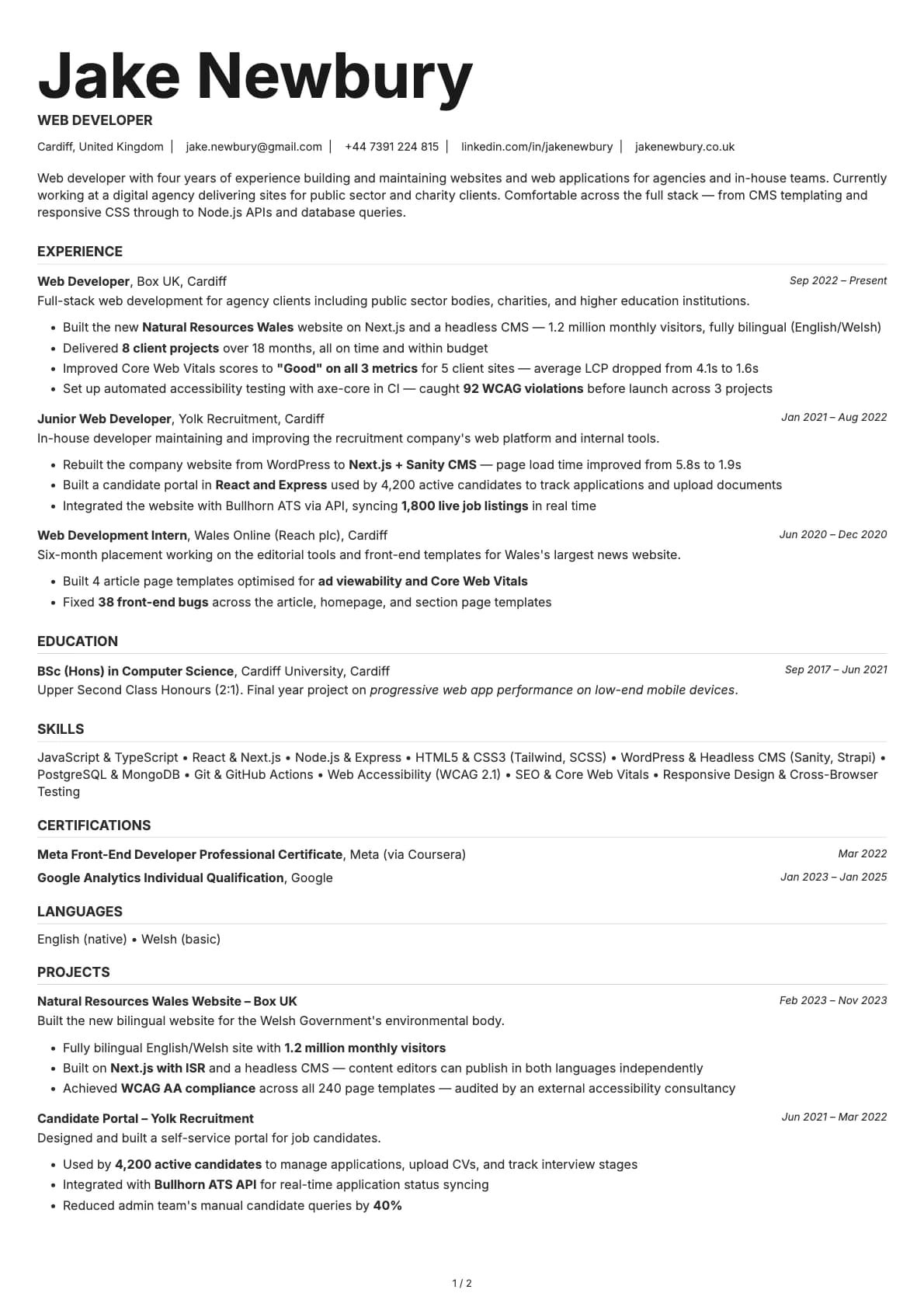
Web Developer
A web developer resume example with agency and in-house experience building Next.js sites, improving Core Web Vitals, and delivering accessible public.
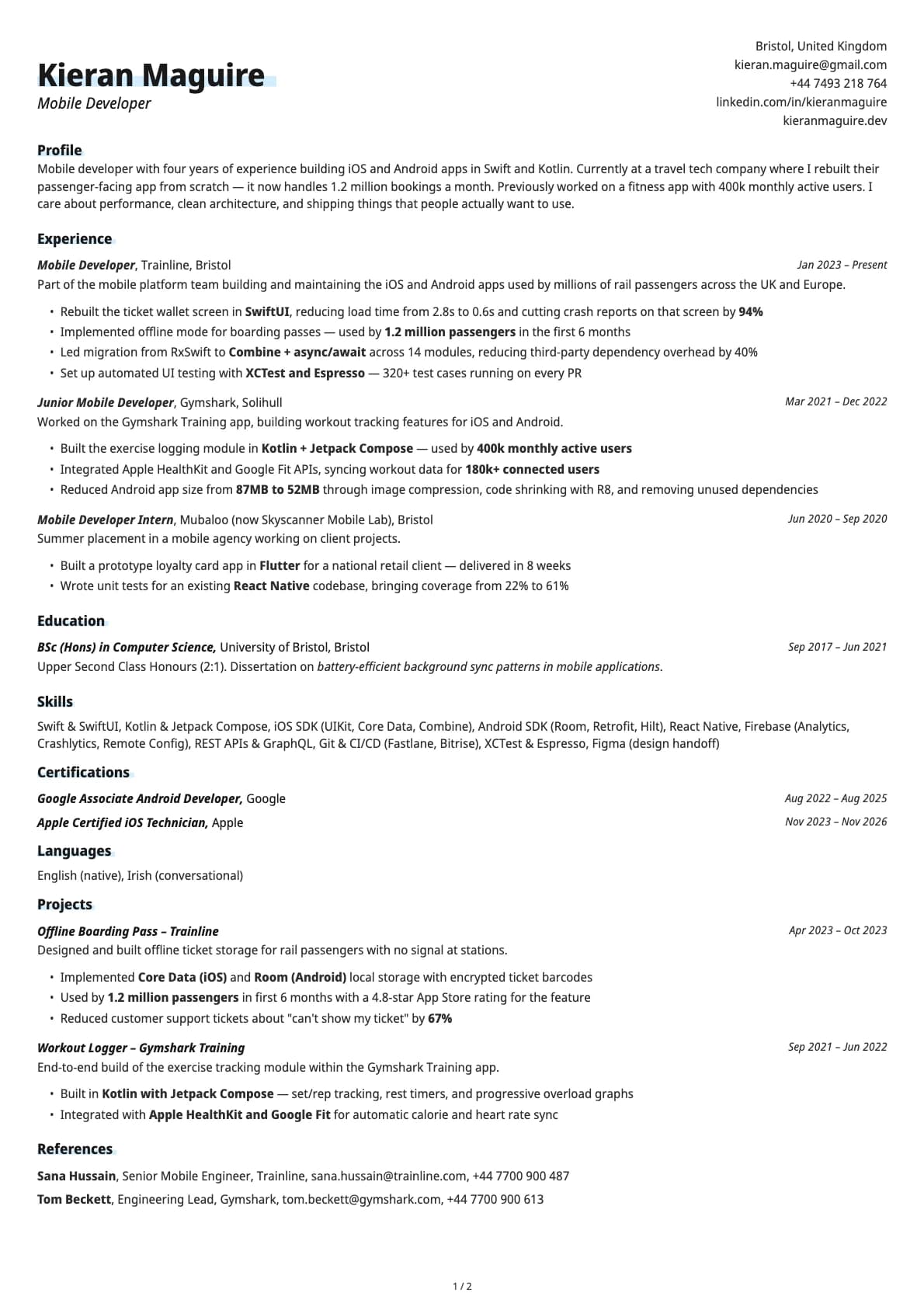
Mobile Developer
A mobile developer resume example with iOS and Android experience, performance metrics, and real app user numbers.
Help Desk / IT Support Technician
A help desk technician resume example with NHS IT support experience.
IT Project Manager
An IT project manager resume example with cloud migration, programme budgets up to £8.5 million, and PRINCE2/Scrum certifications.
Related articles

AI Is Screening Your Resume Before Any Human Sees It
AI screens most resumes before a human ever reads them. 97.4% of Fortune 500 companies run an ATS. This is what that means for you and what you can do about it.

ATS Resume Checker: How to Format a CV That Gets Past the Filters
Run the free copy and paste test to see what an ATS actually reads on your CV, then fix the tables, columns and headings that quietly get you filtered out.

The Best Resume Builders in 2026, Compared Honestly
Resume.io, Zety, Enhancv, Kickresume, Teal, and Laddro compared honestly: real pricing, free tiers, mobile apps, and where each tool wins. All prices checked in September 2026.