Web Developer Resume Example
A web developer resume example with agency and in-house experience building Next.js sites, improving Core Web Vitals, and delivering accessible public.

Laddro Team
Free to use. No account needed to start.
Free to use. No account needed to start.
Overview
Web developer resumes have a specific problem: the job title covers an enormous range of work. You could be building WordPress marketing sites, maintaining a legacy PHP application, writing React SPAs, or doing full-stack work with databases and APIs. A recruiter reading your resume needs to understand your slice of "web development" within the first few lines.
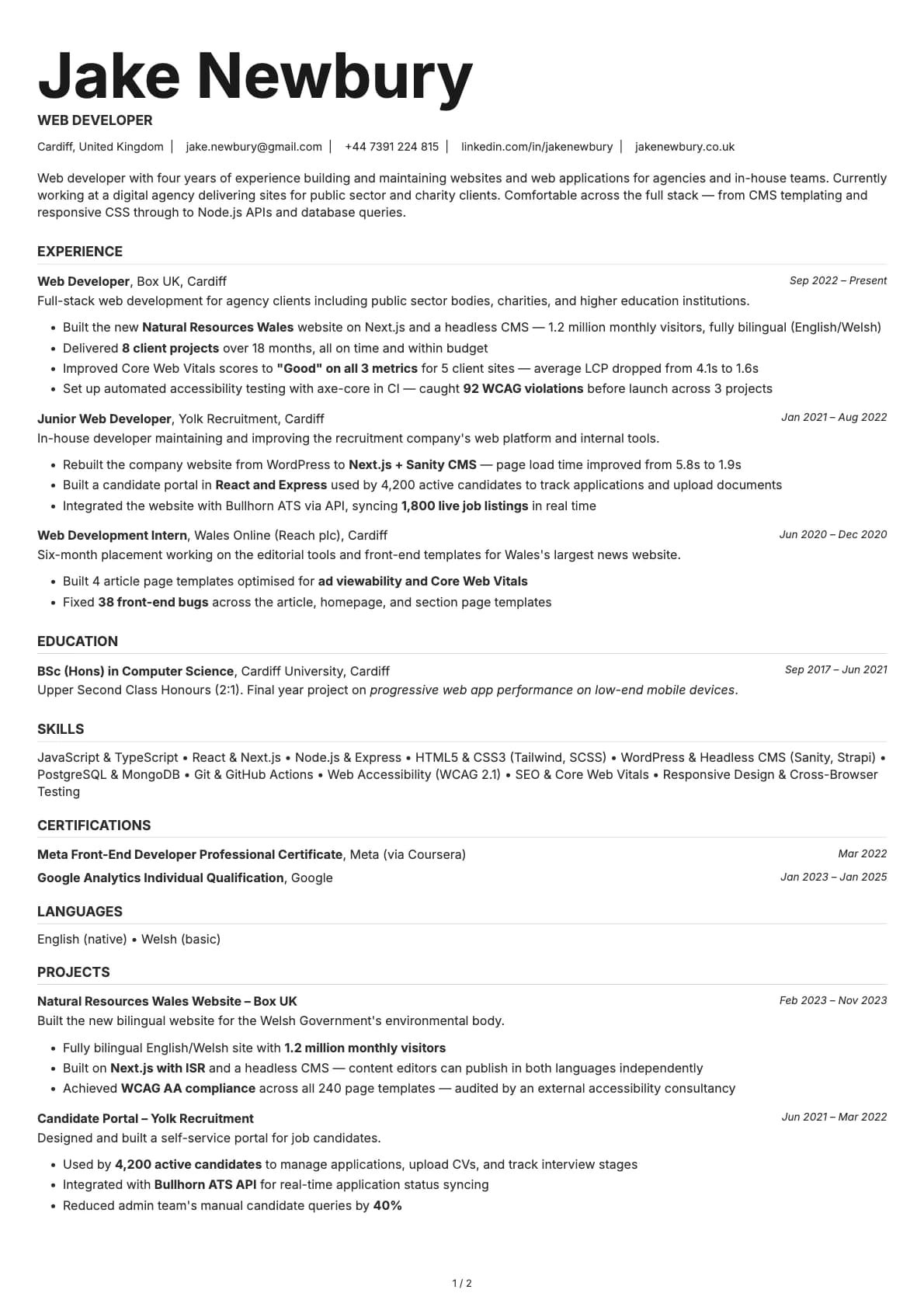
This resume belongs to Jake Newbury, a web developer with four years of experience based in Cardiff. He works at Box UK, a digital agency, building sites for public sector and charity clients. Before that, he was the in-house developer at Yolk Recruitment, and he did an internship at Wales Online. His work spans Next.js, headless CMS platforms, accessibility, and performance optimization.
What this resume does well is show the impact of web development work in terms that non-technical people (like recruiters and hiring managers) can actually understand. Let us look at how.
Your summary needs to define your type of web development
"Web developer" on its own does not tell a recruiter much. Jake's summary immediately narrows it:
Web developer with four years of experience building and maintaining websites and web applications for agencies and in-house teams. Currently working at a digital agency delivering sites for public sector and charity clients. Comfortable across the full stack, from CMS templating and responsive CSS through to Node.js APIs and database queries.
Three things are clear right away: he does agency and in-house work, his clients are public sector and charity organisations, and he works full-stack but is web-focused (not building mobile apps or machine learning models).
For yours: Name the types of sites or applications you build. Name the types of clients or the industry you work in. And be honest about where you sit on the stack. If you are mainly front-end, say so. If you do full-stack work, describe the range like Jake does. Do not claim to be a "full-stack engineer" if you only touch the database once a month.
How to write experience bullets that non-technical people understand
The biggest mistake web developers make on their resumes is writing bullets that only another developer would appreciate. "Refactored the codebase to use server-side rendering" means nothing to a recruiter. "Improved page load time from 5.8s to 1.9s by rebuilding the site in Next.js" means everything.
Look at Jake's Yolk Recruitment entry:
"Rebuilt the company website from WordPress to Next.js + Sanity CMS. Page load time improved from 5.8s to 1.9s."
The technology is there (WordPress, Next.js, Sanity), but the result is a number anyone can understand. Faster page loads. That is a business outcome, not just a technical task.
Another strong bullet from the Box UK role:
"Improved Core Web Vitals scores to 'Good' on all 3 metrics for 5 client sites. Average LCP dropped from 4.1s to 1.6s."
Again, the developer reading this knows what LCP means. But even a non-technical recruiter can see "4.1 seconds to 1.6 seconds" and understand that is a big improvement.
The formula: Name the technology you used + describe the outcome in plain language + give a number. If the number is a time improvement, a user count, or a cost saving, even better.
Accessibility and performance are differentiators
Here is something many web developers overlook on their resumes: accessibility and performance work is increasingly what separates a good web developer from an average one. Especially for agency roles and public sector contracts.
Jake's resume has two accessibility bullets:
"Set up automated accessibility testing with axe-core in CI. Caught 92 WCAG violations before launch across 3 projects."
"Achieved WCAG AA compliance across all 240 page templates. Audited by an external accessibility consultancy."
These are strong because they are specific and verifiable. "92 violations caught" is a real number. "WCAG AA across 240 templates" is a measurable scope. And mentioning the external audit adds credibility.
If you have done any accessibility work, put it on your resume. Public sector projects in the UK must meet WCAG 2.1 AA standards by law. Agencies that bid for government contracts need developers who can demonstrate this experience. It is a genuine competitive advantage, and most web developers do not mention it at all.
The same goes for Core Web Vitals. Google uses them as a ranking signal. Every client cares about their search rankings. If you have improved CWV scores on any project, write it down with before-and-after numbers.
Projects section: go deeper on your best work
Jake includes two projects: the Natural Resources Wales website and the Yolk Recruitment candidate portal. Both are also mentioned in his experience section, but the projects section lets him expand with more technical detail.
The NRW project is a good example:
"Fully bilingual English/Welsh site with 1.2 million monthly visitors. Built on Next.js with ISR and a headless CMS. Content editors can publish in both languages independently."
In the experience section, this project is a single bullet. In the projects section, it gets three bullets covering the bilingual architecture, the tech stack, and the accessibility audit. This is a smart way to highlight your best work without making your experience bullets too long.
When to use a projects section: If you have one or two pieces of work that are significantly more impressive than the rest, give them their own section. If all your work is roughly equal in scope, skip the projects section and put the detail in your experience bullets instead.
For web developers specifically, this is also where you can mention personal or open-source projects. Jake does not include any here (his professional work is strong enough), but if you are earlier in your career, a well-built personal project with a live URL and a GitHub repo can fill the gap left by less professional experience.
Skills: be specific about your stack
Jake lists 10 skills, and each one is specific:
JavaScript & TypeScript, React & Next.js, Node.js & Express, HTML5 & CSS3 (Tailwind, SCSS), WordPress & Headless CMS (Sanity, Strapi)
Notice the pairing. Not just "CSS" but "HTML5 & CSS3 (Tailwind, SCSS)." Not just "CMS" but "WordPress & Headless CMS (Sanity, Strapi)." This matters because ATS systems scan for exact keyword matches. If a job advert asks for Tailwind experience and you only list "CSS," the ATS might not match you.
One area where this resume is smart: listing "Web Accessibility (WCAG 2.1)" and "SEO & Core Web Vitals" as skills. These are not programming languages, but they are skills that web developer roles increasingly require. Including them gives you keyword matches that most applicants miss.
What not to do: Do not list every framework you tried in a tutorial. If you cannot build something real with it today, leave it off. Ten specific, honest skills beat thirty vague ones.
Mistakes web developers make on their resumes
Listing technologies without outcomes. "Built React components" tells the recruiter you used React. "Built a candidate portal in React used by 4,200 active candidates" tells them you built something real that people actually use. Always connect the tech to a result.
Ignoring the client or user. Web development is ultimately about building things for people. Jake's resume mentions Natural Resources Wales (1.2 million monthly visitors), Yolk Recruitment (4,200 candidates), and Wales Online (one of the largest news sites in Wales). The client name and the scale add weight to every bullet.
No live links or portfolio. Jake includes his personal website (jakenewbury.co.uk). If you have a portfolio site, include it. If your projects are live, a hiring manager might actually look at them. Make sure they load fast and work on mobile. Nothing undermines a web developer resume faster than a broken portfolio link.
Over-designing the resume itself. Web developers sometimes use their resume as a design showcase, adding custom layouts, colour schemes, and icons. For most applications, this backfires. ATS systems cannot parse creative layouts. Jake uses Platinum, a clean single-column template. Let your portfolio show your design skills. Let your resume show your work history.
One last thought
Web development moves fast. The tools you used two years ago might not be what companies are hiring for today. But the fundamentals stay the same: build things that work, make them fast, make them accessible, and be able to explain what you did in plain language.
If your resume reads like a list of technologies, rewrite it. For every bullet, ask yourself: "What happened because I did this?" If the answer is faster page loads, more users, fewer bugs, or a successful launch, write that. The technology is the how. The outcome is what gets you the interview.
Build your own version
Open this layout in the builder and swap in your own details. It takes a few minutes.
Free to use. No account needed to start.
Was this resume example helpful?
Rate this example to help us create better content for you.
4.8 average from 167 ratingsRelated resume examples
Software Engineer
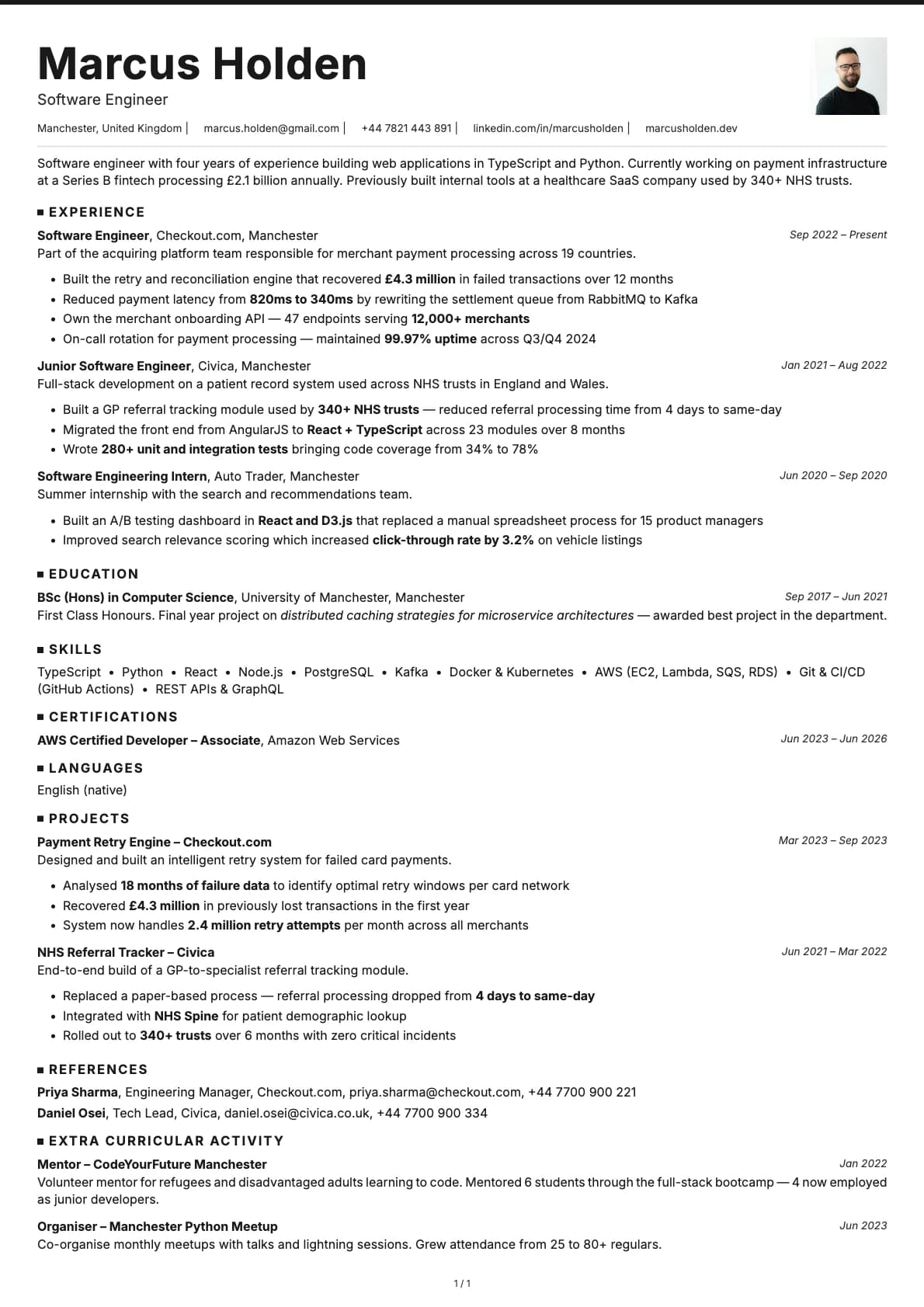
A software engineer resume example with practical tips on how to write your tech stack, quantify your impact, and get past ATS screening.
Frontend Developer
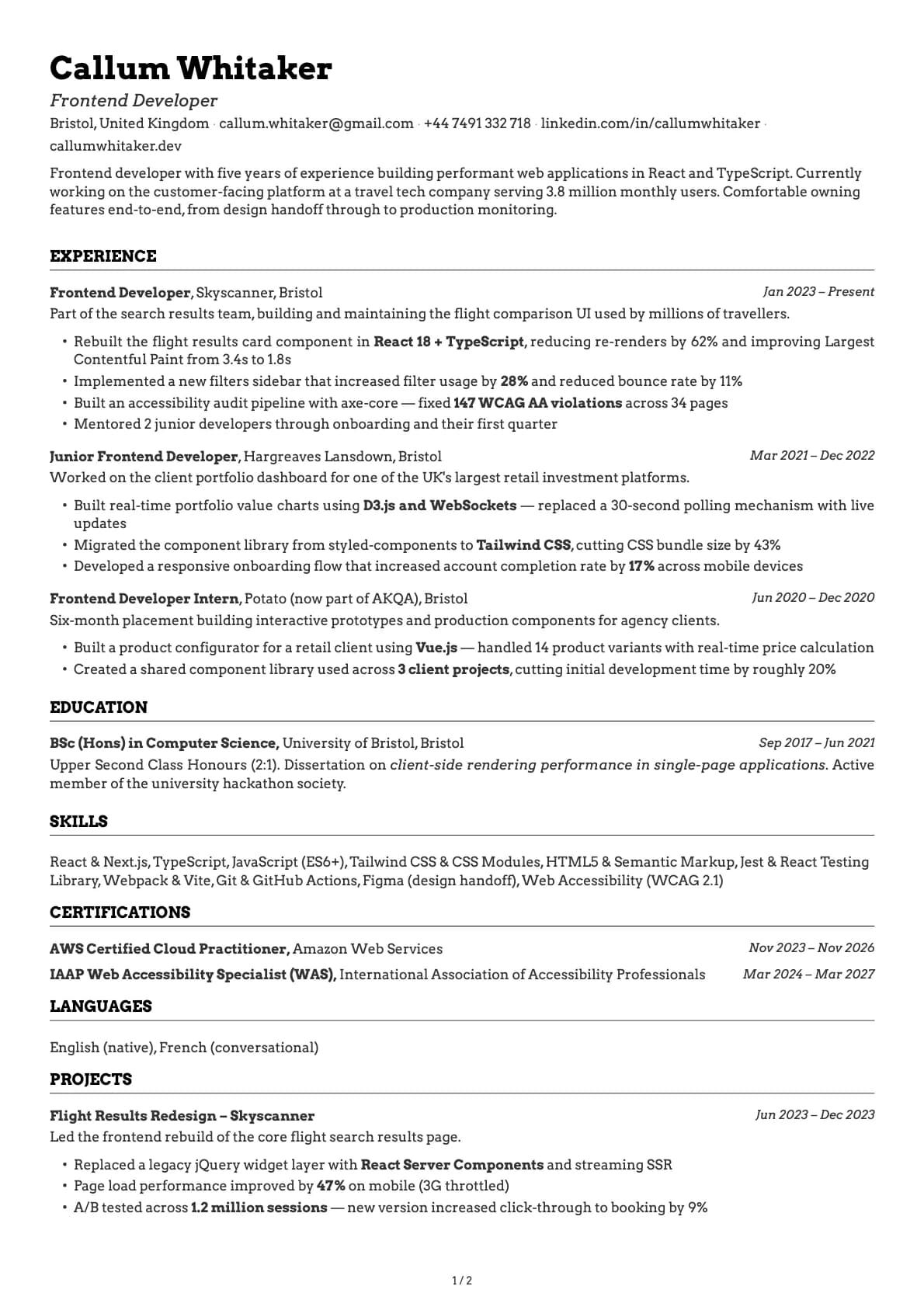
A frontend developer resume example with React and TypeScript experience at Skyscanner and Hargreaves Lansdown.
Backend Developer
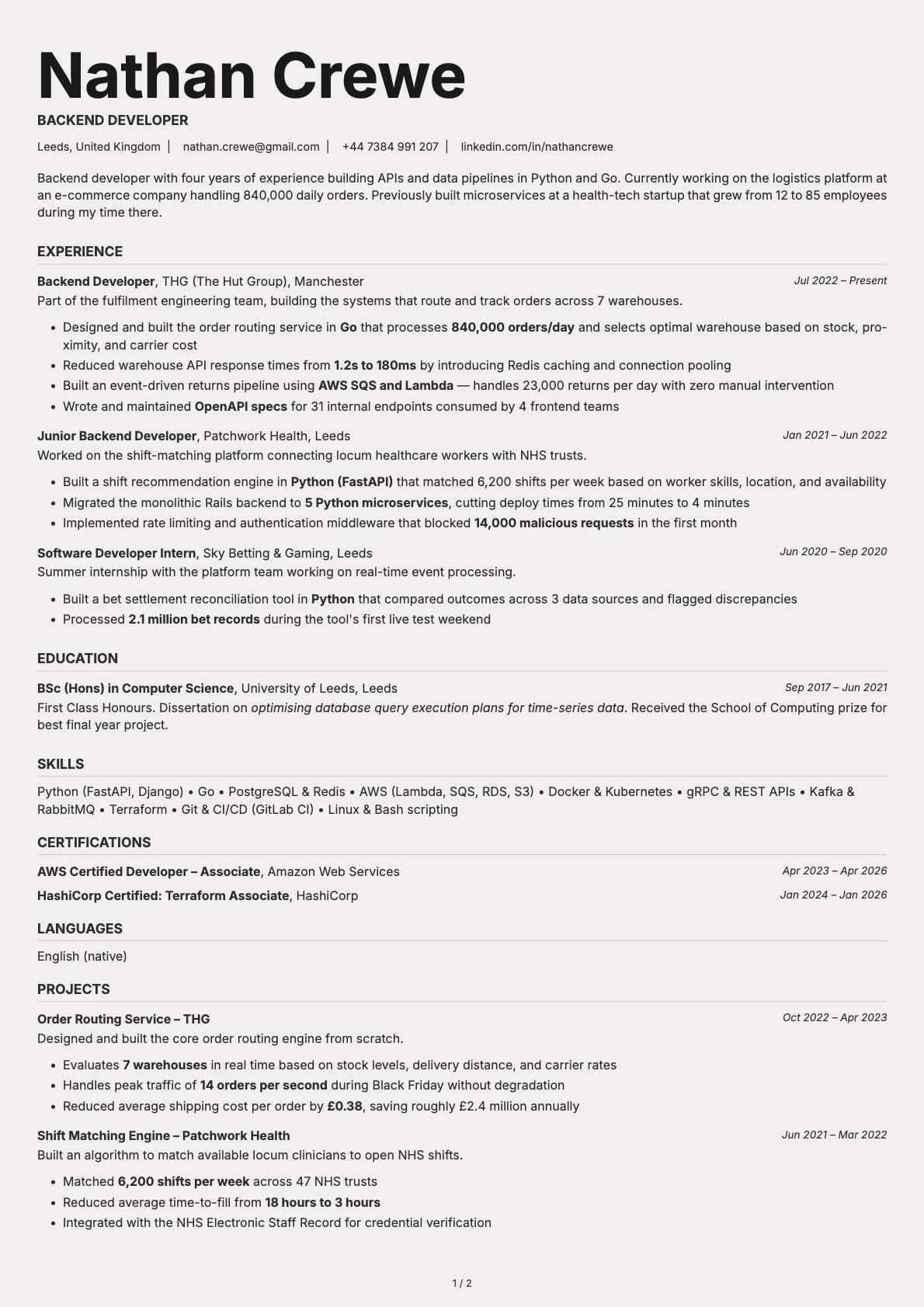
A backend developer resume example with Go and Python experience, system throughput numbers, and infrastructure projects across e-commerce and health-tech.
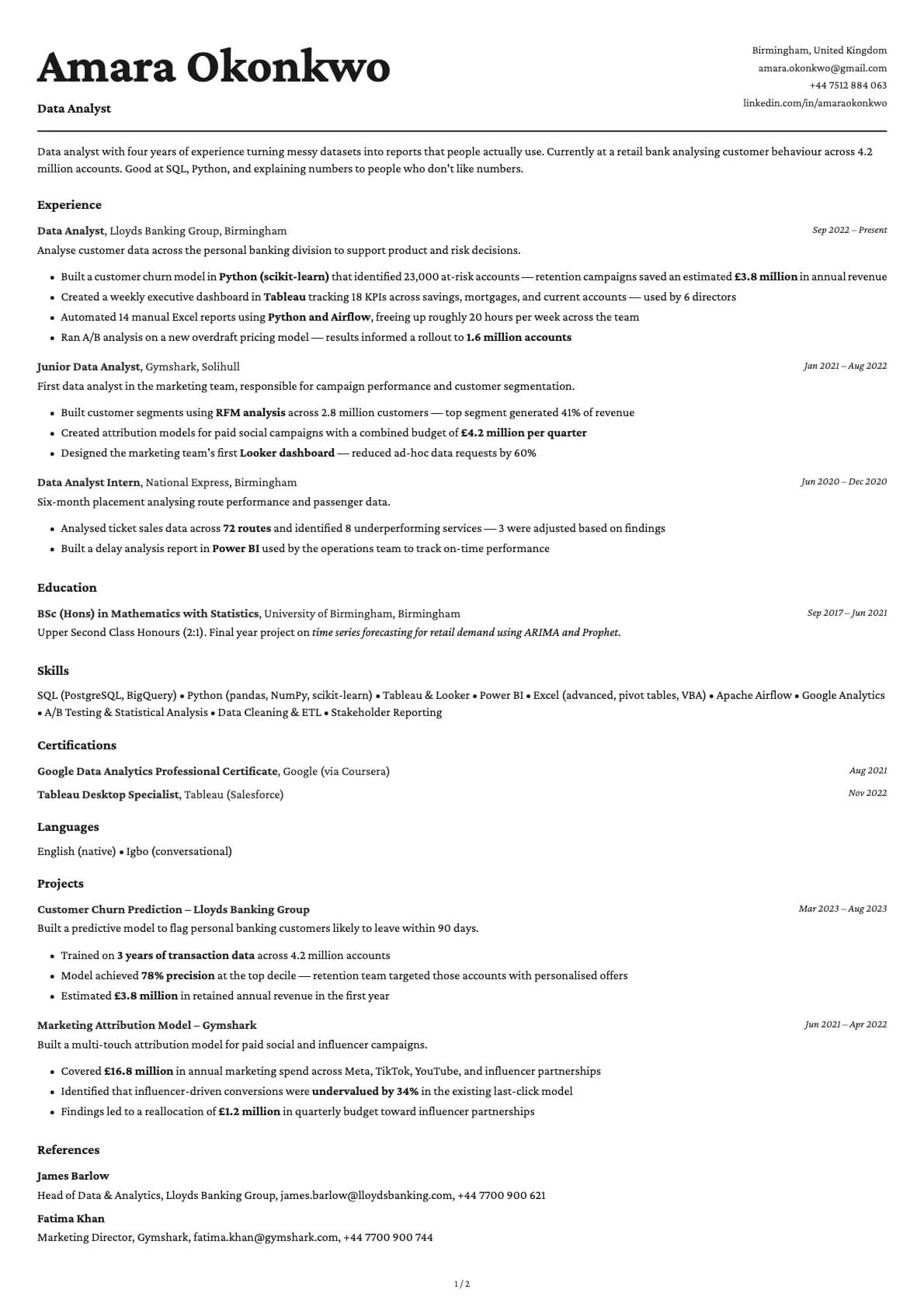
Data Analyst
A data analyst resume example with experience at Lloyds Banking Group and Gymshark.
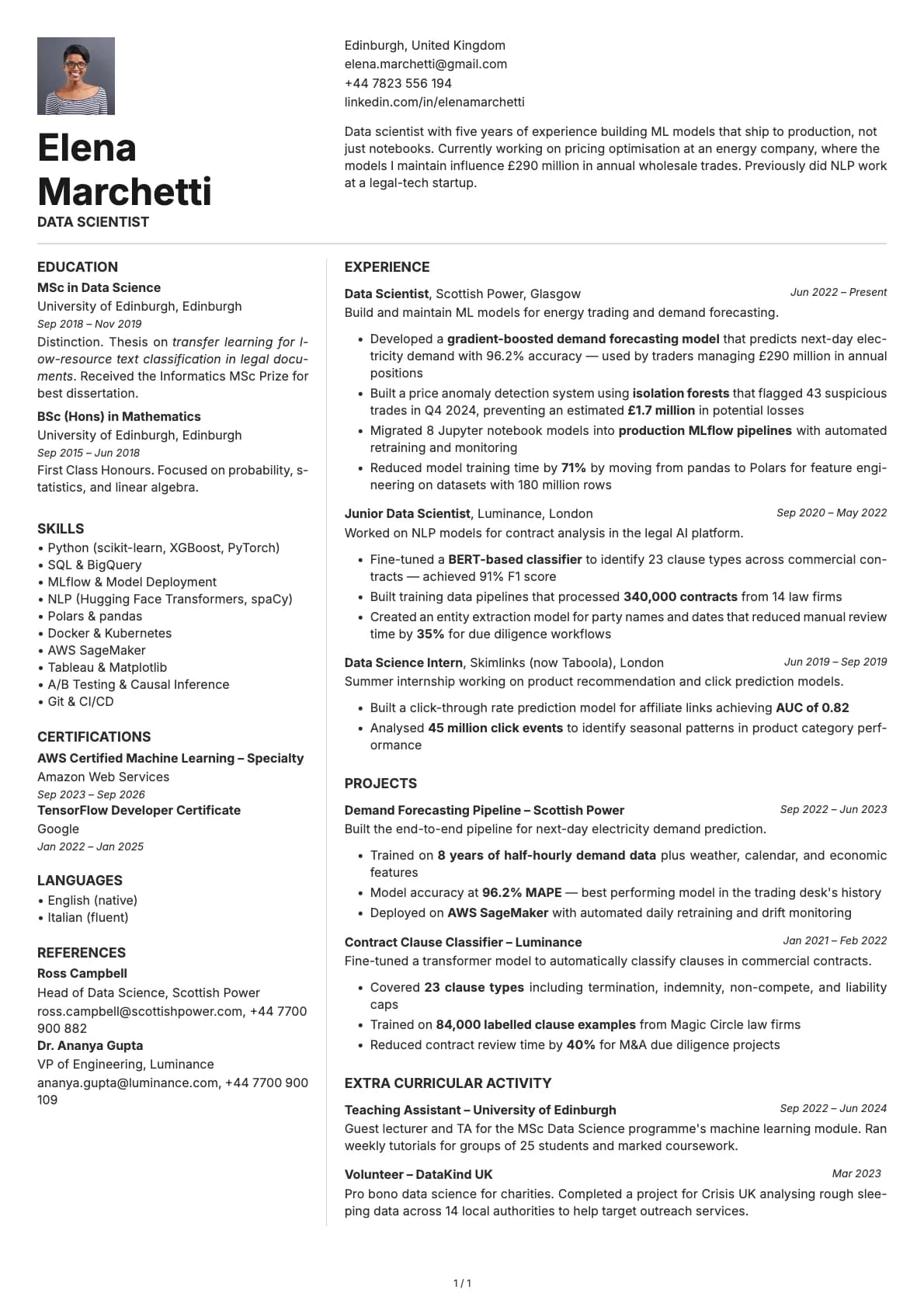
Data Scientist
A data scientist resume example with ML production experience at Scottish Power and NLP work at Luminance.
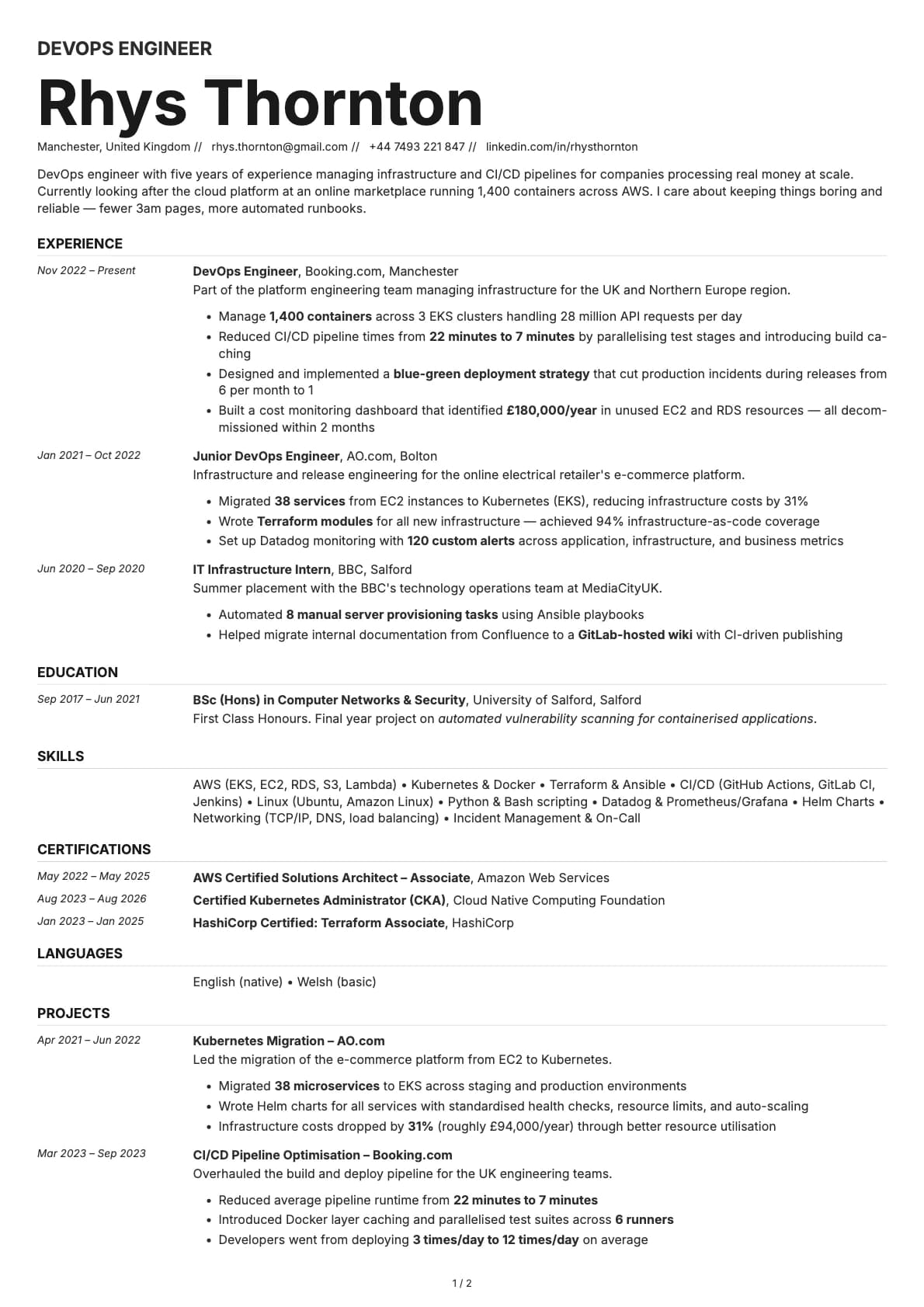
DevOps Engineer
A DevOps engineer resume example with infrastructure experience at Booking.com and AO.com.
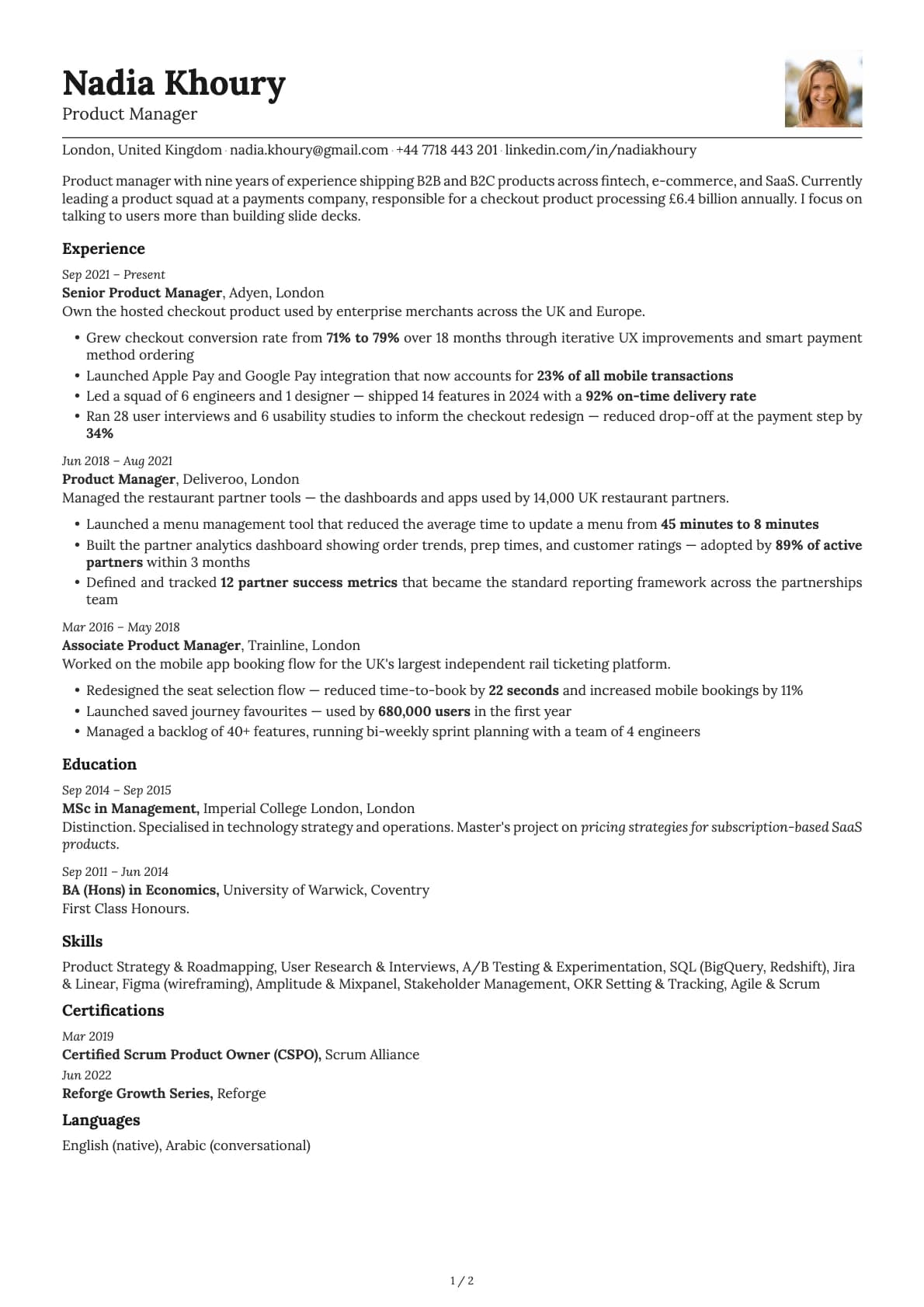
Product Manager
A product manager resume example showing how to present user research, conversion metrics, and feature launches with real business outcomes.
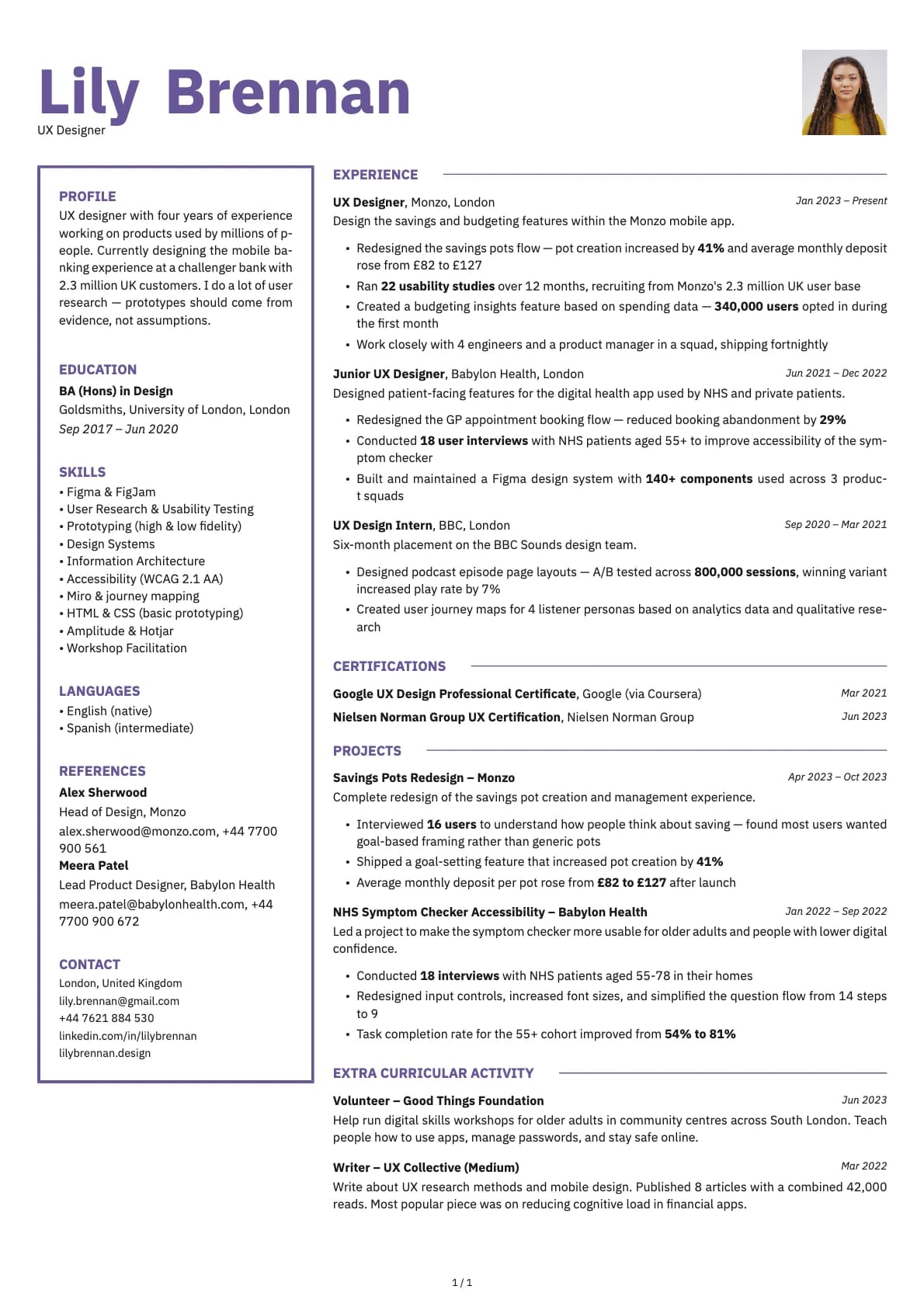
UX Designer
A UX designer resume example with 4 years of product design experience at Monzo and Babylon Health.
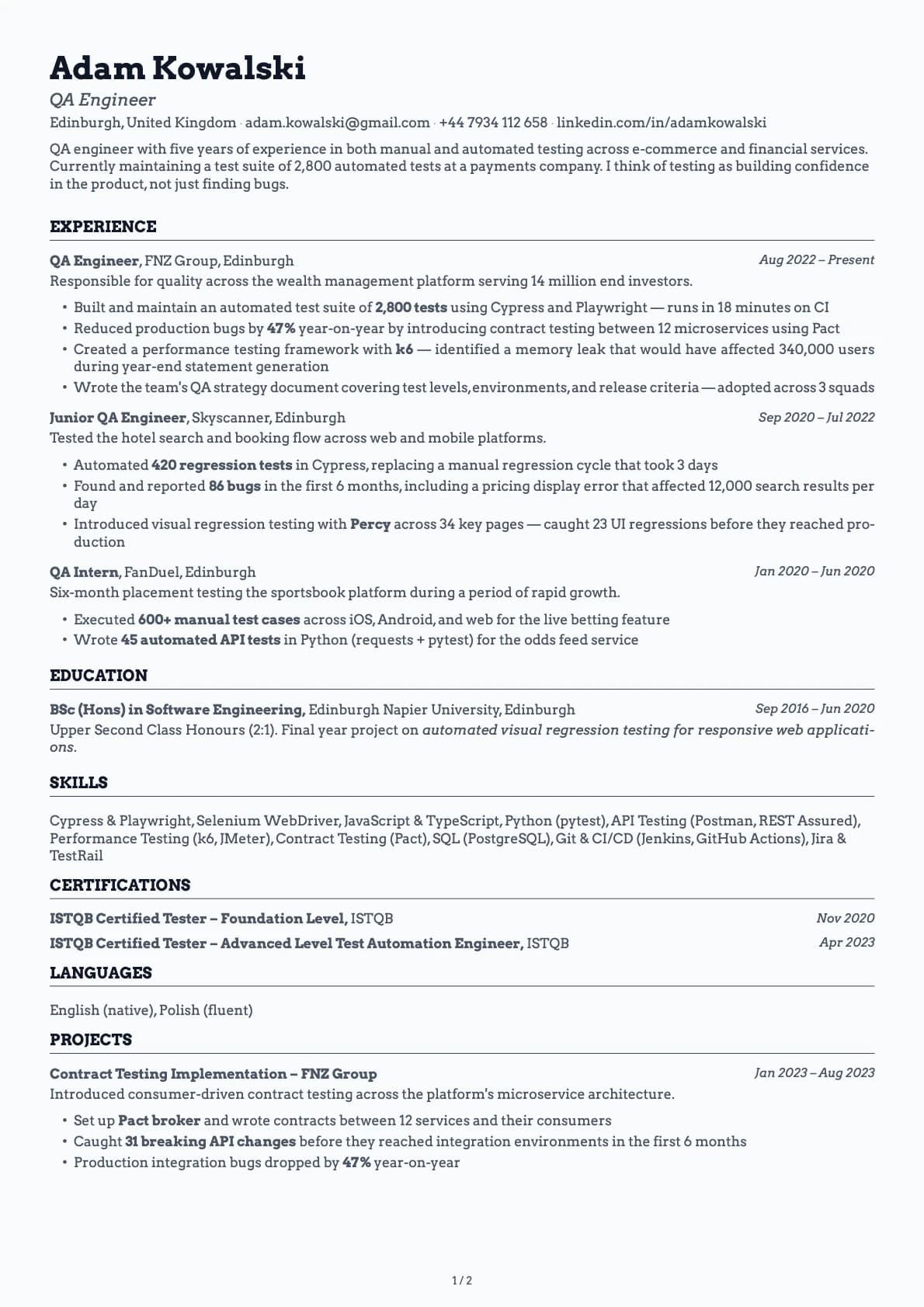
QA Engineer
A QA engineer resume example with automated test suite numbers, production bug reduction, and contract testing implementation details.
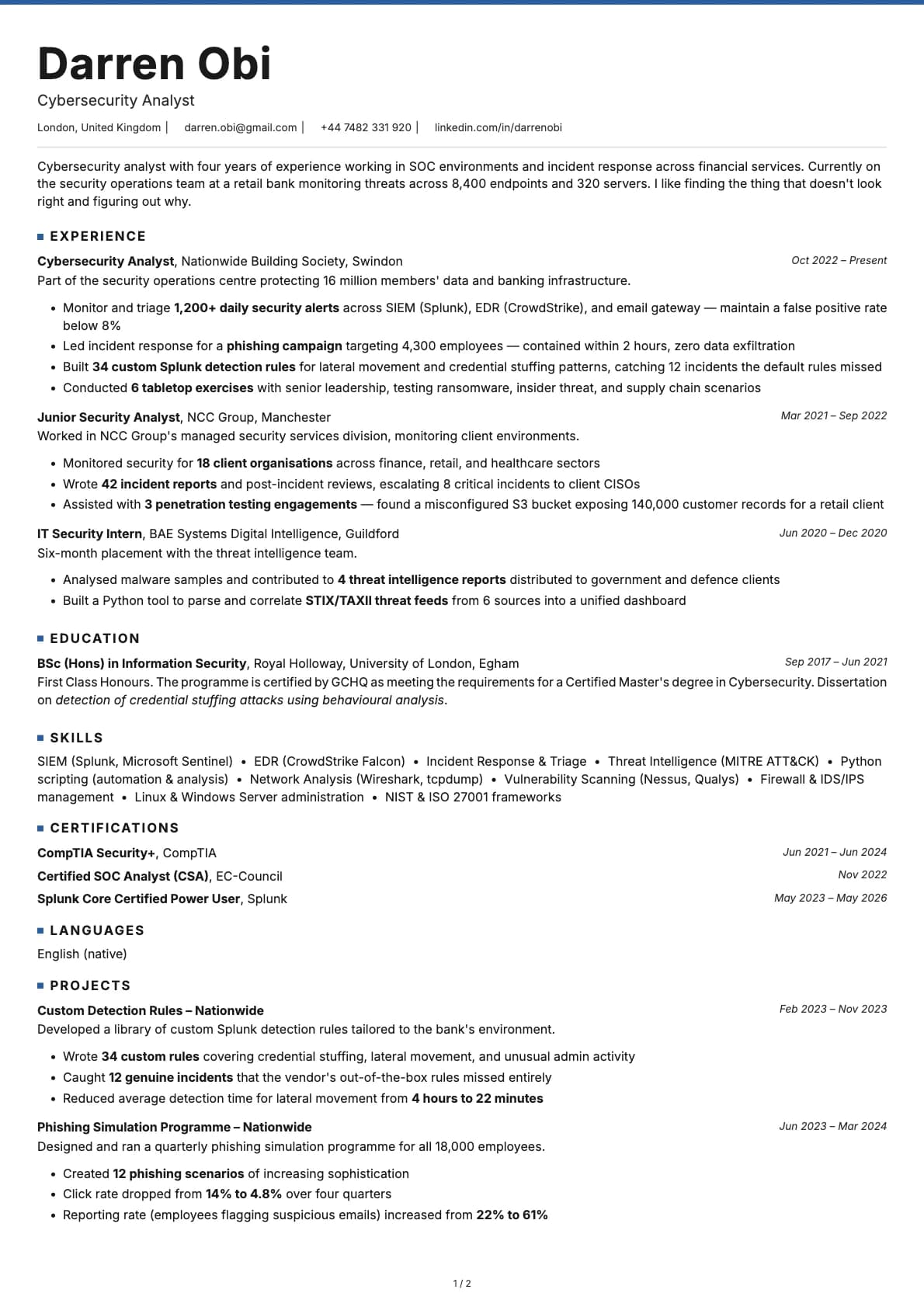
Cybersecurity Analyst
A cybersecurity analyst resume example with SOC experience at Nationwide and NCC Group.
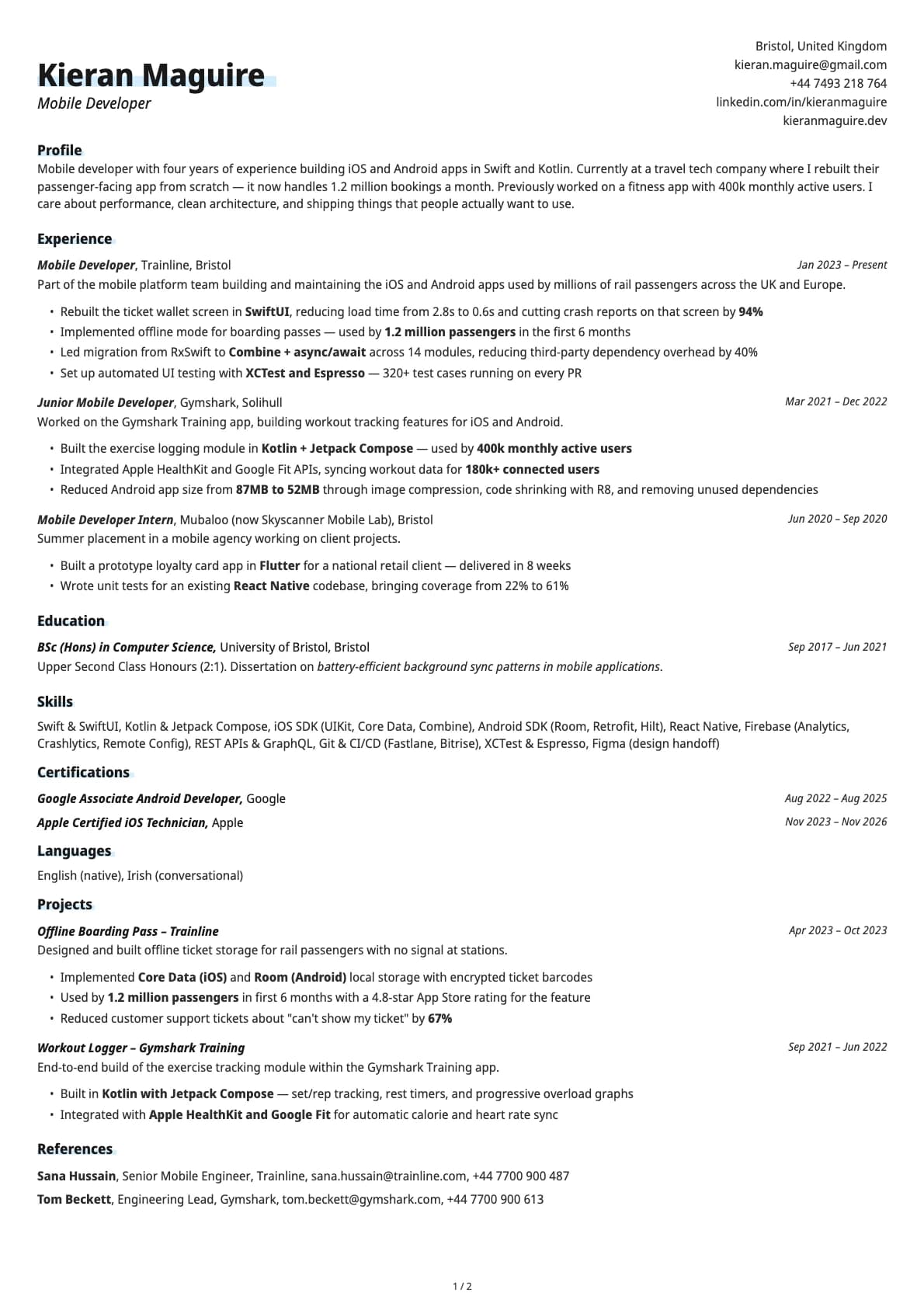
Mobile Developer
A mobile developer resume example with iOS and Android experience, performance metrics, and real app user numbers.
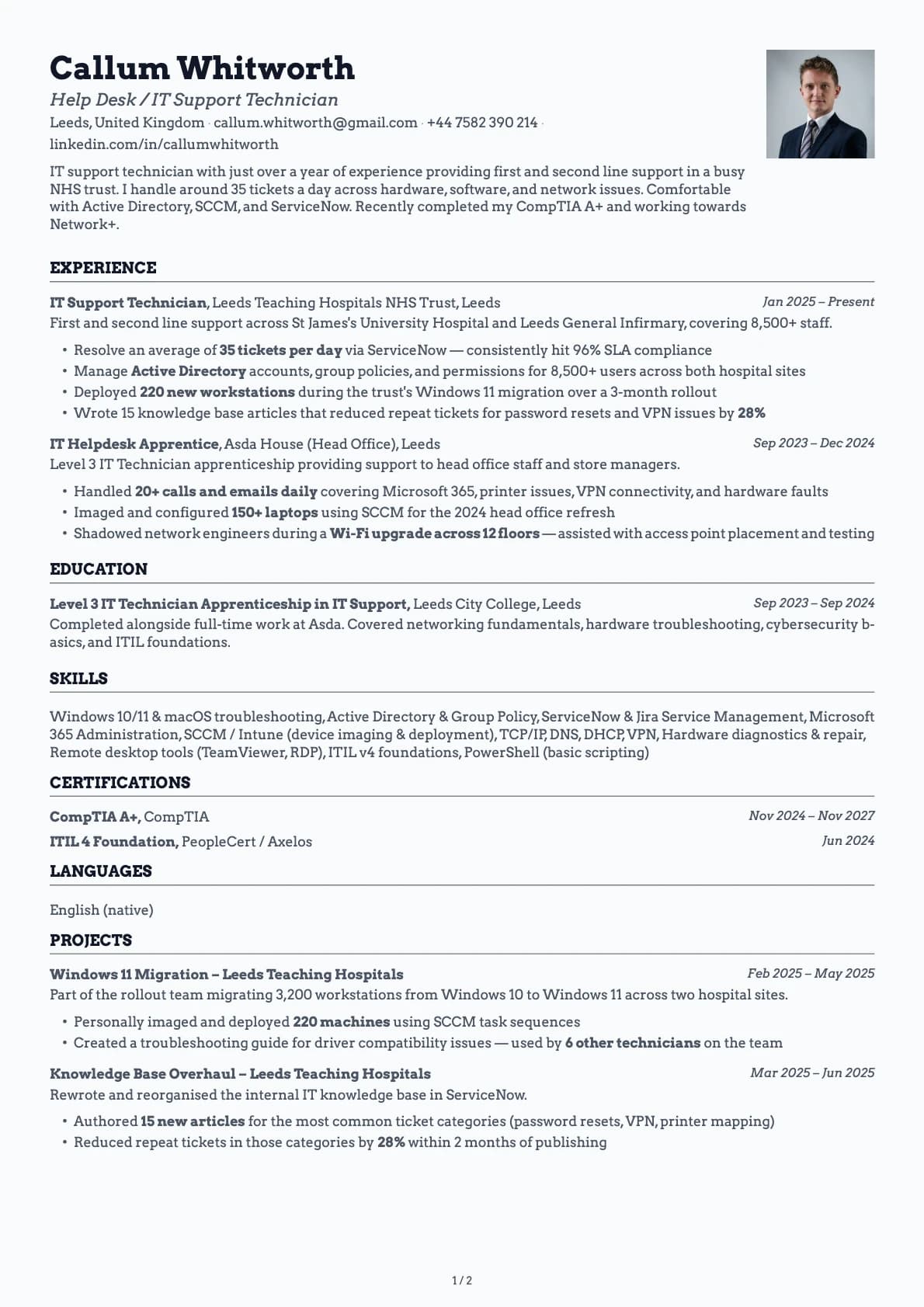
Help Desk / IT Support Technician
A help desk technician resume example with NHS IT support experience.
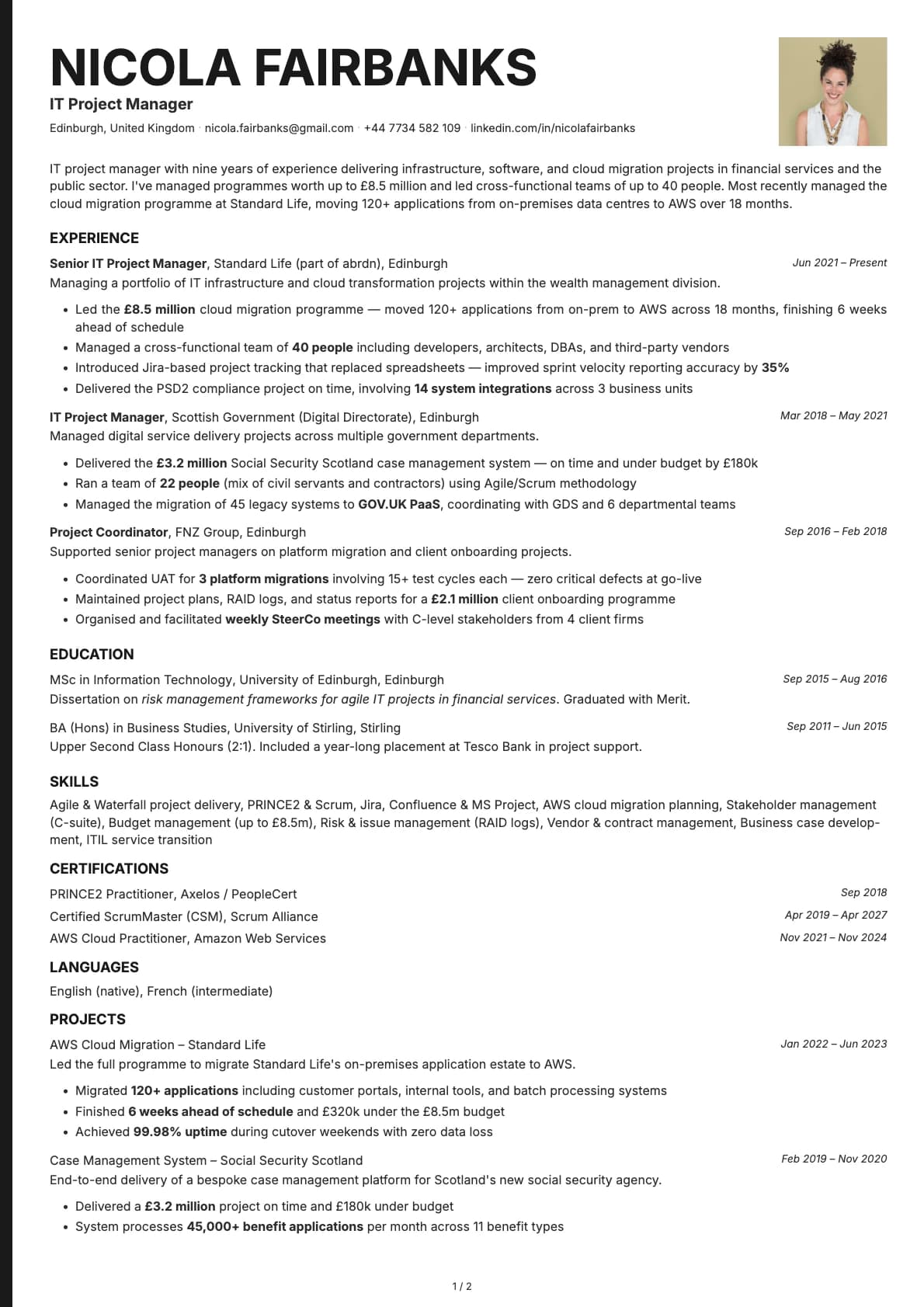
IT Project Manager
An IT project manager resume example with cloud migration, programme budgets up to £8.5 million, and PRINCE2/Scrum certifications.
Related articles

AI Is Screening Your Resume Before Any Human Sees It
AI screens most resumes before a human ever reads them. 97.4% of Fortune 500 companies run an ATS. This is what that means for you and what you can do about it.

ATS Resume Checker: How to Format a CV That Gets Past the Filters
Run the free copy and paste test to see what an ATS actually reads on your CV, then fix the tables, columns and headings that quietly get you filtered out.

The Best Resume Builders in 2026, Compared Honestly
Resume.io, Zety, Enhancv, Kickresume, Teal, and Laddro compared honestly: real pricing, free tiers, mobile apps, and where each tool wins. All prices checked in September 2026.