Mobile Developer Resume Example
A mobile developer resume example with iOS and Android experience, performance metrics, and real app user numbers.

Laddro Team
Free to use. No account needed to start.
Free to use. No account needed to start.
Overview
Mobile developer resumes have a specific problem: everybody lists the same frameworks. Swift, Kotlin, React Native, Flutter. The frameworks alone do not tell a recruiter anything about your ability to ship a real app to real users. What matters is what you built, how many people used it, and what improved because of your work.
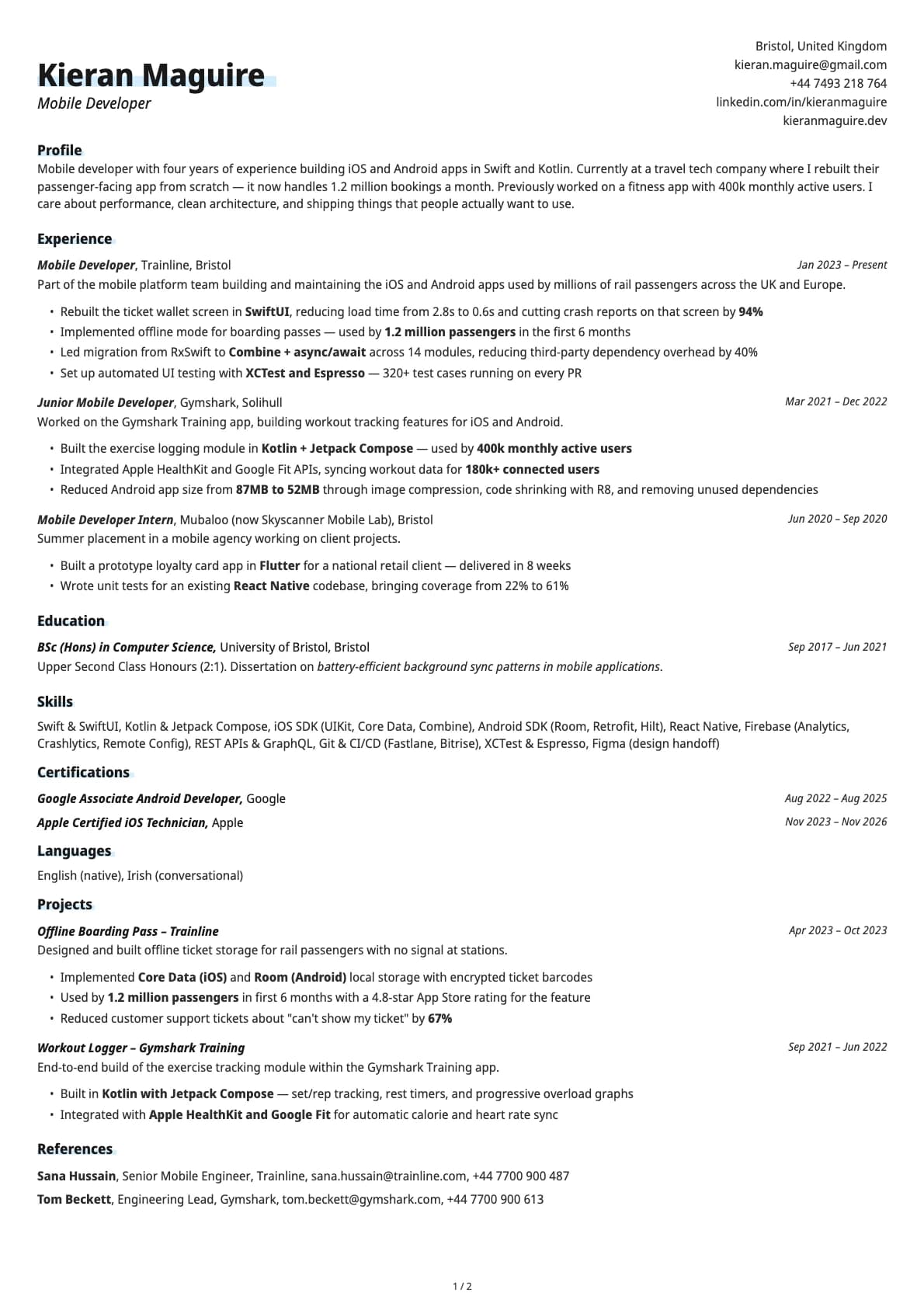
This resume belongs to Kieran Maguire, a mobile developer with four years of experience. He currently works at Trainline, where he rebuilt the ticket wallet screen and implemented offline boarding passes used by 1.2 million passengers. Before that, he built workout tracking features at Gymshark for an app with 400k monthly active users. The resume works because every bullet connects a technical decision to a user-facing outcome.
Let us break it down.
Your summary should name the app, the users, and the scale
Most mobile dev summaries read like a tech stack dump. "Experienced iOS and Android developer proficient in Swift, Kotlin, SwiftUI, Jetpack Compose, MVVM, Clean Architecture..." That is a skills section, not a summary.
Here is Kieran's:
Mobile developer with four years of experience building iOS and Android apps in Swift and Kotlin. Currently at a travel tech company where I rebuilt their passenger-facing app from scratch. It now handles 1.2 million bookings a month.
Three sentences. The first establishes tenure and core languages. The second and third give the reader something to remember: 1.2 million bookings a month. That is the hook.
Your formula: Years of experience + primary languages + current company + the most impressive user or scale number from your work.
Write experience bullets that connect code to users
The difference between a weak mobile dev resume and a strong one is the link between technical work and user impact.
Bad bullet: "Rebuilt the ticket wallet screen using SwiftUI."
Good bullet from this resume:
"Rebuilt the ticket wallet screen in SwiftUI, reducing load time from 2.8s to 0.6s and cutting crash reports on that screen by 94%"
Same work. But the second version tells the recruiter: the load time dropped from 2.8 seconds to 0.6 seconds (that is a performance win users can feel), and crashes dropped by 94% (that is a stability win the support team can measure).
Here is another strong one:
"Led migration from RxSwift to Combine + async/await across 14 modules, reducing third-party dependency overhead by 40%"
This shows architectural judgment. The recruiter sees that Kieran did not just use a framework because it was popular. He migrated away from one when it made sense, and he can quantify why.
The formula: What you built or changed + the technology + the user-facing or operational impact.
How to handle your earlier roles
If you are 2 to 4 years in, your earlier roles might be junior positions or internships. That is fine. Just focus on what you shipped.
Look at the Gymshark role:
"Built the exercise logging module in Kotlin + Jetpack Compose. Used by 400k monthly active users"
"Reduced Android app size from 87MB to 52MB through image compression, code shrinking with R8, and removing unused dependencies"
Neither bullet mentions being a junior developer. They just describe the work and the result. The app size reduction is especially good because it shows awareness of something many junior devs ignore: the download and storage experience.
And the internship at Mubaloo:
"Built a prototype loyalty card app in Flutter for a national retail client. Delivered in 8 weeks"
Short, specific, and it shows he shipped something. If your internship involved building a prototype, writing tests, or fixing bugs, describe it with the same specificity.
Skills: separate iOS from Android
This resume lists Swift & SwiftUI, Kotlin & Jetpack Compose, iOS SDK specifics (UIKit, Core Data, Combine), and Android SDK specifics (Room, Retrofit, Hilt). That separation helps because many roles are platform-specific.
If you are applying for an iOS role, the recruiter needs to see Swift, UIKit, SwiftUI, Core Data, and Combine near the top. If it is Android, they need Kotlin, Jetpack Compose, Room, and Retrofit. If you are a cross-platform developer, group them clearly so each platform's tools are easy to scan.
Also list your testing frameworks. "XCTest and Espresso" on this resume tells the recruiter that testing is part of the workflow, not an afterthought. And include CI/CD tools (Fastlane, Bitrise, GitHub Actions). Deployment automation is a real skill that many mobile devs overlook on their resumes.
Projects reinforce your experience section
The two projects here (Offline Boarding Pass and Workout Logger) expand on work already mentioned in the experience section. This is a smart approach for mid-level developers. It lets you go deeper into the technical details without making your experience bullets too long.
The offline boarding pass project includes implementation details (Core Data on iOS, Room on Android, encrypted barcodes) and a support metric (67% reduction in "can't show my ticket" support tickets). That support metric is gold because it shows the feature solved a real user problem.
Mistakes that hurt mobile dev resumes
Listing every framework you have ever tried. If you did one tutorial in Flutter, do not list Flutter as a skill. Hiring managers will ask about anything on your resume. Only list technologies you are comfortable discussing in depth.
No user numbers. "Built a fitness tracking feature" tells the recruiter nothing about scale. "Built a fitness tracking feature used by 400k monthly active users" tells them everything.
Ignoring performance metrics. Mobile apps live and die by performance. If you improved load times, reduced crash rates, cut app size, or improved battery usage, put those numbers on your resume.
Skipping the App Store or Play Store context. If your app has a public rating, mention it. "4.8-star App Store rating for the feature" is strong social proof.
One more thing
If you have a personal website or portfolio (like Kieran's kieranmaguire.dev), include it. Mobile development is visual. Being able to link to screenshots, demo videos, or open-source projects gives the recruiter something concrete to look at beyond the resume itself.
Build your own version
Open this layout in the builder and swap in your own details. It takes a few minutes.
Free to use. No account needed to start.
Was this resume example helpful?
Rate this example to help us create better content for you.
4.8 average from 165 ratingsRelated resume examples
Software Engineer
A software engineer resume example with practical tips on how to write your tech stack, quantify your impact, and get past ATS screening.
Frontend Developer
A frontend developer resume example with React and TypeScript experience at Skyscanner and Hargreaves Lansdown.
Backend Developer
A backend developer resume example with Go and Python experience, system throughput numbers, and infrastructure projects across e-commerce and health-tech.
Data Analyst
A data analyst resume example with experience at Lloyds Banking Group and Gymshark.
Data Scientist
A data scientist resume example with ML production experience at Scottish Power and NLP work at Luminance.
DevOps Engineer
A DevOps engineer resume example with infrastructure experience at Booking.com and AO.com.
Product Manager
A product manager resume example showing how to present user research, conversion metrics, and feature launches with real business outcomes.
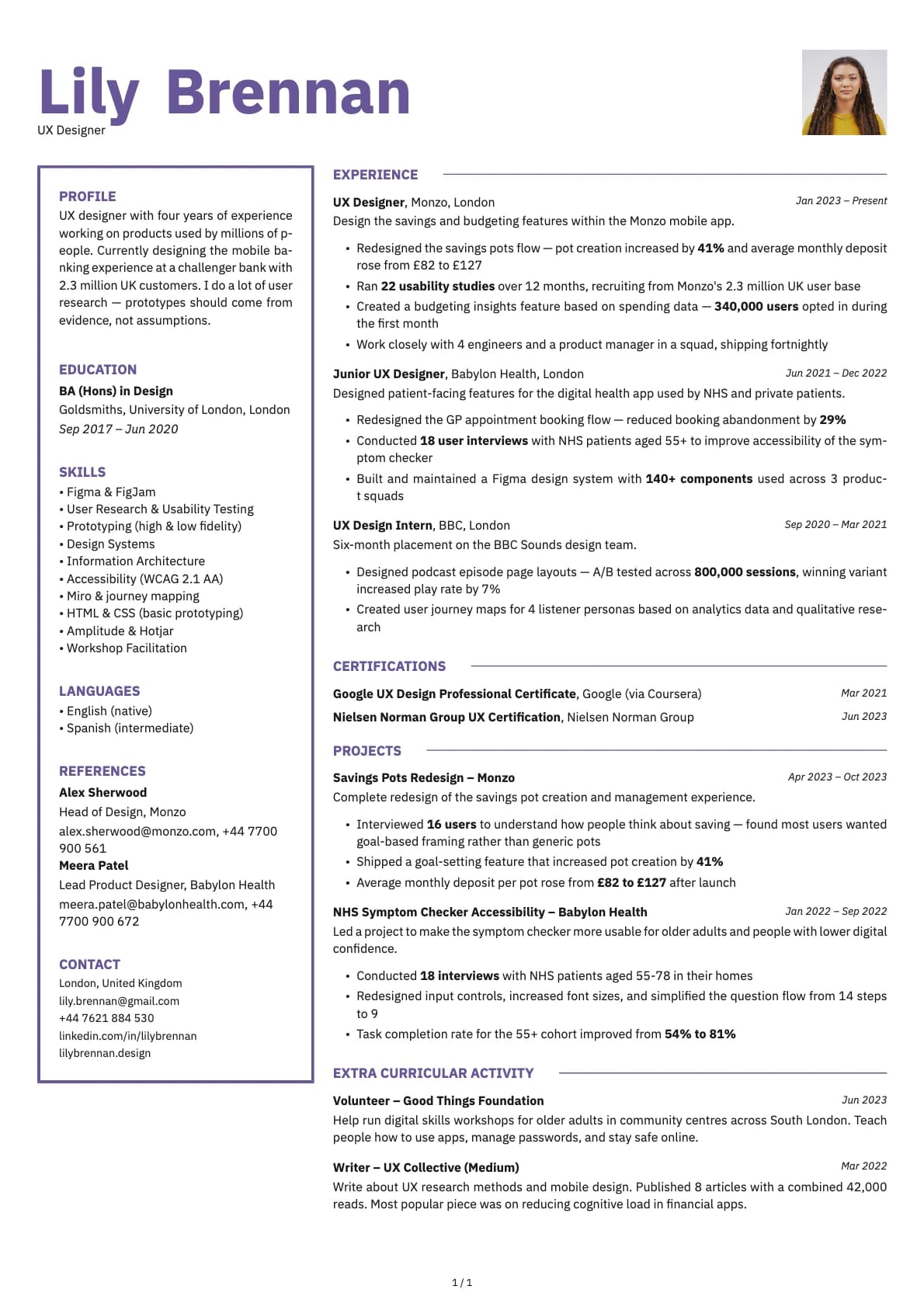
UX Designer
A UX designer resume example with 4 years of product design experience at Monzo and Babylon Health.
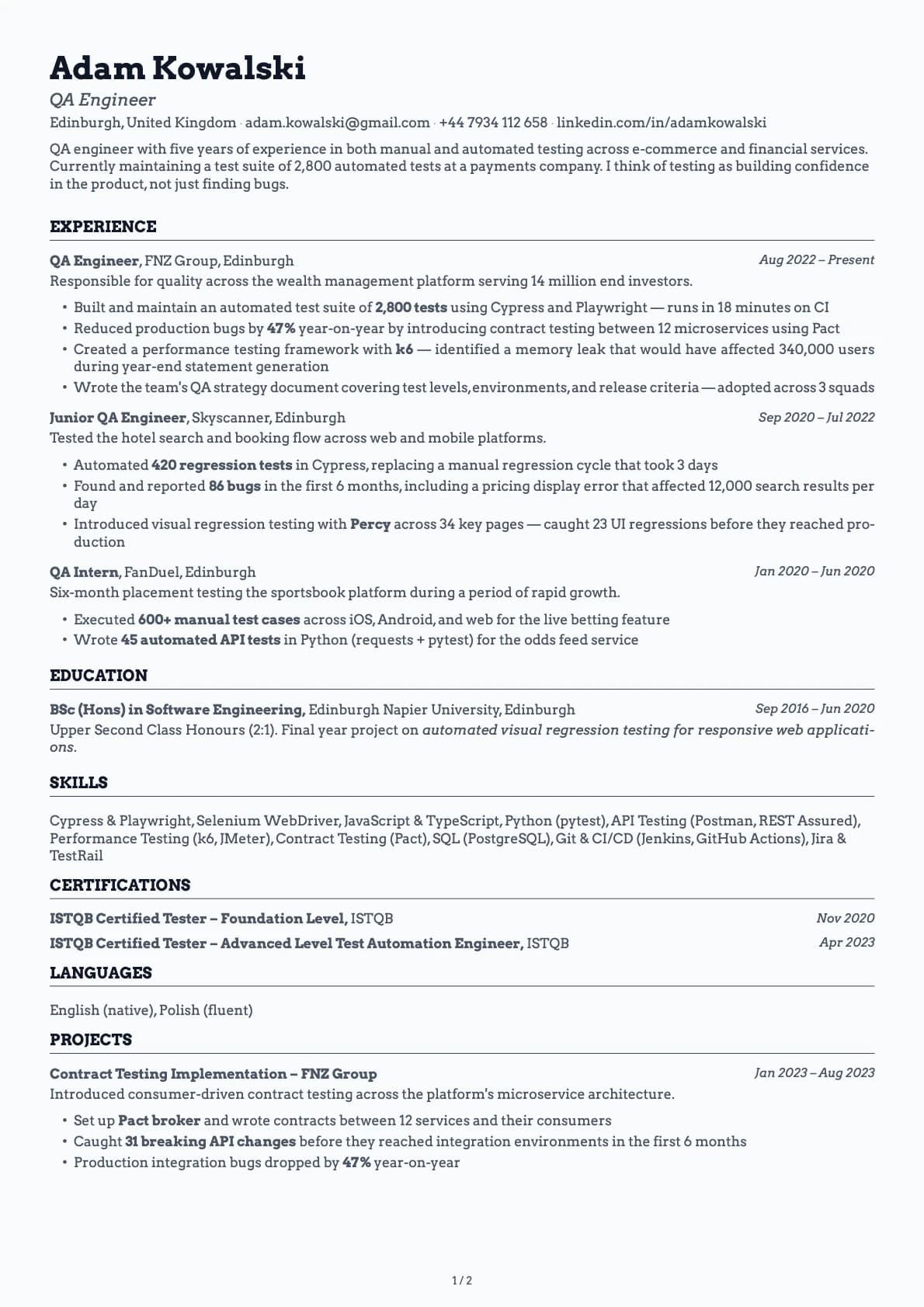
QA Engineer
A QA engineer resume example with automated test suite numbers, production bug reduction, and contract testing implementation details.
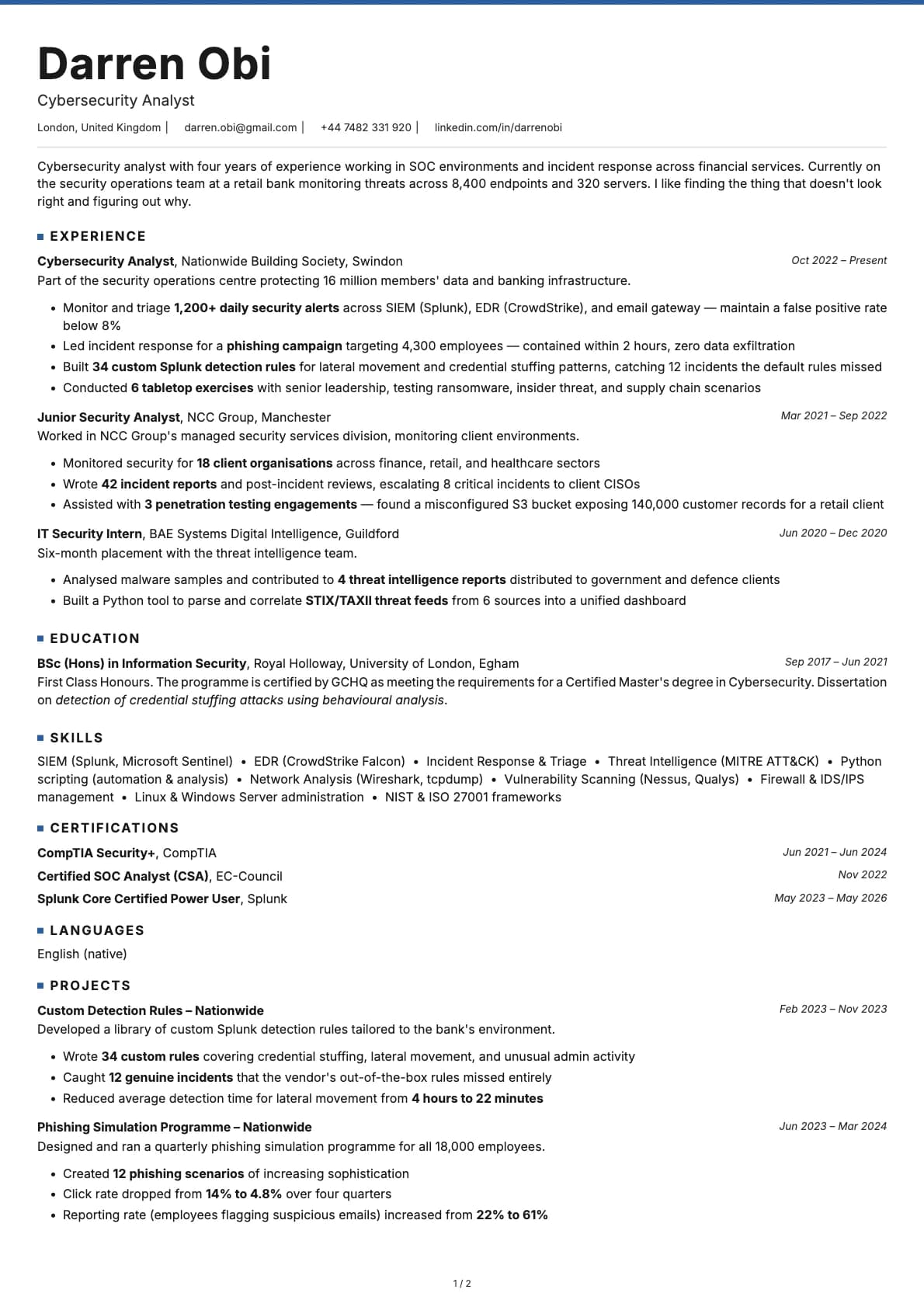
Cybersecurity Analyst
A cybersecurity analyst resume example with SOC experience at Nationwide and NCC Group.
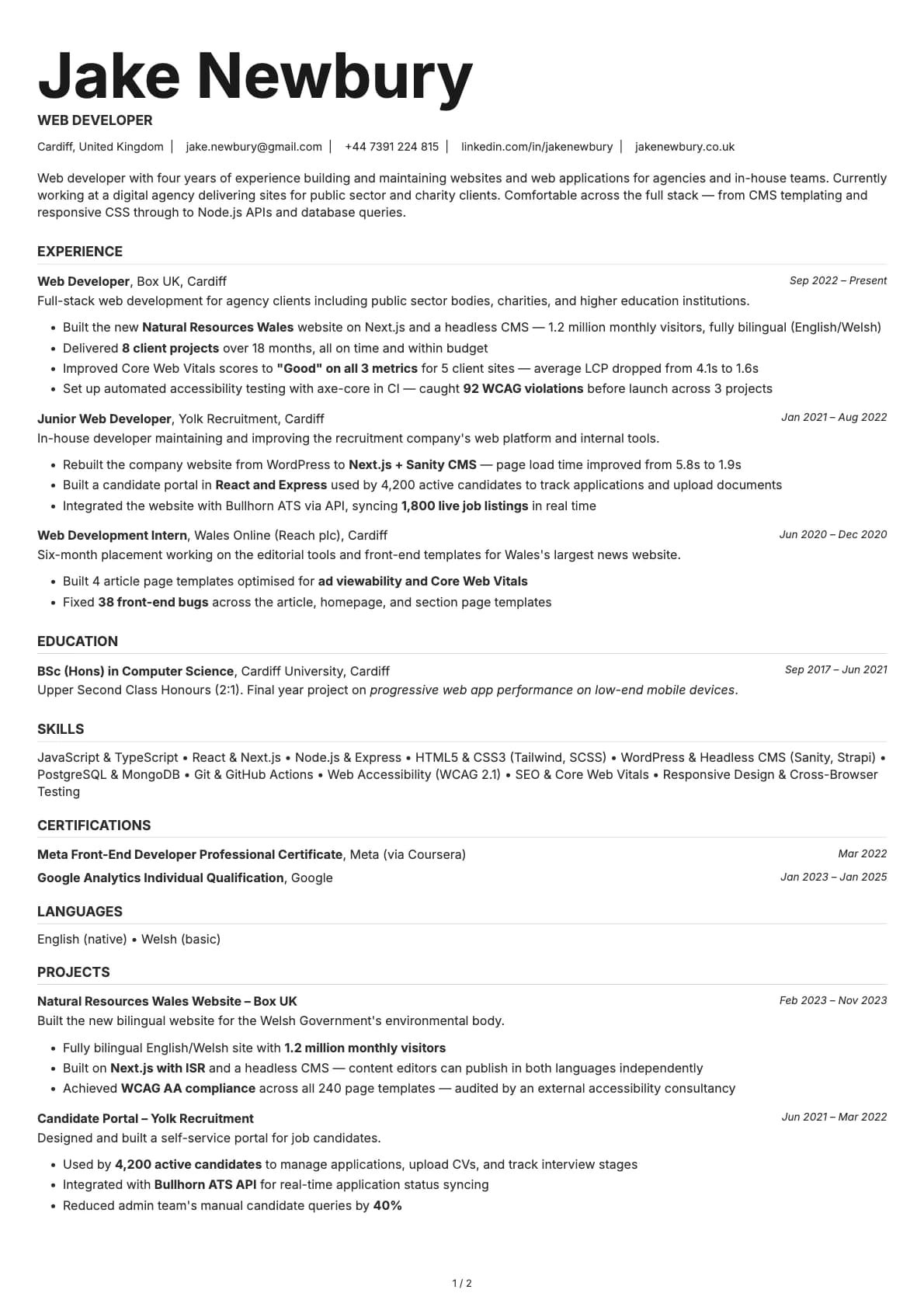
Web Developer
A web developer resume example with agency and in-house experience building Next.js sites, improving Core Web Vitals, and delivering accessible public.
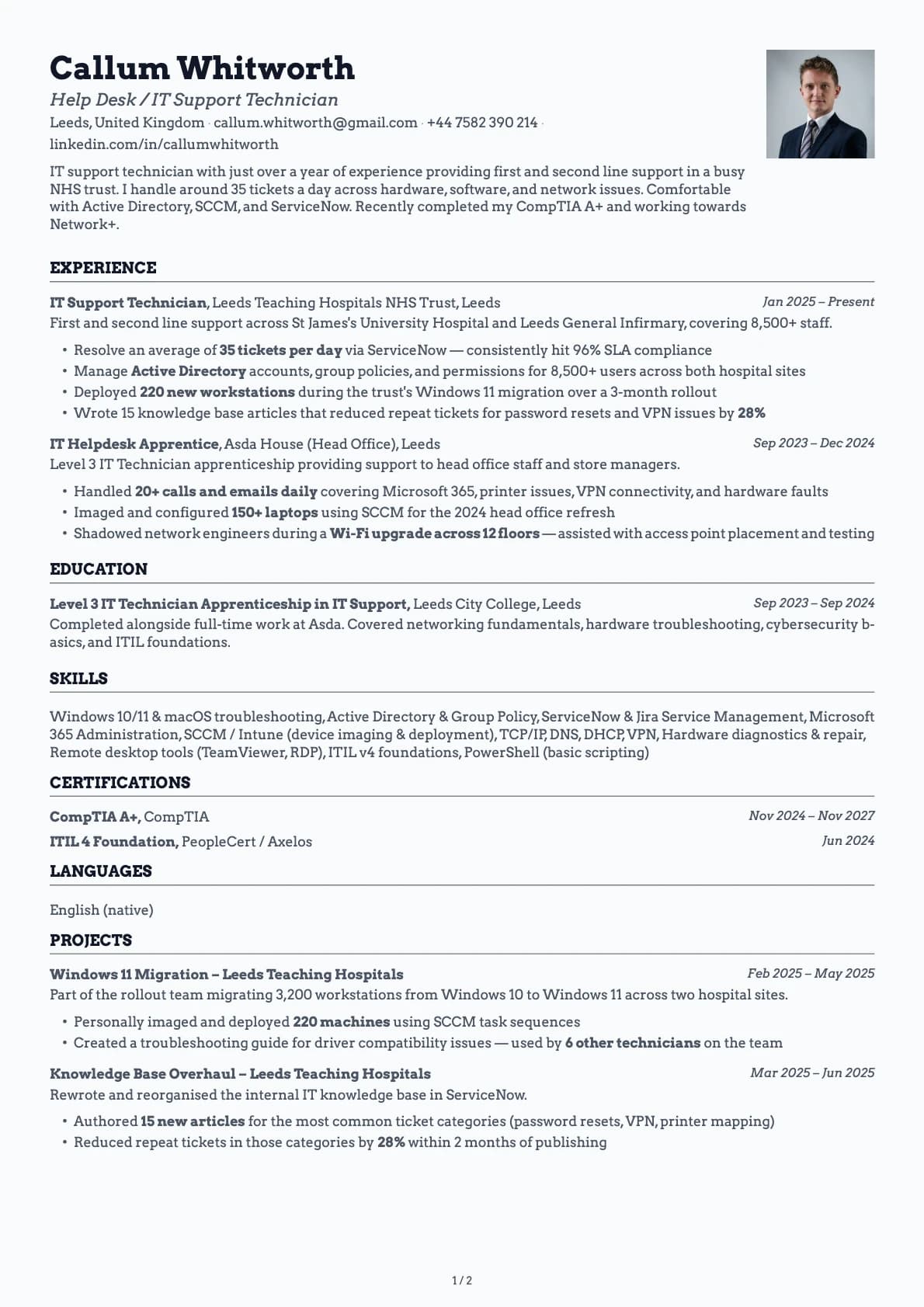
Help Desk / IT Support Technician
A help desk technician resume example with NHS IT support experience.
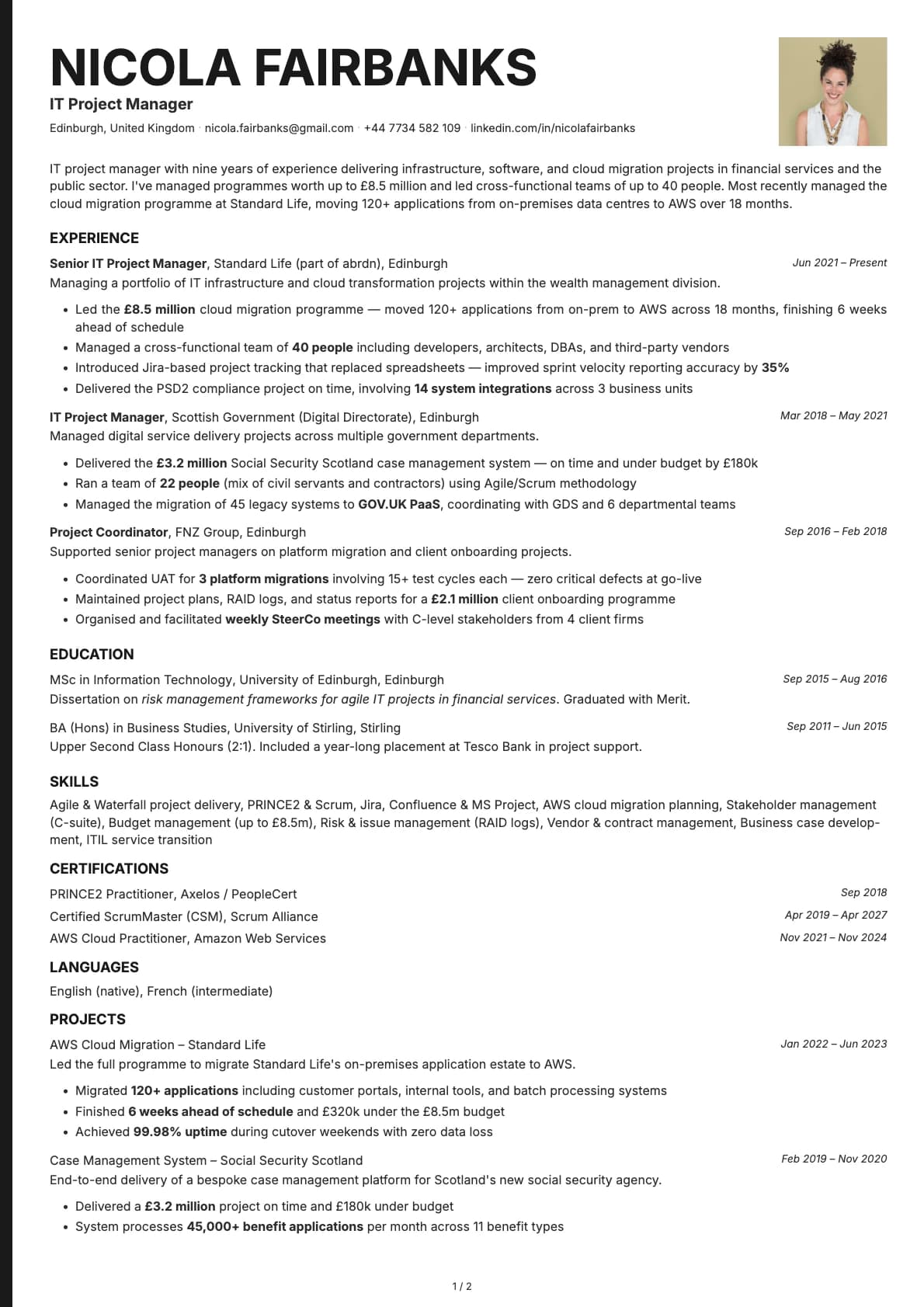
IT Project Manager
An IT project manager resume example with cloud migration, programme budgets up to £8.5 million, and PRINCE2/Scrum certifications.
Related articles

AI Is Screening Your Resume Before Any Human Sees It
AI screens most resumes before a human ever reads them. 97.4% of Fortune 500 companies run an ATS. This is what that means for you and what you can do about it.

ATS Resume Checker: How to Format a CV That Gets Past the Filters
Run the free copy and paste test to see what an ATS actually reads on your CV, then fix the tables, columns and headings that quietly get you filtered out.
The Best Resume Builders in 2026, Compared Honestly
Resume.io, Zety, Enhancv, Kickresume, Teal, and Laddro compared honestly: real pricing, free tiers, mobile apps, and where each tool wins. All prices checked in September 2026.