QA Engineer Resume Example
A QA engineer resume example with automated test suite numbers, production bug reduction, and contract testing implementation details.

Laddro Team
Free to use. No account needed to start.
Free to use. No account needed to start.
Overview
QA engineer resumes have a perception problem. Many hiring managers (and even some engineers) still think of QA as "the people who click through the app before a release." If your resume reads like that, you will be treated like that. The best QA resumes show that testing is an engineering discipline. Automation frameworks, test architecture, CI pipeline integration, performance analysis. That is what gets you interviews at companies that take quality seriously.
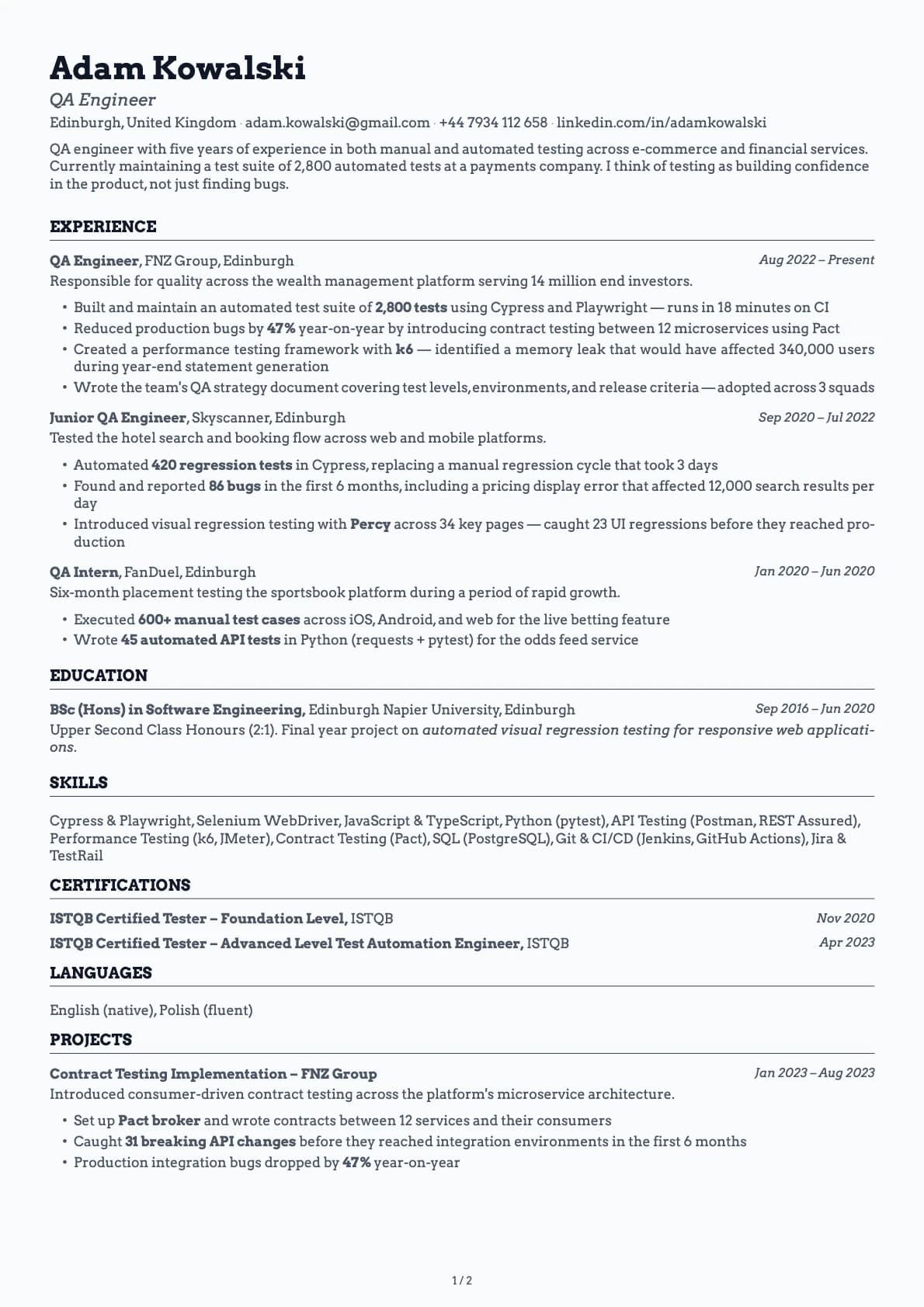
This resume belongs to Adam Kowalski, a QA engineer in Edinburgh with five years of experience. He currently works at FNZ Group, a wealth management platform serving 14 million end investors. He maintains an automated test suite of 2,800 tests, reduced production bugs by 47% through contract testing, and caught a memory leak that would have affected 340,000 users. Before FNZ, he was at Skyscanner and interned at FanDuel.
Let us go through what this resume does right.
Your summary should prove you are an engineer, not a tester
The difference between a QA tester and a QA engineer shows up in the first few lines of the resume. Adam's summary makes it clear immediately:
"Currently maintaining a test suite of 2,800 automated tests at a payments company."
That number (2,800 tests) tells the reader this person builds and maintains real test infrastructure, not just runs manual test cases. Then he adds a line about his philosophy: "I think of testing as building confidence in the product, not just finding bugs."
That second sentence is a signal to hiring managers who care about quality culture. It says: I am not here to gatekeep releases. I am here to help the team ship with confidence.
For yours: Lead with the scale of your testing work (number of automated tests, number of services covered, CI run time). Then add one sentence about how you approach quality. Skip generic phrases about "attention to detail."
How to write experience bullets as a QA engineer
QA bullets should show what you built, what you prevented, and what improved because of your work.
What you built
"Built and maintain an automated test suite of 2,800 tests using Cypress and Playwright, runs in 18 minutes on CI"
This tells the reader: the tech stack (Cypress, Playwright), the scale (2,800 tests), and the speed (18 minutes). That last part matters. A test suite that takes 4 hours to run is a liability. One that runs in 18 minutes is an asset. If your suite is fast, say so.
What you prevented
"Reduced production bugs by 47% year-on-year by introducing contract testing between 12 microservices using Pact"
This is a strong bullet because it connects a specific technique (contract testing with Pact) to a measurable outcome (47% fewer production bugs). It also shows architectural thinking. This person looked at the system, identified where bugs were leaking through (service boundaries), and introduced a targeted solution.
"Created a performance testing framework with k6, identified a memory leak that would have affected 340,000 users during year-end statement generation"
Bugs caught before production are hard to quantify, but this is a good approach. Name the tool, describe the problem you caught, and estimate the impact if it had reached users.
What improved
"Automated 420 regression tests in Cypress, replacing a manual regression cycle that took 3 days"
Before-and-after comparisons are powerful. Manual regression took 3 days. Now it is automated. The hiring manager immediately understands the value.
Earlier roles: show the progression
Adam's career shows a clear path: QA intern at FanDuel (manual test execution and first API tests), junior QA at Skyscanner (building automation suites, visual regression testing), and now QA engineer at FNZ (test strategy, contract testing, performance testing).
If you are early in your career, do not try to make your internship sound like a senior role. Adam's FanDuel entry honestly says he executed 600+ manual test cases and wrote 45 automated API tests. That is a perfectly fine internship. It shows he started with fundamentals and progressed from there.
The Skyscanner role is where the transition from manual to automated testing is clear. He built 420 Cypress tests, introduced visual regression testing with Percy, and found 86 bugs in his first six months (including one affecting 12,000 search results per day). The progression from manual to automated is the story. Let it show.
Skills: frameworks and tools, grouped logically
Adam lists his skills in a way that reads like a tech stack: Cypress & Playwright, Selenium, JavaScript & TypeScript, Python, API testing tools (Postman, REST Assured), performance tools (k6, JMeter), contract testing (Pact), SQL, CI/CD tools, and test management tools.
This is a skills section that tells a hiring manager exactly what you can work with from day one. Notice there is no "problem solving" or "critical thinking" in the list. Those are assumed. The skills section is for tools and frameworks.
If you have ISTQB certification, list it. Adam has both Foundation and Advanced Level Test Automation Engineer. These carry weight, especially for contract roles and companies that follow structured testing processes.
Mistakes QA engineers make on their resumes
Writing "tested the application" as a bullet point. That is your job title, not an achievement. Instead: "Built a regression suite of 420 tests that replaced a 3-day manual cycle."
Not mentioning CI/CD integration. Where do your tests run? On every PR? Nightly? In a dedicated pipeline? The hiring manager wants to know your tests are integrated into the development workflow, not run on your laptop once a week.
Hiding the tech stack. Name your frameworks. Name your languages. Name your CI tools. "Automated testing experience" tells the reader nothing. "Cypress, Playwright, k6, Pact, GitHub Actions" tells them everything.
Focusing only on bugs found. Finding bugs is part of the job, but the best QA resumes show prevention. Test architectures that catch problems before they reach production. Contracts that stop API breaking changes. Performance frameworks that surface issues under load. Show that you are building systems, not just finding faults.
One more thing
QA engineering is moving toward shift-left testing, contract-driven development, and quality engineering embedded within product teams. If your resume still reads like a manual testing role from 2015, you are going to lose out to candidates who show automation, architecture, and engineering thinking. Even if you still do some manual testing (and there is nothing wrong with that), lead with the engineering work. That is what gets you past the initial screen.
Build your own version
Open this layout in the builder and swap in your own details. It takes a few minutes.
Free to use. No account needed to start.
Was this resume example helpful?
Rate this example to help us create better content for you.
4.8 average from 167 ratingsRelated resume examples
Software Engineer
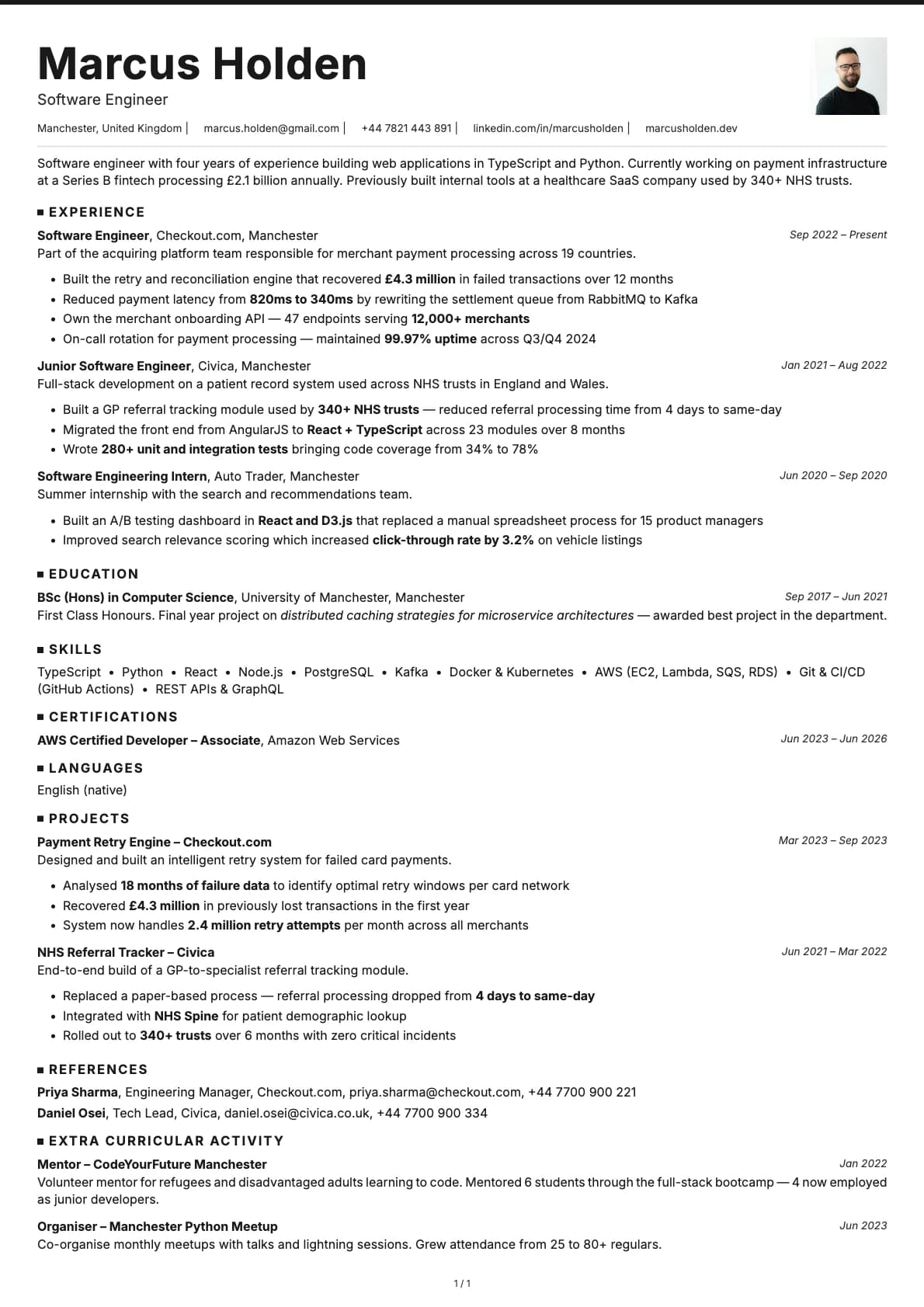
A software engineer resume example with practical tips on how to write your tech stack, quantify your impact, and get past ATS screening.
Frontend Developer
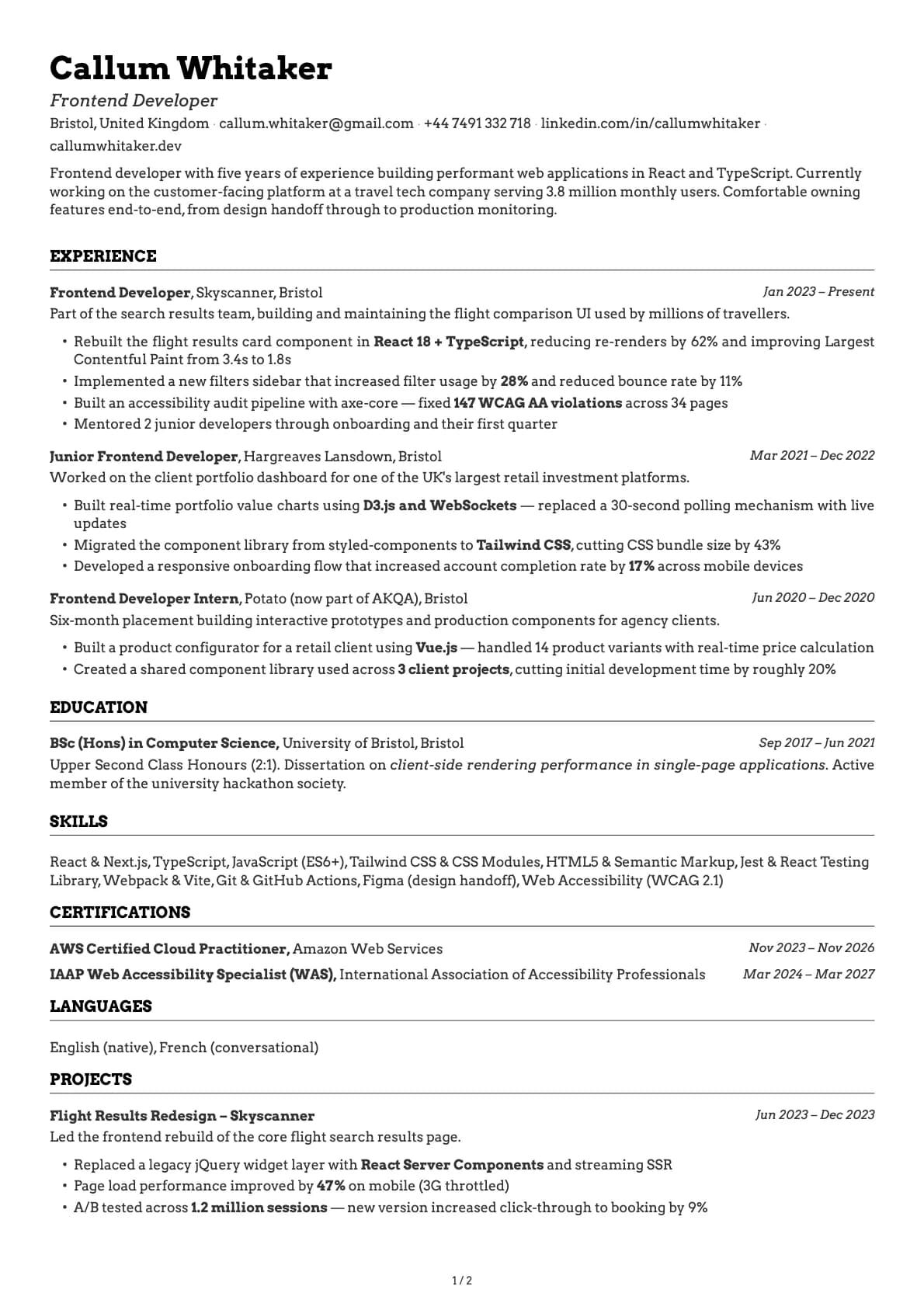
A frontend developer resume example with React and TypeScript experience at Skyscanner and Hargreaves Lansdown.
Backend Developer
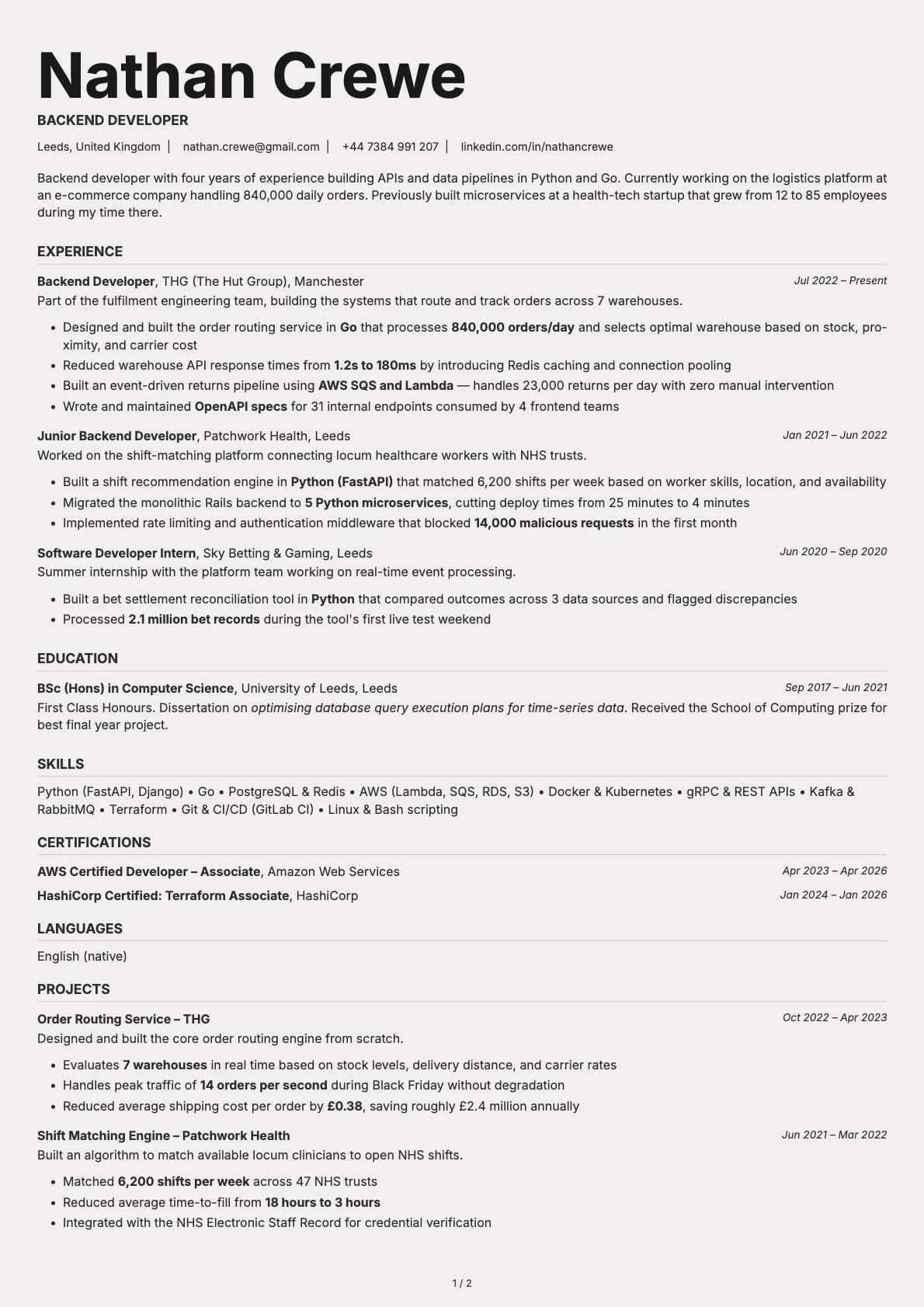
A backend developer resume example with Go and Python experience, system throughput numbers, and infrastructure projects across e-commerce and health-tech.
Data Analyst
A data analyst resume example with experience at Lloyds Banking Group and Gymshark.
Data Scientist
A data scientist resume example with ML production experience at Scottish Power and NLP work at Luminance.
DevOps Engineer
A DevOps engineer resume example with infrastructure experience at Booking.com and AO.com.
Product Manager
A product manager resume example showing how to present user research, conversion metrics, and feature launches with real business outcomes.
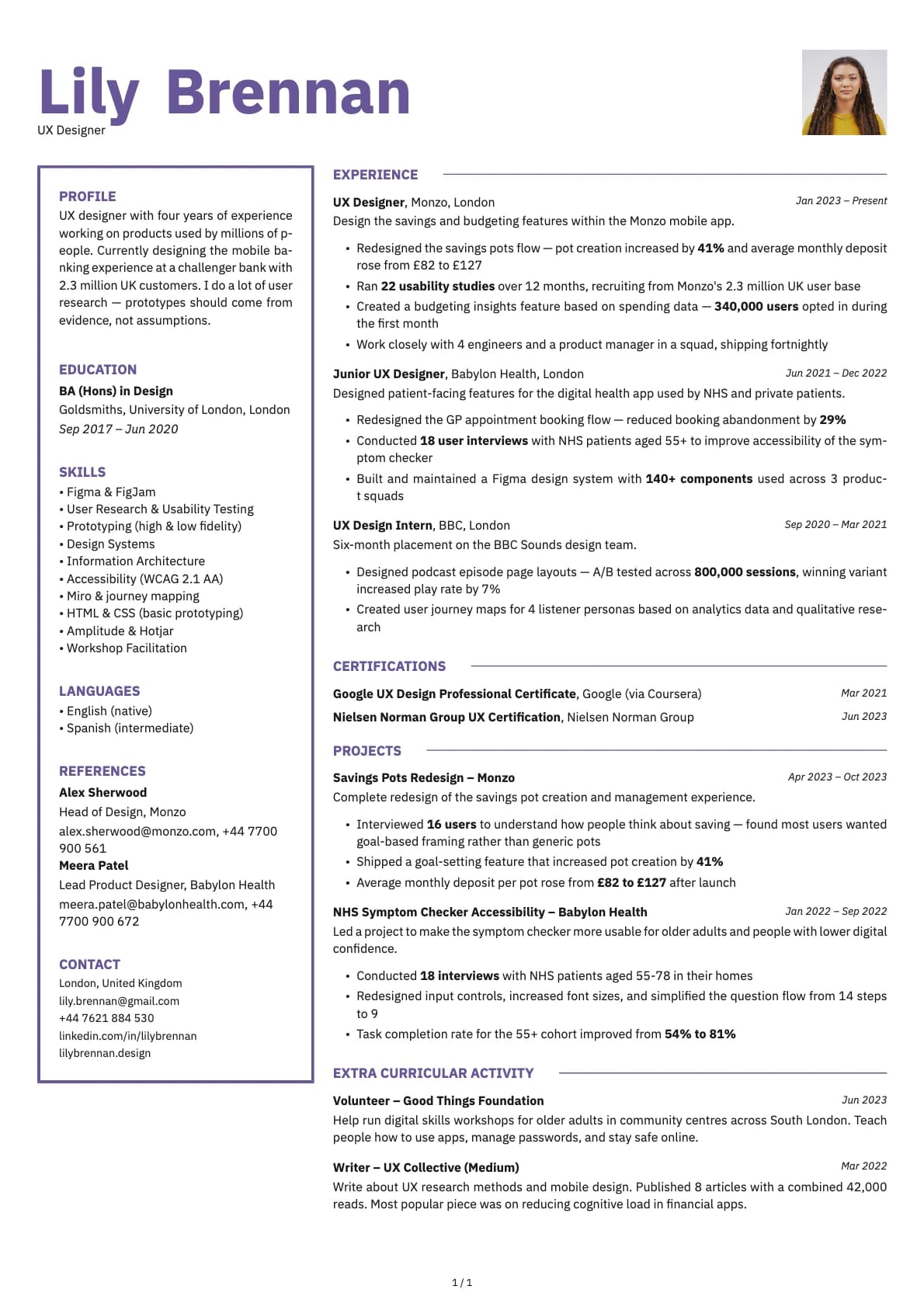
UX Designer
A UX designer resume example with 4 years of product design experience at Monzo and Babylon Health.
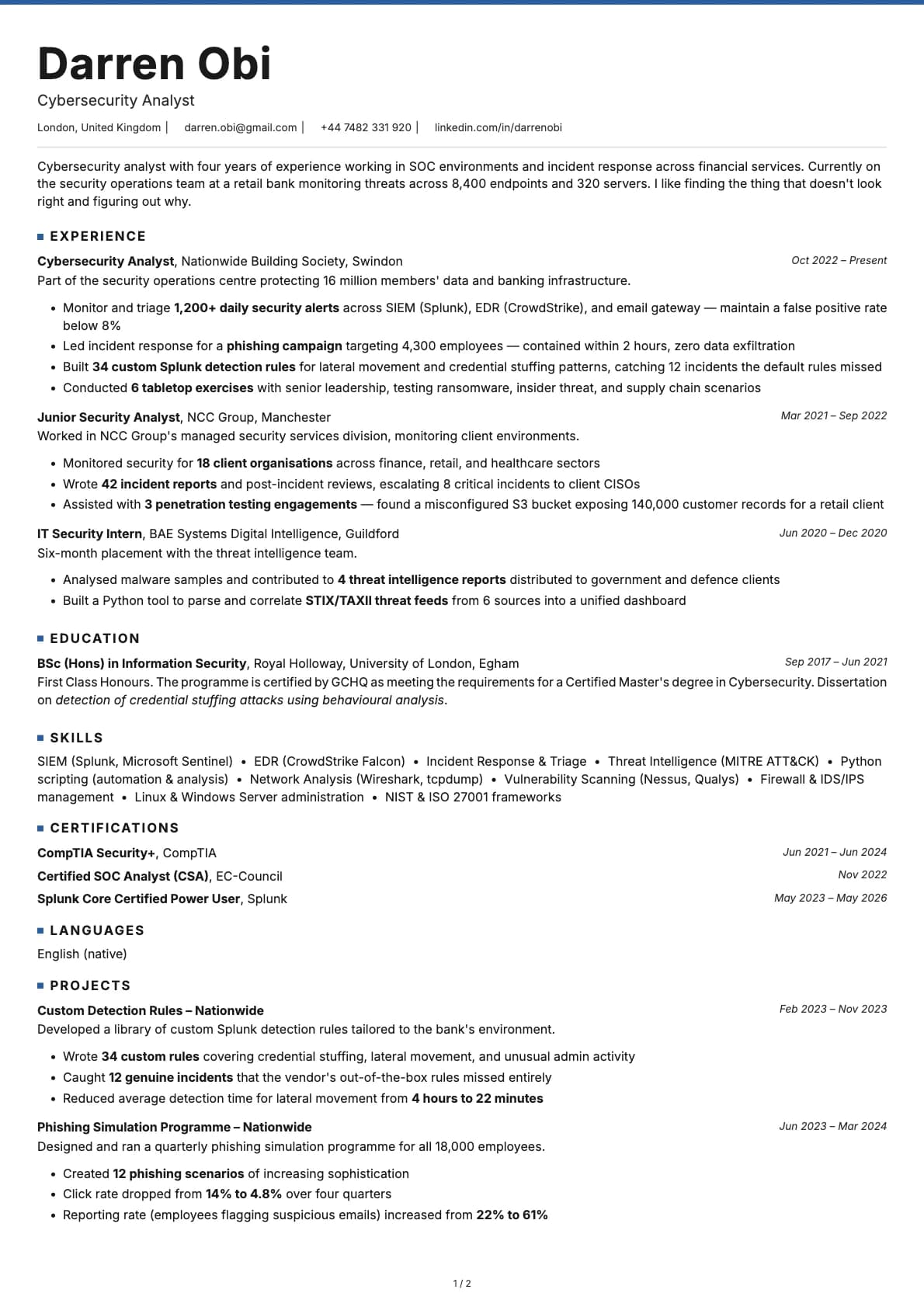
Cybersecurity Analyst
A cybersecurity analyst resume example with SOC experience at Nationwide and NCC Group.
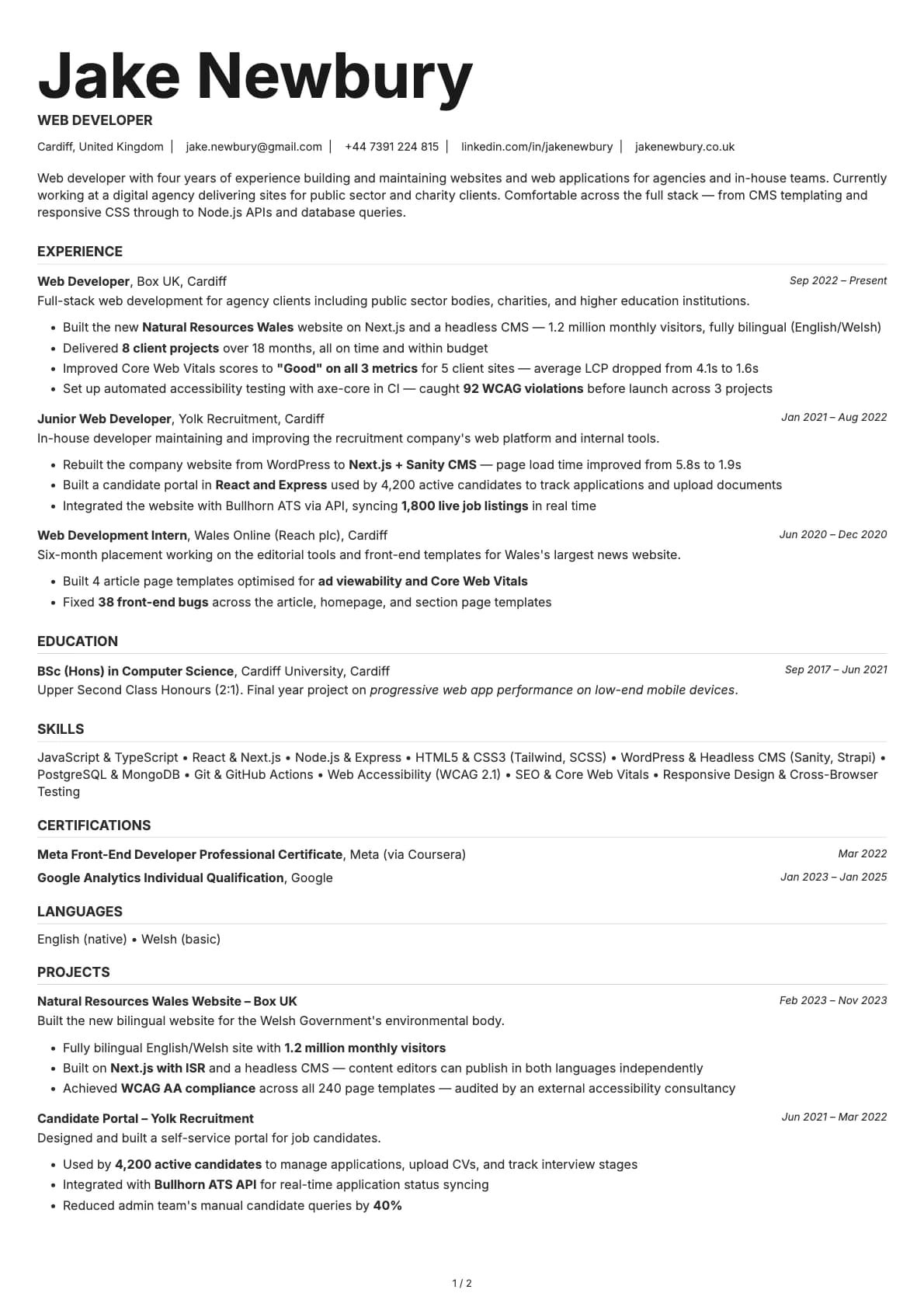
Web Developer
A web developer resume example with agency and in-house experience building Next.js sites, improving Core Web Vitals, and delivering accessible public.
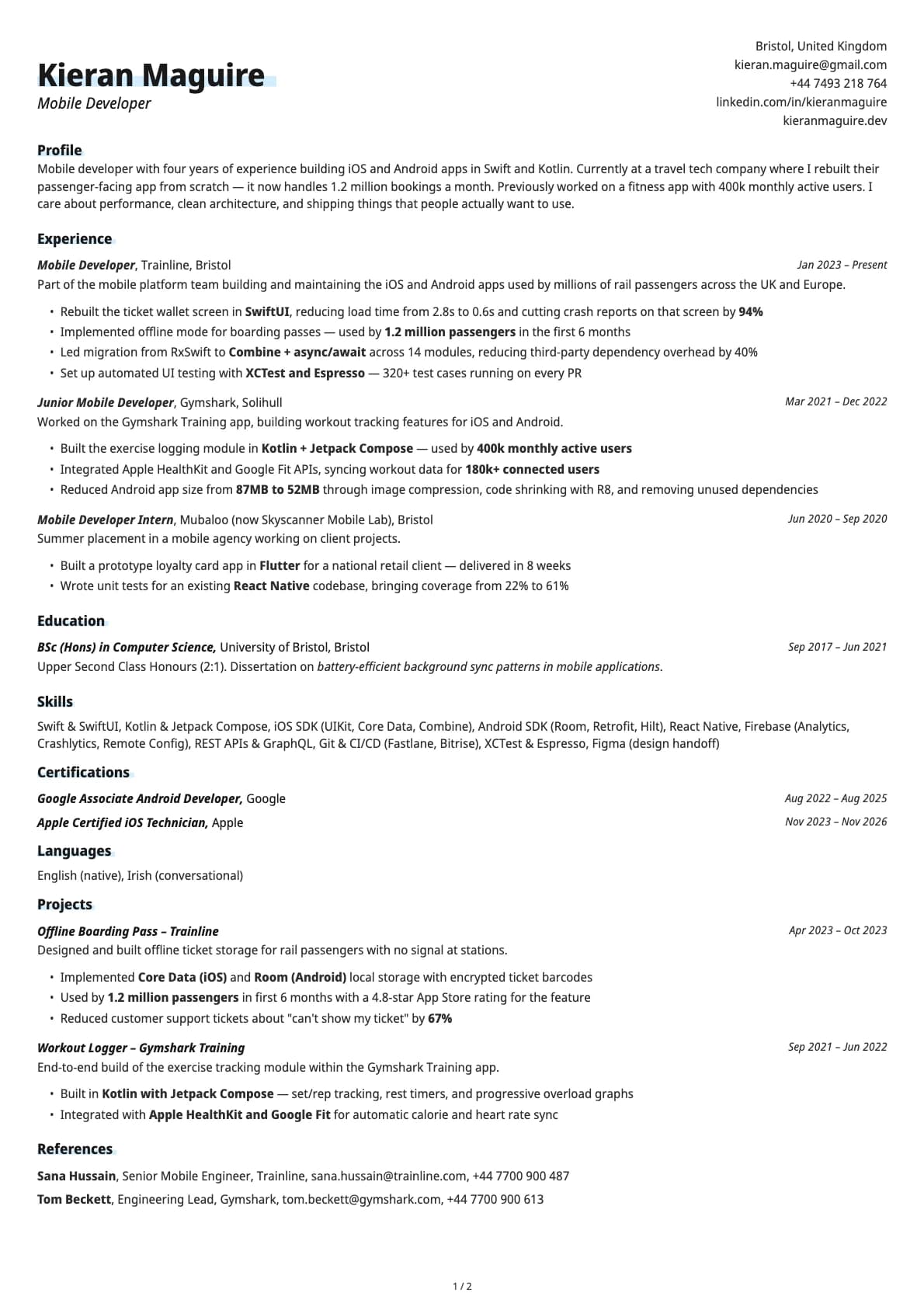
Mobile Developer
A mobile developer resume example with iOS and Android experience, performance metrics, and real app user numbers.
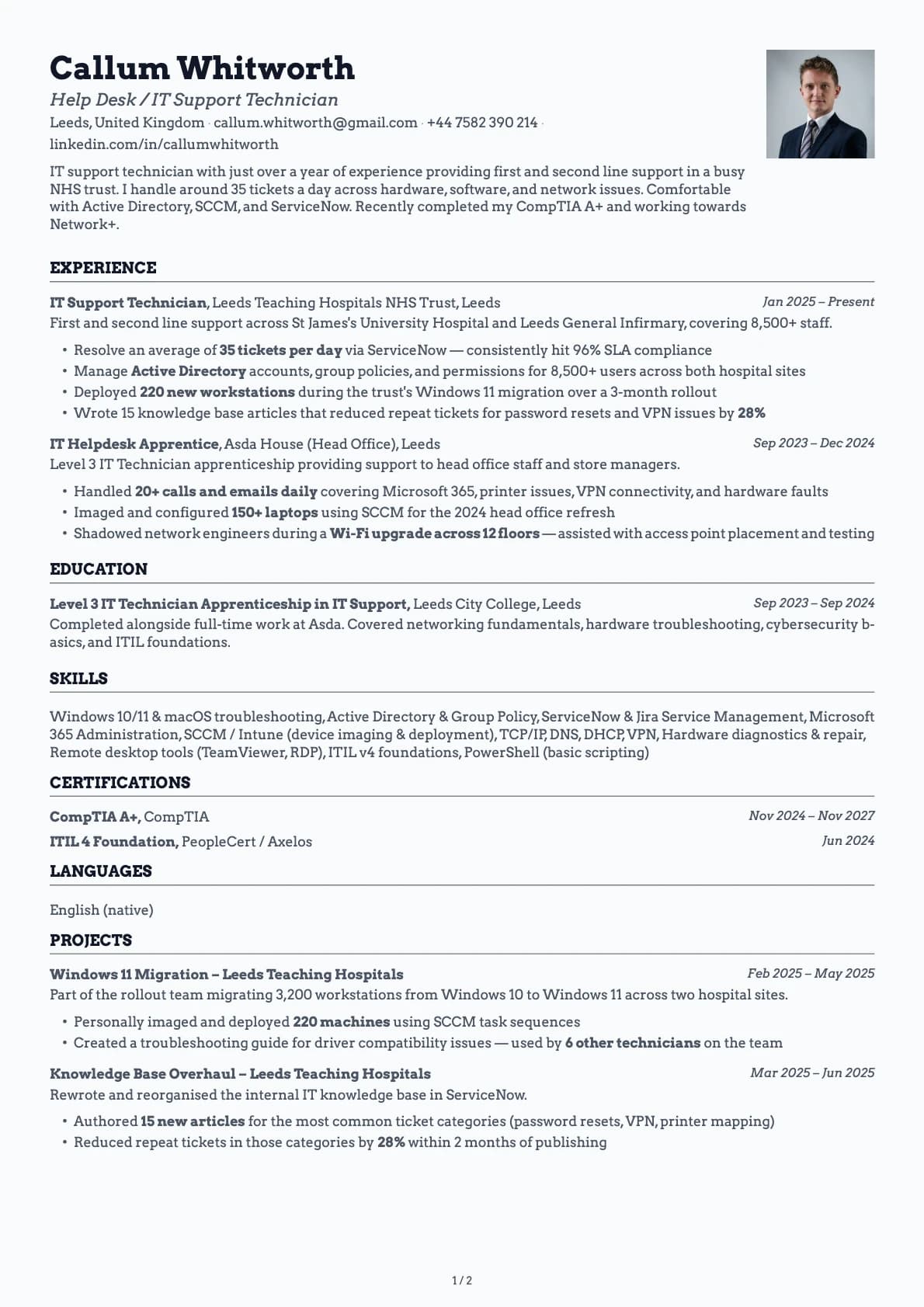
Help Desk / IT Support Technician
A help desk technician resume example with NHS IT support experience.
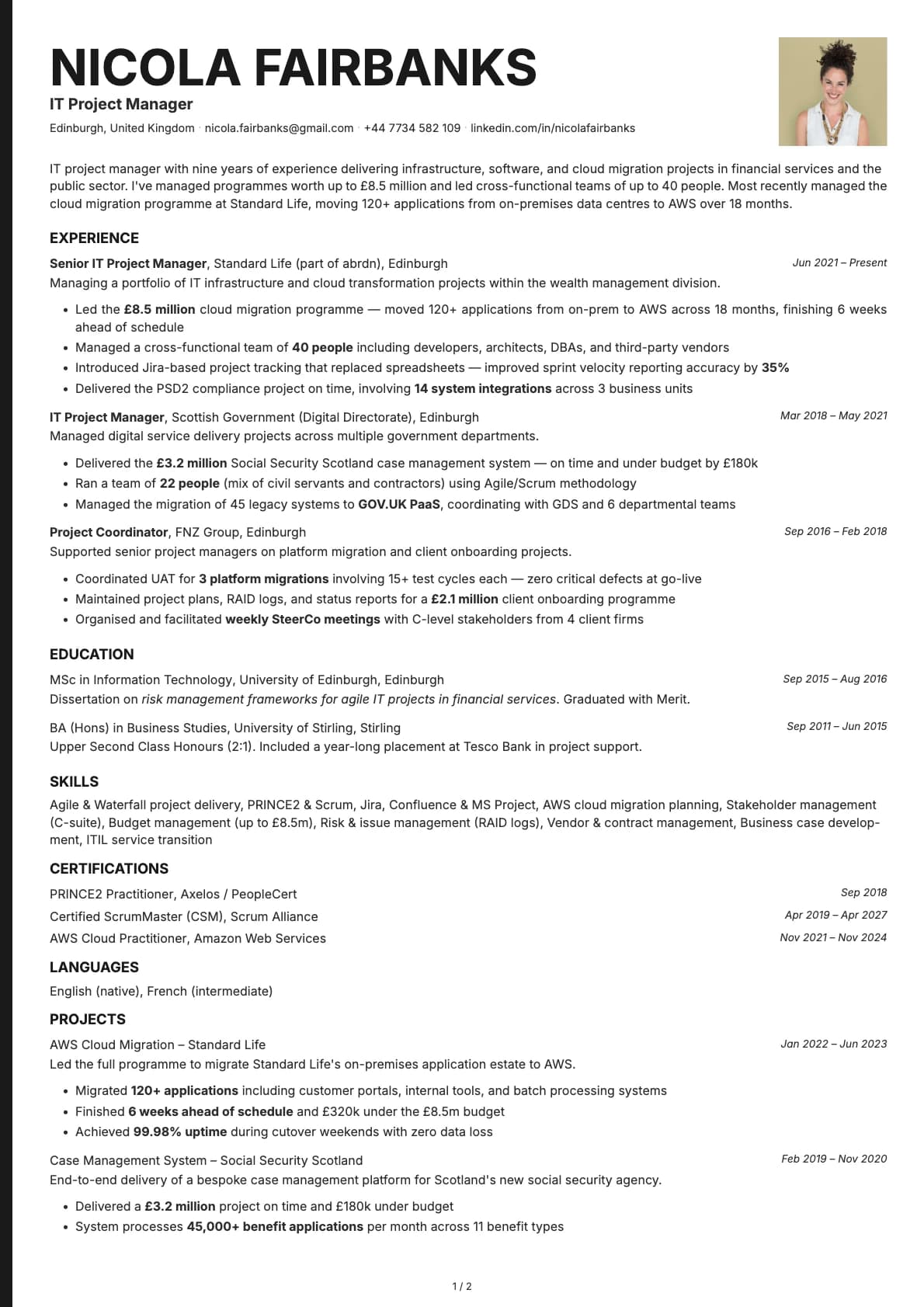
IT Project Manager
An IT project manager resume example with cloud migration, programme budgets up to £8.5 million, and PRINCE2/Scrum certifications.
Related articles

AI Is Screening Your Resume Before Any Human Sees It
AI screens most resumes before a human ever reads them. 97.4% of Fortune 500 companies run an ATS. This is what that means for you and what you can do about it.

ATS Resume Checker: How to Format a CV That Gets Past the Filters
Run the free copy and paste test to see what an ATS actually reads on your CV, then fix the tables, columns and headings that quietly get you filtered out.

The Best Resume Builders in 2026, Compared Honestly
Resume.io, Zety, Enhancv, Kickresume, Teal, and Laddro compared honestly: real pricing, free tiers, mobile apps, and where each tool wins. All prices checked in September 2026.