Court Usher Resume Example
A court usher resume example for candidates entering the court service. See how to present your customer service skills, security awareness, and knowledge of court procedures.

Laddro Team
Free to use. No account needed to start.
Free to use. No account needed to start.
Overview
Court ushers are the first point of contact for everyone entering a courtroom: judges, barristers, solicitors, defendants, witnesses, jurors, and members of the public. The role combines customer service, security awareness, and knowledge of court procedures. You call cases, swear in witnesses, manage the courtroom, and ensure proceedings run smoothly. It is an entry point into the court service that can lead to court clerk, legal advisor, or court manager roles over time.
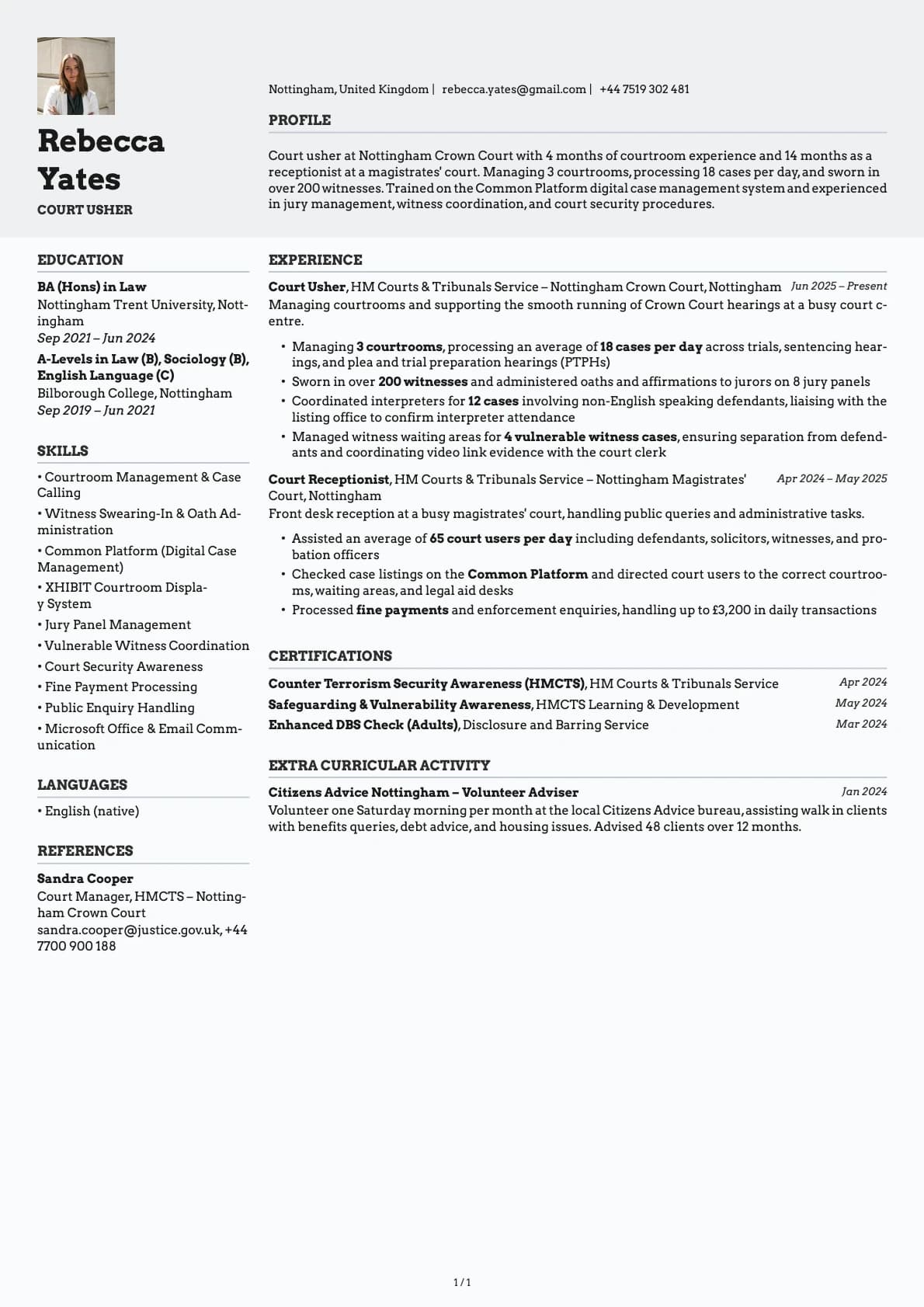
This resume belongs to Rebecca Yates, who studied Law at undergraduate level and has been working as a court usher at a Crown Court for 4 months following a period as a receptionist at a magistrates' court. She manages 3 courtrooms, processes an average of 18 cases per day, and has sworn in over 200 witnesses. Her resume demonstrates the practical competencies that HM Courts & Tribunals Service (HMCTS) looks for.
What Makes This Resume Work
Court operations are described with daily volume. Rebecca manages 3 courtrooms, processing 18 cases per day across Crown Court trials, sentencing hearings, and plea and trial preparation hearings (PTPHs). She has sworn in over 200 witnesses, managed 8 jury panels, and coordinated interpreters for 12 cases involving non-English speaking defendants. This daily operational volume shows she can handle the pace of a busy court centre.
HMCTS systems are named. Rebecca uses the Common Platform (the digital case management system used across criminal courts in England and Wales) to check case listings, update hearing outcomes, and verify defendant details. She also uses the XHIBIT system for courtroom display boards. Naming these systems tells the hiring manager she is already trained on the court's digital infrastructure.
Security and safeguarding awareness are evident. Court ushers are responsible for keeping vulnerable witnesses separate from defendants, managing public gallery access, and alerting security to potential incidents. Rebecca describes how she managed witness waiting areas for 4 cases involving vulnerable witnesses (behind screens or via video link) and coordinated with court security for 3 high profile hearings with increased public interest.
The progression from reception to usher shows ambition. Starting as a receptionist at a magistrates' court and moving to a court usher role at a Crown Court within 18 months demonstrates interest in the court service as a career path, not just a job.
Key Takeaways
Describe your daily caseload and the types of hearings you manage. Trials, sentencing, PTPHs, and bail hearings all require different usher procedures. Showing experience across hearing types proves versatility.
Name the court systems you use. Common Platform, XHIBIT, and any local case management tools. HMCTS is investing heavily in digital court reform, and showing you can navigate the systems is a practical advantage.
Show awareness of security and vulnerability. Managing vulnerable witnesses, coordinating with court security, and maintaining separation between parties are critical parts of the usher role. Employers need to know you understand the sensitivity of the court environment.
Build your own version
Open this layout in the builder and swap in your own details. It takes a few minutes.
Free to use. No account needed to start.
Was this resume example helpful?
Rate this example to help us create better content for you.
4.5 average from 58 ratingsRelated resume examples
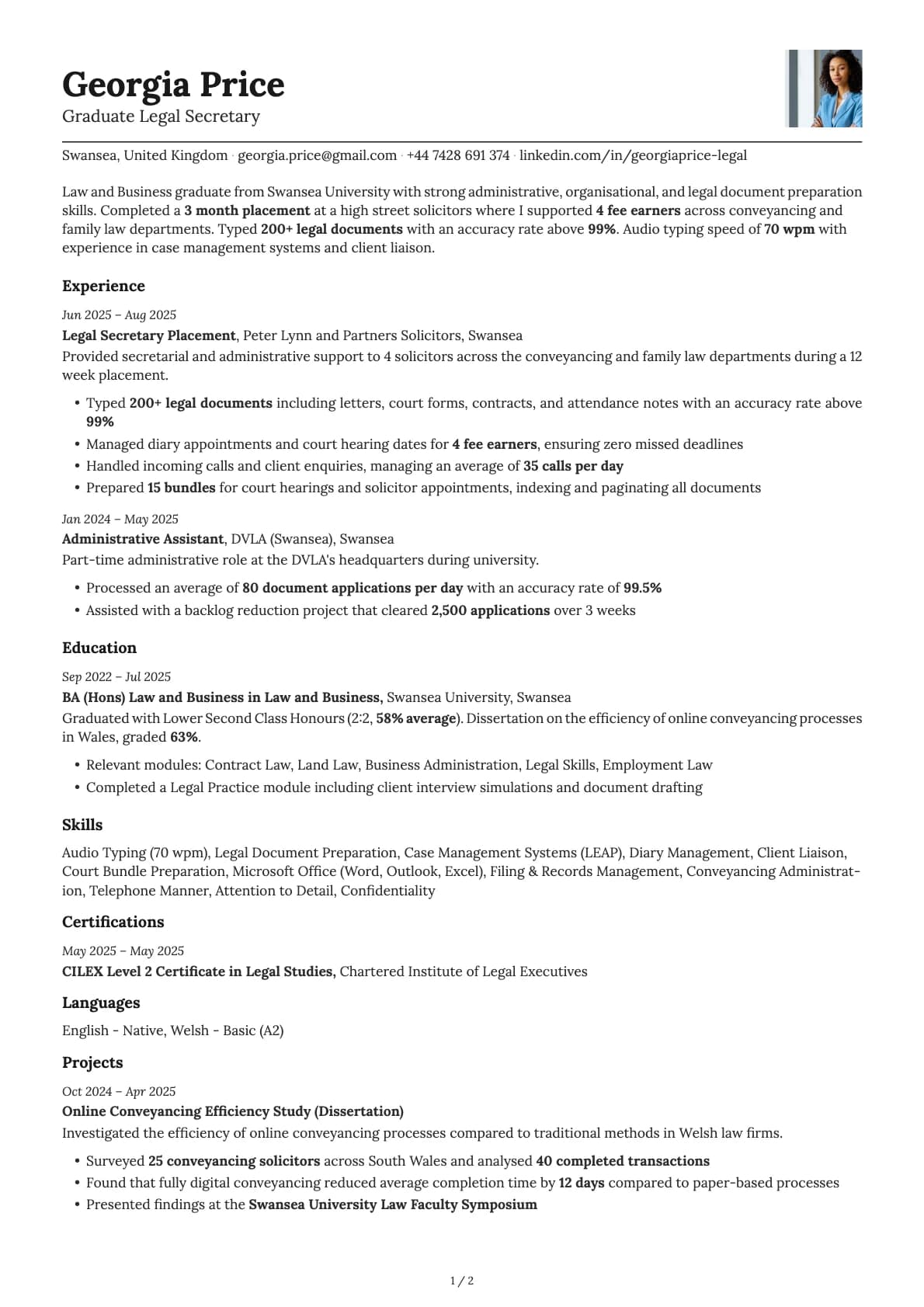
Graduate Legal Secretary
A graduate legal secretary resume example. See how to present typing speed, legal document preparation, and solicitor support experience to land your first legal secretary role.
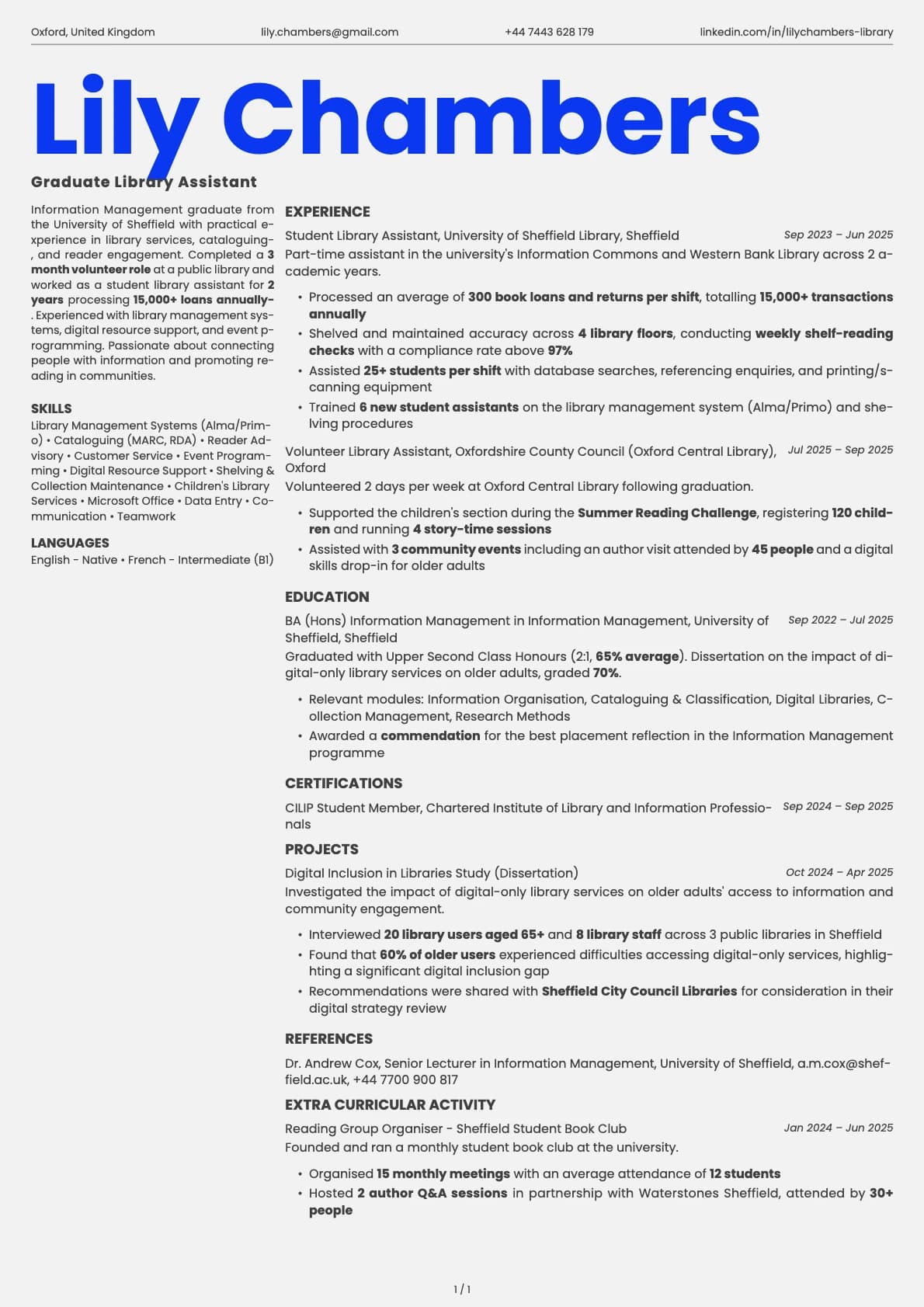
Graduate Library Assistant
A graduate library assistant resume example. See how to present library experience, cataloguing skills, and event programming to land your first library role.
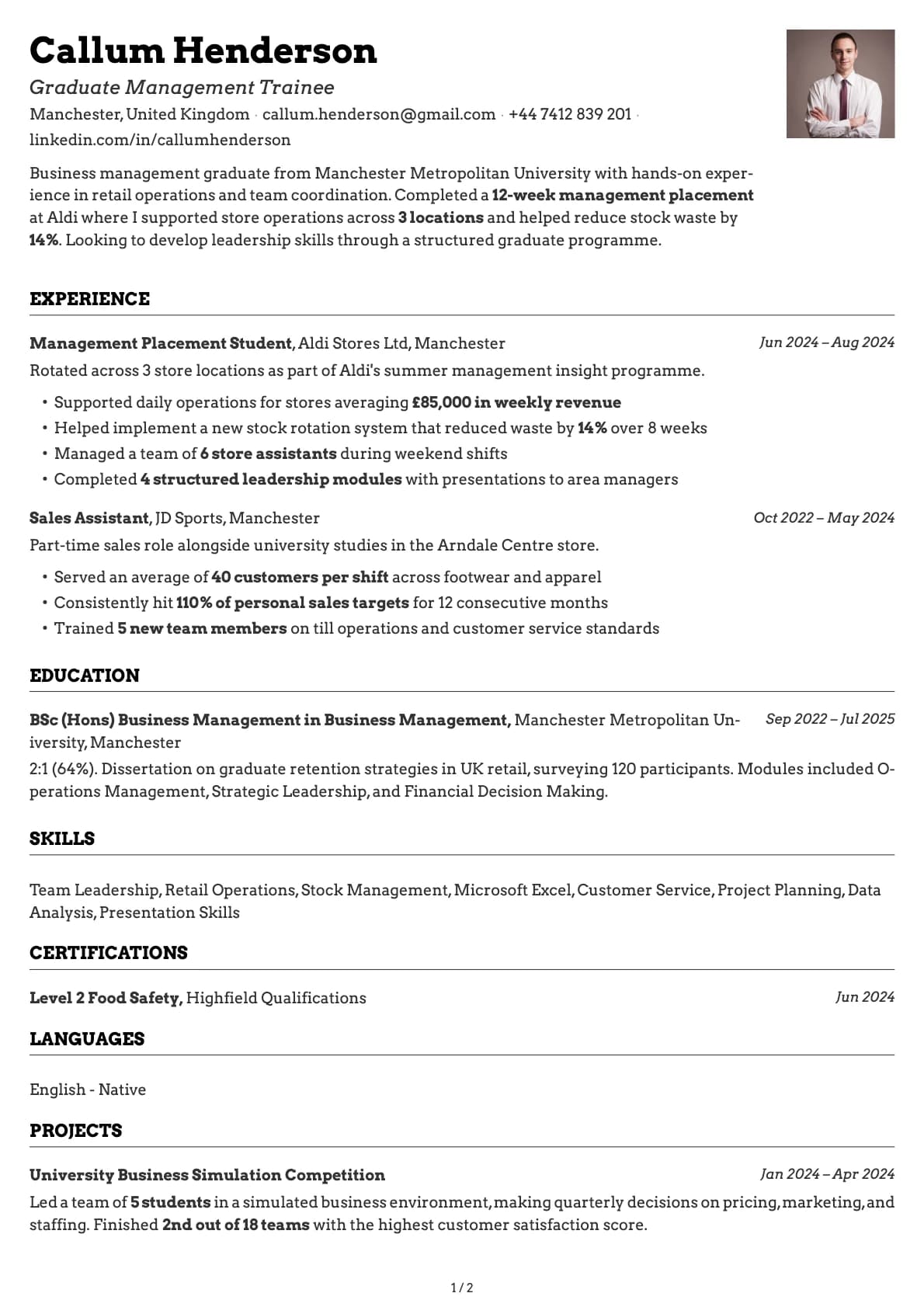
Graduate Management Trainee
A graduate management trainee resume example with retail placement experience and team leadership skills.
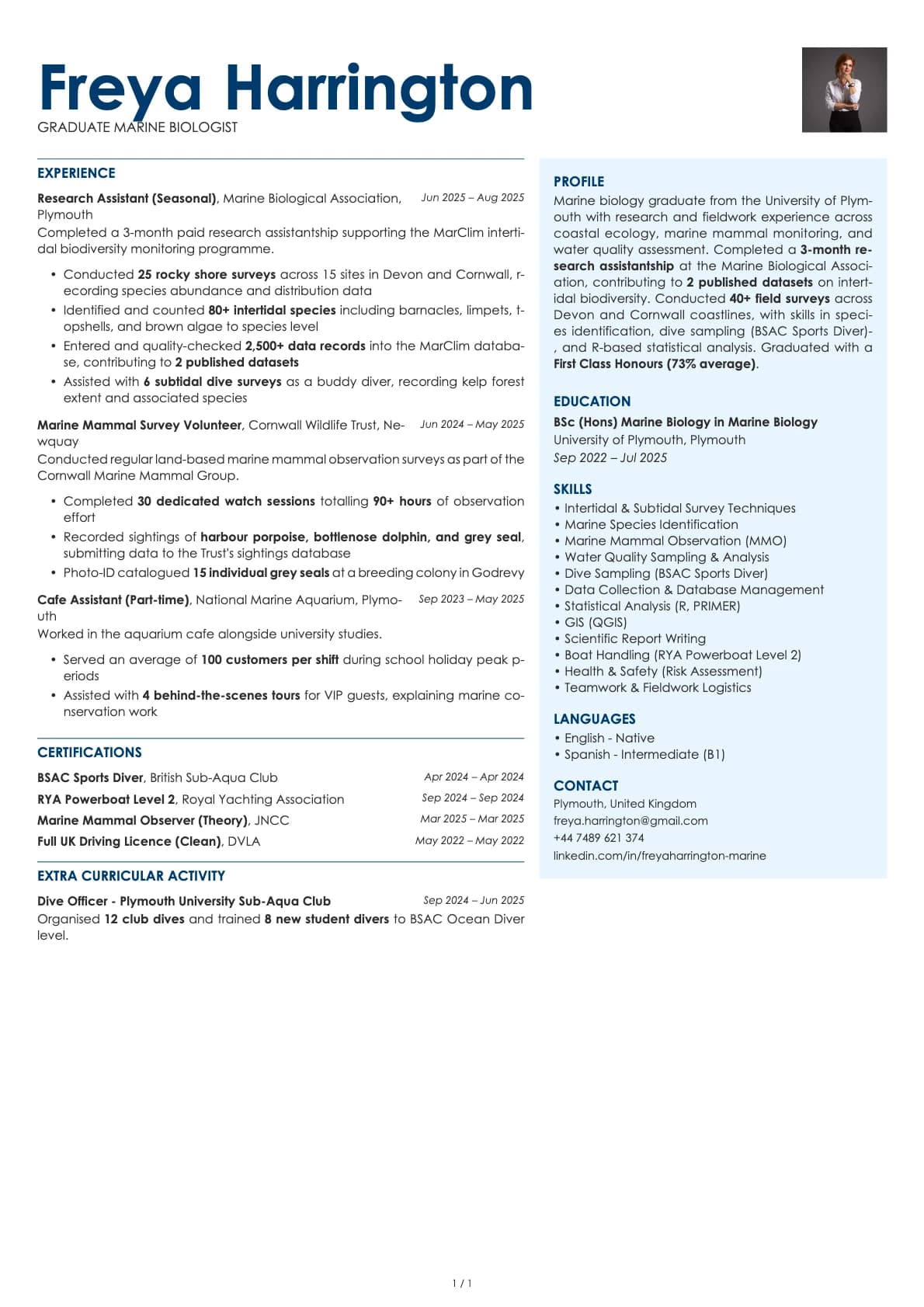
Graduate Marine Biologist
A graduate marine biologist resume example with research placement experience, dive survey qualifications, and intertidal survey numbers.
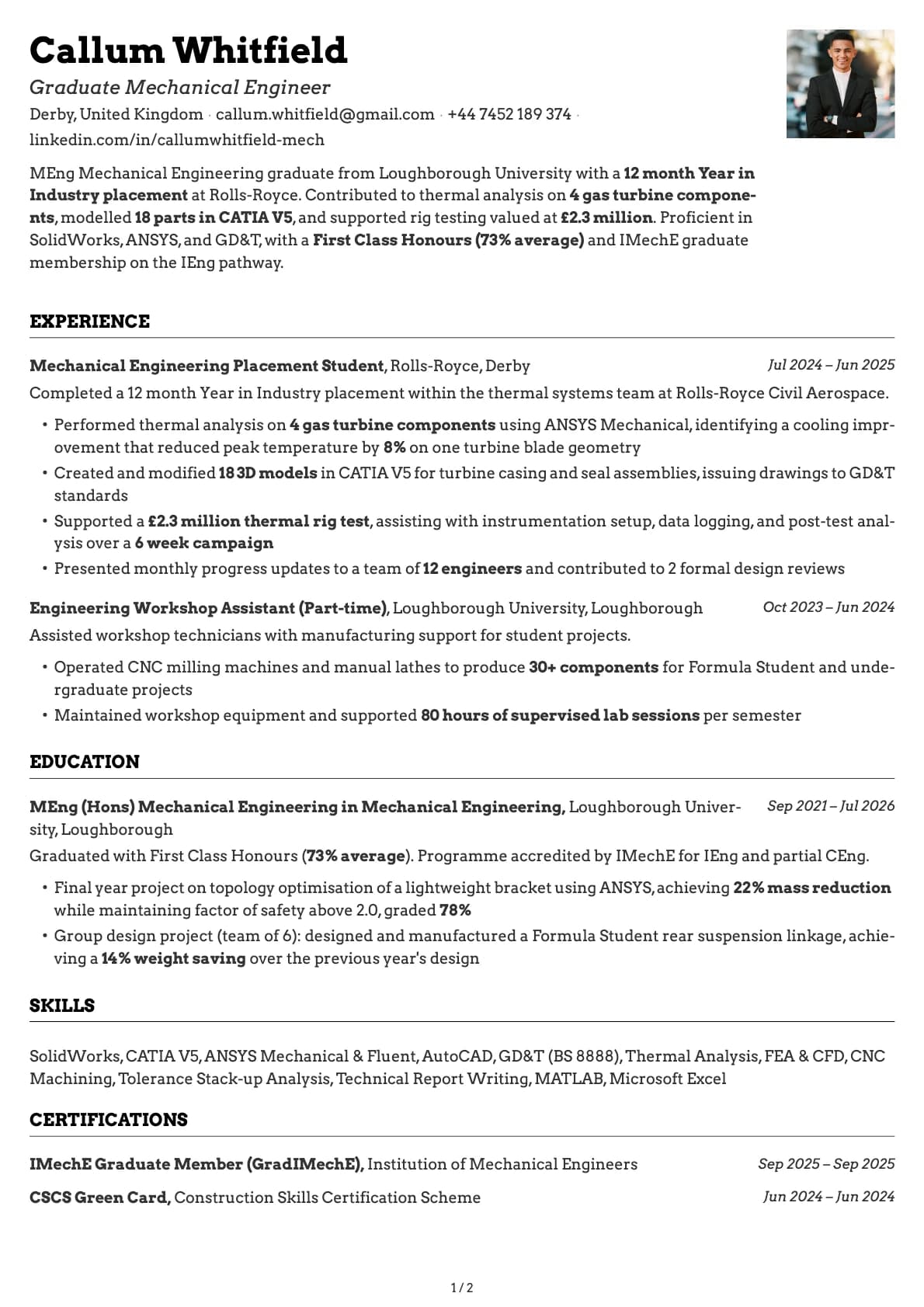
Graduate Mechanical Engineer
A graduate mechanical engineer resume example with Year in Industry placement, SolidWorks proficiency, and IMechE membership on the IEng pathway.
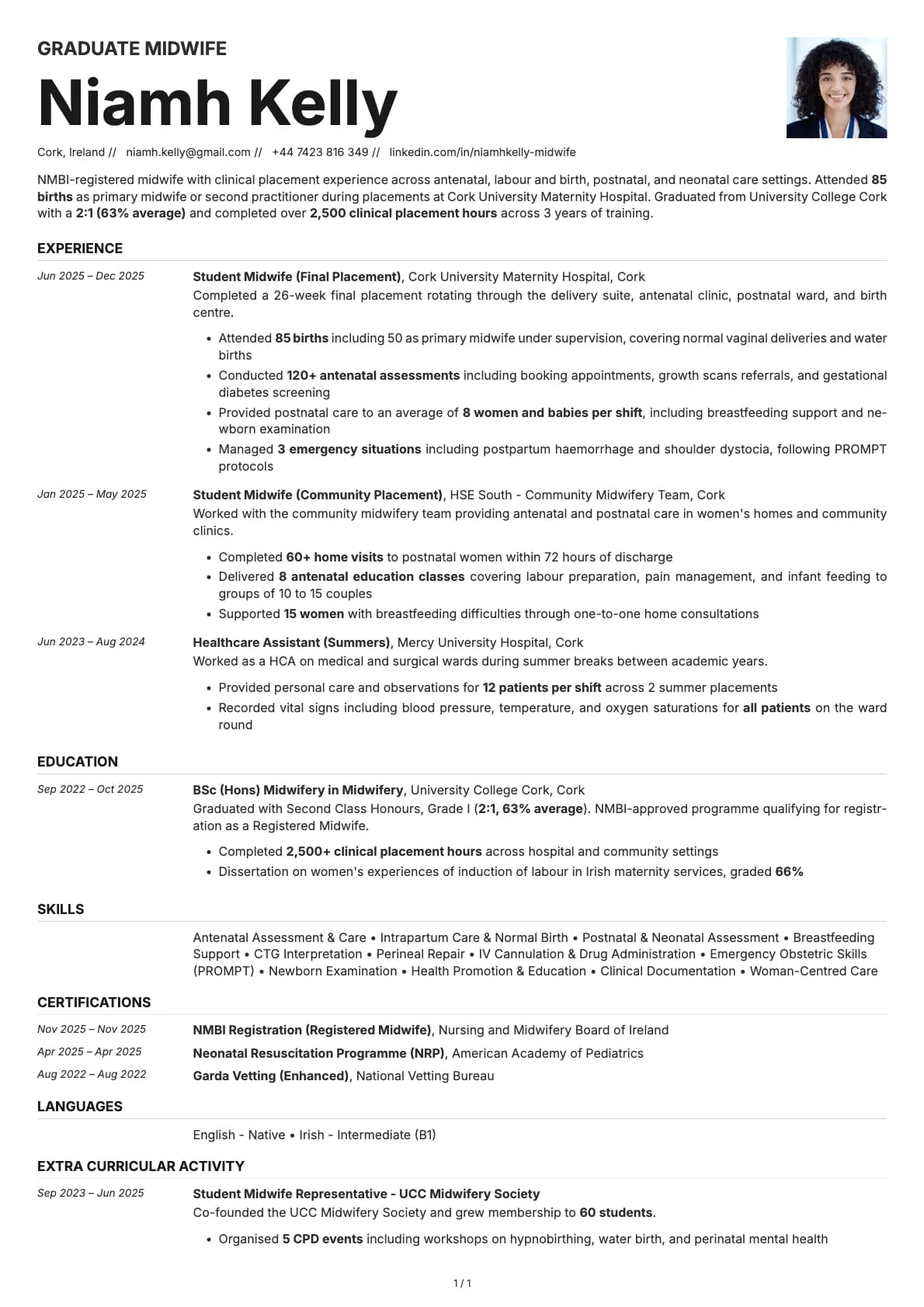
Graduate Midwife
A graduate midwife resume example with birth attendance numbers, NMBI registration, and clinical placement hours for newly qualified midwives.
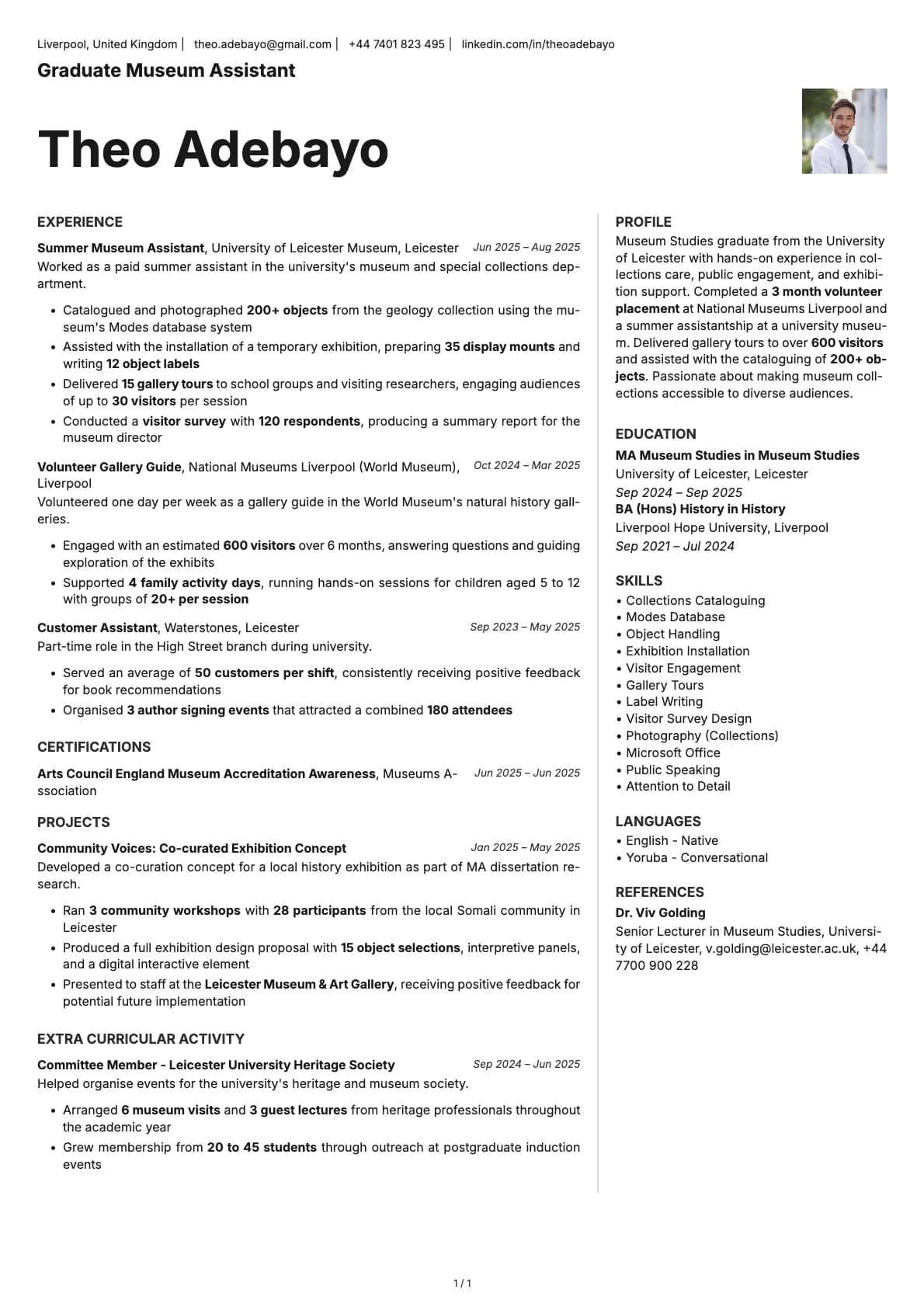
Graduate Museum Assistant
A graduate museum assistant resume example. See how to present collections experience, gallery tours, and museum studies qualifications to land your first museum role.
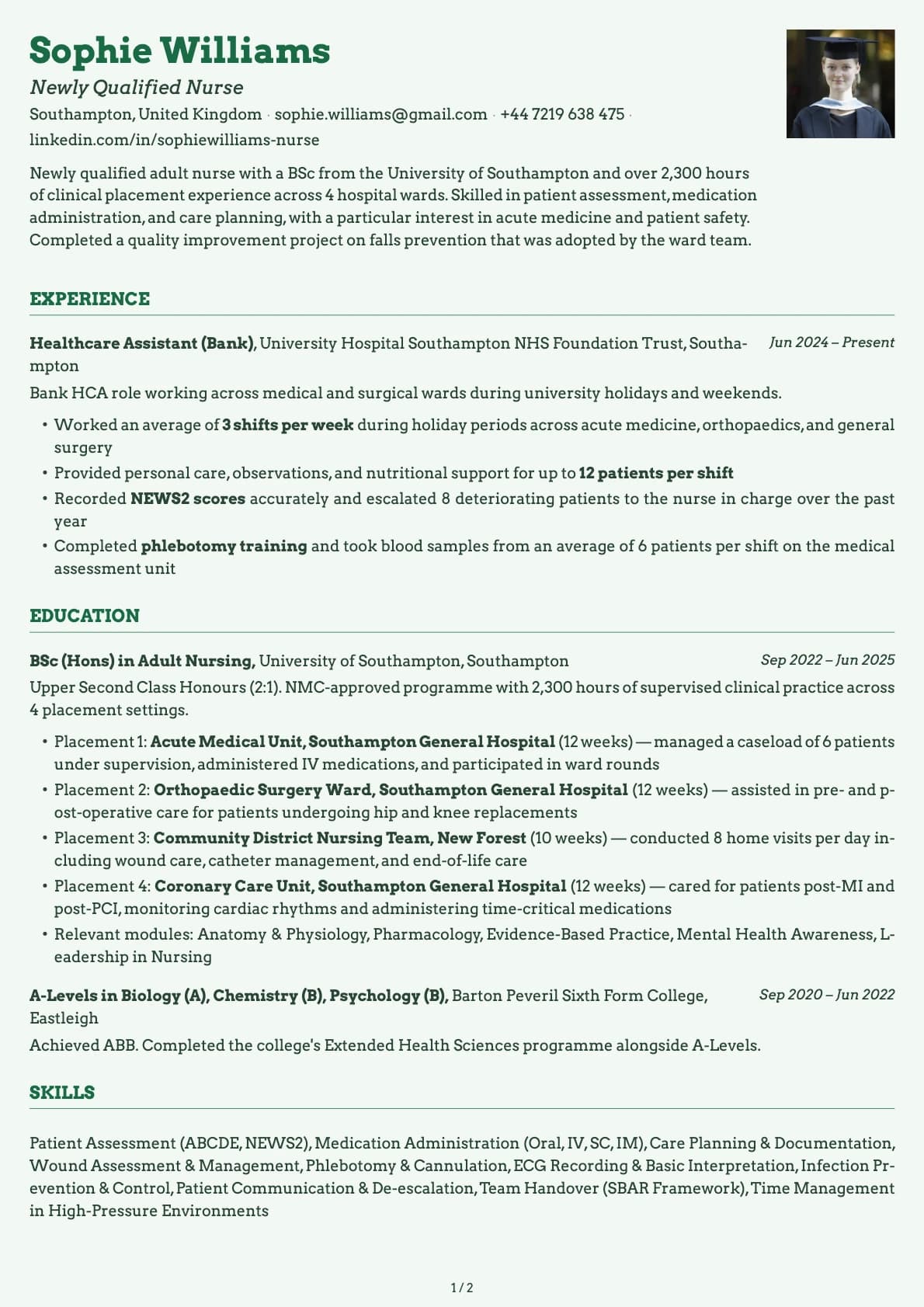
Graduate Nurse
A graduate nurse resume example for recently qualified nurses. See how to present your clinical placements, patient care experience, and NMC registration to land your first nursing role.
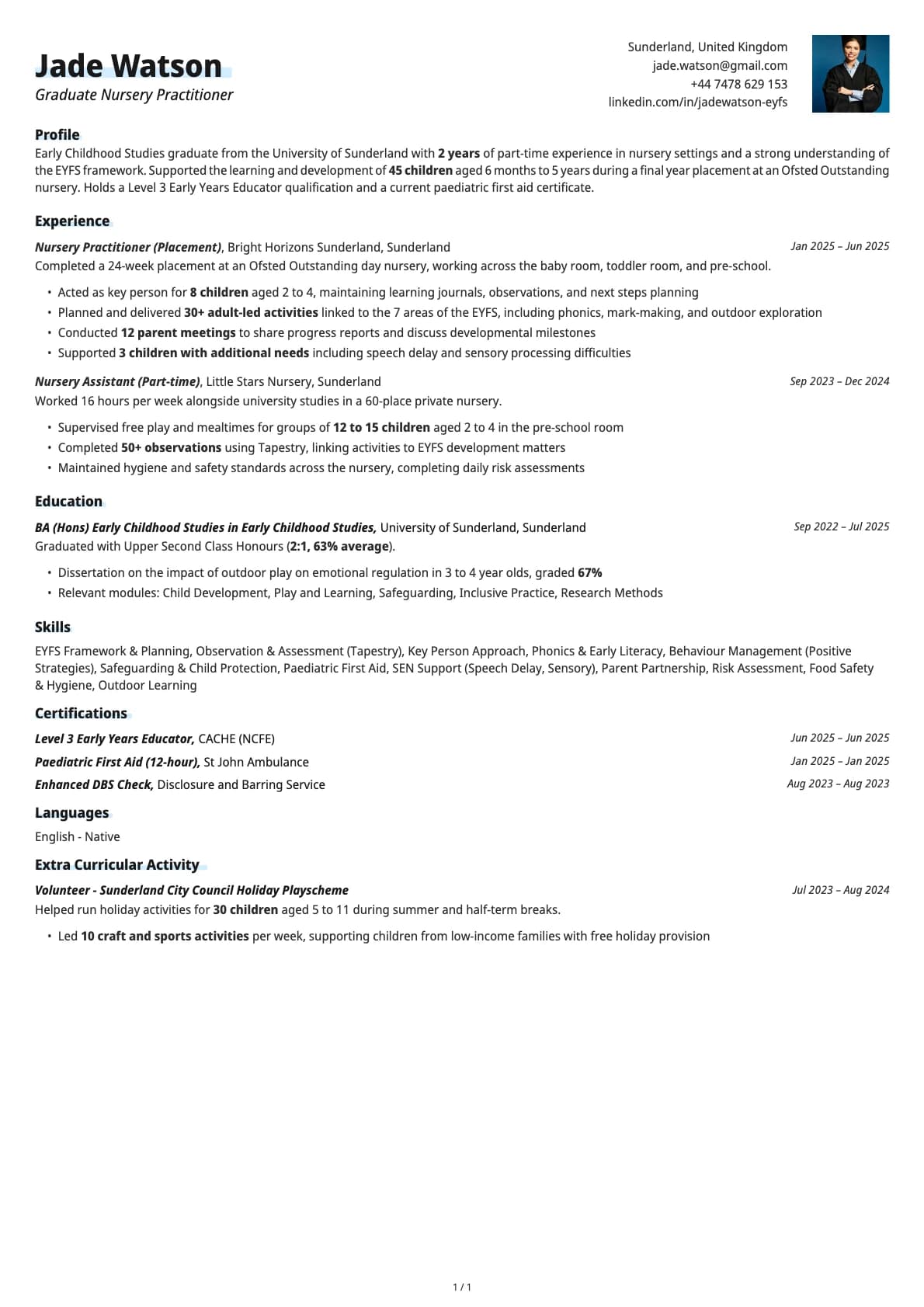
Graduate Nursery Practitioner
A graduate nursery practitioner resume example with EYFS experience, key person responsibilities, and Level 3 Early Years Educator qualification.
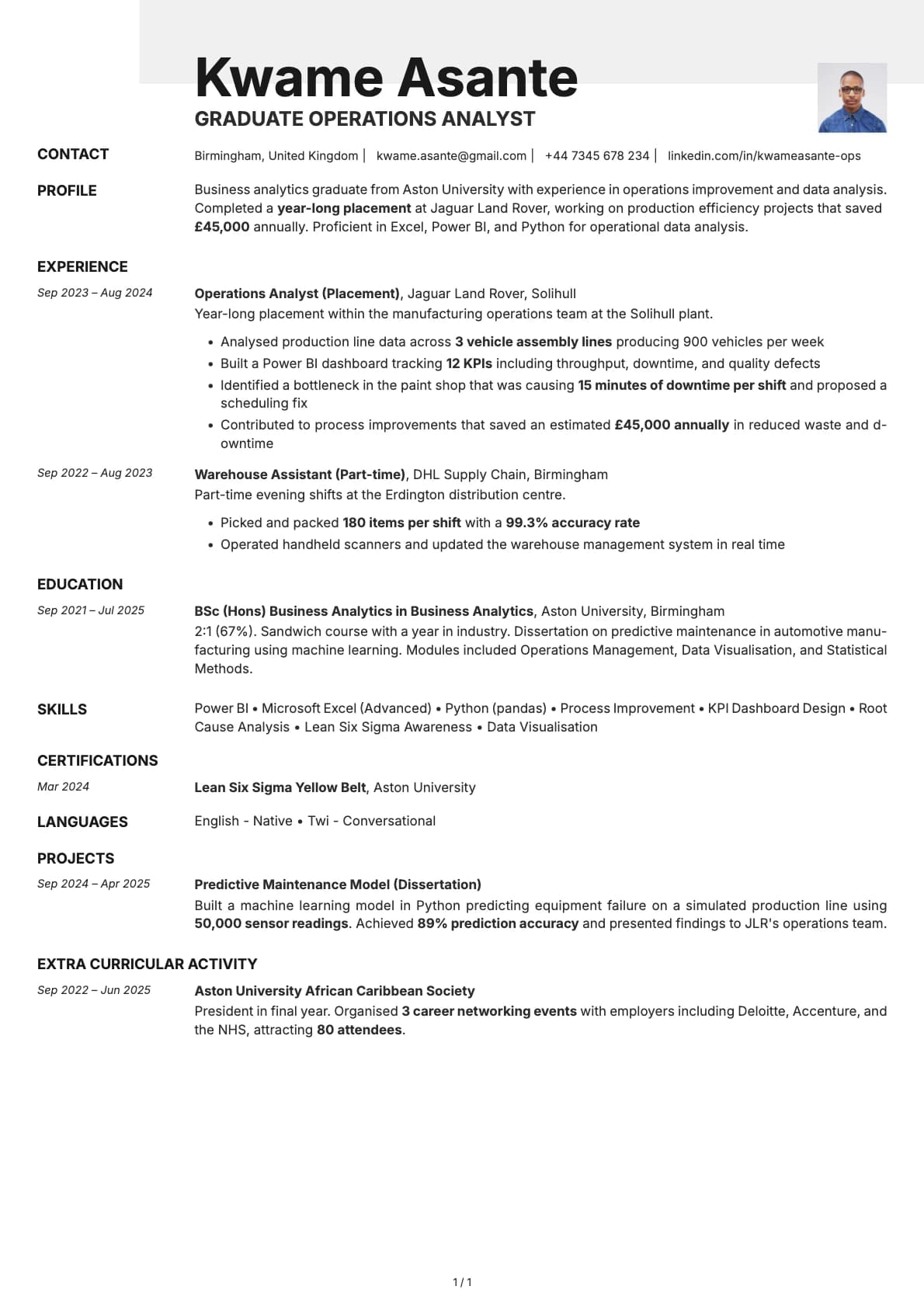
Graduate Operations Analyst
A graduate operations analyst resume example with Jaguar Land Rover placement and data analysis skills.
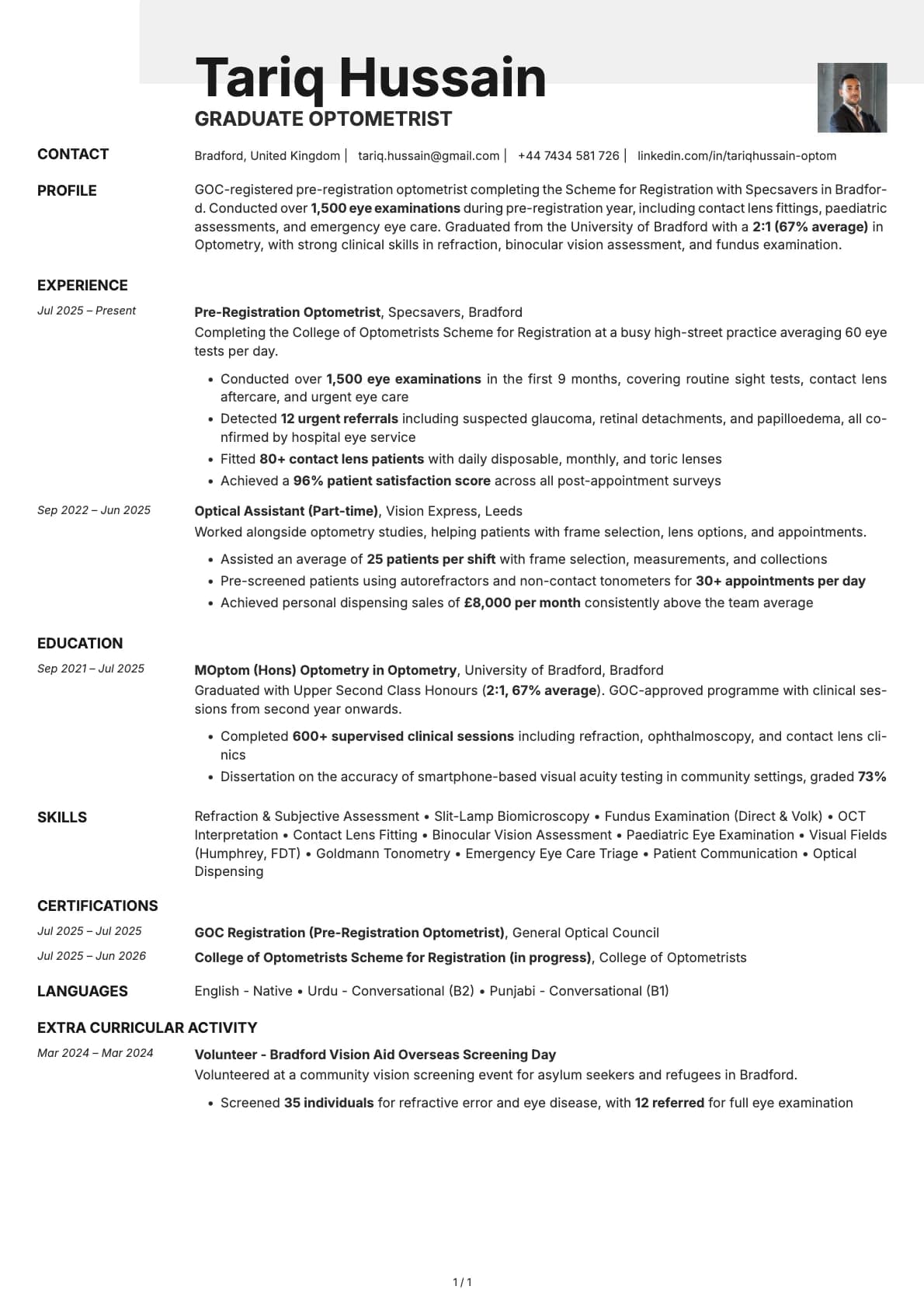
Graduate Optometrist
A graduate optometrist resume example with pre-registration experience, GOC registration, and eye examination numbers for newly qualifying optometrists.
Graduate Paramedic
A graduate paramedic resume example with frontline placement hours, HCPC registration, and emergency call numbers for newly qualified paramedics.