Junior Security Analyst Resume Example
A junior security analyst resume example with SOC experience, CompTIA Security+ certification, and incident triage from a Cybersecurity BSc graduate.

Laddro Team
Free to use. No account needed to start.
Free to use. No account needed to start.
Overview
Cybersecurity hiring is growing faster than almost any other technology discipline, and SOC analyst roles are the most common entry point. Employers want candidates who understand threat detection, can triage alerts efficiently, and hold at least one recognised certification. Hands-on lab experience and CTF (Capture the Flag) competition results help bridge the gap between academic knowledge and operational readiness.
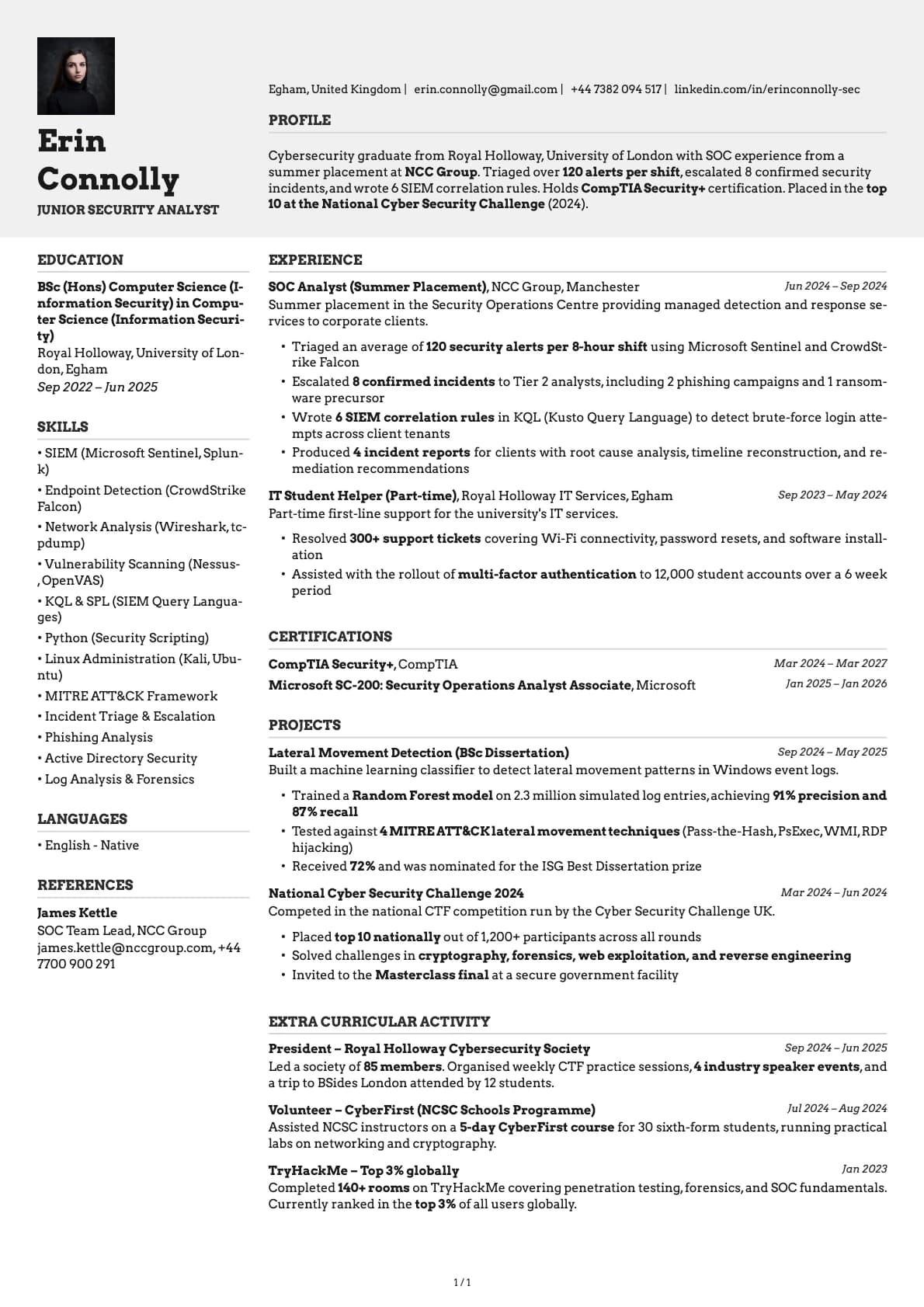
This resume belongs to Erin Connolly, a Cybersecurity graduate from Royal Holloway, University of London. She completed a summer placement in the SOC at NCC Group, holds CompTIA Security+, and placed in the top 10 at the National Cyber Security Challenge. Her resume works because it translates academic security knowledge into operational, measurable experience.
What Makes This Resume Work
The SOC placement at NCC Group is a powerful credential. NCC Group is one of the UK's most recognised cybersecurity consultancies. Erin describes her role in operational terms: alerts triaged, incidents escalated, and SIEM queries written. This is the language SOC managers use.
CompTIA Security+ is featured prominently. This certification is widely requested in junior security analyst job descriptions. Having it before graduating signals that Erin has validated her knowledge against an industry-recognised standard.
CTF competition results demonstrate practical skill. Placing in the top 10 at a national competition shows that Erin can apply security knowledge under pressure, solving real challenges rather than just answering exam questions.
Incident triage numbers are quantified. Reviewing 120+ alerts per shift, escalating 8 confirmed incidents, and writing 6 SIEM correlation rules are the kind of operational metrics that prove hands-on capability.
Key Takeaways
Junior security analyst resumes should lead with certifications (CompTIA Security+, or equivalent), SOC experience (even a short placement), and any CTF results. Describe your alert triage volume, escalation decisions, and SIEM tool experience. Mention specific tools (Splunk, Sentinel, CrowdStrike) by name. Practical, operational language matters more than theoretical security knowledge at this level.
Build your own version
Open this layout in the builder and swap in your own details. It takes a few minutes.
Free to use. No account needed to start.
Was this resume example helpful?
Rate this example to help us create better content for you.
4.8 average from 131 ratingsRelated resume examples
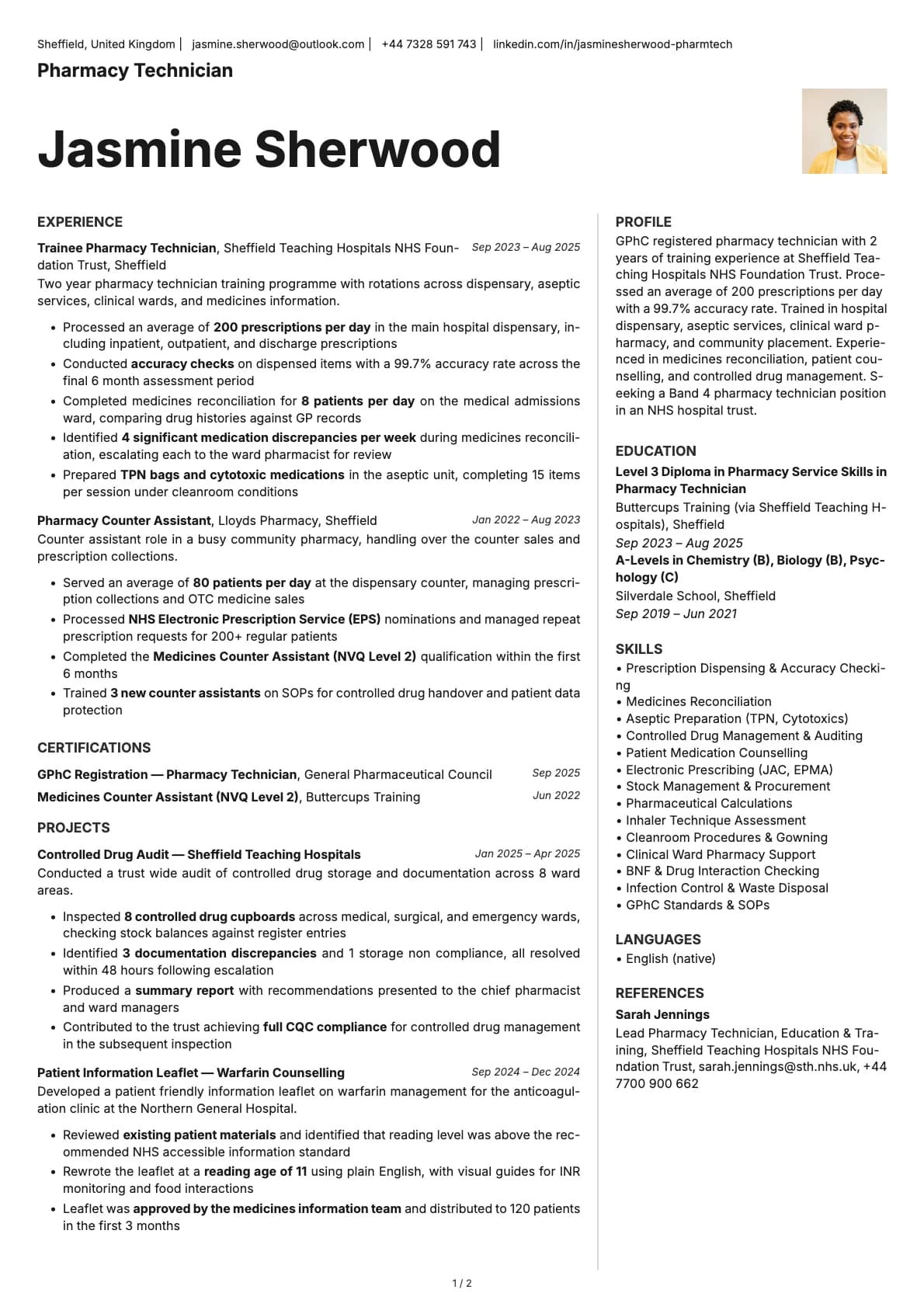
Pharmacy Technician
A pharmacy technician resume example for newly qualified candidates showing how to present GPhC registration, dispensing accuracy, and clinical skills for NHS and community pharmacy roles.
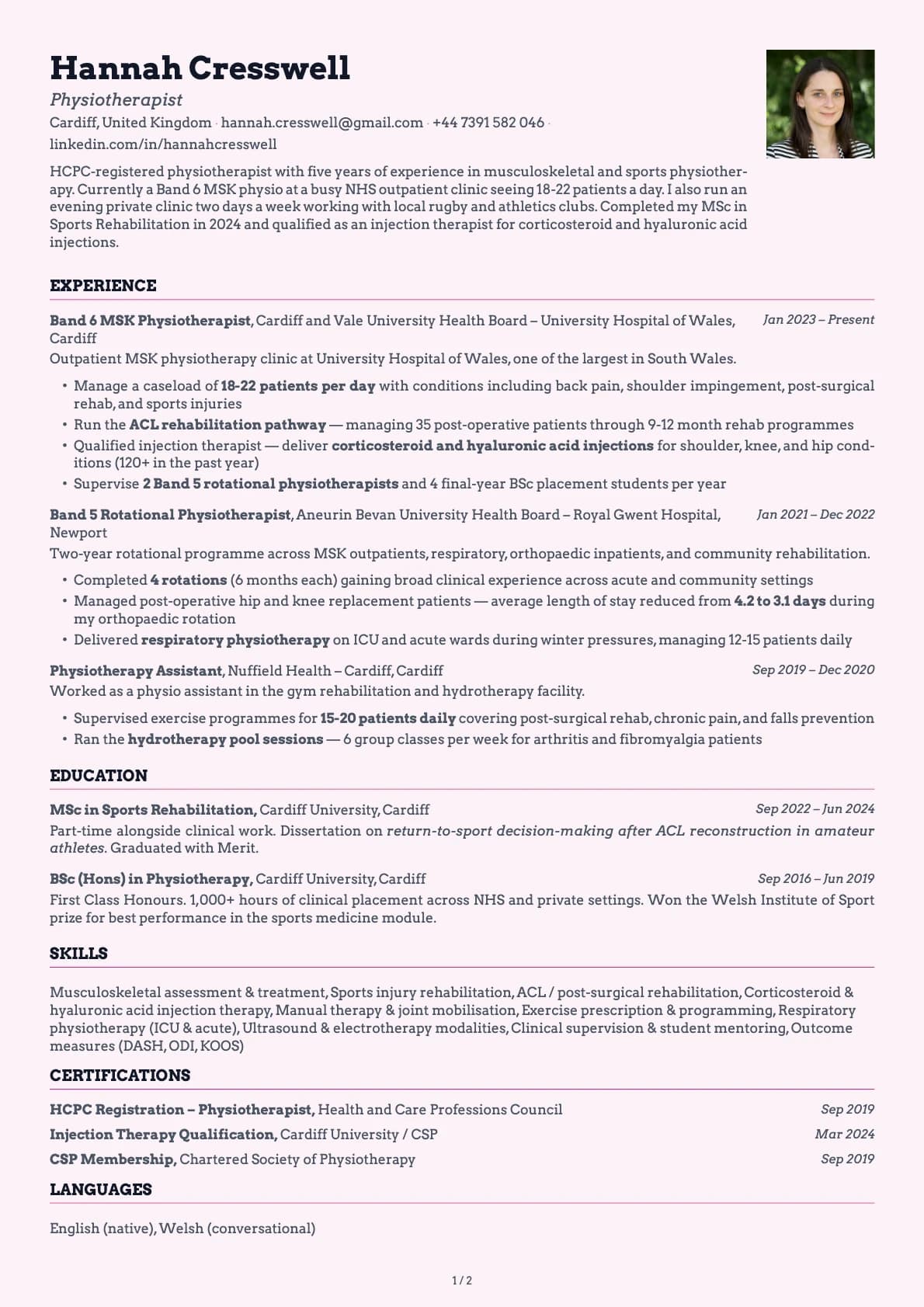
Physiotherapist
A physiotherapist resume example with NHS placement experience. See how to present clinical placements, patient outcomes, and HCPC registration on your first CV.
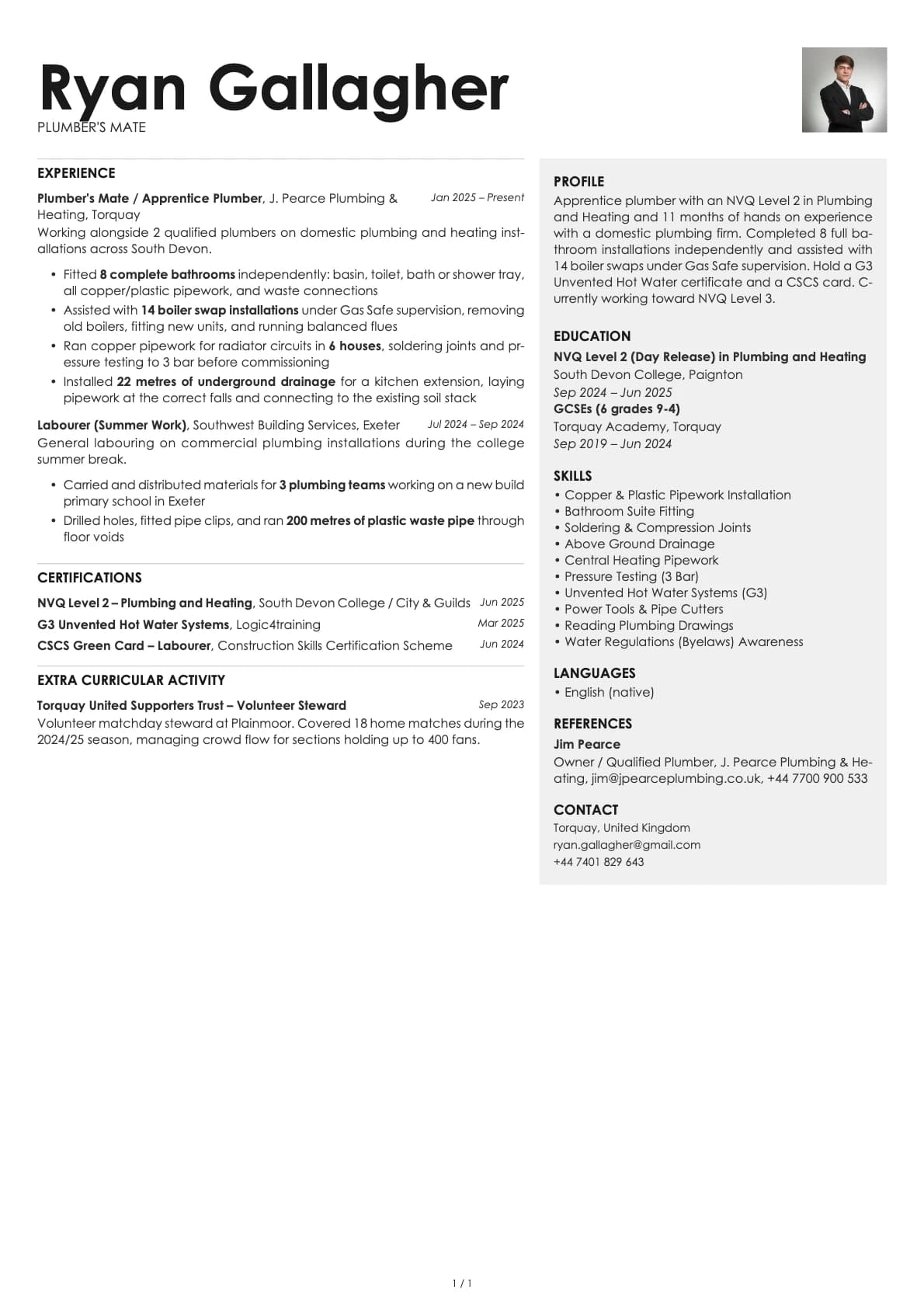
Plumber's Mate
A plumber's mate resume example for apprentice plumbers with NVQ Level 2 qualifications. See how to present your practical plumbing experience for your first employed role.
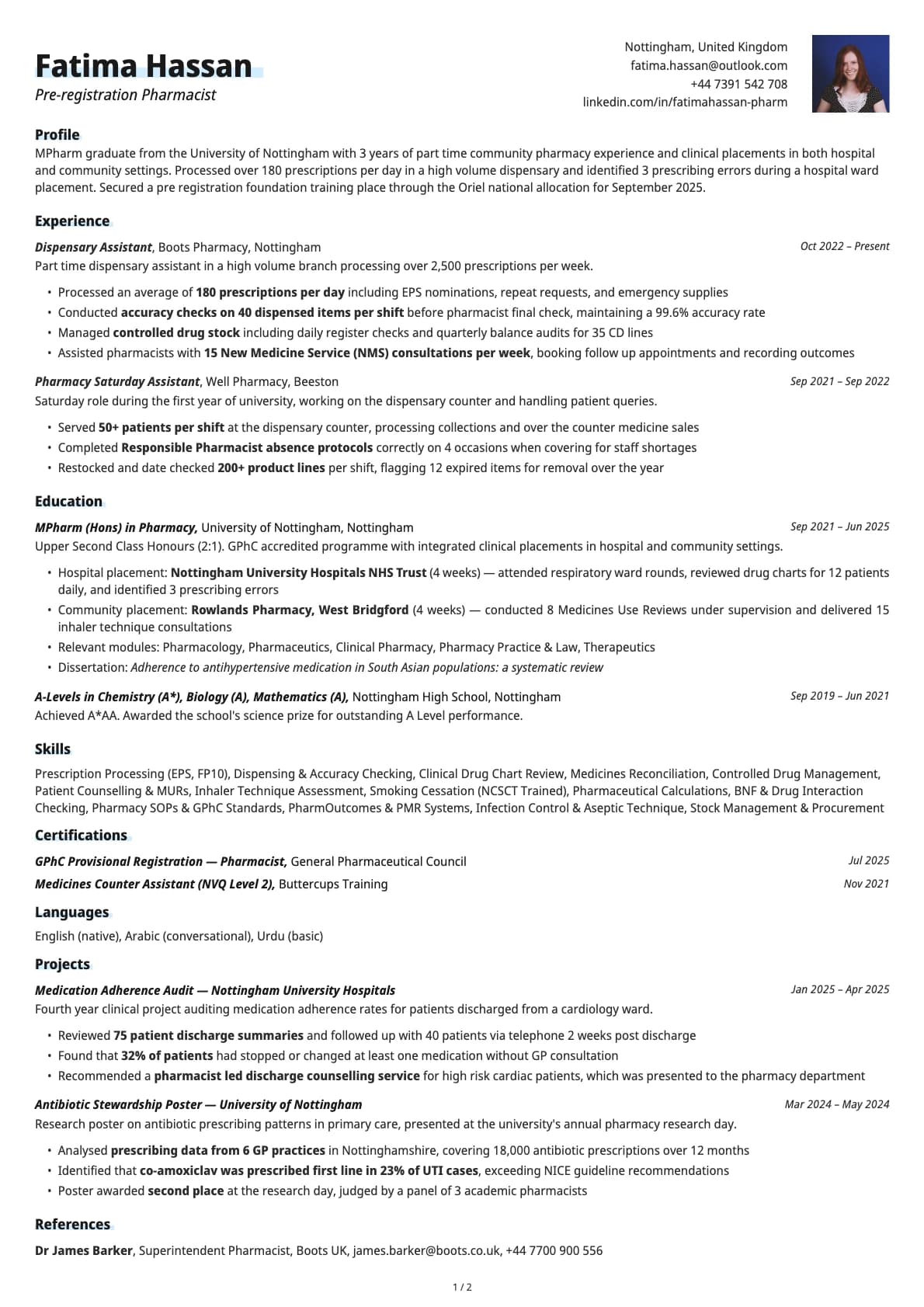
Pre-registration Pharmacist
A pre-registration pharmacist resume example showing how to present your MPharm degree, clinical placements, and GPhC registration progress for your foundation year role.
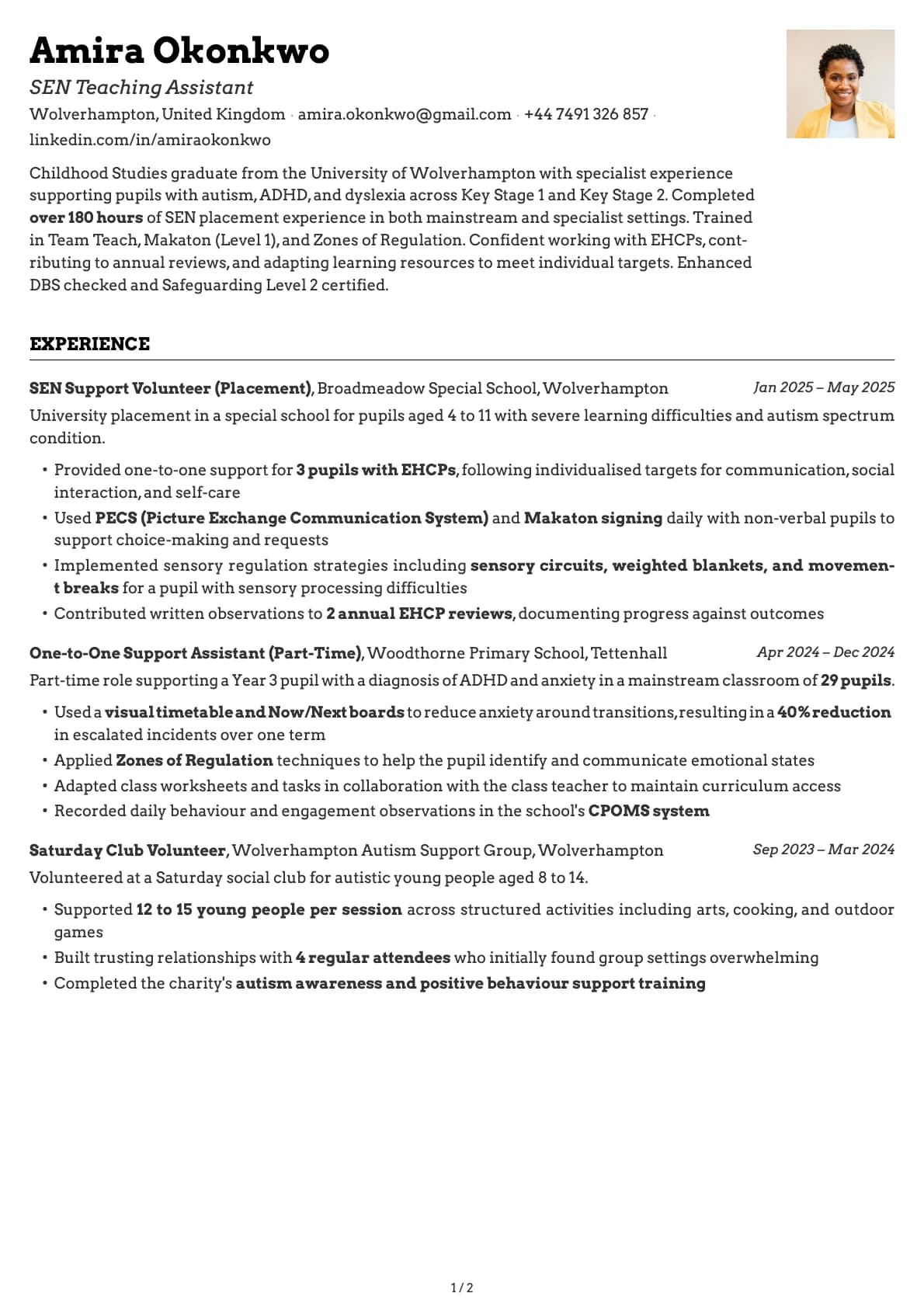
SEN Teaching Assistant
A graduate SEN teaching assistant resume example with SEND placement experience, EHCPs, and autism support. See how to present your specialist skills for SEN TA roles.
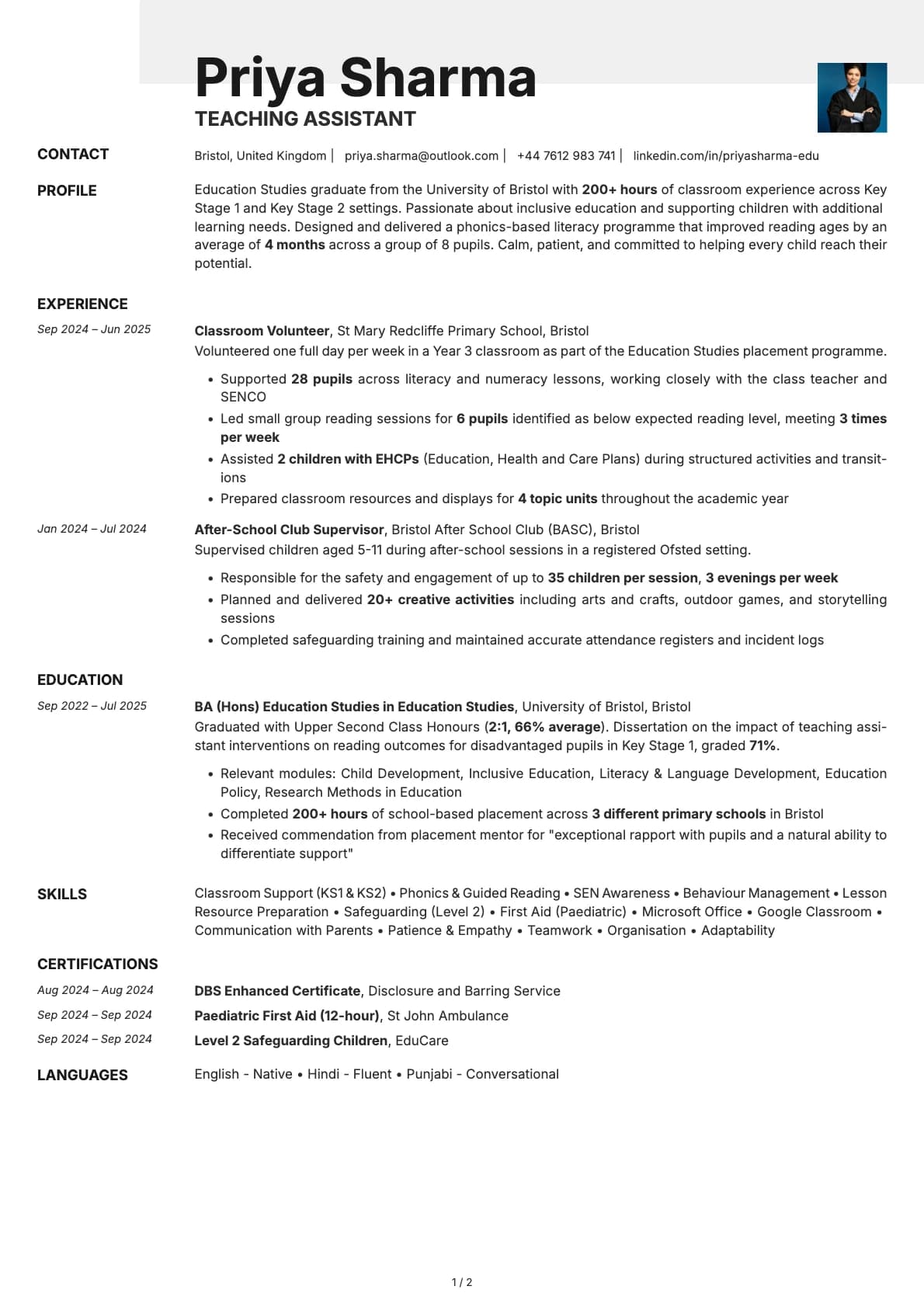
Teaching Assistant
A teaching assistant resume example for recent graduates. See how to present your classroom experience, volunteer work, and education degree to get hired as a TA.
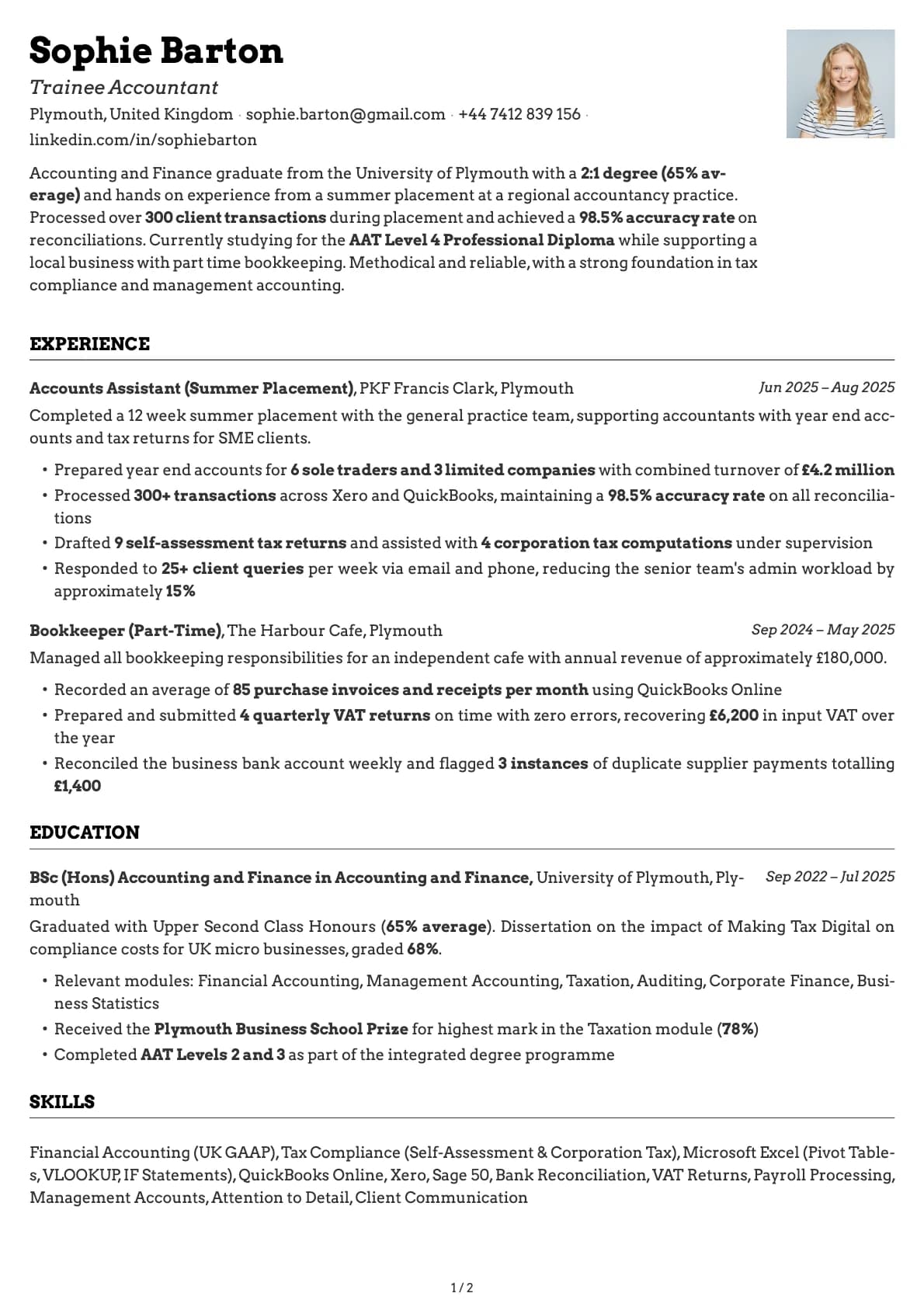
Trainee Accountant
A trainee accountant resume example for recent graduates. See how to present your AAT progress, placement experience, and bookkeeping skills to land your first role.
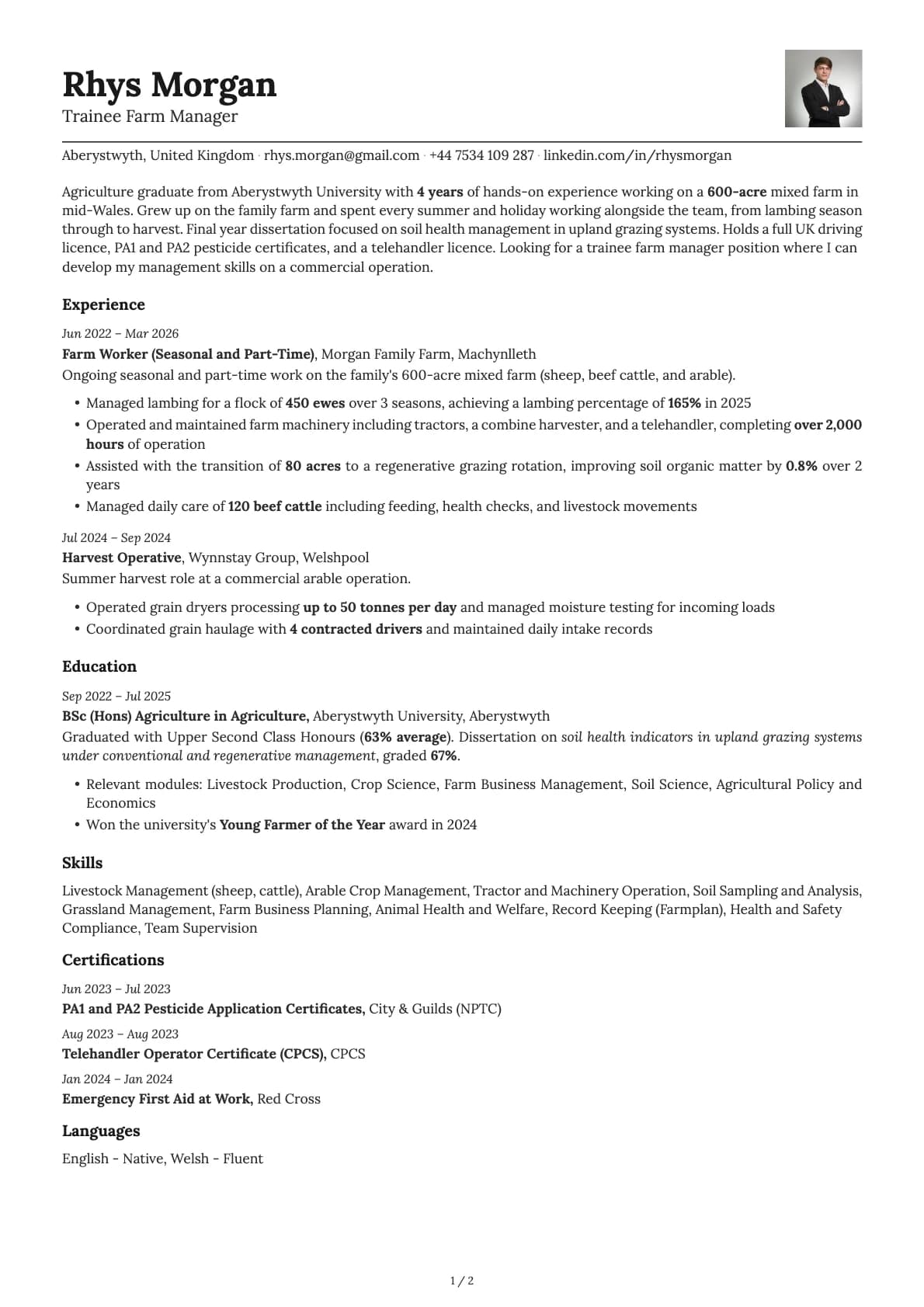
Trainee Farm Manager
A trainee farm manager resume example showing how to combine an agriculture degree with hands-on mixed farming experience on a 600-acre family operation.
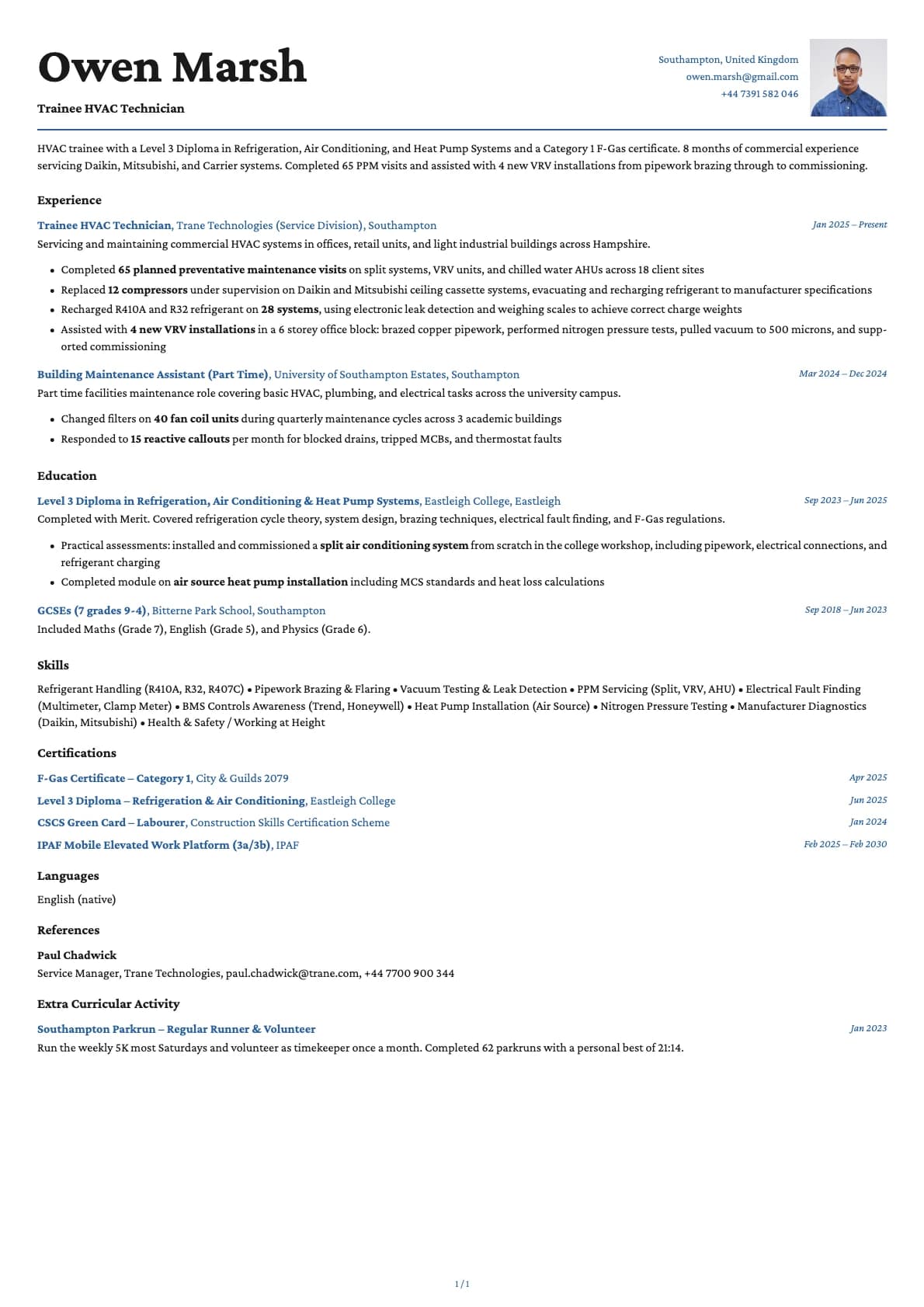
Trainee HVAC Technician
A trainee HVAC technician resume example for graduates entering the heating, ventilation, and air conditioning trade. See how to present your F-Gas certification and refrigeration skills.
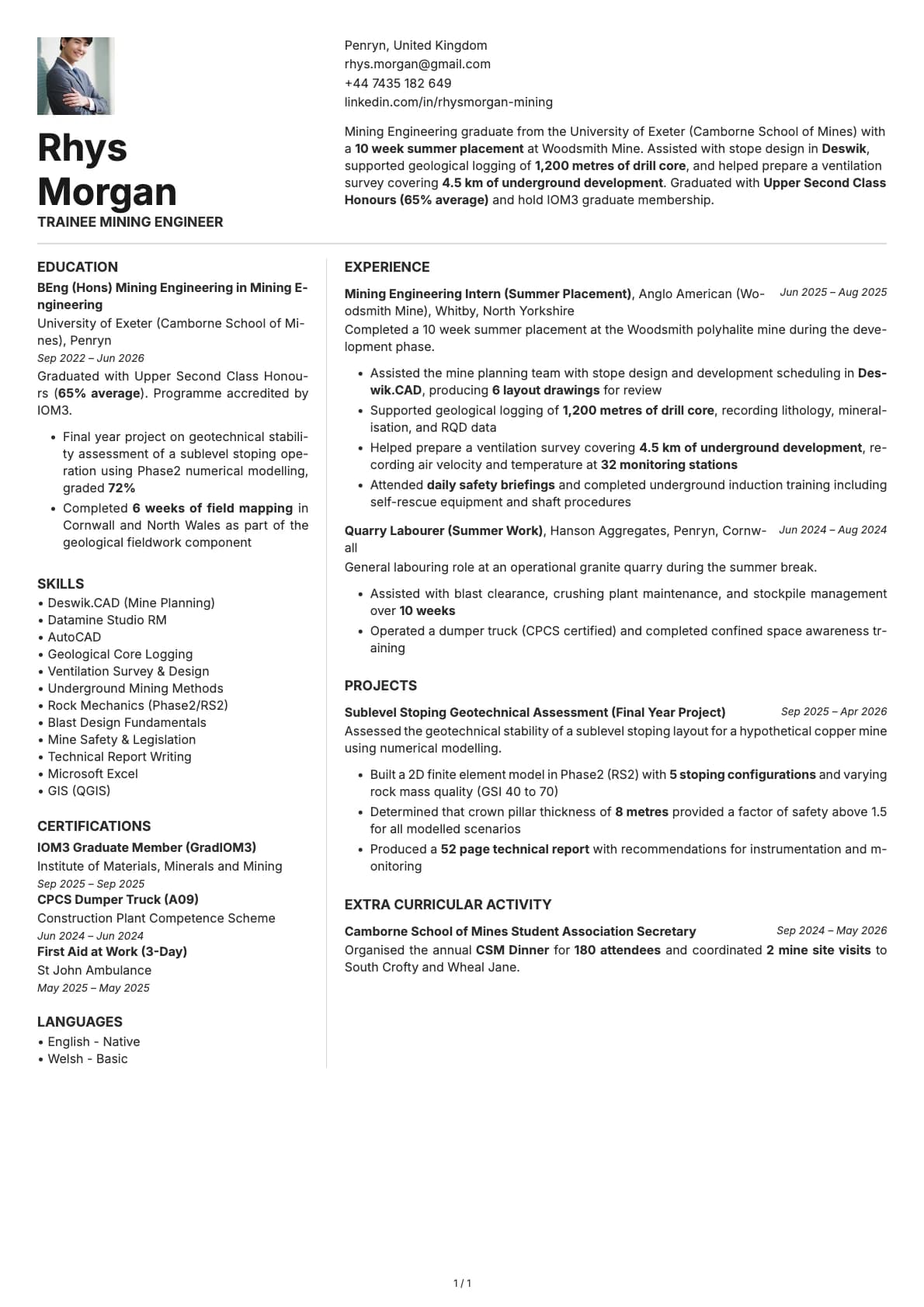
Trainee Mining Engineer
A trainee mining engineer resume example with underground mine placement experience, Deswik proficiency, and IOM3 membership.
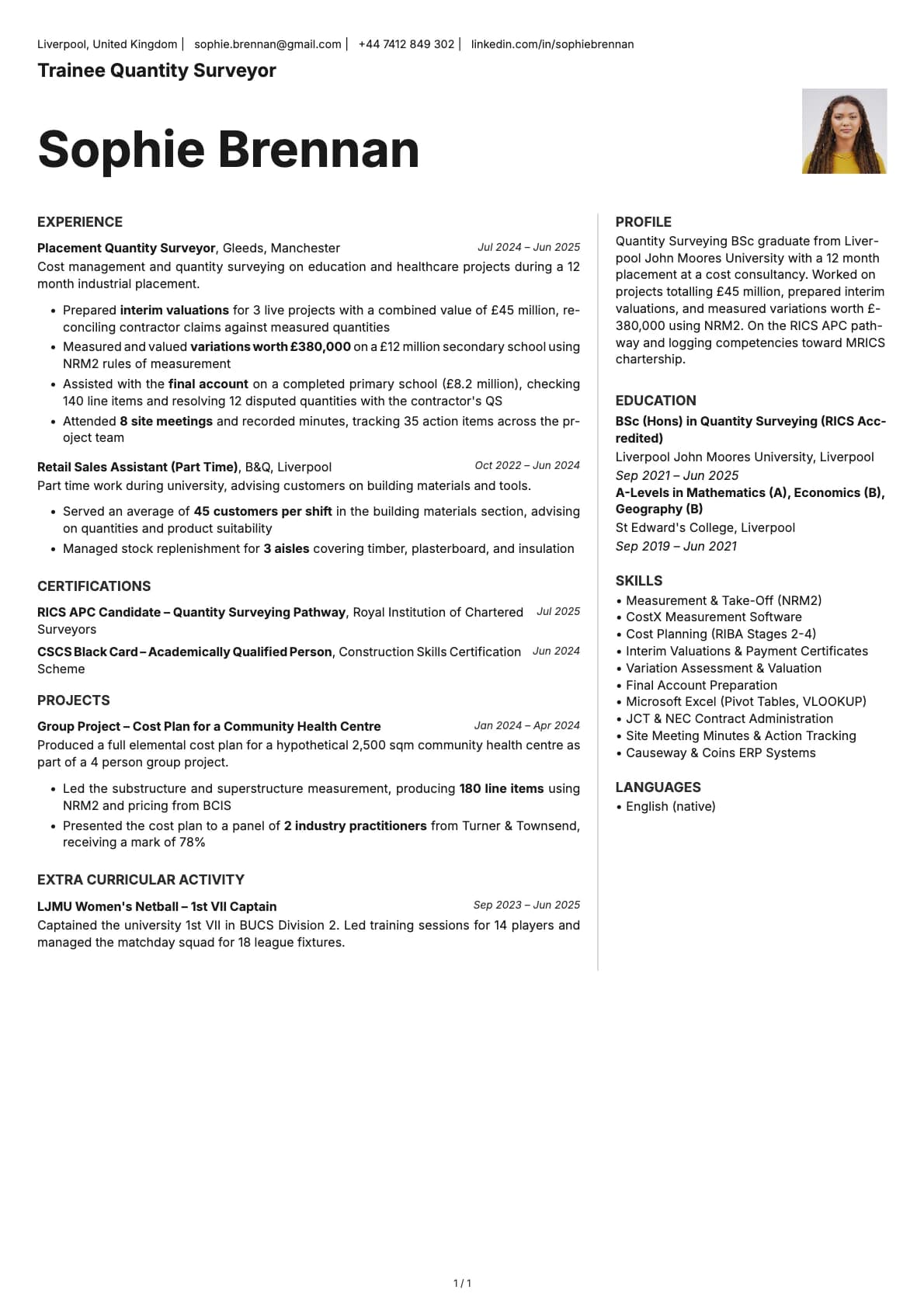
Trainee Quantity Surveyor
A trainee quantity surveyor resume example for QS graduates on the RICS APC pathway. See how to present your measurement skills, cost management experience, and professional development.
Trainee Site Manager
A trainee site manager resume example for construction management graduates. See how to present your BSc, CITB qualifications, and placement experience to land your first site role.