Graduate Firefighter Resume Example
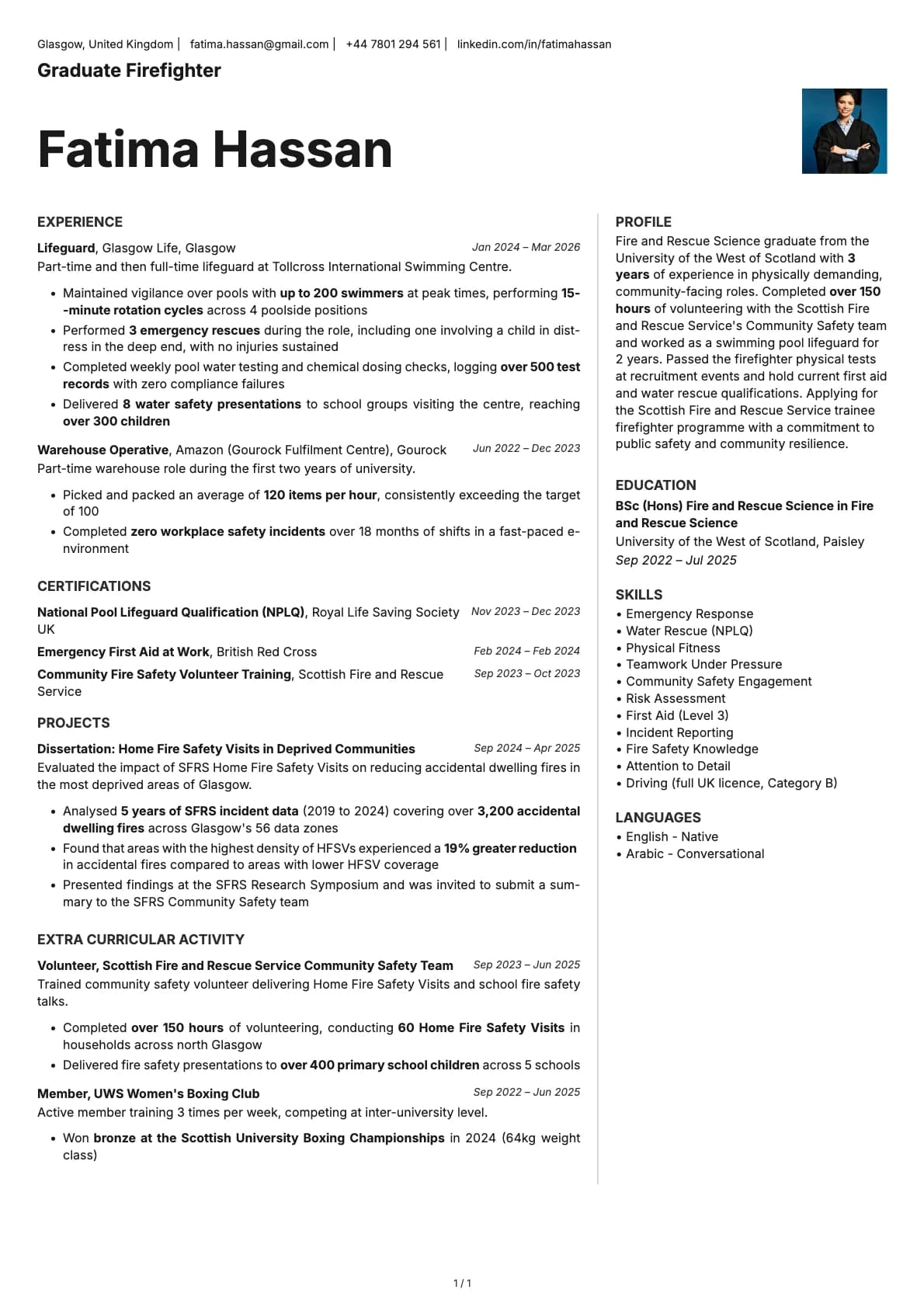
A graduate firefighter resume example showing how to combine a Fire and Rescue Science degree with lifeguarding and community safety volunteering.

Laddro Team
Free to use. No account needed to start.
Free to use. No account needed to start.
Overview
Fire and rescue services receive thousands of applications for every trainee intake. The candidates who stand out are the ones who have already demonstrated physical competence, community commitment, and an understanding of how fire services actually operate. A degree in fire science helps, but it is the practical hours that make a real difference on the application form.
Fatima Hassan graduated from the University of the West of Scotland with a First Class Honours in Fire and Rescue Science, scoring a 72% average and winning the programme prize for the highest mark in her cohort. Outside the lecture hall, she worked as a lifeguard at Tollcross International Swimming Centre in Glasgow and logged over 150 hours volunteering with the Scottish Fire and Rescue Service's Community Safety team. Her resume connects academic knowledge directly to frontline readiness.
What Makes This Resume Work
The lifeguarding experience proves physical composure under pressure. Fatima maintained vigilance over pools with up to 200 swimmers at peak times, rotating across 4 poolside positions every 15 minutes. She performed 3 emergency rescues during her time in the role, including one involving a child in distress in the deep end, with no injuries sustained. This is exactly the kind of calm, immediate response that fire services want to see from candidates.
The volunteering is specific and substantial. Completing 150 hours with the Scottish Fire and Rescue Service is not a token line on a CV. Fatima conducted 60 Home Fire Safety Visits in households across north Glasgow and delivered fire safety presentations to over 400 primary school children across 5 schools. She did not just observe the service; she contributed to it.
The dissertation ties academic work to operational impact. Her research analysed 5 years of SFRS incident data covering over 3,200 accidental dwelling fires across Glasgow's 56 data zones. She found that areas with the highest density of Home Fire Safety Visits experienced a 19% greater reduction in accidental fires. She presented these findings at the SFRS Research Symposium and was invited to submit a summary to the Community Safety team. This is the kind of evidence the service actually uses.
Certifications and fitness round out the profile. The NPLQ, Emergency First Aid at Work from the British Red Cross, and Community Fire Safety Volunteer Training from the SFRS itself all confirm she holds the qualifications recruiters check for. A bronze medal at the Scottish University Boxing Championships in 2024 adds a clear signal of physical conditioning.
Key Takeaways
If you are applying for a trainee firefighter programme, your resume needs to prove three things: that you can handle physically demanding situations, that you understand the community side of fire service work, and that you have already started putting in the hours. Volunteering directly with your target service is the single strongest thing you can do before applying. Pair it with a relevant qualification and evidence of real fitness, and your application will look very different from someone who simply ticks the degree box.
Build your own version
Open this layout in the builder and swap in your own details. It takes a few minutes.
Free to use. No account needed to start.
Was this resume example helpful?
Rate this example to help us create better content for you.
4.7 average from 112 ratingsRelated resume examples
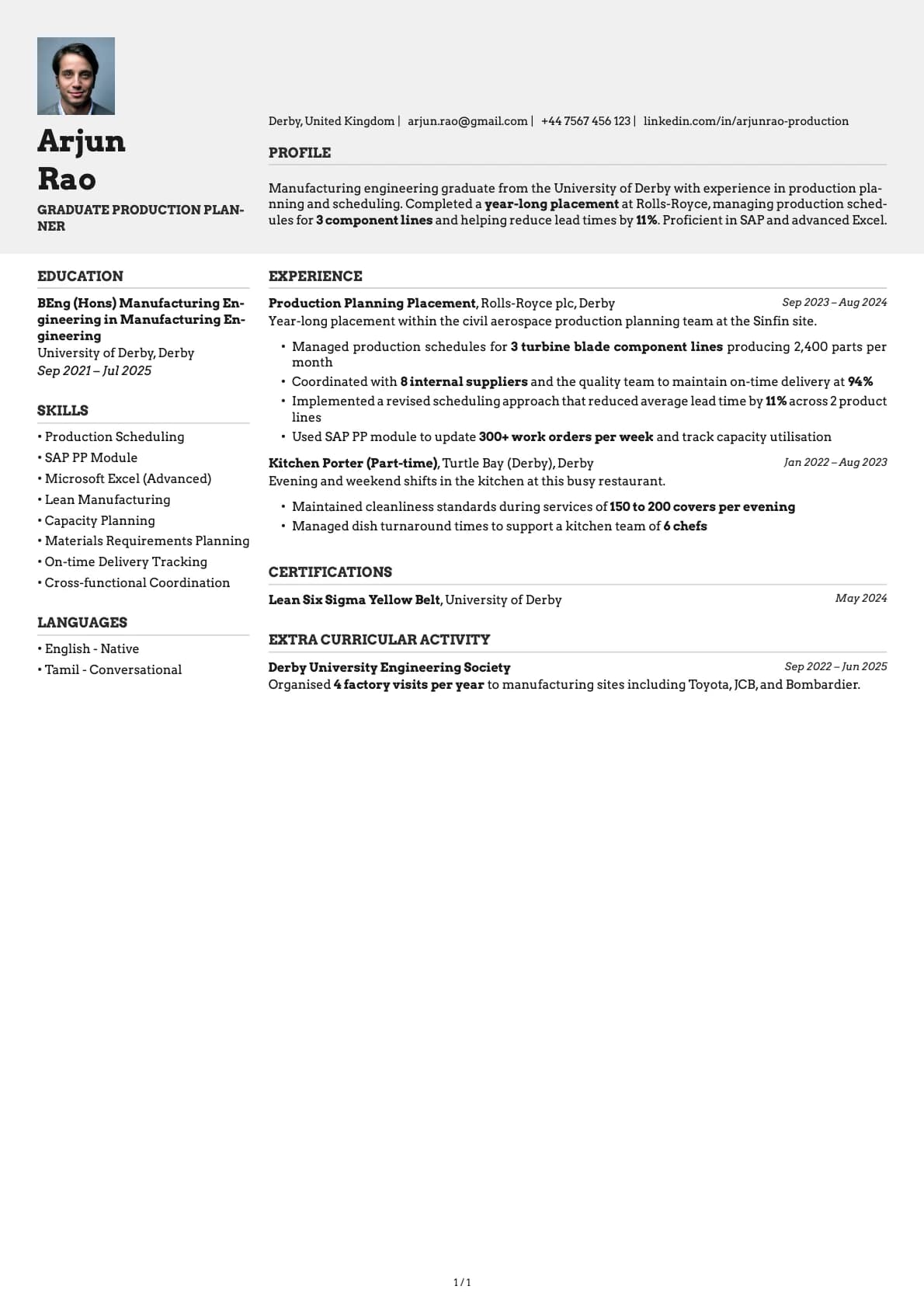
Graduate Production Planner
A graduate production planner resume example with Rolls-Royce placement and SAP scheduling experience.
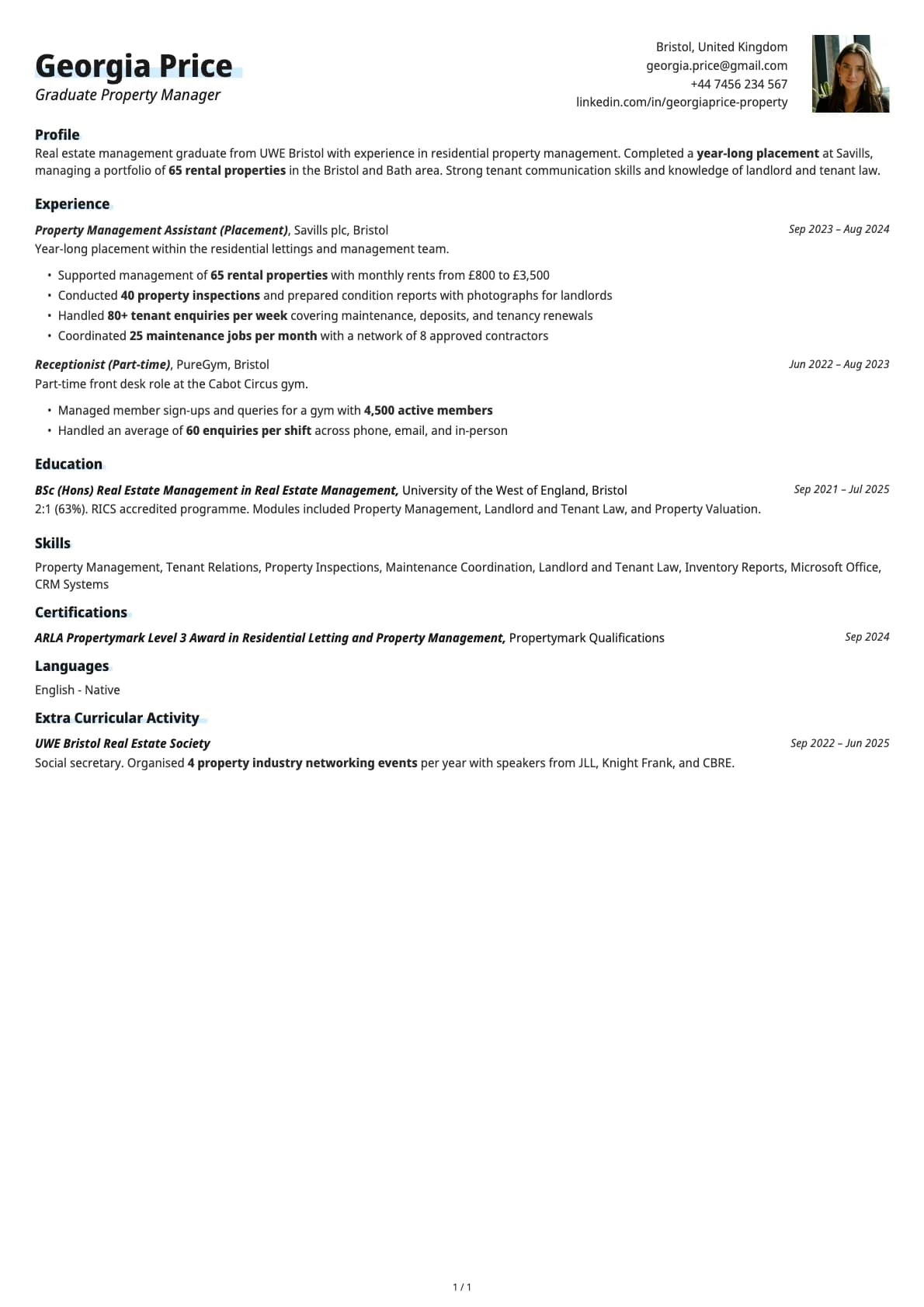
Graduate Property Manager
A graduate property manager resume example with Savills placement and residential lettings experience.

Graduate Quantity Surveyor
A graduate quantity surveyor resume example with a construction placement year. See how to present valuations, measurement skills, and NEC contract experience.
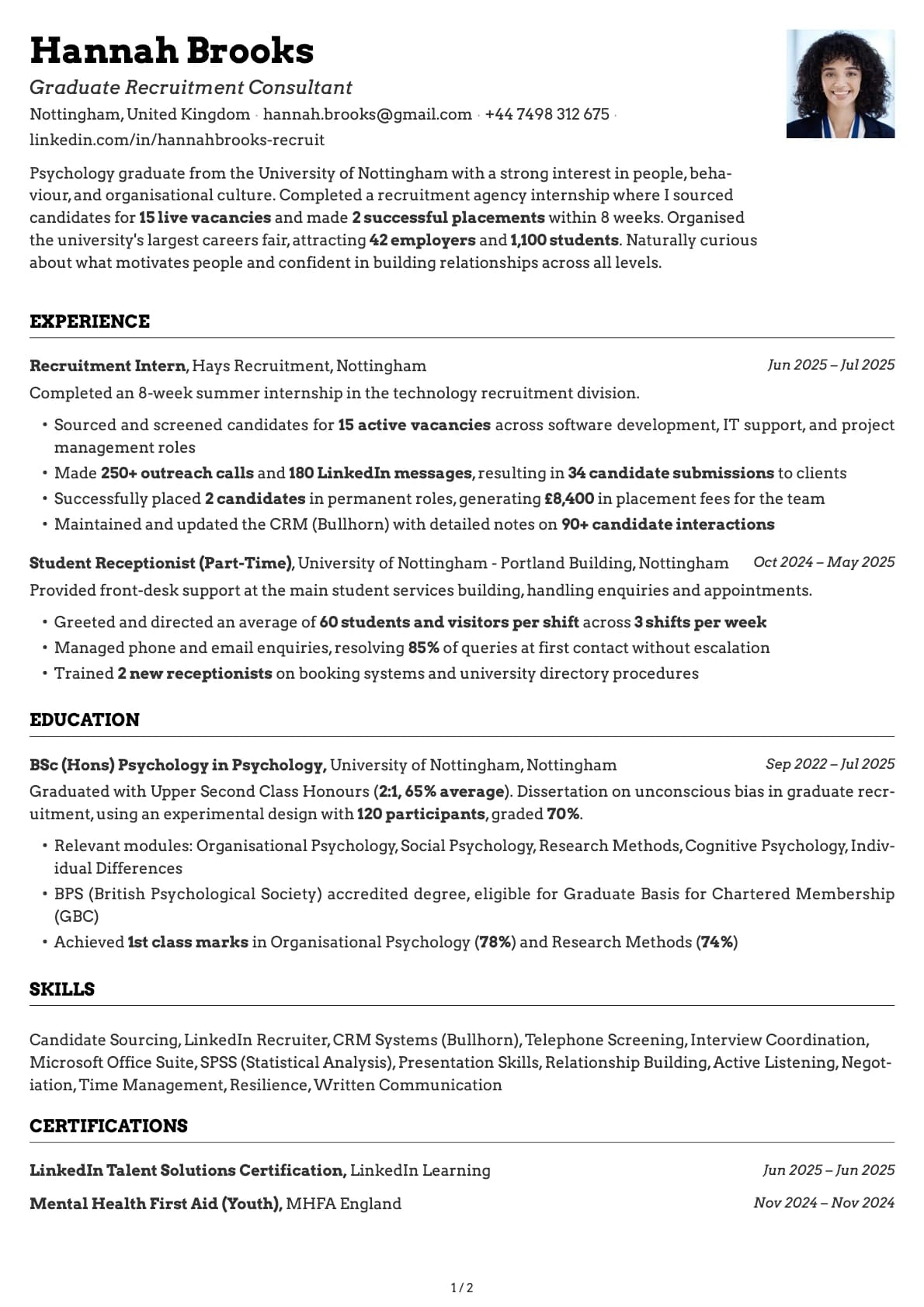
Graduate Recruitment Consultant
A graduate recruitment consultant resume example for recent graduates. Learn how to present your communication skills, sales experience, and people skills for recruitment roles.
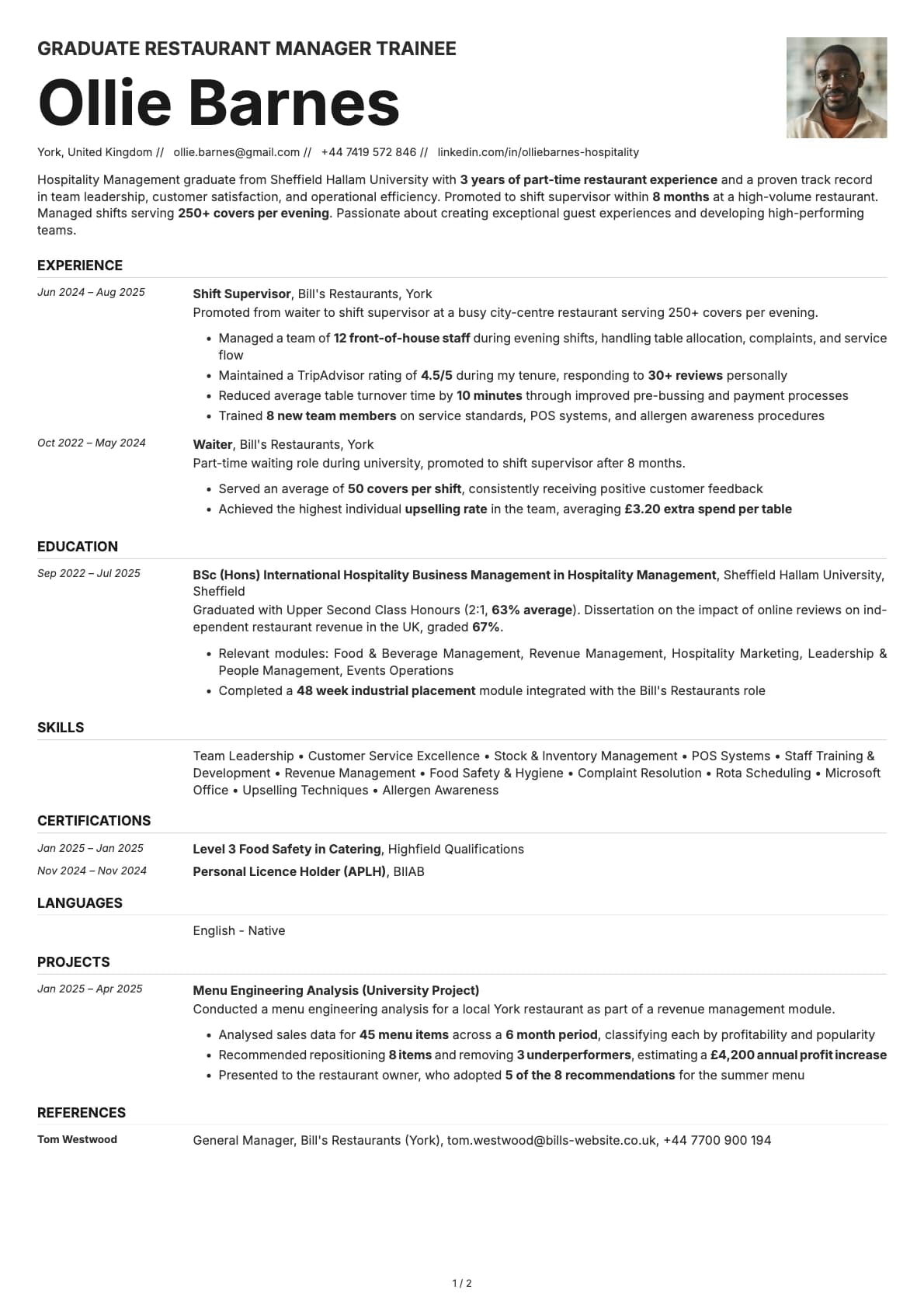
Graduate Restaurant Manager Trainee
A graduate restaurant manager trainee resume example. See how to present shift leadership, customer satisfaction, and hospitality qualifications to land your first management trainee role.
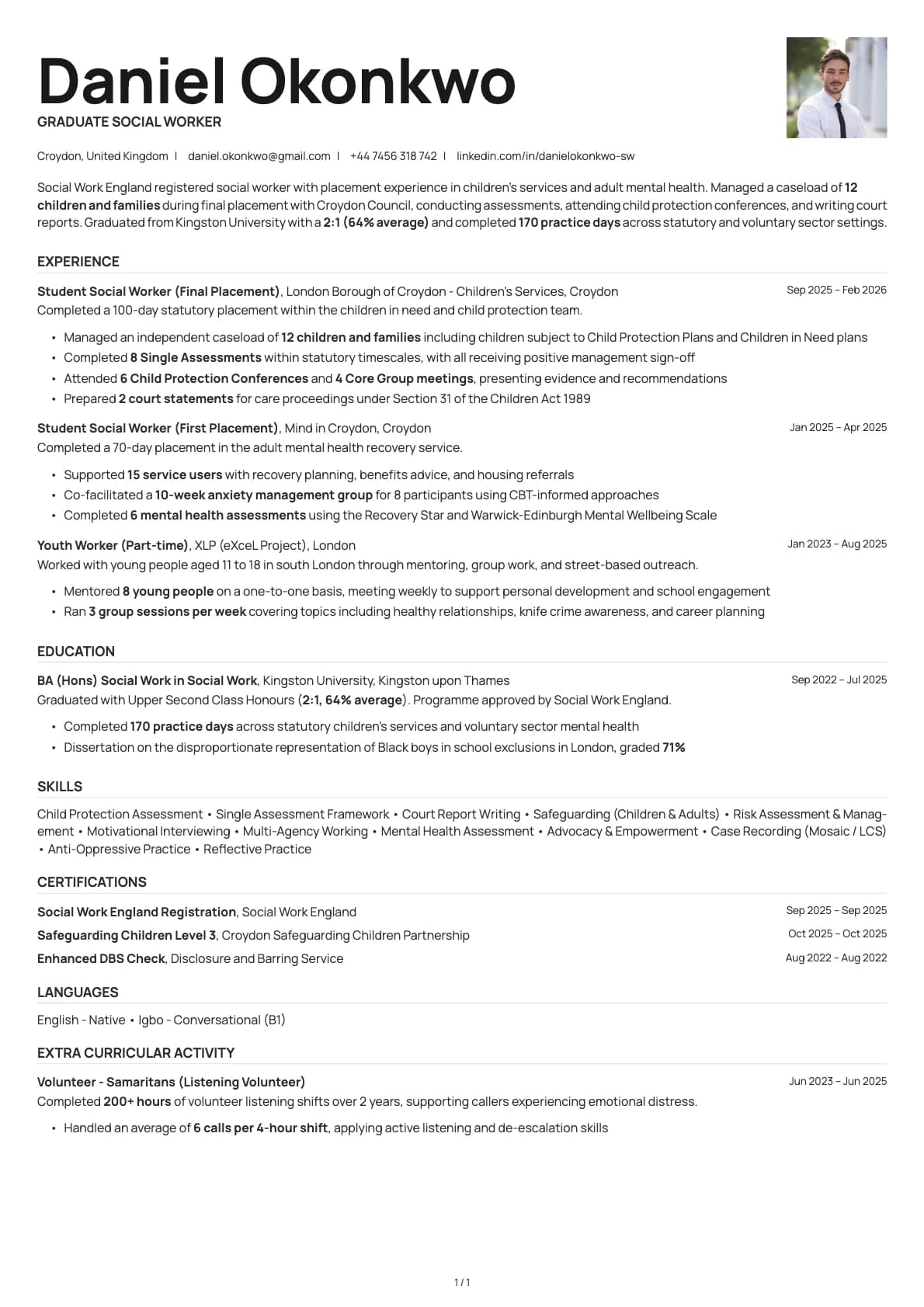
Graduate Social Worker
A graduate social worker resume example with statutory placement experience, caseload numbers, and Social Work England registration for NQSWs.
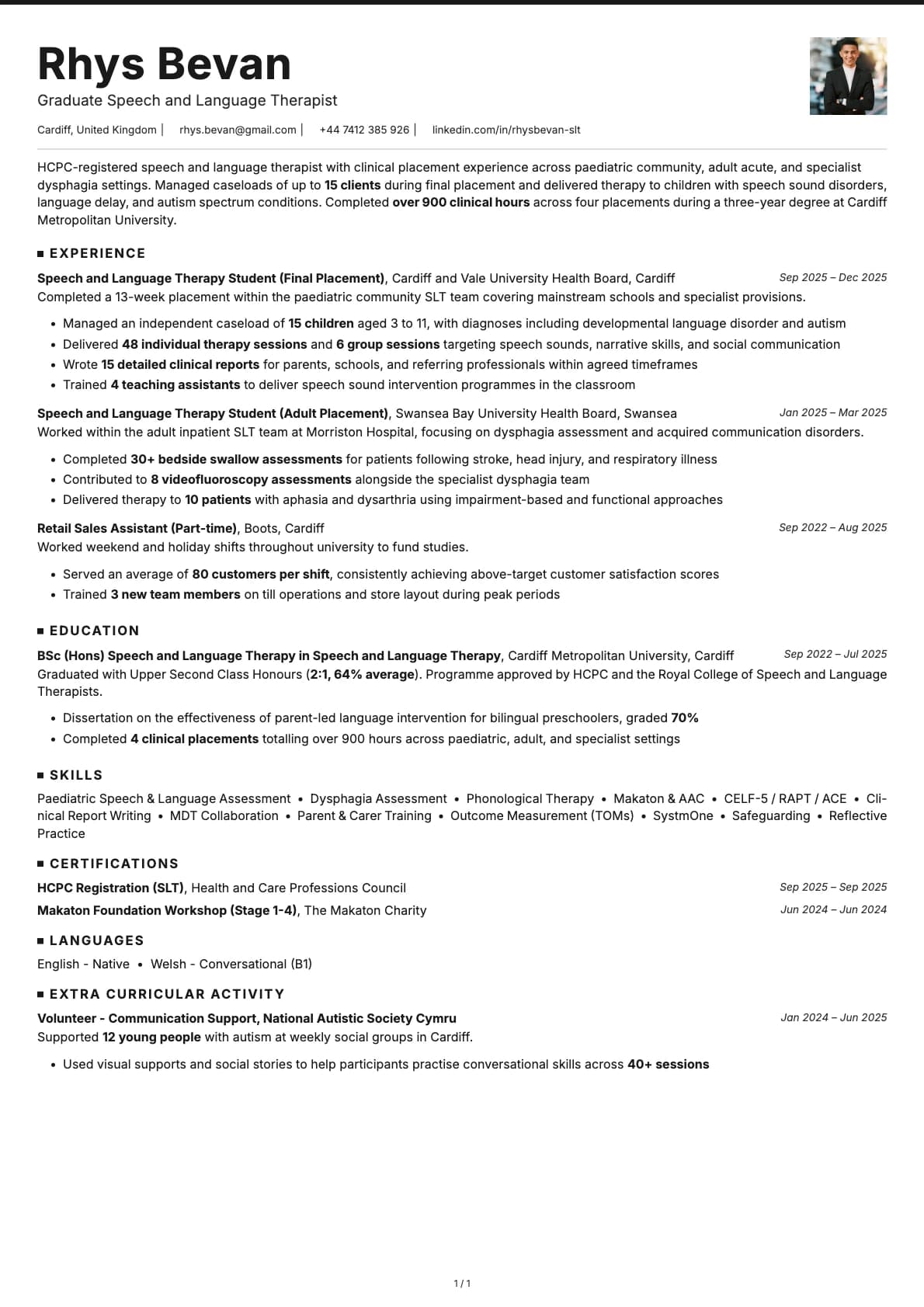
Graduate Speech and Language Therapist
A graduate speech and language therapist resume example with clinical placement hours, HCPC registration, and paediatric caseload numbers.
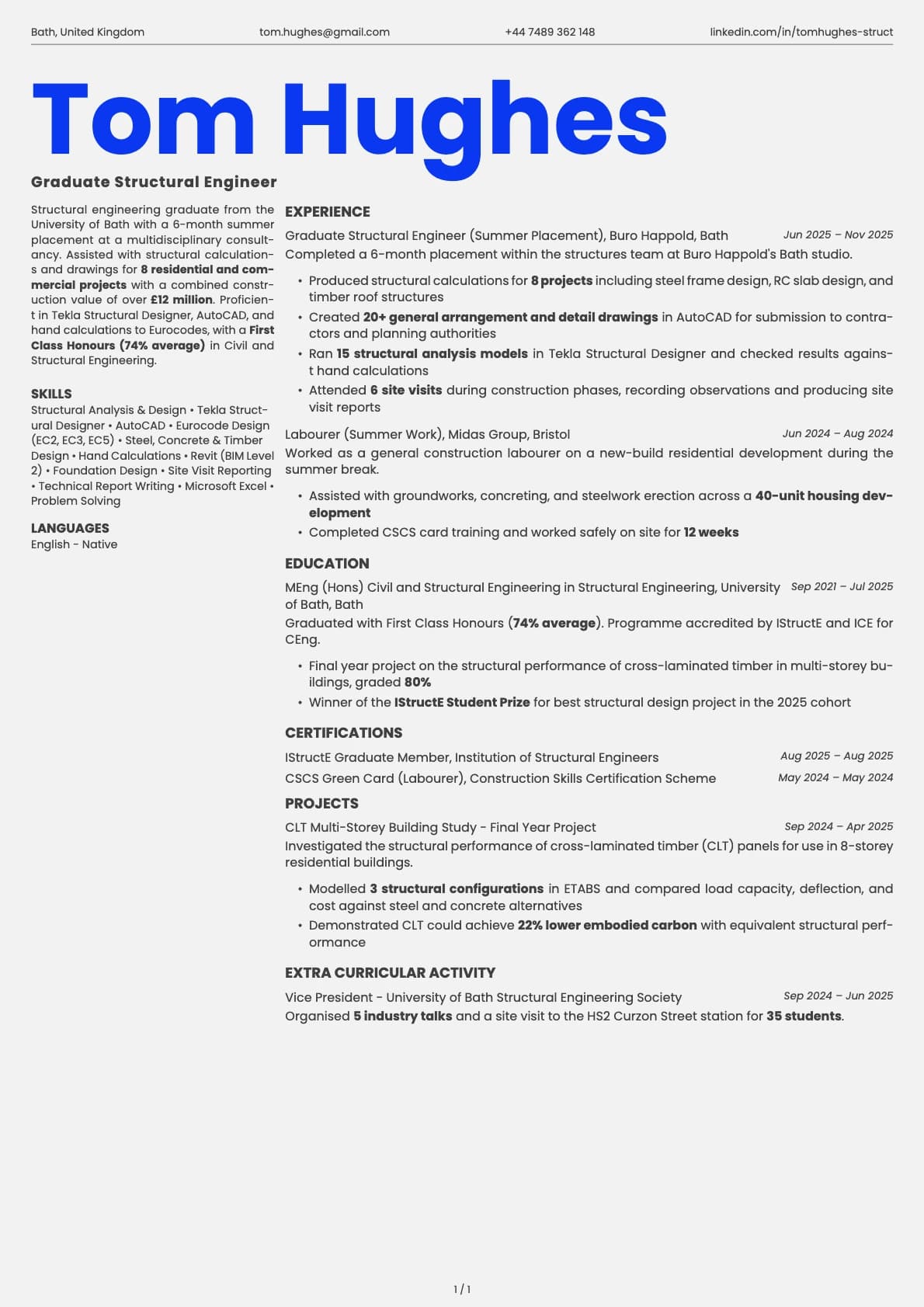
Graduate Structural Engineer
A graduate structural engineer resume example with consultancy placement experience, Eurocode design skills, and IStructE membership.
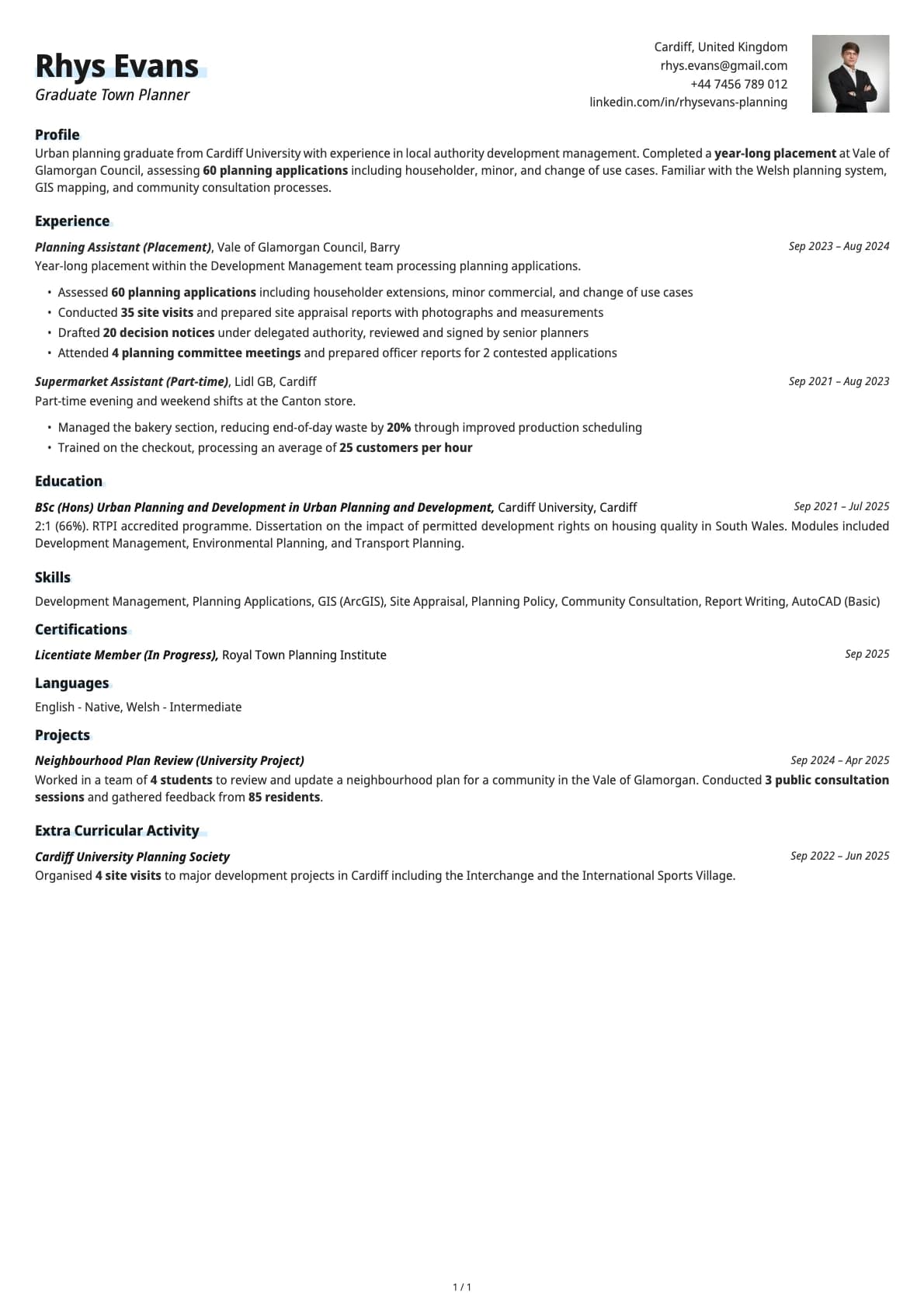
Graduate Town Planner
A graduate town planner resume example with local authority placement experience and RTPI accredited degree.
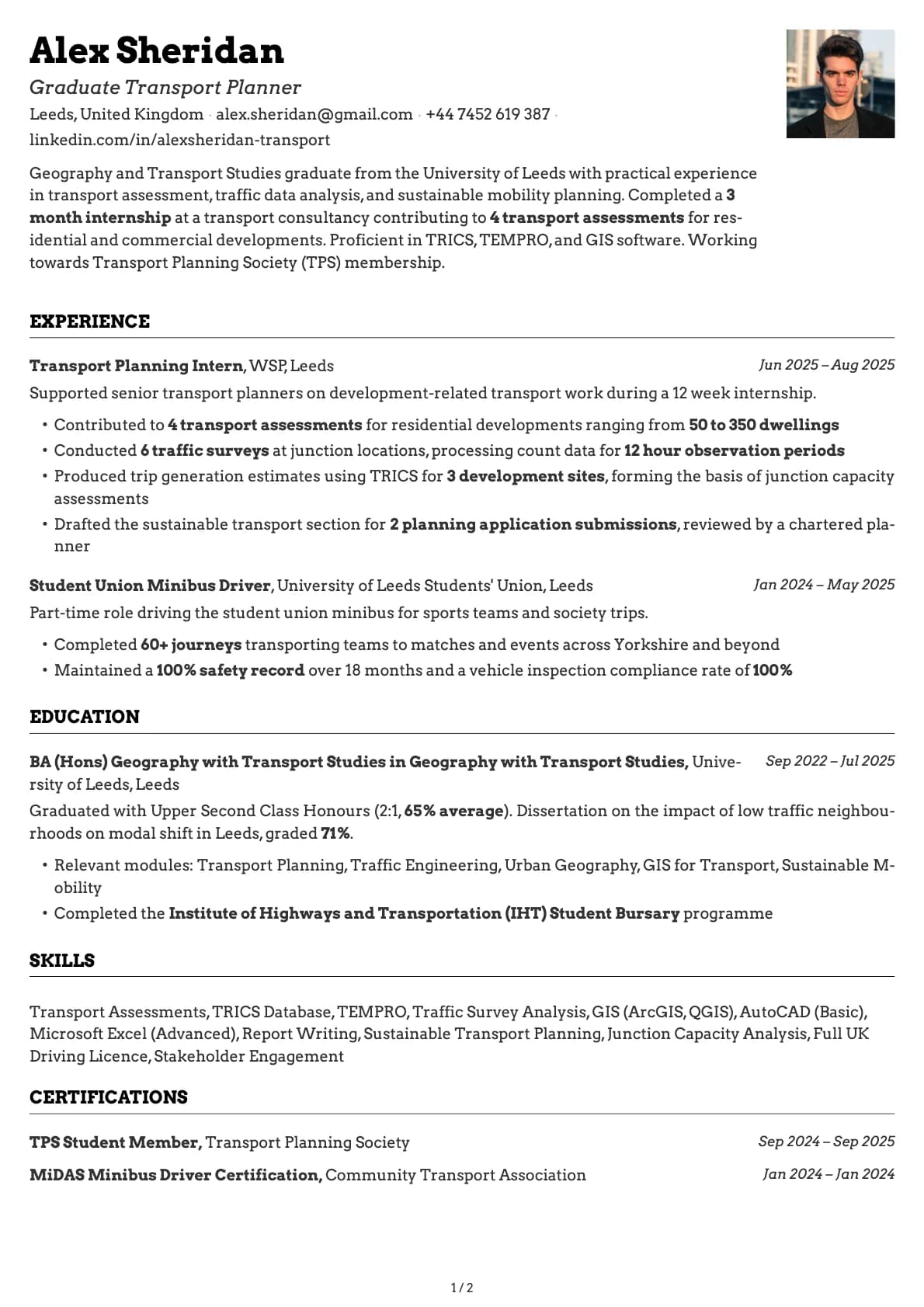
Graduate Transport Planner
A graduate transport planner resume example. See how to present transport assessment experience, traffic survey data, and TPS membership to land your first transport planning role.
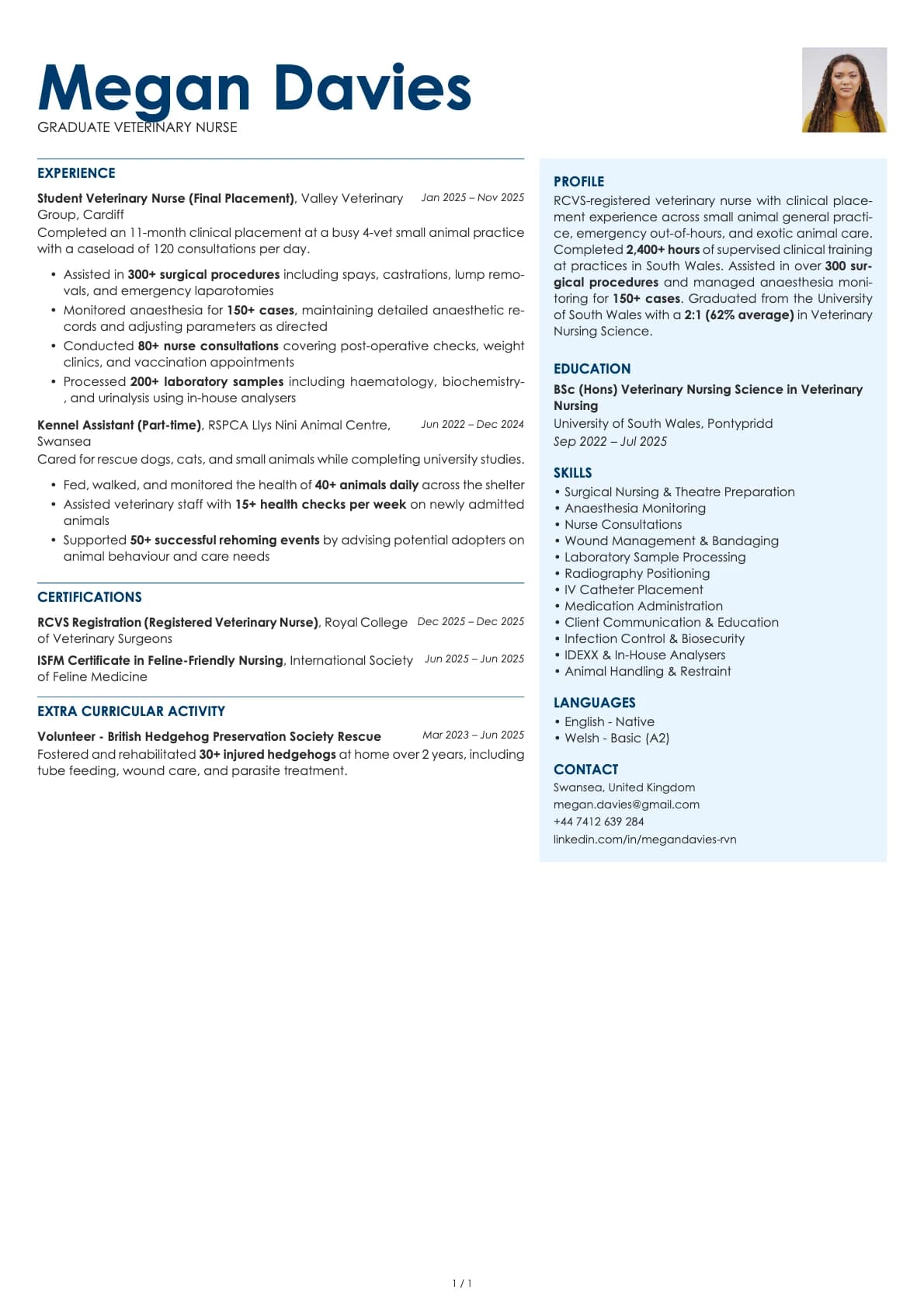
Graduate Veterinary Nurse
A graduate veterinary nurse resume example with RCVS registration, surgical assist numbers, and clinical placement hours for newly qualified RVNs.
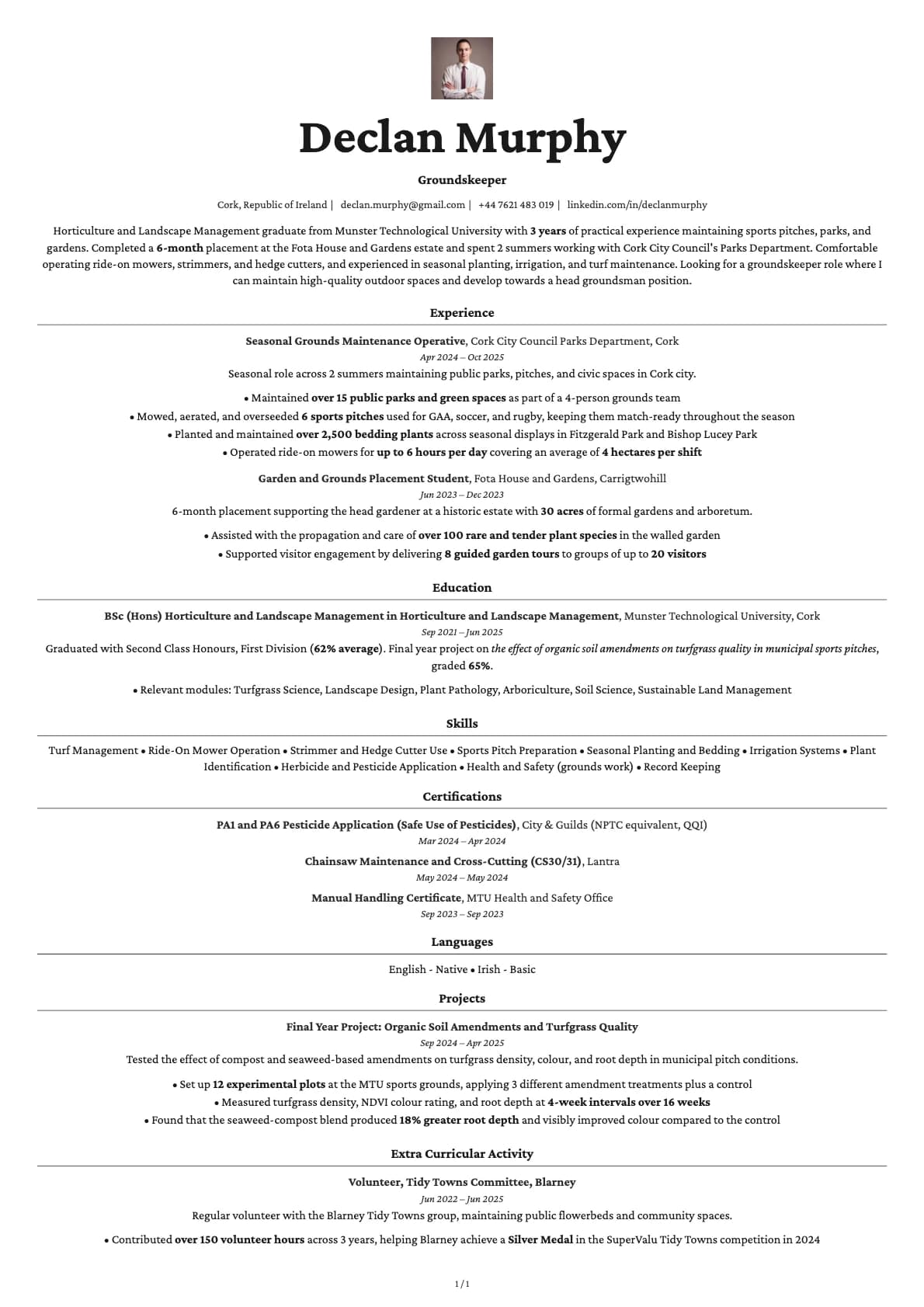
Groundskeeper
A groundskeeper resume example showing how to combine a horticulture degree with council grounds work and a historic garden placement.