Trainee Farm Manager Resume Example
A trainee farm manager resume example showing how to combine an agriculture degree with hands-on mixed farming experience on a 600-acre family operation.

Laddro Team
Free to use. No account needed to start.
Free to use. No account needed to start.
Overview
Trainee farm manager positions on commercial operations attract two types of applicants: agriculture graduates with limited practical hours, and experienced farm workers without formal qualifications. The candidates who get hired are the ones who bring both. Estate managers and farm owners want someone who understands the science behind soil health and grassland management but who has also spent enough hours on a tractor to be useful from day one.
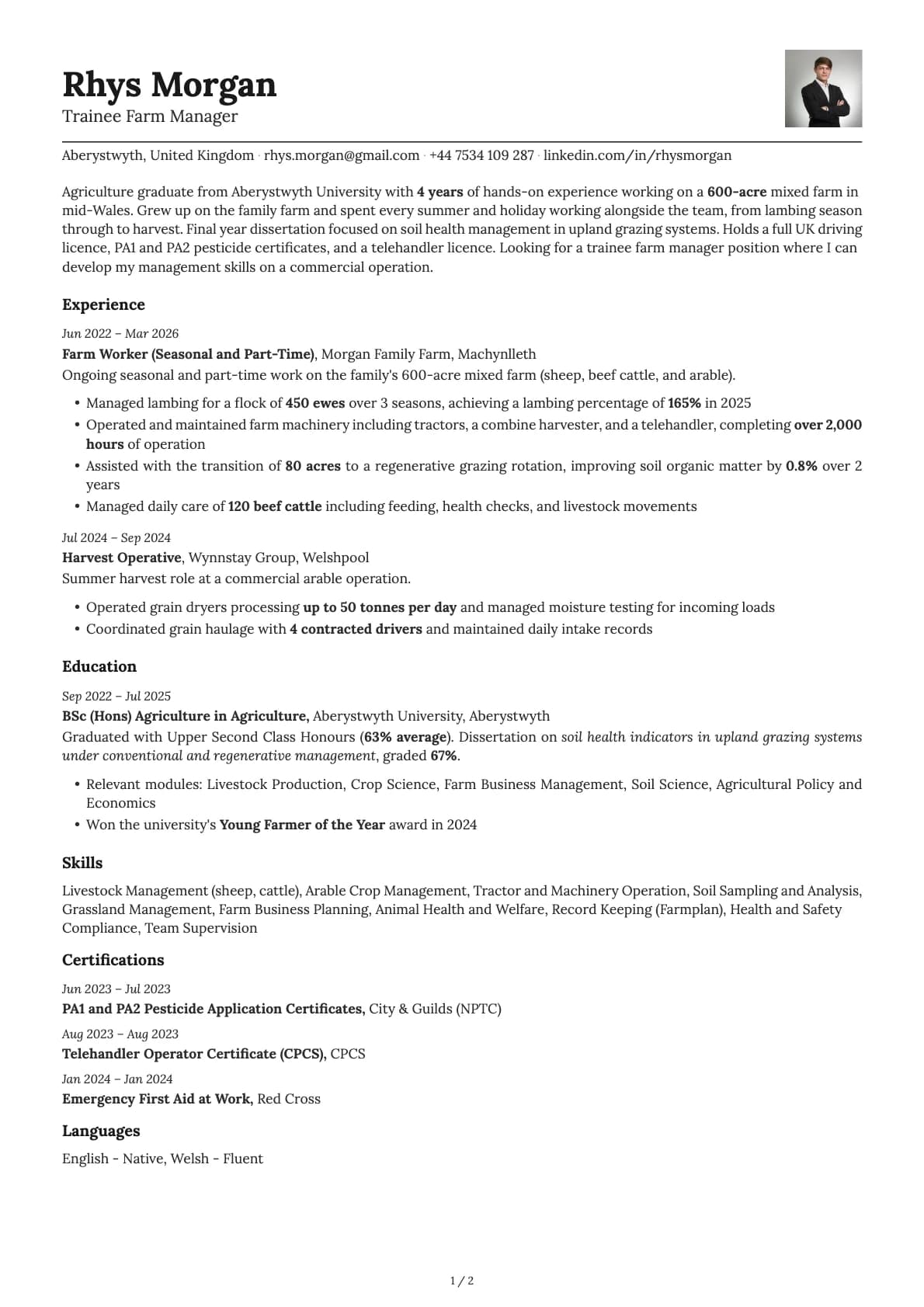
Rhys Morgan graduated from Aberystwyth University with an Upper Second in Agriculture and grew up working on his family's 600-acre mixed farm in mid-Wales. He has managed lambing for a flock of 450 ewes, operated farm machinery for over 2,000 hours, and helped transition 80 acres to a regenerative grazing rotation. He also spent a summer as a harvest operative at the Wynnstay Group, processing up to 50 tonnes of grain per day. His resume combines the depth of someone raised on a farm with the technical knowledge of a university graduate.
What Makes This Resume Work
The livestock experience covers real commercial scale. Rhys managed lambing for 450 ewes over 3 seasons, achieving a lambing percentage of 165% in 2025. He also managed daily care of 120 beef cattle including feeding, health checks, and livestock movements. These are not weekend tasks on a smallholding. They are the responsibilities of someone who has been doing serious farm work for years, and the lambing percentage proves he does it well.
Machinery hours remove any doubt about practical ability. Over 2,000 hours operating tractors, a combine harvester, and a telehandler is a figure that immediately signals competence to any farm manager reading the resume. Combined with PA1 and PA2 pesticide certificates and a CPCS telehandler operator certificate, this means Rhys can legally and safely do the tasks that trainee farm managers are expected to handle from their first week.
The regenerative farming work shows forward-thinking. Assisting with the transition of 80 acres to a regenerative grazing rotation and improving soil organic matter by 0.8% over 2 years is exactly the kind of initiative that progressive farm businesses value. His dissertation reinforced this: he collected 48 soil samples from 6 fields across 2 farms and found that regeneratively managed fields had 22% higher soil organic matter and 35% faster water infiltration. Winning the Aberystwyth Young Farmer of the Year award in 2024 adds further recognition.
The harvest operative role proves he can work beyond the family farm. Spending a summer at Wynnstay Group operating grain dryers processing up to 50 tonnes per day and coordinating haulage with 4 contracted drivers shows he can function in a commercial operation run by someone other than his family. This matters because farm managers interviewing candidates from family farms often wonder whether they can adapt to a different operation's systems and expectations.
Key Takeaways
If you are applying for trainee farm manager roles, your resume needs to show scale: flock size, herd numbers, acreage managed, and machinery hours. Farm owners reading your application will assess whether you can handle the physical and logistical demands of their operation from week one. If you come from a family farm, include at least one role on a different operation to show adaptability. Get your pesticide, machinery, and first aid certifications sorted before you apply, and if you have any data on soil, yield, or livestock performance improvements you contributed to, put those numbers front and centre.
Build your own version
Open this layout in the builder and swap in your own details. It takes a few minutes.
Free to use. No account needed to start.
Was this resume example helpful?
Rate this example to help us create better content for you.
4.6 average from 89 ratingsRelated resume examples
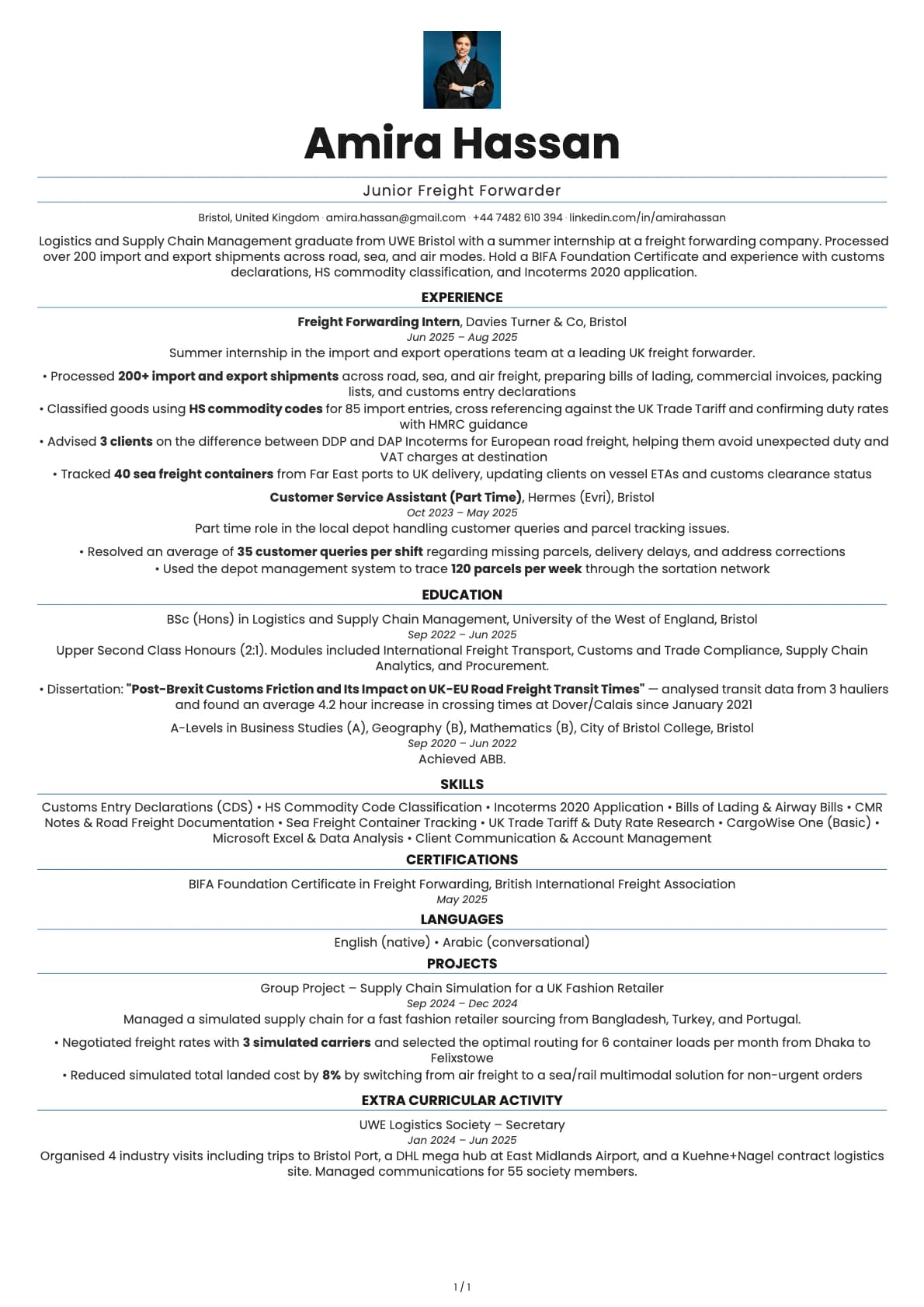
Junior Freight Forwarder
A junior freight forwarder resume example for logistics graduates entering international freight. See how to present your customs documentation, Incoterms knowledge, and freight operations experience.
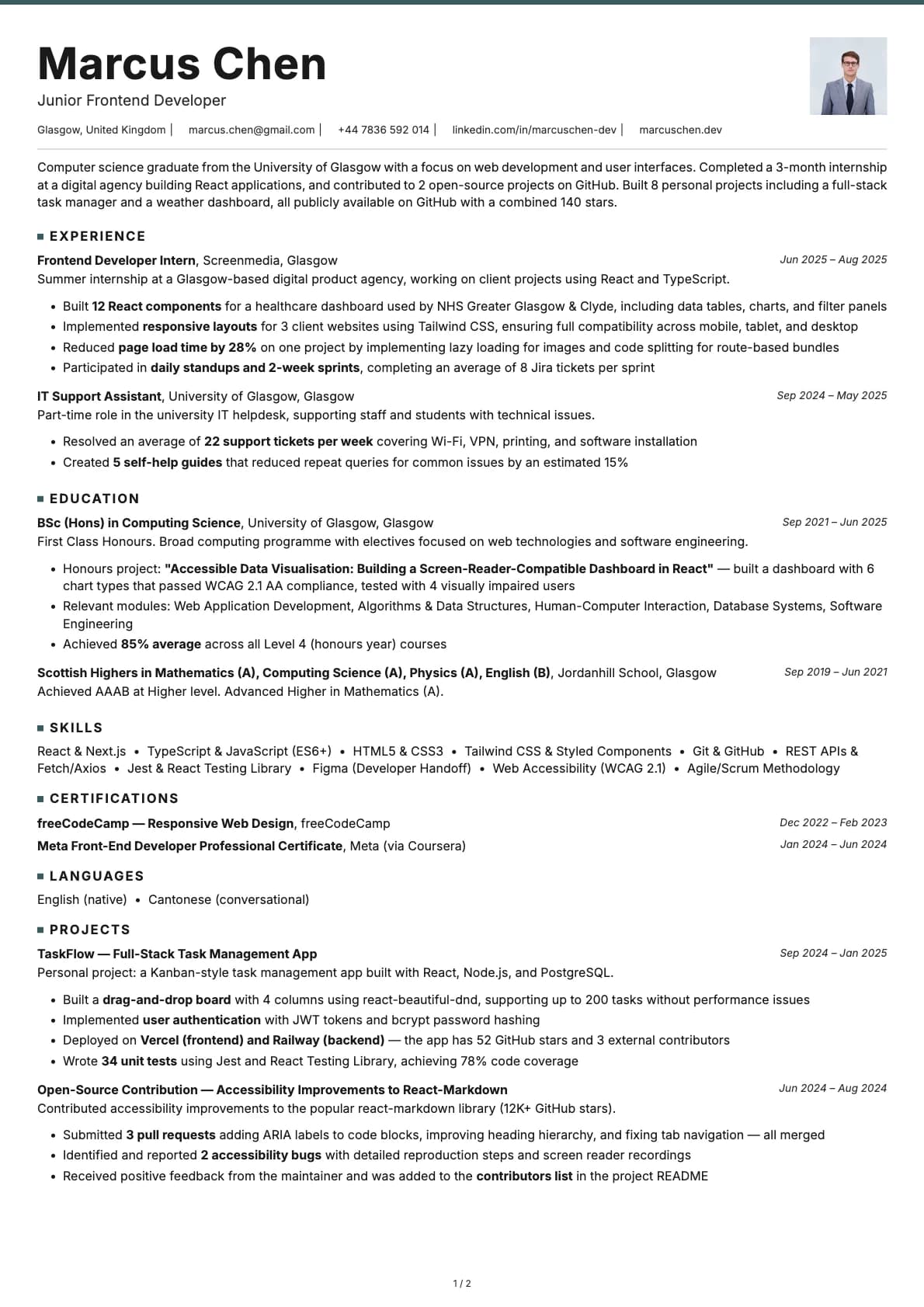
Junior Frontend Developer
A junior frontend developer resume example for recent graduates. Learn how to present your React projects, responsive design skills, and coding experience to get your first dev job.
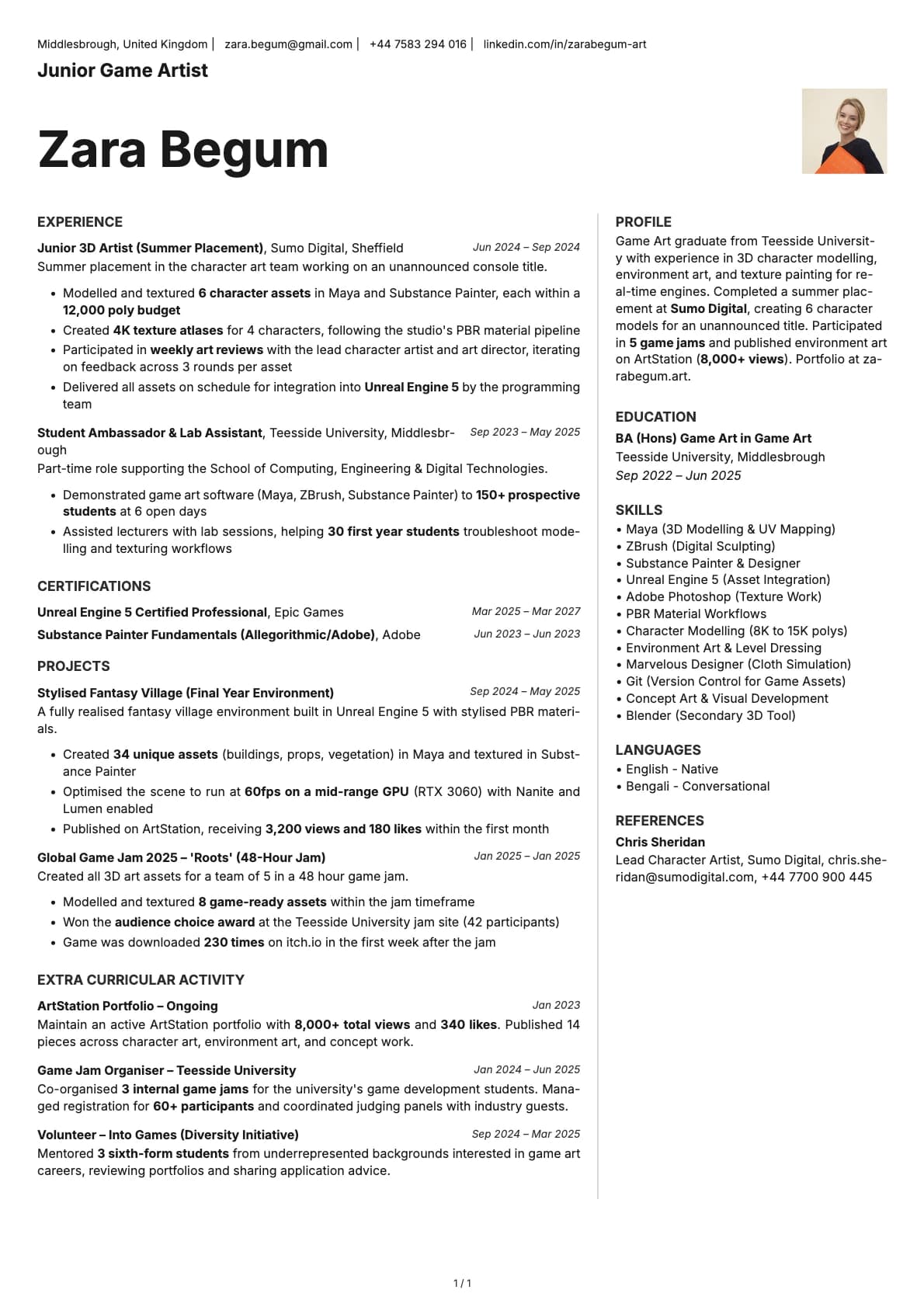
Junior Game Artist
A junior game artist resume example with 3D character models, game jam entries, and portfolio highlights from a Game Art BA graduate breaking into the industry.
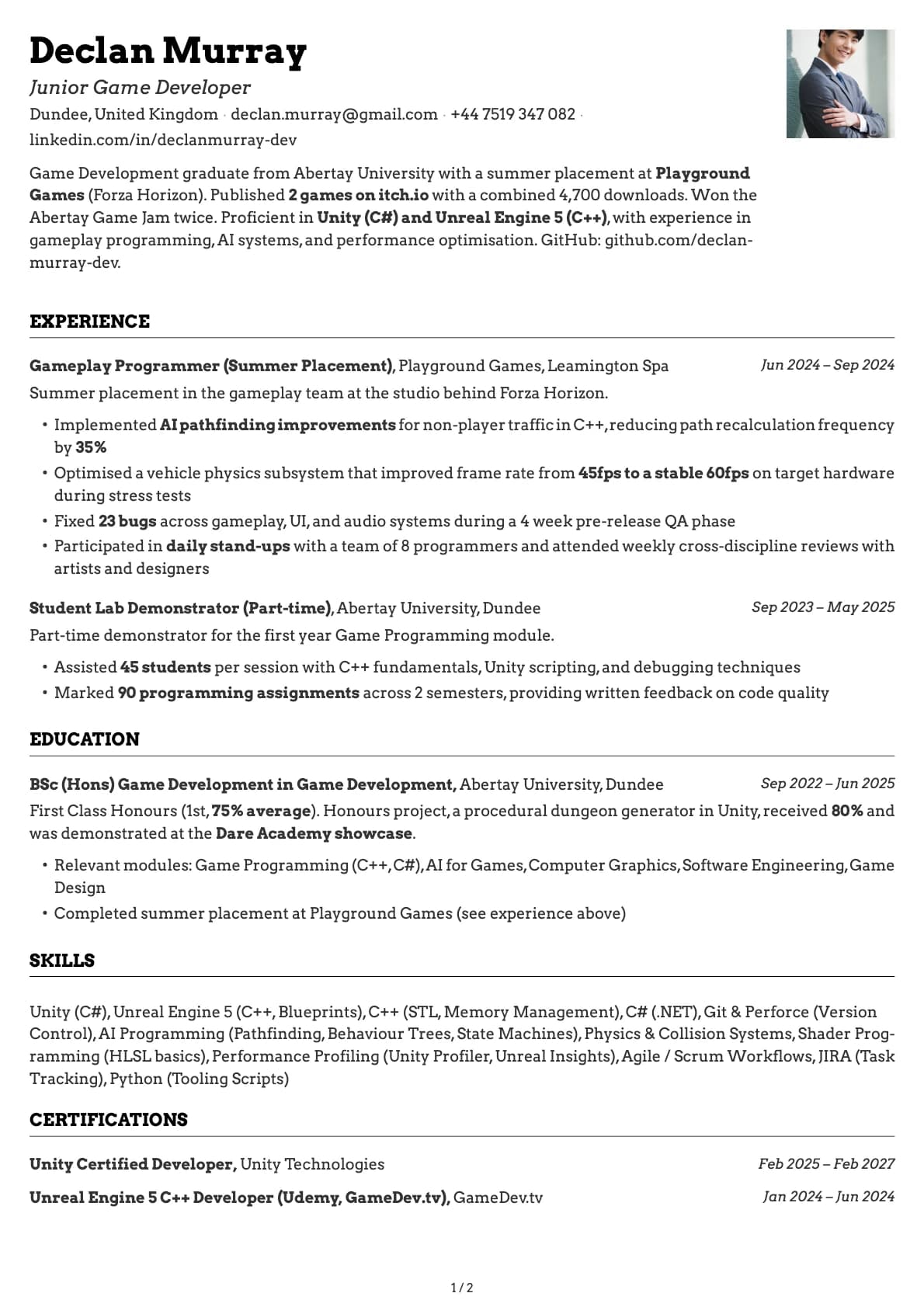
Junior Game Developer
A junior game developer resume example with Unity projects, published games, and game jam wins from a Game Development BSc graduate entering the games industry.
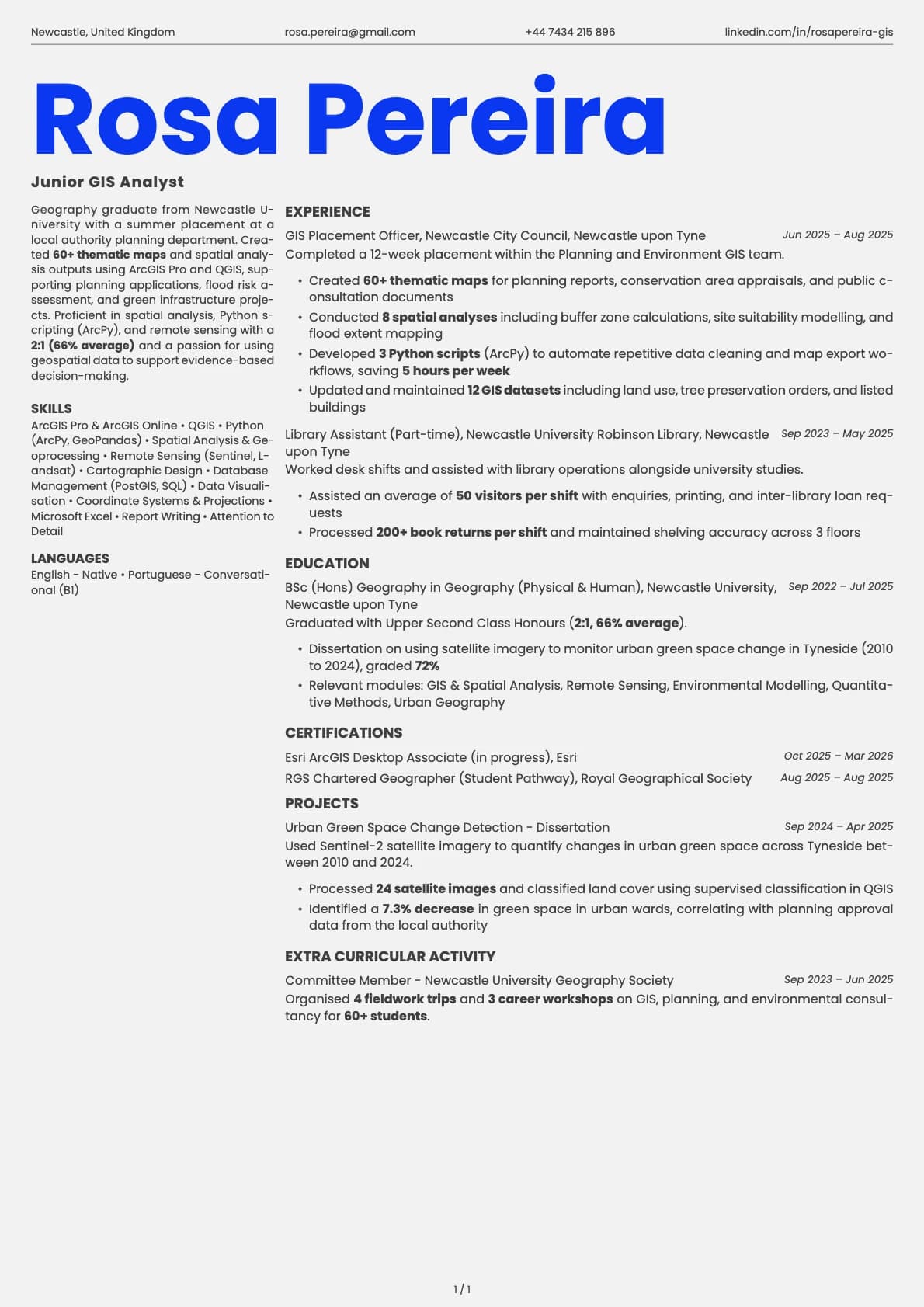
Junior GIS Analyst
A junior GIS analyst resume example with local authority placement experience, spatial analysis, and Python scripting skills for geography graduates.
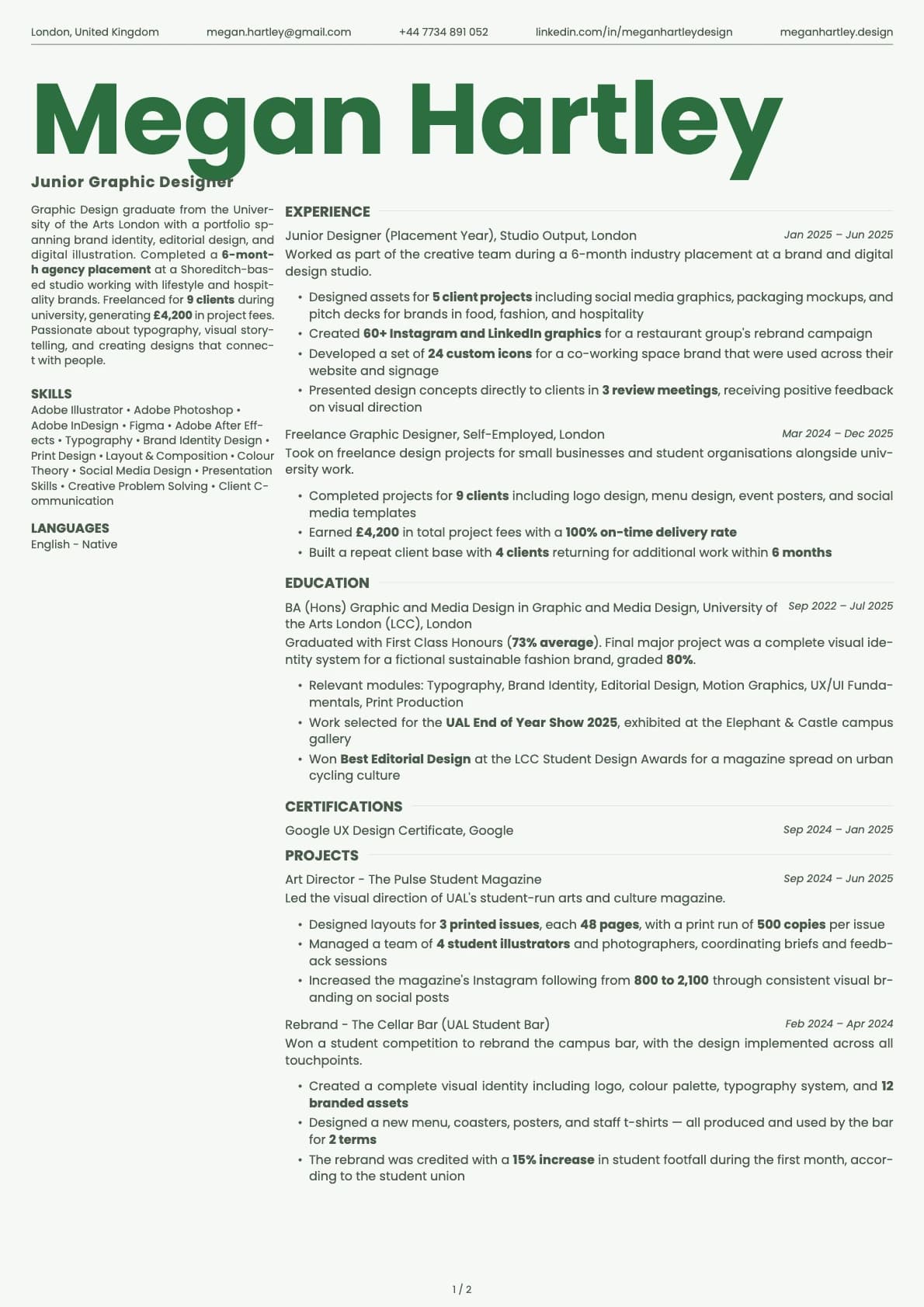
Junior Graphic Designer
A junior graphic designer resume example for recent graduates. Learn how to present your portfolio, design tools, and freelance work to land your first design role.
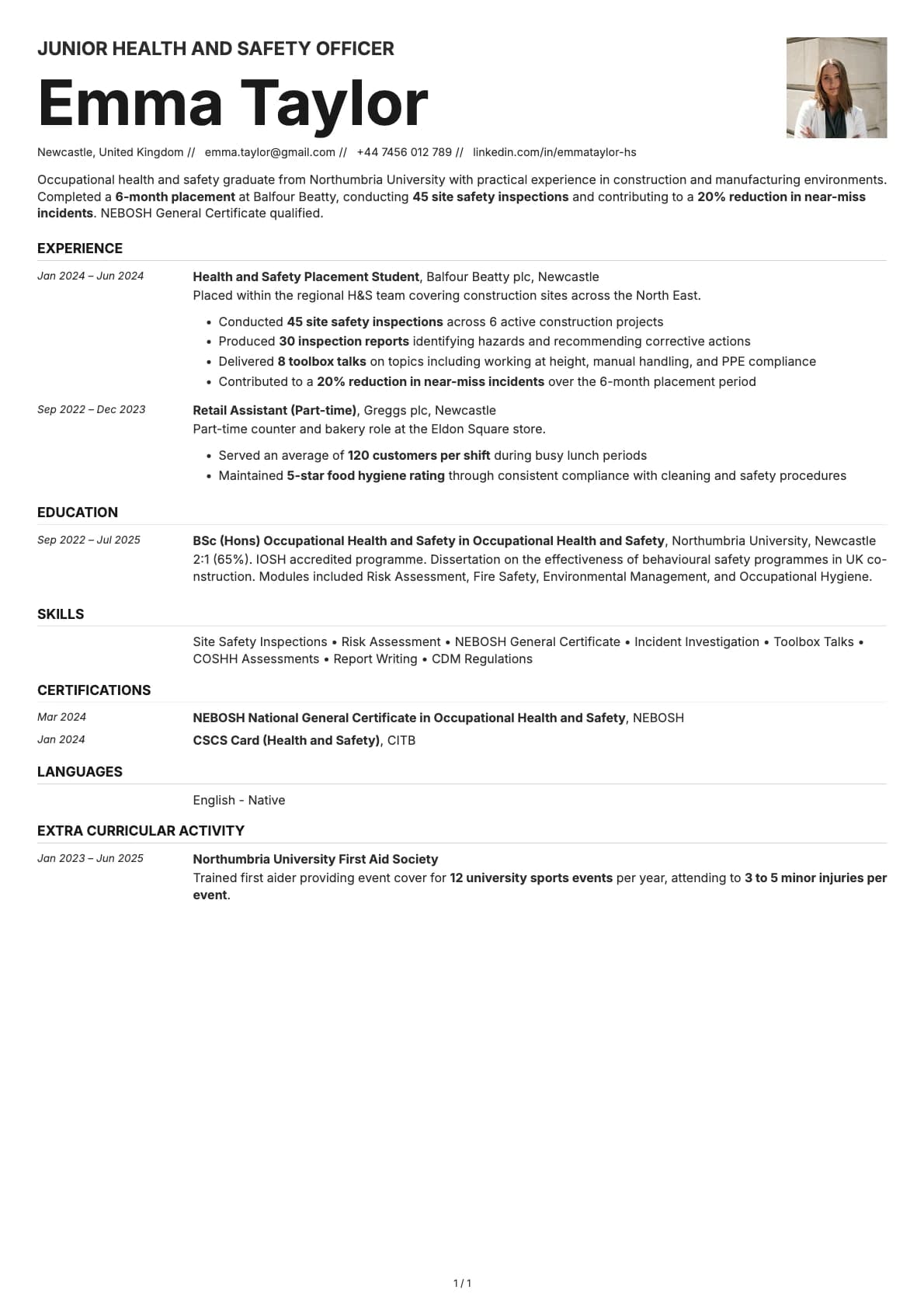
Junior Health and Safety Officer
A junior health and safety officer resume example with Balfour Beatty placement and NEBOSH qualification.
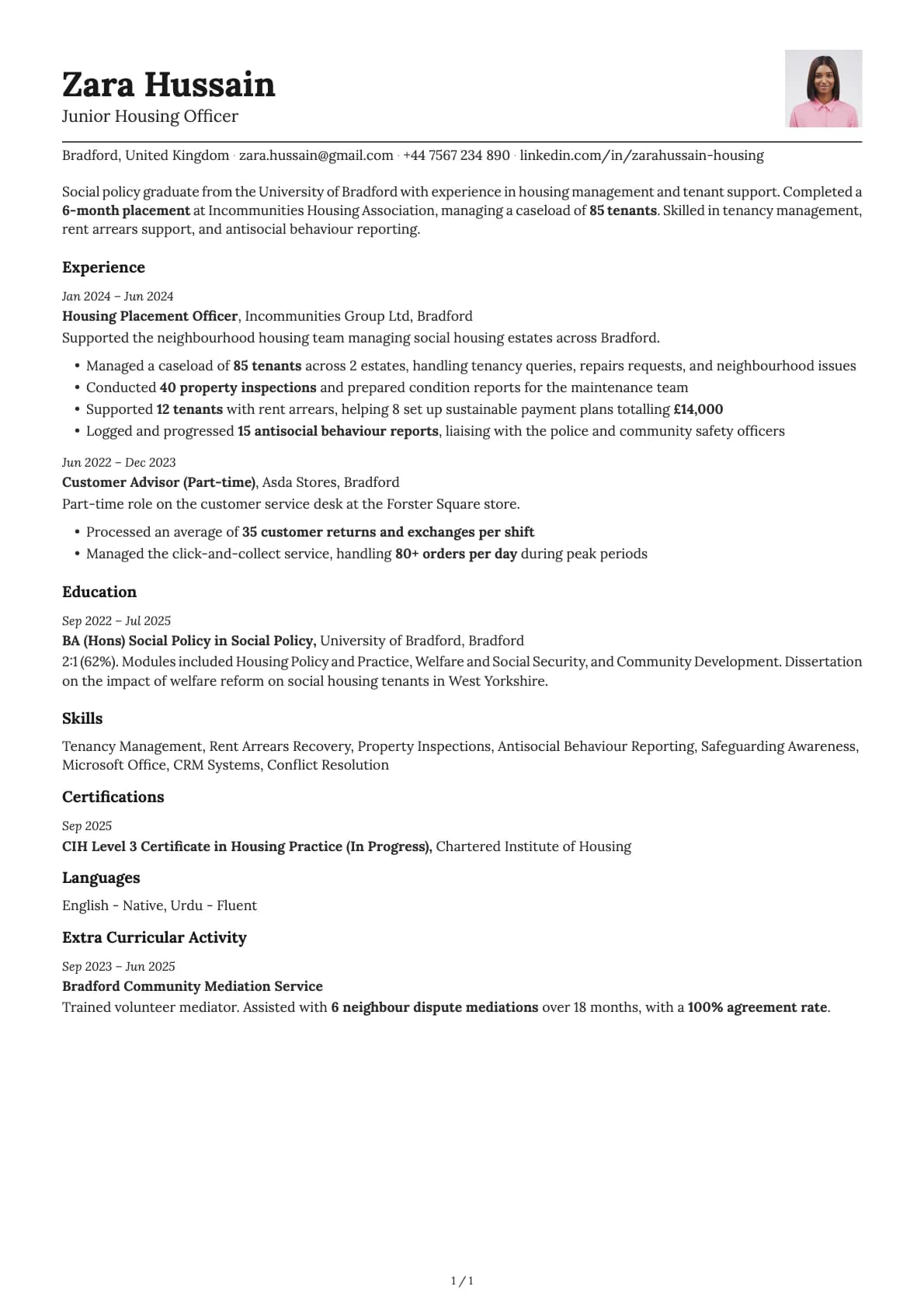
Junior Housing Officer
A junior housing officer resume example with housing association placement and tenant management experience.
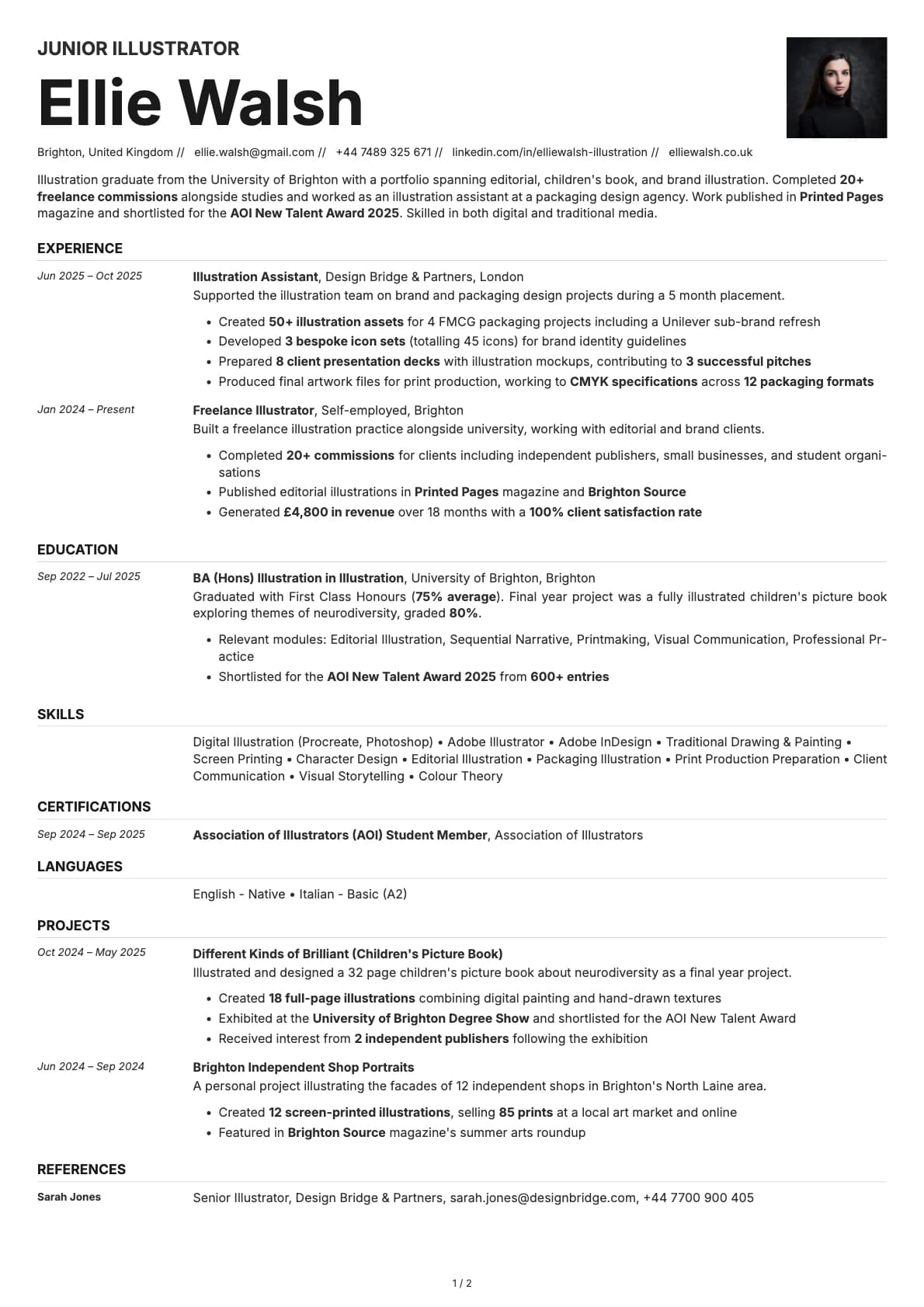
Junior Illustrator
A junior illustrator resume example for graduates. See how to present freelance commissions, agency experience, and published work to land your first illustration role.
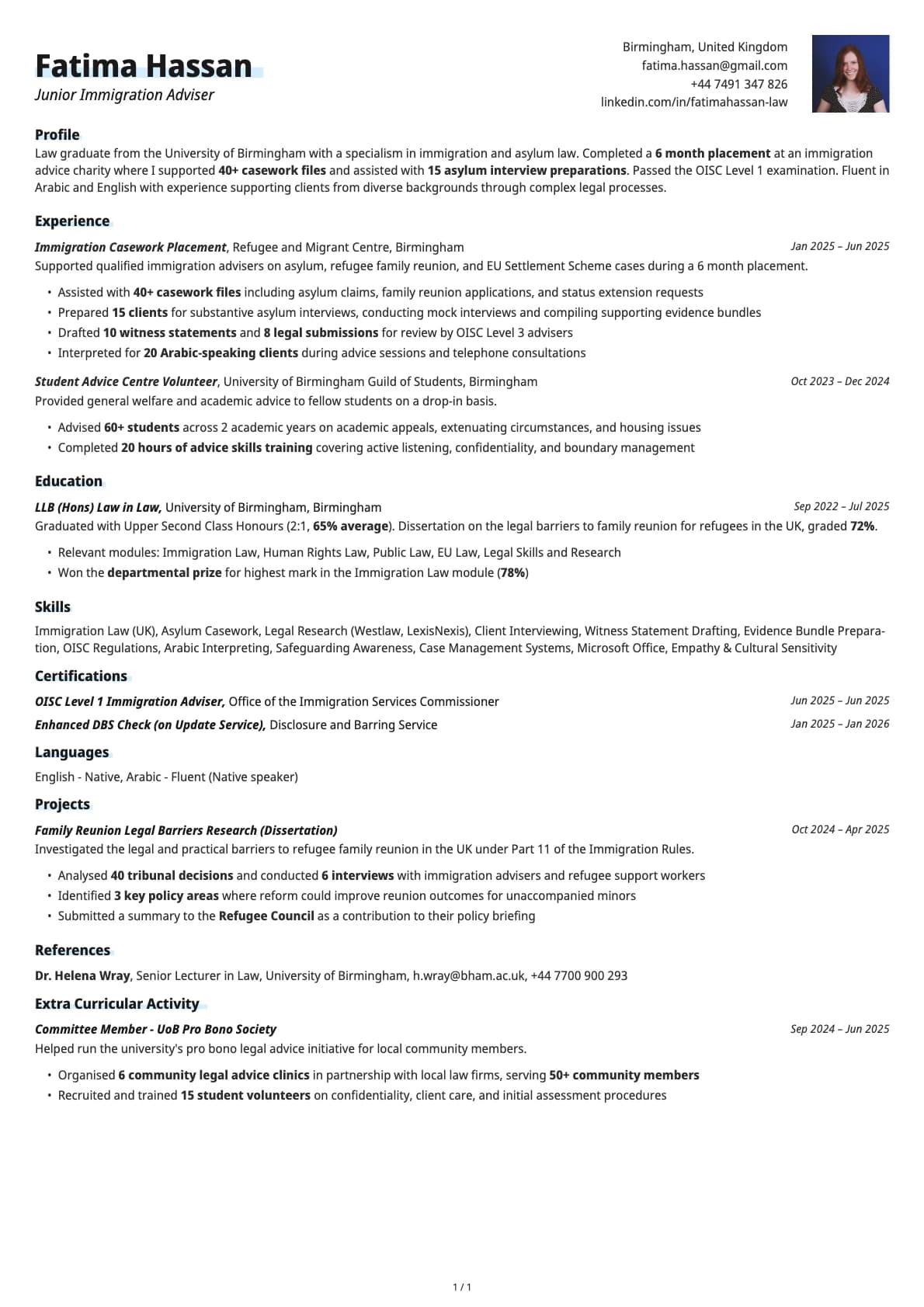
Junior Immigration Adviser
A junior immigration adviser resume example for law graduates. See how to present asylum casework, OISC qualification, and client support experience to land your first immigration advisory role.
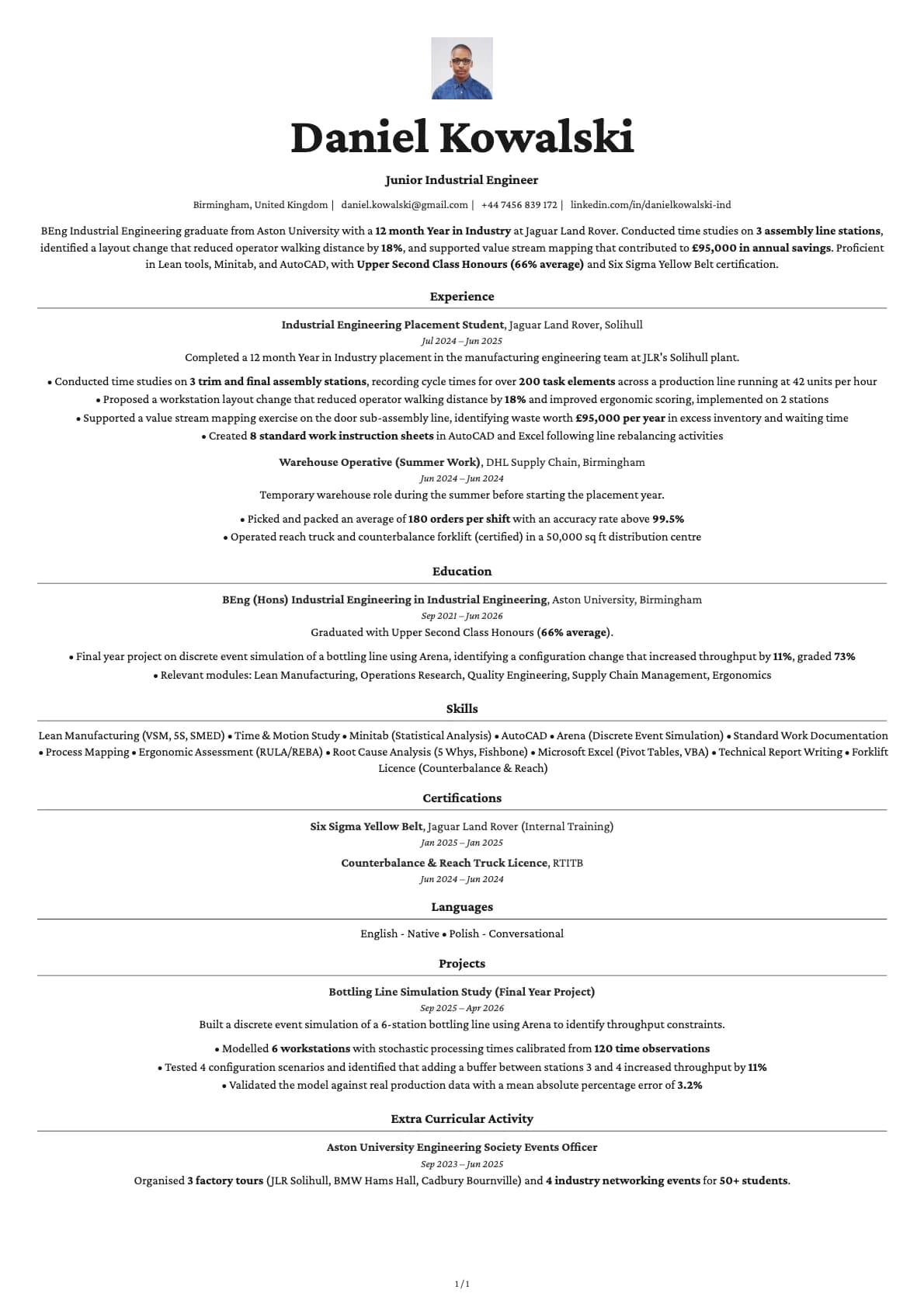
Junior Industrial Engineer
A junior industrial engineer resume example with lean manufacturing placement experience, time study skills, and Six Sigma Yellow Belt.
Junior Interior Designer
A junior interior designer resume example for graduates. Learn how to present studio placement experience, CAD skills, and design awards to land your first interior design role.