Trainee HVAC Technician Resume Example
A trainee HVAC technician resume example for graduates entering the heating, ventilation, and air conditioning trade. See how to present your F-Gas certification and refrigeration skills.

Laddro Team
Free to use. No account needed to start.
Free to use. No account needed to start.
Overview
HVAC (heating, ventilation, and air conditioning) is one of the fastest growing sectors in UK building services. New energy efficiency regulations, the push toward heat pumps, and the growing demand for cooling in commercial buildings mean there are more trainee positions than qualified engineers to fill them. But the barrier to entry is specific qualifications: an F-Gas certificate, a refrigeration handling licence, and ideally a Level 2 or 3 qualification in refrigeration and air conditioning.
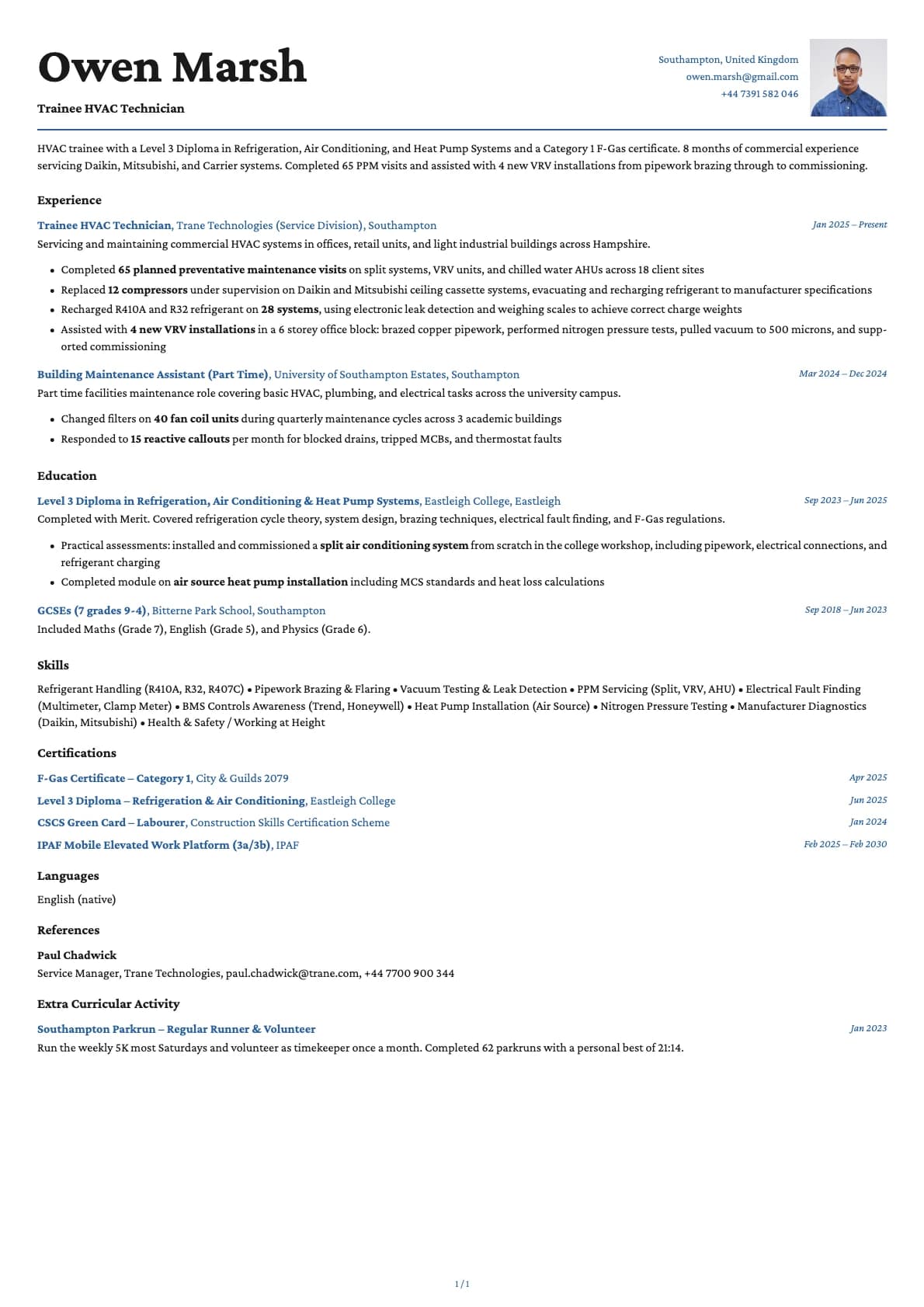
This resume belongs to Owen Marsh, who completed a Level 3 Diploma in Refrigeration, Air Conditioning, and Heat Pump Systems at Eastleigh College and holds a Category 1 F-Gas certificate. He has 8 months of experience with a commercial HVAC contractor, servicing split systems, VRV units, and chilled water plant in office buildings and retail units across Hampshire.
What Makes This Resume Work
The F-Gas certificate is prominent. Owen's Category 1 F-Gas certificate allows him to handle all quantities of fluorinated greenhouse gases. This is a legal requirement for anyone who installs, maintains, or services refrigeration and air conditioning equipment containing F-Gas refrigerants. Without it, he cannot touch the refrigerant circuit. By listing it in both his summary and certifications, he removes any doubt about his legal compliance.
Equipment types are named specifically. Rather than writing "serviced air conditioning units," Owen lists the specific systems he has worked on: Daikin VRV IV split systems, Mitsubishi Electric ceiling cassettes, Carrier chilled water AHUs, and Samsung DVM S heat recovery systems. HVAC employers recruit for brand familiarity because each manufacturer has different control systems, fault codes, and service procedures.
Service numbers give volume. Owen has completed 65 planned preventative maintenance (PPM) visits, replaced 12 compressors under supervision, and recharged refrigerant on 28 systems. He has also assisted with 4 new VRV installations from scratch, including pipework brazing, vacuum testing, and commissioning. These numbers show that he is not just watching; he is doing the work.
The heat pump experience is forward looking. Owen completed a module on air source heat pump installation and has assisted with 3 domestic ASHP installations. With the UK government pushing heat pumps through the Boiler Upgrade Scheme, this experience positions him for the growing residential market alongside his commercial HVAC skills.
Key Takeaways
Lead with your F-Gas certificate category. It is a legal requirement and the first thing HVAC employers check. Category 1 covers all equipment; Category 2 is limited.
Name the brands and system types you have worked on. Daikin, Mitsubishi, Carrier, Toshiba, Samsung. Brand experience matters in HVAC because training and diagnostic tools are manufacturer specific.
Include your PPM count, your commissioning experience, and any refrigerant handling you have done. The more specific your numbers, the easier it is for an employer to assess your readiness for independent work.
Build your own version
Open this layout in the builder and swap in your own details. It takes a few minutes.
Free to use. No account needed to start.
Was this resume example helpful?
Rate this example to help us create better content for you.
4.7 average from 76 ratingsRelated resume examples
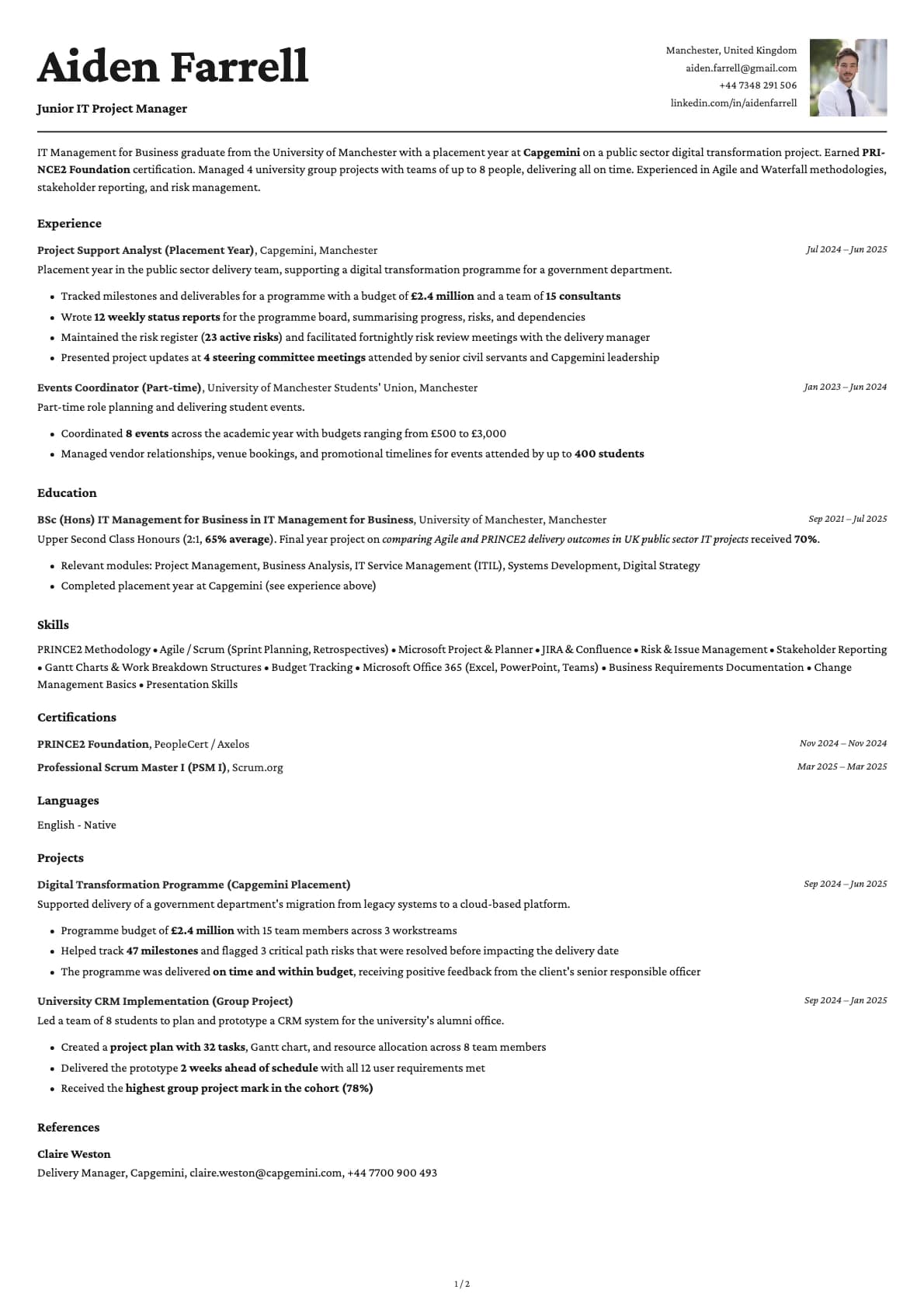
Junior IT Project Manager
A junior IT project manager resume example with agile delivery experience, stakeholder management, and PRINCE2 Foundation from an IT graduate entering project management.
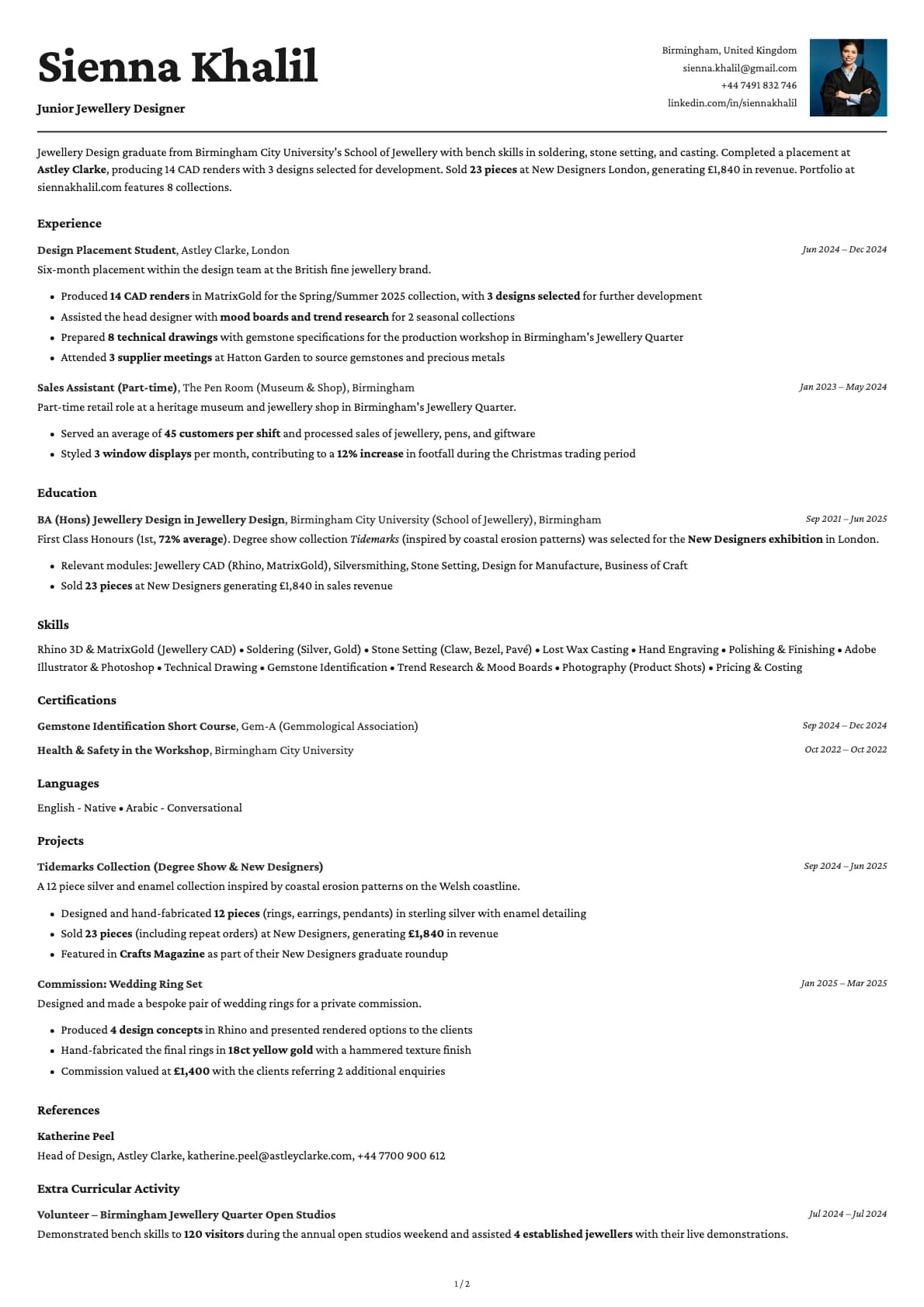
Junior Jewellery Designer
A junior jewellery designer resume example featuring CAD renders, bench skills, and collection launches from a Jewellery Design BA graduate entering the trade.
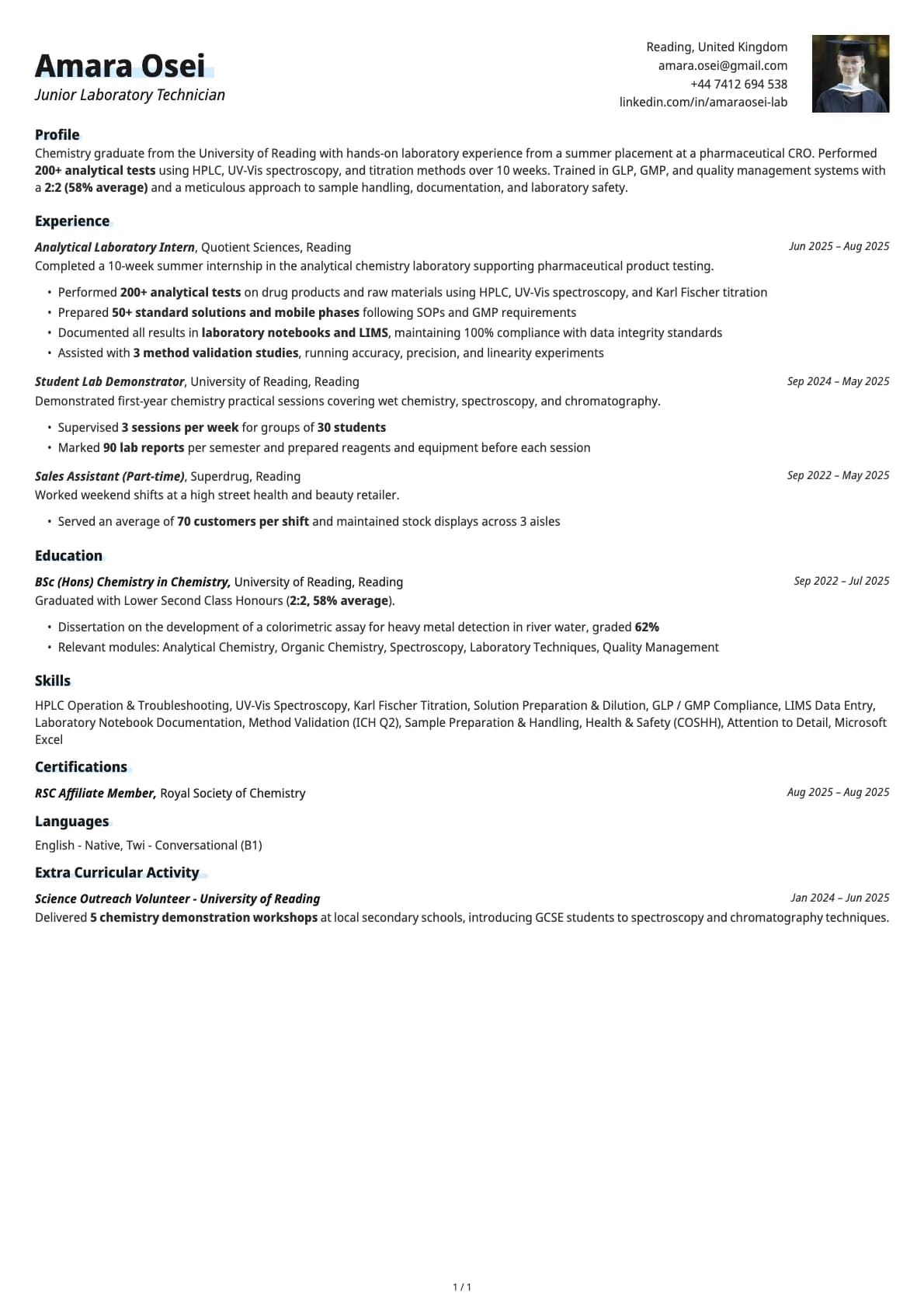
Junior Laboratory Technician
A junior lab technician resume example with pharmaceutical lab internship experience, HPLC skills, and GMP compliance for chemistry graduates.
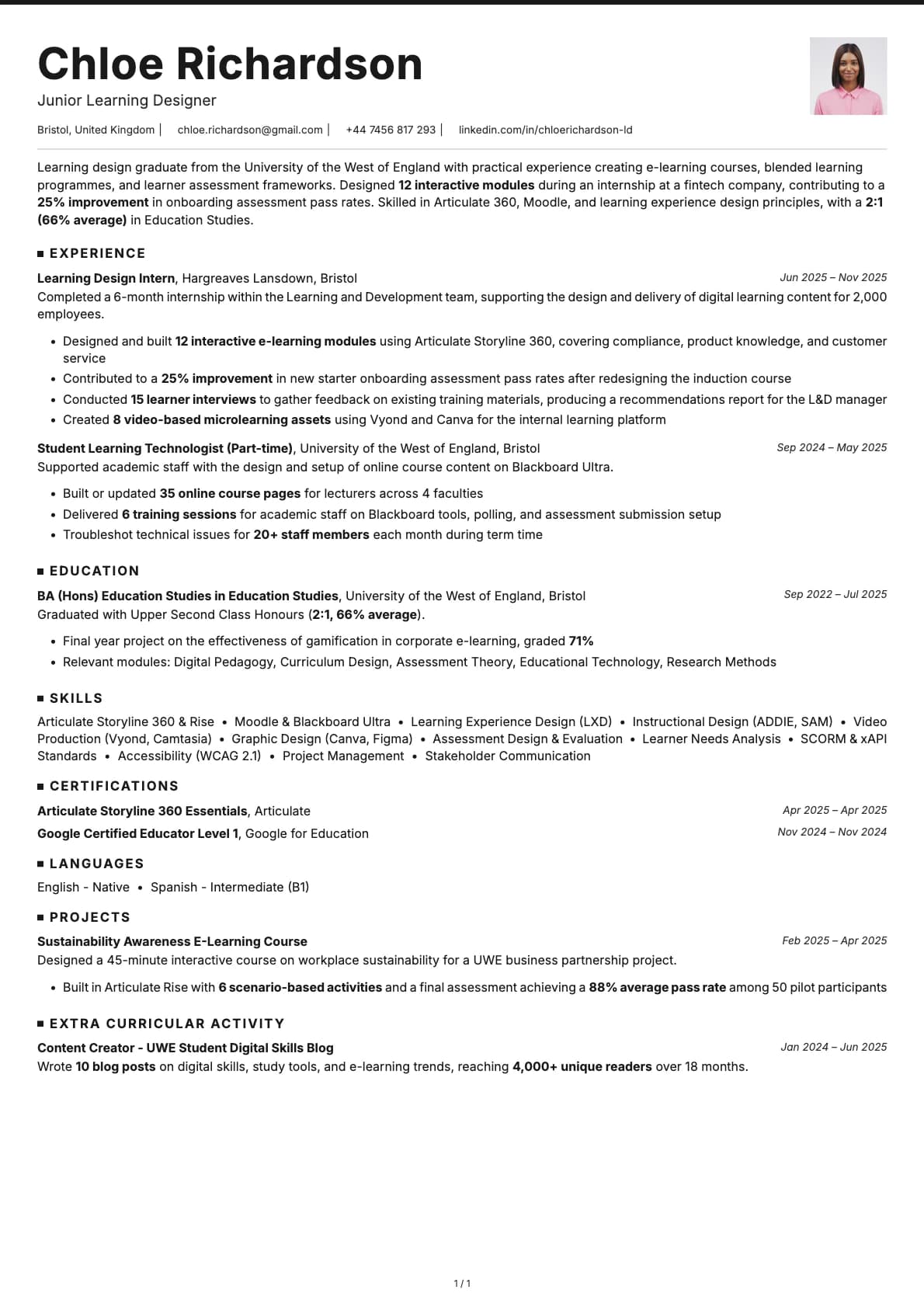
Junior Learning Designer
A junior learning designer resume example with e-learning module numbers, Articulate 360 skills, and corporate training experience for new graduates.
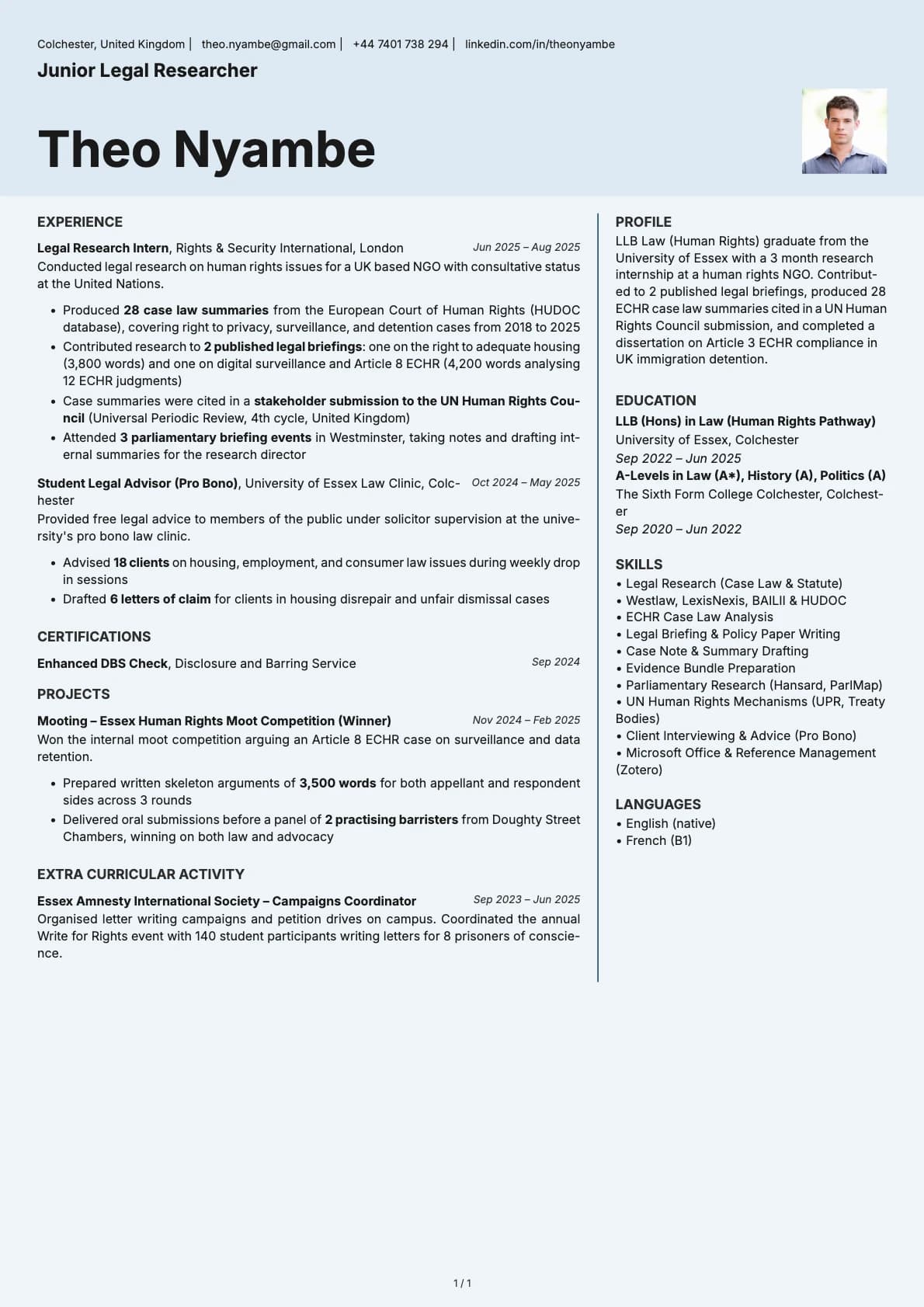
Junior Legal Researcher
A junior legal researcher resume example for human rights law LLB graduates. See how to present your legal research skills, case analysis experience, and advocacy work.
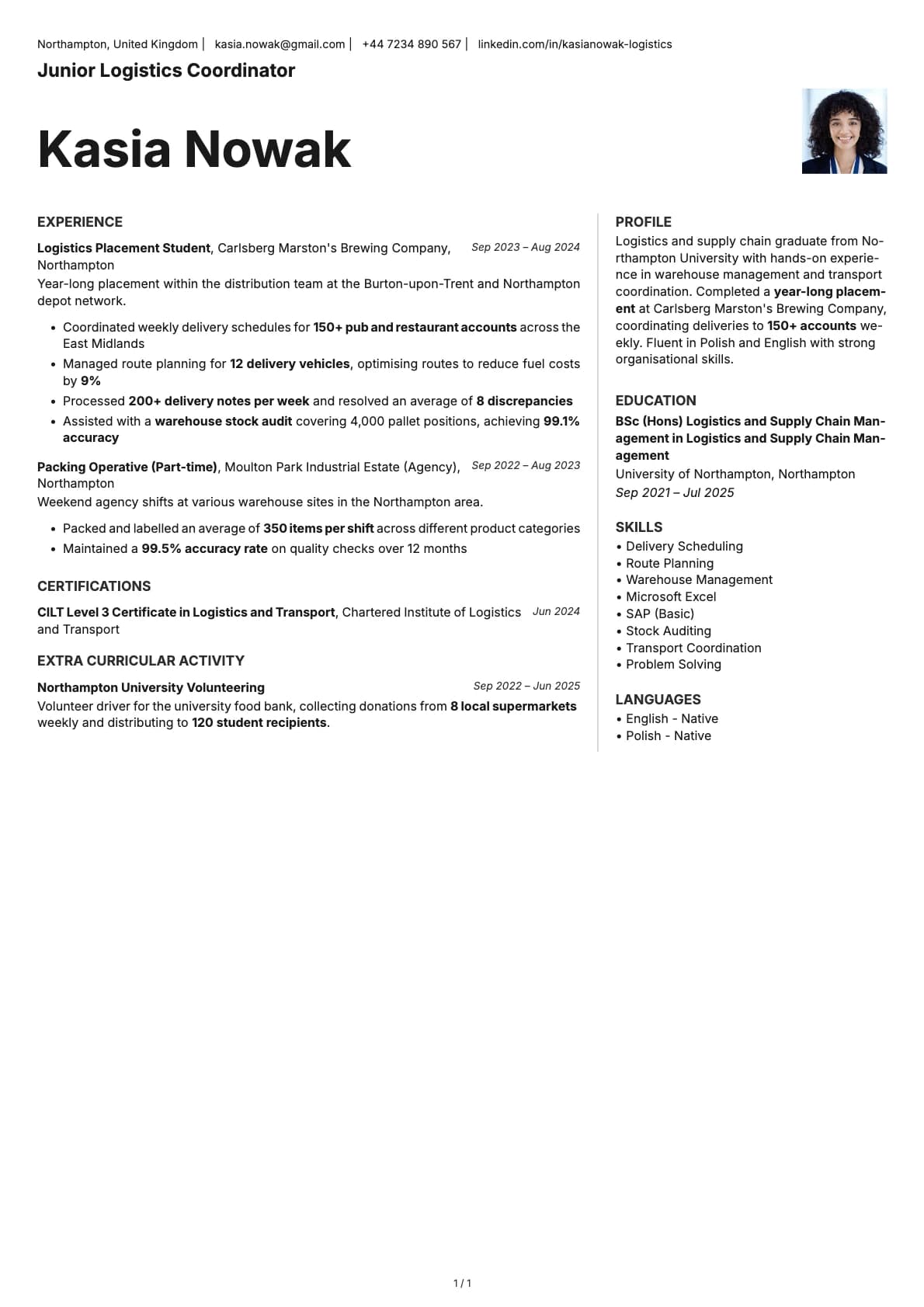
Junior Logistics Coordinator
A junior logistics coordinator resume example with brewery distribution placement and route planning experience.
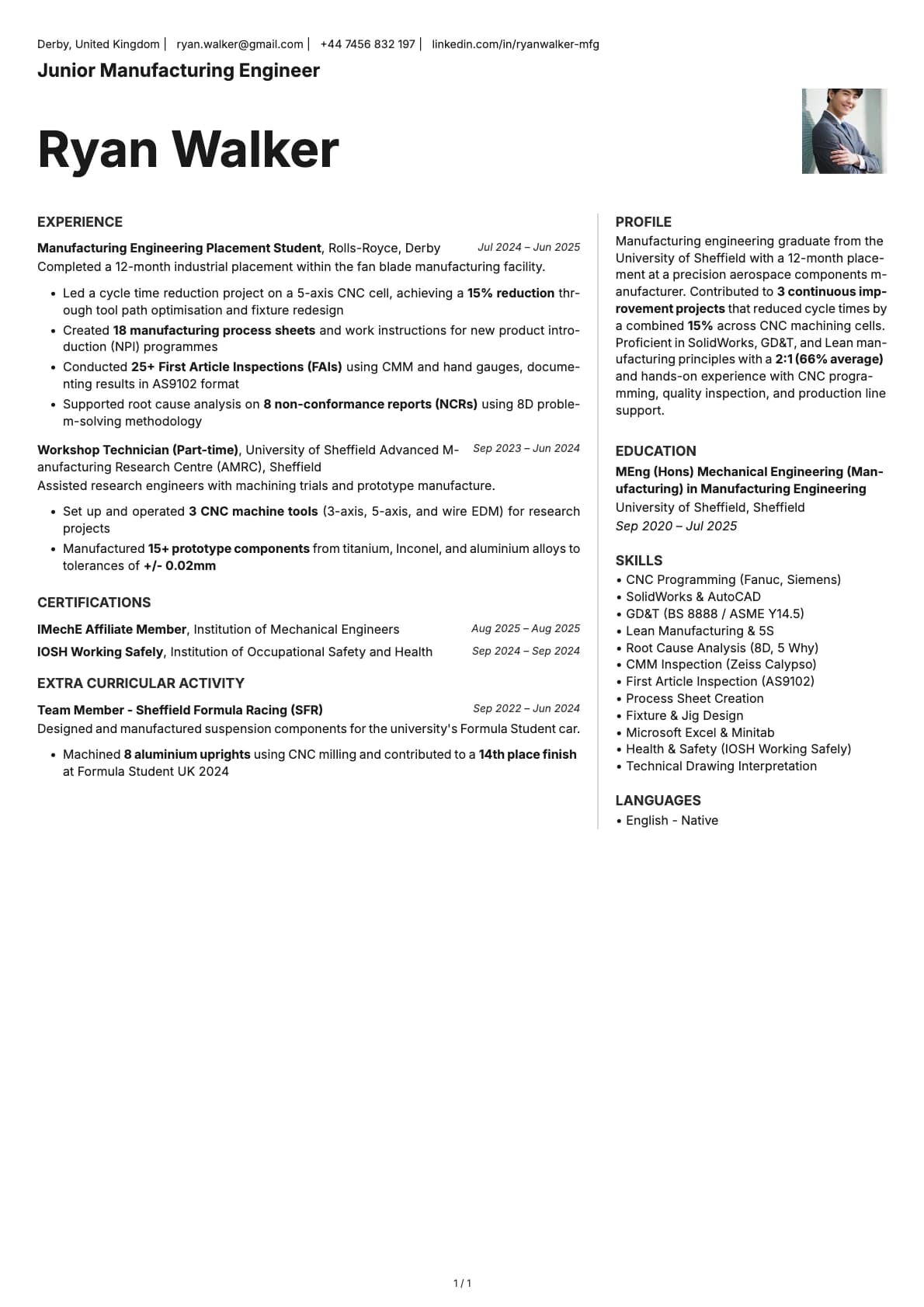
Junior Manufacturing Engineer
A junior manufacturing engineer resume example with aerospace placement experience, CNC skills, and cycle time reduction achievements.

Junior Marketing Coordinator
A junior marketing coordinator resume example for graduates entering the field. See how to turn retail work, volunteering, and a marketing degree into a strong application.
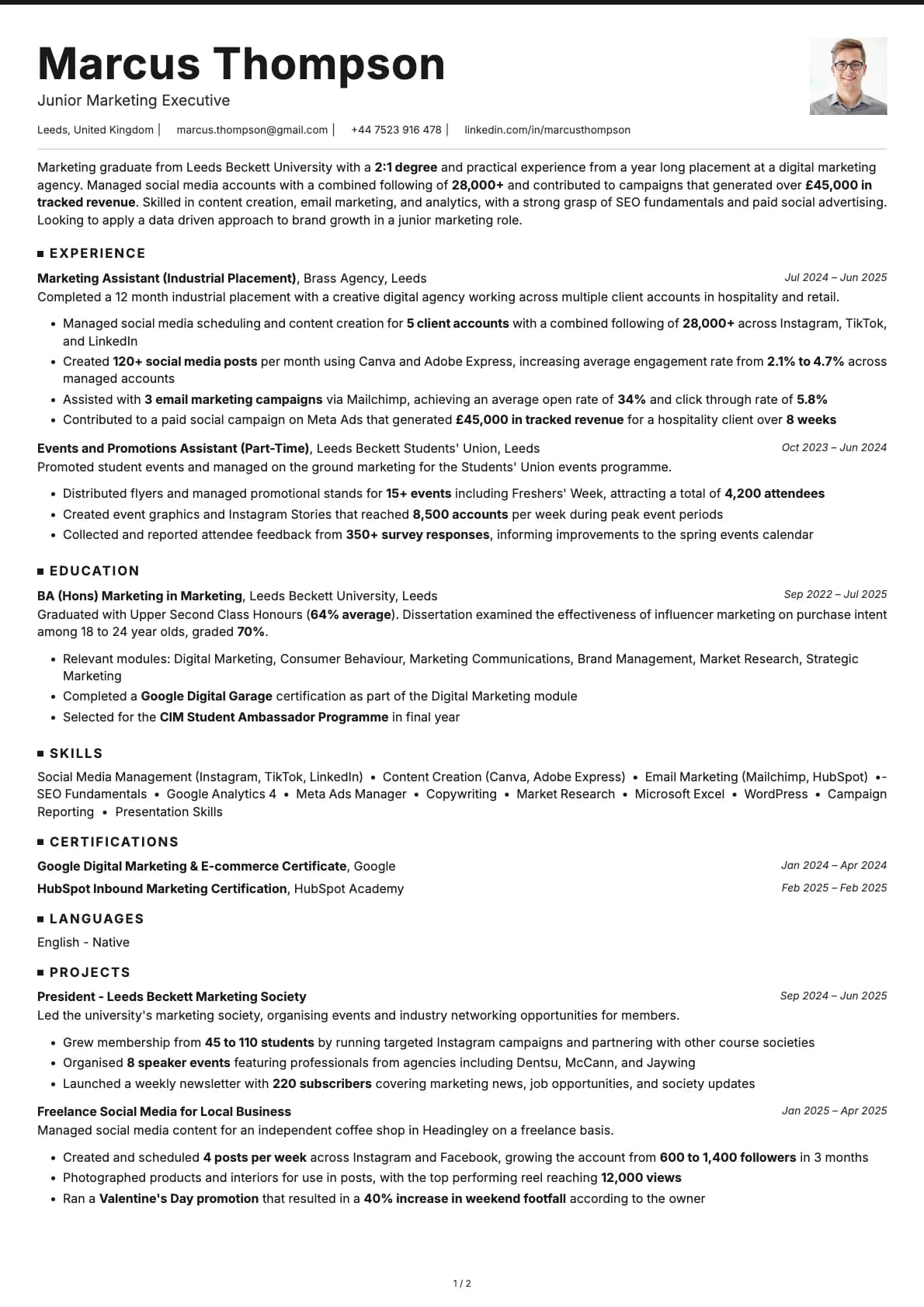
Junior Marketing Executive
A junior marketing executive resume example for recent graduates. See how to showcase social media skills, campaign results, and agency experience effectively.
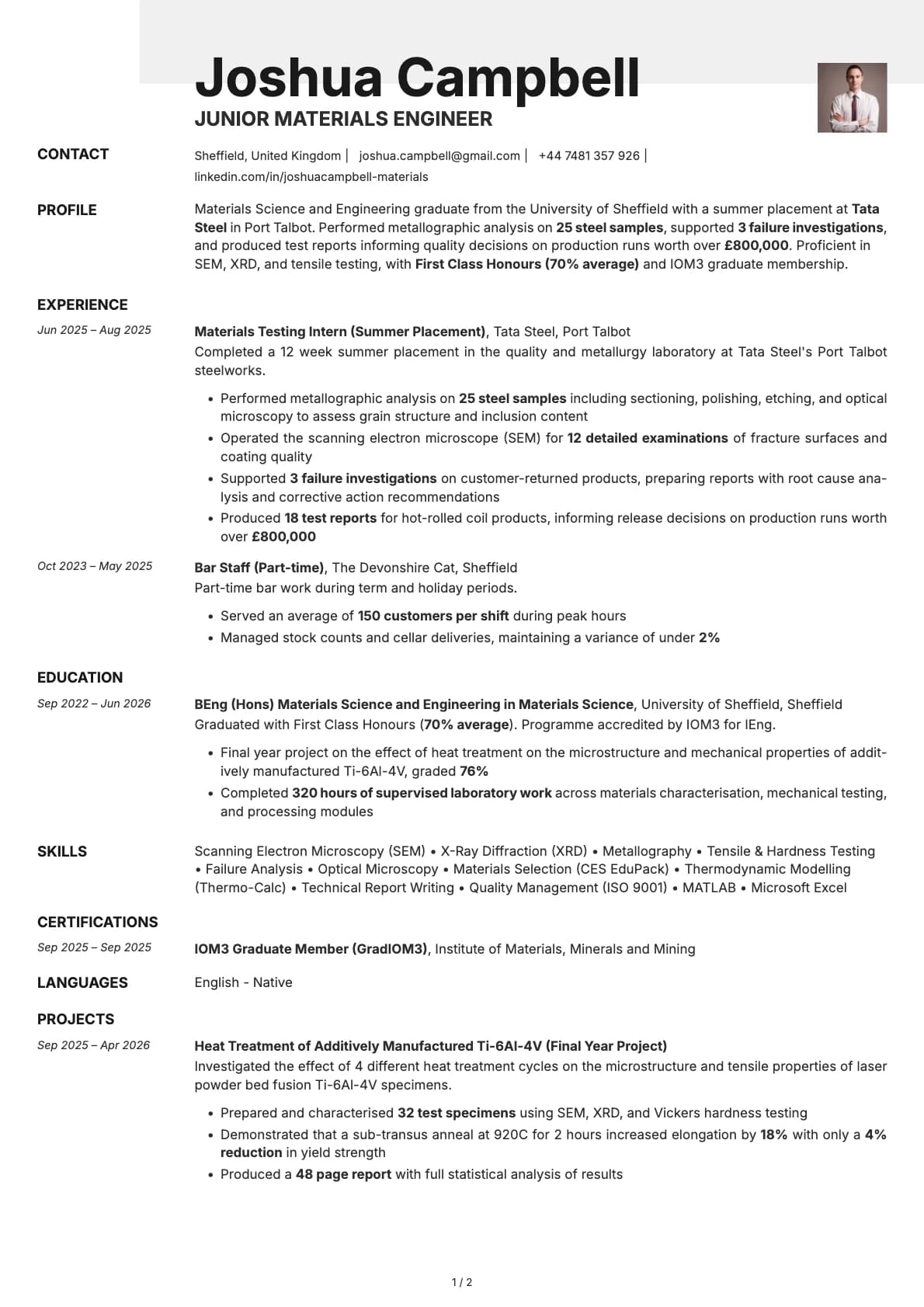
Junior Materials Engineer
A junior materials engineer resume example with metallurgical testing experience, SEM analysis skills, and IOM3 membership.

Junior Mechanical Engineer
A junior mechanical engineer resume example with a year in industry placement. See how to present CAD skills, FEA experience, and engineering projects on your graduate CV.
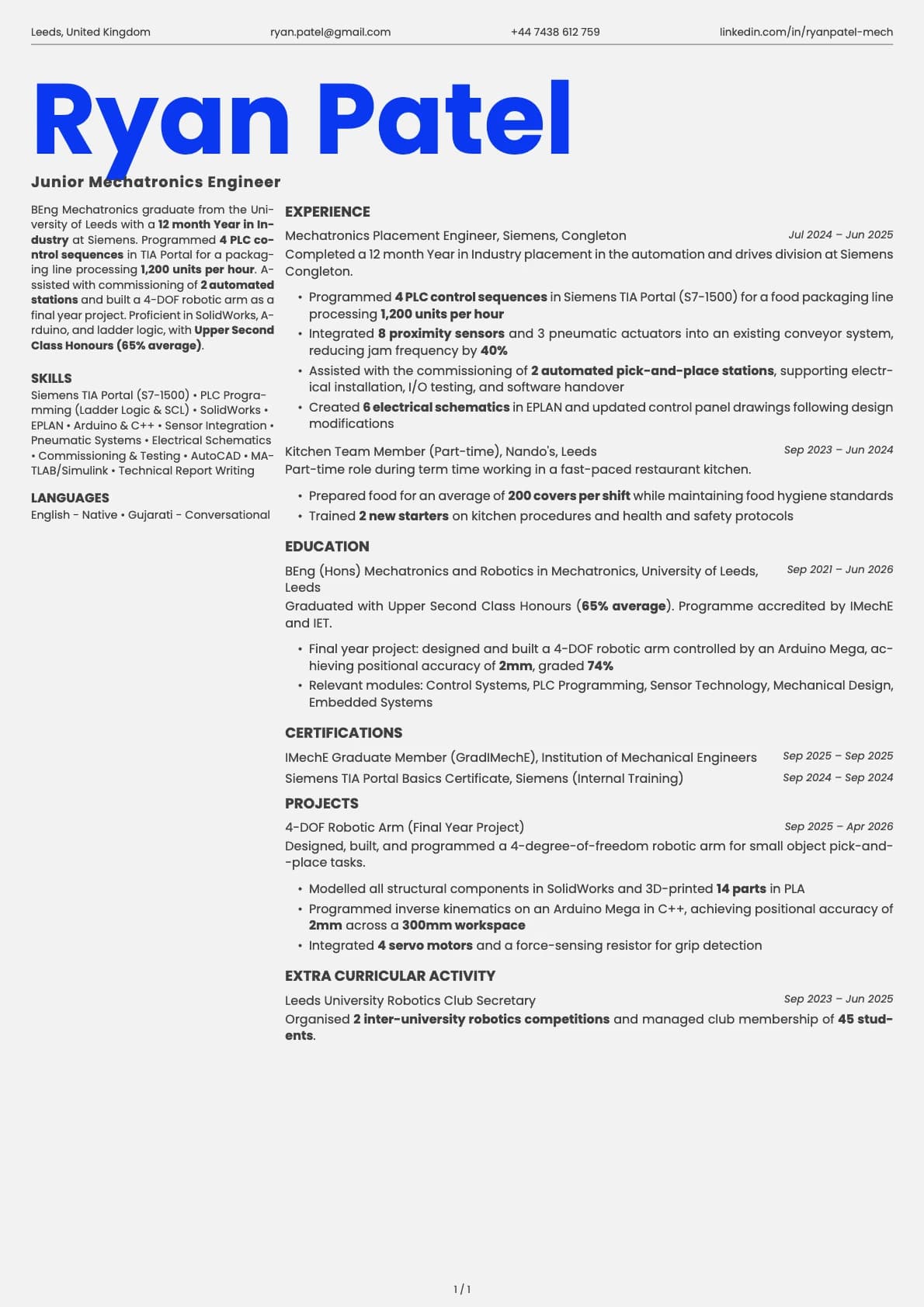
Junior Mechatronics Engineer
A junior mechatronics engineer resume example with PLC programming experience, SolidWorks proficiency, and an industrial automation placement.