Pre-registration Pharmacist Resume Example
A pre-registration pharmacist resume example showing how to present your MPharm degree, clinical placements, and GPhC registration progress for your foundation year role.

Laddro Team
Free to use. No account needed to start.
Free to use. No account needed to start.
Overview
The pre registration year is the bridge between four years of pharmacy theory and independent practice. Employers offering foundation training posts want to see that you understand the realities of dispensing, clinical checking, and patient counselling, not just the pharmacology behind them. Most MPharm graduates have identical modules on their transcripts. What separates strong candidates is evidence of practical experience and an understanding of how pharmacy works in the real world.
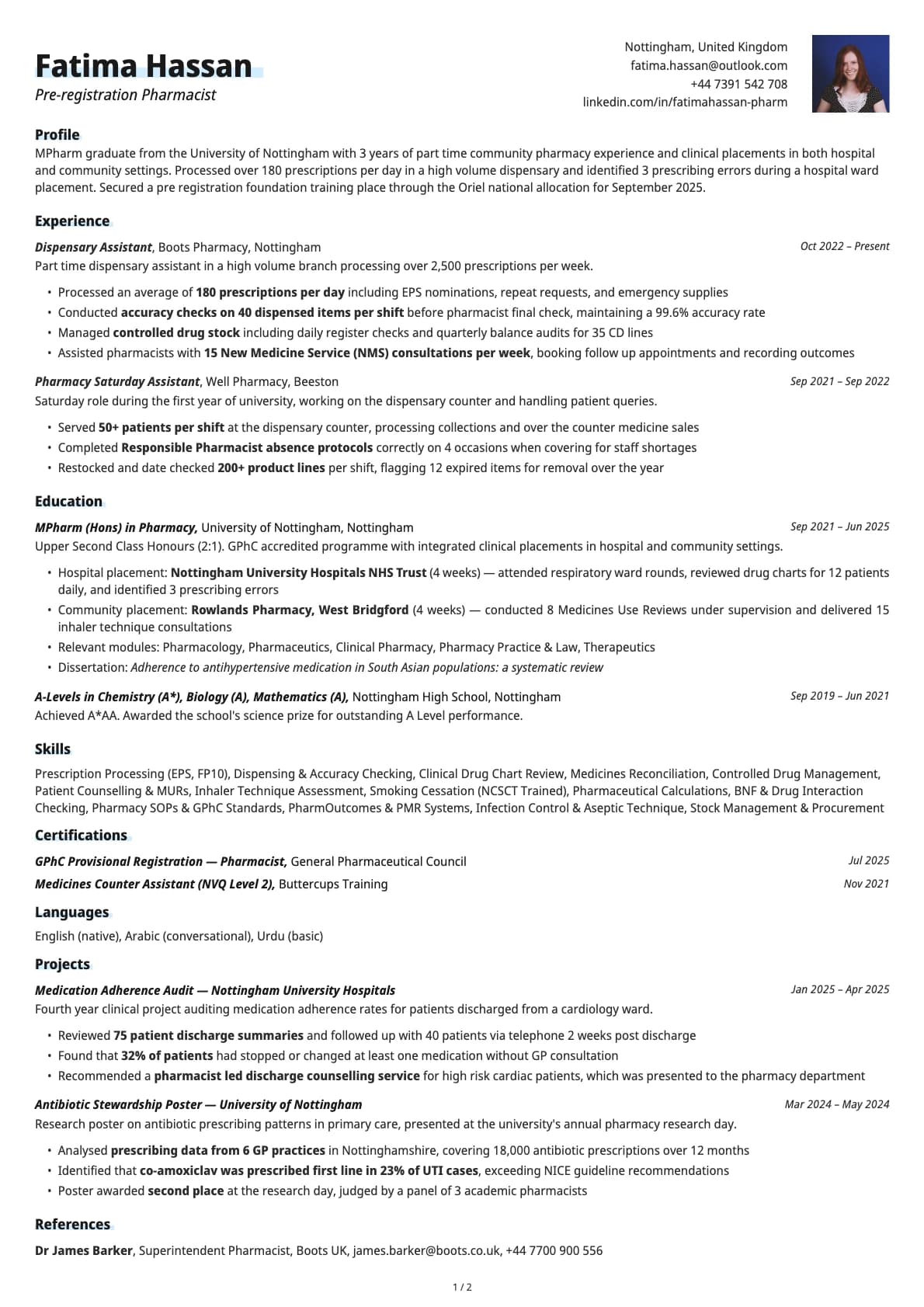
This resume belongs to Fatima Hassan, an MPharm graduate from the University of Nottingham applying for pre registration pharmacist positions. She completed placements in both hospital and community pharmacy settings and worked part time as a dispensary assistant throughout her degree. Her resume works because it bridges academic knowledge and hands on dispensing experience with real numbers.
What Makes This Resume Work
Dispensing experience is quantified. Fatima does not just say she worked in a pharmacy. She states she processed an average of 180 prescriptions per day in a busy community pharmacy and conducted accuracy checks on 40 dispensed items per shift. She also references her experience with the Electronic Prescription Service (EPS) and managed repeat prescription requests. These numbers tell a superintendent pharmacist exactly what volume of work she can handle.
Clinical placements include specific contributions. During her hospital placement at Nottingham University Hospitals NHS Trust, she attended ward rounds on a respiratory ward, reviewed drug charts for 12 patients, and identified 3 prescribing errors that were corrected before administration. These are not extraordinary achievements. They are the normal work of a pharmacy student on placement. But naming them shows she engaged actively rather than simply observing.
Patient facing skills are highlighted. She describes conducting 8 Medicines Use Reviews (MURs) under supervision, delivering inhaler technique consultations for 15 patients with COPD and asthma, and providing smoking cessation advice using the NCSCT framework. Patient facing pharmacy is expanding rapidly, and demonstrating these skills positions her well for modern foundation training.
GPhC registration progress is clear. She lists her MPharm degree, her provisional GPhC registration, and her upcoming foundation training start date. She also mentions passing the Oriel assessment and securing a training place through the national allocation scheme. This administrative detail matters because it confirms she is on track.
Key Takeaways
Quantify your dispensing and clinical checking experience. How many prescriptions per day? How many accuracy checks? How many prescribing errors did you identify? These numbers are the clearest way to demonstrate competence in a dispensary setting.
Describe your clinical placement contributions in specific terms. Drug chart reviews, ward round participation, medicines reconciliation, and error identification are all expected activities. State what you did, for how many patients, and in which clinical setting.
Include patient facing experience even if it was under supervision. MURs, inhaler technique checks, and smoking cessation consultations show you are comfortable talking to patients, which is increasingly important for pharmacists.
Build your own version
Open this layout in the builder and swap in your own details. It takes a few minutes.
Free to use. No account needed to start.
Was this resume example helpful?
Rate this example to help us create better content for you.
4.8 average from 97 ratingsRelated resume examples
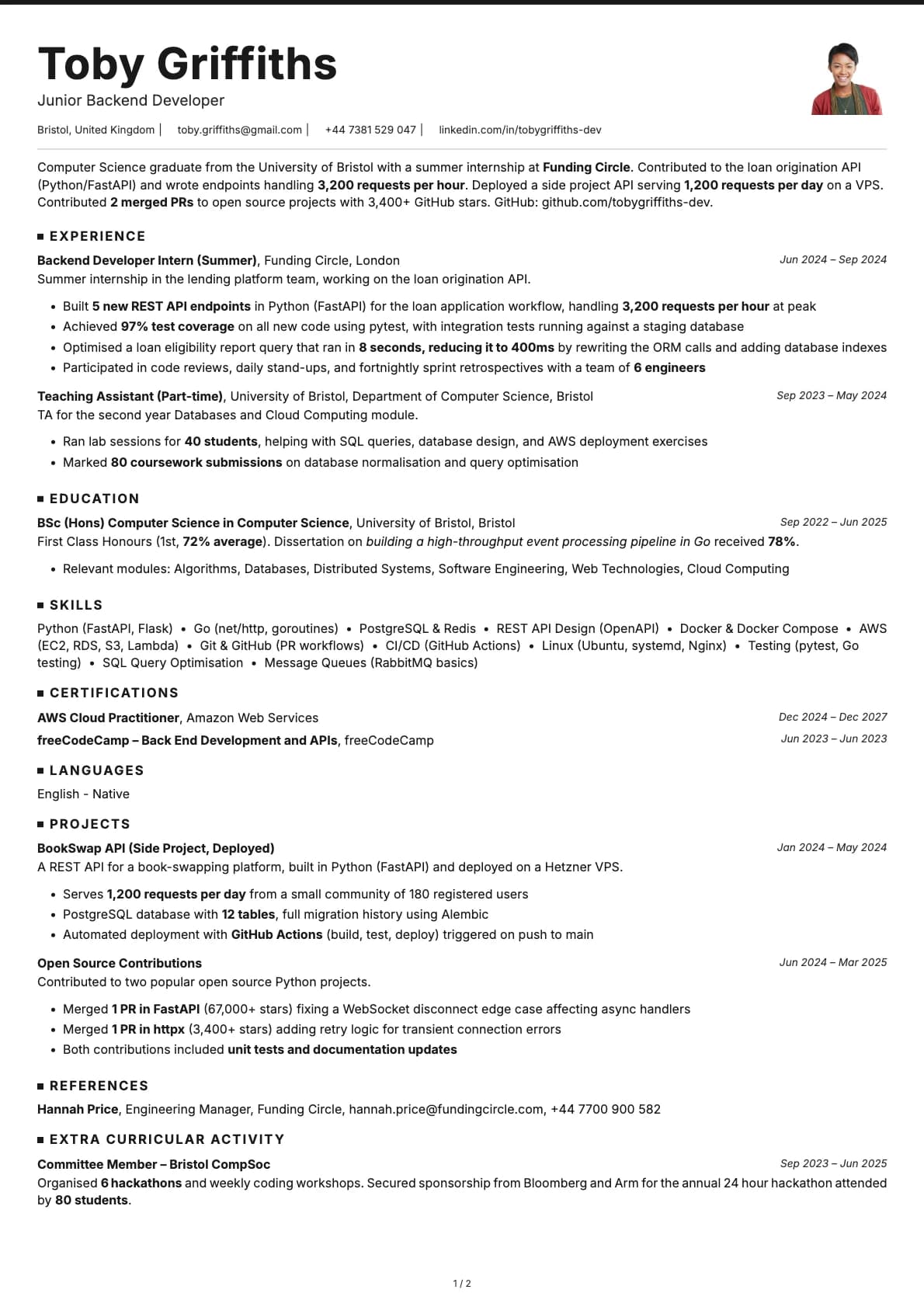
Junior Backend Developer
A junior backend developer resume example with REST API projects, PostgreSQL experience, and deployed services from a Computer Science BSc graduate entering development.
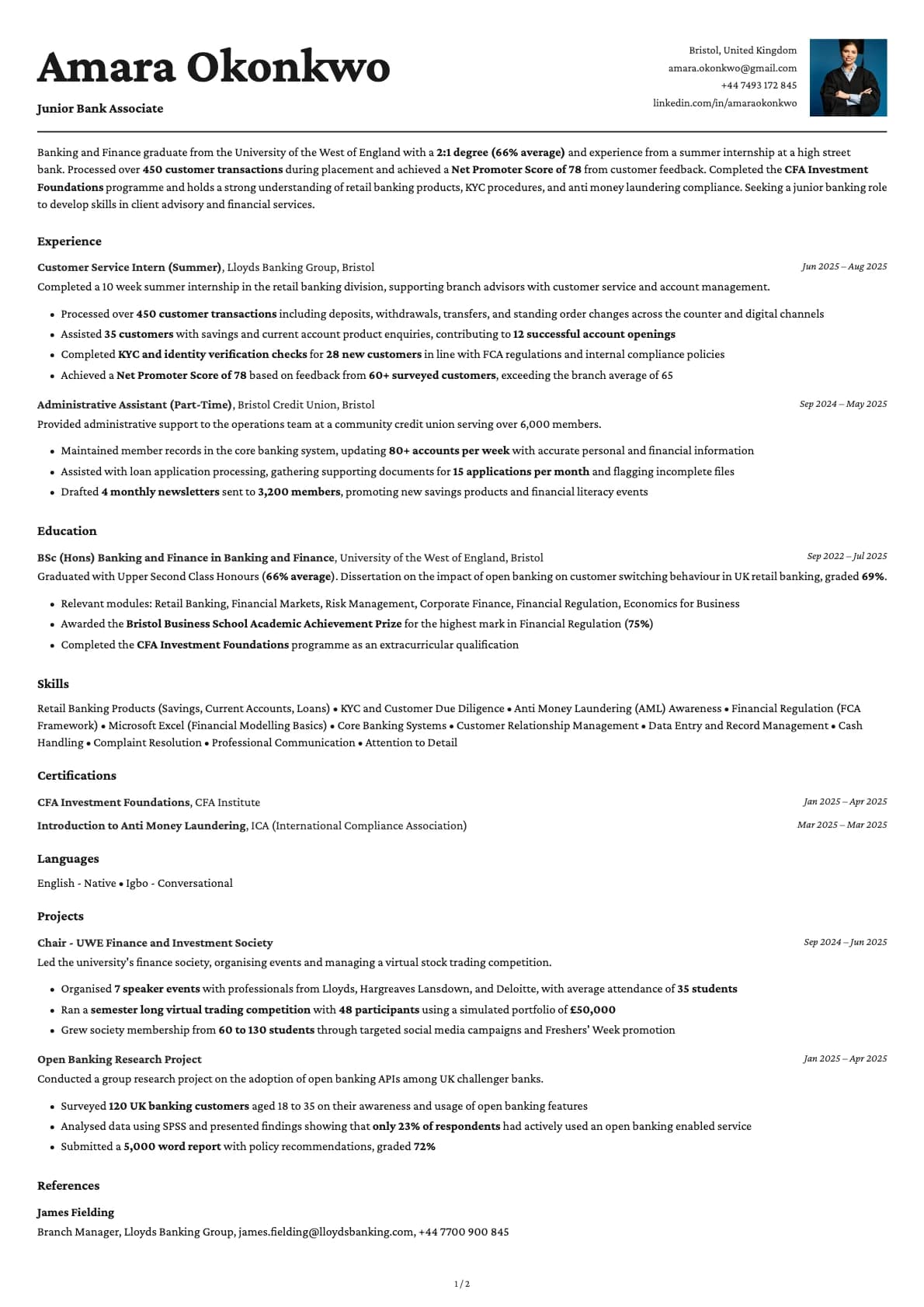
Junior Bank Associate
A junior bank associate resume example for banking graduates. See how to present your compliance knowledge, customer service skills, and internship experience.
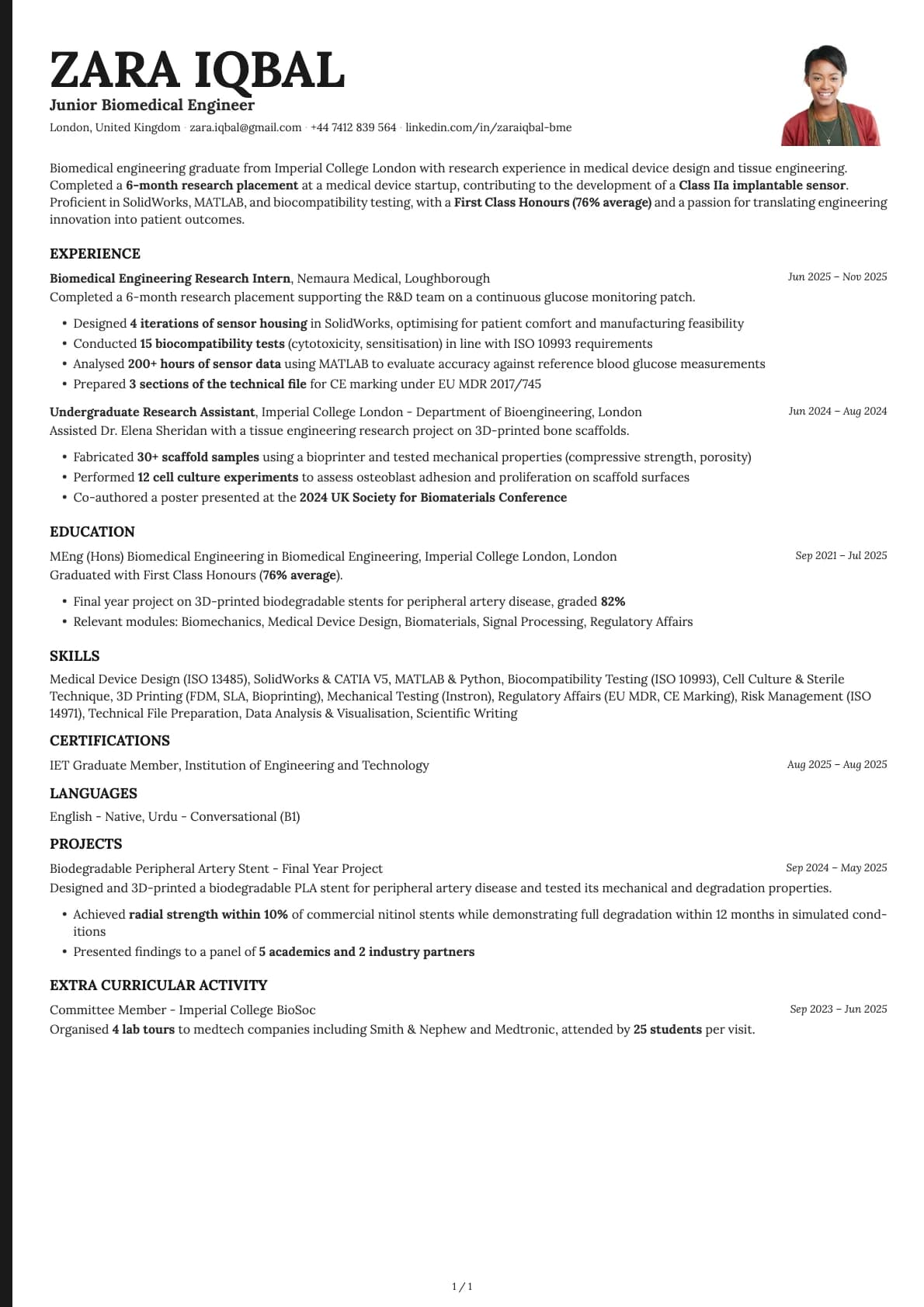
Junior Biomedical Engineer
A junior biomedical engineer resume example with medical device R&D experience, ISO standards knowledge, and research publications.
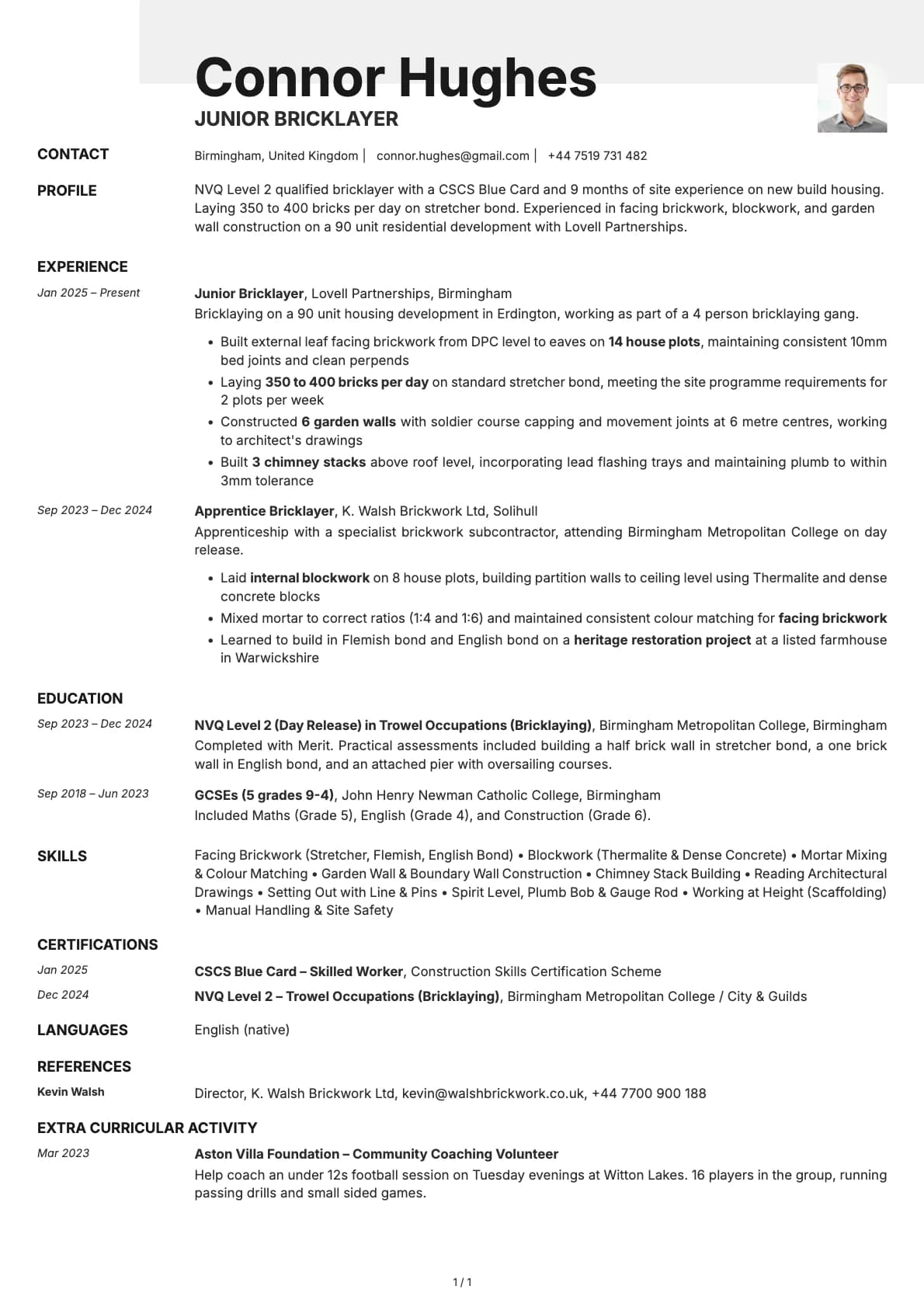
Junior Bricklayer
A junior bricklayer resume example for NVQ qualified bricklayers entering the trade. See how to present your bricklaying skills, CSCS card, and site experience.

Junior Business Analyst
A junior business analyst resume example for career changers. See how to use retail management and a business degree to break into business analysis.
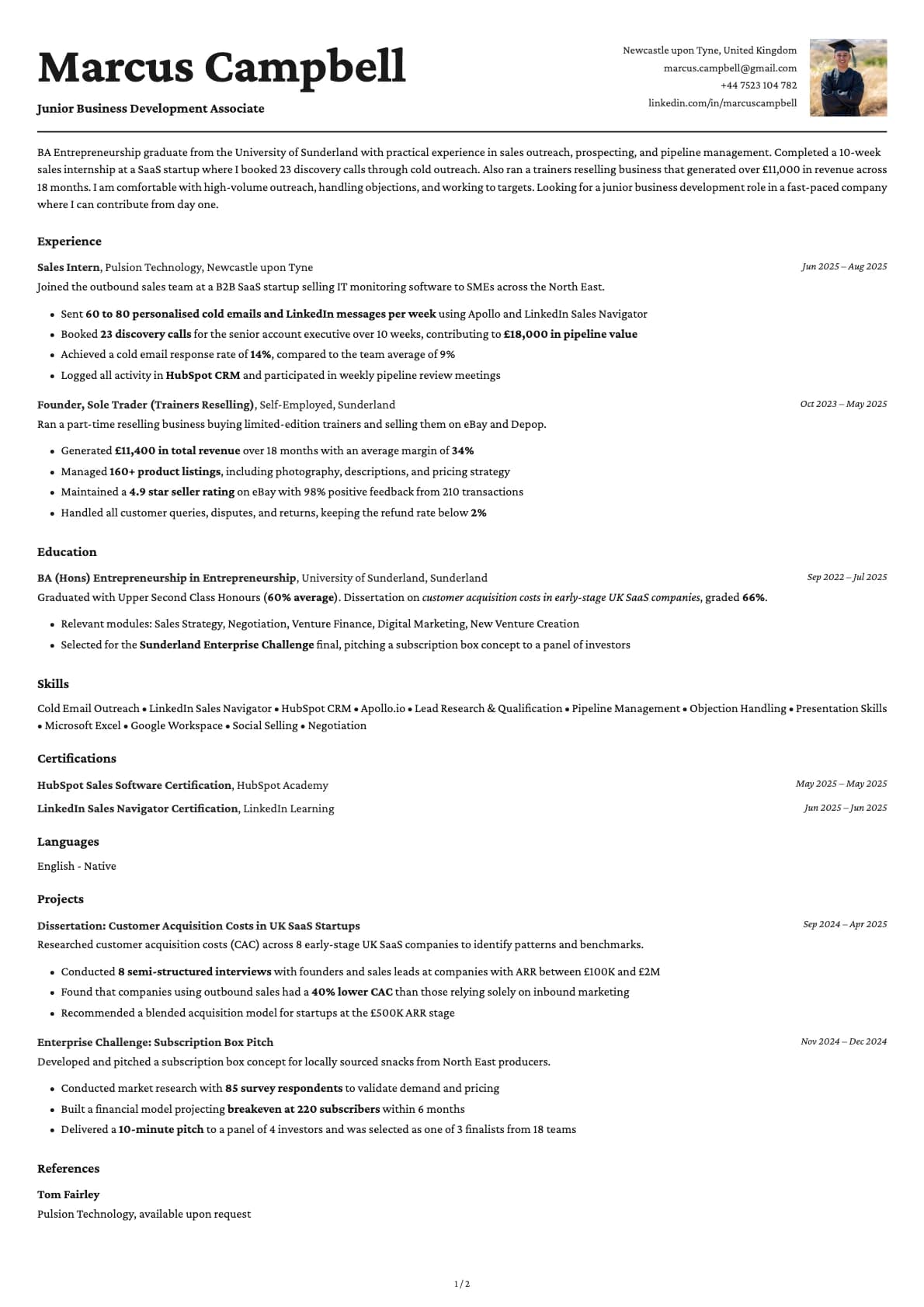
Junior Business Development Associate
A junior business development associate resume example for entrepreneurship graduates. See how cold outreach metrics and startup experience win interviews.
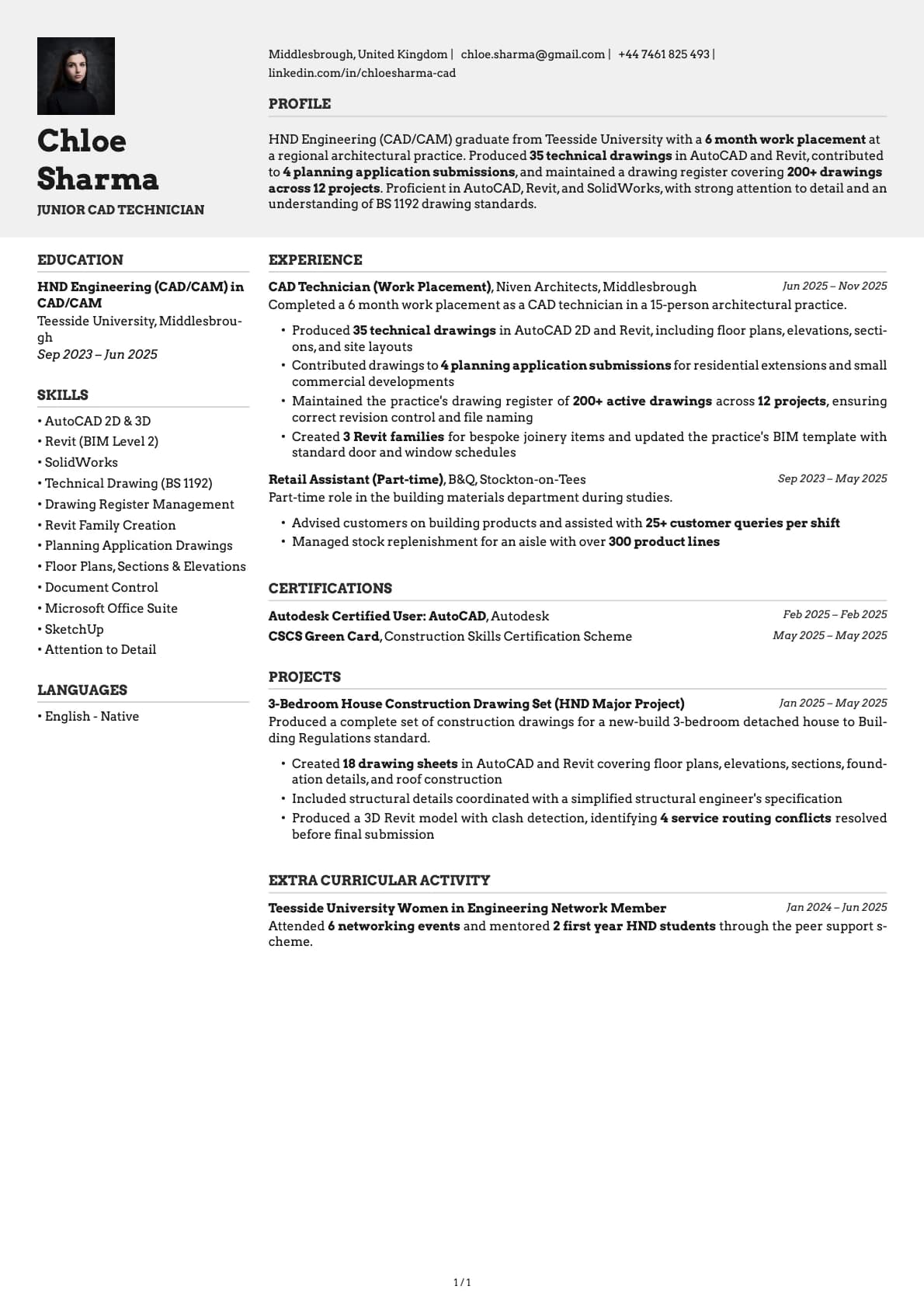
Junior CAD Technician
A junior CAD technician resume example with HND qualification, AutoCAD and Revit proficiency, and architectural practice experience.
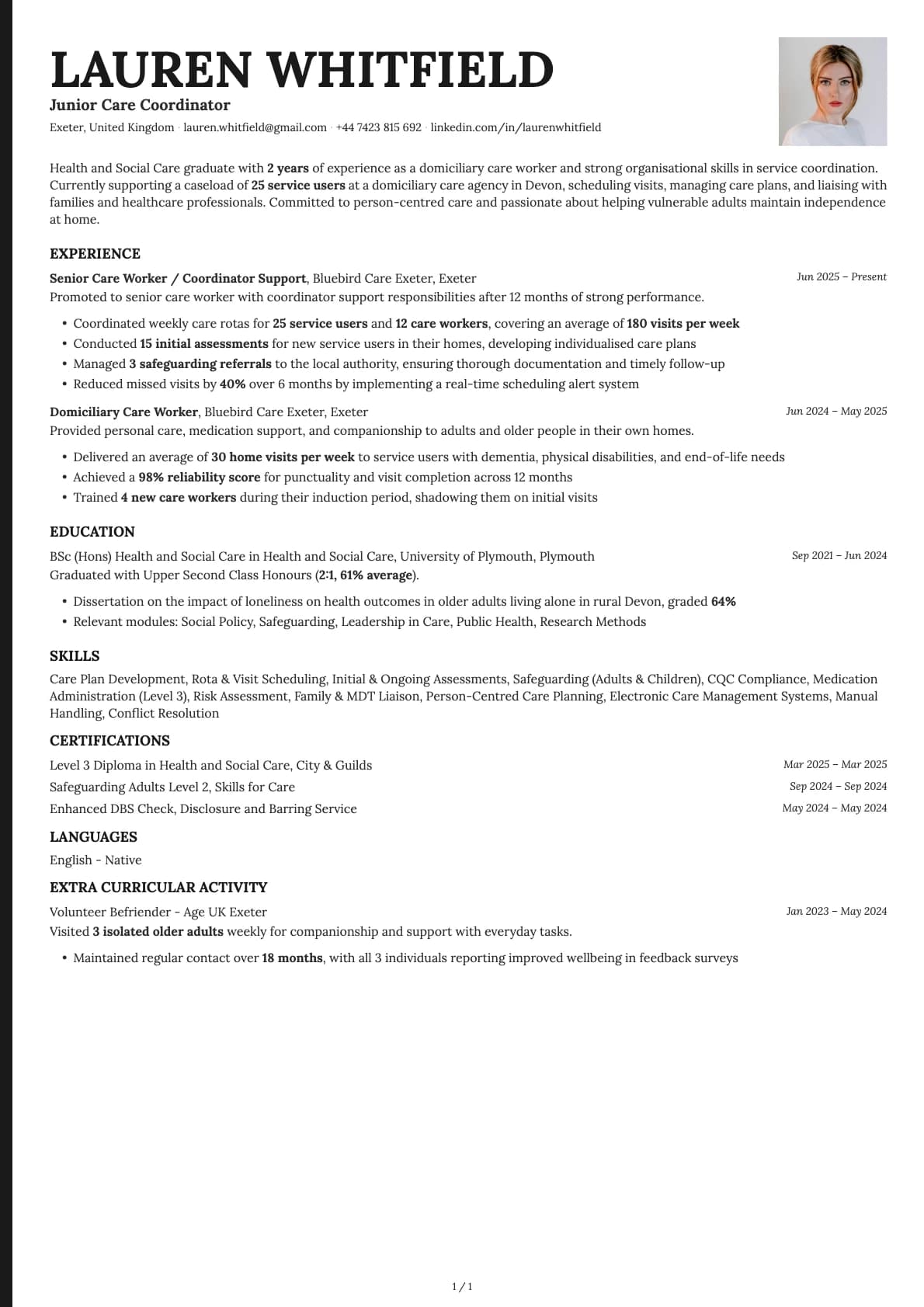
Junior Care Coordinator
A junior care coordinator resume example with domiciliary care experience, rota management numbers, and CQC compliance for new coordinators.
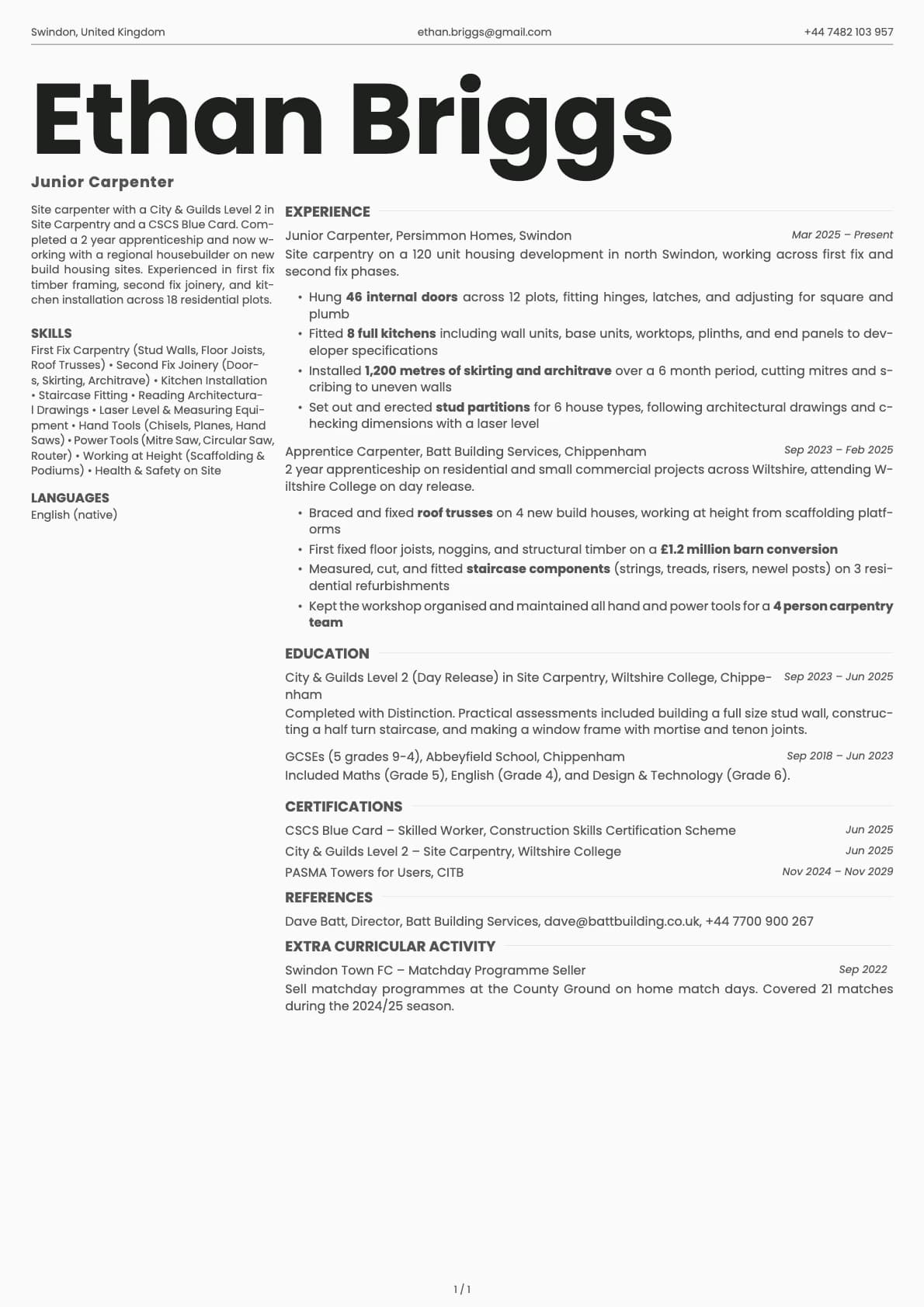
Junior Carpenter
A junior carpenter resume example for carpentry apprenticeship graduates. See how to present your City & Guilds, site joinery experience, and CSCS card details.
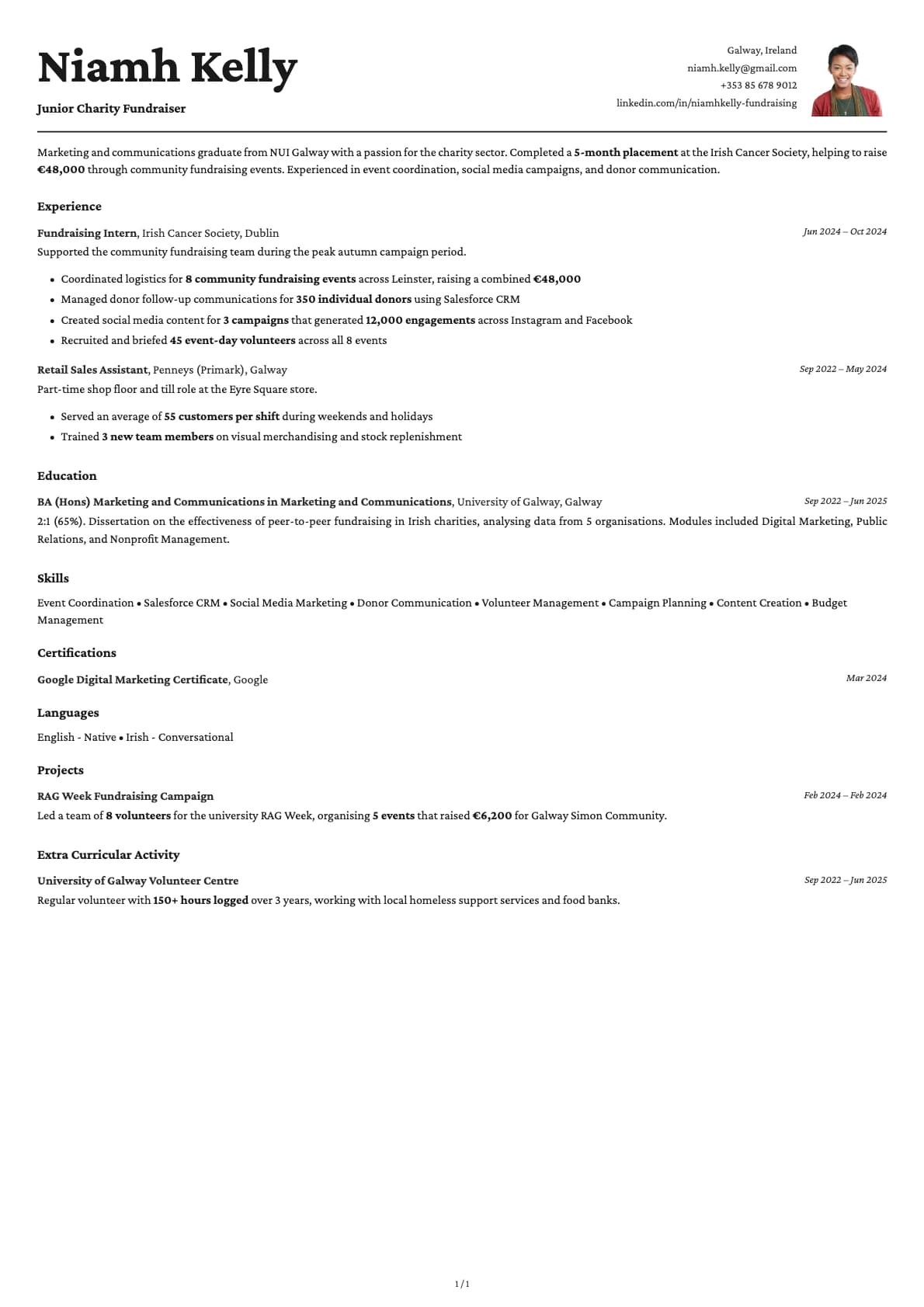
Junior Charity Fundraiser
A junior charity fundraiser resume example with Irish Cancer Society internship and event coordination experience.
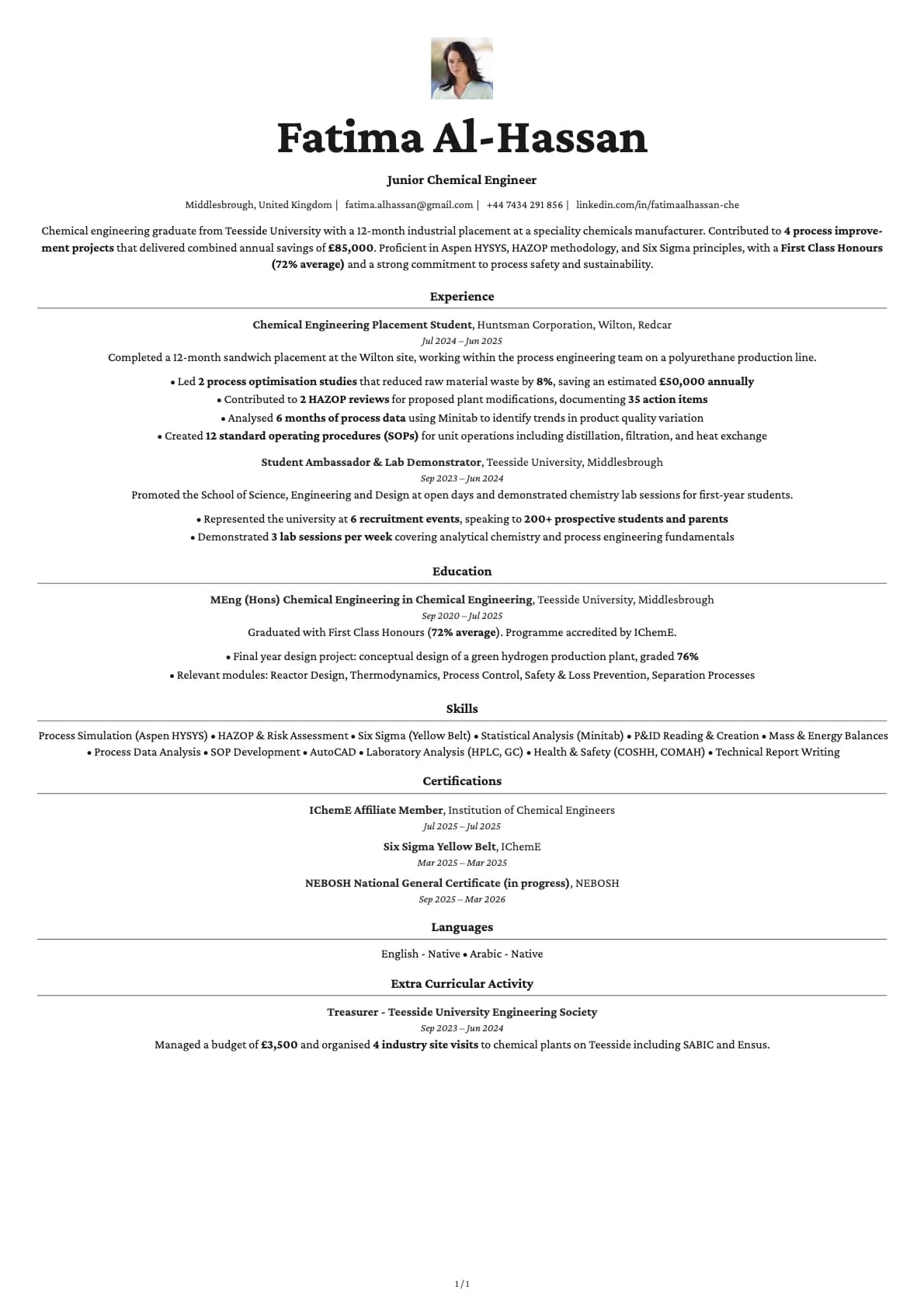
Junior Chemical Engineer
A junior chemical engineer resume example with industrial placement experience, process improvement savings, and IChemE membership for graduates.
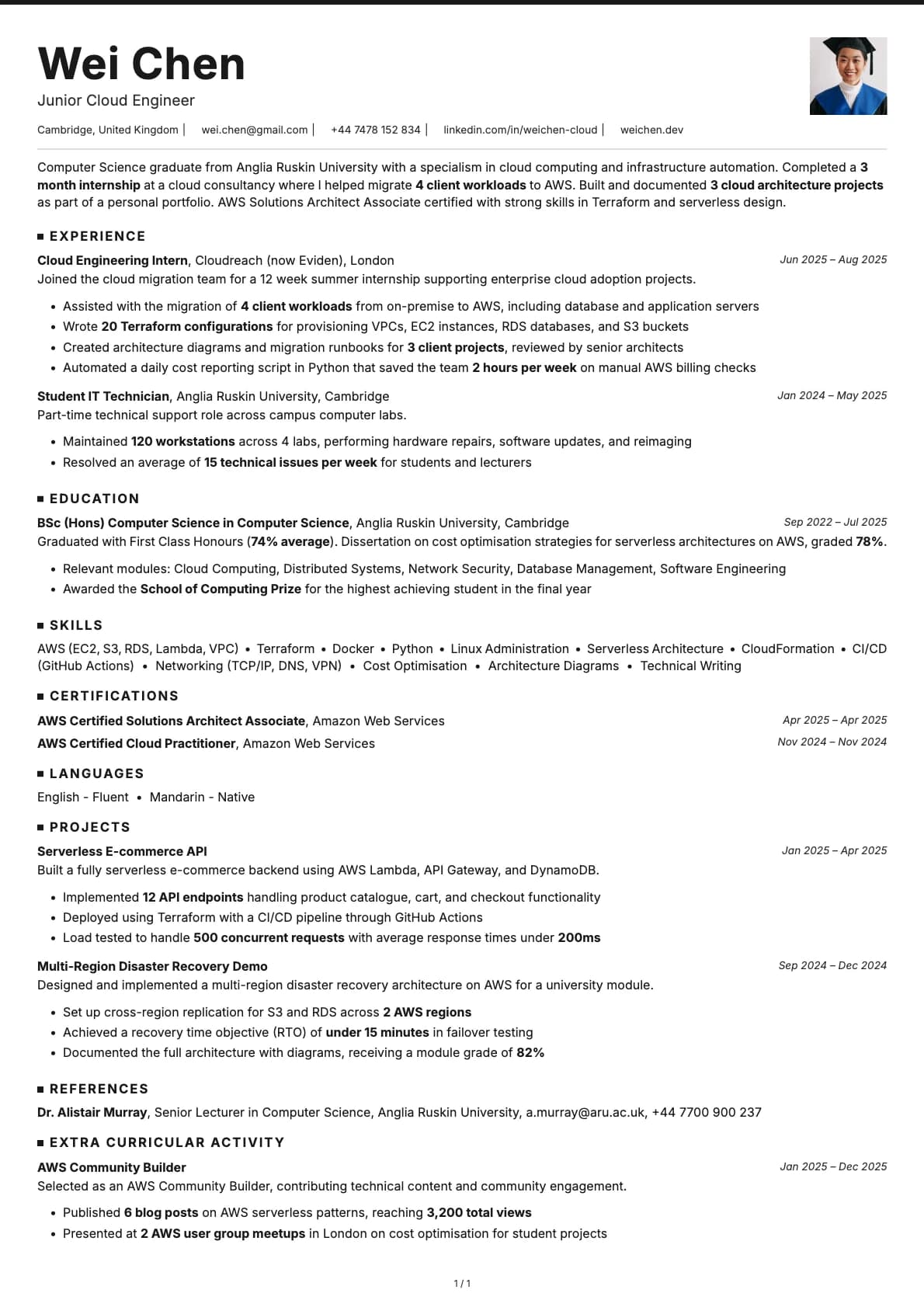
Junior Cloud Engineer
A junior cloud engineer resume example for graduates. Learn how to present AWS experience, Terraform skills, and cloud certifications to land your first cloud engineering role.